Book bitings: how the National Endowment for Democracy was born in “strategic fuzziness” in 1983 (and why it is neither a “CIA cutout” nor a conventional NGO)

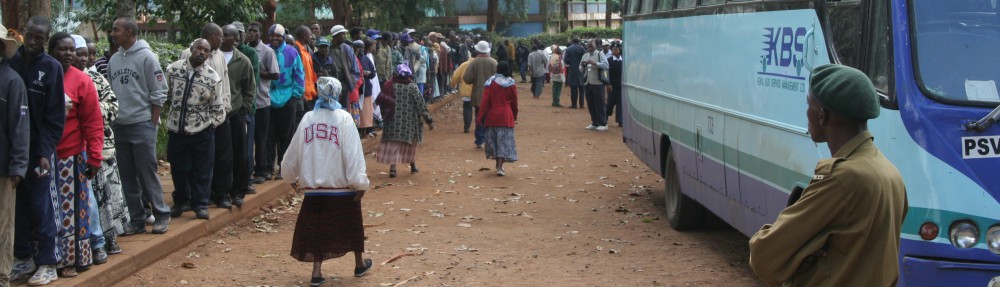
Kenya Election Day 2007

I very much enjoyed recently reading Democracy Promotion, National Security and Strategy: Foreign Policy in the Reagan Administration by Robert Pee, from 2016 in the Routledge Studies in U.S. Foreign Policy series.

“Robert Pee delivers a carefully crafted, nuanced, and comprehensive study of the rise of democracy promotion as a critical component of US foreign policy under the Reagan administration. The analysis is insightful and sophisticated, offering an excellent understanding of the sources of tensions that animate US democracy promotion’s purpose and practices from its inception to the present days.” Blurb from Dr. Jeff Bridoux from Aberystwyth University, UK.

I highly recommend Pee’s book for anyone involved in or interacting with American democracy assistance. The detailed story of how NED, and NDI, IRI and CIPE as three or the four NED core institutions, “happened” is illuminating and important.

A critical factor that is lost, if not deliberately swept under the rug, in much of the internet commentary that has been generated in contemporary environments, is the fundamental institutional role of Congress in establishing NED.

In the very earliest part of the new Reagan Administration from 1981 the question of democracy assistance was on the table as an aspect of the foreign policy challenges of the late Cold War. Most acutely because of the challenge presented by the Solidarity movement and related happenings in Poland on one hand and the civil war in El Salvador and the revolution in Nicaragua on the other. Within the Administration there were a variety of leading actors and voices reflecting a range of viewpoints. Key questions included consideration of what was beneficial and what was necessary in terms of intellectual and ideological commitments to freedom in the context of the risks of confrontation with the Soviet Union, the stability of the “containment” order and hopes for arms control and other negotiations. Reagan was elected as a critic of President Carter’s new formal policy emphasis on “human rights” as ineffectual in the context of the events such as the Soviet invasion of Afghanistan and the hostage-taking by students at the embassy in Iran. So something new and distinguishable was needed. While CIA director William Casey was one of those voices he was far from the only one.

In the meantime, aspirations for democracy assistance had been percolating in academia and civil society since the 1970s. It is essential to place this in the historical context of the post-Vietnam era, and in Pee’s emphasis the era post-Ramparts magazine expose in 1967 of widespread CIA cultural and intellectual subsidies.

In his famous Westminster address to the British Parliament of June 1982 President Reagan made the public commitment to a policy of democracy promotion. With that threshold crossed, the Administration had to come up with actual policy details and bureaucratic structure and the game was on. Reagan’s speech is well worth a re-read, especially to remind of the difficult Cold War context presented by Reagan’s dual commitment to both Strategic Arms Limitation talks with the Soviets and to Solidarity and Poland’s quest “to be Poland”.

Initially those voices of “conservative” caution and constraint who wished the national security structures of the White House to hold the reins won the initial bureaucratic struggle reflected in the Administration’s proposed “Project Democracy” legislation. But however hard it may be to remember this now, in 1983, Congress was a truly co-equal force on these types of foreign policy decisions and the Administration’s proposed “Project Democracy” approach died for lack of support.

In the post-Vietnam, post-Watergate environment, Reagan faced a “permanent” Democratic Party majority in the House of Representatives and a Senate with a range of important and influential thought and action leaders in both parties, with an ideological range in each that would be unthinkable today. Congressional debates on foreign policy were highly engaged and unpredictable. Seniority and Committee structures had greater weight.

And thus the National Endowment for Democracy happened in “strategic fuzziness” as Pee elucidates. At a specific time and place the sausage was made. The Administration had committed to democracy assistance as a new tool of foreign policy and Congress delivered a separate organization “endowed” with funding from Congressional appropriations but not in form a government agency nor reporting to the National Security Council. IRI and NDI which had been incorporated as nonprofits at the Republican and Democratic National Committees respectively earlier that year became “core institutions” of NED and CIPE was formed at the U.S. Chamber of Commerce to join the longstanding international “free labor union” arm of the AFL-CIO which became the other two “core institutions”.

NED was made subject by Congress to the Freedom of Information Act and to audit, but not reporting to the White House. Early gambits to restructure NED to bring it under Administration control were defeated. After forty years NED is a both a fixture of “Washington” and a unique creature born of a specific confluence of global events, policy aspirations and domestic democratic politics in the United States in 1983.

[In reference to my previous posts, this background can explain, in addition to more important things, why Carl Gershman as fledgling NED’s president would have been attracted to having use of Henry Kissinger’s perceived “stature” and “gravitas” inside-the-Beltway” in Washington as a NED board member even if Kissinger was not interested enough in the mission relative to his other priorities to be able to attend the meetings.]

Power as an aphrodisiac – Kissinger’s legacy at the National Endowment for Democracy (NED) was to add “a degree of prestige and credibility that we needed during our early period”

I wanted to follow up on my previous post “What is Henry Kissinger’s legacy as a board member at the National Endowment for Democracy?in light of some comments from one of my much younger friends in academia who also works with and studies democratization assistance. Here are excerpts from Kissinger’s NED files at Yale:

First, I want to make sure not to conflate or overly compress the time period of Kissinger’s service on NED’s Board (1985-89) during the Second Reagan Administration and the time period of the Second George W. Bush Administration when I worked for the International Republican Institute (IRI) in Kenya (2007-08) administering NED and USAID democracy assistance programs. Or the ensuing First Obama Administration when IRI gave Kissinger its 2009 “Freedom Award” and The New York Times published an investigation on the IRI Kenya presidential exit poll I had managed.

I privately noted back when it happened the irony of IRI choosing Kissinger as its recipient for this democracy award in 2009 in the context of IRI’s focused work in the 21st Century on democratization efforts in Cambodia, Bangladesh and East Timor for instance, in the wake of Kissinger’s record as US National Security Adviser and Secretary of State in the Nixon and Ford Administrations in the 1970s in regard to those specific countries. This background then led me in 2023 on Kissinger’s death to learn the overlooked (by me) fact that Kissinger had previously served on NED’s Board. This in turn led to my undertaking initial research – not with the implication that there was something “sinister” whereby Kissinger’s NED role might have been subversive of NED program goals as such – but rather to try to understand the history in light of the obvious dissonance or irony between Kissinger’s approach in Government and the democratization priorities of NED as an institution.

Going through the digitized portions of Kissinger’s NED files at Yale at least seems to confirm: “One is left with the impression that Kissinger might have been something of a foreign affairs celebrity/senior statesman board member who did not heavily engage with NED governance.”

Second, focusing then on the specific years (1985-89) that Kissinger actually served on the Board, we have the very tail end of the Cold War, with Kissinger pushed into resigning by early 1989 by the non-attendance policy, just a few months before the fall of the Berlin Wall. We don’t know one way or the other what Kissinger’s role might have been in regard to Post-Cold War NED democratization work, just that he was not able or willing to find much time in 1985-89 and that his departure was unrelated to the cataclysmic change in international relations and democratization about to take place. The one specific contraposition between Kissinger in the US Government in the First and Second Nixon Administrations and Kissinger on the NED Board involved support for electoral democracy in Chile.

As I noted in my previous post, Kissinger did not attend NED Board meetings approving the programming on the Pinochet plebiscite but did sign off on a solicited consent for the list of programs including Chile after the meeting. So nothing to indicate that Kissinger used his post-Government role at NED to oppose a restoration of democratic elections in Chile.

At the same time, I cannot imagine that there was not some bit of heartburn within the Democratic Party side of the bipartisan NED family about the irony of Kissinger’s role as to Chile even though so much more was still classified in those years than is public knowledge now. (Not to assume that all Democrats opposed Nixon and Kissinger’s Chile policy, or all Republicans excused it, but it did become a source of contention among Republicans and Democrats as well as Right and Left in U.S. politics during those 1970 to 1989 years.)

It is worth noting that the files contain some correspondence in which the NDI President at the time, Brian Atwood, chides NED President Carl Gershman over NED’s public relations approach, which Atwood saw as inappropriately attributing to NED the programing success of NDI on the Chile plebiscite.

It may be that NED was not really in a position to compete as a nonprofit corporation with profit making businesses for Kissinger’s board services, since they did not have fees or stock to offer in compensation. As to what Kissinger received for lending his name, I see it as just one more way in which he distanced his reputation from his extremely controversial policy record—most especially on “democracy”, “freedom” and such ideals. How could a democracy NGO like IRI give Kissinger it’s highest award? Why not, when he had already been a Board Member for the National Endowment for Democracy many years before? Even had Nixon lived much longer, it was much easier to give such an award to Kissinger than to Nixon even though Nixon had so much more involvement in electoral democracy than Kissinger ever did.

I write this on January 6, a date that will live in some degree of infamy in the annals of democratization in the United States. Last night driving home from a family trip I heard on BBC a discussion of the state of democracy in the world with a scholar noting V-DEM research showing democratic rescission has reached the level of 1986 – during the Cold War and Kissinger’s time on the NED Board. See the 2023 V-DEM Democracy Report “Defiance in tbe Face of Autocractization” here. How serious are Americans, especially inside the Washington establishment, about democracy as a priority among our various competing interests? Why haven’t we been more successful in our democratization efforts? Should we do anything different or should we rather double down on making sure not to entertain questions?

With NED turning 40 years old this year – and an obvious and immediate challenge to my children’s freedom and that of their generation worldwide – I would rather not risk “going along to get along” .

What is Henry Kissinger’s legacy as a board member at the National Endowment for Democracy? (Updated 12-14-23)

Greetings and Happy Human Rights Day!

Henry Kissinger served on the board of the National Endowment for Democracy (NED) in the early years of the Endowment during the second Reagan Administration, from 1985 to 1989. Thus during the wind down and end of the Cold War.

For a good scene setter noting Kissinger’s role, see “Missionaries for Democracy: US Aid for Global Pluralism”, in the June 1, 1986 New York Times.

This position for Kissinger had escaped my attention until with the news of his death I looked back at the early 2009 press release from the International Republican Institute (IRI) announcing that Kissinger would receive that year’s IRI “Freedom Award”. (Given that IRI was promoting democracy in Cambodia, Bangladesh and East Timor among other places where Kissinger’s government service record in relation to democracy issues was well known by then to have been, shall we say politely “controversial”, I was a bit taken aback. Obviously Kissinger was a primo draw for a D.C. foreign policy establishment fundraising dinner but I was still surprised at the specific symbolism for IRI.)

I first visited NED in June 2007 as the new IRI Resident Director for East Africa on my way out to Nairobi. I met with Bronwyn Bruton, longtime DC Africa hand, who was managing the East Africa grant portfolio at NED which would fund much of our IRI work in Kenya (assuming approval at a meeting of the NED board which I also attended) along with her boss Dave Peterson who has been NED’s Africa Director dating back to Kissinger’s time on the board in 1988.

It was only in the summer of 2009, after I was back at Northrop Grumman in Mississippi and my dustup with Ambassador Ranneberger over the Kenya IRI/USAID exit poll and election observation had been on the front page of the New York Times that I attended a public Kenya program at NED and got to meet longtime President Carl Gershman and other executives. (I have written about that event previously in regards to Kenya.)

With Kissinger’s death the copyright on material he produced in his NED papers at Yale has passed from Dr. Kissinger to the University. I have spent time this weekend looking at what the Yale Library has digitized on-line of the six boxes. I have reached out to a couple of friends in the academic world who work with the study of democracy assistance to see if they are interested in collaborating with a layman/practitioner to study this.

Some interesting things I have learned so far: Kissinger was not on the initial board of directors when NED was established in 1984 following passage of the enabling legislation in December 1983, but was sent an invitation by Mr. Gershman in December 1984 following discussions that fall. Kissinger accepted in late January explaining that his response had been delayed by his travel schedule.

Most of the material is just copies of NED board correspondence, but there are slips and notes indicating his many scheduling conflicts between Kissinger & Associates business, corporate boards and the Center for Strategic and International Studies.

By late 1988 Kissinger had received a letter from NED’s outside general counsel noting that his three straight absences from board meetings would necessitate his removal by policy, but that there would an opportunity at the next meeting to present “extenuating circumstances” to excuse the attendance issue. After some confusion on whether he had automatically been removed, Kissinger submitted his letter of resignation because of his other time commitments in January 1989.

One is left with the impression that Kissinger might have been something of a foreign affairs celebrity/senior statesman board member who did not heavily engage with NED governance.

Perhaps ironically as to Kissinger, the big feather in NED’s cap in late 1988 was deploying a special Congressional appropriation along with other funds to support in Chile the “no (to General Pinochet)” campaign in the plebiscite that Pinochet had called on continued military rule.

NED funded usual Chilean civil society type programs as well as the funding to NDI for the campaign which among other things paid for three American political consultants, including Glen Cowan of Francis, McGinnis & Rees, who pioneered the NDI-funded PVT through the opposition parties and through the local “Committee for Free Elections”. NDI, according to their quotes in clips circulated by Mr. Gershman to his board, added private funding to the US Government funding provided through NED.

It might be that as a private citizen and businessman by 1988 Dr. Kissinger was no longer intensely interested in Chile or General Pinochet; perhaps he sort of informally recused himself from the NED board in the context of Reagan’s second term pivot reflected in Mr. Gershman’s description (“the basic concept was to promote a peaceful and stable democratic transition”). Maybe he now supported democracy in Chile affirmatively to the point he did not feel it necessary to show up? Without being able to ask him, maybe we can learn more going forward.

National Journal piece on NED and NDI Chile work cited favorably to NED board members

[This Chile work was the origin of the NDI-funded PVT programs that I have written about in Kenya’s 2013 and subsequent elections, as well as in the most recent elections in Malawi and DRC. There are some big differences between the late Cold War NED NDI Chile work in 1988 and the application of the tool by USAID in conjunction with their other democracy programing in 21st Century Africa.

Glenn Cowan joined Eric Bjornlund from NDI in forming Democracy International (DI) in 2003 and published an extensive Vote Count Verification User’s Guide for USAID following a wide consultation among implementors in 2010. They gave me a valued copy several years ago. I will hope to write more about this after catching up with old friends at DI and elsewhere.]

For more from NDI, see the 40th Anniversary retrospective at “NDI: BOLSTERING GENUINE ELECTIONS TO SECURE DEMOCRACY – THROUGH CITIZEN AND INTERNATIONAL ELECTION OBSERVATION”.

NED Memo of 9-87 announcing 1988 Board Meetings (January 1988 was Kissinger’s last, followed by January 1989 resignation.)

UPDATE: Continued research shows that Kissinger attended no more than one NED Board meeting after the spring of 1987, but executed a consent on June 28, 1988 approving the NED grants supported by those members who attended the June 5, 1987 meeting, including 6 grants to NDI, among them “Chile: Promoting Free and Fair Elections -$110,172”.

Kenya’s Moi hired Paul Manfort and Roger Stone’s firm to lobby the National Democratic Institute and others ahead of 1992 election

Back in the 2008 presidential campaign between John McCain and Barack Obama, Senator McCain got some criticism for using Charlie Black, previously of the Black, Manafort, Stone & Kelly firm as a campaign consultant in part because of the firm’s background in lobbying in Washington for various dictators like Moi and Mobutu of African nations and Marcos of the Philippines. More recently, the spotlight has shifted to Paul Manafort and Roger Stone from that storied firm who have been convicted recently of multiple felonies related to their service to Donald Trump’s 2016 campaign and in Manafort’s case also involving money laundering associated with more recent work for a Russian oligarch in Ukrainian politics.

Washington reporting that I saw during the 2008 campaign noting the Black, Manafort Stone & Kelly work for Moi had a significant oversight in accepting spin that the Moi relationship had concluded with the end of the Cold War and the beginning of active U.S. support for democratization in Africa, including the push on Moi to legalize non-KANU parties, which came to fruition in the December 1991 legalization of political opposition.

My guess is that reporters relied on an incomplete aggregator rather than going directly to the original Foreign Agent Registration Act filings (online at http://www.fara.gov). Regardless, the point is that Black, Manafort Stone & Kelly made a third filing for Kenya under Moi for March 1, 1992 to February 28, 1993 that covers Moi’s December 29, 1992 re-election. Along with the U.S. Executive and Legislative branches, Black Manafort Stone & Kelly were to lobby the IMF and World Bank and “public interest and activist groups such as the Black Caucus, Africa Watch, Environmentalists, National Democratic Institute, Civil Rights Lawyers, African-American Institute, Article 19 (journalists) and other activists and public interest groups.”

[Another discrepancy is that the summary list on the Justice Department website lists an incorrect name, a successor firm, for the Black, Manafort Stone & Kelly, Inc. filing for 1992-93.]

As I have written previously, see “My Joel Barkan Tribute“, US Ambassador Smith Hempstone, a George H.W. Bush political appointee, wrote in his memoir Rogue Ambassador that he had recommended to Moi that Kenya allow the National Democratic Institute (NDI) to observe that first post-independence multi-party election featuring FORD-Kenya (Jaramogi Oginga Odinga), Ford-Asili (Kenneth Matiba) and the Democratic Party (Mwai Kibaki) among others challenging Moi’s KANU. Moi vetoed NDI for the Election Observation Mission but went ahead to invite “sister organization” the International Republican Institute (IRI) for whom I served years later in 2007-08 as Resident Director for East Africa in Nairobi.

IRI and NDI are private District of Columbia not-for-profit corporations established originally at the Republican and Democratic National Committees, respectively. Along with two other special purpose democracy assistance not-for-profits associated with two other parents, the United States Chamber of Commerce and AFL-CIO (an affiation of labor unions), these four “core institutes” receive funding from the National Endowment for Democracy or NED, pursuant to 1983 legislation. NED receives direct funding from the United States Government and is also able to raise private donations, as are the four “core institutes”.

It never came to my attention one way or the other whether Black, Manafort, Stone & Kelly consulted Moi on the decision to reject NDI in favor of IRI or what Moi’s considerations might have been in taking that position. Nor of the State Department, USAID and/or others in the US Government and in IRI in going along.

Moi was re-elected according to the Electoral Commission of Kenya with approximately 36% of the vote.

The election was seen as badly flawed but nonetheless representing “the will of the people”. Presumably that would mean a recognition that within a year of opposition being legalized and with State resources deployed on behalf of Moi, a good 2/3 of Kenyans wanted to replace him, but without a runoff or a pre-election “deal” among the fledgling opposition parties Moi would be able to keep power and claim to have switched from a single-party authoritarian system to a “democratic mandate” without giving up power or persuading a majority of Kenyans that he deserved it.

After Bill Clinton defeated President George H.W. Bush and Ross Perot in the November 1992 elections, Bush launched Operation Restore Hope, landing Marines and Navy Special Forces on the beach in Somalia December 9 leading UNITAF, a new UN humanitarian mission to replace UNISOM I, the ultimate predecessor of the current AMISOM which began in 2007. See an early official postmortem on Operation Restore Hope from the United States Institute for Peace here.

In Kenya after 27 years the Moi family remains prominent in political and business matters in Kenya with the son of Moi’s original benefactor Jomo Kenyatta eventually succeeding Moi as president in 2013 after a 2003-2013 interregnum under Mwai Kibaki who was Moi’s Vice President for the first ten years of his presidency from 1978 to 1988.

Remembering Dr. Joyce Laboso and Jerry Okungu and Rift Valley Rural Women Empowerment

Kenya Rift Valley Rural Women Empowerment NetworkRift Valley Rural Women Empowerment Network – Jerry Okungu seated in front row, far right, Dr. Joyce Laboso standing in second row, in white ball cap, 2nd from right

Dr. Joyce Laboso, who died in July while serving as Governor of Kenya’s Bomet County, and Jerry Okungu, the late journalist, columnist, media consultant and publisher, were favorites from working with them through the International Republican Institute in 2007 before that years’ election. Sadly they have both been lost to cancer at much too early an age.

Jerry worked with us as a consultant doing media and communications training and I travelled with him to conduct multiday programs at Edgerton University in the Rift Valley and Garissa in then North Eastern Province. My next post will be a more involved tribute to Jerry who died in January 2014. In the meantime, see his obituary from Citizen TV. Jerry and I kept up in later years and I have always regretted that we missed getting together again in person as we had hoped.

During the months leading up to the 2007 election, we at the IRI East Africa office were on a relative shoestring. Our primary Kenya work was our National Endowment for Democracy country program which was focused on training women and minority members who aspired to run for parliament. So we latched onto the invitation to work with the UN-supported Rift Valley Rural Women Empowerment Network to provide training and encouragement. We engaged Jerry to provide media and communications training.

At the time, Dr. Laboso’s sister Lorna was running for parliament in Sotik and was nominated by ODM and elected. I got to spend time with Joyce who was especially helpful to me as a newcomer in understanding the “bad old days” (my term not hers) when she spent years as a student and graduate student in England, but at home could not safely even mention in public the name of the then-President. She also helped me understand a bit about “intra-Kalenjin” politics (she was Kipsigis). An ODM wave was coming in the Rift Valley that year and a number of women candidates were part of the perceived post-Moi “change”.

Sadly, Joyce’s entry into elective politics herself later in 2008 came about from two untimely deaths.

The first was on the morning of January 31, 2008 (during the post election violence). David Too of Ainimoi Constituency became the second ODM Member of Parliament to be shot dead since the election. Too was shot by a policeman who also shot and killed a policewoman Too was with in a car. During that time the strategy of Kibaki’s PNU during the post election violence period was to consolidate power by drawing away (or down) the ODM margin in Parliament that allowed the narrow election of ODM’s Kenneth Marende as Speaker (and Marende’s elevation cost ODM one seat). Kibaki had appointed third-place candidate ODM-Kenya’s Kalonzo Musyoka as Vice President (according to Joe Khamisi part of a pre-election deal he negotiated with Stanley Murage representing Kibaki), and KANU’s Uhuru Kenyatta as Minister of Local Affairs. Kenyatta and “Retired President” Moi had endorsed Kibaki by August and aligned KANU with Kibaki’s new PNU when it was formed in September, even though Uhuru remained “the leader of the Official Opposition”. (This sticks in my mind in part because I met with new Speaker Marende at his request that morning and the news of Too’s killing hit shortly before I arrived.)

(In October 2009, Judge David Maraga, elevated to Chief Justice of the Supreme Court in 2016, found the killer guilty of reduced charges of manslaughter in the killings of both the policewoman and MP Too. Maraga found the downgrade from murder to manslaughter warranted by the lack of intent indicated by “provocations” of both jealousy and self-defense.)

Unfortunately, on February 1, the day after Too’s killing and my meeting with Speaker Marende, I was told that IRI back in Washington had made the decision not to release the exit poll contradicting the presidential totals announced by the Electoral Commission of Kenya shortly before Kibaki’s swearing in on December 30 (per our agreement with USAID release of the results for this exit poll, the third in a series, was to involve consultations with the Nairobi mission that included diplomatic considerations, although there have been some claims that these did not occur for unexplained reasons.) Following that news I was constrained in my ability to interact freely with Kenyan politicians—and on Speaker Marende’s request that I meet with Kofi Annan to encourage the mediation process—since I was not willing to go along with telling anyone the exit poll was “invalid” per the “official line”.  I ended up going home in May when my temporary duty with IRI was up without initiating goodbyes to Joyce or most of the others that I might have.

Raila and Kibaki agreed to their “peace deal” for power sharing on February 28 and it held in spite of the lack of support from some leaders and on the back benches on Kibaki’s PNU side who still wanted to try to wrangle a working majority in parliament, engineer a vote of “no confidence” against the new Prime Minister and re-take full control of government.

Tragically, in June 2008, Joyce’s sister, the Hon. Lorna Laboso, along with her colleague Kipkalia Kones, in his fifth term from Bomet and serving as Roads Minister, were killed when their light plane from Nairobi crashed on a trip to campaign for the ODM candidate in the special election to replace David Too in Ainimoi Constituency. Lorna was remembered as a a pioneer of women in politics and for campaigning against the cultural practice of female genital mutilation among the Kipsigis . (Both she and Kones were mentioned for allegations of backing politically related violence in PEV period but of course there were never any legal proceedings; that part of the February 28 “peace deal” ultimately failed and we are left with the muddle of mass informal immunity among the living, and questions about others, for the mass violence.)

It was this sequence that led Joyce to step up as a candidate in the special election that September to fill Lorna’s Sotik seat. I sent condolences on her sister’s death and congratulations on her special election, and but we never interacted again so I am left with appreciating her as a pre-political leader and not knowing what she thought about the various twists and turns of her own career in politics, sadly cut short by cancer as too many others.

The simple truth of the allegedly “contested” Kenya 2007 exit poll–what IRI reported to USAID (FOIA series part 14, War for History series part 19)

Raila Odinga has a couple of times recently made conspicuous public mention of the Kenya 2007 IRI/USAID/UCSD exit poll results identifying him as the winning vote-getter, including in his speech at the tenth anniversary of the founding of the Orange Democratic Movement party a few days ago, as well as a significant discussion in his autobiography.

Even a year-and-a-half after the Kenyan election, in July 2009, Kenyan Ambassador to the United States Peter Ogego said at the National Endowment for Democracy in Washington that it was important to get to the bottom of the situation with the U.S.-sponsored exit poll indicating an Odinga rather than a Kibaki win.  The late Congressman Donald Payne, then Chairman of the House Foreign Affairs Subcommittee on Africa said at the same event that the poll should have been published sooner and that not releasing it had been a mistake, although IRI, he thought, had a “good reason” for not releasing it initially.  This is the basic structure of what actually happened, contra what IRI claimed in a March 29, 2009 “rebuttal” to the New York Times investigation. (My point here is still not to berate IRI for continuing to publish this defamatory material worldwide, but I have sadly come to realize that many people seem to have been, surprisingly to me, actually misled by at least some of it.)

On Monday, January 14, 2008 the International Republican Institute’s Coalition for Electoral and Political Process Strengthening (CEPPS) manager submitted by email to USAID at 6:25pm our formal Quarterly Report on the Kenya polling program.  The program had begun with an exit poll for the 2005 constitutional referendum and was scheduled to end with our final pre-election public opinion survey in September 2007, but an amendment that September added the exit poll for the 2007 general election.

Here is this January 14, 2008 report as released under the Freedom of Information Act:

CEPPS IRI Kenya 8038_Oct-Dec 2007

In the report, we at IRI wrote:

Implementation of the December 2007 General Elections Exit Poll
IRI initiated discussions on the exit poll to be conducted during the December 2007 general elections. IRI reviewed the survey instruments, deployment plans, and schedules. Discussions between IRI, USAID, and the local polling firm, Strategic Public Relations and Implementation of the December 2007 General Elections Exit Poll
Research (“Strategic”), took place. Researchers from the University of California at San Diego also partnered with IRI to advise on the sample design, methodology, and data analysis, which they are using for independent studies on polling.

Training of Researchers
In consultation with IRI, Strategic conducted training sessions for the researchers collecting exit poll data. As with the previous polls, Strategic trained a number of researchers, who later deployed to the field as trainers of trainers (TOTs) to identify and train research assistants that would be used to collect data.

The training reviewed field resource management techniques, sampling, and interviewing techniques, as well as training to ensure that all staff had a good understanding of the questionnaire. The questionnaire was then pre-tested in various constituencies of Nairobi. The interviewers later met for a debrief and assessment of the pre-test before deploying nationally.

Data Collection

The poll was fielded on election day in Kenya, December 27, 2007.  A group of 2,887 researchers from Strategic deployed in teams to 175 of 210 constituencies, covering all eight provinces of Kenya.

The interviewers were expected to carry out interviews approximately 100 meters from polling stations.  The interviews were limited to people that had just voted, and the administration of the questionnaire varied from less than five to seven minutes.  To ensure the validity of the sample, between 15 to 25 interviews were conducted at selected polling stations, and only every fifth voter was asked to participate.  Strategic supervisors accompanied researchers to ensure the accuracy of reporting on a number of questionnaires.  Researchers relayed immediate results to their direct supervisors, who then called in to Strategic’s data processing center in Nairobi.

Challenges

During the implementation of the poll, researchers encountered certain challenges, such as the inaccessibility of some areas due to poor roads; poor network coverage; and hostility from polling officials and respondents.  In one instance, a researcher’s questionnaires were confiscated by a polling official.  However, these issues did not significantly affect the data collection exercise.  (emphasis added).

Data Analysis

As data was collected, it was immediately relayed to Strategic headquarters for compilation.  However, data analysis for the exit poll was still ongoing through the end of this quarter. (through December 31)

Earlier that Monday the McClatchy newspapers ran Shashank Bengali’s story “Kenyan president lost election according to U.S. exit poll”. 

Continue reading

Why does the House Foreign Affairs Africa Subcommittee keep leaving the Carter Center off their election hearings?

The U.S. House of Representatives Committee on Foreign Affairs, Subcommittee on Africa, Global Health, Global Human Rights and International Organizations is holding a hearing Wednesday morning, March 18, on U.S. Election Support in Africa.

Good.  Unfortunately, as was that much more conspicuous with the hearing about the 2013 Kenyan election, the subcommittee has scheduled testimony from the IFES/NDI/IRI troika, but without the Carter Center scheduled.  The Carter Center conducted the USAID-funded Election Observation Mission itself for Kenya in 2013, so the omission was hard to understand on a hearing on that very election; it is still hard to understand for an Africa-wide hearing.  (I have no idea why things have turned out this way, I am simply making the point that Congress would have an opportunity to be better informed if this wasn’t just an “all in the Beltway” experience.)

For Kenya’s last vote, see Carter Center quietly publishes strikingly critical Final Report from Kenya Election Observation.

For further discussion of the Subcommittee’s April 2013 Kenya hearing, see AfriCOG’s Seema Shah asks in Foreign Policy: “Are U.S. Election Watchdogs Enabling Bad Behavior in Kenya?”

In new developments, now with the British #Chickengate prosecutions for bribing Kenyan election officials: USAID Inspector General should take a hard look at Kenya’s election procurements supported by U.S. taxpayers.

The Carter Center also observed the 2002 and 1997 elections in Kenya, along with many others, including the most recent election in the Democratic Republic of the Congo in 2011 which provides perhaps another set of lessons as the Kabila government arrests democracy supporters and even a U.S. diplomat.

DRC: “We have to debunk the idea that it is peace versus transparent elections. The idea that lousy elections are going to bring peace is madness.”

Carter Center calls it as they see it in DRC

U.S. and other Western donors support review of election irregularities in DRC–offer technical assistance.

State Department to Kabila on DRC Presidential Election: “Nevermind”?

IRI Poll Releae Press Conference

“The War for History” part ten: What was going on in the State Department on Kenya’s failed election, recognizing change at IRI–and how the 2007 exit poll controversy turned into a boon for IRI in Kenya

The International Republican Institute’s New Leader and Kenya

The new president of the International Republican Institute (“IRI”) since January 2014, Mark Green, visited Kenya this past summer with a personal background in East Africa.  He and his wife taught for a year in western Kenya in the 1980s and he came back to observe the election in 2002 as a Member of Congress from Wisconsin (he was elected in 1998).  After unsuccessfully running for governor in 2006 he led the Washington office of Malaria No More and was appointed Ambassador to Tanzania by President Bush in August 2007.

Ironically, Green was appointed Ambassador in the wake of a controversy in which his predecessor, a political appointee who had been Chairman of the Mississippi Republican Party, was accused of interference with the intended independence of the Peace Corp operation in Tanzania.  The Peace Corp headquarters defended their Country Director who was expelled from Tanzania by Green’s predecessor.  The expulsion was enough of an issue that first Senator Dodd and then Senator Kerry put a “hold” on Green’s confirmation as replacement until the State Department issued an apology and Green gave assurances that his approach would be substantially different.  Ambassador Green had significant support in moving through the controversy from Senator Feingold, the Democratic Chairman of the Foreign Relations Africa Subcommittee–also from Wisconsin–who emphasized Green’s background with the region.

It was just a few months later that Senator Feingold, on February 7, 2008 grilled Assistant Secretary of State Jendayi Frazer and Assistant USAID Administrator Kathleen Almquist on why the USAID-funded exit poll conducted through IRI on the Kenyan election on December 27 had not been released.  It was that evening that IRI released their statement that the poll was “invalid” which they did not reverse until six months later, the day before testimony about the exit poll in Nairobi before the Kreigler Commission.  [To be precise, IRI did not retract their statement that the poll was “invalid”; they rather issued a new statement releasing the poll and thus in fact superseding their previous characterization.]

Diplomats on the ground: East Africa during the Kenyan crisis 2007-08

As Ambassador in Tanzania from 2007-09, Green hosted President Bush on the President’s February 2008 Africa visit.  Meanwhile, Secretary of State Rice flew to Nairobi to meet with the ODM and PNU leaders on February 18 and push for a power sharing deal that made space for the opposition in the second Kibaki Administration that had been inaugurated by Kibaki’s twilight swearing in on December 30.

Before Rice visited, the State Department had issued congratulations to Kibaki, then backed off, while Ambassador Ranneberger was initially encouraging Kenyans to accept the election results as announced by the ECK. Kibaki had appointed his core team of fifteen top ministers, including the new Vice President Kalonzo Musyoka and Uhuru Kenyatta in the Local Government portfolio with jurisdiction over Nairobi, on January 8, four days after Assistant Secretary of State Jendayi Frazer arrived to lead the State Department team in person in Nairobi.  Frazer joined other Western diplomats in objecting to the new appointments but, as with Kibaki’s swearing in, the new appointments became fait accompli.  See “Fury as Kenyan leader names ministers”.  By his arrival in Africa on February 17, President Bush himself, however, was warning of consequences to a continuing failure to negotiate power sharing:

“We’ve been plenty active on these issues, and we’ll continue to be active on these issues because they’re important issues for the U.S. security and for our interests,” Bush said after landing in the tiny coastal country of Benin. He noted he will send Secretary of State Condoleezza Rice to Kenya on Monday. “The key is that the leaders hear from her firsthand the U.S. desires to see that there be no violence and that there be a power-sharing agreement that will help this nation resolve its difficulties.”

A senior administration official later told reporters that the administration wants to use the Rice visit to pressure Kenyan President Mwai Kibaki to compromise with his opposition. The official expressed frustration that Kibaki seems to assume unqualified U.S. support and said that Rice will tell him, “If you can’t make a deal, you’re not going to have good relations with and support of the United States.” The official added, “We’re not going to support a Kenya government that’s going on as business as usual.”  [emphasis added]

“Bush, in Africa, issues warning to Kenya”, Washington Post, Feb. 17, 2008.

As Ambassador in Tanzania, Green received the cables from Ambassador Ranneberger in Kenya that I have discussed in my FOIA Series on this blog, including Ranneberger’s pre-election description of the planned exit poll: “The Mission is funding national public opinion polling to increase the availability of objective and reliable data and to provide an independent source of verification of electoral outcomes via exit polls.  The implementing partner is IRI.” [emphasis added].  Likewise Ambassador Ranneberger’s January 2 cable describing personally witnessing the altered vote tallies received at the ECK headquarters prior to the announcement of Kibaki as winner on December 30.  See Part Ten–FOIA Documents From Kenya’s 2007 Election–Ranneberger at ECK: “[M]uch can happen between the casting of votes and the tabulation of ballots, and it did”.

I was in Somaliland for IRI the day Secretary Rice spent in Nairobi.  She also met that day with some other Kenyans at the embassy residence and a cable over her name regarding “Secretary Rice’s February 18, 2008 visit with Kenyan business and civil society leaders” was sent on February 21 from “USDEL SECRETARY KENYA” to Washington “IMMEDIATE” and to “AMEMBASSY DAR ES SALAAM PRIORITY” along with other interested posts.  Under a section of the cable labeled “Worries about Hardliners, Militias, and Accountability”  are three paragraphs: Continue reading

To eliminate redundancy with constrained budgets and growing demand: Is it time to merge IRI and NDI?

Donkey

Mara Herd

This is a post I started a few years ago and let sit.  I usually avoid writing about things that directly mention the International Republican Institute other than as specifically necessary in regard to the 2007 election in Kenya and some advocacy for people arrested in Egypt.   It’s awkward for a lot of reasons to write about IRI,  the most personally important of which is my deep affection for people that work there.  And to the extent I have criticisms it would be my desire that they become better rather than that they be harmed.

Nonetheless, I think the structure of democracy assistance is something we need to think about and almost everyone who is in a position to be engaged is also in a position to feel constrained from speaking freely or has an unavoidable conflict of interest.  And its is an especially challenging time for the effort to share or support democracy so I am going to suck it up and proceed:

—————–

In an era of hyperpartisanship in the U.S. we are also faced with a divided government and a real question about our collective ability to do the basic business of governance in terms of passing budgets, for instance.

More specific to democracy support, the old notion that “politics stops at the water’s edge” is long dead. Every issue anywhere is contested space between Democrats and Republicans in grappling for power. [The attack on the U.S. government facility in Benghazi, Libya in September 2012 being perhaps the most conspicuous example.] There are profound divisions in a few areas of policy and culture between the Republican and Democratic base voters.  Nonetheless, it is also clear, ironically perhaps, that in the present moment there is not any clearly identified and coherent policy difference between the parties on foreign affairs as such. Now in the early stages of the 2013-16 presidential campaign, Republican Senator Rand Paul appears to be his party’s front runner for the nomination. The traditional Republican foreign policy establishment has less disagreement on specific points of foreign policy with the Obama Administration than with Senator Paul. And much of its membership would presumably in private vote for a Democrat seen as somewhat more hawkish and interventionist than Obama, such as for instance Hillary Clinton, than for Paul. Some piece of the base of the Democratic Party might well feel obligated to vote for Paul over Clinton in a general election if it came to it.

Referencing the policies of the most recent Republican Administration, which was in office when I worked for IRI in East Africa, there is no reason to think that Jeb Bush, for instance, believes in the “Bush Doctrine” and certainly Ron Paul doesn’t.  Foreign policy was important in the 2008 Democratic primaries and in the 2008 general election and there was at that time a sharp perceived difference between Obama/Biden and McCain/Palin over the aspects of foreign policy that were important to most voters and that difference was essential to Obama’s election.  Not so much in 2012 in either the Republican primaries or in the general election.  All presidential elections matter with great intensity for Washington foreign policy people because they decide who gets what jobs (like do you go to the State Department or stay at IRI or NDI or some think tank) and in general everyone is either Democrat or Republican and either wins completely or loses completely, heads or tails, each time.  For most American voters the relationship of parties and elections to foreign affairs is completely different.

The traditions of the Democratic and Republican foreign policy establishment in Washington are based on the Cold War, like the structure of the National Endowment of Democracy itself, with IRI and NDI along with the overseas arms of the U.S. Chamber of Commerce and the AFL-CIO as its “core” “private” institutes. Relatedly this tradition and structure is also critically Eurocentric. Going on a quarter century after the fall of the Soviet Union the terms of the contest between a democratic Washington and an authoritarian Moscow are very different in Europe itself today–and much less of immediate relevance in, say, Africa. The old days of the American Democrats supporting the democratic left in Europe and the American Republicans supporting the right–both as a pro-American alternative to Soviet-aligned Communists–are interesting history that we should learn more from, but they are history.  And we are not nearly so Eurocentric now in our policies and relationships in Africa, Asia and Latin America, so we have different types of opportunities to support democracy and its related values in those regions rather than dividing everyone up as pro-Western Bloc versus pro-Eastern Bloc.

In practice today, I don’t see the Democratic Party in power in Washington really aligned with the “democratic left” in other countries, given the lack of need to shore up against Marxist/Communist forces (among other reasons) nor much particular interest in the Republican Party in supporting more rightist or conservative parties abroad per se.  Generally Republican and Democrat campaign and media consultants, like lobbyists, seem to work for whoever they come to terms with commercially in any given emerging or frontier market rather than on the basis of some coherent party related framework.

Formally, IRI and NDI are completely overlapping as they are both non-partisan.  Occasionally they are said to be “affiliated” with their respective parties, but more frequently they are said to have “no connection” to parties.  Ultimately this is simply confusing and unclear–and not really consistent with the principles that the organizations are trying to teach to others.  In Germany where the government funds overseas institutes of the parties, the law is different and the government provides funding for the parties themselves in a way that would presumably be unconstitutional in the United States.  So you don’t have a counterpart to this strange melange of “nonpartisan Republican” or “nonpartisan Democratic” even though the German organizations are said to be a model for setting up IRI and NDI back in the early 1980s.

In my personal experience, I had the clear impression that IRI was quite serious about being legally compliant in terms of the 501(c)(3) nonpartisan formalities [and this was noteworthy in an  a organization that did not have an overall compliance component at that time–I am not going to be a whistleblower or even a public critic on this but have noted that they have gotten in at least a little difficulty with the government for ignoring cost accounting regulations that I told them they shouldn’t ignore when I worked for them].  I have no reason to assume that NDI is not equally serious.  In the case of IRI, with the chairman running for president two different times during his tenure, they know that the Democrats have had incentive to catch them if they were to get tangled with a Republican campaign; and of course everything is potentially tit-for-tat in that regard for the other side.

At the same time, both parties have an incentive to make as much use of “their” respective unaffiliates as permissible on a mutally backscratching basis.  While there are certain cultural and stylistic differences in how this plays out–as any observer of the current American political scene can well imagine–I don’t think this warrants the whole separate infrastructure of two duplicate organizations.  For instance, unaffliliated Republicans could still do programming at the Republican National Convention and unaffiliated Democrats could still do programming at the Democratic National Convention even if it was under the umbrella of one unaffiliated nonpartisan organization instead of two separate unaffiliated nonpartisan organizations. And the unaffiliated Republicans could apply a conservative orientation to have programming that is solid, on-message stuff supporting the party line; and the unaffiliated Democrats could be liberal-minded and have a “soft power” approach that involves people on both sides at the convention of their side.

Continue reading

Washington event on “The Implications of the Kenyan Election” tomorrow; Mutunga’s judicial philosophy

Tomorrow afternoon at the National Endowment for Democracy, Joel Barkan and Maina Kiai will discuss “The Implications of the Kenyan Election”. Watch the video stream from 1930 to 2100 GMT or 1:30 to 3:00pm EDT (Washington) time.

In continuing to try to come to grips with the lack of substance of the Supreme Court’s ruling in the election petition cases, I am reminded of an article from The Africa Report for February, titled “Can They Pull It Off? The judiciary and electoral commission say they are prepared for the 4 March vote and will not repeat the mistakes of the contested December 2007 polls”.

In the article, the new Chief Justice Mutunga gives what my be some foreshadowing of the Court’s ultimate deference to the IEBC in the election petitions:

Keeping the three arms of government separate and independent should not rule out constructive cooperation, says Mutunga: “I see us protecting the independence of the judiciary but also realising that you’ve got to talk to the ministry of finance, to parliament and that sometimes you might also ask the president to intervene.”

A dialogue between the arms of state is important, insists Mutunga: “As a matter of fact, President [Mwai] Kibaki has never called me about a case. The the hotline [from the President’s office to the Chief Justice’s] is not hot — nobody uses it!” As chief justice, Mutunga joined discussions last year with businesses and President Kibaki about how to ensure the elections were credible and peaceful. He added that the judiciary is committed to helping the Independent Electoral and Boundaries Commission (IEBC). For example, it has allocated special courts to deal with all electoral disputes quickly.

. . . .

There is, however, nervousness about how the IEBC will fare . . . .

If the role of the Court is to work collectively with the other parts of the Government to promote “credibility” to keep “peace” then perhaps it is best to ignore “legalistic” details like more votes than registered voters in many polling places, and the raising and lowering of the number of registered voters in various parts of the country. Perhaps this is what is meant by a “robust” and “progressive” jurisprudence.