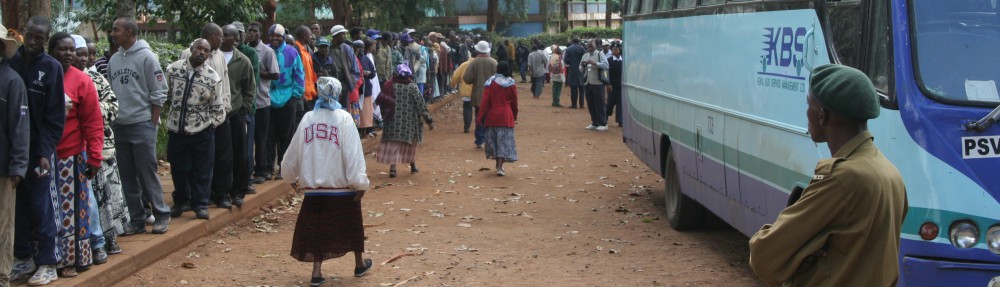
Raila leaves the race . . .

Raila Odinga Kenya president campaign

[Update: since I have not been actively writing here for several months, I may have been a bit hasty in offering here an assessment of Raila’s immediate legacy in current Kenyan politics upon hearing the news of his unfortunate passing from heart failure in India. Those who grew up with Raila’s role in opposing dictatorship through brutal detention and have stayed continuously emotionally engaged with Kenya over the years—especially Kenyans, who do not have the option of pulling back as I have as an American —will feel the weight of a mighty tree falling and the sudden change of light, landscape and horizon. In other words, this post may have been a bit “too soon” as well as superficial. I will endeavor to do more justice to Raila’s impact ahead after the initial memorials.]

[See also the eulogy and remembrance in The Kenya Times from former US Ambassador Michael Ranneberger who served through the 2006-07 campaign and election and PEV, the peace deal and the constitutional referendum under Government of National Unity during Kibaki’s second term. And Jeffrey Gettleman remembering Raila campaigning in 2007 to be denied by the blatant rigging.

Raila’s primary definitive legacy is Kenya’s 2010 Constitution, negotiated as a result of his 2007 campaign which I believe clearly garnered the most votes and led him to the temporary but critical post of Prime Minister for Kibaki’s second term from 2008-2013 as part of the February 28 peace deal between Raila and Kibaki.

The peace deal did not result in the fully formed power sharing contemplated but it was enough to get to a reform Constitution through the elite establishment gauntlet so long as the sole executive power of the presidency was retained (in other words, the Prime Minister position would go away). Devolution, the Supreme Court and many rights that we can hope will eventually come to fruition for Kenyans did result and have created real change.

For my explanation of Raila’s 2007 election, aside from many blog posts categorized and tagged accordingly, see my piece in The Elephant: “The Debacle of 2007: How Kenyan Politics Was Frozen and an Election Stolen With US Connivance.”

Raila’s other legacy is the enduring ODM party itself. The party unfortunately has been in jeopardy in recent years as being without a clear identity with Raila’s handshakes with first Uhuru Kenyatta, then William Ruto. Collaboration with Kenyatta had a clear rationale in achieving Kenyatta’s support for Raila and running mate Martha Karua, intending to stop a Ruto succession. The recent support for Ruto, however, heading into a 2027 re-election campaign, has been hard to square with the notions of the Orange Democratic Movement advertised over the years.

It has been awhile now since Raila was carrying the torch as a reformist leader himself and I will hope that this legacy can now come to greater fruition with younger generations, through a re-tooled ODM and new avenues to compete with ossified elite capture.

See from Africa Report, “Raila Odinga: the man who lost every election but won Kenya’s democracy.”


Condolences to the famiky and their many friends and supporters.

[Updated] Ruto term nears halfway point as USAID is strangled and Kenyan politics faces disruption from loss at Raila AUC vote Saturday

Update 2-15: Raila fell short to Djibouti’s candidate in the 7th round of voting.

If Raila Odinga doesn’t win his election for Chairman of the African Union Commission on Saturday then Ruto on one hand and the ODM Party on the other will have to face the question of how to repurpose Raila within Kenya’s political establishment. Will he return to the customary role as opposition presidential candidate? Will he and Ruto reach a deal on a new alternative role to keep him and his key loyalists “onside” with the Ruto presidency?

Is there any chance that he would take some “senior statesman” status within ODM and/or the opposition more broadly and not move toward a run for the Presidency in 2027?

What will be the impact of the demise of US democracy assistance, being cemented as this is written, have on the hugely delayed preparations for the 2027 elections?

Mzalendo reports today on claims that the Independent Electoral and Boundaries Commission—intended to be a permanent Government of Kenya institution under the 2010 Constitution—may have a selection panel in place by April of this year to start the process of selecting Commissioners. USAID has been the leading donor for process for decades.

See this piece from The Standard:

Addis setback, a political turning point for both opposition and government

He returns home empty handed, leaving his admirers divided and his detractors wary. There are those who want the Raila to take up his role of calling the government back to order.www.standardmedia.co.ke

Raila Odinga Kenya president campaign

Following Jimmy Carter funeral Donald Trump takes office and deploys “neutron bomb” to US foreign assistance

American “olds” of my generation (we who are 45-64 are the only age cohort who went for Trump in last year’s presidential election) may remember the 1970s controversy over President Carter’s decision to go forward with deployment of the neutron bomb in Western Europe.

To some sensitivities way back in the day, before we “beat the Vietnam syndrome”, the notion of a defensive nuclear weapon that could kill people without “nuking” physical infrastructure was distasteful even faced off against the Soviet Red Army across the Iron Curtain. This was before the peak of the “nuclear freeze” movement and the birth of the National Endowment for Democracy and the modern era of democracy assistance under “PeaceThroughStrength” during the Ronald Reagan administration.

If you are too young to remember the Cold War I think you probably had to be there but I will try to link back soon to some of my related blogs posts and list some other references.

On Friday an acting official on behalf of Secretary of State Rubio delivered the symbolic equivalent of such a weapon to direct immediate Stop-Work orders freezing funding for State Department and USAID funded Foreign Assistance (subject to a few advance waivers for Egypt and Israel, some emergency food assistance and security matters). All to be reviewed and restarted, modified or terminated on authority of Secretary Rubio to make sure they directly serve the strictures of the Trump/Rubio formulation of “America First” as opposed to, you know, helping other people in service to our national interests as per US statutes enacted during the Truman, Eisenhower, Kennedy and subsequent administrations up through 2024.

Of course it was never not America first but it was in some real sense at important times and in important ways “America +” (or so most of us Americans have always believed).

Secretary Rubio came off the Board of Directors of the International Republican Institute (a major State and USAID nonprofit foreign assistance implementor) as well as leaving the U.S. Senate this week to take the post under Trump.

A good piece explaining “Why Kenya’s protests are different this time”.

Happy Saba Saba Day.

A range of Kenyan voices have been saying that the current “Gen Z” protest movement has already generated an irrevocable shift in Kenyan politics and/or even Kenyan society.

I suspect that veteran professional “Kenya watchers” and analysts in interested foreign capitols are not yet sure about that.

Here is a good piece in The Conversation by Owino Okech at SOAS that I find useful in assessing the durability of the movement:Kenya’s protests are different this time: 3 things that make it harder for government to crush them.”

A circle not an arc: Ruto and Biden re-enact Kenyan-American history with a reprise of the Kibaki-Bush State Dinner of 2003

Kenya 2007 PEV Make Peace Stop Violence

Before the exposure of the Anglo Leasing security sector corruption and other scandals Mwai Kibaki was in quite good books with the Bush Administration in Washington.

Kibaki’s 2002 election victory could be seen at the time as a feather in the cap for Bush’s “freedom agenda” in Africa. Kibaki was a core establishment insider who had served for 10 years as Daniel arap Moi’s vice president during Cold War era single party KANU rule, but had been democratically elected as titular head of a broad “opposition” coalition after the Bush Administration squeezed Moi to honor term limits and allow succession after 24 years and Moi chose his predecessor’s son Uhuru as his intended successor over more senior KANU leaders. (The best of both worlds for us Americans from a strictly diplomatic/foreign relations standpoint.)

Kibaki was used to dealing with the American government going back at least as far as arms purchases during the Gerald Ford Administration with Henry Kissinger as Secretary of State.

A lot has happened since October 2003, but not so much of it has been in Kenya. The biggest single change in Kenya has been population growth (with relatively flat human development). No big fluctuations on corruption or security, etc. and some worsening of an already challenging climate.

Ruto is another first term Kenyan president in very good books in Washington. An establishment protege of Daniel arap Moi who is seen as having had an oppositionist wrinkle to his 2022 election as President as the sitting incumbent Vice President by the fact that the outgoing incumbent President, his erstwhile running mate, Uhuru Kenyatta (also an American favorite while President and close to important Americans before taking office) tried to throw him over for his new “handshake” partner Raila Odinga.

Now, Ruto has a handshake deal of his own to back Odinga for the AU Commission chair as an alternative to domestic Kenyan opposition leadership.

The one big event in Kenya between 2003 and 2024 was Kibaki’s stolen 2007 re-election and the ensuing murder and mayhem as Kenya went “to the brink of civil war”. But as they say, “it’s been a minute”.

And since both the election fraud and the Post Election Violence successfully achieved their objectives it’s hard to find time to remember who was killing whom after so many years.

Externally, the current round of war in Somalia started a little more than two years after Kibaki’s 2003 State Dinner. The Second Kibaki Administration itself invaded Somalia in 2010 and 14 years later the beat goes on. And diplomatically we need Nairobi as a place from which to address any saving of Darfur and democratizing or at least stabilizing Southern/South Sudan as we did back in 2003. A new bonus is the chance to pay to get some of Kenya’s police force out of the country for awhile while also putting African boots on Haitian ground.

I guess the one word that I would choose to fit the Ruto-Biden State Dinner is “predictable”.

See “Disillusion grows in Kenya as Biden hosts Ruto for a historic state visit” in Semafor.

Senegal democracy event at CSIS

I was fortunate to get to stop by the Center for Strategic and International Studies last week while in Washington for other business and hear an interesting Africa Program discussion on Senegal. The link here includes the video:

Senegal’s Democracy: How Did We Get Here and What Should We Expect

Senegal’s civil society held things together to keep the election process from getting derailed and Senegal has a newly elected opposition leader. While challenges persist everyone who cares about democracy in Africa probably needs a morale boost right now and what learning we can find from the way things played out in Senegal so I encourage you to take a little time to watch.

Book bitings: how the National Endowment for Democracy was born in “strategic fuzziness” in 1983 (and why it is neither a “CIA cutout” nor a conventional NGO)

Kenya Election Day 2007

I very much enjoyed recently reading Democracy Promotion, National Security and Strategy: Foreign Policy in the Reagan Administration by Robert Pee, from 2016 in the Routledge Studies in U.S. Foreign Policy series.

“Robert Pee delivers a carefully crafted, nuanced, and comprehensive study of the rise of democracy promotion as a critical component of US foreign policy under the Reagan administration. The analysis is insightful and sophisticated, offering an excellent understanding of the sources of tensions that animate US democracy promotion’s purpose and practices from its inception to the present days.” Blurb from Dr. Jeff Bridoux from Aberystwyth University, UK.

I highly recommend Pee’s book for anyone involved in or interacting with American democracy assistance. The detailed story of how NED, and NDI, IRI and CIPE as three or the four NED core institutions, “happened” is illuminating and important.

A critical factor that is lost, if not deliberately swept under the rug, in much of the internet commentary that has been generated in contemporary environments, is the fundamental institutional role of Congress in establishing NED.

In the very earliest part of the new Reagan Administration from 1981 the question of democracy assistance was on the table as an aspect of the foreign policy challenges of the late Cold War. Most acutely because of the challenge presented by the Solidarity movement and related happenings in Poland on one hand and the civil war in El Salvador and the revolution in Nicaragua on the other. Within the Administration there were a variety of leading actors and voices reflecting a range of viewpoints. Key questions included consideration of what was beneficial and what was necessary in terms of intellectual and ideological commitments to freedom in the context of the risks of confrontation with the Soviet Union, the stability of the “containment” order and hopes for arms control and other negotiations. Reagan was elected as a critic of President Carter’s new formal policy emphasis on “human rights” as ineffectual in the context of the events such as the Soviet invasion of Afghanistan and the hostage-taking by students at the embassy in Iran. So something new and distinguishable was needed. While CIA director William Casey was one of those voices he was far from the only one.

In the meantime, aspirations for democracy assistance had been percolating in academia and civil society since the 1970s. It is essential to place this in the historical context of the post-Vietnam era, and in Pee’s emphasis the era post-Ramparts magazine expose in 1967 of widespread CIA cultural and intellectual subsidies.

In his famous Westminster address to the British Parliament of June 1982 President Reagan made the public commitment to a policy of democracy promotion. With that threshold crossed, the Administration had to come up with actual policy details and bureaucratic structure and the game was on. Reagan’s speech is well worth a re-read, especially to remind of the difficult Cold War context presented by Reagan’s dual commitment to both Strategic Arms Limitation talks with the Soviets and to Solidarity and Poland’s quest “to be Poland”.

Initially those voices of “conservative” caution and constraint who wished the national security structures of the White House to hold the reins won the initial bureaucratic struggle reflected in the Administration’s proposed “Project Democracy” legislation. But however hard it may be to remember this now, in 1983, Congress was a truly co-equal force on these types of foreign policy decisions and the Administration’s proposed “Project Democracy” approach died for lack of support.

In the post-Vietnam, post-Watergate environment, Reagan faced a “permanent” Democratic Party majority in the House of Representatives and a Senate with a range of important and influential thought and action leaders in both parties, with an ideological range in each that would be unthinkable today. Congressional debates on foreign policy were highly engaged and unpredictable. Seniority and Committee structures had greater weight.

And thus the National Endowment for Democracy happened in “strategic fuzziness” as Pee elucidates. At a specific time and place the sausage was made. The Administration had committed to democracy assistance as a new tool of foreign policy and Congress delivered a separate organization “endowed” with funding from Congressional appropriations but not in form a government agency nor reporting to the National Security Council. IRI and NDI which had been incorporated as nonprofits at the Republican and Democratic National Committees respectively earlier that year became “core institutions” of NED and CIPE was formed at the U.S. Chamber of Commerce to join the longstanding international “free labor union” arm of the AFL-CIO which became the other two “core institutions”.

NED was made subject by Congress to the Freedom of Information Act and to audit, but not reporting to the White House. Early gambits to restructure NED to bring it under Administration control were defeated. After forty years NED is a both a fixture of “Washington” and a unique creature born of a specific confluence of global events, policy aspirations and domestic democratic politics in the United States in 1983.

[In reference to my previous posts, this background can explain, in addition to more important things, why Carl Gershman as fledgling NED’s president would have been attracted to having use of Henry Kissinger’s perceived “stature” and “gravitas” inside-the-Beltway” in Washington as a NED board member even if Kissinger was not interested enough in the mission relative to his other priorities to be able to attend the meetings.]

In light of Kenya’s latest “handshake” here are my unpublished thoughts from the last one: “Is the BBI Report more about a legacy for Raila (and Jaramogi) in the context of the Kenyattas’ domination of power?”

[In light of the latest “Handshake” through which Kenyan President Ruto is supporting his erstwhile election rival Raila Odinga for Chairman of the African Union Commission there might be value in the historical context from this is previously unpublished post from December 2019 on the release of the Building Bridges Initiative report as an outcome of the March 2018 Uhuru-Raila “handshake”]
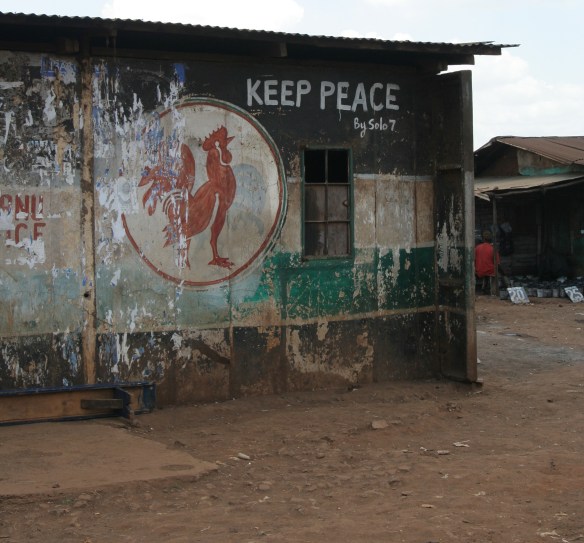
Old Party Office in Kibera

I have just finished finally reading Jaramogi Odinga’s Not Yet Uhuru. Months ago I had gotten started, got pulled away and came back to finish after the BBI report.

To understand how the BBI Report came to be full of small commonplace good ideas but so fundamentally “preservationist” of the basic order of things, perhaps we should see it as facing back rather than forward.

For the Kenyattas, in light of the selection of Jomo as the first leader, his success in consolidating power and gathering and brokering resources for the rest of his life, and the ultimate handoff through Moi to Uhuru following the potentially disruptive threat of the post PEV 2008 National Accord, the BBI Report offers the elevation of a retroactive “national ethos” as valedictory icing of the cake.

Three things imposed risk in the National Accord if you were the Kenyattas, in order of immediacy and gravity: 1) the risk of punishment of Uhuru under the agreement to pursue justice for conduct during the Post Election Violence, a risk shared with many others including Raila; 2) the risk of claims from prior conduct under the Truth Justice and Reconciliation Commission, in particular claims to disgorge assets or participate in land reform of some type; 3) the risk of dilution of power in the presidency creating general long term political risk.

The Supreme Court victory avoiding a runoff in the March 2013 election of the Uhuruto ticket terminated the first and second risks.

The third risk, unlike the first two, has involved a small measure of compromise and this is where Raila has delivered something lasting for Kenyans as a whole including those who have never voted for him.

The reform constitution of 2010 is a product of much work and struggle by many, not always in tandem, but would not exist without Raila’s role as the most popular opposition leader of the era. At the end of the day the unique form of devolution as it has come out of the 2010 constitution and its early evolution has created some real opportunity for governance separate from the power of State House.

On balance devolution provided a limited form of the majimbo that KADU sought before merging into KANU in the immediate post-independence, which KANU and Jaramogi originally saw as representing a collusive deal by some regional leaders and settlers to hold back from full liberation, but could also be seen as holding out from the national pot that was to ultimately be looted once power was consolidated by Jomo.

The office and role of Prime Minister under the National Accord in 2008-13 which gave Raila some poorly defined but not completely insubstantial power, on the other hand, “went away” behind the scenes at a Naivasha resort in 2010 as I have written about previously. It was the Prime Minister’s right of “consultation” that put previous opposition intellectual activist and leader Willy Mutunga on the bench as the first Chief Justice in return for withdrawing objection to a “usual suspect” to replace Amos Wako as Attorney General.

For Raila, his family and close supporters, with these accomplishments under their belts, the Building Bridges Initiative offers a seat in the shade under the tent while eating their slices of cake without the precariousness associated with two generations of being in opposition with no certainty of more than contingent freedom from detention, while going back in time to attend to a bit of the psychology at least of what Jaramogi was getting at in the 1950s and 60s.

Finally peace in the valley, even if the valley is quite small and the plains, hills and lakesides are full of millions of other Kenyans who were not around at the liberation. Those will have to find peace in their own way but what is new about that?

In the concluding part of his book, Jaramogi wrote, ” We are struggling to prevent Kenyans in black skins with vested interests from ruling as successors to the administrators of colonial days.” Obviously that struggle was unsuccessful.

Is that a good thing or a bad thing? It depends on where you sit and what your interests are. If you are one of or close to the successors of the prior administrators it is great and if you are not you may still have the satisfaction of looking around at statist Tanzania, tribal Somalia and revolutionary South Sudan and say that things could be worse. If you are in the Foreign and Commonwealth Office it is hard to argue with it on the basis of the interests you represent. If you are a diplomatic or commercial agent of the post-Tiananmen Chinese Communist Party at the very least it is the most convenient and compatible arrangement.

Regardless, it doesn’t do anyone any substantive good to simply pretend that the outcome was other than it was.

As for the younger generation and others who would wish for more and feel let down, let me reiterate that the honest recognition of where you are is not an impediment to improvement. No, the BBI Report in itself does not change much big, but why would you have ever thought it would?

The reality is that Uhuru was not going to have a level playing field for his and Ruto’s re-election in 2017 and why would he? Who was going to seriously insist and enforce the obligation to be “free and fair”. The Supreme Court had the courage to throw out the presidential vote because of the manifest misdoings in the administration of the KIEMS system, but Uhuru had no need to negotiate on the rerun and since there was never any proof brought forth by Raila that he “won” on August 8, 2017 had the tally not been maladministered he ended up being more rather than less on the defensive with the external democracies who were the only potential source of real leverage.

Raila is not a revolutionary general as opposed to a politician. He has a record as both a deal maker and a serious half-reformist. As opposed to who else in the political class? Arguably he has saved more space under the Uhuruto/Jubilee post-ICC dispensation than anyone could have expected.

If you are Kikuyu or Kalenjin especially and you wish for more change you might have voted for the opposition in 2013 instead of going with Uhuruto on tribal affinity and justifying it on the notion that things would improve because they were younger and bought a slicker more “youthful” seeming message. And since 2017 was part of the package in 2013, at the very least without a full accounting of the failed technology purchases which the Supreme Court order to be investigated but were not, the real question is what are you going to do now with time running to create the environment to have an election you can have trust in and good choices in 2022?

Power as an aphrodisiac – Kissinger’s legacy at the National Endowment for Democracy (NED) was to add “a degree of prestige and credibility that we needed during our early period”

I wanted to follow up on my previous post “What is Henry Kissinger’s legacy as a board member at the National Endowment for Democracy?in light of some comments from one of my much younger friends in academia who also works with and studies democratization assistance. Here are excerpts from Kissinger’s NED files at Yale:

First, I want to make sure not to conflate or overly compress the time period of Kissinger’s service on NED’s Board (1985-89) during the Second Reagan Administration and the time period of the Second George W. Bush Administration when I worked for the International Republican Institute (IRI) in Kenya (2007-08) administering NED and USAID democracy assistance programs. Or the ensuing First Obama Administration when IRI gave Kissinger its 2009 “Freedom Award” and The New York Times published an investigation on the IRI Kenya presidential exit poll I had managed.

I privately noted back when it happened the irony of IRI choosing Kissinger as its recipient for this democracy award in 2009 in the context of IRI’s focused work in the 21st Century on democratization efforts in Cambodia, Bangladesh and East Timor for instance, in the wake of Kissinger’s record as US National Security Adviser and Secretary of State in the Nixon and Ford Administrations in the 1970s in regard to those specific countries. This background then led me in 2023 on Kissinger’s death to learn the overlooked (by me) fact that Kissinger had previously served on NED’s Board. This in turn led to my undertaking initial research – not with the implication that there was something “sinister” whereby Kissinger’s NED role might have been subversive of NED program goals as such – but rather to try to understand the history in light of the obvious dissonance or irony between Kissinger’s approach in Government and the democratization priorities of NED as an institution.

Going through the digitized portions of Kissinger’s NED files at Yale at least seems to confirm: “One is left with the impression that Kissinger might have been something of a foreign affairs celebrity/senior statesman board member who did not heavily engage with NED governance.”

Second, focusing then on the specific years (1985-89) that Kissinger actually served on the Board, we have the very tail end of the Cold War, with Kissinger pushed into resigning by early 1989 by the non-attendance policy, just a few months before the fall of the Berlin Wall. We don’t know one way or the other what Kissinger’s role might have been in regard to Post-Cold War NED democratization work, just that he was not able or willing to find much time in 1985-89 and that his departure was unrelated to the cataclysmic change in international relations and democratization about to take place. The one specific contraposition between Kissinger in the US Government in the First and Second Nixon Administrations and Kissinger on the NED Board involved support for electoral democracy in Chile.

As I noted in my previous post, Kissinger did not attend NED Board meetings approving the programming on the Pinochet plebiscite but did sign off on a solicited consent for the list of programs including Chile after the meeting. So nothing to indicate that Kissinger used his post-Government role at NED to oppose a restoration of democratic elections in Chile.

At the same time, I cannot imagine that there was not some bit of heartburn within the Democratic Party side of the bipartisan NED family about the irony of Kissinger’s role as to Chile even though so much more was still classified in those years than is public knowledge now. (Not to assume that all Democrats opposed Nixon and Kissinger’s Chile policy, or all Republicans excused it, but it did become a source of contention among Republicans and Democrats as well as Right and Left in U.S. politics during those 1970 to 1989 years.)

It is worth noting that the files contain some correspondence in which the NDI President at the time, Brian Atwood, chides NED President Carl Gershman over NED’s public relations approach, which Atwood saw as inappropriately attributing to NED the programing success of NDI on the Chile plebiscite.

It may be that NED was not really in a position to compete as a nonprofit corporation with profit making businesses for Kissinger’s board services, since they did not have fees or stock to offer in compensation. As to what Kissinger received for lending his name, I see it as just one more way in which he distanced his reputation from his extremely controversial policy record—most especially on “democracy”, “freedom” and such ideals. How could a democracy NGO like IRI give Kissinger it’s highest award? Why not, when he had already been a Board Member for the National Endowment for Democracy many years before? Even had Nixon lived much longer, it was much easier to give such an award to Kissinger than to Nixon even though Nixon had so much more involvement in electoral democracy than Kissinger ever did.

I write this on January 6, a date that will live in some degree of infamy in the annals of democratization in the United States. Last night driving home from a family trip I heard on BBC a discussion of the state of democracy in the world with a scholar noting V-DEM research showing democratic rescission has reached the level of 1986 – during the Cold War and Kissinger’s time on the NED Board. See the 2023 V-DEM Democracy Report “Defiance in tbe Face of Autocractization” here. How serious are Americans, especially inside the Washington establishment, about democracy as a priority among our various competing interests? Why haven’t we been more successful in our democratization efforts? Should we do anything different or should we rather double down on making sure not to entertain questions?

With NED turning 40 years old this year – and an obvious and immediate challenge to my children’s freedom and that of their generation worldwide – I would rather not risk “going along to get along” .

What is Henry Kissinger’s legacy as a board member at the National Endowment for Democracy? (Updated 12-14-23)

Greetings and Happy Human Rights Day!

Henry Kissinger served on the board of the National Endowment for Democracy (NED) in the early years of the Endowment during the second Reagan Administration, from 1985 to 1989. Thus during the wind down and end of the Cold War.

For a good scene setter noting Kissinger’s role, see “Missionaries for Democracy: US Aid for Global Pluralism”, in the June 1, 1986 New York Times.

This position for Kissinger had escaped my attention until with the news of his death I looked back at the early 2009 press release from the International Republican Institute (IRI) announcing that Kissinger would receive that year’s IRI “Freedom Award”. (Given that IRI was promoting democracy in Cambodia, Bangladesh and East Timor among other places where Kissinger’s government service record in relation to democracy issues was well known by then to have been, shall we say politely “controversial”, I was a bit taken aback. Obviously Kissinger was a primo draw for a D.C. foreign policy establishment fundraising dinner but I was still surprised at the specific symbolism for IRI.)

I first visited NED in June 2007 as the new IRI Resident Director for East Africa on my way out to Nairobi. I met with Bronwyn Bruton, longtime DC Africa hand, who was managing the East Africa grant portfolio at NED which would fund much of our IRI work in Kenya (assuming approval at a meeting of the NED board which I also attended) along with her boss Dave Peterson who has been NED’s Africa Director dating back to Kissinger’s time on the board in 1988.

It was only in the summer of 2009, after I was back at Northrop Grumman in Mississippi and my dustup with Ambassador Ranneberger over the Kenya IRI/USAID exit poll and election observation had been on the front page of the New York Times that I attended a public Kenya program at NED and got to meet longtime President Carl Gershman and other executives. (I have written about that event previously in regards to Kenya.)

With Kissinger’s death the copyright on material he produced in his NED papers at Yale has passed from Dr. Kissinger to the University. I have spent time this weekend looking at what the Yale Library has digitized on-line of the six boxes. I have reached out to a couple of friends in the academic world who work with the study of democracy assistance to see if they are interested in collaborating with a layman/practitioner to study this.

Some interesting things I have learned so far: Kissinger was not on the initial board of directors when NED was established in 1984 following passage of the enabling legislation in December 1983, but was sent an invitation by Mr. Gershman in December 1984 following discussions that fall. Kissinger accepted in late January explaining that his response had been delayed by his travel schedule.

Most of the material is just copies of NED board correspondence, but there are slips and notes indicating his many scheduling conflicts between Kissinger & Associates business, corporate boards and the Center for Strategic and International Studies.

By late 1988 Kissinger had received a letter from NED’s outside general counsel noting that his three straight absences from board meetings would necessitate his removal by policy, but that there would an opportunity at the next meeting to present “extenuating circumstances” to excuse the attendance issue. After some confusion on whether he had automatically been removed, Kissinger submitted his letter of resignation because of his other time commitments in January 1989.

One is left with the impression that Kissinger might have been something of a foreign affairs celebrity/senior statesman board member who did not heavily engage with NED governance.

Perhaps ironically as to Kissinger, the big feather in NED’s cap in late 1988 was deploying a special Congressional appropriation along with other funds to support in Chile the “no (to General Pinochet)” campaign in the plebiscite that Pinochet had called on continued military rule.

NED funded usual Chilean civil society type programs as well as the funding to NDI for the campaign which among other things paid for three American political consultants, including Glen Cowan of Francis, McGinnis & Rees, who pioneered the NDI-funded PVT through the opposition parties and through the local “Committee for Free Elections”. NDI, according to their quotes in clips circulated by Mr. Gershman to his board, added private funding to the US Government funding provided through NED.

It might be that as a private citizen and businessman by 1988 Dr. Kissinger was no longer intensely interested in Chile or General Pinochet; perhaps he sort of informally recused himself from the NED board in the context of Reagan’s second term pivot reflected in Mr. Gershman’s description (“the basic concept was to promote a peaceful and stable democratic transition”). Maybe he now supported democracy in Chile affirmatively to the point he did not feel it necessary to show up? Without being able to ask him, maybe we can learn more going forward.

National Journal piece on NED and NDI Chile work cited favorably to NED board members

[This Chile work was the origin of the NDI-funded PVT programs that I have written about in Kenya’s 2013 and subsequent elections, as well as in the most recent elections in Malawi and DRC. There are some big differences between the late Cold War NED NDI Chile work in 1988 and the application of the tool by USAID in conjunction with their other democracy programing in 21st Century Africa.

Glenn Cowan joined Eric Bjornlund from NDI in forming Democracy International (DI) in 2003 and published an extensive Vote Count Verification User’s Guide for USAID following a wide consultation among implementors in 2010. They gave me a valued copy several years ago. I will hope to write more about this after catching up with old friends at DI and elsewhere.]

For more from NDI, see the 40th Anniversary retrospective at “NDI: BOLSTERING GENUINE ELECTIONS TO SECURE DEMOCRACY – THROUGH CITIZEN AND INTERNATIONAL ELECTION OBSERVATION”.

NED Memo of 9-87 announcing 1988 Board Meetings (January 1988 was Kissinger’s last, followed by January 1989 resignation.)

UPDATE: Continued research shows that Kissinger attended no more than one NED Board meeting after the spring of 1987, but executed a consent on June 28, 1988 approving the NED grants supported by those members who attended the June 5, 1987 meeting, including 6 grants to NDI, among them “Chile: Promoting Free and Fair Elections -$110,172”.