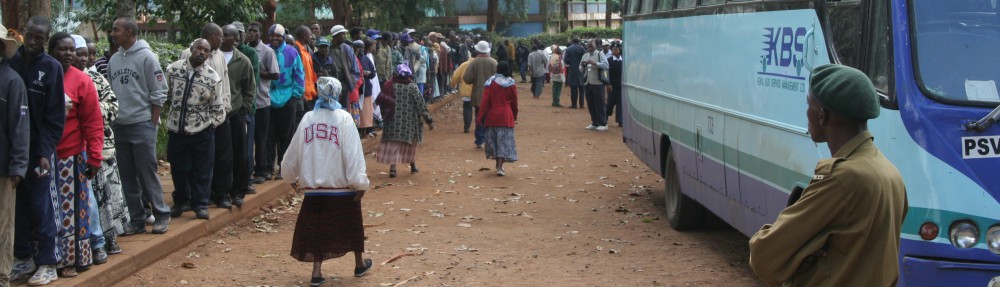
Raila leaves the race . . .

Raila Odinga Kenya president campaign

[Update: since I have not been actively writing here for several months, I may have been a bit hasty in offering here an assessment of Raila’s immediate legacy in current Kenyan politics upon hearing the news of his unfortunate passing from heart failure in India. Those who grew up with Raila’s role in opposing dictatorship through brutal detention and have stayed continuously emotionally engaged with Kenya over the years—especially Kenyans, who do not have the option of pulling back as I have as an American —will feel the weight of a mighty tree falling and the sudden change of light, landscape and horizon. In other words, this post may have been a bit “too soon” as well as superficial. I will endeavor to do more justice to Raila’s impact ahead after the initial memorials.]

[See also the eulogy and remembrance in The Kenya Times from former US Ambassador Michael Ranneberger who served through the 2006-07 campaign and election and PEV, the peace deal and the constitutional referendum under Government of National Unity during Kibaki’s second term. And Jeffrey Gettleman remembering Raila campaigning in 2007 to be denied by the blatant rigging.

Raila’s primary definitive legacy is Kenya’s 2010 Constitution, negotiated as a result of his 2007 campaign which I believe clearly garnered the most votes and led him to the temporary but critical post of Prime Minister for Kibaki’s second term from 2008-2013 as part of the February 28 peace deal between Raila and Kibaki.

The peace deal did not result in the fully formed power sharing contemplated but it was enough to get to a reform Constitution through the elite establishment gauntlet so long as the sole executive power of the presidency was retained (in other words, the Prime Minister position would go away). Devolution, the Supreme Court and many rights that we can hope will eventually come to fruition for Kenyans did result and have created real change.

For my explanation of Raila’s 2007 election, aside from many blog posts categorized and tagged accordingly, see my piece in The Elephant: “The Debacle of 2007: How Kenyan Politics Was Frozen and an Election Stolen With US Connivance.”

Raila’s other legacy is the enduring ODM party itself. The party unfortunately has been in jeopardy in recent years as being without a clear identity with Raila’s handshakes with first Uhuru Kenyatta, then William Ruto. Collaboration with Kenyatta had a clear rationale in achieving Kenyatta’s support for Raila and running mate Martha Karua, intending to stop a Ruto succession. The recent support for Ruto, however, heading into a 2027 re-election campaign, has been hard to square with the notions of the Orange Democratic Movement advertised over the years.

It has been awhile now since Raila was carrying the torch as a reformist leader himself and I will hope that this legacy can now come to greater fruition with younger generations, through a re-tooled ODM and new avenues to compete with ossified elite capture.

See from Africa Report, “Raila Odinga: the man who lost every election but won Kenya’s democracy.”


Condolences to the famiky and their many friends and supporters.

If Raila Odinga wants to be elected the next President of Kenya, he should expect to be evaluated on his performance as Prime Minister

Personally, from everything I knew professionally in “real time” in Kenya during the last presidential campaign and its aftermath, and everything I have learned since, I am of the opinion that Odinga would have been the President but for the manipulation of the vote totals as ultimately reported.  The lack of any actual investigation of this issue is in itself telling.

Nonetheless, no one is entitled to the Presidency of Kenya.  If the election was stolen on behalf of Kibaki it was stolen from the Kenyan voters, not from Raila personally.  It would appear most likely that a plurality but not a majority of votes went to Odinga in 2007.  In supporting the brokering of a “power sharing” deal following the election our Ambassador Ranneberger was fond of saying that Kibaki and Odinga “needed” each other to govern.  My corollary would be that Kenyans did not “need” either of them to govern.  Both Odinga and Kibaki were credible candidates with plausible cases to be made to the voters based on platform, party and past performance–both were also controversial and had disappointed many who had supported them in various instances in the past.  In my mind at the time, from Nairobi, neither seemed as moved as I would have hoped by the suffering associated with the election debacle and the ensuing violence.

I continue to believe that determining what happened last time and why is a necessary part of trying for a better election process next time in Kenya, and a more effective role for the United States in assisting Kenyans toward that better process.   Nonetheless, Kenyans deciding how to cast their vote in 2012 or 2013 should take account of how Raila has used the power, albeit limited, that he ended up with in the current government.

While there is no confusion about who is President in Kenya, under the “Grand Coalition” Prime Minister Odinga is one of a small  second tier of key actors in Kenyan government–not because of a clearly defined role for the Prime Minister as such, but for the combination of his own stature as the apparent winner of the last race and the perceived front runner in the next, his role as head of ODM as still the largest single party, and his role in consensus appointments with Kibaki on behalf of the “Coalition”.

Kenya has a new constitution approved by a successful referendum–finally, after so many years.  The office of Prime Minister rather than being given a clearly defined role is going away.  Raila may have helped to block some bad appointments and to vindicate a better selection process for the judiciary and election officials–he may have also assented to some other bad appointments.   On corruption, Kenyans will need to be asking whether Raila as Prime Minister has accomplished things to advance reform–or whether he has just been talking the talk like other officeholders.  This is one reason why getting to the bottom of the facts of the  management of the “Kazi Kwa Vijana” programs from the Office of the Prime Minister is important.  What does the stewardship of this program say about what Kenyans could expect from Raila as president?  Likewise, if there is no major scandal here, how do his critics justify baying for his head when there are so many major scandals from this government and its predecessors that have not been addressed and accounted for?

Cornelius Vanderbilt’s Second Wife and Somalia’s New Prime Minister

A little item from this week’s alumni news in my e-mail:

Ali Alumnus named prime minister of SomaliaThe New York Times—Alumnus Abdiweli Mohamed Ali, MA’88, who holds a master’s degree in economics from Vanderbilt, has been appointed the new prime minister of Somalia. Full story »

Vanderbilt is not as well known for producing African leaders, perhaps, as some universities. But it does have an economics department that has educated Nobel Prize winner Muhammad Yunus, for instance, so it may not be surprising that Somalia’s new Prime Minister got his masters in economics at Vanderbilt.

Cornelius Vanderbilt himself was arguably a quintessentially American character. Surely if he were alive today he would be making money in and around Africa. Maybe in airlines as well as shipping and rail, and maybe fiberoptics and other means of the “transportation of information” along with moving physical goods and people.

From his biography from The New Netherland Institute:

Between the years 1805 and 1810 Cornelius worked for his father and for the ferry services serving Staten Island. In 1810 when he was sixteen years old he convinced his parents to lend him $100 so he could buy a sailboat to start his own ferry and freight business. They provided him with the money but with the understanding that he would share the profits from the business with his parents. He used the money to start a passenger and freight service between Staten Island and New York City. There was a lot of competition in the ferry service business but Vanderbilt competed on the basis of lower fares, asking as little as 18 cents per trip. He was quite successful and apparently was able to repay the $100 loan to his parents within one year. According to local lore, he was even able to earn a $1000 for his parents during the first year of operations as part of their share in the profits.

The war of 1812 provided new opportunities for growth. The forts around New York City expanded and Vanderbilt obtained a government contract to supply them. Between 1814 and 1818 he expanded with additional schooners for freight and passenger services in Long Island Sound and in the coastal trade from New England to Charleston, South Carolina.

In 1818 he sold all his sailing vessels and became a steamboat captain and partner with Thomas Gibbons who operated a ferry service between New Brunswick, New Jersey and New York City. The Vanderbilt-Gibbons partnership charged only a quarter of the competitive fares. It soon became the dominant ferry service on the busy Philadelphia-New York City route. During the 1818-1829 time period the partnership made a fortune.

In 1829 Vanderbilt decided to go on his own and began passenger and freight service on the New York City-Peekskill Hudson River route. Again he competed on the basis of price and quickly eliminated the competition. He then expanded his service to Albany, New York. He also opened passenger and freight service to the Long Island Sound, Providence and Connecticut areas. By the 1840s Vanderbilt had a fleet of 100 steamships and he had become the biggest employer in the U.S.A. At that point he not only competed on the basis of price but also on the basis of comfort, size, speed, luxury and elegance of the steamship passenger transportation industry.

During the California gold rush in 1849 Vanderbilt began steamship service to San Francisco by way of Nicaraqua. His competitiors used the Panama route which was longer. Vanderbilt was able to cut two days off the length of the trip to San Francisco, and it was 600 miles shorter. This part of his transportation business netted him over one million dollars per year. As a result he became the principal transportation service provider on the East Coast to San Francisco route.

In the 1850s he did two possibly foolish things. In 1853 he decided to take his first vacation ever. He had a steam yacht built and made a triumphant tour of Europe. While on his trip he had left the management of the business to contract managers. They tried to fraudulently take over the business while he was away in Europe. Although they were not successful, his temporary absence from his business proved to be costly, but he quickly recovered. .  .  .

In the 1860s he became aware that the big growth in the future for the transportation industry was not by way of water but by way of rail. So he became interested in railroad transportation . . .
. . . .
A year after the death of his wife Sophia, Vanderbilt now 73 years old, married a distant cousin named Frances Armstrong Crawford, and known as Frank. She was 34 years his junior. The marriage was probably a good one because it gave him a new outlook on life. It is doubtful if his children approved of it. After all, his new wife was younger than seven of his twelve children. It appears that the marriage to a younger woman gave him an imagined extension to his life.

Although Vanderbilt had not engaged in philanthropy at all until that point in his life, through his new wife’s influence, he perpetuated his name through a gift of one million dollars to Nashville’s Central University. One million dollars may not sound like a lot of money, but in the 1870’s it was. Based on the gross domestic product per capita in 1870 and at the present time, the conversion ratio would amount to about 260. So the one million dollars was essentially equal to $260 million in today’s terms. The University would become, and to this day still is, the prestigious Vanderbilt University in Nashville, Tennessee.