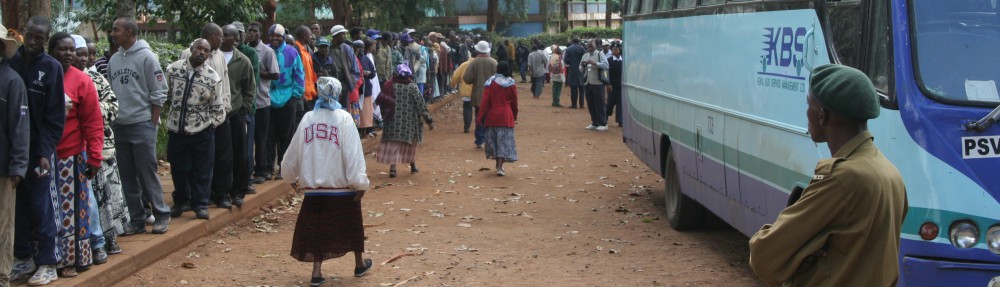
About Ken

American lawyer who took leave from career and moved family to Nairobi for a year to "assist" democratic development. After stolen '07 election in Kenya and violent aftermath I have tried to bring out truth of events and support knowledge and awareness toward better future outcomes.

Raila leaves the race . . .

Raila Odinga Kenya president campaign

[Update: since I have not been actively writing here for several months, I may have been a bit hasty in offering here an assessment of Raila’s immediate legacy in current Kenyan politics upon hearing the news of his unfortunate passing from heart failure in India. Those who grew up with Raila’s role in opposing dictatorship through brutal detention and have stayed continuously emotionally engaged with Kenya over the years—especially Kenyans, who do not have the option of pulling back as I have as an American —will feel the weight of a mighty tree falling and the sudden change of light, landscape and horizon. In other words, this post may have been a bit “too soon” as well as superficial. I will endeavor to do more justice to Raila’s impact ahead after the initial memorials.]

[See also the eulogy and remembrance in The Kenya Times from former US Ambassador Michael Ranneberger who served through the 2006-07 campaign and election and PEV, the peace deal and the constitutional referendum under Government of National Unity during Kibaki’s second term. And Jeffrey Gettleman remembering Raila campaigning in 2007 to be denied by the blatant rigging.

Raila’s primary definitive legacy is Kenya’s 2010 Constitution, negotiated as a result of his 2007 campaign which I believe clearly garnered the most votes and led him to the temporary but critical post of Prime Minister for Kibaki’s second term from 2008-2013 as part of the February 28 peace deal between Raila and Kibaki.

The peace deal did not result in the fully formed power sharing contemplated but it was enough to get to a reform Constitution through the elite establishment gauntlet so long as the sole executive power of the presidency was retained (in other words, the Prime Minister position would go away). Devolution, the Supreme Court and many rights that we can hope will eventually come to fruition for Kenyans did result and have created real change.

For my explanation of Raila’s 2007 election, aside from many blog posts categorized and tagged accordingly, see my piece in The Elephant: “The Debacle of 2007: How Kenyan Politics Was Frozen and an Election Stolen With US Connivance.”

Raila’s other legacy is the enduring ODM party itself. The party unfortunately has been in jeopardy in recent years as being without a clear identity with Raila’s handshakes with first Uhuru Kenyatta, then William Ruto. Collaboration with Kenyatta had a clear rationale in achieving Kenyatta’s support for Raila and running mate Martha Karua, intending to stop a Ruto succession. The recent support for Ruto, however, heading into a 2027 re-election campaign, has been hard to square with the notions of the Orange Democratic Movement advertised over the years.

It has been awhile now since Raila was carrying the torch as a reformist leader himself and I will hope that this legacy can now come to greater fruition with younger generations, through a re-tooled ODM and new avenues to compete with ossified elite capture.

See from Africa Report, “Raila Odinga: the man who lost every election but won Kenya’s democracy.”


Condolences to the famiky and their many friends and supporters.
The Foreign Policy establishment will continue to hold Beltway confabs and hearings about “Africa policy” but the author of “The Flight 93 Election” is running Policy Planning at State and Congress has neutered itself.

I think it is probably a sucker’s game to do too much mastication around the idea of what Trump II may do in or in relation to Africa by reference to the Kennedy through Biden 1961-2025 “A.I.D./USAID Era” of African relations.

Take a moment to read Michael Anton’s famous opinion piece in the Claremont Review of Books from July 2016 entitled “The Flight 93 Election”. This is the very same Michael Anton who is the Trump II Director of Policy Planning at the State Department.

As far as I am concerned the wood chippering of USAID, programs and especially people, is best understood in the intellectual “Cold Civil War” environment as a subspecies of “Defunding the Left” (something that I had some involvement in as a College Republican leader back in the”Reagan Revolution” days) rather than a more specific foreign policy pivot. The impact on Africa, Africans, and relations with African states specifically is just collateral damage in “The Third World” in Flight 93 terms.

Probably better to study the Eisenhower Administration—when decolonization was close enough to warrant standing up a separate Africa Bureau in the State Department but many in Congress addressing foreign policy represented segregated Jim Crow States and districts and the question of civil rights for Black Americans generally was much in contest. And perhaps a counterfactual to identify what a Goldwater Administration Africa policy might have been. [Recognizing that Eisenhower was seen as a proto-Communist by many of the ideological godfathers of the current Trump II core thought leaders.]

The most important American regarding Africa policy is likely Elon (“We’ll Coup Who We Want To“) Musk, and ProPublica has an expose about how aggressively the new Trump II State Department leaned on Gambia for Musk’s Starlink business.

Musk has used his X megaphone (the repurposed Twitter) to spread accusations of a genocide against white Afrikaners in snyc with the rest of the Trump Administration declaring same as the basis for the new program to designate Afrikaners as “refugees” and resettle them in the US. In the context of “The Flight 93 Election” view of seeing “Third World” immigration as the most daunting failure of the pre-Trump Conservative Movement and pre-Trump Republican Party as well as the ultimate goal of the Left “enemy within”, it makes perfect sense to affirmatively bring in Afrikaners while expelling “non-Western” refugees impacted by wars or terrorism elsewhere in Africa or “The Third World”.

Beyond the barriers of “culture” and “development” to finding time out from the Cold Civil War to develop an actual foreign policy strategy for Africa, the Trump II Administration will not be able to take this on without having first a strategy for China. I do not expect that four years will be long enough for Trump to make many of the necessary choices. So far the most important fork in the road in the Trump II China policy (and foreign policy writ large) is the announcement by Treasury Secretary Bessent that the US does not seek to decouple with China.

In the meantime, gutting the State Department means that more of the burden of diplomacy as well as development will be left to AFRICOM by default. Of course the Trump policy of refocusing the Pentagon on “warfighting” by a more lethal warrior class and enhanced technology cuts away from the likelihood that AFRICOM as a Combatant Command will be more rather than less dexterous and ultimately successful at diplomacy than it has been since starting to take up that burden at inception in 2008 as what the G.W. Bush Administration conceived as a “different kind of Combatant Command.”

Congress has elected to defer wholly to Trump II on Africa policy so far as the major changes have been effectuated with the demise of USAID. The Senate Foreign Relations Committee didn’t even hold a hearing (!) on the demise of USAID and the hearing in the House was not of any legal relevance in spite of the preponderance of the testimony debunking the basic rationale of Musk for the “woodchippering”.

Last week the Senate Committee solicited the thoughts of Joshua Meservy of the Hudson Institute, previously Heritage, and Michelle Gavin of the Council of Foreign Relations on “East Africa & The Horn: At a Turning Point or Breaking Point” but again, no real indication that Congress will do anything to get involved as opposed to deferring entirely to Trump II.

While some associated with the Trump II administration pay lip service to an approach of “trade not aid” in the aftermath of the death of aid, there is no evidence of comparative substance to the words. The UAE is the latest country after China to completely dwarf U.S. current and planned financial investment in Africa and like China provides a counter to previous U.S. expressed values on governance and the rule of law, and not just in relation to war and mineral smuggling in Sudan and Central Africa.

See “UAE Pouring Money into Africa, Seeking Resources Resources and Power” in the New York Times on May 17:

“In 2022 and 2023, the Emirates announced a total of $97 billion in investments in Africa — three times China’s total, according to fDi Markets, a database of foreign investments. U.S. investment in 2023 was about $10 billion.”

“Meanwhile, Mr. Trump has fast-tracked America’s exit from Africa, ending billions of dollars in funding, dismantling the U.S. Agency for International Development and ending all contributions to the African Development Bank. The State Department’s reorganization plan also calls for the elimination of most operations in the region.”

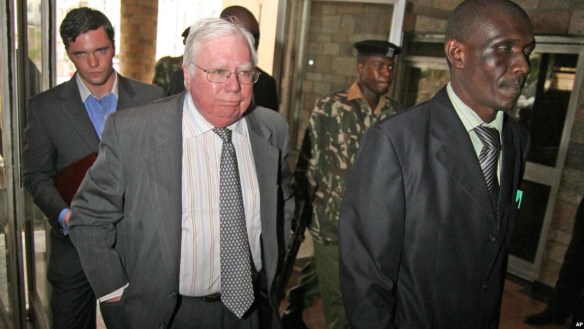
Birther John Corsi in Kenya to investigate Senator Obama
Jerome Corsi, bestselling “Obamanation” and “Where’s The Birth Certificate” author in Nairobi during early Birtherism era.

Third Rubio-Ruto call

The below is attributable to Spokesperson Tammy Bruce:

Secretary of State Marco Rubio spoke with Kenyan President William Ruto to discuss the ongoing conflict in eastern Democratic Republic of the Congo, including the unacceptable capture of Goma and Bukavu by the Rwanda-backed M23 armed group. They emphasized that there is no military solution to the conflict and called for an immediate ceasefire. Both leaders reaffirmed their commitment to push for a diplomatic resolution to the crisis.

How many X accounts and subscriptions does the United States Government pay for?

Let’s ask President Trump to direct DOGE, which we are now told via court filing, he runs in lieu of Elon Musk, to investigate?

Republican senators remaining on Board of IRI following Rubio’s resignation to become Secretary of State are silent on takedown of USAID and NED — both as Senators and as Board members

Hard to understand why Senator Sullivan continues to serve as IRI Board Chair given that the Senate has not even had hearings relating to the “woodchippering” of USAID, the freeze of State Department foreign assistance funding and the separate impoundment of appropriated funds for NED.

Nor is he reportedly willing to speak in any detail to the press or offer any public defense of NED or IRI under attack from Elon Musk and his X platform and laying off most staff due to the defunding.

What is a Board Chairman for?

The others who sit in both the Senate and on the IRI Board are Tom Cotton, Joni Ernst and Lindsey Graham.

All USAID implementation partners are in a terrible conflict not of their own making starting from the Musk “woodchippering” of USAID and accompanying assault through X on the weekend after the Inauguration. But IRI is also one of the four NED “core institutions” and a “Government Organized NGO” pursuant to legislation. IRI and it Board Members themselves are targets of the X-led digital smear campaign in support of the elimination of U.S. foreign assistance. If IRI leadership is unwilling to speak up to defend IRI, who else should be expected to.

Why should it fall on people like me, as private citizens, and in my case one with a mixed experience working for IRI years ago, to advocate for the underlying value and values served by democracy assistance and “mending not ending” the enterprise?

Of course it does need to be noted that IRI does raise private donations as a nonpartisan 501(c)(3) charitable, religious, educational or scientific organization. During my time, no private funds were available for our East Africa program activities as opposed to things such as Board activities or Washington approved extras that were not allowable costs to the Government. So the Board may be able to sustain itself separately from the actual democracy assistance programs?

[Updated] Ruto term nears halfway point as USAID is strangled and Kenyan politics faces disruption from loss at Raila AUC vote Saturday

Update 2-15: Raila fell short to Djibouti’s candidate in the 7th round of voting.

If Raila Odinga doesn’t win his election for Chairman of the African Union Commission on Saturday then Ruto on one hand and the ODM Party on the other will have to face the question of how to repurpose Raila within Kenya’s political establishment. Will he return to the customary role as opposition presidential candidate? Will he and Ruto reach a deal on a new alternative role to keep him and his key loyalists “onside” with the Ruto presidency?

Is there any chance that he would take some “senior statesman” status within ODM and/or the opposition more broadly and not move toward a run for the Presidency in 2027?

What will be the impact of the demise of US democracy assistance, being cemented as this is written, have on the hugely delayed preparations for the 2027 elections?

Mzalendo reports today on claims that the Independent Electoral and Boundaries Commission—intended to be a permanent Government of Kenya institution under the 2010 Constitution—may have a selection panel in place by April of this year to start the process of selecting Commissioners. USAID has been the leading donor for process for decades.

See this piece from The Standard:

Addis setback, a political turning point for both opposition and government

He returns home empty handed, leaving his admirers divided and his detractors wary. There are those who want the Raila to take up his role of calling the government back to order.www.standardmedia.co.ke

Raila Odinga Kenya president campaign

Secretary Rubio’s Call with Kenyan President Ruto

The below is attributable to Spokesperson Tammy Bruce:

Secretary of State Marco Rubio spoke with Kenyan President William Ruto to underscore the value of the U.S.-Kenya bilateral relationship and thank him for Kenya’s leadership of the Multinational Security Support (MSS) mission to Haiti.  The Secretary also reiterated the importance of Kenya’s role in promoting regional peace and security in Somalia, Sudan, South Sudan, and the DRC.

Following Jimmy Carter funeral Donald Trump takes office and deploys “neutron bomb” to US foreign assistance

American “olds” of my generation (we who are 45-64 are the only age cohort who went for Trump in last year’s presidential election) may remember the 1970s controversy over President Carter’s decision to go forward with deployment of the neutron bomb in Western Europe.

To some sensitivities way back in the day, before we “beat the Vietnam syndrome”, the notion of a defensive nuclear weapon that could kill people without “nuking” physical infrastructure was distasteful even faced off against the Soviet Red Army across the Iron Curtain. This was before the peak of the “nuclear freeze” movement and the birth of the National Endowment for Democracy and the modern era of democracy assistance under “PeaceThroughStrength” during the Ronald Reagan administration.

If you are too young to remember the Cold War I think you probably had to be there but I will try to link back soon to some of my related blogs posts and list some other references.

On Friday an acting official on behalf of Secretary of State Rubio delivered the symbolic equivalent of such a weapon to direct immediate Stop-Work orders freezing funding for State Department and USAID funded Foreign Assistance (subject to a few advance waivers for Egypt and Israel, some emergency food assistance and security matters). All to be reviewed and restarted, modified or terminated on authority of Secretary Rubio to make sure they directly serve the strictures of the Trump/Rubio formulation of “America First” as opposed to, you know, helping other people in service to our national interests as per US statutes enacted during the Truman, Eisenhower, Kennedy and subsequent administrations up through 2024.

Of course it was never not America first but it was in some real sense at important times and in important ways “America +” (or so most of us Americans have always believed).

Secretary Rubio came off the Board of Directors of the International Republican Institute (a major State and USAID nonprofit foreign assistance implementor) as well as leaving the U.S. Senate this week to take the post under Trump.

Meanwhile, Michelle Gavin at CFR calls out “accountability gone missing” for Ruto in Kenya

Accountability gone missing in Kenya

“In the wake of last year’s Gen Z protests, Kenyan President William Ruto had two choices. He could accept the youthful population’s rejection of business as usual and get serious about cleaning up corruption in government, aiming to ride the wave of enthusiasm for change to usher in a new political paradigm based on delivering for voters rather than knitting together a coalition of self-serving elites. Or he could revert to darker days of Kenyan history, using political violence to suppress dissent and cow the public. He chose the latter path.

. . . .

The result is, as the Kenyan Conference of Catholic Bishops put it, an attempt to make everyone complicit in a “culture of lies.” In a statement issued last November, the group lamented, “Basically it seems that truth does not exist, and if it does, it is only what the Government says.” It’s a political scenario that deserves close watching. How does a society that has lost faith in its political class but not necessarily in its own ability to affect change react to obvious untruths coming from official sources, to threats and violence, and to an attempt to distort the very idea of truth? How can Kenyans continue to center the ideas that energized a nationwide movement for change while contending with old attempts to divide them and this latest intentional shirking of responsibility at the very top? The answers will matter a great deal to Kenya’s future, and to the prospects for democracies in peril far beyond Kenya’s borders.”

Ruto made his big career move from the 2008 Post Election Violence and being a target of the failed attempts at accountability. So no right to be surprised.

Old Party Office in Kibera
Solo 7–Kibera

US State Department issues Genocide Determination in Sudan

Statement from Secretary of State Blinken:

Genocide Determination in Sudan and Imposing Accountability Measures

On April 15, 2023, the Sudanese Armed Forces (SAF) and the Rapid Support Forces (RSF) launched a conflict of unmitigated brutality that has resulted in the world’s largest humanitarian catastrophe, leaving 638,000 Sudanese experiencing the worst famine in Sudan’s recent history, over 30 million people in need of humanitarian assistance, and tens of thousands dead.  In December 2023, I concluded that members of the SAF and the RSF had committed war crimes.  I also determined that members of the RSF and allied Arab militias had committed crimes against humanity and ethnic cleansing.   

The RSF and RSF-aligned militias have continued to direct attacks against civilians.  The RSF and allied militias have systematically murdered men and boys—even infants—on an ethnic basis, and deliberately targeted women and girls from certain ethnic groups for rape and other forms of brutal sexual violence.  Those same militias have targeted fleeing civilians, murdering innocent people escaping conflict, and prevented remaining civilians from accessing lifesaving supplies.  Based on this information, I have now concluded that members of the RSF and allied militias have committed genocide in Sudan.   

The United States is committed to holding accountable those responsible for these atrocities.  We are today sanctioning RSF leader Mohammad Hamdan Daglo Mousa, known as Hemedti, for his role in systematic atrocities committed against the Sudanese people.  We are also sanctioning seven RSF-owned companies located in the United Arab Emirates and one individual for their roles in procuring weapons for the RSF.  In addition, we are today announcing Hemedti’s designation under Section 7031(c) for his involvement in gross violations of human rights in Darfur, namely the mass rape of civilians by RSF soldiers under his control.  As a result of this designation, Hemedti and his immediate family members are ineligible for entry to the United States.  

Hemedti has wantonly ignored commitments under international humanitarian law, the 2023 “Jeddah Declaration of Commitment to Protect the Civilians of Sudan,” and the 2024 Code of Conduct produced by the Advancing Lifesaving and Peace in Sudan initiative.  This code includes commitments to allow the unimpeded passage of humanitarian relief and prevent war crimes such as sexual violence, which the RSF and aligned militias under Hemedti’s leadership have committed.  

Today’s action is part of our continued efforts to promote accountability for all warring parties whose actions fuel this conflict.  The United States does not support either side of this war, and these actions against Hemedti and the RSF do not signify support or favor for the SAF.  Both belligerents bear responsibility for the violence and suffering in Sudan and lack the legitimacy to govern a future peaceful Sudan.  The United States continues to evaluate additional actions to impose costs on those perpetuating the conflict and atrocities against the Sudanese people.  We also continue to support the Sudanese people in achieving their aspirations for a peaceful, just, and inclusive democratic future, which is why in December I announced that the United States will provide $30 million to support Sudanese civil society actors.   

The Department of the Treasury actions were taken pursuant to Executive Order 14098, “Imposing Sanctions on Certain Persons Destabilizing Sudan and Undermining the Goal of a Democratic Transition,” as amended.  For more information on today’s action, see Treasury’s press release. The public designation is made pursuant to Section 7031(c) of the Department of State, Foreign Operations, and Related Programs Appropriations Act, 2024 (Div. F, P.L. 118-47), as carried forward by the Further Continuing Appropriations Act, 2025 (Div. A, P.L. 118-158).