Challenging Nigeria International Election Observation may present tests of character (2nd update on lobbying/funding) #NigeriaDecides

International Election Observation Mission members, including those from IRI/NDI, are arriving in Nigeria for the general election Saturday in a difficult environment.

Although invited by Nigeria’s government there has been at least one unwelcoming statement and no one could deny that this is a hard job simply from the stakes of the election, the instability in some areas, the poverty and underdeveloped infrastructure faced by large portions of the voting population and the simple relative newness of regular competitive elections.

International election observation, which focuses on civil and political rights, is part of international human rights monitoring and must be conducted on the basis of the highest standards for impartiality concerning national political competitors and must be free from any bilateral or multilateral considerations that could conflict with impartiality. It assesses election processes in accordance with international principles for genuine democratic elections and domestic law, while recognizing that it is the people of a country who ultimately determine credibility and legitimacy of an election process.

Quoted is the standard of independence and impartiality to which the USAID-funded NDI/IRI International Election Observation Mission is pledged under the Declaration of Principles for International Election Observation (Oct. 2005).

The IRI/NDI Nigeria 2015 Observation Mission was funded directly by the State Department so shifting back to USAID funding this time is one of the positive things that I see as having potential to help preserve independence and maintain clarity between an Assistance Observation and a Diplomatic Observation to the benefit of the process.

See my post “President Trump’s Asst. Sec. of State for Africa candidly explains why election observation and technical assistance have to be ‘fire-walled’ from diplomacy to have integrity” for a current discussion and further links.

The joint IRI/NDI EOM model has positives and negatives in terms of actual and perceived independence. In Nigeria where democracy assistance is confronted by “resource curse” funded problems and lobbyists working “both sides of aisle” in Washington at a unusual level for an “African election”, along with prominent American campaign consultants usually involved, the joint model seems to me to have some important advantages over IRI or NDI doing a nonpartisan mission on its own, in-spite of the tradeoffs (alternatively you could go with the Carter Center as an “outside the beltway” if politically connected choice, or Democracy International as a truly private entity).

IRI in Africa from my now distant view has come quite far from some of the vulnerabilities that we faced in the 2007 Kenya Election Observation–experience is the best “capacity builder” and institutional funding and attention are now much more appropriate to the scope of the job. Some of my old Kenyan friends and colleagues who did such a great job running things on the ground in 2007 have stayed on and climbed the ladder. And we can expect this election in Nigeria to be better than their 2007 election, observed by many involved this year, as well.

Since Nigerian elections are always high profile and “on the map” in Washington there is no danger of overlooking the situation from that front. This Observation is long-planned and expected and well-funded; there have been an ongoing series of pre-election missions with reports on preparations. Likewise these observations have been going on with regularity throughout this century–and we’ve even been through the scenario of an incumbent seeking re-election during the Boko Haram war.

At the same time, you need no expertise to know that national elections are always challenging in Nigeria and that while cumulative progress has been made in some areas there are some particular concerns that have been reported on and discussed by this Observation Mission and others in the donor governments and media.

Thus, there may be hard calls ahead for the Observers, both on concerns they have already highlighted and from unexpected events as the voting, counting and disclosing play out.

American lobbyist and Ellen Johnston Sirleaf advisor Riva Levinson articulated part of the present challenge well in The Hill in Washington over the weekend: “At Risk: Credibility of U.S. democracy promotion in Africa“. Johnston Sirleaf is in Nigeria as lead observer for the ECOWAS intergovernmental Election Observation Mission and was co-lead for the most recent IRI-NDI Mission, “ZIEOM” in Zimbabwe.

UPDATE (Feb 12): Riva Levinson and her firm KRL are “registered foreign agents” in Washington for Retail Express Limited of Lagos, Nigeria. The Foreign Agent Registration Act filing from September 30, 2018 identifies this client as a “limited partnership which supports the goals of the Senate President of Nigeria, Dr. Aubakar Bukola Saraki, to engage international stakeholders in support of free and fair national elections in February, 2019, seek a level playing field for opposition parties, and convey the core tenants of the Senate President’s vision for the future of the country.” (She also currently lobbies for the Ministry of Foreign Affairs of Liberia and the Ministry of Finance of Ghana.)

Sakari lost the now-opposition People’s Democratic Party (PDP) nomination to Atiku Abubarka but stayed in PDP, having defected from the All Progressives Congress (APC) of Pres. Buhari in July. The PDP itself hired Ballard Partners as its Washington lobbyists for a year at $1,080,000 two days before Retail Express hired KRL.

Recent former diplomat and Council on Foreign Relations Africa lead Amb. Michelle Gavin had a notably hard-hitting CFR blog post last week headlined: “The Truth About United States Complicity in DRC’s Fraudulent Election” although in the text she just covers the macro level issue of diplomatically blessing an election whose official result was contrary to all available evidence.

We in the U.S. got partially off the hook in the DRC where the incumbent Kabila did not invite U.S.-funded or other international observers beyond the African diplomatic groupings (although I learned from Levinson’s piece that we provided funding for the Catholic Church run ‘Parallel Vote Count’, a fact I totally missed in the news reporting. USAID’s website indicates we were also providing “technical assistance” to the election management body CENI itself (!) which again I missed somehow in the news reports. These facts may have informed Gavin’s view even if the journalists that I read did not take notice.)

Update II (Feb 18): As it turns out, the U.S. not-for-profit IFES continued USAID-funded work with CENI, along with its partner IRI in the Coalition for Electoral Process and Party Strengthening (CEPPS) according to a brief overview on IFES’s website, and continues to work with CENI toward local elections. CENI hired its own Washington lobbying firm in 2018, Avenue Strategies, founded by former DJ Trump campaign manager Corey Lewandowski (he left and set up a separate firm before the CENI contract). In January 2019 after CENI named Felix Tshisekedi as president-elect, Avenue Strategies also signed on to represent Tshisekedi as president-elect and now president.

Presumably, then, under the CEPPS mechanism USAID funded the third partner, NDI, for the work with the Catholic Church Parallel Vote Count. I will contact USAID to confirm the arrangement and see if they are willing to release any contractual details without a formal Freedom of Information Act request.

The Carter Center stood firm in calling out Kabila’s 2011″re-election” as failing to meet international standards. The State Department followed along in declining to bless the election and offering technical assistance to address irregularities back then, unlike the current situation which Levinson and Gavin question (although the diplomatic impetus for remediation at the presidential level in 2011 went away quickly).

See Dr. Carl LeVan’s Homepage “Development for Security” blog for an overview of the Nigeria election contest. Likewise, Amb. John Campbell’s “Nigeria’s Election: What to Know” at CFR.

Here is my piece from The Elephant in the wake of Kenya’s judicially annulled 2017 presidential election: “Free, Fair and Credible? Turning the Spotlight on Election Observers“.

[UPDATE III: here is the Preliminary Statement issued by the IRI/NDI Observation on February 25, after the delayed vote of February 23.]

International Election Observation Mission IRI Kenya Kibera Lavington Nairobi 2007

George H.W. Bush’s legacy in Kenya

George H.W. Bush was of a generation of America’s traditional elite who not only fought World War II, but also collectively oversaw the transition from Jim Crow racial segregation and discrimination through the Civil Rights era while managing the American response to decolonization in Africa and forming relations with the newly independent African states during the Cold War.

Most notably it was during the G.H.W. Bush presidency that Secretary of State James Baker gave permission to Assistant Secretary of State Herman Cohen to begin supporting democratization in Africa as a distinct element of U.S. policy. (See Cohen’s Intervening in Africa: Superpower Peacemaking in a Troubled Continent, a memoir published in 2000). Part of the initial impetus was to help Soviet leader Gorbachev buy latitude by de-escalating tensions at a time of transition for the Russians.

Although U.S. democratization policy did not fare so well in Russia itself, I do think that we were helpful during the Bush Administration and beyond in bringing some African conflicts to a close and in Kenya, an established U.S. regional security partner, in pushing for a political liberalization through legalization of non-KANU parties and forcing President Moi to actually run for re-election in 1992.

President Bush’s politically-appointed Ambassador Smith Hempstone was fondly remembered during my time in Kenya with the International Republican Institute (2007-08) for having challenged Moi and his circle on political liberty issues. He was seen as having provided aid and comfort to actors in “the Second Liberation” within the context of the basic Kenyan-American security relationship. Hempstone was a journalist and newspaperman, not a diplomat, so needless to say he was not quite a cultural/professional favorite in the State Department itself but he knew his way around both East Africa and Washington with enough background and pedigree in both places to successfully test what he could get away with.

It is worth remembering today that Bush appointed Hempstone (who died in 2006) and stuck with him when it might have been easier to assuage Moi by replacing him with someone who would not “rock the boat” or speak too plainly. My late friend Joel Barkan and others I got to know in the democracy community were admirers of Hempstone’s fortitude at a crucial moment of inflection for Kenya. See “My Joel Barkan Tribute“.

Also see the Foreign Affairs review of Hempstone’s memoir “Rogue Ambassador.”

Caring about democracy in Kenya can be discouraging, but there is no doubt that most Kenyans are in fact freer now than they were prior to the Bush/Baker/Hempstone period. While Kenyans fought their own fight, I think that we made the correct choice to be supportive under Bush’s presidency.

My writing on my experience with the birth of “Birtherism” and Trump’s foreign policy

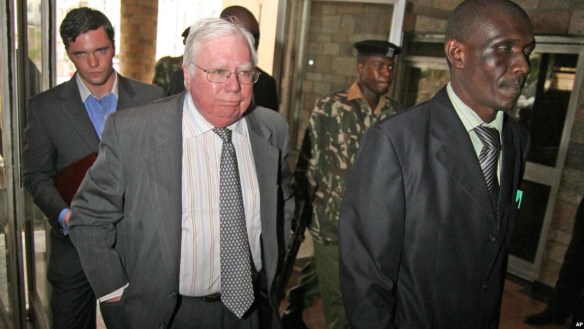
Birtherism is back in the news with statements by Jerome Corsi, author of The Obama Nation and Where’s the Birth Certificate?, that he expects to be indicted by the Grand Jury in the Special Counsel investigation of Russian interference in the American presidential election. News stories this week on Corsi’s role in the current investigation used photos from Corsi at Kenya Immigration in 2008 when he was expelled while investigating Obama while I was Regional Director for the International Republican Institute.

Update: Voice of America, Nov 23, “Roger Stone Associate in Plea Talks with Mueller“.

FILE – Jerome Corsi, center, who wrote “The Obama Nation: Leftist Politics and the Cult of Personality, follows an immigration department officer holding his passport.

Likewise, Michelle Obama made news in pre-tour snippets from her new memoir “Becoming” that she most especially found birtherism from Trump unforgivable on a personal basis because of “his loud and reckless innuendos putting my family’s safety at risk.” See “In Her New Book, Michelle Obama Denounces Trump’s Sexism and His Promotion of the ‘Birther’ Conspiracy” from The New York Times.

A few weeks ago I had a piece in The Elephant which ran with the title “From Birther to More of the Same: American foreign policy in the Age of Trump and it’s impact on Kenya.” Salim Lone, former Raila Odinga spokesman, commented: “As always, a very interesting and objective look at our elections and the role the U.S. has played here from Ken Flottman. He is on the dot for pointing out the continuity in Kenya of the Bush Obama Trump arc, but on matters election, I’d give Bush an upper hand.” (I would appreciate any thoughts or observations you might have.)

I wrote about Corsi more specifically and his role in the 2008 United States presidential campaign between the late International Republican Institute Chairman Senator John McCain and then Senator Barack Obama back in 20014 here:

“A few thoughts about ethnic polarization in Kenya as we wait on the ICC”

An important thing for outsiders to realize is how complex, and deliberately obscured, these things are in Kenyan politics–and how much of what is said in popular fora in the United States is at least misleading if not flatly wrong factually and in some cases deliberately malicious. (I have finally just now brought myself to read the whole Chapter 4 on “Kenya, Odinga, Communism and Islam” in Jerome Corsi’s book The Obama Nation which was published shortly after I returned from Kenya in the summer of 2008 during the American presidential campaign.  It was a major bestseller and thousands of Americans may have read more about Kenyan politics in that chapter than they have ever read elsewhere over their lifetimes.  Corsi . . . paints a picture of the Kenyan election and the post election violence that is very much at odds with my understanding and experience, as well as anything I heard expressed internally at the International Republican Institute, or through my family’s church in Kenya or from our missionary friends or at my children’s missionary supported school.  In other words, malicious.)

One of the most important and interesting things that I have learned (so far) from my Freedom of Information Act requests to the State Department relating to observation of the 2007 Kenyan election was that the Ambassador’s staff reported to him and up the chain during the campaign that while there was hate speech showing up on both sides of the ODM/Odinga and PNU/Kibaki contest, the greater weight of it was directed against Odinga.  This surprised me because I had relatively limited separate interaction with anyone else at the State Department besides the Ambassador and his personal approach and attitude in my dealings with him certainly gave no hint of this background from his staff in the context of his tactics in addressing the Kenyan campaign.

Barack Obama image New Orleans

Monday at USIP:  What Really Works to Prevent Election Violence?

One in five elections worldwide is marred by violence—from burned ballot boxes to violent suppression of peaceful rallies, to assassinations of candidates. A USIP study of programs to prevent violence suggests focusing on improving the administration and policing of elections. The study, of elections in Kenya and Liberia, found no evidence that programs of voter consultation or peace messaging were effective there. Join USIP to discuss this important new report.

Source: What Really Works to Prevent Election Violence?

“The great observer gamble” is a “must read” on the Zimbabwe election and international election observation

An important election and election observation drama is playing out now in Zimbabwe, and “The great observer gamble” (free feature) in Africa Confidential is the key explainer.

Subhead: “After an eight-month charm offensive wooing bankers and diplomats, the government is failing the legitimacy test”

Please follow the link and read in full.

In this case the U.S.-funded joint NDI-IRI international observation mission made a difference in international understanding of the difficult realities of the election in the context of seemingly conclusory approvals from the regional SADC (of which Zimbabwe is a member) and the African Union.

I have no criticism of the NDI-IRI effort and as far as I can tell my old colleagues have upped their game in important ways in this situation from my previous experience in Kenya. At the same time I would note that with the incumbent government already under sanction and not an important U.S. ally, and in a fairly small (in population) country with lots of opposition support in the U.S., this was a case where it was easier to stick to the facts of the vote without getting caught in a diplomatic undertow.

An important question now is how IFES in supporting the Zimbabwe Election Commission will handle the announced election challenge litigation from the primary opposition. With a fraction of one percent margin over the 50 percent runoff threshold and a lot of delay and uncertainty with the central tally (aside from voter register and larger “playing field” issues, this looks quite a lot like Kenya 2013, which I have been looking into through the Freedom of Information Act.

Mnangagwa’s team may have done enough to allow the most enthusiastic business people and governments to step up re-engagement. Much will depend on the strength of the opposition’s case at the election tribunal and the credibility of its handling by the courts.

Africa Confidential

[Update – the judicial challenge has been file. As in Kenya the process is truncated by a 14 day deadline for the court to rule.]

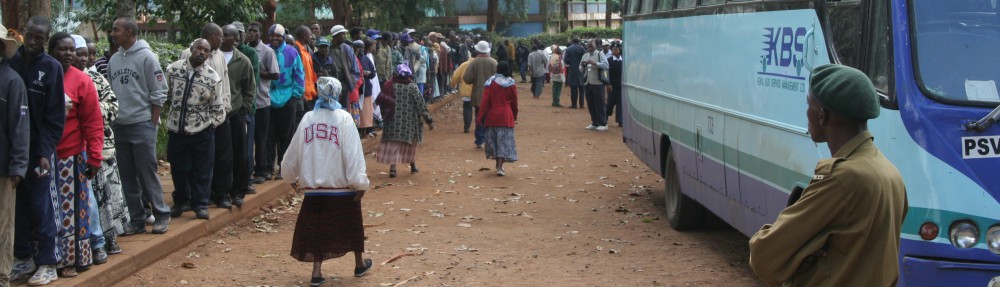
[This is one of my photos from the IRI Kenya 2007 Observation, as we arrived at Olympic Primary School in Kibera, Nairobi. One of the Zimbabwean newspaper sites used a copy of this image with the gentleman on the left cropped out for their Zim coverage.]

USAID documents show profound U.S. policy shift in Kenya from disappointment on reforms and corruption in 2005-06 to Ranneberger’s April 2007 “building capital” with Kibaki

Kenya 2007 election- Ambassador Ranneberger and Connie Newman at polling station Nairobi

In my last post I discussed the late FOIA release of an April 2007 cable setting out U.S. Ambassador Michael Ranneberger’s explanation of a policy of hands-off neutrality on election reform proposals, and a “plague on both their houses” view of corruption. Ranneberger’s approach was to “build capital” with incumbent Mwai Kibaki’s Kenyan government heading into his re-election campaign, while distancing the U.S. from dissenting opposition and civil society voices.

A very different take was set forth only a few months before in documents released to me by USAID in 2014 under a FOIA request relating to the exit and public opinion polling program I managed in that 2007 election cycle as Chief of Party for the International Republican Institute. In memoranda from November 2006 to release a second round of $250,000 in funds for the polling program which had started with an exit poll for the 2005 Constitutional Referendum, USAID noted “a policy shift toward NGO and civil society partners in light of the weakening of Kenya’s Executive Branch as a reliable and willing partner in areas such as Democracy and Governance”.

Here are excerpts from the documents linked above:

PROGRAM BACKGROUND

Embassy Nairobi has requested that the funds be used to support activities to strengthen democracy and governance, environmental sustainability and economic development and trade. All the programs will be managed by the United States Agency for International Development (USAID).

In FY 2006, the funds will be used as follows:

*Democracy and Governance ($2,570,000):

$2.25 million will be used to support domestic and international observations, including training for political party agents and independent observers, allowing them to assess whether the presidential and parliamentary elections in 2007 are non-violent, transparent, and competitive.

ADDITIONAL INFORMATION

*The U.S. Government seeks to build a democratic and economically prosperous Kenya. This is addressed through five strategic objectives focusing on: reducing fertility and the risk of HIV/AIDS transmission; improving natural resource management; improving the balance of power among the institutions of governance; increasing rural household incomes; and supporting education for children of marginalized populations.

PROGRAM DESCRIPTION

I. SUMMARY

The Recipient [IRI] shall institute a program to improve and increase access to objective, reliable information on citizen views and reform priorities through public opinion polling. The Recipient’s activities aim to provide this information to the Kenyan public, Kenyan policymakers, and the diplomatic community and to improve the science and popular perception of opinion survey research in the country.

II. BACKGROUND

The degradation of political discourse and consensus-building in Kenya since the country’s landmark 2002 election has culminated in the stalemate over the constitutional reform process. Having ridden a wave of public optimism into power, the National Rainbow Coalition (NARC) followed through on several of its most important promises during its first year in power. Shortly after taking office, President Mwai Kibaki’s government instituted free primary education nationwide. It also made a strong start in attacking the problem of corruption, beginning with a purge of corrupt members of the judiciary. However, in many areas of concern the performance of the government has been disappointing. Despite its promise of a new constitution within 100 days of taking office, deep disagreements within the NARC government about the content of various drafts have kept this new constitution from Kenyans for nearly three years. Furthermore, NARC’s promises of 500,000 new jobs per year and a vastly reduced crime rate have not materialized. Most unfortunate has been the government’s lack of seriousness in dealing with the resurgence of corruption at high levels of the Kenyan government, resulting in severe criticism by donor countries and civil society groups. Poverty and unemployment remain high; electricity, water, and other services are provided on an irregular basis; and violent crime is prevalent and uncontrolled. Expectations among Kenyans were high that the new leadership would bring rapid relief, but most of the problems have worsened, remained unchanged, or been only marginally improved during NARC’s first three years in office.

. . . .

A chief obstacle for the political parties and other major stakeholders in Kenya has been the lack of reliable information on the concerns and opinions of ordinary Kenyans. Policy priorities are set by political elites who have almost no access to data regarding trends in public opinion and no means by which to gauge how popular or unpopular specific policies are with different segments of the population. In he first few years of this decade, a number of influential opinion polls were conducted that showed the deep satisfaction of the Kenyan public with the Moi government and their desire for a viable alternative to come out of the scattered opposition. These surveys, including one poll conducted by the Recipient [IRI] in 2002 that showed for the first time that a united opposition could beat the Kenya African National Union (KANU), gave strong impetus to the formation of the NARC coalition.

However, after 2002, opinion polling did not become a regular feature of the Kenyan political scene . . . Some major media houses . . . most of these polls have focused exclusively on the “horse race” issues most likely to sell newspapers . . . Moreover, the methods used in some of the most widely-reported polls have been fiercely criticized . . .

. . . .

The future of democracy in Kenya is now much more uncertain than it seemed amid the euphoria of the 2002 election . . . .

It needs to be noted as well that in seeking release of additional funding for the IRI polling in 2006 USAID noted the IRI’s successful performance to date, including the “accurate” 2005 exit poll with the completion of all items on the program work plan, which included the public release of the exit poll results.

(Thus I was taken aback by the objection to public release of the 2007 exit poll results under an extension of the same program, not having incorporated a new direction of “building capital” into the program.)

“Achieving USG Goals in Kenya’s Election” (FOIA Update): Ranneberger April 2007 cable shows shift in US approach to upcoming Kenya election to “build capital with the government”

Kenya 2007 Election campaign posters “Kalonzo Musyoka for President” on duka Eastern KenyaA breakthrough on unraveling the story of Kenya’s stolen 2007 election:

This is from my original 2009 Freedom of Information Act request to the State Department for documents related to the 2007 Kenya exit poll I managed as Chief of Party for the International Republican Institute’s USAID funded polling program.

Just after the next election in Kenya, in March 2013, the State Department made its original release of documents to me on this 2009 request, as I discussed in my post here at the time: Africa Bureau under Frazer coordinated “recharacterization” of 2007 Kenya exit poll showing Odinga win (New documents: FOIA Series No. 12)

At that time State withheld one document in full on the basis of “predecisional privilege”; I eventually got that document released on appeal, and heard no more.

Yesterday, I checked in with the State Department FOIA web library to see if there was anything new on Kenya from other requesters and my search showed that an additional document had been published online in 2017, unbeknownst to me, in response to my 2009 request. It is an April 24, 2007 cable titled “Achieving USG Goals in Kenya’s Election” over the signature of Ambassador Ranneberger to the Secretary of State for the Africa Bureau and the Bureau of Intelligence and Research (INR) in Washington. “Sensitive But Unclassified” and released with no redaction. No explanation as to why this document, which pre-dates all of the others released or identified to me in 2013, was published online on April 18, 2017; if it was mailed to me at some point I did not receive it. Nonetheless, I am glad to finally have it (although I wish I had known about it when I published my June 2017 summary story on “The Debacle of 2007 for The Elephant).

The big significance of the cable for me is that it documents that the State Department had in fact changed its approach toward Kibaki and toward the opposition between 2005 and April 2007. This was my perception “on the ground” during the campaign, but I had no explicit documentation until now. It also confirms that as of April, the plan was for a diplomatic observation of the election by State Department personnel only and not an International Observation Mission by the Carter Center as recommended by a 2006 USAID evaluation (referenced in the cable) or by IRI as initiated at the behest of the Ambassador that summer.

Likewise, the cable includes one more recitation that the purpose of the exit poll, formally, was to deter and oppose election fraud through an “independent verification of election results”, not to be “a training exercise never intended to be released” as asserted by Ambassador Ranneberger on a State Department webchat in March 2008 after the quashed but leaked poll had become a “hot potato”, and supported in State Department talking points prepared and circulated in response to media reporting in 2008 and 2009.

Unfortunately for me, when I took over the USAID polling program for IRI in June 2007, the program was operating under a Cooperative Agreement from 2005 that expressed the old policy of being disappointed in the corruption and underperformance within the Kenyan government as reflected in the Anglo Leasing security procurement frauds, the Standard Raid and Artur Brothers, etc. No one at USAID or IRI intimated that the State Department had changed policy and I had to figure it out for myself on the fly.

Here are key excerpts from the cable as published:

3. (SBU) Positioning: Some civil society leaders and opposition members of Parliament have complained recently that the U.S. mission is not close enough to the opposition. In fact, we have close contacts with the opposition from the top levels through the Ambassador to to all levels. However, the opposition longs for the days in 2005 when Foreign Minister Tuju publicly condemned the U.S. mission for supposedly desiring “regime change” in Kenya. They also cite the period in the 1990s when the U.S. mission openly sided against the Moi administration in favor of the multiparty democracy movement. However, the present government, for all its flaws, was elected under conditions widely considered free and fair. As for its indulgence of corrupt members of the political class, we note that the opposition has taken no disciplinary action against notoriously corrupt members within its own ranks. Corruption plagues the entire political class. We will continue to publicly condemn it as a major impediment to Kenya’s progress. We will continue to work closely with the Kibaki administration to achieve USG goals, but we will continue to assert ourselves as completely neutral concerning the election itself. Our strategy is to build capital with the government to be spent as needed over the course of the campaign to address critical electoral issues. We started that process through emphasis on the U.S.-Kenya partnership (reftel B). While we will be strictly neutral among the contending political parties, we will be fiercely partisan in support of the democratic process.

. . . .

8. (SBU) Electoral Reform: As reported in reftel B, electoral reform continues to be a hotly debated topic in Kenya. There is a consensus among all political parties and civil society that reform is required. There are no prominent defenders of the status quo. However, there is no consensus on the scope of reforms and the particulars of those reforms. Since the 2002 general election and the 2005 referendum on the draft constitution were both held under the present electoral system and were deemed free and fair, and since Kenyan society is adequately debating electoral reform, we see no reason for the USG to enter the fray. However, we have urged on all parties a spirit of compromise and an emphasis on the longterm best interests of the nation rather than short term electoral advantage. An opposition leader recently threatened a boycott of elections if his party’s electoral reform demands are not met. We made it clear to him that such intemperate language is not constructive and that boycotts are not acceptable. He stopped issuing boycott threats.

. . . .

– Public Opinion Polling: The International Republican Institute began implementing a public opinion program in 2005. The program seeks to achieve two results: increasing the availability of objective and reliable polling data; and providing an independent source of verification of electoral outcomes via exit polls. These results make an important contribution to elections and political processes. First, genuine free and fair elections require that citizens make informed choices. The polling data adds to the objective data available to citizens on key electoral issues. Second, the exit polls provide an independent assessment of the accuracy of the official electoral results, thereby supporting the assessment of the credibility of Kenyan electoral processes.

This program also enhances democratic political parties by enhancing the likelihood that candidates base their platforms on the key issues and concerns of their constituents, evidenced in the polling data, rather than the traditional focus on ethnicity and personalized political wrangling.

2007 Kenya election Kibaki billboard

I will discuss the context and layers of meaning in this “new old” cable more in the near future.

“Sitting on” the embargoed USAID-funded IRI exit poll indicating opposition win in Kenya 2007 election, I wished someone would subpoena me


A Kenyan blogger wrote in early 2008 that  I “should be” subpoenaed after I was reported in Slate magazine as “sitting on” the embargoed USAID-funded IRI exit poll. I would have welcomed it. Sadly no subpoena came.  No one approached me except from the media as I hoped that the decision would be made in Washington to end the embargo as Joel Barkan and I urged.

The exit poll was publicly released by the the University of California San Diego research team at an event at CSIS in Washington only in July 2008 after the six month publicity restriction in their consulting contract with IRI. [ed. note: Remember it was then released in August by IRI.]

By that time, it mattered  for “the war for history” as to whether the election had actually been stolen or not, but had no real time impact in that Kibaki’s second full term was well underway.  The “Kreigler Commission” reporting to President Kibaki was staying off the question of what really happened to the presidential tally at the ECK.

Lessons for today, in time to matter?

What if vital information about what happened with the presidential tally is in the hands of people working for the donor-funded election assistance operations who wish they could provide that information and answer the vital questions?

FREE, FAIR AND CREDIBLE? Turning The Spotlight On Election Observers in Kenya | The Elephant

Published today in The Elephant: FREE,FAIR AND CREDIBLE? Turning The Spotlight On Election Observers in Kenya | The Elephant by Ken Flottman.

“THE DEBACLE OF 2007” – my piece in The Elephant on how Kenya’s politics was frozen and an election stolen . . .

THE DEBACLE OF 2007: How Kenyan Politics Was Frozen and an Election Stolen with US Connivance | The Elephant