USAID documents show profound U.S. policy shift in Kenya from disappointment on reforms and corruption in 2005-06 to Ranneberger’s April 2007 “building capital” with Kibaki

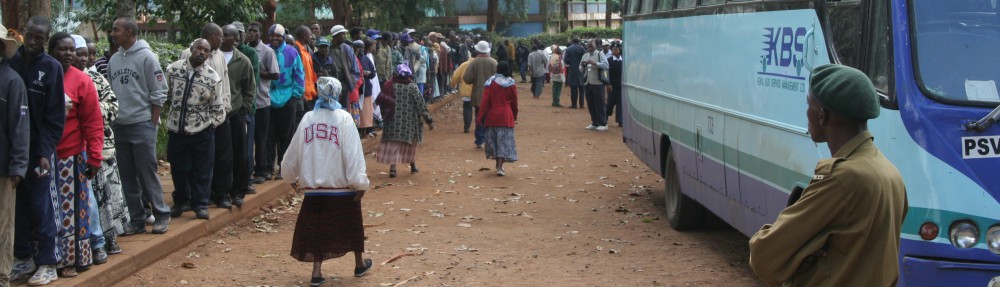
Kenya 2007 election- Ambassador Ranneberger and Connie Newman at polling station Nairobi

In my last post I discussed the late FOIA release of an April 2007 cable setting out U.S. Ambassador Michael Ranneberger’s explanation of a policy of hands-off neutrality on election reform proposals, and a “plague on both their houses” view of corruption. Ranneberger’s approach was to “build capital” with incumbent Mwai Kibaki’s Kenyan government heading into his re-election campaign, while distancing the U.S. from dissenting opposition and civil society voices.

A very different take was set forth only a few months before in documents released to me by USAID in 2014 under a FOIA request relating to the exit and public opinion polling program I managed in that 2007 election cycle as Chief of Party for the International Republican Institute. In memoranda from November 2006 to release a second round of $250,000 in funds for the polling program which had started with an exit poll for the 2005 Constitutional Referendum, USAID noted “a policy shift toward NGO and civil society partners in light of the weakening of Kenya’s Executive Branch as a reliable and willing partner in areas such as Democracy and Governance”.

Here are excerpts from the documents linked above:

PROGRAM BACKGROUND

Embassy Nairobi has requested that the funds be used to support activities to strengthen democracy and governance, environmental sustainability and economic development and trade. All the programs will be managed by the United States Agency for International Development (USAID).

In FY 2006, the funds will be used as follows:

*Democracy and Governance ($2,570,000):

$2.25 million will be used to support domestic and international observations, including training for political party agents and independent observers, allowing them to assess whether the presidential and parliamentary elections in 2007 are non-violent, transparent, and competitive.

ADDITIONAL INFORMATION

*The U.S. Government seeks to build a democratic and economically prosperous Kenya. This is addressed through five strategic objectives focusing on: reducing fertility and the risk of HIV/AIDS transmission; improving natural resource management; improving the balance of power among the institutions of governance; increasing rural household incomes; and supporting education for children of marginalized populations.

PROGRAM DESCRIPTION

I. SUMMARY

The Recipient [IRI] shall institute a program to improve and increase access to objective, reliable information on citizen views and reform priorities through public opinion polling. The Recipient’s activities aim to provide this information to the Kenyan public, Kenyan policymakers, and the diplomatic community and to improve the science and popular perception of opinion survey research in the country.

II. BACKGROUND

The degradation of political discourse and consensus-building in Kenya since the country’s landmark 2002 election has culminated in the stalemate over the constitutional reform process. Having ridden a wave of public optimism into power, the National Rainbow Coalition (NARC) followed through on several of its most important promises during its first year in power. Shortly after taking office, President Mwai Kibaki’s government instituted free primary education nationwide. It also made a strong start in attacking the problem of corruption, beginning with a purge of corrupt members of the judiciary. However, in many areas of concern the performance of the government has been disappointing. Despite its promise of a new constitution within 100 days of taking office, deep disagreements within the NARC government about the content of various drafts have kept this new constitution from Kenyans for nearly three years. Furthermore, NARC’s promises of 500,000 new jobs per year and a vastly reduced crime rate have not materialized. Most unfortunate has been the government’s lack of seriousness in dealing with the resurgence of corruption at high levels of the Kenyan government, resulting in severe criticism by donor countries and civil society groups. Poverty and unemployment remain high; electricity, water, and other services are provided on an irregular basis; and violent crime is prevalent and uncontrolled. Expectations among Kenyans were high that the new leadership would bring rapid relief, but most of the problems have worsened, remained unchanged, or been only marginally improved during NARC’s first three years in office.

. . . .

A chief obstacle for the political parties and other major stakeholders in Kenya has been the lack of reliable information on the concerns and opinions of ordinary Kenyans. Policy priorities are set by political elites who have almost no access to data regarding trends in public opinion and no means by which to gauge how popular or unpopular specific policies are with different segments of the population. In he first few years of this decade, a number of influential opinion polls were conducted that showed the deep satisfaction of the Kenyan public with the Moi government and their desire for a viable alternative to come out of the scattered opposition. These surveys, including one poll conducted by the Recipient [IRI] in 2002 that showed for the first time that a united opposition could beat the Kenya African National Union (KANU), gave strong impetus to the formation of the NARC coalition.

However, after 2002, opinion polling did not become a regular feature of the Kenyan political scene . . . Some major media houses . . . most of these polls have focused exclusively on the “horse race” issues most likely to sell newspapers . . . Moreover, the methods used in some of the most widely-reported polls have been fiercely criticized . . .

. . . .

The future of democracy in Kenya is now much more uncertain than it seemed amid the euphoria of the 2002 election . . . .

It needs to be noted as well that in seeking release of additional funding for the IRI polling in 2006 USAID noted the IRI’s successful performance to date, including the “accurate” 2005 exit poll with the completion of all items on the program work plan, which included the public release of the exit poll results.

(Thus I was taken aback by the objection to public release of the 2007 exit poll results under an extension of the same program, not having incorporated a new direction of “building capital” into the program.)

On Cambridge Analytica for Kenyatta, The Star reported arrival of a campaign team back in May – why no follow-up?

Below is a draft post I wrote but did not publish back on May 10, 2017:

Uhuruto re-election and Cambridge Analytica coverage in The Star: why now?

Today, the Star, Nairobi’s previously opposition-leaning third daily newspaper (a must read together with The Daily Nation and The Standard) ran a story announcing the arrival of a team from Cambridge Analytica for the Uhuruto/Jubilee re-election campaign.

Note the attribution to “well placed sources in the Office of the President.”

Generally speaking the Kenyan media declines to cover the foreign firms working the Kenyan election campaigns, especially for an incumbent president.  That type of thing is in the category of “we are a ‘free press’ but not free like that”.  For the “foreign correspondents” the Western campaign operatives are fellow habitues of the expat “circle of trust” or omertà or whatever you want to call it: sources not subjects of reporting.

So why this story today?  If I can put myself in the loafers of an Uhuruto campaign operative rather than just a bystanding fan of “truth, justice and the American way of life” I might want this for a couple of ressons that I can think of: 1) this could be what has been famously termed a “limited modified hang out” – if information is starting to leak you might want to seize control to misdirect attention by putting out a shaped half-truth version; 2) this could be a way for the Uhuruto campaign to “signal” the idea that it has powerful support in Washington and London in response to the black eye received in the form of the USAID suspension of Ministry of Health funding due to corruption which went public Monday.  Of course, this is all just hypothetical/conjectural “thinking out load” from someone who is not involved.

One of many fruitful questions for further review now is the extent to which these operations were run by Government of Kenya officials out of Government offices.

Was Cambridge Analytica given access to Government of Kenya data? On the pattern of use of State resources for the Jubilee campaign, beyond running the campaign through office holders and out of the Office of The President and State House, note this from The Star story;

Aspirants who won nominations in the just-concluded Jubilee primaries will be expected to campaign for Uhuru in their home areas.

A deal has been offered to nomination losers to stick with Jubilee and be rewarded with state jobs after the election.

Here is yesterday’s Reuters report with the first “on record” confirmation from Jubilee after the now-infamous Channel 4 undercover expose and leaks regarding Facebook that it used SCL/Cambridge Analytica in the campaign.

And please remember as well the role of the American firm Harris Media: “Don’t Mess From Texas: disturbing Privacy International report indicates Uhuruto re-election campaign bought Texas-based negative propaganda campaign.”

Don’t be confused: preparations for Kenya’s failed August election election were controlled by Kenya’s ousted “Chickengate” IEBC and its CEO and staff with support of international “partners”

From this blog late last year:

Meanwhile, Kenya is paying an average of about $343,000.00 “severance” to each of the outgoing Independent Electoral and Boundary Commissioners for leaving earlier this fall rather than completing their terms through November 2017. No signs of accountability for the #Chickengate bribes to the IEBC by Smith & Ouzman that were prosecuted by the UK and no sign of accountability for corruption in the subsequent 2013 election technology procurements.

While the “buyout” has been negotiated, the incumbent IEBC staff without the “servered” Commission has been proceeding to undertake election preparations that will be fait accompli for the new Commission when it is appointed next year.  

Accordingly, the chief executive has proceeded to report plans to spend an astounding 30Billion KSh to conduct the 2017 general election, while setting a target of 22 million registered voters. In other words and figures, roughly $13.40US per registered voter if the target is met or $19.60US per currently registered voter. (For comparative data from places like Haiti and Bosnia,see The Ace Project data on cost of registration and elections.)

Update: see Roselyne Akombe’s interview in the Saturday Nation, Credible Oct. 26 election not possible: Akombe” 

“Sitting on” the embargoed USAID-funded IRI exit poll indicating opposition win in Kenya 2007 election, I wished someone would subpoena me


A Kenyan blogger wrote in early 2008 that  I “should be” subpoenaed after I was reported in Slate magazine as “sitting on” the embargoed USAID-funded IRI exit poll. I would have welcomed it. Sadly no subpoena came.  No one approached me except from the media as I hoped that the decision would be made in Washington to end the embargo as Joel Barkan and I urged.

The exit poll was publicly released by the the University of California San Diego research team at an event at CSIS in Washington only in July 2008 after the six month publicity restriction in their consulting contract with IRI. [ed. note: Remember it was then released in August by IRI.]

By that time, it mattered  for “the war for history” as to whether the election had actually been stolen or not, but had no real time impact in that Kibaki’s second full term was well underway.  The “Kreigler Commission” reporting to President Kibaki was staying off the question of what really happened to the presidential tally at the ECK.

Lessons for today, in time to matter?

What if vital information about what happened with the presidential tally is in the hands of people working for the donor-funded election assistance operations who wish they could provide that information and answer the vital questions?

FREE, FAIR AND CREDIBLE? Turning The Spotlight On Election Observers in Kenya | The Elephant

Published today in The Elephant: FREE,FAIR AND CREDIBLE? Turning The Spotlight On Election Observers in Kenya | The Elephant by Ken Flottman.

Kenya’s presidential election petition – it was clear IEBC did not follow the law, even before Supreme Court Registrar showed serious skulldugery with ICT

Discussing Kenyan elections can get tense, even among friends who are not Kenyans and try to be relatively dispassionately analytical. I have copied here one of my emails from an ongoing exchange in late August during the pendency of the Presidential Petition in the Supreme Court. My friend with whom I was corresponding is a Westerner who knows far more about Kenya (and lots of other relevant things) than I do and is someone I greatly respect (he is also a layman as far the legal profession goes). My friend was much more sanguine than I about the IEBC’s implementation and use of the KIEMS Results Transmission System, both in terms of facts and law. This explains how I saw things (and still do):

Uploading an alleged Form 34A offline after the election and reporting of results reflects a failure of the use of the RTS by its terms as consistently represented by IEBC and IFES until well after the election.

It is simply not the same thing at all in my opinion.

Even ELOGs sample in their PVT found 13.5% of Polling Stations did not publicly post Form 34A. If it wasn’t scanned and transmitted in real time, or at least scanned with delayed transmission upon being moved into a coverage area contemporaneously, and it also wasn’t publicly posted, then it cannot credibly treated as if it was reliable without explanation and evidence.

Your figure of 29,000 and the IEBC tweet claiming all but just over 1000 leaves a huge gap in a very short time period. (Further, I understand you to refer to some “backlog in uploading them” which apparently refers to something other than KIEMS transmission, so I am not sure at all that I am really understanding your argument.)

I also disagree with your characterization of “clear rules” of Kenyan election law implementing the Maina Kiai court decision against the IEBC. IFES advised to the contrary in their last pre-election publication on the process that I am aware of, the July 20 FAQ that also explained how KIEMS was to work.

People may have gambled that Chebukati could use the Court of Appeals ruling to announce on day 3 of 7 “final results” from most but not all alleged Form 34Bs without the 34As having been demonstrably transmitted to the Constituencies to generate the Form 34Bs. This tactic might very well win the Supreme Court of Kenya, legitimately or illegitimately, but I don’t find it persuasive myself, nor do I find that provides any justification for the assertive lack of basic transparency.

Kenyan lawyer Nelson Havi’s piece in The Elephant from about the same time gives a good summary of the issues in the Presidential Petition and the Petitiiners basic case: “KENYA ON TRIAL: Truth, Justice and the Supreme Court.”

“Preliminary Findings” released by Kenyan civil society coalition on election

Update 23 Aug – Here is the latest from the  Kura Yangu Sauti Yangu monitoring:    KYSYElectionDataUpdate-WhyDisputed-22Aug2017

Following the unlawful raid on AfriCOG in Nairobi yesterday, today the Kura Yangu Sauti Yangu election monitoring program which has been engaged since long before any of the International Election Observation Missions were constituted, released its Preliminary Findings.

Please read for yourself (especially if you have commented publicly so far on Kenya’s election).

It would be easier for Mr. Chebukati and Mr. Kerry to make their case to Mr. Odinga’s supporters with much greater transparency

There is a lot that Kenyan voters could be told that they have not been told about how their votes were represented to them by the IEBC over the last several days since they voted and all the ballots were counted Tuesday evening.  As assurances given to the voters in 2007 and again in 2013 in the immediate aftermath of voting those years did not in some substantial respects turn out to be factually sustainable, it is no suprise many Kenyans would want to verify rather than just trust now.

One would expect everyone involved this year to anticipate questions.  There were lots of prominently published warnings of the need for transparency (from the International Crisis Group among others).

Mr. Kerry was Secretary of State in 2013 and presumably has current clearances that would allow him as an individual, now post-government service, to make doublely sure he is fully briefed about the failed Results Transmission System of 2013, as well as other past problems, if he wasn’t before coming to Nairobi last weekend for the Carter Center.  Presumably he could also ask the current US and Kenyan governments to go through the details relating to procurement and use of KIEMS this year.  Then he could answer questions and demonstrate the kind of transparency that would build trust.

Alternatively Mr. Chebukati and the current U.S. government could answer questions irrespective of the Carter Center or other independent Election Obsevation Missions.

Kenyan election – amid uncertainty, unfortunate there was no Kalonzo v. Ruto debate [updated 7 Aug]

Today [Sunday 6 Aug.] the IEBC announced for the first time that over 25% of its more than 40,000 polling stations do not have network coverage.  Satellite phones have only been provided, apparently, to the 290 constituency tally centres.

So with a very messy voter register again–see AfriCOG report here–the election is entirely dependent on the KIEMS system.   The procurement of the system remains deliberately shrouded, the techical director murdered–with offers of assistance from the FBI and Scotland Yard spurned.  And now the connectivity bombshell.

Along with the deployment by the Kenyatta administration of twice the security personnell as Kibaki deployed in 2013 in the wake of 2007.

So no need to pretend that this is a normal election in which voters could have standard expectations.  Still, the contrast between the coalitions and the generational consequences at issue might have been best captured by a debate between Kalonzo and Ruto.

Update Monday 7 Aug: seemingly keen to signal that there has been no end to the use of the assets of the Government of Kenya for the Uhuruto re-election campaign, the official website of the Office of the Presidency today features this piece dated Saturday to  correspond with the end of the campaign:  “President Kenyatta: I served Kenya diligently–vote for me again“.  Last year Kenyatta and Ruto launched the Jubilee Party as their re-election vehicle at State House in a telling contrast from Kibaki’s 2007 launch of his PNU re-election vehicle at his private Silver Spring Hotel in Nairobi.

The unwillingness or inability of Kenya’s other institutions, including the media, to stand up to the “re-KANUization” of the State by the Executive’s Party is one of the most troubling indicators of the deteriorization of democratic health from the seeming breakthough of the 2003-05 with the NARC coalition defeat of KANU.

Update: here is a VOA overview.

“THE DEBACLE OF 2007” – my piece in The Elephant on how Kenya’s politics was frozen and an election stolen . . .

THE DEBACLE OF 2007: How Kenyan Politics Was Frozen and an Election Stolen with US Connivance | The Elephant