“Six Years An Ambassador” : Godec’s Kenya valedictory with Macharia Gaitho

Macharia Gaitho seems to have been of late the designated Kenyan columnist to convey certain background perspectives from the American Embassy.  His April 8 Sunday Nation column provides in interview form a review by outgoing Ambassador Godec of his tenure and the position of the State Department at present.

For me the primary “takeaway” is, as the Nation headlined, the continued/renewed statement of the need for “national dialogue”. The issues were apparent from the 2017 election going back to the 2007-08 election. The “handshake” of a month ago is said to open an opportunity for that dialogue. Likewise the U.S. position is reiterated on the status of the October 26 election and Kenyatta as legitimate per the IEBC and Supreme Court as the U.S. sees it.

I have not met Godec and I really do not have an opinion about him personally. I am not able to say, with the late American humorist Will Rogers, that “I never met a man I didn’t like” but I try to be able to say “I never dislike a man that I’ve never met.”

What makes me sad is that Godec as the Ambassador has been controversial and drawn more anger as well as more disappointment from many Kenyans than I have seen in the past.

Some of the heat would fall on the shoulders of anyone who was the voice of the controversial policies from Washington. Some of it reflects more specifically the reasons that “national dialogue” is needed: the 2008 “peace deal” got only perhaps half-executed and a lot of Kenyans are unenthused as they should be about getting the short end of the stick over the past ten years from their own government. As a “friend” of the Government of Kenya we naturally find ourselves with some “guilt by association” from the Kenyan public. And of course some of it is the behind the scenes stuff that we Americans back home have to hope to evaluate, someday, from the media or private conversations with insiders or the Freedom of Information Act, if ever.

Godec was candid enough to acknowledge that “peace” was prioritized first as a “must” in United States foreign policy in regard to Kenyan elections as but noted that we continued to also support other equities of justice and fairness. For instance, we support  allowing civil society freedom to operate. Nothing was said however to indicate we ourselves need to take a fresh look at our own role in supporting the election mechanisms or our role in supporting reform and transparency out of our own experience in these last three Kenyan election cycles.

It perhaps goes without saying that we no longer mention any notion or prospect of justice for the victims of the 2007-08 post election violence. (Or pre-election 2013 for that matter.) That was something we always used to talk about.

Ambassador Godec noted that his biggest regret was the ongoing security situation as reflected in the Westgate and Garissa University attacks. I assume we are not waiting for those reports from the Government of Kenya on those attacks that Kenyans have been waiting on. (Of course both Kenya and the United States remain at war in Somalia as we were when the Ambassador arrived as Charge in 2012.)

The biggest thing that really struck me from Ambassador Godec’s interview was that there are now 28,000 Americans living in Kenya. More people have been realizing what a great place to live Kenya can be if you are an American, as I can attest. I hope that’s a good thing.

I also hope the Ambassador will sit down with The Elephant as a newer Kenyan publication that is able to generate more depth on current controversies than the big media groups usually feel able.

“Michael & Me” – retrospective thoughts on tying up with Amb. Ranneberger and separating “foreign policy” from “personality”

With a new political appointment announced for the U.S. Embassy in Kenya, Raila Odinga’s criticism at the Center for Strategic and International Studies (CSIS) on his last U.S. visit of the role of the U.S. and U.K. envoys in supporting Kenyan elections for favoring immediate stability over democracy raises the underlying question of how much of the issue has to do with specific envoys and how much is pre-determined policy handed down from Washington or London.

Thus some overdue consideration of my interactions with Ambassador Michael Ranneberger in 2007-08 in that context:

I have written about the actions of the Ambassador as “the point of the spear” that I dealt with in Nairobi with a desire to be cautious to speak to direct knowledge, along with such documents as I have obtained from FOIA, and other direct sources. Addressing specific interactions with the Ambassador and comparing those with his now-disclosed reporting to Washington raises some questions, but does not provide clear answers, as to how responsibility should fall as to decisions about how the State Department played Kenya’s 2007 election during Ranneberger’s tenure.

Obviously I got along fine with Ranneberger for a period of months before we “crossed up” over specifics of my job with the International Republican Institute (IRI) in the month of the election; where I did not agree with his approach, it not lead me to personally dislike him, nor did I feel I was informed adequately or was otherwise in a position to challenge how he was doing his job as Ambassador. Rather my obligation as I saw it was to stand my ground to be able to do my own job. At some level the problem was simply institutional in that Ranneberger felt that his job encompassed managing my work in managing the IRI Election Observation Mission and I did not (nor did IRI as I was told without exception).

When Ambassador Ranneberger and I contradicted each other about issues from our interactions during the 2007 Kenyan election on the front page of the New York Times in a story published in January 2009, soon after the Obama inauguration, Ranneberger was quoted as reacting by claiming that he was being falsely accused by people who were out to get him.

By the time the Times story ran I had been back at my job in the States as a lawyer for defense contractor Northrop Grumman for a year-and-a-half. It was potentially consequential to be called a liar in the New York Times by the serving American Ambassador to a country in which my company at the time had business for the U.S. as a national security contractor.

Fortunately I was treated very well by my client/employer (as when they held my job open for me to take “public service leave” to support democracy in Kenya in the first place). When my security clearance came up for renewal a year later I seemed to draw some flack from somewhere leading to a follow up along the lines of whether I had in some sense let my loyalties “go native” to which I re-iterated my loyally clean conscience. Since my clearance was renewed I did not lose my job. (Likewise, I assumed that it was understood that I had not been lying in my interviews with The Times.)

It was well after the Times story ran that it was mentioned to me in passing that there were efforts from Kenyans to persuade Washington to replace Ranneberger. I was never involved in such efforts and did not know anything about the topic when I was interviewed by the Times July 2008 or in a follow up after the U.S. election that November. The decision to accept the interview request from the Times was strictly mine and I did not consult with anyone about whether to agree or what to say. As I have written here, I requested a meeting with IRI with no reply that October (2008) and had a discussion with the IRI Press Secretary that November but again IRI never followed up with me.

I can say this: I was surprised that the Obama Administration continued to be represented by Ranneberger for more than half of Obama’s first term after the election debacle. I would have assumed that Obama’s message from the campaign of a changed foreign policy approach along with the personal factors of being identified with Kenya through his father and having visited Kenya I believe three times by then, would have given extra assurance that Obama would want to get a fresh start after the previous mess sooner rather than later. But just for these “macro” reasons, not because of any details of the election saga I filled in for investigating reporters.

At some point subsequently I made an extracurricular call on a staffer to Sen. Feingold to inquire as to what response the Asst. Secretary of State and the Asst. Administrator for USAID had provided to the Senator’s demand for answers as to why the USAID/IRI exit poll was being embargoed at his hearing on February 8, 2008 Subcommittee Hearing on the Kenyan elections. I got nothing in the way of cooperation on my inquiry, but did get out of the blue and to my surprise what may have been a less than ingenuous question that “since it seems like we are going to need a new Ambassador” if I had any recommendations. Perhaps this reflected in some fashion Ranneberger’s conspiratorial notion of my motives? [no way to know, it just seems strange; I had no relationship with that office or stature that would warrant the question, especially in the context of being stonewalled on the small actual request for information that prompted the visit]

Here is how I viewed things at the time of Ranneberger’s departure from the Embassy in September 2011 (from a draft I did not post then):

Ambassador Ranneberger has been giving “exit interviews” and traveling to say his goodbyes to return to Washington.  He has indicated that he loves Kenya in particular of his postings and would like to settle in Kenya (although he says he has not acquired property) and he has introduced the woman that he has described as the “Queen” to his “King”, with hints of a future wedding.

The British Royal wedding was a big hit in Kenya, and now we have the “changing of the guard” at the U.S. embassy as well.  Swapping U.S. ambassadors is an unusually high profile public event in Kenya right now because, aside from the U.S. being “the sole superpower” and Kenya being a tourist destination and Nairobi being a big regional haven for “the international community” and being important in the regional economy, Ranneberger himself plays so large in Kenyan media and politics.  Ironically, he is just a bit like Prime Minister Raila Odinga in this way.

Ranneberger has somewhat reinvented his public persona in Kenya the last couple of years, in that he now openly criticizes and challenges Kenyan politicians and is outspoken against corruption.  Readers of this blog will know that I agree with him on corruption and that corruption is nothing new.

His style of saying a great deal in public and taking a high profile was there before, and is largely a matter of taste.  Some people like it, some people dislike it.  I am in between personally.  My ultimate disagreement with him while I was IRI East Africa Director in Kenya was over content and underlying substance during the election, not over style and I have never borne him any personal ill will.

A key difference between Raila and Ranneberger is that Raila is in reality “the second man” in the Kenyan government and power structure behind the President who is extraordinarily quiet in the way that he conducts business and exercises that power while Raila takes a more public role both in Kenya and internationally.  Ranneberger, on the other hand, is in most cases the only American present with a significant public profile.

The recent position as anti-corruption critic is clearly a departure from Ranneberger’s stance during my time with IRI in Kenya during the 2007 election campaign and the aftermath of the vote.

Nine days before the 2007 election Ranneberger appeared in the Standard newspaper in a big full page “exclusive interview” with his official photo. He announced that he was confident that the election would be “free and fair”.

“Q: What are your views on corruption?

A: Lots of people look at Kenya and say lots of big cases have not been resolved because of Anglo Leasing and Goldenberg. I always point out that we have lots of corruption even in the US. These cases take a lot of time to bring to justice. We had the famous Enron case. It took over four years to resolve in a system that works efficiently, yet only a couple of people were convicted. These things take a long time.

There has been substantial effort to fight corruption in Kenya and the award the country won for Civil Service reform [from the World Bank] is a pointer to that effect. The fact that the Civil Service is more professional than ever before is progress as are the new procurement laws recently put in place and the freedom of the Press to investigate and expose corruption. More, of course, needs to be done.

The economy has grown by 7 per cent. How much of that has actually trickled down to the people will again be determined by time.

A career diplomat, Ranneberger has been in Kenya for close to one-and-a-half years, and has served in Europe, Latin America and Africa.”

During previous days The Standard had been running new revelations about corruption in the Kibaki administration from documents from exiled former Kenya Anti-Corruption Commission chairman John Githongo.  Githongo’s personal adventure trying to address corruption in the Kibaki administration is the subject of Michela Wrong’s It’s Our Turn to Eat.

It may be that Kenyans benefited from a re-born zeal for the post-debacle “Reform Agenda” from Ranneberger, given a second chance of sorts under a new U.S. administration. Likewise, Ranneberger’s aggressive behind the scenes style may have been valuable in helping “deliver” finally a reformed Kenyan constitution through the 2010 referendum. At the same time, the bleed over of millions of dollars from officially neutral process support for the referendum into the “Yes” campaign suggests that the “new” Ranneberger was not quite so different–just as the new administration was not quite as different as many expected either.

Kenya 2007 election- Ambassador Ranneberger and Connie Newman at polling station Nairobi

Carter Center, NDI , EUEOM and other International Observers should follow up on Cambridge Analytica, other actors in Kenyan elections

To the best of my knowledge and recollection, none of the various Election Observation Mission reports from Kenya for the March 2013 election covered the role of SCL Group of Britain (subsequent parent of Cambridge Analytica) for Uhuru Kenyatta. Nor were other foreign contractors for either side addressed to a substantial degree. [I will check back on this and add reference to anything I find.]

Likewise, I do not believe that Cambridge Analytica, SCL or Harris Media were examined in the 2017 Election Observation reporting. [I covered the final reports from the EUEOM here (January) and the Carter Center here (March).]

With new revelations coming — in addition to The Star reporting from pre-election 2017 I mentioned in my last post — I think this warrants follow-up. NDI and ELOG still have 2017 final reports outstanding so they are presumably well situated to cover this important part of the factual background the election competition in Kenya.

Given the apparent “slow roll” on the duty to investigate the Msando murder from July 2017, together with new questions now coming up about the 2012 death of Romanian Dan Muresan while working in Kenya for Cambridge Analytica on Kenyatta’s original campaign for the 2013 presidency, Election Observation Missions, and the democracy assistance establishment in general, have a lot of unfinished business.

The concerns are not new. See this from June 2017 at Snopes.com: “Privacy advocates concerned about Kenyan Governments hiring of Cambridge Analytica“.

For one of the best pieces assessing the questions faced is Nanjala Nyanbola’s “Politics in the Digital Age: Cambridge Analytica in Kenya” at AlJazeera English.

Another must read is Nic Cheeseman and Brian Klaas’ cover feature “How to Rig an Election” in The Spectator.

Carter Center releases Final Report on Kenya’s Elections

Download: Carter Center: Kenya Final Report General and Presidential Elections 2017[pdf]

Read the whole thing — that is what we American taxpayers have paid for. In summary: “Regrettably, the elections represent a major setback in Kenya’s democratic development.”

Kenya 2013 election IRI Electoral Commission voter education poster

(h/t Daniel Finan of RFI English)

Update: (As of this morning, 8 March) I was not able to find the Final Report or related material on the Carter Center website.)

Most recently the Center had summarized: “The Carter Center said that the fresh presidential election was not fully competitive and marked by insecurity and political uncertainty. It called for national dialogue and reconciliation process to heal political and tribal rifts that were made worse by the 2017 elections.”

Must reads on Kenya

Kenya’s dangerous path toward authoritarianism by Neha Wadekar in The New Yorker.

Kenyatta’s grand plan to silence Kenya’s free press by George Ogola in African Arguments.

This is how you capture the rise of Kenya’s vibrant contemporary art scene by Abdi Latif Dahir in Quartz Africa.

Central Kenya’s Biting Poverty by Dauti Kahura in The Elephant.

Crackdown on the media in the best fashion of past despots by Macharia Gaitho in The Nation.

Uhuru must resist temptation to take Kenya back to KANU days by Rasna Warah in The Nation.

Vested interests may stifle U.S. arms embargo on South Sudan by Fred Oluoch in The East African. [“Kenya — whose Mombasa port is the main entry for arms destined for South Sudan — has remained cagey on the issue.”]

Were Americans right to be so fearful of Odinga’s “People’s President” swearing in?

[Update Feb. 2: Here is a good overview from Martina Stevis-Gridnef in the Wall Street Journal, Kenya Crackdown on Media, Opposition Deepens“; Fr. Gabriel Dolan explains how the Kenyatta government has popularized the “National Resistance Movement by banning it, with good historical context.]

Since I elected to stay away from the 2017 election in Kenya myself, I have tried to avoid offering a lot of derivative commentary from afar, but have continued to be interested and concerned with how my American government representatives approach this on behalf of the American people.

Privately, I shared the worry that perhaps Raila was not being a good steward of the lives of his supporters given the risk of threatened action by the Kenyan governments’ security forces (and my inability to decipher what he was really aiming to accomplish).

Nonetheless, I also decided that it was not my place to lecture for several reasons. First, any Kenyan who would be deciding to attend or not attend the rally knew full well and far better than I the risks of running afoul of the GSU (General Service Unit, a paramilitary wing of the police, known for use for high profile political missions, such as sealing off Uhuru Park in the weeks after the 2007 election to prevent opposition rallies) or other force at the disposal of the “Commander in Chief President”.

Second, we ourselves have passed on doing our part to forthrightly deal with the detritus of the stolen 2007 election and the substandard and opaque election process that put the current Uhuruto regime in power in 2013.

Third, in this election cycle we did not give visible public support to reasonable reforms of the IEBC process. I am not willing to be too critical from afar without knowing more (although I don’t know more because our approach is intentionally more opaque than I think is appropriate or prudent) but in watching as an American back home we certainly gave the impression over the last couple of years that while we wanted things to go smoothly and would support negotiation of the disputes surrounding the IEBC in areas where they were pushed to the forefront by the opposition, we remained in the mode of supporting the old “Chickengate” IEBC team and staff, even while the investigation of procurement fraud directed by the April 2013 Supreme Court ruling never happened. Even when the British secured criminal convictions for the Chickengate bribes and paid money over to the Government of Kenya, we were mute as Kenyans enjoyed the customary impunity for corruption–and when Uhuru used the funds to do a “photo op” for the purchase of ambulances as if it was a charitable donation.

We allowed the incumbent administration to attack and potentially interfere with our assistance to the IEBC through IFES in the critical months before the election (see “The hardest job in Kenya . . .”) without obvious penalty, and stayed silent on reforms called for by the EU Election Observation Mission and others–aside from the opposition–in the wake of the Supreme Court’s September 1 ruling striking the presidential election of August 8 because of the IEBC deficiencies.

As it turned out the incumbent administration acted extra-legally to shut down private broadcasters (except the President’s own) but had the security forces pull back and did not initiate the feared violence. If we had any influence on that decision then I am pleased that our long years of support to Kenya’s various police and security services and governments of the day may have borne some positive fruit in that instance.

As far as the notion that Raila would be likely to unilaterally instigate violence in this situation, people in the State Department would do well to remember the analysis of Ranneberger’s own staff pre-election in 2007 that while there was hate speech on both sides the largest share was directed against Raila rather than on behalf of his candidacy or the opposition.

Invoking the so-called “ooga booga factor” to scare Westerners about Raila has been more than a cottage industry in Kenya (and in London and Washington PR shops) along side the ethnic hate speech to rally other ethnic groups against him in Kenya. And Raila is unavoidably controversial in some respects and gives his critics ammunition. But at present Raila is in a relatively physically powerless position in opposition; the Government of Kenya security forces are in the hands of “Uhuruto”, controversially elected in the first place as a “coalition of the killing” from the violence that was taking place exactly ten years ago.

In this context the “black propaganda” operation on behalf of the Uhuruto re-election campaign through Harris Media of Texas, United States, was particularly pernicious and even worse than 2007.

Let’s remember that then-Assistant Secretary of State Jendayi Frazer herself insisted that what was being done through the Kalenjin militias in the Rift Valley in early 2008 was “ethnic cleansing” and we all know the “revenge” attacks through the Mungiki against especially Luo and Luhya who had the misfortune of living and working in Naivasha and Nakuru were horrific. And that the largest share of the killing was done by the police and largest number of killed identified by ethnicity Luo per the Waki Commission. The ICC Prosecutor’s Office may have run a sloppy legal operation, but did they really get “the wrong guys” factually in the six indictments? Will O.J. someday find the real killers? (Do Raila and Kibaki–Commander in Chief then–and many other politicians also bear some real moral responsibility, too–surely so; does Kalonzo Musyoka? I personally would not vote for either ticket if they were running in my country, but they weren’t, and left us with our own problems.)

Fair minded representatives of the United States in current circumstances have to recognize that the threat of violence on behalf of an incumbent “Uhuruto” regime in full control of all military, paramilitary and other police forces is much greater than that presented by an opposition rally or ceremony.

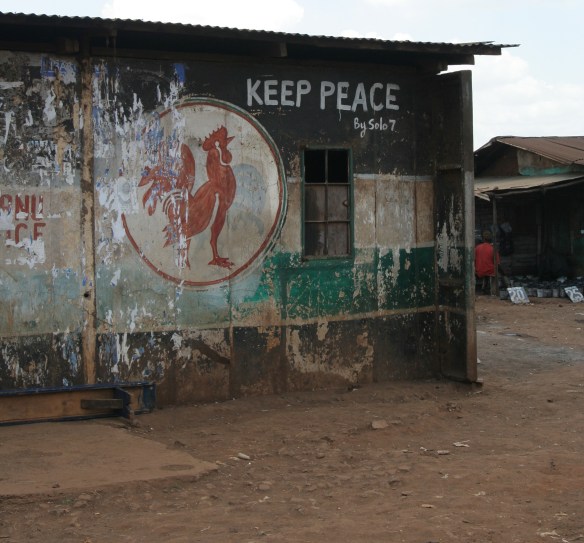
Old Party Office in Kibera

Kenya elections: State Dept declassifies memo of Jan 3, 2008 telecon between Secretary Rice and H.R. Javier Solana on “power sharing”

I originally sought this document in a separate FOIA in 2009 because it seemed to me in Nairobi in real time as Chief of Party for the USAID-funded exit poll and election observation programs that this Rice/Solana conversation marked a key  point for Kibaki in locking down a second term. Up until that time, as best I could tell, the EU supported remediation of the bad election (stolen through bribery as I was told by a diplomatic source later that January during the continued violence as I have written) whereas US Ambassador Ranneberger moved to support “power sharing” as soon as the initial U.S. congratulations to Kibaki were withdrawn.  That same day the Kenyan Attorney General called for an investigation of the alleged election results (such an investigation never in substance happened, although it was a key proviso of the February 2008 settlement agreement between Kibaki on behalf of PNU and Odinga on behalf of ODM and the legislation entering the deal into Kenyan law).

The document was withheld in full on national security grounds in the original 2010 FOIA response and again on appeal, then again in 2016 on a follow up Mandatory Declassification Review request after the requisite two year wait.  Today’s mail was the favorable response to my September 2016 appeal..

See from my page with a chronology of links for the election (in particular BBC’s January 3 “Tic-Toc”):

A CHRONOLOGY IN LINKS:

EA Standard–”Envoy predicts free and fair election” (and praises Kenyan administration on corruption), Dec 18 07

Daily Nation–”Local Firm Conducted Exit Poll Expected to Give Provisional Presidential Results”, Dec 28 07

Somaliland Times–”Kenya: Preliminary Findings of IRI’s International Election Observation Mission” Dec 28 ’07

IRI–“Reuters cites IRI Opinion on Kenyan election” Dec. 28 ’07 

EU Election Observation–Statement on Announcement of Presidential Results, Dec 30 ’07

VOA–”US Congratulates Kenya Presidential Vote Winner, EU Monitors Question Results” Dec 30, ’07

Global Voices–“Is Kenya turning into a police state?” Dec 31 07

Telegraph-“Kenya could be facing it’s greatest crisis” Dec 31 07

VOA–”Britain Expresses Concern About Kenyan Election Results” Dec 31 07

EU Election Observation–Preliminary Statement, Jan 1 08

NY Times–”Fighting Intensifies After Election in Kenya” Jan 1, ’08

Telegraph–EU calls for inquiry into Kenya election Jan 1 ’08

Slate–”What’s Really Going on in Kenya?” Jan 2, ’08

USAToday- “Kenyan official calls for vote probe” Jan 3, ’08

BBC- “At a glance: Kenya unrest” Jan 3, ’08

CBS/National Review Online–”Inside Kenya’s Clumsily Rigged Election” Jan 4, ’08

IFES–“Kenya at the crossroads” Jan 4, ’08

Candy and Communists for Kenya: as Kenyatta’s Jubilee “deepens” partnership with Communist Party of China, Mars’ Wrigley East Africa to sell “affordable Skittles”

“Affordable Skittlesfor the “kadogo market” as Wrigley offers may not quite match Kentucky Fried Chicken in Nairobi, but perhaps the biggest news since Burger King arrived?

And yes that event at State House celebrating the deeping partnership of Jubilee and the Communist Party of China yesterday has turned heads. I think a lot of Americans had not been aware of this relationship. Obviously it makes sense in carrying forward the spirit of KANU of Kenyatta and Moi and their understudies. Kenya always labeled itself a “democracy” whether one party rule was formal or informal. China, of course, is also “democratic” with numerous parties other than the Communist Party.

Caption from Presidential Communications operation: “Today we agreed to deepen our relationship with the The Communist Party of China in order to enhance Jubilee party management and democracy.” The Presidency

At a micro level I would take umbrage at the blatant use of State resources for Jubilee Party business, but since the Party was launched at State House in the first place and the donors supporting “Western-style” democracy and the “rule of law” and such were not willing to say “boo”–nor the IEBC nor the Office of the Registrar of Political Parties, there is never a reason to be surprised at this point. We reap as we sow.

ICYMI: An important read from Tristan McConnell in The Atlantic: A Deadly Election Season in Kenya – The Killings Suggest a State that is More Predator than Protector.

And here is the story from Moroccan World News of how the Chinese connected the African Unions computer servers at the Addis headquarters directly to Chinese servers in Shanghai.

Remembering Paul Muite’s open questions about the IEBC’s integrity before Kenya’s previous elections

Back in February 2013 The Africa Report ran a feature entitled “Can Kenya’s judiciary and election commission pull it off?” on readiness for the general election on that March 4. In a blog post from that April after the Supreme Court upheld the election I discussed Hon. Willie Mutunga’s “judicial philosophy” in the context of what he had had conveyed in that Africa Report just before the vote.

With this year’s Supreme Court decision annulling the August 8 presidential vote with Paul Muite, one of Kenya’s most prominent lawyers–and sometimes “Central Province” politician and official–representing the Election Commission (IEBC) I thought it was worthwhile to highlight his pre-election integrity concerns when he was not litigating:

There is, however, nervousness about how the IEBC will fare.

Led by Ahmed Issack Hassan, the IEBC has enjoyed public confidence since August 2010 when it ran the referendum on the new constitution.

It then held several by-elections with textbook efficiency.

But troubles began last year over a tender for biometric voter registration kits.

After anomalies were exposed, the government intervened and awarded the tender to France’s Safran Morpho at almost double the stipulated cost.

The delayed voter registration was com- pressed to one month instead of three.

James Oswago, the IEBC chief executive, says it is absolutely committed to transparency: “In fact, I am not aware of any public procurement officer who has referred a controversial process to the government for arbitration. I did. You have not heard anybody going to court for corruption linked to this process.”

Unlike the old Electoral Commission of Kenya, whose top officials were in the president’s gift, the IEBC has nine one-term commissioners including Oswago, who acts as secretary to the board.

Each commissioner was selected after consultations between President Kibaki and Prime Minister Odinga, the two main rivals in the 2007 election, and then vetted by parliament.

“We have in place structures that invalidate a discretionary announcement – a rigged vote. You can accuse the commission of inefficiency or of lateness and so on, but not of rigging,” Oswago says confidently.

INTEGRITY QUESTIONS

But Paul Muite, a lawyer who is contesting the presidency himself, does not share such certainty: “The IEBC is not inspiring confidence. I am not sure that they have the capacity or political will to conduct credible elections.

“There are integrity questions regarding some commissioners […] the composition of the commissioners was motivated not by merit but by the coalition government’s need for ethnic and regional balance.”

Similarly, a report by South Consulting, which has been monitoring the coalition government for the Panel of Eminent African Personalities led by former United Nations secretary general Kofi Annan, raised questions about the IEBC’s capacity.

It questioned its capacity to act decisively on electoral disputes and pointed to its inability to censure rogue parties and politicians during the chaotic party primaries in January.

In January, the IEBC vetted and registered eight presidential candidates, rejecting two on technical grounds.

Among those approved was Uhuru Kenyatta, although he was facing a local case challenging his candidature on integrity grounds.

The case is unlikely to be decided before the presidential elections.

It seems the IEBC did not want to prejudge it, so was happy to let the courts decide.

Pressure is certain to build on the new and inexperienced IEBC as elections approach and then again in likely second round elections.

The courts, determined to uphold their independence, will probably act as a buffer against violent street protests.

The police force, overstretched as it is and caught in a maelstrom of reform, resistance and warring political factions, may not.

Voters may find themselves caught between these two institutions●

Read the original article on Theafricareport.com : Can Kenya’s judiciary and electoral commission pull it off? | East & Horn Africa

Follow us: @theafricareport on Twitter | theafricareport on Facebook

Kenya 2017 – EU Election Observation Mission releases Final Report

The Kenyan Ambassador to the EU accuses the EU EOM of violating a Memorandum of Agreement with the Government of Kenya governing its observation by releasing its Final Report this week. (I have not had a response yet from a request for a copy of the MOU from the EOM or been able to otherwise locate a copy–it is likely routine.)

The report has a fair bit of information on the immediate mechanics of voting this year, while noting that few of the recommendations of the 2013 EUEOM had been met in preparation.

Of the 22 recommendations made by the 2013 EU EOM, it appears that none of the five priority recommendations have been implemented, and only two have been fully implemented (related to a unified voter register and defining the duration of the campaign). The rest have been partially implemented, albeit minimally in some cases, or not implemented at all.

I do not have any particular comment regarding the voting itself having elected not to be there myself.

While observing that the new IEBC was appointed unduly late, in a climate of mistrust, the report does not addresses the context or even mention the “Chickengate” convictions by the Courts of EU Member the UK for bribes paid for previous IIEC/IEBC procurements, or the Government of Kenya’s failure to prosecute the recipients, for example.

I will be interested to hear more on the thoughts of others who were there.

EU Election Observation Mission 2017 Final Report