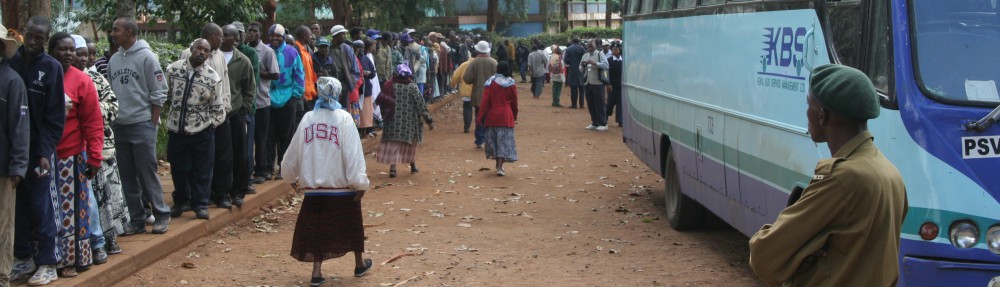
Raila leaves the race . . .

Raila Odinga Kenya president campaign

[Update: since I have not been actively writing here for several months, I may have been a bit hasty in offering here an assessment of Raila’s immediate legacy in current Kenyan politics upon hearing the news of his unfortunate passing from heart failure in India. Those who grew up with Raila’s role in opposing dictatorship through brutal detention and have stayed continuously emotionally engaged with Kenya over the years—especially Kenyans, who do not have the option of pulling back as I have as an American —will feel the weight of a mighty tree falling and the sudden change of light, landscape and horizon. In other words, this post may have been a bit “too soon” as well as superficial. I will endeavor to do more justice to Raila’s impact ahead after the initial memorials.]

[See also the eulogy and remembrance in The Kenya Times from former US Ambassador Michael Ranneberger who served through the 2006-07 campaign and election and PEV, the peace deal and the constitutional referendum under Government of National Unity during Kibaki’s second term. And Jeffrey Gettleman remembering Raila campaigning in 2007 to be denied by the blatant rigging.

Raila’s primary definitive legacy is Kenya’s 2010 Constitution, negotiated as a result of his 2007 campaign which I believe clearly garnered the most votes and led him to the temporary but critical post of Prime Minister for Kibaki’s second term from 2008-2013 as part of the February 28 peace deal between Raila and Kibaki.

The peace deal did not result in the fully formed power sharing contemplated but it was enough to get to a reform Constitution through the elite establishment gauntlet so long as the sole executive power of the presidency was retained (in other words, the Prime Minister position would go away). Devolution, the Supreme Court and many rights that we can hope will eventually come to fruition for Kenyans did result and have created real change.

For my explanation of Raila’s 2007 election, aside from many blog posts categorized and tagged accordingly, see my piece in The Elephant: “The Debacle of 2007: How Kenyan Politics Was Frozen and an Election Stolen With US Connivance.”

Raila’s other legacy is the enduring ODM party itself. The party unfortunately has been in jeopardy in recent years as being without a clear identity with Raila’s handshakes with first Uhuru Kenyatta, then William Ruto. Collaboration with Kenyatta had a clear rationale in achieving Kenyatta’s support for Raila and running mate Martha Karua, intending to stop a Ruto succession. The recent support for Ruto, however, heading into a 2027 re-election campaign, has been hard to square with the notions of the Orange Democratic Movement advertised over the years.

It has been awhile now since Raila was carrying the torch as a reformist leader himself and I will hope that this legacy can now come to greater fruition with younger generations, through a re-tooled ODM and new avenues to compete with ossified elite capture.

See from Africa Report, “Raila Odinga: the man who lost every election but won Kenya’s democracy.”


Condolences to the famiky and their many friends and supporters.

[Updated] Ruto term nears halfway point as USAID is strangled and Kenyan politics faces disruption from loss at Raila AUC vote Saturday

Update 2-15: Raila fell short to Djibouti’s candidate in the 7th round of voting.

If Raila Odinga doesn’t win his election for Chairman of the African Union Commission on Saturday then Ruto on one hand and the ODM Party on the other will have to face the question of how to repurpose Raila within Kenya’s political establishment. Will he return to the customary role as opposition presidential candidate? Will he and Ruto reach a deal on a new alternative role to keep him and his key loyalists “onside” with the Ruto presidency?

Is there any chance that he would take some “senior statesman” status within ODM and/or the opposition more broadly and not move toward a run for the Presidency in 2027?

What will be the impact of the demise of US democracy assistance, being cemented as this is written, have on the hugely delayed preparations for the 2027 elections?

Mzalendo reports today on claims that the Independent Electoral and Boundaries Commission—intended to be a permanent Government of Kenya institution under the 2010 Constitution—may have a selection panel in place by April of this year to start the process of selecting Commissioners. USAID has been the leading donor for process for decades.

See this piece from The Standard:

Addis setback, a political turning point for both opposition and government

He returns home empty handed, leaving his admirers divided and his detractors wary. There are those who want the Raila to take up his role of calling the government back to order.www.standardmedia.co.ke

Raila Odinga Kenya president campaign

A circle not an arc: Ruto and Biden re-enact Kenyan-American history with a reprise of the Kibaki-Bush State Dinner of 2003

Kenya 2007 PEV Make Peace Stop Violence

Before the exposure of the Anglo Leasing security sector corruption and other scandals Mwai Kibaki was in quite good books with the Bush Administration in Washington.

Kibaki’s 2002 election victory could be seen at the time as a feather in the cap for Bush’s “freedom agenda” in Africa. Kibaki was a core establishment insider who had served for 10 years as Daniel arap Moi’s vice president during Cold War era single party KANU rule, but had been democratically elected as titular head of a broad “opposition” coalition after the Bush Administration squeezed Moi to honor term limits and allow succession after 24 years and Moi chose his predecessor’s son Uhuru as his intended successor over more senior KANU leaders. (The best of both worlds for us Americans from a strictly diplomatic/foreign relations standpoint.)

Kibaki was used to dealing with the American government going back at least as far as arms purchases during the Gerald Ford Administration with Henry Kissinger as Secretary of State.

A lot has happened since October 2003, but not so much of it has been in Kenya. The biggest single change in Kenya has been population growth (with relatively flat human development). No big fluctuations on corruption or security, etc. and some worsening of an already challenging climate.

Ruto is another first term Kenyan president in very good books in Washington. An establishment protege of Daniel arap Moi who is seen as having had an oppositionist wrinkle to his 2022 election as President as the sitting incumbent Vice President by the fact that the outgoing incumbent President, his erstwhile running mate, Uhuru Kenyatta (also an American favorite while President and close to important Americans before taking office) tried to throw him over for his new “handshake” partner Raila Odinga.

Now, Ruto has a handshake deal of his own to back Odinga for the AU Commission chair as an alternative to domestic Kenyan opposition leadership.

The one big event in Kenya between 2003 and 2024 was Kibaki’s stolen 2007 re-election and the ensuing murder and mayhem as Kenya went “to the brink of civil war”. But as they say, “it’s been a minute”.

And since both the election fraud and the Post Election Violence successfully achieved their objectives it’s hard to find time to remember who was killing whom after so many years.

Externally, the current round of war in Somalia started a little more than two years after Kibaki’s 2003 State Dinner. The Second Kibaki Administration itself invaded Somalia in 2010 and 14 years later the beat goes on. And diplomatically we need Nairobi as a place from which to address any saving of Darfur and democratizing or at least stabilizing Southern/South Sudan as we did back in 2003. A new bonus is the chance to pay to get some of Kenya’s police force out of the country for awhile while also putting African boots on Haitian ground.

I guess the one word that I would choose to fit the Ruto-Biden State Dinner is “predictable”.

See “Disillusion grows in Kenya as Biden hosts Ruto for a historic state visit” in Semafor.

Book bitings: I read Ahmed Isaack Hassan’s memoir from his time at Kenya’s IIEC and IEBC and promised to engage.

I will do a series of posts here to accompany my agreement to engage with former Chairman Hassan after reading his memoir Referee of a Dirty Ugly Game: In the Theatre of Kenya’s Elections — an Insider’s Account. This is an introduction.

I learned a lot about the Chairman’s personal background, his family, his personal and professional networks, in particular involving his previous political service in unsuccessful constitutional reform endeavors in Mwai Kibaki’s first term, his law practice and work for the UN on Somalia. I learned his personal opinions about several politicians, and many actors in various positions in the Kenyan government and in the Kenyan social and business establishment.

I learned a lot about Ahmed Isaack Hassan, how he sees himself and wants to be seen.

Certainly Hassan has been presented by some who were involved with him in running, presenting and defending the 2013 election as a hero for getting through a process in which power was passed from Kibaki to Kenyatta and Ruto without Kenya “burning”. It is in this context a memoir of this sort fits.

To the extent that this was what Hassan was appointed to do then he did deliver and this is his chance to box his critics. Undoubtedly he was put “through the wringer” to an extreme degree and treated badly in various respects as so many people trying to fulfill positions of public trust are in Kenya and one has to have empathy for the impossible position. Thank God he wasn’t murdered like IT Director Chris Msando from the successor IEBC in 2017.

Unfortunately I did not learn as much as I hoped to about the questions that I raised in this blog and elsewhere about the specifics of the 2013 elections.

I learned that he had and has dismissive and negative opinions of organized civil society generally and people that I worked with to some extent and have liked and admired but I am not very clear why for the most part. Part of it may be that his deference as an insider himself to Kibaki and his establishment executive branch apparatus leads him to have little empathy for a role for outsiders. In particular he evinces no real concern for fraud in the 2007 presidential tally and no moral qualms – as opposed to concerns of international relations – implicated by the question of the participation of candidates in 2013 who were involved in the 2007-08 Post Election Violence.

In particular, the heavily redacted contract materials for IFES from the initial responses to my Freedom of Information Act requests several years ago were much more informative regarding some issues involved in the mechanics of the election and point the way to other sources.

This is the kind of thing that I would be grateful to engage on with the former Chairman.

Of course, ultimately there is a “glass half full or half empty” problem about the 2013 election that will not be fully reconcilable among Kenyans about their own democracy with their own perspectives and interests. On the other hand, for me as an outsider without a “dog in the hunt” directly it seems unequivocal that the glass is partly full of liquid and partly full of air and it is simply a matter of fact to identify what is what even though the significance and value derived from the facts will be a matter of individual judgment for Kenyans.

Sometimes people just have different values and priorities. But maybe 10 years after the fact there is more room for discourse and persuasion than there was in the heat of the struggle.

TO BE CONTINUED. . . .

In light of Kenya’s latest “handshake” here are my unpublished thoughts from the last one: “Is the BBI Report more about a legacy for Raila (and Jaramogi) in the context of the Kenyattas’ domination of power?”

[In light of the latest “Handshake” through which Kenyan President Ruto is supporting his erstwhile election rival Raila Odinga for Chairman of the African Union Commission there might be value in the historical context from this is previously unpublished post from December 2019 on the release of the Building Bridges Initiative report as an outcome of the March 2018 Uhuru-Raila “handshake”]
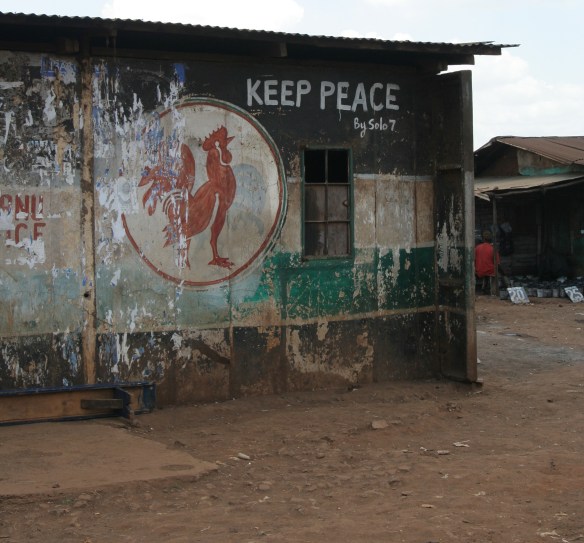
Old Party Office in Kibera

I have just finished finally reading Jaramogi Odinga’s Not Yet Uhuru. Months ago I had gotten started, got pulled away and came back to finish after the BBI report.

To understand how the BBI Report came to be full of small commonplace good ideas but so fundamentally “preservationist” of the basic order of things, perhaps we should see it as facing back rather than forward.

For the Kenyattas, in light of the selection of Jomo as the first leader, his success in consolidating power and gathering and brokering resources for the rest of his life, and the ultimate handoff through Moi to Uhuru following the potentially disruptive threat of the post PEV 2008 National Accord, the BBI Report offers the elevation of a retroactive “national ethos” as valedictory icing of the cake.

Three things imposed risk in the National Accord if you were the Kenyattas, in order of immediacy and gravity: 1) the risk of punishment of Uhuru under the agreement to pursue justice for conduct during the Post Election Violence, a risk shared with many others including Raila; 2) the risk of claims from prior conduct under the Truth Justice and Reconciliation Commission, in particular claims to disgorge assets or participate in land reform of some type; 3) the risk of dilution of power in the presidency creating general long term political risk.

The Supreme Court victory avoiding a runoff in the March 2013 election of the Uhuruto ticket terminated the first and second risks.

The third risk, unlike the first two, has involved a small measure of compromise and this is where Raila has delivered something lasting for Kenyans as a whole including those who have never voted for him.

The reform constitution of 2010 is a product of much work and struggle by many, not always in tandem, but would not exist without Raila’s role as the most popular opposition leader of the era. At the end of the day the unique form of devolution as it has come out of the 2010 constitution and its early evolution has created some real opportunity for governance separate from the power of State House.

On balance devolution provided a limited form of the majimbo that KADU sought before merging into KANU in the immediate post-independence, which KANU and Jaramogi originally saw as representing a collusive deal by some regional leaders and settlers to hold back from full liberation, but could also be seen as holding out from the national pot that was to ultimately be looted once power was consolidated by Jomo.

The office and role of Prime Minister under the National Accord in 2008-13 which gave Raila some poorly defined but not completely insubstantial power, on the other hand, “went away” behind the scenes at a Naivasha resort in 2010 as I have written about previously. It was the Prime Minister’s right of “consultation” that put previous opposition intellectual activist and leader Willy Mutunga on the bench as the first Chief Justice in return for withdrawing objection to a “usual suspect” to replace Amos Wako as Attorney General.

For Raila, his family and close supporters, with these accomplishments under their belts, the Building Bridges Initiative offers a seat in the shade under the tent while eating their slices of cake without the precariousness associated with two generations of being in opposition with no certainty of more than contingent freedom from detention, while going back in time to attend to a bit of the psychology at least of what Jaramogi was getting at in the 1950s and 60s.

Finally peace in the valley, even if the valley is quite small and the plains, hills and lakesides are full of millions of other Kenyans who were not around at the liberation. Those will have to find peace in their own way but what is new about that?

In the concluding part of his book, Jaramogi wrote, ” We are struggling to prevent Kenyans in black skins with vested interests from ruling as successors to the administrators of colonial days.” Obviously that struggle was unsuccessful.

Is that a good thing or a bad thing? It depends on where you sit and what your interests are. If you are one of or close to the successors of the prior administrators it is great and if you are not you may still have the satisfaction of looking around at statist Tanzania, tribal Somalia and revolutionary South Sudan and say that things could be worse. If you are in the Foreign and Commonwealth Office it is hard to argue with it on the basis of the interests you represent. If you are a diplomatic or commercial agent of the post-Tiananmen Chinese Communist Party at the very least it is the most convenient and compatible arrangement.

Regardless, it doesn’t do anyone any substantive good to simply pretend that the outcome was other than it was.

As for the younger generation and others who would wish for more and feel let down, let me reiterate that the honest recognition of where you are is not an impediment to improvement. No, the BBI Report in itself does not change much big, but why would you have ever thought it would?

The reality is that Uhuru was not going to have a level playing field for his and Ruto’s re-election in 2017 and why would he? Who was going to seriously insist and enforce the obligation to be “free and fair”. The Supreme Court had the courage to throw out the presidential vote because of the manifest misdoings in the administration of the KIEMS system, but Uhuru had no need to negotiate on the rerun and since there was never any proof brought forth by Raila that he “won” on August 8, 2017 had the tally not been maladministered he ended up being more rather than less on the defensive with the external democracies who were the only potential source of real leverage.

Raila is not a revolutionary general as opposed to a politician. He has a record as both a deal maker and a serious half-reformist. As opposed to who else in the political class? Arguably he has saved more space under the Uhuruto/Jubilee post-ICC dispensation than anyone could have expected.

If you are Kikuyu or Kalenjin especially and you wish for more change you might have voted for the opposition in 2013 instead of going with Uhuruto on tribal affinity and justifying it on the notion that things would improve because they were younger and bought a slicker more “youthful” seeming message. And since 2017 was part of the package in 2013, at the very least without a full accounting of the failed technology purchases which the Supreme Court order to be investigated but were not, the real question is what are you going to do now with time running to create the environment to have an election you can have trust in and good choices in 2022?

An Early Warning ignored: “it is possible to infer that a well-orchestrated plan was implemented to ensure a predetermined election result”

Struck me this week that 15 (!) years had gone by since the July and August release of the International Republican Institute Kenya 2007 Election Observation Mission final report and the Exit Poll following my family’s return to the US from my time in Kenya as Chief of Party on each of those USAID programs.

A quick catch up on-line generated a critical document that I had not noted previously. It is a report prepared by IFES for Open Society East Africa for submission to IREC, popularly known as the “Kreigler Commission” which was to investigate the failed election as a result of the February 28, 2008 “Peace Deal” and subsequent processes to implement the basic terms. The Commission reported privately to President Kibaki and then released a public report (see my key document links) that elided actual investigation of the ECK’s tally of the Presidential vote as such.

Lots of worthwhile material but here is key except, in context of US policy – as I was told by a “player” well after the fact – to back the result of the ECK full stop. Aside from the issue of such a policy making the USAID-funded IRI Election Observation Mission Program and the Exit Poll beside the point at best, it clarifies why the State Department should have known better than to have such a policy—and stick with it in being alone in initially congratulating Kibaki until the violence was raging (aside from the fact that Ambassador Ranneberger himself witnessed fraud in the central ECK tally operation with EU Chief Observation Delegate Lambsdorf as I have demonstrated through obtaining his January 2, 2008 cable to Washington through FOIA).

From “The Electoral Process in Kenya: A Review of Past Experience and Recommendations for Reform” IFES Final Report August 2008:

. . . .

Kenya 2007 election Kibaki Tena Kazi iendelee re-election

Early Warning Signs in Electoral Management

With the benefit of hindsight, it is possible to infer that a well-orchestrated plan was
implemented to ensure a predetermined election result:

a. President Kibaki’s decision to abrogate the IPPG agreement of 1997 on the
formula for appointments to the Electoral Commission ensured that all of the
Commissioners were appointed by him alone. The IPPG agreement had capped
the maximum number of Commissioners to 22 and reserved 10 seats to be filled
by persons appointed by the President after recommendations by opposition
parliamentary parties.

b. The allegations of questionable procedure in the appointment of returning
officers by Commissioners.

c. An offer from the International Foundation for Election Systems (IFES) to install a
computer program that would have enabled election officials in the
constituencies to submit results electronically to Nairobi and then on to a giant
screen available to the public, making it virtually impossible to change results,
was rejected.

d. The use of ECK staff in the Verification and Tallying Center was abandoned in
favor of casual staff recruited directly by the Commissioners.

e. The Commission refused to ensure that election officials in areas with large
predictable majorities for any of the candidates came from different areas so as
to reduce the likelihood of ballot stuffing.

Since opinion polls from the 2007 elections consistently indicated a very tight contest, the
neutrality of the ECK was always paramount, particularly in the event of a thin margin and a
too-close-to-call election. The new appointments made by President Kibaki to the ECK early in
2007 elicited protests from the opposition that he was fortifying the ECK with his supporters
despite the need for the electoral body to be perceived as fair and independent, a perception
crucial to political stability in a region where many political systems are unstable. Several actors
appealed to President Kibaki to consult the opposition prior to making appointments to the
Electoral Commission, with no perceptible effect.

These developments exacerbated problems within the ECK. Although the ECK had improved
substantially since 2002 in its ability to manage elections, the commission still clung to many
questionable practices. For example, votes were counted at the polling station without
transportation to a central tallying center, a process prone to abuse and manipulation by the
former regime. The unilateral appointments by the President meant that the ECK was now
perceived as subject to control, direction, and manipulation by the government.

Diplomatic engagement from Western Democracies stepped up on Kenya protests

The observation in my last post that diplomats in Nairobi and Western capitals were unusually quiet about the Azimio opposition protests and the Government response in Kenya has been somewhat overcome by events.

My sense is that with Ruto touring Western Europe and the Biden Administration running its Summit for Democracy and the Vice President Harris tour (Ghana, Tanzania and Zambia) and the U.S. hosting business investment promotions in Nairobi, there was a previously unusual desire to avoid getting sucked into Kenyan politics and rather to stay “on message”. The countries for whom democratization is somewhere in the mix diplomatically—in particular the United States—presumably hoped initially that opposition demonstrations would not generate a critical mass of disruption/instability to warrant official attention.

That did not turn out to be the case as neither the Kenya Kwanza Administration nor the Azimio opposition were willing to minimize provocation and escalation and were presumably playing to a global as well as local audience (as in the election last year and previous years). So now we have a variety of statements and comments from U.S. Ambassador Whitman and a formal joint statement from a raft of embassies of Western democracies in Nairobi as well as the dispatch of Delaware Senator Coons to engage the two Kenyan “sides” in “informal” diplomacy.

I am far removed at this point in my life from Washington diplomacy and bilateral international political engagement, so I will be uninformed about various things important within that circle, but I do not detect any deflection from the baseline U.S. Kenya policy as it was explained to me for the 2007 election after the fact: support the determination of the ECK/IIEC/IEBC.

In 2007 the “capture” at the ECK and accompanying malfeasance was too obvious and was called out after the voting by the EU and by other European democracies — and ECK Chairman Kivuitu publicly acknowledged his regret at being pressured to go along with certifying a Kibaki win. So the U.S. quickly pivoted withdraw congratulations to Kibaki, to declare the results as “unknowable” and to push a requirement for Kibaki to share power.

As I have explained here on this blog years ago and in The Elephant from my FOIA reviews, Ambassador Ranneberger’s cables to Washington before that 2007 election had argued that it would be “enormously damaging” for U.S. interests to “be forced” to acknowledge election fraud because of the magnitude of our relationship with Kenya, even though both Raila and Kibaki were “friends of the United States”. But part of the reason for the initial approach to “look and point the other way” at election fraud at the ECK was Ranneberger’s assessment (in his December 24, 2007 cable) the Courts were well understood to be corrupt:

14. As long as the electoral process is credible, the U.S.-Kenyan partnership will continue to grow and serve mutual interests regardless of who is elected. While Kibaki has a proven track record with us, Odinga is also a friend of the U.S. . . .

15. It is likely that the winner will schedule a quick inauguration (consistent with past practice) to bless the result and, potentially, to forestall any serious challenge to the results. There is no credible mechanism to challenge the results, hence likely recourse to the streets if the result is questionable. The courts are both inefficient and corrupt. Pronouncements by the Chairman of the Electoral Commission and observers, particularly from the U.S., will therefore have be [sic] crucial in helping shape the judgment of the Kenyan people. With an 87% approval rating in Kenya, our statements are closely watched and respected. I feel that we are well -prepared to meet this large responsibility and, in the process, to advance U.S. interests.” END

The one thing Kenyans as a whole—as opposed to the successful politician perpetrators—got out of the 2008 Post Election Violence was a partially reform-oriented 2010 Constitution that created the Supreme Court that changed the equation to challenge presidential vote tallies.

This time after 2022 it is sort of the opposite extreme from 2007—a general diplomatic unanimity that in spite of the actual closeness of the vote and an overt power struggle within the IEBC the conduct of the voting and results reporting were in substance greatly improved as well as upheld by the Supreme Court. Thus zero sympathy for the notion that Azimio and Raila in particular have any entitlement to relitigate on the streets after months of what can be seen from the outside Kenya as political stability and positive diplomatic interaction with the new Government.

My sense in 2017 was that there was a certain grudging admiration for the Opposition in winning at the Supreme Court (in the first round; a quorum could not hold against Executive pressure on considering terms of the re-run) on the basis of the IEBC irregularities, accompanied by some resentment for Raila’s claim that he had “actually” won, which was widely seen as dishonest and without substance, or at least a serious attempt at proof.

I think that any diplomatic support the Opposition can muster from the U.S. or European democracies will be based strictly on pragmatic immediate stability interests—diplomatically “we” do not care about Ruto’s past record and now see Raila as having spent his capital on being “the People’s President” in 2008 and on to the Handshake with Uhuru. Of course “we” would presumably prefer all other things being equal that Ruto bring Raila in for the same reasons that “we” supported the Building Bridges Initiative at conception but I am skeptical that official Washington will see it as necessary to strongarm Ruto or otherwise spend our own political capital on this.

I really don’t think it has a lot to do with Raila personally, one way or the other—I think if he was President we would flatter him the way we flatter Ruto, having no genuine or sincere misapprehensions about the character or track record of either man. Just as Trump and Biden were big “fans” of Uhuru as President of Kenya, the same status would have been enjoyed by Raila had he been certified by the IEBC.

I can see why this would be hard to swallow for Raila and his close confidants—“how does Kenya end up in the hands of someone like Ruto with Riggy G instead of us when we won in 2007 in the old system and finally made a preemptive deal with Uhuru for 2022 after the 2017 mess?”.

My personal answer to Raila would be that you let BBI turn into such a fiasco that you let Ruto, of all people, run as if he were “the opposition” while you ran as in effect the defender of much you had been in opposition to in the past. Yet you and Uhuru still failed to actually get any of the original “fixes” envisioned for BBI passed. You let the IEBC sit open without quorum without real protest. You should have known well that Ruto was more energetic, more wily and more ruthless than both Kibaki and Uhuru, with each of whom he aligned in facing corruption and ICC charges from the early days of the 2nd Kibaki Administration. In spite of all that it was an extremely close election, but you had the opportunity to win convincingly with a few better choices it seems to me. Regardless of all this, when you did not follow up to closely examine in public what happened at the ECK in 2007, or after the Supreme Court rulings in 2013 or in 2017, what is it you expect now?

“Seller Beware” – diplomatic community quiet on Kenya. No one outside Kenya believes Raila’s claims to having won a dominant majority in 2022; but all know that Ruto is corrupt and violent and that diplomatic credibility was undermined by attempts to sell previous bad elections.

Raila Odinga Kenya president campaign

A variety of openly extralegal gambits by the Ruto Administration to centralize and consolidate power, including waivers of corruption cases, accompanied by severe economic pain for the majority of Kenyans and fiscal crises sets the stage in which the Odinga led opposition has initiated debilitating protests against the “cost of living” and the conduct of the last elections.

Given that Kenya is more and more “the last man standing” as a potentially arguable multiparty democracy in all of East Africa, the expanded EAC, the Greater Horn or however one might define the region, you would think diplomats would be all over this situation if you had been listening over the past 15 years.

Instead, “crickets”.

Presumably that has at least something to do with the fact that both “sides” are so clearly in the wrong and generally unsavory, yet with real power through the paramilitarized police, illicit funds and “the street” that it is best not to risk being seen as saying anything that could be used by one side or the other.

Uhuru and Raila competed for Ruto’s hand as Deputy in 2012 – it would have been rational for Western diplomatic actors to support a Ruto-Uhuru wedding to inoculate against the type of PEV used in 1992, 1997 and 2007-08.

Did we do this? I really have no idea factually. Back in 2009 when I attended my first annual meeting of the African Studies Association, in nearby New Orleans that year, I was left with the notion after sitting at the knee of an up-and-coming “scholar/actor” that diplomatic players in the U.S. and/or the U.K. and whomever else might fairly obviously be expected to try to broker a pre-election Kalenjin-Kikuyu coalition.

UhuruRuto Kenya 2013 billboard Nairobi

At the time, the idea of helping put together Uhuru Kenyatta and William Ruto would have seemed improbably Machiavellian.

Again, as I said, no idea. But if I were to resume taking a look-see into the 2013 election following my initial FOIA request about the IFES program at the IEBC I would be interested to get into the pre-election period as well.


Kenya’s election was very close – would Raila have won with Ngilu instead of Karua as running mate?

Raila Odinga Kenya president campaign

The closeness of the election is somewhat obscured now by the “winner take all” nature of Kenya politics and the quick consolidation of power by Ruto, but it really was very tight under any view. No disrespect to Martha Karua intended because her choice did help revitalize Raila’s campaign when he had persistently trailed in the polls throughout and then moved ahead when she was tapped.

Nonetheless, all politics in Kenya is local/tribal and she was undoubtedly picked in part to try to offset Raila’s weakness versus Ruto in the core Kikuyu old Central Province, as well as a play for “good governance” support from the “international community” and civil society (which had adopted Karua for a variety of reasons in recent years in spite of her understood role as a Kibaki Kikuyu hardliner opposed to the peace deal and power sharing in the 2007-08 ECK and PEV crisis).

At the end of the day, I think Karua was respected but not highly popular, whereas Ngilu was less respected internationally, and perhaps among some parts of Kenya’s more intellectual class, but more popular as a politician.

One thing that I am guessing that happened is that Raila overestimated the practical value of going with a “Good Government” choice in terms of support from Washington and London, and otherwise from “the Western donors”, just as he overestimated the transferability of the support that Kenyatta had in those capitals to him. I think he just may have been behind the times on this: there were years when Ruto or a candidate with his profile would have drawn active criticism internationally for corruption but 2022 was just not such a year for a variety of reasons. Likewise people in Washington that considered Ruto “dangerous” as late as a couple of years ago because of his role in the PEV seem to have gotten over it once they saw him as the long-established frontrunner in the polls and BBI not catching on. I think many were unsure whether Kenyatta was really going to follow through on supporting Raila which made it that much easier to rationalize a Ruto presidency.

“On the ground” among Kenyan voters, Raila could not pull off running a traditional opposition anti-corruption oriented campaign after several years of the handshake and clearly counting on Kenyatta’s support. Too much cognitive dissonance, especially after getting beat in the Courts on a BBI that got larded up and bogged down to the point of becoming notably unpopular in its own right. On that front, the Karua pick seems to have proven too late and too out of step with the messaging from Raila’s other coalition heavyweights.

Given that he was behind in the polls and needed a spark, I do think choosing a woman made sense, but Ngilu as a more traditional Kenyan politician who was a current office holder and a long established vote getter from a “swing” region and ethnicity might have fit the bill quite a bit better. A more obvious choice to match up versus Mudavadi and Wetagula on Ruto’s side and a more congruous fit with the rest the established heavyweights on the Azimio team.