The recent feature “Stolen Ballot: Inside the bitter 2007 presidential election heist” from Kenya’s leading commercial television broadcaster NTV features some of the people directly involved in the logistics of delivering that announcement of “results” of the election by Electoral Commission of Kenya chairman Samuel Kivuitu through the state broadcaster KBC even though we have documented from my #FOIA research that Kivuitu had not wanted to do so. [Not that it wasn’t obvious on live television in Kenya in real time that Kivuitu was alarmed by what was going on with the submission of the results before the Minister of Internal Security John Michuki shut down live broadcasting.]
is the story of some of the people the late Kivuitu said “should not have been born” in his first press availability from his back yard during early stages of the Post Election Violence following the swearing in when he said that he did not know who had won in spite of making the announcement and providing the certificate for Kibaki’s twilight swearing in at State House.
It describes an operation from State House to strong arm Kivuitu with confessional testimony of some of those directly involved.
This dovetails with my previous reporting that I was told by a diplomat that his country had learned that Returning Agents had been paid “life changing amounts of money” to turn off their phones and drop out of contact with Kivuitu’s IEBC headquarters to allow the results in their constituencies to be “marked up” for Kibaki.
Last year Martha Karua, Kibaki’s Justice Minister during the 2007 election and leader of Kibaki’s mediation team during the failed mediation published her memoir “Against the Tide”revealing that during her visit to Kenya in support of the negotiations US Secretary of State Condoleezza Rice told Kibaki to his face that “You know Mr. President, you never won.”
To me, Daniel arap Moi in person seemed more like Raila (and I am guessing Uhuru, whom I never met). A more relaxed demeanor reflecting longevity in the game presumably. At that time, in July 2007, Moi seemed to be trying to stay relevant politically. (Shortly after I met him the deal was cut whereby Moi and KANU, led nominally by Uhuru, crossed over from leading “the official opposition” to supporting Kibaki’s re-election and Moi was appointed by Kibaki as Envoy to Sudan).
Ruto was conspicuously more telegenic and articulate. Thus his natural role in squaring off against Kibaki’s Justice Minister Martha Karua at the Electoral Commission (ECK) Headquarters on television at the Kenyatta International Conference Center (KICC) during the tally in the days following December 27, 2007 election (until the Kibaki Government through Interior Minister John Michuki shut off the live broadcasting). Even though Ruto wasn’t a lawyer.
The surprising thing to me when I introduced myself briefly to Ruto was how different he came across in person than on television. A person of much more intense physical presence than a typical politician like Moi or Raila, Kalonzo, Mudavadi or others I met.
This impression lends itself to a question: is Ruto a typical Kenyan politician, or is he a telegenic but more especially dangerous person who has simply been normalized by pundits and diplomats because he acquired power by virtue of a “coalition of accused kingpins of violence” with Uhuru Kenyatta during the failed ICC prosecutions for the 2007-08 Post Election Violence (PEV)?
Or was Ruto simply normal in his relation to political violence and wrongly tagged as more responsible than other Kalenjin politicians, such that the opportunistic political gain from being indicted by the ICC is just one more common facet of democratic competition. So that in the environment of total agreed impunity of the political class for the murder and mayhem of 2007-08 Ruto has simply the normal association with violence so that his qualities of telegenic articulation can be credited positively rather than treated with suspicion?
Or is it, to the contrary, plausible to see him as something something else entirely, a fresh candidate now, breaking the mold of Kenyan politics not by virtue of having been an especially dangerous protagonist of ethnic violence, but by becoming the first real reformist to win by moving Kenya beyond ethnicity on a platform of better economic policy? Or a fresh candidate breaking breaking the mold in some other way?
Some of this depends on whether one sees continuity between the actions and history of politicians from one campaign cycle to the next, or whether it is tacitly agreed that democracy means every candidate should get a clean slate to be whatever they want to be in each particular campaign.
(Note that none of these questions are intended to comment in any detail about other comparisons between Ruto and his rivals or examine the track record of those rivals, each of whom have their own controversies even if they are easier to group together more generally.)
[As the year winds down and things crank up in Kenya’s 2022 presidential campaign and BBI referendum I am going through some of my old unpublished drafts – this is an idea that could matter that the parties involved do not have an incentive to bring forward.]
To me, the answer to the headline question is clearly “yes”.
Very specifically to my experience as in Kenya in 2007 as International Republican Institute Resident East Africa Director, I was able to explain to the USAID Kenya Mission that we at IRI were bound as a party to a published International Code of Conduct in conducting an International Election Observation that required us to maintain independence from the Ambassador.
(Readers may recall that then-Ambassador Ranneberger had pushed for a USAID-funded IRI Election Observation Mission for Kenya’s 2007 election which USAID had decided not to conduct in their ordinary planning process for the election and that IRI did not seek to undertake.)
We on the IRI staff were able to push back on Ambassador Ranneberger’s desire to select Election Observation Mission delegates, although we ended up informally going along with Ranneberger’s choice of Connie Newman and Chester Crocker as lead delegates (Crocker was not available to travel on the dates required).
The rest of the delegates were our choices rather than the Ambassador’s and we resisted Ranneberger’s expressed desire to remove his predecessor Amb. Mark Bellamy from the Observation until Ranneberger “laid down a marker” as he put it.
Likewise, we invited against Ranneberger’s wishes Bellamy’s predecessor as Ambassador to Kenya, Johnnie Carson, who was then the Africa lead at the Office of the Director of National Intelligence and later Assistant Secretary of State under Obama (Carson was not cleared to participate–I was privately relieved for two reasons: it got me off the hook on a potential conflict with Ranneberger and while Carson seemed like a real asset for the Observation I thought the optics of having a high ranking Executive Branch employee and particularly one directly in an Intelligence Community job would not be great from an independence standpoint. In hindsight it might have done some real good to have him there.).
Unfortunately, on the now perhaps infamous Exit Poll, I was more or less naked in dealing with USAID and the Ambassador. The polling program was under a separate Cooperative Agreement between the CEPPS (IRI, NDI and IFES) and USAID which had started with the Exit Poll for the 2005 Constitutional Referendum. (The defeat of the proposed “Wako Draft” Constitution gave rise to the Orange Democratic Party which led Kenya’s opposition in the 2007, 2013 and 2017 elections, culminating in the March 2018 “handshake” and the present “Building Bridges Initiative” referendum campaign).
The 2005-07 polling program was scheduled to end with a public opinion survey in September 2007, well ahead of the general election, the date of which was not set until weeks later. USAID amended the Agreement to add the general election Exit Poll at the end. It was only after I initially reported a few days before the election that we were going to have to cancel the Exit Poll due to the objection of Electoral Commission of Kenya Chairman Samuel Kivuitu that I was told by USAID that the Exit Poll as a higher priority for the Ambassador than the Election Observation itself. Kivuitu’s acquiescence was achieved.
On the late afternoon of Election Day as I was dragging my feet on releasing preliminary numbers before the polls closed I was told that “the whole reason” for doing the Exit Poll was for “early intelligence” for the Ambassador and USAID went to our subcontracted polling firm to get the figures. [Remember that I covered all this in complaints to the Inspectors General at USAID and State.]
IRI had no established backstop to protect itself from interference on the Exit Poll because unlike on the Election Observation Mission there was no published Code or Agreement that I could use to push back to preserve our independence.
We had agreed internally at IRI that we should not report any Exit Poll numbers externally including to USAID or the Embassy until the polls closed, and it was quite clear that we had no contractual obligation to make a report during the vote. But given that USAID was willing to go underneath us to the pollster it was out of our hands literally and there were no clear standards beyond that.
The US Government ultimately had rights to our data as a matter of government contracts law and USAID had arguably and ambiguously constrained our ability to release the Exit Poll results to the public in the Amendment to the Cooperative Agreement funding the Exit Poll by providing for “consultation” with the Embassy on “diplomatic or other” considerations. The Cooperative Agreement for the Program was neither classified nor available publicly until I had it released under the Freedom of Information Act years later. The Exit Poll from the 2005 Referendum had been released.
Fortunately we have not seen another disaster quite like Kenya 2007-08, but the questions about transparency and release and reporting of information from election verification and anti-fraud tools are still there. For instance in the most recent elections in the DRC and Malawi, as well as the controversy in Kenya in 2013. This could be addressed by pre-established standards or codes if donors, host governments and democracy assistance organizations or implementers are willing to give up some of their case-by-case flexibility and frankly some of the power of controlling information.
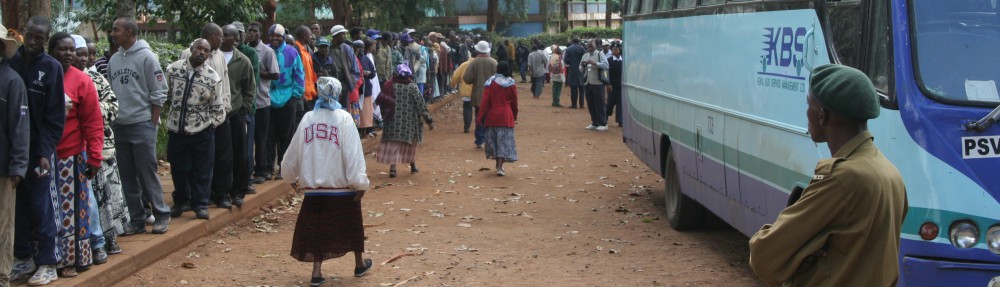
Following the transfer of the ballot boxes, it was reported that in some areas constituency-level officials from the Electoral Commission of Kenya (ECK) turned off their cells phones, and many suspected these officials of manipulating the results of the presidential poll. In addition, the ECK in Nairobi refused to allow observers into tallying areas throughout the final process, and the government instituted a media blackout until the sudden announcement of President Kibaki as the winner of the poll, which furthered suspicions of malfeasance.
Although IRI’s observation mission consisted of only short-term observers who were unable to be present through all of the vote- tallying at the constituency level, IRI has reason to believe that electoral fraud took place and condemns that fraud. The rigging and falsifying of official documentation constitutes a betrayal of the majority of the Kenyan people who peacefully and patiently waited in long lines to vote on December 27.
The Institute also condemns the tragic loss of life and property that characterized the post-election period. It has been estimated that the violence claimed more than 1,500 lives, displaced close to 600,000 people and caused millions of dollars in property destruction and lost revenue and wages.1 At the time of printing this report the mediation efforts have led to a tentative power- sharing deal, but it remains to be seen if the government will in fact honor the agreement signed by President Mwai Kibaki and Raila Odinga on February 28, 2008 (emphasis added).
8. I think it is important to look at the exit poll situation in the context of IRI’s Election Observation Mission Final Report which has now been published as a printed booklet (they FedEx’d me a copy with a cover letter from Lorne in mid-July). The report, which I had the opportunity to provide input on, working with my staff in Nairobi on early drafting and through later editorial input on into April when I was doing follow-up work such as the internal exit poll memo of 4-20 that I sent you, is very explicit that IRI found that “after the polls closed and individual polling stations turned over their results to constituency-level returning centers, the electoral process ceased to be credible”. Likewise, the report states that “To date, there has been no explanation from the ECK as to exactly how or when it determined the final election totals, or how and when that determination was conveyed to President Kibaki to prepare for the inauguration.” The report also notes “. . . the obvious fraud that took place during the tallying of the presidential race . . . ” The Executive Summary states: ” . . . IRI has reason to believe that electoral fraud took place and condemns that fraud. The rigging and falsifying of official documentation constitutes a betrayal of the majority of the Kenyan people who peacefully and patiently waited in long lines to vote on December 27.”
CEPPS stands for the the Consortium for Elections and Political Process Strengthening; the members are the International Republican Institute (IRI), the National Democratic Institute (NDI) and the International Foundation for Election Systems (IFES).
While I have no idea why this has evolved in recent times, I will note that building up CEPPS as an “entity” with its own brand could be seen from outside as a way to establish an alternative structure directly tied to USAID in competition with funding for democracy assistance through the National Endowment for Democracy (NED).
IRI and NDI are two of four core NED institutions. IRI and NDI were incorporated by the leaders of the Republican and Democratic National Committees respectively, pursuant to the legislation establishing the National Endowment for Democracy as private organization, with a bipartisan board and Congressionally-appropriated funding and subject to the Freedom of Information Act. (The other two NED core institutions are the Center for International Private Enterprise [CIPE] affiliated with the United States Chamber of Commerce and the Solidarity Center affiliated with the American Federation of Labor-Congress of Industrial Organizations or AFL-CIO.)
IFES, on the other hand, which the branding material describes as a “core institution” of CEPPS, borrowing the NED terminology for the consortium members, is a more explicitly “private” entity created in 1987, four years later in than NED, during the second Reagan Administration, at the instance of then-USAID Director Peter McPherson as he describes in a 2017 interview on the IFES website. McPherson went to a American political campaign manager with a “bipartisan tone,” Cliff White (known publicly primarily for his role as Barry Goldwater’s 1964 campaign manager) to found the nonprofit because among the contractors USAID used there was a lack of technical expertise on the mechanics of organizing and holding elections. USAID provided an initial grant but IFES is not part of the Congressional mandate and annual budget appropriation process of NED and its four “core institutions” including IRI and NDI.
Readers will remember that IFES is a nonprofit corporation (like IRI and NDI) and was registered as such with the Kenyan government when President Kenyatta and his party leaders and government officials attacked IFES for not being registered as an “NGO” in late 2016 and early 2017 and allegedly being too cooperative with the opposition while managing the USAID election assistance and supporting the Independent Electoral and Boundaries Commission. Of course since IFES had been working on the same basis in essentially the same role with ECK since 2001 under Samuel Kivuitu’s Chairmanship and the IIEC and then IEBC under Issack Hassan, I saw this as pre-election “muscle flexing” by the incumbent President Kenyatta and his coalition directed at both the new Chebukati-led Independent Commission taking office in January to replace Hassan’s group after opposition protests and at IFES. The democracy donor diplomatic group led by US Ambassador Godec pushed back but Kenyatta’s Administration used its control of Immigration to force out the IFES Country Director and another key IFES employee. An outside replacement Country Director was “parachuted in” mid-March for the August 8 election.
CEPPS was founded in 1995 by the National Democratic Institute (NDI), the International Republican Institute (IRI), and the International Foundation for Electoral Systems (IFES), and holds a global Leader with Associate assistance award with the DRG Center to implement a variety of DRG activities, including political party assistance programs.
According to USAID officials, CEPPS received a series of global assistance awards from USAID for 1995 through 2020, which helped CEPPS partners develop a capacity to deliver political party assistance programming and establish a global footprint with a presence in every region in which USAID operates. The current global assistance mechanism was awarded in 2015 (a cooperative agreement) and provides missions the option to offer funding opportunities directly to CEPPS rather than develop a notice of funding opportunity locally.
Agency mission and headquarters personnel reported that, overall, CEPPS partners have excellent technical leadership and organizational experience to work collaboratively with host-country political leaders. CEPPS partners have developed strong work relationships with local stakeholders in many countries and are acknowledged as global leaders in the DRG sector. For example, in Ukraine, mission officials praised the NDI, IRI, and IFES Chiefs of Party as outstanding leaders who are highly accomplished and respected in their areas of expertise. They noted that the technical skills and positive reputations of these individuals are an asset for the mission and its DRG portfolio.
However, Agency officials also noted that missions often default to working with CEPPS partners through USAID’s global assistance award with the DRG Center—instead of pursuing opportunities to partner with other organizations that can provide similar services. Relying on CEPPS gives significant influence to a small group of partners to implement political party assistance programs and increases USAID’s reputational risk. Specific concerns reported to us by USAID officials include:
• NDI, IRI, and IFES have significant political connections and powerful benefactors on their boards of directors, including sitting Members of the U.S. Congress, former Ambassadors, and other political appointees. NDI and IRI in particular could be perceived as extensions of the U.S. Democratic and Republican Parties, respectively, by host-country stakeholders. For example, NDI’s website acknowledges that it has a “loose affiliation” with the U.S. Democratic Party and IRI’s current Chairman is a U.S. Senator in the Republican Party.
• In Georgia, CEPPS attempted to exclude a host-country democratic political party. In a 2017 letter to USAID/Georgia written on behalf of NDI and IRI, CEPPS stated that it would temporarily suspend assistance to a Georgian political party because of media reports of derogatory remarks made by party leaders about CEPPS partner staff, along with CEPPS’s disagreement with the party’s political platform and rhetoric. The mission responded to CEPPS’s letter by directing NDI and IRI to continue delivering assistance to the Georgian political party in compliance with USAID’s Political Party Assistance Policy.
When Wikileaks first published the mass of stolen State Department cables in late 2010 while Michael Ranneberger was Ambassador to Kenya The Star to my recollection did not write any stories from them–including about this 2009 cable, classified SECRET, on the Amos Wako issues. Of course it was more timely then and Wako was still serving as Attorney General.
The Star and The Standard both stayed away from direct coverage of material from the leaked cables, while The Nation did a small number of Kenya stories–not including this Wako subject matter–before quickly backing off.
The most topical of those for me back in 2011 was a Nation story revealing that in early 2008 the US had issued undisclosed (and unknown to me) visa bans against three members of the Electoral Commission of Kenya based on substantial evidence of bribery. The State Department has never to this day acknowledged knowing about the bribery at the ECK in the 2007 election and the publication of such stories in the Nation quickly dried up. (I was told of ECK bribery by another diplomatic source in January 2008.)
Back in the States in my job in the defense industry (with my security clearance) I was told by a friend in the Kenyan media that I had been “sweetly vindicated” on my public contradictions with the Ambassador in the New York Times and otherwise about the 2007 election but the “Wikileaked” cables were not available to me due to the obligations of my security clearance. Readers of this blog will know that I started the process of requesting related information through the Freedom of Information Act in 2009, more than a year before Wikileaks hit, and that I have received released versions of some of the same Cables that Wikileaks published unredacted.
I learned in real time that Ranneberger expressed active displeasure with The Star for publishing a story in February 2008 on the leaked USAID/International Republican Institute exit poll showing an opposition (Odinga) win in the December 2007 election, so I always assumed that it was likely that the Kenyan newspapers received diplomatic encouragement not to publish independently from the stolen cables.
Clearly the Trump Administration has had quite a very different approach with Wikileaks than the Obama Administration did back in 2010 and Ranneberger is now retired from Government himself and working as a consultant and lobbyist looking, among other things, to influence the Trump Administration. So lots of things have changed aside from Wako moving to the Senate from the Attorney General’s office and having a leading role in the current Building Bridges Initiative.
[I will add links to my previous posts, but wanted to go ahead and get this up.]
The quest for accountability to Kenyan voters has remained unanswered sadly. A news story in theDaily Nation in 2011, in the final item on my chronology of links to coverage of the Kenyan election, reports from an alleged leaked cable that ten days before this February 18, 2008 meeting at the Ambassador’s residence, the State Department issued “visa bans” against ECK members based on evidence regarding bribery–but did not disclose this circumstance, or the evidence, at this [Feb 18] meeting (I checked with a participant). We, the United States, made clear that we were willing to step up financial and rhetorical support for reforms in Kenya–such as the new constitution–under a deal in which the new Kibaki administration shared power with the opposition under an Kofi Annan-brokered bargain–but we brushed aside the issue of the fraud in the election.
Recent news finds the successful Goldenburg scam architect Kamlish Pattni obtaining a court judgement for additional funds from the Government relating to incompetent prosecution endeavors against him. Also we read this week that more than Switzerland have been holding frozen funds related to the Anglo Leasing scandal which have not been released to Kenya.
The previous visa ban on Wako under U.S. Presidential Proclamation 7750 of 2004, was legally confidential, but was announced by then-Ambassador Michael Ranneberger in a Tweet in November 2009. Wako publicly acknowledged the ban for alleged failure to cooperate with reforms in the wake of the Post Election Violance following the 2007 election and announced he would sue to have it lifted. It is unclear when that ban was lifted, although it must have been a some point. As of December 2015 then-Ambassador Robert Godec told The Standard that there were several Kenyans barred from the US under Presidential Proclamation 7750.
In early 2008, according to a Daily Nation report said to be from Wikileaks, the US banned three Kenyan member of the Electoral Commission of Kenya based on evidence of bribery, but the US has never made any type of disclosure of that action or the underlying Election Commission bribery issue although I was told separately of ECK bribery by non-US diplomatic sources in the course of my work for the International Republican Institute during the Post Election Violence.
Reviewing the 1992 Election Observation Report from the International Republican Institute for my last post I noted that Attorney General Wako was accused by IRI of being “responsible for egregious pre-election irregularities related to the election framework” along with many of the District Commissioners.
“Former Kass FM presenter Joshua Sang is set to make a comeback to the airwaves after landing a job at Emoo FM, a station owned by Mediamax Network Ltd.
Even though both the Kenyatta family and Ruto hold substantial stakes in the DMS Place-headquartered Mediamax Network – sources claim Ruto is the hitherto biggest shareholder even as he aims to consolidate media support around his 2022 ambitions.”
In a series of preliminary statements crafted by the team and released by the State Department on Jan. 3, 10, and 16—before confirmation of the final results—the United States sharply condemned reports of election-related interference and violence. The Jan. 3statementincluded a threat that people involved “may find themselves not welcome in the United States and cut off from the U.S. financial system.”
With the Constitutional Court’s decision to confirm the election later in the month and with news of widespread election fraud, the group drafted a new U.S. response on Jan. 23. It noted the election results rather than welcoming them—a diplomatic way of signaling displeasure—and condemned the “deeply flawed and troubling” election, according to a draft reviewed by FP. It also stated that Congo’s electoral commission “failed to live up to the responsibility” it had to carry out elections fairly and ivowed that the United States would “hold accountable” any figures engaged in election fixing or violent crackdowns on any ensuing protests.
But none of this language made it into the final statement. Instead, Washington welcomed the results and declared itself committed to working with Tshisekedi. The revised statement made only passing mention to “electoral irregularities.”
Michael Hammer, the U.S. ambassador to Congo, along with Michael McKinley, a senior career diplomat advising Secretary of State Mike Pompeo, pushed for the revised statement, according to three U.S. officials. The department’s third-ranking official, David Hale, ultimately signed off on it, the officials said.
Senior U.S. officials in other agencies and some State Department officials—including the special envoy for the region, Pham—were kept out of the final decision entirely and did not know that a shift in policy was in the works, officials toldFP. They said some officials found out about the shift in policy only once the statement came out. It left some of them fuming.
“If we said we’ll hold the government accountable … and five days later we congratulate a bunch of thieves, what good are our threats?” one senior U.S. official said.
One former State Department official familiar with the process said the implications went beyond Congo. “It was just a stupid decision to release that statement, a statement that has much bigger bearing on U.S. government democracy promotion in Africa,” the former official said.
The State Department, USAID, and NSC all declined to comment for this story. A State Department spokesperson also did not respond to a request to interview the senior diplomats whoFPwas told were involved in the process. . . . .
This is the kind of thing I always had hoped to see about Kenya 2007 where the U.S. initially relied on what my FOIA research indicates was a pre-determined blessing of Kibaki’s alleged re-election even after Ambassador Ranneberger witnessed vote totals being changed by the Kibaki-controlled Electoral Commission of Kenya and reported some pre-knowledge of unlawful rigging plans and conduct. In the face of violence the initial congratulations were withdrawn and the State Department pivoted to support a negotiation to include the opposition in a sharing of power with Kibaki. I know that there were differing internal opinions but I have never seen this level of public reporting on the internal debate.
Some of this may reflect differences in the internal environment and reporters’ expectations and aspirations during the Bush and Trump administrations as well as “the times” more generally. Regardless, I am glad to know more about how my government made this decision and encouraged that the problems with the positive statement final statement on the were recognized by some of those involved.
On the Congressional side, here is the January 18 Statement from the incoming Republican Ranking Member on the Foreign Affairs Committee:
Washington D.C. –House Foreign Affairs Committee lead Republican Michael McCaul (R-TX) released the following statement on the fraudulent election in the Democratic Republic of Congo (DRC).
“After eighteen years of the Kabila regime, the Democratic Republic of the Congo had a historic opportunity to give its people a voice by holding free and fair elections. Millions of Congolese bravely went to the polls to cast their vote amid long lines, intimidation and violence. Unfortunately, the fraudulent vote count does not demonstrate the will of the people.
“I commend the African Union’s call for transparency and credible election results. All parties must refrain from violence as this process continues. It’s imperative for the United States and the rest of the world to stand with the Congolese people to demand an accurate vote tally and I urge Secretary Pompeo to fully engage at this pivotal moment. All individuals who impede this democratic process must be held accountable.”
A breakthrough on unraveling the story of Kenya’s stolen 2007 election:
This is from my original 2009 Freedom of Information Act request to the State Department for documents related to the 2007 Kenya exit poll I managed as Chief of Party for the International Republican Institute’s USAID funded polling program.
At that time State withheld one document in full on the basis of “predecisional privilege”; I eventually got that document released on appeal, and heard no more.
Yesterday, I checked in with the State Department FOIA web library to see if there was anything new on Kenya from other requesters and my search showed that an additional document had been published online in 2017, unbeknownst to me, in response to my 2009 request. It is an April 24, 2007 cable titled “Achieving USG Goals in Kenya’s Election” over the signature of Ambassador Ranneberger to the Secretary of State for the Africa Bureau and the Bureau of Intelligence and Research (INR) in Washington. “Sensitive But Unclassified” and released with no redaction. No explanation as to why this document, which pre-dates all of the others released or identified to me in 2013, was published online on April 18, 2017; if it was mailed to me at some point I did not receive it. Nonetheless, I am glad to finally have it (although I wish I had known about it when I published my June 2017 summary story on “The Debacle of 2007“ for The Elephant).
The big significance of the cable for me is that it documents that the State Department had in fact changed its approach toward Kibaki and toward the opposition between 2005 and April 2007. This was my perception “on the ground” during the campaign, but I had no explicit documentation until now. It also confirms that as of April, the plan was for a diplomatic observation of the election by State Department personnel only and not an International Observation Mission by the Carter Center as recommended by a 2006 USAID evaluation (referenced in the cable) or by IRI as initiated at the behest of the Ambassador that summer.
Likewise, the cable includes one more recitation that the purpose of the exit poll, formally, was to deter and oppose election fraud through an “independent verification of election results”, not to be “a training exercise never intended to be released” as asserted by Ambassador Ranneberger on a State Department webchat in March 2008 after the quashed but leaked poll had become a “hot potato”, and supported in State Department talking points prepared and circulated in response to media reporting in 2008 and 2009.
Unfortunately for me, when I took over the USAID polling program for IRI in June 2007, the program was operating under a Cooperative Agreement from 2005 that expressed the old policy of being disappointed in the corruption and underperformance within the Kenyan government as reflected in the Anglo Leasing security procurement frauds, the Standard Raid and Artur Brothers, etc. No one at USAID or IRI intimated that the State Department had changed policy and I had to figure it out for myself on the fly.
Here are key excerpts from the cable as published:
3. (SBU) Positioning: Some civil society leaders and opposition members of Parliament have complained recently that the U.S. mission is not close enough to the opposition. In fact, we have close contacts with the opposition from the top levels through the Ambassador to to all levels. However, the opposition longs for the days in 2005 when Foreign Minister Tuju publicly condemned the U.S. mission for supposedly desiring “regime change” in Kenya. They also cite the period in the 1990s when the U.S. mission openly sided against the Moi administration in favor of the multiparty democracy movement. However, the present government, for all its flaws, was elected under conditions widely considered free and fair. As for its indulgence of corrupt members of the political class, we note that the opposition has taken no disciplinary action against notoriously corrupt members within its own ranks. Corruption plagues the entire political class. We will continue to publicly condemn it as a major impediment to Kenya’s progress. We will continue to work closely with the Kibaki administration to achieve USG goals, but we will continue to assert ourselves as completely neutral concerning the election itself. Our strategy is to build capital with the government to be spent as needed over the course of the campaign to address critical electoral issues. We started that process through emphasis on the U.S.-Kenya partnership (reftel B). While we will be strictly neutral among the contending political parties, we will be fiercely partisan in support of the democratic process.
. . . .
8. (SBU) Electoral Reform: As reported in reftel B, electoral reform continues to be a hotly debated topic in Kenya. There is a consensus among all political parties and civil society that reform is required. There are no prominent defenders of the status quo. However, there is no consensus on the scope of reforms and the particulars of those reforms. Since the 2002 general election and the 2005 referendum on the draft constitution were both held under the present electoral system and were deemed free and fair, and since Kenyan society is adequately debating electoral reform, we see no reason for the USG to enter the fray. However, we have urged on all parties a spirit of compromise and an emphasis on the longterm best interests of the nation rather than short term electoral advantage. An opposition leader recently threatened a boycott of elections if his party’s electoral reform demands are not met. We made it clear to him that such intemperate language is not constructive and that boycotts are not acceptable. He stopped issuing boycott threats.
. . . .
– Public Opinion Polling: The International Republican Institute began implementing a public opinion program in 2005. The program seeks to achieve two results: increasing the availability of objective and reliable polling data; and providing an independent source of verification of electoral outcomes via exit polls. These results make an important contribution to elections and political processes. First, genuine free and fair elections require that citizens make informed choices. The polling data adds to the objective data available to citizens on key electoral issues. Second, the exit polls provide an independent assessment of the accuracy of the official electoral results, thereby supporting the assessment of the credibility of Kenyan electoral processes.
This program also enhances democratic political parties by enhancing the likelihood that candidates base their platforms on the key issues and concerns of their constituents, evidenced in the polling data, rather than the traditional focus on ethnicity and personalized political wrangling.
I will discuss the context and layers of meaning in this “new old” cable more in the near future.


 A breakthrough on unraveling the story of Kenya’s stolen 2007 election: