Always “steady progress” – COMESA “elders” to observe COMESA member elections in Kenya and Rwanda

From a COMESA Press Release yesterday:

COMESA believes that elections play a pivotal role in societal transformation in the region and provide a footstall for entrenching democratic principles.

Premised on this critical role, Member States have continued holding periodic elections which have heralded a new dawn by signifying steady progress towards deepening and institutionalizing democracy in the 19-member bloc.

Nonetheless, COMESA is still dispatching teams of Election Observers to issue Preliminary Statements just after the upcoming elections in Rwanda on August 4 and Kenya on August 8, with further reports after 90 days.

Zimbabwean Ambassador Dr. Simbi Mubako will lead the team for Kenya to arrive 30 July.

Think I am too jaded?  Enjoy this:

The presidential elections in Rwanda follows the 2015 referendum that unanimously approved a constitutional amendment that allowed President Kagame to run for office in 2017.  The forthcoming elections are considered important in Rwanda’s socio-economic and political progress.

In the past years, Rwanda has made significant progress in consolidating its political stability, economic growth and development.  Furthermore, Rwanda has recorded major milestones in consolidating democracy through holding periodic parliamentary and presidential elections as stipulated in its legal framework.

Since 2008, COMESA has continued to support the elections process in Rwanda.  COMESA observed the parliamentary that were held in 2008, 2013 and the presidential elections held in 2010.

I am all for extra diplomats and elders from the region being in Kenya for the election to meet diplomatic needs that may arise.  But let’s not confuse this type of “intramembership” diplomatic obsevation with an independent election observation. 

[See U.S. and IGAD Statements on Djibouti election from last year, featuring Kenya’s Issack Hassan for IGAD]

Kenya vote: target turns from “will of the people” to “free and fair, peaceful and credible” to “fair, orderly, credible and nonviolent”

Old KANU Office

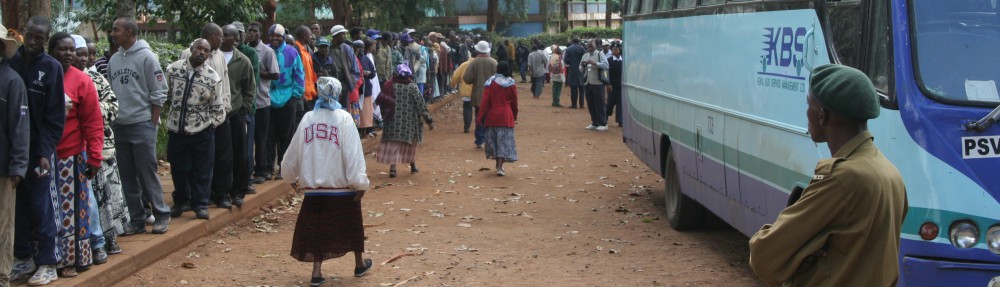
Solo 7–Kibera

In the 2013 Kenyan election John Kerry was the American Secretary of State, speaking to Kenya’s elections that year in his role as lead American diplomat.  The U.S. provided key funding as well as embedded technical support for the IEBC in that election, including funding for the failed procurement of an electronic results transmission system.

It was suggested that the election, in spite of a certain disarray and incomplete results, reflected “the will” of Kenyan voters–and was subsequently upheld by Kenya’s Supreme Court (with preliminary observer statements from the Carter Center and EU as evidence offered by the IEBC in litigating against the challenges).

Likewise as Secretary of State Kerry addressed Kenya’s 2017 elections during his official visits in 2015 and 2016.  The second quote above, “free and fair, peaceful and credible”, comes from Secretary Kerry in Kenya last year.  The new terminology for the 2017 vote, “fair, orderly, credible and nonviolent”, comes now from former Secretary Kerry, wearing a new hat as co-leader of the independent International Election Observation Mission being conducted by the U.S. based NGO, The Carter Center. (See Daily Nation 14 July “Ex-Secretary of State insists on fair election“)

Over the years I have written and noted the potential distinctions involved in the decision of international observers to suggest that a particular election “reflected” or corresponded to a standard labeled “the will of the people” on one hand, and on the other to label an election “free and fair.”

An overview and “gateway” is my post “An insider’s explanation of the difference between a ‘free and fair’ election and a ‘will of the people’ election — Kriegler deputy’s memoir“.   The issue is discussed in relation to the internationally supported South African election of 1994 discussed in the recent memoir referred, and on into 2007 and 2013 in Kenya, with Kreigler and IFES re-engaged in a different context.

See especially my post “Are free and fair elections passe in Kenya?“.

The most important point for Kenyans is that the 2010 Constitution adopts explicitly as law a “free and fair” standard.  Peace, order and nonviolence are good and important societal goals.  Many of us are skeptical that tolerating corruption or other substandard conduct in administration of elections is somehow a useful tool to serve peace, order or nonviolence (just as war, disorder and violence do not clean up the election process).

“THE DEBACLE OF 2007” – my piece in The Elephant on how Kenya’s politics was frozen and an election stolen . . .

THE DEBACLE OF 2007: How Kenyan Politics Was Frozen and an Election Stolen with US Connivance | The Elephant

Election Violence threat in Kenya — my thoughts on NDI’s new warning 


1. NDI is right to warn of a risk of violence, highlighting the unprecedented level of division and tension in Kenya related to the competition for power in this election scheduled for August.

2.  Given that the Kenyan Government is led by politicians widely understood to have been major players in the killing and mayhem following the failure of the 2007 election — elevated to office on the basis of their status as tribal champions indicted by the ICC — #1 can hardly be any surprise.

3.  Further, the “reform agenda” intended to address the catastrophe of 2007-08 has long been diverted and shelved.  Zero accountability across the board for the previous election violence.  The Truth, Justice and Reconciliation Commission report was interfered with by the Executive, then shelved with so many other accumulated Kenyan commission reports gathering dust.  No accountability for the bribery of Election Commission members and officers in 2007 (in fact, a cover up), followed by impunity in the buyout of the IEBC last year after Chickengate and the failures of 2013.

4.  The main reform was the passage of the new Constitution of 2010, but in the hands of anti-reform politicians under no serious further international pressure, the main change is more offices to potentially fight over.  There has been some strengthening of some institutions and backsliding in others.  I think everyone agrees there is still widespread extrajudicial killing by police (the biggest cause of death in the PEV) and extensive corruption (which facilitated the collapse of the ECK).

5.  Certainly the performance of the KDF as well from Westgate to Somalia suggests a less disciplined force than most of us perceived in the 2007 and 2013 elections.

6.  Arguably the incumbent Kenyan Administration has more leverage over the US and UK governments now than Kibaki did in 2007.  Although in 2007 Kenya was a key security cooperator with the US on Al Shabaab, at this point the KDF is in Somalia on an indefinite basis, in part as a component of AMISOM in which the US and the UK are heavily invested, with the US now stepping up direct action against Al Shabaab.  In the meantime, South Sudan — the other “nation-building” project with its back office in Nairobi —  is really failing.  Conflict threatens in the DR Congo with Uganda and Rwanda pulling away from democratization progess as the potential threats and temptations may be increasing in the neighborhood.  Obviously it would be hard for the US or the UK, as well as for others, to “cry foul” over a situation like 2007 where the incumbent was not willing to be found to have lost re-election.

7.  It’s too early to know what the dynamics of the campaign will be and I am not closely in touch at all with the hidden backstories this time (like most outsiders, especially those not even living in Kenya this year).  It seems foolish for any of us to gamble much on prognostications or predictions, but the macro risk is surely great enough to warrant some soul searching and some planning.  Part of this is sobriety in recognizing that there is no time left for extensive reconciliation efforts or deeper institutional work that has eluded us over the years.

8.  Boris Johnson will have Kenya on his radar, for better or worse, but it’s hard to guess who outside of AFRICOM will really be engaged on Kenya at a senior level in the US Government before any election crisis, even though the risk is so much more widely recognized this time.  Pre-election funding is much greater than in 2007 but extra resources for a political crisis may be harder to rally.

9.  I remain of the belief that Kenya was not really “on the brink of civil war” in 2008 because such a large part of the violence was instrumental for political gain and none of the politicians would have benefited from a civil war.  In 2013, I agree that some level of optimism about institutions, mostly the Supreme Court, that we don’t necessarily see now had a lot to do with reducing violence, but a big factor was the mass security mobilization – it was understood that protestors would face police and military bullets and not many were willing to take an initiative in that direction.  The benefit of 2013 and the other problems with the institutions pre-election this year is that expectations are low — an openly stolen election would be far less of a shock than in 2007 and as in 2013 the State’s willingness to kill cannot be doubted.  On the other hand, if violence did break out inspite of these initial barriers it might be harder to temper and eventually end than in 2008.

Update: 13 April — See Muthoni Wanyeki’s latest column in The East African, Polls: the heat is rising, mayhem escalating,” for a look at the current temperature official behavior around the country.
 

An appreciation for church leaders and diplomats pushing dialogue in Kenya; next steps?

Someday, my hope remains, administration of elections in Kenya can be a straightforward and transparent affair that is not the stuff of secrets, drama and death.  However, that is not an option on today’s menu.  Church leaders by first speaking out earlier on the need for reform of the IEBC, followed by a call for dialogue now with escalating tensions and killings by police, have served the needs of the mwananchi; the foreign envoys who have spoken collectively both publicly and presumably privately during the recent opposition demonstrations and crackdown have added muscle toward an a needed de-escalation.

Next steps: let’s lance the boil of secrecy in the administration of elections; I firmly believe that Kenyans can be trusted to know how they voted and that counting votes in Kenya does not really have to be harder than in other countries.  

Without the secrecy, the opportunity opens for the more patriotic and more humane voices within the policitical process, both within parties and in civil society, to come to the fore.

Cancellation of election in Zanzibar should be wake up call on credibility of diplomatic “election observers” [updated]

Zanzibar HatariThe EAC, along with SADC as noted in my post yesterday, declared the Tanzanian election “free and fair” early in the vote count.

Of course, this should never have been taken with a straight face by the media as it is wholly implausible. You have to have a “free and fair” count and reporting of the count to have a free and fair election.

Tanzania is one of five EAC member states (and the one with the most stabile recent democratic progress, but a ruling party that has not turned over since independence).  Groups of diplomats from the EAC and SADC are not similarly situated to outside, at least notionally independent, observation organizations.

See:  How is IGAD’s “diplomatic observation” regarding Kenya’s election process helpful? from February 1, 2013.

Election Observation: Diplomacy or Assistance? from July 25, 2010.

Here is the link to the EU Election Observation Mission which issued a positive but temperate preliminary statement on the progress of the election yesterday.  There are always “real world” issues and limitations, but these EOM’s are institutionally established to have some level of bona fide independence, and the government facing this election is not a member of the EU which includes many members with a wide range of relevant interests.

Tanzania vote count continues; SADC observers find election was “free and fair” and represents “the will of the people” [updated]

[The point here is you cannot possibly reach a plausible conclusion that an election was “free and fair” or reflected “the will of the people” in the early stages of counting the vote! Would have thought that goes without saying . . .]

The Southern African Development Community election observation mission is led by Oldemiro Baloi, Foreign Minister of Mozambique. Tanzania is a member state of SADC.  Amid the “preliminary” statements from the various observation missions being reported by the international media, from Twitter:

@sarahkimani: Baloi: Tanzania’s elections were free, fair, transparent and credible and represent the will of the people of Tanzania. #SABCnews

“Look, no hands” — Outgoing U.S. Ambassador to Uganda declines to offer support for electoral reforms (updated)

In an interview in today’s edition of Uganda’s state owned New Vision, retiring U.S. Ambassador Scott DeLisi addressed the current Ugandan campaign for the 2016 elections. In response to a question about civil society concerns about narrowing of the democratic space in Uganda, DeLisi declined to weigh in and went so far as to volunteer a position on behalf of the United States that he would leave the issue of electoral reforms for Ugandans to “discuss among themselves”.  Translated from diplospeak, discussion among Ugandans here means that prospective voters can mutter, murmur or swear and Museveni can decide as he will without consequence.

In his most recent re-election in 2011, Museveni stiffed the United States by keeping control of the appointment of Uganda’s electoral commission. See “High level U.S. delegation carries requests to Museveni on fair elections and Iran sanctions” and “Plenty of reason to be concerned about Uganda election” along with linked related posts. This time, the Obama Administration, fresh off dancing with Kenyatta literally and with Hailemariam figuratively, seems to have given up on any aspiration for pro-reform influence well in advance.

From the interview:

You have always asserted that the US mission will not get entangled in local politics. But as an ambassador, what advice would you give to players in the impending elections?

We never said we will not get involved in politics. Just as citizens of this country, we have invested in this country. Do we want this country to be a success with a strong and vibrant democracy? Yes.
If caring about this means getting involved in politics, then we will do. As for which candidate or party to support, that is for people of Uganda to decide.

We talk to leaders of all political parties – NRM, FDC, DP, UPC. Name them, we talk to them. We tell them that there should be a constructive electoral process in which people’s views are respected, where people engage each other respectively, where there is no room for violence.

So that, at the end of the day, no matter who wins the election, it is a credible result that services Uganda well and gives the new leader legitimacy to lead the country effectively and deal with the challenges that will emerge.

Do you share concerns by civil society that political space in Uganda is narrowing?

I don’t know whether it is narrowing down but I perfectly appreciate the challenges of civil society. But this is a constant dialogue we are always having with the Government to ensure that there is room for meaningful dialogue and engagement.

There is the NGO Bill currently before Parliament and during consultations; we have seen the NGO community, civil society engage with MPs in a robust dialogue that has brought significant changes to this piece of legislation. I don’t know what the final law will look like.

I know civil society would have liked to see the issue of electoral reforms addressed fully, but I leave that to Ugandans to debate among themselves about the need to strengthen the democratic process. We have seen in US that even after 250 years, we are still working to improve our democracy.

Update: To understand the context and significance of the Museveni government’s continued stonewalling, see today’s Daily Monitor: The Unresolved Question of  Electoral Reforms, What it Means for 2016.

American diplomatic perspective on Obama’s Kenya visit, and a few personal thoughts (updated)

Johnnie Carson and Mark Bellamy have a very well done op-ed up in the New York Times on “Obama’s chance to revisit Kenya“.  In case you missed it, I would recommend it as the most worthwhile commentary I have seen in the U.S.-based news media on the presidential trip this week.

I hope the visit goes well and accomplishes something worthwhile for both countries.  The topic of entrepreneurship is certainly an important one for Kenya, where most people do not have employment. [The director for human development of the African Development Bank cites a 80% unemplyment rate for Kenyans under age 35 in support of a loan of $62M to the Government of Kenya to support training for 3000 youth in “technical vocational education” that will “play an important role in supporting the emerging oil, gas and mining industry.” ]

The first U.S. presidential visit to Kenya will unavoidably be a major boost politically for Uhuru Kenyatta and his administration by its nature and will be a boon for the Kenyan president’s elite friends and cronies in other political/business roles in Nairobi.  I am not sure how important a “global summit” of this type is for entrepreneurship as such, but I will try to accentuate the positive in this regard by looking at the trip as a diplomatic endeavor with potential side benefits.

One small thing that I do think should be said:  I hope that before getting to Kenya President Obama will have apologized to former Ambassador Gration for letting him get “run up the flagpole” over doing State Department business on a private email account in light of subsequent news on this topic within the State Department. General Gration did important service to Senator Obama as his military escort on his last trip to Kenya in 2006 and in speaking out about the “birther” and related personal smears as I have previously written (“Gration spoke out on Obama/Odinga “smears” in 2008 campaign” August 16, 2010).  The Ambassador serves at the pleasure of the president and I don’t question the President’s prerogative to change his mind about a political appointment, but in hindsight this should have been handled differently.

On the security front, please read “Ahead of Obama Visit, Kenya Seeks to Show Security Threats Are Under Control” in the Wall Street Journal:

The government’s push to move beyond its security challenges is one of the problems, said Andrew Franklin, a former U.S. Marine who runs a security consultancy .  .  . “Nobody is interested in getting to grips with the situation,” Mr. Franklin said.  “What the government of Kenya is refusing to accept is that we have a genuine insurgency going on.”
He argued that an attack in April at a university in the eastern town of Garissa showed just how little the Kenyan security forces had learned.  Al-Shabaab killed 147 people in an assault that wasn’t put down until late in the day because of delays flying an elite unit out to fight the militants.
“They had all day to kill students,” Mr. Franklin said.
But Mr. Kenyatta’s message that it was time to move on appeared to be gaining the upper hand with Nairobi residents pouring into the Westgate mall over the weekend. . . .

For a great panel discussion of the trip to Kenya and Ethiopia from the perspective of U.S. foreign policy, see the audio or visual from last week’s program at CSIS, “Policy Issues in Kenya and Ethiopia Ahead of President Obama’s Trip.”  The panel included Ambassador Mark Bellamy, Terrence Lyons of George Mason University, Sarah Prey of the Open Society Foundations and EJ Hogendoorn of the International Crisis Group.

Update: Make sure to also see the letter to President Obama from 14 U.S. experts on East Africa released by Human Rights Watch Tuesday.  Signers include Ambassador Bellamy, senior scholars John Harbeson and David Throup and many of the younger generation of policy and civil society leaders in Washington who will be familiar to Americans engaged on American policy in and on Kenya.

“The War for History” part twelve: Why did Rannenberger and Lambsdorf react so differently to the election fraud they witnessed together?

Election Observation as “Diplomacy or Assistance” in practice

We learned four years after the 2007 Kenyan election from my 2009 Freedom of Information Act requests to the State Department that U.S. Ambassador Michael Ranneberger had witnessed in person the inflation of vote tallies at the Electoral Commission of Kenya leading to the announcement of Kibaki as the winner of the election by 230,000 votes on December 30, 2007. This is described in my post Part Ten—FOIA Documents from the Kenya 2007 election–Ranneberger at ECK: “[M]uch can happen between the casting of votes and the final tabulation of ballots, and it did”.

We also learned that Ranneberger was with the head of the EU Election Observation Mission, Alexander Graf Lambsdorf, at the ECK while witnessing what happened.

Ranneberger’s cable back to Washington explaining what he saw and his version of its significance is notably backward looking, as it is dated January 2, 2008, the Wednesday after Kibaki was sworn in at twilight Sunday.  He explains that most of his contemporaneous reporting to Washington had been oral due to the exigencies of events. By the time of this cable quite a number of people were dead and injured by the police in suppressing protest and by other violence such as the infamous church burning in the Rift Valley.

On January 1, 2008, the day before the cable, the EU Election Observation Mission released its Preliminary Statement on the election, with Lambsdorf presenting and answering questions from the press and public at the Intercontinental Hotel.  The EU Observers strongly criticized the fraud.  The EU at that time was pressing for remedial action on the election fraud while the US was pushing for a “power sharing” settlement after Ranneberger initially promoted acceptance of the results speaking to the media from Nairobi.  Back in Washington the State Department’s Africa Bureau had election day media guidance stressing that the opposition might claim fraud regardless if they lost and when the results were announced the State Department spokesman issued congratulations to Kibaki that evening which were “walked back” the next day.

On December 28, the day after the election, Ranneberger sent the last of the cables I have been provided before the January 2 cable explaining the fraudulent tallying, titled “Kenya’s Elections–A Positive Process Thus Far” as discussed in “Part Six–What did the U.S. Ambassador report to Washington the day after the Kenyan election?”. In this cable he reiterated his assertion that it was in the diplomatic interest of the United States for the election to be a “positive example” and a “watershed in the consolidation of Kenyan democracy”.

“Advancing U.S. Interests”

We will keep the Department closely informed as results become clearer. At this point, there are sound reasons to believe that this election process will be a very positive example for the continent and for the developing world, that it will represent a watershed in the consolidation of Kenyan democracy, and that it will, therefore, significantly advance U.S. interests. The Kenyan people will view the U.S. as having played an important and neutral role in encouraging a positive election process” [End]

In a December 24 cable titled “Kenya on the Eve of National Elections” Ranneberger had been explicit that it was in the U.S. diplomatic interest to be able to treat the announced outcome by the ECK as credible.

Thus we have a clear example of an election observer and a diplomat witnessing election fraud together and reacting in contradictory ways, and an explanation from the diplomat from the produced cables of his a priori position as to the interests of his client in how the election would come to be seen.

We don’t know from any of this what anyone in Washington thought about the interests of the United States as opposed to Ranneberger’s assertions to them.  Nor where Kivuitu’s expression of concern to Ranneberger prior to the election (which is not reflected in these cables) fits in; nor a possible election eve meeting among the Ambassador, Kibaki advisor Stanley Murage and Connie Newman, the designated lead delegate for the International  Republican Institute election observation mission (it was agreed in advance among the IRI staff that such a meeting “must not happen” but in spite of my precautions there were a couple of logistical windows of opportunity when such a meeting may have been possible; again nothing in the cables I have received to explain the purpose of a meeting or whether or not it actually took place).

What we do know is that an independent election observation mission is in a position to be objective about the facts of the conduct of an election in way that a diplomatic mission is unlikely to be. In terms of the “war for history”–whether Kibaki’s second term was in fact the result of a stolen election–the independent observers rather than the diplomats should be the point of reference for the facts.