A thought about the International Crisis Group statement headined “Kenyans should come together” . . .

3387011018_0499c6bf57_o

Kenya election banner Kibaki Nakuru 2007

Yes, of course, they “should”.  As we Americans should also, for instance.  How is another question entirely.  Anyone who wants to “help” Kenyans should engage with them and see what they want and need toward that far off goal.

Needless to say, politics and these elections have not historically been involved in bringing Kenyans “together”.  Quite the opposite in fact.

“Shocking” news again from Kenya:  the more things don’t change the more they stay the same.  This election time is quite different than 2007 or 2013 in many ways and not in others.

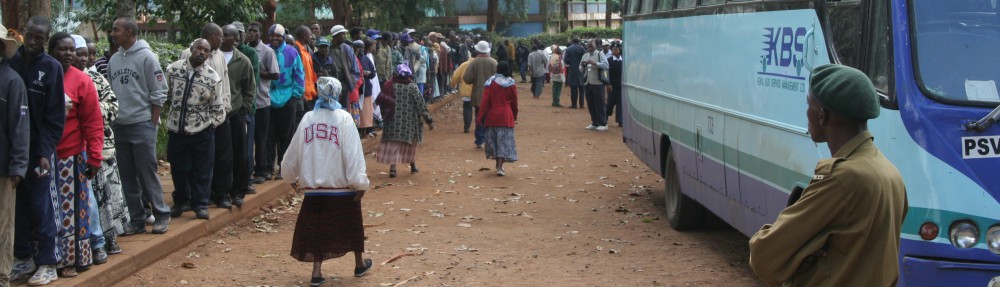
In regard to post election mechanics (analog and digital), these change a lot each election.  Not as much as the law requires perhaps, but significantly.The process of voting by paper ballot, counting the paper ballots by hand and recording the vote by hand on paper on Form 34A and posting it on the door (or in some cases deciding not to) is fixed and well established, 2007, 2013, 2017.  Kenyans have and do “come together” over this process.  They always do it peacefully.

Not sure why people are seeming to find that to be a novelty.  A great and important thing yes–and it should not be taken for granted. Nor should it be misrepresented as “progress” or any form of “change” each time it is repeated.

So no, this peaceful turnout in long lines to vote by this same process in 2007, 2013 and again in 2017 is not, in fact, an act of faith at all as described by ICG.  It is an act of hope each time.  Arguably for many an act of love for country or subgroup.  Kenyans are broadly faithful, but not in the election process as a whole.

Here is the ICG statement.

Kenyan election – amid uncertainty, unfortunate there was no Kalonzo v. Ruto debate [updated 7 Aug]

Today [Sunday 6 Aug.] the IEBC announced for the first time that over 25% of its more than 40,000 polling stations do not have network coverage.  Satellite phones have only been provided, apparently, to the 290 constituency tally centres.

So with a very messy voter register again–see AfriCOG report here–the election is entirely dependent on the KIEMS system.   The procurement of the system remains deliberately shrouded, the techical director murdered–with offers of assistance from the FBI and Scotland Yard spurned.  And now the connectivity bombshell.

Along with the deployment by the Kenyatta administration of twice the security personnell as Kibaki deployed in 2013 in the wake of 2007.

So no need to pretend that this is a normal election in which voters could have standard expectations.  Still, the contrast between the coalitions and the generational consequences at issue might have been best captured by a debate between Kalonzo and Ruto.

Update Monday 7 Aug: seemingly keen to signal that there has been no end to the use of the assets of the Government of Kenya for the Uhuruto re-election campaign, the official website of the Office of the Presidency today features this piece dated Saturday to  correspond with the end of the campaign:  “President Kenyatta: I served Kenya diligently–vote for me again“.  Last year Kenyatta and Ruto launched the Jubilee Party as their re-election vehicle at State House in a telling contrast from Kibaki’s 2007 launch of his PNU re-election vehicle at his private Silver Spring Hotel in Nairobi.

The unwillingness or inability of Kenya’s other institutions, including the media, to stand up to the “re-KANUization” of the State by the Executive’s Party is one of the most troubling indicators of the deteriorization of democratic health from the seeming breakthough of the 2003-05 with the NARC coalition defeat of KANU.

Update: here is a VOA overview.

Very bad news regarding Kenya’s election preparation on multiple fronts (updated)

Kenya’s IEBC Chairman announced over the weekend that one member of the IEBC technical staff had “gone missing”.  Reports indicated last contacts of 10pm Friday or 3:00am Saturday.  Today we learn that his dismembered body is in the morgue–I have not seen information yet on when he was murdered, when or by whom he was brought to morgue, etc.  (So far these details appear standard for a Nairobi politically related murder.  Normally the cases are unsolved and are subject to features years down the road in the major Kenyan dailies with important details after key suspects have died.)

The extrodinarily last minute testing of the KIEMS (“Kenya Integrated Election Management System”)  — crucial for a credible election because we know that the register has lots of dead voters and other problems –set for 3pm today has been cancelled/postponed due to the fact that the murdered staffer was leading this part of the election.

Meanwhile, the IEBC has announced that more than 20 million paper ballots from its highly controversial sole source contract are arriving.  This allows enough for each of the perhaps 5% dead voters on the register to vote, plus more than an additional 1 million extra ballots.  

Leaked documents publicized by the opposition confirm what seems to be otherwise clear from other official sources — that the KDF is being deployed by the Goverment (the same Secretaries and Ministries involved in the re-election campaign of their Commander-in-Chief per their public communications) for purposes of election security along with the civilian paramilitaries of the Kenya Police Service that were exposed to have been implicated in partisan election activity and in the Post Election Violence in 2007-08.

Parliament has not approved the integration of the KDF into domestic election security.  

We know from the Jubilee (ruling) Party vote to force the IEBC to accept a “manual backup” (substitute) in the event of a failure of the KIEMS that the government would have the votes to have authorized the KDF role had it elected to.  And speaking of that insistence on manual back up . . .

Frankly this stinks.

(UPDATE: Additional details reported by the Standard midday indicate body of Chris Msando in forest by local citizens Sunday evening; they called police Kenya Police Service whose officers took the body to morgue. This is contradictory to some other reports, as usual in cases of murder involving high politics in Kenya. US and UK have offered assistance to investigate what is apparently a clear case of torture and murder.)

(2nd Update: Chris Msando has been variously referred to as “Manager” and as “Acting Director” for the IEBC ICT. The previous ICT director was fired some weeks ago under a cloud. So the person being called a “staff member” in early reports is as a practical matter the most important member of the Commission’s staff other than the chief, Chiloba, who is a holdover from the old Issak Hassan commission.)

(3rd Update: “Uproar over Moses Kuria’s post on slain IEBC officer” has more details and part of the state of play in the campaign pending further information.  

The “simulation” of the KIEMS is re-scheduled now for Wednesday afternoon.)

Always “steady progress” – COMESA “elders” to observe COMESA member elections in Kenya and Rwanda

From a COMESA Press Release yesterday:

COMESA believes that elections play a pivotal role in societal transformation in the region and provide a footstall for entrenching democratic principles.

Premised on this critical role, Member States have continued holding periodic elections which have heralded a new dawn by signifying steady progress towards deepening and institutionalizing democracy in the 19-member bloc.

Nonetheless, COMESA is still dispatching teams of Election Observers to issue Preliminary Statements just after the upcoming elections in Rwanda on August 4 and Kenya on August 8, with further reports after 90 days.

Zimbabwean Ambassador Dr. Simbi Mubako will lead the team for Kenya to arrive 30 July.

Think I am too jaded?  Enjoy this:

The presidential elections in Rwanda follows the 2015 referendum that unanimously approved a constitutional amendment that allowed President Kagame to run for office in 2017.  The forthcoming elections are considered important in Rwanda’s socio-economic and political progress.

In the past years, Rwanda has made significant progress in consolidating its political stability, economic growth and development.  Furthermore, Rwanda has recorded major milestones in consolidating democracy through holding periodic parliamentary and presidential elections as stipulated in its legal framework.

Since 2008, COMESA has continued to support the elections process in Rwanda.  COMESA observed the parliamentary that were held in 2008, 2013 and the presidential elections held in 2010.

I am all for extra diplomats and elders from the region being in Kenya for the election to meet diplomatic needs that may arise.  But let’s not confuse this type of “intramembership” diplomatic obsevation with an independent election observation. 

[See U.S. and IGAD Statements on Djibouti election from last year, featuring Kenya’s Issack Hassan for IGAD]

Kenya vote: target turns from “will of the people” to “free and fair, peaceful and credible” to “fair, orderly, credible and nonviolent”

Old KANU Office

Solo 7–Kibera

In the 2013 Kenyan election John Kerry was the American Secretary of State, speaking to Kenya’s elections that year in his role as lead American diplomat.  The U.S. provided key funding as well as embedded technical support for the IEBC in that election, including funding for the failed procurement of an electronic results transmission system.

It was suggested that the election, in spite of a certain disarray and incomplete results, reflected “the will” of Kenyan voters–and was subsequently upheld by Kenya’s Supreme Court (with preliminary observer statements from the Carter Center and EU as evidence offered by the IEBC in litigating against the challenges).

Likewise as Secretary of State Kerry addressed Kenya’s 2017 elections during his official visits in 2015 and 2016.  The second quote above, “free and fair, peaceful and credible”, comes from Secretary Kerry in Kenya last year.  The new terminology for the 2017 vote, “fair, orderly, credible and nonviolent”, comes now from former Secretary Kerry, wearing a new hat as co-leader of the independent International Election Observation Mission being conducted by the U.S. based NGO, The Carter Center. (See Daily Nation 14 July “Ex-Secretary of State insists on fair election“)

Over the years I have written and noted the potential distinctions involved in the decision of international observers to suggest that a particular election “reflected” or corresponded to a standard labeled “the will of the people” on one hand, and on the other to label an election “free and fair.”

An overview and “gateway” is my post “An insider’s explanation of the difference between a ‘free and fair’ election and a ‘will of the people’ election — Kriegler deputy’s memoir“.   The issue is discussed in relation to the internationally supported South African election of 1994 discussed in the recent memoir referred, and on into 2007 and 2013 in Kenya, with Kreigler and IFES re-engaged in a different context.

See especially my post “Are free and fair elections passe in Kenya?“.

The most important point for Kenyans is that the 2010 Constitution adopts explicitly as law a “free and fair” standard.  Peace, order and nonviolence are good and important societal goals.  Many of us are skeptical that tolerating corruption or other substandard conduct in administration of elections is somehow a useful tool to serve peace, order or nonviolence (just as war, disorder and violence do not clean up the election process).

“THE DEBACLE OF 2007” – my piece in The Elephant on how Kenya’s politics was frozen and an election stolen . . .

THE DEBACLE OF 2007: How Kenyan Politics Was Frozen and an Election Stolen with US Connivance | The Elephant

Mocking democracy: Government of Kenya announces “Kenyan Asian community backs President Kenyatta’s re-election”

Democracy Assistance

“URAIA Because Kenyans Have Rights”  — Democracy Assistance facade?


[Update: The Daily Nation, State Officials on the campaign trail“:  “The Jubilee administration has deployed civil servants and key government officials on vote hunting missions across the country in contravention of the law.”]

Let it not be said that there is any serious pretense that the Government of Kenya is neutral in the contest for political allegiance of potential “swing” ethnic groupings, rich in votes or money, in the current election, a contest for power between the Uhuruto ticket representing the current generation of the original KANU establishment led by the Kenyatta family and an opposition coalition led by Raila Odinga and Kalonzo Musyoka.

Here is the “latest news” from the Government of Kenya, Office of the President (www.president.go.ke): “Kenyan Asian community backs President Kenyatta’s re-election”.

This years’ “Jubilee Party” was literally formed at State House as the Uhuruto re-election vehicle, formally merging Uhuru Kenyatta’s TNA and Ruto’s URP, just as this meeting of State Officials and “Asian” Kenyan businesspeople and politicians for the re-election campaign was convened at State House.

Conduct of this sort, aside from being a clear form of corruption per se as a misappropriation of public resources for private gain, is explicitly against the mandatory Code of Conduct for the Kenyan political parties.  (On paper the campaign, in full swing for months, is not even to start until May 28.)

Will the Registrar of Political Parties and the Independent Electoral and Boundaries Commission take action?  The IFES led consortium of US based organizations both facilitating and underwriting the cost of the election, while also coordinating its “observation” at the expense of American (and in parts Canadian) taxpayers?  What about ELOG, the donor supported Kenyan observation group?

IFES has already beeen attacked by the Kenyan Government and ELOG is charged with continuing to do business in Nairobi on a permanent basis, so it would be a huge act of institutional courage for it to seriously challenge the conduct of the Office of the Presidency.  We have been in the mode of continuous institutionalized democracy promotion in Kenya for 15 years (!) now.  No matter how many  capacity building seminars we hold for the little people in the cities or the politicians in the resorts in the Rift Valley or at the beaches, if we let ourselves simply be mocked and pretend that this is working we will surely risk moral injury to our own democracy.

Read the whole campaign piece here:

The Asian community in Kenya has endorsed the re-election of President Uhuru Kenyatta.

Leaders of the community said they have taken the decision to rally behind the President because of his commitment to creating an enabling environment of business and development.

The leaders, who visited President Kenyatta at State House, Nairobi, said policies implemented by the Jubilee Government have enabled more business to thrive and made Kenya a preferred destination for investors.

At the meeting which was also attended by Deputy President William Ruto, representatives of the community assured the President that they would rally behind him to ensure the country’s development tempo is sustained.

“What we have seen in the last four years needs no magnification and my words can be supported by facts that can be seen and quantified, “said businessman Iqbal Rashid.

The businessman cited the upgrading of the old railway system with the Standard Gauge Railway, the upgrading of the Jomo Kenyatta International Airport and continuous improvement of the infrastructure connecting cities and towns.

He said the continued flow of investments into Kenya from all corners of the globe was as a result of the confidence in the leadership of President Kenyatta.

Women leaders Parveen Adam, Shamsha Fadhil and Farah Mannzoor thanked the President for championing an agenda that fosters inclusiveness as well as the prosperity and unity of all Kenyans.

They said women appreciate his efforts to spearhead the campaign to have the two third gender rule passed by the National Assembly.

Businessman Bismiahirahman Nirrahim said the Asian community has witnessed the transformative leadership of President Kenyatta which has helped in creating conducive environment for investments.

He cited the increased ease of doing business resulting from President Kenyatta’s policies including the policy to reduce the time it takes to register a new business.

Nirrahim said the youth and women empowerment program implemented by President Kenyatta’s Administration has also been a transformational policy that deserves praise.

President Kenyatta thanked the leaders for their support and assured them that he would continue working tirelessly to make Kenya a more prosperous country with shared prosperity.

He said the Asian community has been keen in developing Kenya saying the community has always been in the forefront championing the interests of the nation since the days of independence struggle.

“Like all of us you were part and parcel of the Kenyan struggle for Independence, the role you played cannot be ignored,” said President Kenyatta.

The President said he is a believer in an inclusive society adding that he would want to see the Asian community participate more in both social and economic development of the country.

“This is the government that believes in encouraging partnership and working together. Your success is our success,” said President Kenyatta.

Also present were the Chief of Staff and Head of Public Service Joseph Kinyua among other senior government officials.

Author

Gok

Update May 26:  See “Asian Kenyans seek to be declared a ‘tribe’ of their own” in today’s New York Times.
“No shame, and thus immune from embarrassment” – it’s primary election time again in Kenya 

We have seen this before, in 2007 and 2013, but here is the best description I have read. A few details are unique but in general terms this is the same scene from a different year.

Courtesy of a Freedom of Information Act request, here is a November 20, 2007 State Department email which is a headquarters “readout” of a video conference held “with Post to discuss the experiences of Post’s first-ever observation of the political primary process in Kenya.”:

The Observation Effort:

*21 teams (total about 60 people) deployed to the field. This is our first time observing the primaries. We expect to deploy about 50 (100+ people) teams to the general elections as part of the larger international observer effort. The EU plans to deploy 150 people.

*These will be Kenya’s 4th multiparty elections but only the second “free and fair”.

Negatives Observed:

*The process was very poorly organized. We would say the the parties embarrassed themselves, except most of the party leaders have no shame and are thus immune from embarrassment. General feeling is that apparent total lack of organization is not an accident, but reflects efforts to rig/manipulate the outcomes.

*There were obvious deals between the incumbents and local party operatives.

*The process was well-run and by the book only in areas where parties had no hope of winning in that area anyway. Where there were real stakes, manipulation was rampant and obvious.

*Ballots were delayed for many hours in many locations; some politicians felt this was intentional and especially disenfranchised women voters, who either couldn’t wait all day or had to go home before dark for safety reasons.

*Hate literature observed to date is overwhelmingly generated by PNU supporters.

Positives Observed:

*Turnout was surprisingly good. People were very determined to vote. Many waited from 6 a.m. to 3 p.m. or later for ballots to arrive. In some cases where ballots were delayed, people agreed amongst themselves to vote on whatever pieces of paper and honored the results.

*Dozens of outgoing MPs (including some we are very happy to see go, i.e. [REDACTED] were eliminated at this stage, which suggests that you can’t always manipulate the results.

*Our sample was biased as we purposely went to areas where trouble was expected and/or stakes were high, so we likely observed a disproportionate amount of rigging, etc.

*With the recent passage of the Political Parties Bill, this is the last time that the party nomination process will be run by the parties themselves. In the future, the Electoral Commission of Kenya (ECK) will run it (at least, for all parties who want public money). PNU contracted with the ECK to run their primary this time, but it didn’t happen in practice–party leaders took over and wouldn’t let ECK do its job.

After the Primaries:
*We expect a lot of horse trading. Some winners were DQed on appeal and even without an appeal. There were also many “directed nominations,” which led to the resuscitation and handpicking of many old dinosaurs/unpopular incumbents notwithstanding voter opposition.

*There may be blowback with an impact on turnout for Dec. 27. There were widespread feelings of bitterness and disappointment, especially among ODM supporters, who expected to participate in a “new beginning.” Many people complained that, populist image notwithstanding, ODM is run like a dictatorship and that the way of doing things is no different than KANU used to do in the past. The positive difference is that the electorate is much more vocal and active in demanding transparency and participation in the electoral process. The howls of protest regarding some of the directed nominations show the electorate’s increasing maturity and lack of interest in this kind of politics.

*Many unsuccessful candidates have jumped to smaller/marginal parties. There is a cottage industry of sorts selling nominations.

Possible Impact on Main Parties:

*The disappointment and frustration with the nominating process was greatest among ODM supporters. Will this experience sap the energy of ODM supporters, or can ODM redeem itself? Will people continue to be willing to take a chance on an unknown quantity?

*Fear/stability is a powerful motivating factor in Kibaki’s reelection prospects. The contest between ODM and PNU can be characterized as “hope vs. fear.”

*PNU has much less internal discipline and message consistency. Virtually all PNU parties are fielding their own candidates for Parliamentary seats, so not much of a real coalition.

Political Violence

*Two possible types. One, aspirant (often incumbent) MPs use paid gangsters (and sometimes local police officials) to intimidate or disrupt the polling process (trash polling stations, threaten voters waiting in line and/or election officials). Two, spontaneous voter uprisings, where voters feel they are being disenfranchised and attach the presiding officers. If the ECK runs an efficient process as expected, this should lessen the possibility of voter violence. —–END—–

As I wrote in including this content in my 2012 post titled “Part Eight, new documents from FOIA: Diplomacy versus Assistance Revisited–why observe elections if we don’t tell people what we see?“:

For context, this November 20, 2007 summary of what was observed during the primary elections was roughly a month after the Ambassador’s intervention in the public opinion polling as described in previous documents and a month before the Ambassador’s public statement predicting a “free and fair” election the week before the general election. Nairobi is the State Department’s biggest Sub-Saharan post; it was staffed with smart and observant people and obviously well funded–the problem was not what the State Department did not know, rather it was what it would not say.

Kenya Election FOIA news: [heavily redacted] Election Assistance agreement shows US paid for failed 2013 “Results Transmission System”

From the Kenya Election and Political Process Strengthening (KEPPS) Program from USAID for the last Kenyan election:

“Considering the role that results transmission played in the 2007 election violence, IFES will build on its recent work with Kenya’s results transmission system to further enhance it and ensure its sustainability.  IFES will ensure this system is fully installed, tested and operational for the 2012 election.  Furthermore, IFES will fund essential upgrades and adjustments to this results transmission system.” 

[p.28 of the Kenya Election and Political Process Strengthening 2012 Program – Cooperative Agreement between USAID and CEPPS (coalition of NDI, IFES and IRI)]

The Agreement is heavily redacted and divided into four files for length;

(1 of 4) F-00034-16 1st Interim-Response Documents (4-4-2017)

(2 of 4) F-00034-16 1st Interim-Response Documents (4-4-2017)

(3 of 4) F-00034-16 1st Interim-Response Documents (4-4-2017)

(4 of 4) F-00034-16 1st Interim-Response Documents (4-4-2017)

Since I have been fussing periodically about how long it has been taking to get any documents released from my October 2015 FOIA request to USAID for documents about our funding for the IEBC in 2013 and related, I need to thank the USAID FOIA Office for getting this initial release out (and hope for the rest to be in time to be usable for process improvement for the impending next election).

As I wrote more than two years ago, as more information was being uncovered in the UK’s prosecution of Smith & Ouzman, Ltd. and its owners for bribing Kenyan election officials for favor on procurements:  USAID’s Inspector General should take a hard look at Kenya’s election procurements supported by U.S. taxpayers.

Also see: “Thoughts on Kenya’s Supreme Court Opinion” from April 2013:

The Court did not give rulings on the admission of evidence such as the videotapes presented by AfriCOG’s counsel of results being announced at the County level that differed substantially from those announced by the IEBC at its national tally centre in Nairobi, or otherwise grapple with any specifics of reported anomalies, including those among the sample of 22 polling stations that were to be re-tallied. Nor did it address the fact that its order to review all 33,000 Forms 34 and the Forms 36 from all constituencies was only slightly over half completed.

The Court declined to impose legal consequences in terms of the announced election outcome from the failure of the IEBC’s technology, but significantly did find that the main cause of the failures of the electronic voter identification system and the electronic results transmission system appeared to be procurement “squabbles” among IEBC members. “It is, indeed, likely, that the acquisition process was marked by competing interests involving impropriety, or even criminality: and we recommend that this matter be entrusted to the relevant State agency, for further investigation and possible prosecution.”

According to the Independent Review (“Kreigler”) Commission, in 2007 USAID through IFES paid for the purchase of computers for the planned results transmission system for the ECK.  Very late before the vote, according to the Commission, the ECK voted to shelve the system and not use it.  None of the actors, ECK, IFES, USAID nor the US Ambassador publicly disclosed the “shelving” decision. The Ambassador gave his subsequent pre-election Nairobi interview published as “Ambassador expects free and fair election” nonetheless.

The Kreigler Commission investigating sought the minutes of the ECK’s action; the ECK refused to release the minutes and the Commission went ahead and submitted its report to President Kibaki and disbanded, noting the missing evidence.  [Again, I was told by a diplomat involved in January 2008 that key Returning Officers at the last minute were bribed to turn off their cell phones and “go missing” so that vote tallies could then be “marked upwards” to give Kibaki the necessary margin at the national level; likewise, we learned from the Daily Nation that Wikileaks published cables showing that the U.S. issued “visa bans” against three ECK members based on evidence of alleged bribery.  The late decision by the ECK to shelve the U.S. purchased computer system would thus have been critical to allowing the bribery scheme to be effectuated.  See “The War for History part seven: What specifically happened to Kenyan’s votes?“.]

In 2007 we obviously knew that the system had been shelved and kept quiet about it. In 2013 we let on that we expected the system to work–even was in the process of working–until it was shut down early after the vote.  That is hard to understand given that IFES was to “ensure this system was fully installed, tested and operational” and make the necessary purchases.  I will hope that the rest of the requested documents will clarify all this and be released as soon as possible to benefit the planning for the upcoming 2017 election.

See also:  “Nigeria example shows U.S. and other donors should act now on Kenya IEBC technology procurement corruption“.

Election Violence threat in Kenya — my thoughts on NDI’s new warning 


1. NDI is right to warn of a risk of violence, highlighting the unprecedented level of division and tension in Kenya related to the competition for power in this election scheduled for August.

2.  Given that the Kenyan Government is led by politicians widely understood to have been major players in the killing and mayhem following the failure of the 2007 election — elevated to office on the basis of their status as tribal champions indicted by the ICC — #1 can hardly be any surprise.

3.  Further, the “reform agenda” intended to address the catastrophe of 2007-08 has long been diverted and shelved.  Zero accountability across the board for the previous election violence.  The Truth, Justice and Reconciliation Commission report was interfered with by the Executive, then shelved with so many other accumulated Kenyan commission reports gathering dust.  No accountability for the bribery of Election Commission members and officers in 2007 (in fact, a cover up), followed by impunity in the buyout of the IEBC last year after Chickengate and the failures of 2013.

4.  The main reform was the passage of the new Constitution of 2010, but in the hands of anti-reform politicians under no serious further international pressure, the main change is more offices to potentially fight over.  There has been some strengthening of some institutions and backsliding in others.  I think everyone agrees there is still widespread extrajudicial killing by police (the biggest cause of death in the PEV) and extensive corruption (which facilitated the collapse of the ECK).

5.  Certainly the performance of the KDF as well from Westgate to Somalia suggests a less disciplined force than most of us perceived in the 2007 and 2013 elections.

6.  Arguably the incumbent Kenyan Administration has more leverage over the US and UK governments now than Kibaki did in 2007.  Although in 2007 Kenya was a key security cooperator with the US on Al Shabaab, at this point the KDF is in Somalia on an indefinite basis, in part as a component of AMISOM in which the US and the UK are heavily invested, with the US now stepping up direct action against Al Shabaab.  In the meantime, South Sudan — the other “nation-building” project with its back office in Nairobi —  is really failing.  Conflict threatens in the DR Congo with Uganda and Rwanda pulling away from democratization progess as the potential threats and temptations may be increasing in the neighborhood.  Obviously it would be hard for the US or the UK, as well as for others, to “cry foul” over a situation like 2007 where the incumbent was not willing to be found to have lost re-election.

7.  It’s too early to know what the dynamics of the campaign will be and I am not closely in touch at all with the hidden backstories this time (like most outsiders, especially those not even living in Kenya this year).  It seems foolish for any of us to gamble much on prognostications or predictions, but the macro risk is surely great enough to warrant some soul searching and some planning.  Part of this is sobriety in recognizing that there is no time left for extensive reconciliation efforts or deeper institutional work that has eluded us over the years.

8.  Boris Johnson will have Kenya on his radar, for better or worse, but it’s hard to guess who outside of AFRICOM will really be engaged on Kenya at a senior level in the US Government before any election crisis, even though the risk is so much more widely recognized this time.  Pre-election funding is much greater than in 2007 but extra resources for a political crisis may be harder to rally.

9.  I remain of the belief that Kenya was not really “on the brink of civil war” in 2008 because such a large part of the violence was instrumental for political gain and none of the politicians would have benefited from a civil war.  In 2013, I agree that some level of optimism about institutions, mostly the Supreme Court, that we don’t necessarily see now had a lot to do with reducing violence, but a big factor was the mass security mobilization – it was understood that protestors would face police and military bullets and not many were willing to take an initiative in that direction.  The benefit of 2013 and the other problems with the institutions pre-election this year is that expectations are low — an openly stolen election would be far less of a shock than in 2007 and as in 2013 the State’s willingness to kill cannot be doubted.  On the other hand, if violence did break out inspite of these initial barriers it might be harder to temper and eventually end than in 2008.

Update: 13 April — See Muthoni Wanyeki’s latest column in The East African, Polls: the heat is rising, mayhem escalating,” for a look at the current temperature official behavior around the country.