The Foreign Policy establishment will continue to hold Beltway confabs and hearings about “Africa policy” but the author of “The Flight 93 Election” is running Policy Planning at State and Congress has neutered itself.

I think it is probably a sucker’s game to do too much mastication around the idea of what Trump II may do in or in relation to Africa by reference to the Kennedy through Biden 1961-2025 “A.I.D./USAID Era” of African relations.

Take a moment to read Michael Anton’s famous opinion piece in the Claremont Review of Books from July 2016 entitled “The Flight 93 Election”. This is the very same Michael Anton who is the Trump II Director of Policy Planning at the State Department.

As far as I am concerned the wood chippering of USAID, programs and especially people, is best understood in the intellectual “Cold Civil War” environment as a subspecies of “Defunding the Left” (something that I had some involvement in as a College Republican leader back in the”Reagan Revolution” days) rather than a more specific foreign policy pivot. The impact on Africa, Africans, and relations with African states specifically is just collateral damage in “The Third World” in Flight 93 terms.

Probably better to study the Eisenhower Administration—when decolonization was close enough to warrant standing up a separate Africa Bureau in the State Department but many in Congress addressing foreign policy represented segregated Jim Crow States and districts and the question of civil rights for Black Americans generally was much in contest. And perhaps a counterfactual to identify what a Goldwater Administration Africa policy might have been. [Recognizing that Eisenhower was seen as a proto-Communist by many of the ideological godfathers of the current Trump II core thought leaders.]

The most important American regarding Africa policy is likely Elon (“We’ll Coup Who We Want To“) Musk, and ProPublica has an expose about how aggressively the new Trump II State Department leaned on Gambia for Musk’s Starlink business.

Musk has used his X megaphone (the repurposed Twitter) to spread accusations of a genocide against white Afrikaners in snyc with the rest of the Trump Administration declaring same as the basis for the new program to designate Afrikaners as “refugees” and resettle them in the US. In the context of “The Flight 93 Election” view of seeing “Third World” immigration as the most daunting failure of the pre-Trump Conservative Movement and pre-Trump Republican Party as well as the ultimate goal of the Left “enemy within”, it makes perfect sense to affirmatively bring in Afrikaners while expelling “non-Western” refugees impacted by wars or terrorism elsewhere in Africa or “The Third World”.

Beyond the barriers of “culture” and “development” to finding time out from the Cold Civil War to develop an actual foreign policy strategy for Africa, the Trump II Administration will not be able to take this on without having first a strategy for China. I do not expect that four years will be long enough for Trump to make many of the necessary choices. So far the most important fork in the road in the Trump II China policy (and foreign policy writ large) is the announcement by Treasury Secretary Bessent that the US does not seek to decouple with China.

In the meantime, gutting the State Department means that more of the burden of diplomacy as well as development will be left to AFRICOM by default. Of course the Trump policy of refocusing the Pentagon on “warfighting” by a more lethal warrior class and enhanced technology cuts away from the likelihood that AFRICOM as a Combatant Command will be more rather than less dexterous and ultimately successful at diplomacy than it has been since starting to take up that burden at inception in 2008 as what the G.W. Bush Administration conceived as a “different kind of Combatant Command.”

Congress has elected to defer wholly to Trump II on Africa policy so far as the major changes have been effectuated with the demise of USAID. The Senate Foreign Relations Committee didn’t even hold a hearing (!) on the demise of USAID and the hearing in the House was not of any legal relevance in spite of the preponderance of the testimony debunking the basic rationale of Musk for the “woodchippering”.

Last week the Senate Committee solicited the thoughts of Joshua Meservy of the Hudson Institute, previously Heritage, and Michelle Gavin of the Council of Foreign Relations on “East Africa & The Horn: At a Turning Point or Breaking Point” but again, no real indication that Congress will do anything to get involved as opposed to deferring entirely to Trump II.

While some associated with the Trump II administration pay lip service to an approach of “trade not aid” in the aftermath of the death of aid, there is no evidence of comparative substance to the words. The UAE is the latest country after China to completely dwarf U.S. current and planned financial investment in Africa and like China provides a counter to previous U.S. expressed values on governance and the rule of law, and not just in relation to war and mineral smuggling in Sudan and Central Africa.

See “UAE Pouring Money into Africa, Seeking Resources Resources and Power” in the New York Times on May 17:

“In 2022 and 2023, the Emirates announced a total of $97 billion in investments in Africa — three times China’s total, according to fDi Markets, a database of foreign investments. U.S. investment in 2023 was about $10 billion.”

“Meanwhile, Mr. Trump has fast-tracked America’s exit from Africa, ending billions of dollars in funding, dismantling the U.S. Agency for International Development and ending all contributions to the African Development Bank. The State Department’s reorganization plan also calls for the elimination of most operations in the region.”
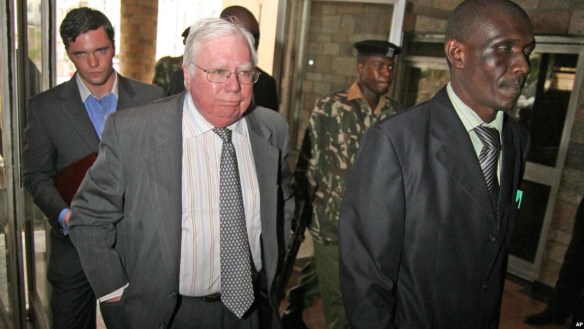
Birther John Corsi in Kenya to investigate Senator Obama
Jerome Corsi, bestselling “Obamanation” and “Where’s The Birth Certificate” author in Nairobi during early Birtherism era.

What is Henry Kissinger’s legacy as a board member at the National Endowment for Democracy? (Updated 12-14-23)

Greetings and Happy Human Rights Day!

Henry Kissinger served on the board of the National Endowment for Democracy (NED) in the early years of the Endowment during the second Reagan Administration, from 1985 to 1989. Thus during the wind down and end of the Cold War.

For a good scene setter noting Kissinger’s role, see “Missionaries for Democracy: US Aid for Global Pluralism”, in the June 1, 1986 New York Times.

This position for Kissinger had escaped my attention until with the news of his death I looked back at the early 2009 press release from the International Republican Institute (IRI) announcing that Kissinger would receive that year’s IRI “Freedom Award”. (Given that IRI was promoting democracy in Cambodia, Bangladesh and East Timor among other places where Kissinger’s government service record in relation to democracy issues was well known by then to have been, shall we say politely “controversial”, I was a bit taken aback. Obviously Kissinger was a primo draw for a D.C. foreign policy establishment fundraising dinner but I was still surprised at the specific symbolism for IRI.)

I first visited NED in June 2007 as the new IRI Resident Director for East Africa on my way out to Nairobi. I met with Bronwyn Bruton, longtime DC Africa hand, who was managing the East Africa grant portfolio at NED which would fund much of our IRI work in Kenya (assuming approval at a meeting of the NED board which I also attended) along with her boss Dave Peterson who has been NED’s Africa Director dating back to Kissinger’s time on the board in 1988.

It was only in the summer of 2009, after I was back at Northrop Grumman in Mississippi and my dustup with Ambassador Ranneberger over the Kenya IRI/USAID exit poll and election observation had been on the front page of the New York Times that I attended a public Kenya program at NED and got to meet longtime President Carl Gershman and other executives. (I have written about that event previously in regards to Kenya.)

With Kissinger’s death the copyright on material he produced in his NED papers at Yale has passed from Dr. Kissinger to the University. I have spent time this weekend looking at what the Yale Library has digitized on-line of the six boxes. I have reached out to a couple of friends in the academic world who work with the study of democracy assistance to see if they are interested in collaborating with a layman/practitioner to study this.

Some interesting things I have learned so far: Kissinger was not on the initial board of directors when NED was established in 1984 following passage of the enabling legislation in December 1983, but was sent an invitation by Mr. Gershman in December 1984 following discussions that fall. Kissinger accepted in late January explaining that his response had been delayed by his travel schedule.

Most of the material is just copies of NED board correspondence, but there are slips and notes indicating his many scheduling conflicts between Kissinger & Associates business, corporate boards and the Center for Strategic and International Studies.

By late 1988 Kissinger had received a letter from NED’s outside general counsel noting that his three straight absences from board meetings would necessitate his removal by policy, but that there would an opportunity at the next meeting to present “extenuating circumstances” to excuse the attendance issue. After some confusion on whether he had automatically been removed, Kissinger submitted his letter of resignation because of his other time commitments in January 1989.

One is left with the impression that Kissinger might have been something of a foreign affairs celebrity/senior statesman board member who did not heavily engage with NED governance.

Perhaps ironically as to Kissinger, the big feather in NED’s cap in late 1988 was deploying a special Congressional appropriation along with other funds to support in Chile the “no (to General Pinochet)” campaign in the plebiscite that Pinochet had called on continued military rule.

NED funded usual Chilean civil society type programs as well as the funding to NDI for the campaign which among other things paid for three American political consultants, including Glen Cowan of Francis, McGinnis & Rees, who pioneered the NDI-funded PVT through the opposition parties and through the local “Committee for Free Elections”. NDI, according to their quotes in clips circulated by Mr. Gershman to his board, added private funding to the US Government funding provided through NED.

It might be that as a private citizen and businessman by 1988 Dr. Kissinger was no longer intensely interested in Chile or General Pinochet; perhaps he sort of informally recused himself from the NED board in the context of Reagan’s second term pivot reflected in Mr. Gershman’s description (“the basic concept was to promote a peaceful and stable democratic transition”). Maybe he now supported democracy in Chile affirmatively to the point he did not feel it necessary to show up? Without being able to ask him, maybe we can learn more going forward.

National Journal piece on NED and NDI Chile work cited favorably to NED board members

[This Chile work was the origin of the NDI-funded PVT programs that I have written about in Kenya’s 2013 and subsequent elections, as well as in the most recent elections in Malawi and DRC. There are some big differences between the late Cold War NED NDI Chile work in 1988 and the application of the tool by USAID in conjunction with their other democracy programing in 21st Century Africa.

Glenn Cowan joined Eric Bjornlund from NDI in forming Democracy International (DI) in 2003 and published an extensive Vote Count Verification User’s Guide for USAID following a wide consultation among implementors in 2010. They gave me a valued copy several years ago. I will hope to write more about this after catching up with old friends at DI and elsewhere.]

For more from NDI, see the 40th Anniversary retrospective at “NDI: BOLSTERING GENUINE ELECTIONS TO SECURE DEMOCRACY – THROUGH CITIZEN AND INTERNATIONAL ELECTION OBSERVATION”.

NED Memo of 9-87 announcing 1988 Board Meetings (January 1988 was Kissinger’s last, followed by January 1989 resignation.)

UPDATE: Continued research shows that Kissinger attended no more than one NED Board meeting after the spring of 1987, but executed a consent on June 28, 1988 approving the NED grants supported by those members who attended the June 5, 1987 meeting, including 6 grants to NDI, among them “Chile: Promoting Free and Fair Elections -$110,172”.

USAID is using a model for Kenya election assistance contracting that creates unnecessary conflicts of interest between organizations supporting election observation, voter education and embedded support to the Election Commission

Kenya challenged vote Kenya election 2007 ECK Presiding Officer holding ballot with disputed marking

USAID has used the multiyear year cooperative agreements with CEPPS, the “consortium” of IRI, NDI and IFES, since the 1990s as a vehicle to award democracy assistance work. There are a variety of internal practical advantages to this in terms of bureaucratic speed and convenience.

In 2007 when I was East Africa Director at IRI in Nairobi, IRI’s public opinion polling program was conducted as a separate 2005 “follow” agreement under a overall master CEPPS “leader” agreement. All the work was done separately by IRI. When Ambassador Ranneberger wanted an exit poll for election day, USAID just issued a modification to our agreement to add on the additional work.

When the Ambassador wanted IRI to conduct an International Election Observation things were more involved because USAID had already decided not to do an Observation and IRI was not anxious to do one either. And there was no agreement in place as the only work we were doing for USAID was the polling program. Nonetheless, USAID was ultimately prepared to “move heaven and earth” to meet the Ambassador’s wish as they told me, and allocated a small amount of Economic Support Funds to support a new “follow” agreement for an Election Observation Mission. A Request For Proposals was issued to CEPPS, but it was written on a basis that excluded NDI as conflicted out due to its work with the political parties and IFES was conflicted out based on its work with the Electoral Commission of Kenya, so that IRI was the only available CEPPS entity to conduct the Observation Mission.

We conducted the Election Observation Mission and the Exit Poll, and reported on them to USAID, without being entangled with the separate work that IFES was doing with the Election Commission (ECK). I did not know any inside details of the ECK’s decision not to use the laptop computers purchased for them by USAID through IFES to do Results Transmission; likewise, no one at IFES (or NDI) had input or involvement in the Exit Poll or International Election Observation.

For the 2013 election, however, USAID’s FOIA response discussed in my previous post shows that the package of election assistance from early 2011 was bundled together in one “follow” agreement with CEPPS including the embedded technical support from IFES, including advice on the BVR and Poll Book acquisitions and the acquisition and development of the Results Transmission System handled by IFES, party and domestic observation support handled by NDI (too much is redacted to be specific on this part of the work) and voter education handled by IRI.

Appropriately, the International Election Observation Mission was funded separately through the Carter Center (and there is nothing about that in my FOIA request).

In 2017, the consolidated approach was ramped up a notch. USAID issued a published invitation for proposals (a good step for transparency and development of fresh thinking) but they wanted one entity to be in overall management of the work. Thus when they selected a team of IFES, NDI and IRI along the lines of 2013, IFES was in a supervisory position for the work, which this time included an International Observation Mission by NDI along with NDI’s domestic observation support and other normal work.

As it turns out, NDI’s International Observation took place and did preliminary reporting (as well as a pre-election assessment) but never issued a final report. At some point before the election USAID accepted an unsolicited proposal from the Carter Center to do an International Observation Mission separate from NDI’s work under the overall IFES-led Kenya Election Assistance Program. This was the delegation led by former Secretary of State John Kerry who had been in office during the 2013 election.

This is all more confusing and opaque than it needs to be! Aside from the inevitable conflicts associated with “observing” your own work and with maintaining trust where you know of critical risks and problems that your recipient government partners” are choosing not to disclose to their own public.

Retired Admiral Stavridis publishes op-ed demonstrating American “National Security Establishment” view of “Africa’s Security and the Power Struggle”

I highly commend to my friends who are Africanists or African, or Americans who have not been directly involved in the “national security” professions, a short op-ed piece today from Admiral James Stavridis (Ret.):

Africa’s Security and the Power Struggle

The immediate policy debate in Washington being addressed is consideration of reductions to AFRICOM to be redeployed in support of the Trump Administration’s National Security Strategy of greater emphasis on “Great Power Competition” relative to “Violent Extremism”/”Global Terrorism” so Adm. Stavridis provides an “ionospheric” look at the Continent and its future in support of his argument.

Adm. Stavridis retired from the Navy in 2013 after an extremely accomplished career. He served as Commander of the U.S. Southern Command from 2006 to 2009, then served as Commander of the European Command and Supreme Allied Commander. The perspective of a recent former SOUTHCOM and EUCOM Commander on AFRICOM is clearly invaluable to understanding that way of seeing the world.

Stavridis graduated from the Naval Academy in 1976 and climbed the ladder as a distinguished Surface Warfare Officer, along with UN/NATO deployments to Bosnia and Haiti in the 1990s. He ultimately commanded the Enterprise Carrier Strike Group “conducting combat operations in the Arabian Gulf in support of both Operation Iraqi Freedom and Operation Enduring Freedom”.

Along the way, he did his PhD in International Relations at Tufts, along with other graduate degrees from Tufts, and the National and Naval War College. After retirement he served as the Dean of Tufts’ Fletcher School of Law and Diplomacy. So he is simply put a superstar by background and experience.

Today he is the Operating Executive for The Carlyle Group, the famous global defense-focused equity fund [NASDAQ: CG] and the Chair of the “Board of Counselors” of McClarty Associates, the famous Washington-based global consulting firm [“We know diplomacy; We provide diplomatic solutions”].

By way of disclosure, I retired from 12+ years as a defense industry lawyer working primarily in Navy shipbuilding around the time Stavridis retired from the Navy. I was on unpaid “public service leave” for my East Africa democracy assistance work at the International Republican Institute. So Stavridis’ perspective is all “second nature” for me but will not be intuitive to those from other places and backgrounds.

[Longtime readers or those who otherwise follow Kenyan elections closely might remember that McClarty Associates Vice Chairman John Negroponte was Deputy Secretary of State during the 2007-08 election crisis in Kenya. Negroponte met with representatives of the ODM opposition seeking release of the embargoed USAID-funded International Republican Institute exit poll done with the University of California, San Diego, showing an Odinga win. I learned through FOIA that Kalonzo Musyoka met with Negroponte the same day:

The War for History” part nine: from FOIA, a new readout of Vice President Kalonzo Musyoka’s February 2008 meeting with John Negroponte:

The Kalonzo-Negroponte meeting was the same day as U.S. Senate hearings on the Kenyan election, lobbying by ODM with IRI and Negroponte for release of the USAID/IRI exit poll and that evening’s announcement that IRI found the poll “invalid”. (My FOIA did not result in any documents regarding the ODM-Negroponte meeting.)

From my e-mail to Joel Barkan in 2012:

Kalonzo meeting with Negroponte was in Washington on Feb 7, 08–also included [Kenyan Ambassador] Ogego and a staffer from Kenyan embassy. He said power sharing would be a set back for democracy as Kibaki win was “evident” from review at ECK. Would be willing to step aside as VP for Raila, but the Kenyan people would not support it as it would be “undemocratic”. Kalonzo assured that the violence was now under control, but that the U.S. should continue to call it “ethnic cleansing”. According to Salim Lone interview in Standard back in December ’08 he and ODM delegation met with Negroponte that day to push for release of exit poll before meeting with IRI.

Kenya Public/Private Equity Healthcare Market faces another setback with management displaced at Nairobi Women’s Hospital Group in wake of Owaahh reporting

[Update: Feb 25: A review by Kenya Medical Practitioners and Dentist Council, the doctors’ union, found that rates themselves charged for services were permissible but verified that a What’s App group was being used to allow managers to have direct input into medical decisions such as discharges warranting better procedures. The Star has taken down a story –which I linked–that seems to have a reflected a PR spin on the report which was itself then leaked on Twitter. So the saga continues.]

Update: Feb. 12, Jaindi Kisero column in Daily Nation recommends, “To ward off greedy investors, fund locals to put up private hospitals“.

Back in 2019 a private equity group from Ft. Worth, Texas and San Francisco, TPG, took over the Abraaj Growth Markets Health Fund from its interim manager Alix Partners, the U.S.- based restructuring/insolvency advisors. The Abraaj funds, run out of Dubai by original Pakistani investors, had been apparently fraudulently tapped by management, thus the restructuring under the auspices of a Limited Partner Advisory Committee, which hired Alix.

The Limited Partners included global healthcare giants Phillips and Medtronic, multilateral development lenders including the IFC as well as bilateral development finance agencies such as the US Government’s OPIC, the CDC and Proparco. Likewise the Bill & Melinda Gates Foundation invested.

TPG renamed the Abraaj Growth Markets Health Fund as the Evercare Health Fund, to be managed by TPG Growth. At the time of the TPG announcement, Evercare was identified as having a “portfolio which includes 26 hospitals, 18 clinics, 40 diagnostics centres and 2 brownfield and greenfield assets” in Africa and Asia. One of the asset groups in the newly renamed Health Fund was a Kenya for profit group of small hospitals called Nairobi Women’s.

See “US fund cleared to take over Avenue Park and Metropolitan” in The Business Daily.

Triggered by an explosive series by prominent Nairobi blogger Owaahh, “Have you ever been to a private hospital“, scrutiny has come down on the group for profiteering behavior toward patients without medical basis. Insurers pulled back and now the Fund has announced an interim management change with the entrepreneur/doctor who built and ran group stepping aside in favor of a three member team of Evercare representatives pending professional reviews.

USAID Administrator Mark Green and Advisor to the President Ivanka Trump Deliver Remarks on the Women’s Global Development and Prosperity (W-GDP) Initiative | USAID Media Advisory

On Wednesday, July 10, Administrator Mark Green of the U.S. Agency for International Development (USAID) and Ivanka Trump, Advisor to the President, will participate in a discussion co-hosted by USAID and the U.S. Global Leadership Coalition (USGLC). Administrator Green and Advisor Trump will highlight new partnerships and activities of the Women’s Global Development and
— Read on www.usaid.gov/news-information/press-releases/jul-8-2019-usaid-administrator-mark-green-and-advisor-president-ivanka-trump

See Labor Secretary Alex Acosta’s announcement of the program here.

WASHINGTON, DC

“The Trump administration continues to empower women economically with the launch of the Women’s Global Development and Prosperity initiative.

“This initiative aims to benefit 50 million women from 2017 to 2025 through economic empowerment efforts and motivates private sector actors – both abroad and at home – to emphasize the critical role women play in creating prosperity. Economic empowerment of women has a significant effect on global growth as women invest in stable societies and promote a world free of child labor and forced labor.

“The U.S. Department of Labor supports the W-GDP initiative through its efforts to promote the development of in-demand skills among women in the workforce, the identification of entrepreneurship opportunities, and the creation of an empowering environment for working women to flourish in the global economy.

“The Department of Labor works every day to ensure a fair global playing field for workers in the U.S. and around the world by enforcing trade commitments and strengthening labor standards.

“As part of this work, the Department of Labor seeks to ensure that the workplace rights of women are enforced – through policy engagement in both bilateral and multilateral contexts, and through negotiations and enforcement of labor protections under U.S. trade agreements that promote women’s empowerment as workers and as entrepreneurs.”

Agency

Office of the Secretary

Date

February 7, 2019

Release Number

19-252-NAT

Contact: Megan Sweeney

Phone Number

So how is United States global leadership on child sex trafficking? Impartial administration of justice?

East Africa is the pits for press freedom, but congratulations to Namibia, Ghana and South Africa for outranking France, the U.K. and the U.S. in the World Press Freedom index

Here is the new 2019 World Press Freedom index from RSF, with the United States down to No. 48 (!) and France and the U.K. at 32 and 33 respectively. Namibia at 23, Ghana at 27 and South Africa at 31 lead SubSaharan Africa. Burkina Faso at 36 and Botswana at 44 also outrank the United States.

Thus, five African nations are ranked above the United States for press freedom this year according to Reporters Without Borders. The United States continues to rank above all of the East African nations.

Here are the East African Community member rankings:

Kenya 100

Tanzania 118

Uganda 125

South Sudan 139

Rwanda 155

Burundi 159

Elsewhere in the East and Horn Region: Ethiopia 110; Somalia 164; Djibouti 173; Sudan 175.

And other “development partners”: Norway 1; Germany 13; Japan 67; UAE 133; Russia 149; Egypt 163; Iran 170; Saudi Arabia 172; North Korea 179

Podcast recommendation: over the past six months Travis Adkins’ “On Africa” from Washington has been a great resource

Djibouti IGAD Election Observation Mission press conference led by Kenya’s Issack Hassan of IEBC

There has been an explosion of great work in English relating to Africa in the podcast genre recently, and as an amateur I am way behind in sampling the free learning available just from time constraints. Today I want to flag the relatively new “On Africa” podcast hosted by Travis Adkins which has been a great teacher for me.

Start with Episode One, on October 4 of last year with Amb. Johnnie Carson, who has lived the history of the relationship between the U.S. and Zimbabwe, on “Zimbabwe after Mugabe.” November 6 on Cameroon as an “Electoral Dictatorship in Crisis” with Dr. Chris Fomunyoh of NDI was especially helpful for me since I focus on East Africa and do not have much background on the unique challenges there. Dr. Fomunyoh is a native of Anglophone Cameroon but attended university in Francophone Cameroon and has been a high level fixture for many years at NDI where he is Director for West and Central Africa.

Episodes of December 19, 26 and 31 on Sudan and South Sudan with Amb. Susan Page were especially good. Amb. Page has a personal background with the negotiations leading to the 2005 provisional government, served as NDI Regional Director and was appointed by President Obama as the first U.S. Ambassador following South Sudanese independence–so again, a sweep of recent history on into current events from an “insider” perspective.

Most recently for me, the February 13 episode with Zach Vertin, former diplomat now at the Brookings Institution Doha gives a 39 minute dive into the current “Red Sea Rivalries” shaking up international relations in the Horn of Africa region. Partin has a new book out on the birth of South Sudan which sounds fascinating and I have on my list.

Most of the best Africa podcasts I have been able to take time for in recent years have been more of an academic nature–what Adkins is doing at “On Africa” with accessible overviews of high level politics and diplomacy with people directly involved is a welcome addition for someone like me who wants to deepen and broaden their knowledge as an interested citizen with limited time due to other responsibilities.

MILSPEAK will never die; and a COMBATANT COMMAND may never be great at Public Diplomacy – AFRICOM and a “Failed Communication”

When General Thomas Waldhauser, the outgoing AFRICOM Commander, went before the Senate Armed Services Committee (“SASC”) for public testimony on the AFRICOM Annual Posture Statement relating to the legislative budget process–a performative function for the Senators and the Senate and the Military–someone seems to have failed to scrub the presentation with an appreciation for how it would look to use an “infographic” to publicly describe to the world–especially to interested citizens in the 53 “partner” states of the AFRICOM Area of Operations (“AOR”)–one of the “U.S. strategic interests in Africa” as to “decrease potential for Africa to become a failed continent”.

Some of us who are “olds” (surely this term is a bit insensitive 🧐) and have spent at least some of our formative years before the pervasiveness of global public communications seem to forget that we Americans live in a global fishbowl of our own making.

General Waldhauser will have spent his career with military electronic communications but will have climbed some ranks before civilian application reached the point that “public” in Washington was automatically realtime “public” nearly everywhere.

Security issues, especially terrorism and civil unrest, have cross-border components that may be magnified by the large number of independent countries in the geographic areas involved, but this sort of loose, broad brush talk that might be useful for selling a budget in a competitive bureaucratic marketplace is embarrassing and counterproductive from the standpoint of official communications and “public diplomacy” because it makes AFRICOM look out of touch and patronizing.

In this way, AFRICOM seems to have accidentally put itself at cross purposes in communications with what is supposed to be the “New Africa Strategy” as announced by the National Security Advisor that is intended to reflect a shift of emphasis to American trade and investment with and in African countries. Since the end of the Cold War we have focused on securing the global “lanes of trade”, especially the world’s only “blue water Navy”, facilitating trade between China as well as India, Japan, the EU and others and African countries, without much real policy focus on our own economic participation beyond aid and philanthropy.

Now that China is so much richer, seems to be re-doubling domestic repression and investing heavily in quickly building out both traditional and “new technology” military tools, while leaning on our longstanding allies in Southeast Asia and showing other geopolitical ambitions, we wish to increase our own economic participation in Africa’s growth for the kind of normal geopolitical reasons that we had de-emphasized in recent years.

In competing against the United States, as well as against Japan, Europe and the UK and other more developed democratic powers in Africa, the PRC naturally wants to sell the idea that the Chinese Communist Party offers some sort of South-South mutual respect to African borrowers and customers in spite of its huge actual size and command structure and the way it treats its own ethnic minorities. Whereas the United States Government has the task not only of assuring African markets of our respect and compatibility, but also of encouraging and persuading, rather than directing, U.S. domiciled companies and investors to go take on risk and invest in African countries.

So clumsy negative hyperbole is not the thing we are looking for here. I have a distaste for some of the slick overproduced happy talk “success stories” that get funded within the rubric of “development assistance” and we need straight honesty from our military leaders about the status of wars we are fighting, but we should avoid being carelessly negative when expressing our aspirations.

I do think on this one that the buck really ought to stop with General Waldhauser — he himself in his many-hatted role should have personally known better and not stepped in that hole. Much of the articulated reason to have AFRICOM–as opposed to not having AFRICOM–was that it was to be a “different type of Command” which integrated personnel from the State Department and USAID directly into its structure to be better at things like diplomacy than the Commands dating to the Cold War, presumably based on lessons learned.

UPDATE: Sept. 8

Investigative reporting from Amanda Sperber in The Nation : “Inside the secretive US air campaign in Somalia“.

From the Longwar Journal (Foundation for Defense of Democracies): “US military intensifies airstrikes against al Shabaab in Somalia“.

Dr. Peter Pham gets new post-midterm Trump diplomatic appointment as Great Lakes Special Envoy [Updated]

Ahead of the long-overdue elections scheduled for next month in the Democratic Republic of the Congo, the State Department announced the nomination of Dr. Peter Pham, Africa Director at the Atlantic Council, to be Trump’s special envoy to the African Great Lakes Region.

U.S. names new envoy for Africa’s Great Lakes. (AFP)

Pham has a long background in academics and national security related policy/”think work” on Africa from the Right, which is a fairly limited universe. I became aware of Dr. Pham’s work initially as a “friend of IRI” in relation to my work on Somaliland as IRI country director in 2007-08. He was involved in publicly advising the Trump transition on Africa-related issues and was often identified as the frontrunner to be the nominee as Assistant Secretary of State. See “Trump Team’s Queries About Africa Point to Skepticism About Aid,” New York Times, Jan. 13, 2017, by Helene Cooper.

Pham and his deputy at the Atlantic Council, Bronwyn Bruton, have been prominent critics/skeptics of the initial 2006 invasion of Somalia and aspects of the subsequent “nation building” process there, and Pham has been seen as an advocate for Somaliland. Beyond that, I’m not as familiar with his background on the numerous various immediate issues in the Great Lakes, or how the election results and retirements will re-shape Congressional interests.

I will endeavor to read up.

In the meantime, I have not heard any public comment about any likely impact on a vote on the stalled nomination of Illinois State Senator Kyle McCarter to replace Ambassador Godec in Kenya.

Update: I had forgotten Pham’s controversial advocacy from November 2012 in the New York Times: To save Congo, let it fall apart“. A view that could be seen as very pro-Kagame/RPF and that is certainly at odds with many considered opinions and perhaps a tough starting point for a new diplomatic posting.

See also, from Foreign Policy: Pompeo to appoint new envoy for troubled central Africa region.”

Update II: Richard Dowden of the Royal African Society on Pham last year in African Arguments:

A one-time Washington outsider who challenged the consensus on US-Africa relations, Pham has reportedly been trying to broaden his connections in departments whose staffs are more likely to lean Democrat than Republican. He is working hard to establish relationships with experts across the spectrum, trying to build a policy consensus.

Pham has written profusely on Africa and rejects the previous approach – espoused by Bill Clinton, George W. Bush and Barack Obama – that insisted democracy and human rights should be the cornerstone of US support. Instead, he argues that economic growth should take precedence, though he has recently emphasized security and good governance too. He urges US companies to grasp business opportunities on the continent.