Book bitings: I read Ahmed Isaack Hassan’s memoir from his time at Kenya’s IIEC and IEBC and promised to engage.

I will do a series of posts here to accompany my agreement to engage with former Chairman Hassan after reading his memoir Referee of a Dirty Ugly Game: In the Theatre of Kenya’s Elections — an Insider’s Account. This is an introduction.

I learned a lot about the Chairman’s personal background, his family, his personal and professional networks, in particular involving his previous political service in unsuccessful constitutional reform endeavors in Mwai Kibaki’s first term, his law practice and work for the UN on Somalia. I learned his personal opinions about several politicians, and many actors in various positions in the Kenyan government and in the Kenyan social and business establishment.

I learned a lot about Ahmed Isaack Hassan, how he sees himself and wants to be seen.

Certainly Hassan has been presented by some who were involved with him in running, presenting and defending the 2013 election as a hero for getting through a process in which power was passed from Kibaki to Kenyatta and Ruto without Kenya “burning”. It is in this context a memoir of this sort fits.

To the extent that this was what Hassan was appointed to do then he did deliver and this is his chance to box his critics. Undoubtedly he was put “through the wringer” to an extreme degree and treated badly in various respects as so many people trying to fulfill positions of public trust are in Kenya and one has to have empathy for the impossible position. Thank God he wasn’t murdered like IT Director Chris Msando from the successor IEBC in 2017.

Unfortunately I did not learn as much as I hoped to about the questions that I raised in this blog and elsewhere about the specifics of the 2013 elections.

I learned that he had and has dismissive and negative opinions of organized civil society generally and people that I worked with to some extent and have liked and admired but I am not very clear why for the most part. Part of it may be that his deference as an insider himself to Kibaki and his establishment executive branch apparatus leads him to have little empathy for a role for outsiders. In particular he evinces no real concern for fraud in the 2007 presidential tally and no moral qualms – as opposed to concerns of international relations – implicated by the question of the participation of candidates in 2013 who were involved in the 2007-08 Post Election Violence.

In particular, the heavily redacted contract materials for IFES from the initial responses to my Freedom of Information Act requests several years ago were much more informative regarding some issues involved in the mechanics of the election and point the way to other sources.

This is the kind of thing that I would be grateful to engage on with the former Chairman.

Of course, ultimately there is a “glass half full or half empty” problem about the 2013 election that will not be fully reconcilable among Kenyans about their own democracy with their own perspectives and interests. On the other hand, for me as an outsider without a “dog in the hunt” directly it seems unequivocal that the glass is partly full of liquid and partly full of air and it is simply a matter of fact to identify what is what even though the significance and value derived from the facts will be a matter of individual judgment for Kenyans.

Sometimes people just have different values and priorities. But maybe 10 years after the fact there is more room for discourse and persuasion than there was in the heat of the struggle.

TO BE CONTINUED. . . .

In light of Kenya’s latest “handshake” here are my unpublished thoughts from the last one: “Is the BBI Report more about a legacy for Raila (and Jaramogi) in the context of the Kenyattas’ domination of power?”

[In light of the latest “Handshake” through which Kenyan President Ruto is supporting his erstwhile election rival Raila Odinga for Chairman of the African Union Commission there might be value in the historical context from this is previously unpublished post from December 2019 on the release of the Building Bridges Initiative report as an outcome of the March 2018 Uhuru-Raila “handshake”]
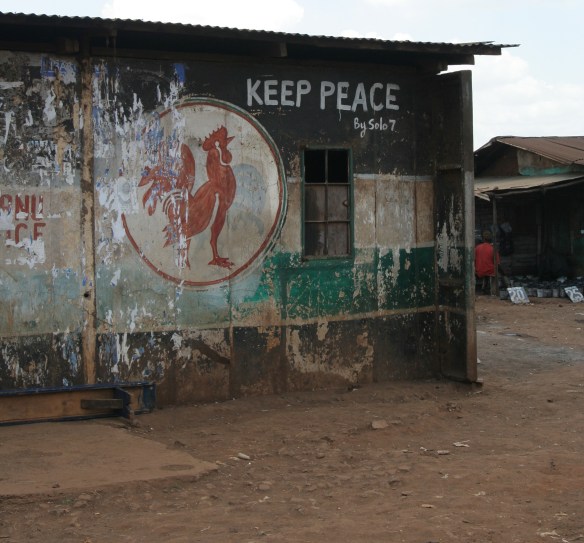
Old Party Office in Kibera

I have just finished finally reading Jaramogi Odinga’s Not Yet Uhuru. Months ago I had gotten started, got pulled away and came back to finish after the BBI report.

To understand how the BBI Report came to be full of small commonplace good ideas but so fundamentally “preservationist” of the basic order of things, perhaps we should see it as facing back rather than forward.

For the Kenyattas, in light of the selection of Jomo as the first leader, his success in consolidating power and gathering and brokering resources for the rest of his life, and the ultimate handoff through Moi to Uhuru following the potentially disruptive threat of the post PEV 2008 National Accord, the BBI Report offers the elevation of a retroactive “national ethos” as valedictory icing of the cake.

Three things imposed risk in the National Accord if you were the Kenyattas, in order of immediacy and gravity: 1) the risk of punishment of Uhuru under the agreement to pursue justice for conduct during the Post Election Violence, a risk shared with many others including Raila; 2) the risk of claims from prior conduct under the Truth Justice and Reconciliation Commission, in particular claims to disgorge assets or participate in land reform of some type; 3) the risk of dilution of power in the presidency creating general long term political risk.

The Supreme Court victory avoiding a runoff in the March 2013 election of the Uhuruto ticket terminated the first and second risks.

The third risk, unlike the first two, has involved a small measure of compromise and this is where Raila has delivered something lasting for Kenyans as a whole including those who have never voted for him.

The reform constitution of 2010 is a product of much work and struggle by many, not always in tandem, but would not exist without Raila’s role as the most popular opposition leader of the era. At the end of the day the unique form of devolution as it has come out of the 2010 constitution and its early evolution has created some real opportunity for governance separate from the power of State House.

On balance devolution provided a limited form of the majimbo that KADU sought before merging into KANU in the immediate post-independence, which KANU and Jaramogi originally saw as representing a collusive deal by some regional leaders and settlers to hold back from full liberation, but could also be seen as holding out from the national pot that was to ultimately be looted once power was consolidated by Jomo.

The office and role of Prime Minister under the National Accord in 2008-13 which gave Raila some poorly defined but not completely insubstantial power, on the other hand, “went away” behind the scenes at a Naivasha resort in 2010 as I have written about previously. It was the Prime Minister’s right of “consultation” that put previous opposition intellectual activist and leader Willy Mutunga on the bench as the first Chief Justice in return for withdrawing objection to a “usual suspect” to replace Amos Wako as Attorney General.

For Raila, his family and close supporters, with these accomplishments under their belts, the Building Bridges Initiative offers a seat in the shade under the tent while eating their slices of cake without the precariousness associated with two generations of being in opposition with no certainty of more than contingent freedom from detention, while going back in time to attend to a bit of the psychology at least of what Jaramogi was getting at in the 1950s and 60s.

Finally peace in the valley, even if the valley is quite small and the plains, hills and lakesides are full of millions of other Kenyans who were not around at the liberation. Those will have to find peace in their own way but what is new about that?

In the concluding part of his book, Jaramogi wrote, ” We are struggling to prevent Kenyans in black skins with vested interests from ruling as successors to the administrators of colonial days.” Obviously that struggle was unsuccessful.

Is that a good thing or a bad thing? It depends on where you sit and what your interests are. If you are one of or close to the successors of the prior administrators it is great and if you are not you may still have the satisfaction of looking around at statist Tanzania, tribal Somalia and revolutionary South Sudan and say that things could be worse. If you are in the Foreign and Commonwealth Office it is hard to argue with it on the basis of the interests you represent. If you are a diplomatic or commercial agent of the post-Tiananmen Chinese Communist Party at the very least it is the most convenient and compatible arrangement.

Regardless, it doesn’t do anyone any substantive good to simply pretend that the outcome was other than it was.

As for the younger generation and others who would wish for more and feel let down, let me reiterate that the honest recognition of where you are is not an impediment to improvement. No, the BBI Report in itself does not change much big, but why would you have ever thought it would?

The reality is that Uhuru was not going to have a level playing field for his and Ruto’s re-election in 2017 and why would he? Who was going to seriously insist and enforce the obligation to be “free and fair”. The Supreme Court had the courage to throw out the presidential vote because of the manifest misdoings in the administration of the KIEMS system, but Uhuru had no need to negotiate on the rerun and since there was never any proof brought forth by Raila that he “won” on August 8, 2017 had the tally not been maladministered he ended up being more rather than less on the defensive with the external democracies who were the only potential source of real leverage.

Raila is not a revolutionary general as opposed to a politician. He has a record as both a deal maker and a serious half-reformist. As opposed to who else in the political class? Arguably he has saved more space under the Uhuruto/Jubilee post-ICC dispensation than anyone could have expected.

If you are Kikuyu or Kalenjin especially and you wish for more change you might have voted for the opposition in 2013 instead of going with Uhuruto on tribal affinity and justifying it on the notion that things would improve because they were younger and bought a slicker more “youthful” seeming message. And since 2017 was part of the package in 2013, at the very least without a full accounting of the failed technology purchases which the Supreme Court order to be investigated but were not, the real question is what are you going to do now with time running to create the environment to have an election you can have trust in and good choices in 2022?
Power as an aphrodisiac – Kissinger’s legacy at the National Endowment for Democracy (NED) was to add “a degree of prestige and credibility that we needed during our early period”

I wanted to follow up on my previous post “What is Henry Kissinger’s legacy as a board member at the National Endowment for Democracy?in light of some comments from one of my much younger friends in academia who also works with and studies democratization assistance. Here are excerpts from Kissinger’s NED files at Yale:

First, I want to make sure not to conflate or overly compress the time period of Kissinger’s service on NED’s Board (1985-89) during the Second Reagan Administration and the time period of the Second George W. Bush Administration when I worked for the International Republican Institute (IRI) in Kenya (2007-08) administering NED and USAID democracy assistance programs. Or the ensuing First Obama Administration when IRI gave Kissinger its 2009 “Freedom Award” and The New York Times published an investigation on the IRI Kenya presidential exit poll I had managed.

I privately noted back when it happened the irony of IRI choosing Kissinger as its recipient for this democracy award in 2009 in the context of IRI’s focused work in the 21st Century on democratization efforts in Cambodia, Bangladesh and East Timor for instance, in the wake of Kissinger’s record as US National Security Adviser and Secretary of State in the Nixon and Ford Administrations in the 1970s in regard to those specific countries. This background then led me in 2023 on Kissinger’s death to learn the overlooked (by me) fact that Kissinger had previously served on NED’s Board. This in turn led to my undertaking initial research – not with the implication that there was something “sinister” whereby Kissinger’s NED role might have been subversive of NED program goals as such – but rather to try to understand the history in light of the obvious dissonance or irony between Kissinger’s approach in Government and the democratization priorities of NED as an institution.

Going through the digitized portions of Kissinger’s NED files at Yale at least seems to confirm: “One is left with the impression that Kissinger might have been something of a foreign affairs celebrity/senior statesman board member who did not heavily engage with NED governance.”

Second, focusing then on the specific years (1985-89) that Kissinger actually served on the Board, we have the very tail end of the Cold War, with Kissinger pushed into resigning by early 1989 by the non-attendance policy, just a few months before the fall of the Berlin Wall. We don’t know one way or the other what Kissinger’s role might have been in regard to Post-Cold War NED democratization work, just that he was not able or willing to find much time in 1985-89 and that his departure was unrelated to the cataclysmic change in international relations and democratization about to take place. The one specific contraposition between Kissinger in the US Government in the First and Second Nixon Administrations and Kissinger on the NED Board involved support for electoral democracy in Chile.

As I noted in my previous post, Kissinger did not attend NED Board meetings approving the programming on the Pinochet plebiscite but did sign off on a solicited consent for the list of programs including Chile after the meeting. So nothing to indicate that Kissinger used his post-Government role at NED to oppose a restoration of democratic elections in Chile.

At the same time, I cannot imagine that there was not some bit of heartburn within the Democratic Party side of the bipartisan NED family about the irony of Kissinger’s role as to Chile even though so much more was still classified in those years than is public knowledge now. (Not to assume that all Democrats opposed Nixon and Kissinger’s Chile policy, or all Republicans excused it, but it did become a source of contention among Republicans and Democrats as well as Right and Left in U.S. politics during those 1970 to 1989 years.)

It is worth noting that the files contain some correspondence in which the NDI President at the time, Brian Atwood, chides NED President Carl Gershman over NED’s public relations approach, which Atwood saw as inappropriately attributing to NED the programing success of NDI on the Chile plebiscite.

It may be that NED was not really in a position to compete as a nonprofit corporation with profit making businesses for Kissinger’s board services, since they did not have fees or stock to offer in compensation. As to what Kissinger received for lending his name, I see it as just one more way in which he distanced his reputation from his extremely controversial policy record—most especially on “democracy”, “freedom” and such ideals. How could a democracy NGO like IRI give Kissinger it’s highest award? Why not, when he had already been a Board Member for the National Endowment for Democracy many years before? Even had Nixon lived much longer, it was much easier to give such an award to Kissinger than to Nixon even though Nixon had so much more involvement in electoral democracy than Kissinger ever did.

I write this on January 6, a date that will live in some degree of infamy in the annals of democratization in the United States. Last night driving home from a family trip I heard on BBC a discussion of the state of democracy in the world with a scholar noting V-DEM research showing democratic rescission has reached the level of 1986 – during the Cold War and Kissinger’s time on the NED Board. See the 2023 V-DEM Democracy Report “Defiance in tbe Face of Autocractization” here. How serious are Americans, especially inside the Washington establishment, about democracy as a priority among our various competing interests? Why haven’t we been more successful in our democratization efforts? Should we do anything different or should we rather double down on making sure not to entertain questions?

With NED turning 40 years old this year – and an obvious and immediate challenge to my children’s freedom and that of their generation worldwide – I would rather not risk “going along to get along” .

What is Henry Kissinger’s legacy as a board member at the National Endowment for Democracy? (Updated 12-14-23)

Greetings and Happy Human Rights Day!

Henry Kissinger served on the board of the National Endowment for Democracy (NED) in the early years of the Endowment during the second Reagan Administration, from 1985 to 1989. Thus during the wind down and end of the Cold War.

For a good scene setter noting Kissinger’s role, see “Missionaries for Democracy: US Aid for Global Pluralism”, in the June 1, 1986 New York Times.

This position for Kissinger had escaped my attention until with the news of his death I looked back at the early 2009 press release from the International Republican Institute (IRI) announcing that Kissinger would receive that year’s IRI “Freedom Award”. (Given that IRI was promoting democracy in Cambodia, Bangladesh and East Timor among other places where Kissinger’s government service record in relation to democracy issues was well known by then to have been, shall we say politely “controversial”, I was a bit taken aback. Obviously Kissinger was a primo draw for a D.C. foreign policy establishment fundraising dinner but I was still surprised at the specific symbolism for IRI.)

I first visited NED in June 2007 as the new IRI Resident Director for East Africa on my way out to Nairobi. I met with Bronwyn Bruton, longtime DC Africa hand, who was managing the East Africa grant portfolio at NED which would fund much of our IRI work in Kenya (assuming approval at a meeting of the NED board which I also attended) along with her boss Dave Peterson who has been NED’s Africa Director dating back to Kissinger’s time on the board in 1988.

It was only in the summer of 2009, after I was back at Northrop Grumman in Mississippi and my dustup with Ambassador Ranneberger over the Kenya IRI/USAID exit poll and election observation had been on the front page of the New York Times that I attended a public Kenya program at NED and got to meet longtime President Carl Gershman and other executives. (I have written about that event previously in regards to Kenya.)

With Kissinger’s death the copyright on material he produced in his NED papers at Yale has passed from Dr. Kissinger to the University. I have spent time this weekend looking at what the Yale Library has digitized on-line of the six boxes. I have reached out to a couple of friends in the academic world who work with the study of democracy assistance to see if they are interested in collaborating with a layman/practitioner to study this.

Some interesting things I have learned so far: Kissinger was not on the initial board of directors when NED was established in 1984 following passage of the enabling legislation in December 1983, but was sent an invitation by Mr. Gershman in December 1984 following discussions that fall. Kissinger accepted in late January explaining that his response had been delayed by his travel schedule.

Most of the material is just copies of NED board correspondence, but there are slips and notes indicating his many scheduling conflicts between Kissinger & Associates business, corporate boards and the Center for Strategic and International Studies.

By late 1988 Kissinger had received a letter from NED’s outside general counsel noting that his three straight absences from board meetings would necessitate his removal by policy, but that there would an opportunity at the next meeting to present “extenuating circumstances” to excuse the attendance issue. After some confusion on whether he had automatically been removed, Kissinger submitted his letter of resignation because of his other time commitments in January 1989.

One is left with the impression that Kissinger might have been something of a foreign affairs celebrity/senior statesman board member who did not heavily engage with NED governance.

Perhaps ironically as to Kissinger, the big feather in NED’s cap in late 1988 was deploying a special Congressional appropriation along with other funds to support in Chile the “no (to General Pinochet)” campaign in the plebiscite that Pinochet had called on continued military rule.

NED funded usual Chilean civil society type programs as well as the funding to NDI for the campaign which among other things paid for three American political consultants, including Glen Cowan of Francis, McGinnis & Rees, who pioneered the NDI-funded PVT through the opposition parties and through the local “Committee for Free Elections”. NDI, according to their quotes in clips circulated by Mr. Gershman to his board, added private funding to the US Government funding provided through NED.

It might be that as a private citizen and businessman by 1988 Dr. Kissinger was no longer intensely interested in Chile or General Pinochet; perhaps he sort of informally recused himself from the NED board in the context of Reagan’s second term pivot reflected in Mr. Gershman’s description (“the basic concept was to promote a peaceful and stable democratic transition”). Maybe he now supported democracy in Chile affirmatively to the point he did not feel it necessary to show up? Without being able to ask him, maybe we can learn more going forward.

National Journal piece on NED and NDI Chile work cited favorably to NED board members

[This Chile work was the origin of the NDI-funded PVT programs that I have written about in Kenya’s 2013 and subsequent elections, as well as in the most recent elections in Malawi and DRC. There are some big differences between the late Cold War NED NDI Chile work in 1988 and the application of the tool by USAID in conjunction with their other democracy programing in 21st Century Africa.

Glenn Cowan joined Eric Bjornlund from NDI in forming Democracy International (DI) in 2003 and published an extensive Vote Count Verification User’s Guide for USAID following a wide consultation among implementors in 2010. They gave me a valued copy several years ago. I will hope to write more about this after catching up with old friends at DI and elsewhere.]

For more from NDI, see the 40th Anniversary retrospective at “NDI: BOLSTERING GENUINE ELECTIONS TO SECURE DEMOCRACY – THROUGH CITIZEN AND INTERNATIONAL ELECTION OBSERVATION”.

NED Memo of 9-87 announcing 1988 Board Meetings (January 1988 was Kissinger’s last, followed by January 1989 resignation.)

UPDATE: Continued research shows that Kissinger attended no more than one NED Board meeting after the spring of 1987, but executed a consent on June 28, 1988 approving the NED grants supported by those members who attended the June 5, 1987 meeting, including 6 grants to NDI, among them “Chile: Promoting Free and Fair Elections -$110,172”.

An Early Warning ignored: “it is possible to infer that a well-orchestrated plan was implemented to ensure a predetermined election result”

Struck me this week that 15 (!) years had gone by since the July and August release of the International Republican Institute Kenya 2007 Election Observation Mission final report and the Exit Poll following my family’s return to the US from my time in Kenya as Chief of Party on each of those USAID programs.

A quick catch up on-line generated a critical document that I had not noted previously. It is a report prepared by IFES for Open Society East Africa for submission to IREC, popularly known as the “Kreigler Commission” which was to investigate the failed election as a result of the February 28, 2008 “Peace Deal” and subsequent processes to implement the basic terms. The Commission reported privately to President Kibaki and then released a public report (see my key document links) that elided actual investigation of the ECK’s tally of the Presidential vote as such.

Lots of worthwhile material but here is key except, in context of US policy – as I was told by a “player” well after the fact – to back the result of the ECK full stop. Aside from the issue of such a policy making the USAID-funded IRI Election Observation Mission Program and the Exit Poll beside the point at best, it clarifies why the State Department should have known better than to have such a policy—and stick with it in being alone in initially congratulating Kibaki until the violence was raging (aside from the fact that Ambassador Ranneberger himself witnessed fraud in the central ECK tally operation with EU Chief Observation Delegate Lambsdorf as I have demonstrated through obtaining his January 2, 2008 cable to Washington through FOIA).

From “The Electoral Process in Kenya: A Review of Past Experience and Recommendations for Reform” IFES Final Report August 2008:

. . . .

Kenya 2007 election Kibaki Tena Kazi iendelee re-election

Early Warning Signs in Electoral Management

With the benefit of hindsight, it is possible to infer that a well-orchestrated plan was
implemented to ensure a predetermined election result:

a. President Kibaki’s decision to abrogate the IPPG agreement of 1997 on the
formula for appointments to the Electoral Commission ensured that all of the
Commissioners were appointed by him alone. The IPPG agreement had capped
the maximum number of Commissioners to 22 and reserved 10 seats to be filled
by persons appointed by the President after recommendations by opposition
parliamentary parties.

b. The allegations of questionable procedure in the appointment of returning
officers by Commissioners.

c. An offer from the International Foundation for Election Systems (IFES) to install a
computer program that would have enabled election officials in the
constituencies to submit results electronically to Nairobi and then on to a giant
screen available to the public, making it virtually impossible to change results,
was rejected.

d. The use of ECK staff in the Verification and Tallying Center was abandoned in
favor of casual staff recruited directly by the Commissioners.

e. The Commission refused to ensure that election officials in areas with large
predictable majorities for any of the candidates came from different areas so as
to reduce the likelihood of ballot stuffing.

Since opinion polls from the 2007 elections consistently indicated a very tight contest, the
neutrality of the ECK was always paramount, particularly in the event of a thin margin and a
too-close-to-call election. The new appointments made by President Kibaki to the ECK early in
2007 elicited protests from the opposition that he was fortifying the ECK with his supporters
despite the need for the electoral body to be perceived as fair and independent, a perception
crucial to political stability in a region where many political systems are unstable. Several actors
appealed to President Kibaki to consult the opposition prior to making appointments to the
Electoral Commission, with no perceptible effect.

These developments exacerbated problems within the ECK. Although the ECK had improved
substantially since 2002 in its ability to manage elections, the commission still clung to many
questionable practices. For example, votes were counted at the polling station without
transportation to a central tallying center, a process prone to abuse and manipulation by the
former regime. The unilateral appointments by the President meant that the ECK was now
perceived as subject to control, direction, and manipulation by the government.

“Seller Beware” – diplomatic community quiet on Kenya. No one outside Kenya believes Raila’s claims to having won a dominant majority in 2022; but all know that Ruto is corrupt and violent and that diplomatic credibility was undermined by attempts to sell previous bad elections.

Raila Odinga Kenya president campaign

A variety of openly extralegal gambits by the Ruto Administration to centralize and consolidate power, including waivers of corruption cases, accompanied by severe economic pain for the majority of Kenyans and fiscal crises sets the stage in which the Odinga led opposition has initiated debilitating protests against the “cost of living” and the conduct of the last elections.

Given that Kenya is more and more “the last man standing” as a potentially arguable multiparty democracy in all of East Africa, the expanded EAC, the Greater Horn or however one might define the region, you would think diplomats would be all over this situation if you had been listening over the past 15 years.

Instead, “crickets”.

Presumably that has at least something to do with the fact that both “sides” are so clearly in the wrong and generally unsavory, yet with real power through the paramilitarized police, illicit funds and “the street” that it is best not to risk being seen as saying anything that could be used by one side or the other.

Uhuru and Raila competed for Ruto’s hand as Deputy in 2012 – it would have been rational for Western diplomatic actors to support a Ruto-Uhuru wedding to inoculate against the type of PEV used in 1992, 1997 and 2007-08.

Did we do this? I really have no idea factually. Back in 2009 when I attended my first annual meeting of the African Studies Association, in nearby New Orleans that year, I was left with the notion after sitting at the knee of an up-and-coming “scholar/actor” that diplomatic players in the U.S. and/or the U.K. and whomever else might fairly obviously be expected to try to broker a pre-election Kalenjin-Kikuyu coalition.

UhuruRuto Kenya 2013 billboard Nairobi

At the time, the idea of helping put together Uhuru Kenyatta and William Ruto would have seemed improbably Machiavellian.

Again, as I said, no idea. But if I were to resume taking a look-see into the 2013 election following my initial FOIA request about the IFES program at the IEBC I would be interested to get into the pre-election period as well.


“A Few Thoughts on the Kenyan Election”

A Kenyan friend recently checked in to ask what I had written about the Kenyan election. I had to say “very little”. I have been committed to my more unique role as a witness to what went wrong in 2007-08 and tried to avoid the risk of being just another opinionated outsider missing the real conduct and motivations of the opaque competition for power through the election.

Nonetheless, I did send a private email memo to a few friends in Kenya and Washington back on May 15, 2022 (shortly before Raila and Ruto chose running mates) titled “A Few Thoughts on the Kenyan Election”:

1. First big election in Africa after the end of the Post-Cold War peace in Europe.

2. In this environment, the democratic Western players are less able to credibly claim to speak for a notional international community.

3. So on balance, not much reason to indulge Kenyatta now the way we did Kibaki in 2007. Unless we can be sure that the Kenyattas have a deal with Ruto to assure no major violence, why would we signal that we would be willing to look the other way if they steal it for Raila? Major violence would be riskier and more unpredictable now than back in 2007. On the other hand, if they do steal it, the last thing we would want to do is risk instabilty on behalf of a few votes for Wm. Ruto.

4. Obviously Obama and Trump and their administrations overestimated Uhuru for 15 years, but if we really cared about the details of Kenyan politics we would have gotten serious about injecting some competence into Kenyatta’s BBI fiasco.

5. There are still a few weeks left in a 4 1/2 year campaign so Raila could get it together, but who really thinks that’s highly likely? Under the circumstances, it isn’t that hard to see why ordinary Kenyans would be attracted to a candidate who is even more corrupt and more ruthlessly ambitious, but presents as having some basic discipline and competence, among the actual choices. Especially if you have lived through recent American elections.

6. The American humorist Will Rogers (from the era of my grandparents on the small family farm in Kansas during the Great Depression) was famous for the phrase: “I never met a man I didn’t like”. We have never met a President of Kenya we didn’t like.

UhuruRuto Kenya 2013 billboard Nairobi

Just my honest, private thoughts at the time, for what it is worth.

To be clear, State Department records show Department did flatly misrepresent the Kenya Exit Poll in 2008 to avoid pressure to release it

From a 2017 release in response to my 2009 Freedom of Information Act request on the Exit Poll showing an Opposition win in Kenya’s 2007 Presidential election:

R 170924Z APR 07
FM AMEMBASSY NAIROBI
TO SECSTATE WASHDC 9024

FOR AF/E AND INR/AA

SUBJECT: ACHIEVING USG GOALS IN KENYA’S ELECTION

12. (U) Ongoing Assistance: USAID/Kenya has ongoing support
in the areas of electoral administration, public opinion
polling and political party strengthening. Program
activities include the following:

. . .

– Public Opinion Polling: The International Republican
Institute began implementing a public opinion program in
2005. The program seeks to achieve two results: increasing
the availability of objective and reliable polling data; and
providing an independent source of verification of electoral
outcomes via exit polls. These results make an important
contribution to elections and political processes. First,
genuine free and fair elections require that citizens make
informed choices. The polling data adds to the objective data
available to citizens on key electoral issues. Second, the
exit polls provide an independent assessment of the accuracy
of the official electoral results, thereby supporting the
assessment of the credibility of Kenyan electoral processes.
This program also enhances democratic political parties by
enhancing the likelihood that candidates base their platforms
on the key issues and concerns of their constituents,
evidenced in the polling data, rather than the traditional
focus on ethnicity and personalized political wrangling.

Read the whole April 2007 Ranneberger cable at the State Department FOIA site.

Yet, after the election, the State Department developed “talking points to deal with press questions if they came” that told a contradictory story, that the exit poll was a “training exercise” rather than an “independent verification of outcomes” and “assessment of credibility of the Kenyan electoral process”:

IRI Exit poll Q&A

Q — Why isn’t the Embassy pressuring to release its exit poll conducted in conjunction with the December general elections?


A — As explained on their website, IRI did not conduct the Opinion poll themselves and have real concerns over its validity. Moreover, the poll was conducted as a capacity building or training exercise. We should not Pressure’ firms to bring a product to market that they don’t believe in, whether it is a defective automobile, or a defective opinion poll.


Q — Strategic Public Relations ind Research Limited (SPRR), the firm IRI contracted to Conduct the poll, stands by their results and refutes IRI’s statement.
They said they were “shocked and disappointed” at IRI’s decision. What is your reaction to that?


A This is a highly technical dispute between private parties over raw data that no one
else has even seen. We understand that IRI is examining the disputed data to see if any of it is usable, which sound’s reasonable under the circumstances.


Q — In his recent testimony before Congress and in an editorial that he co-wrote, Maina Kiai, Chairperson of the Kenya National Commission on Human Rights,
urged Congress to pressure IRI to release the exit poll. In the op-ed, he said it was important to release the exit poll because there are “Suspicions that the institute has
suppressed its results not because they were flawed but because they showed that Mr. Odinga won.” These suspicions, he said, have fueled mistrust. What is your
position?


A Again, we should not pressure IRI to release information gathered in a training 
exercise, especially when they lack confidence in its validity.

Additional “AF (Africa Bureau) Press Guidance” with the same misrepresentations were issued on July 9, 2008 after the Exit Poll was finally released in Washington by the University of California, San Diego researchers and it was covered in the McClatchy newspapers.

For further discussion, see “Should there by an international Code of Conduct for Exit Polls and Parallel Vote Tabulations?“:

. . . .

The US Government ultimately had rights to our data as a matter of government contracts law and USAID had arguably and ambiguously constrained our ability to release the Exit Poll results to the public in the Amendment to the Cooperative Agreement funding the Exit Poll by providing for “consultation” with the Embassy on “diplomatic or other” considerations. The Cooperative Agreement for the Program was neither classified nor available publicly until I had it released under the Freedom of Information Act years later. The Exit Poll from the 2005 Referendum had been released.


Fortunately we have not seen another disaster quite like Kenya 2007-08, but the questions about transparency and release and reporting of information from election verification and anti-fraud tools are still there. For instance in the most recent elections in the DRC and Malawi, as well as the controversy in Kenya in 2013. This could be addressed by pre-established standards or codes if donors, host governments and democracy assistance organizations or implementers are willing to give up some of their case-by-case flexibility and frankly some of the power of controlling information.


New report that Trump Administration learned of staggering procurement corruption at top of DRC’s Election Commission “a few weeks before” 2018 election, stayed mum

In a must read story of “Africa in DC”, Buzzfeed’s Albert Samaha peels back several layers of the story of how DRC strongman Joseph Kabila managed his 2016-19 election problem with the new Trump Administration: “A Secretive Company Needed to Convince Washington That Congo’s Election Would Be “Free and Fair.” It Found A Friendly Ear Among Trump Allies.

Previous reporting disclosed internal dissent within the State Department, including an early 2019 story from Robbie Graemer and Jeffcoate O’Donnell I noted here: “Foreign Policy article gives insight on disagreements within Trump Administration on backing off on criticism of flawed DRC vote.”

Kabila’s innovation was to turn directly to his Israeli surveillance and security contractors to broker the hiring of lobbyists connected to the Trump Administration, such as Robert Stryk’s Sonoran Policy Group who repped the Kenyatta-Ruto Administration in Washington during its 2017 re-election effort. Kenyatta hired Stryk through the Kenyan foreign ministry rather than through surveillance contractors. One could suggest that the use of outside-the-Beltway intermediaries raised eyebrows and ultimately loosened tongues.

Update: Here is a link to the U.S. Foreign Agent Registration Act filing of Mer Security and Communications, Ltd of Halon, Israel for the Government of the DRC for the 2018 election. And the filing of Stryk’s Sonoran Policy Group for their subcontracted portion, including lobbying the National Security Council, and hosting “the Cobalt Reception”. (Further on Sonoran Group, see “Trump-linked lobbyist turns from Gulf Arabs to more toxic clients,” al-Monitor, Feb. 19, 2020.)

You owe it to yourself to read Samaha’s whole story, but the thing that is most profoundly disappointing to me is the report that my government learned about massive corruption at the CENI in time to say something before the vote but elected not to.

This casts new color to the internal debate within the U.S. government over what to say and do, and what to disclose, when CENI subsequently announced “results” that lacked credibility.

The excuse for not speaking to government-sponsored election fraud is supposedly the fear of instability from aggrieved voters faced with intransigent incumbents—a real concern—but how can we claim to be serious about democracy support when we chose to keep quite on obviously debilitating fraud before the vote? A key question for me about the Kenyan election disaster in 2007 has always been how much we knew about Kibaki’s intentions before the election, having documented through FOIA that Ambassador Ranneberger personally witnessed the wrongful changing of tallies at the Kenyan IEBC but still encouraged Kenyans to accept the vote without disclosure.

Update: Assistant Secretary of State Tibor Nagy appears to have effectively announced the “climb down” by the State Department on supporting Tshisekedi as the de facto president at a CSIS dinner in Washington on January 30, 2019, while still asserting “In addition, we will continue to voice our disapproval of the poor implementation of a flawed electoral process, which was far below the standards of a fully democratic process. We will hold accountable those most responsible for undermining D.R.C.’s democratic processes and institutions.” Nagy celebrated a peaceful transition of power “that few thought possible”. “Ultimately, the Congolese people have the final word. After President Kabila left office, there have been no meaningful protests to the election outcome. Felix Tshisekedi has vowed to unite the country, reform the security forces and justice sector, fight corruption, and spur greater U.S. investment and it is in our interest to help him succeed.”

On March 21, 2019 the Treasury Department announced personal sanctions against the two top officials of CENI:

Under Nangaa’s leadership, CENI officials inflated by as much as $100 million the costs for the electronic voting machine contract with the intent to use surplus funds for personal enrichment, bribes, and campaign costs to fund the election campaign of Kabila’s candidate. Nangaa, with other CENI officials, awarded an election-related contract and doubled the award amount on the understanding that the winning company would award the extra funds to a DRC company controlled by CENI leadership. Nangaa approved the withdrawal of CENI operation funds for non-authorized budget items for personal use by DRC government employees. Nangaa ordered CENI employees to fabricate expense receipts to cover spending gaps resulting from CENI funds being used for personal gain. Nangaa delivered bribes to Constitutional Court justices to uphold a decision by the CENI to delay DRC’s 2016 elections.

Consider in light of the ultimately similar context from Kabila’s alleged 2011 “re-election” during Secretary Clinton’s State Department tenure as I warned about in a post here on August 8, 2018: “With DRC’s Kabila Backing a Substitute Candidate This Year, Time to Review the International Observation Experience from 2011 Vote”:

At the time of the last election in 2011, Africa democratizers were buoyed by an understood success story in Ghana, the hope of an “Arab Spring”, the lull of violence in Iraq and more generally encouraging environment. As explained in my posts from that time, the U.S.- funded International Observation Mission (conducted by the Carter Center) found the election to fall short of adequacy by the applicable international standards and said so explicitly.

Initially standing up to Kabila over the failures of his alleged re-election and pushing for them to be addressed appeared to be U.S. policy. If so, we apparently changed our mind for some reason. Tolerating a bad election then leaves us in a more difficult position with seven years of water under that bridge. The U.S. has stepped up recently to pressure Kabila to schedule the election, allow opposition and stand down himself.

In this vein, we need to be careful, and transparent, as things proceed to continue to evaluate realistically what is feasible and where we are really able and willing to assist.  In particular, the decision to initiate and fund one or more Election Observation Missions for a vote in these circumstances should involve serious soul-searching at the State Department (and/or USAID).

On the last election:

DRC: “We have to debunk the idea that it is peace versus transparent elections. The idea that lousy elections are going to bring piece is madness.”

Carter Center calls it as they see it in DRC

U.S. and other Western donors support review of election irregularities in DRC — offer technical assistance

State Department to Kabila on DRC Presidential Election: “Nevermind”?