Should the United States offer to replace Ugandan and Burundian troops in AMISOM?

Hargeysa Somaliland Gate

This is in the nature of a “thought experiment” rather than an actual suggestion at this point, but here goes rough sketch of the basic points:

1) We all recognize–whether we are willing to publicly admit it–that Somalia is in a “permanent” war state although progress has been made from the lowest ebbs over the years. Somalia is like Afghanistan, Iraq, Libya, Syria and Yemen in the sense that it is a place in which perpetual fighting appears indefinitely sustainable pending some major change.

2) The current phase of the civil war in Somalia started in December 2006 with a full scale invasion by Ethiopia, with US support, at the invitation of the Transitional Federal Government (TFG), to displace the Islamic Courts Union (ICU) with a re-instated TFG. In early 2007 this gave way to the multilateral AMISOM “peace-keeping” military force of surplus Subsaharan African national troops seconded by their governments. Funding came from the EU and UN, passed through the African Union.

3) As we approach the 12th anniversary of the Ethiopian invasion with the Somali Federal Government (SFG) having significant influence but not consolidated military or civilian control of the country, we all know that there is no immediate prospect of a complete military defeat of Al Shabaab, the al Queda affiliate that coalesced in the breakdown of the ICU in the fighting in 2006-07. Al Shabaab at present no longer controls any major cities, following the Kenyan-led assault on Kismayo in 2012, but has sustaining financial support and territory, and seems to have wider influence in Kenyan territory in particular than in the past. Likewise the latest International Crisis Group report indicates increased influence in Tanzania.

4) Somalia has not had a clearly established national government since 1991– presumably before most of the foot soldiers on any of the sides were born.

5) Ugandan and Burundian troops have been provided to AMISOM by Museveni and Nkrurunziza, the “elected dictators” of Uganda and Burundi, respectively. Under this arrangement the United States provides training and support, and a patina of international legitimacy, to forces under the command of Musveni and Nkurunziza and they in turn loan out on a fully reimbursed basis some of those forces to the EU and UN through the AU.

6) Conceptually, the advantage to the United States from this arrangement, as I once heard it put a few years ago from a military perspective, is “better them than us.” The advantage to Museveni and Nkurunziza is leverage vis-a-vis the United States, the EU, the UK, the UN and the AU. For the AU the arrangement provides at no cost superficial prestige and legitimacy.

7) The disadvantage for the United States is that it also gives Museveni and Nkurunziza superficial prestige and legitimacy in spite of their repudiation of democratic values. It also gives a hint of reverse leverage in the relationship. Rwandan strongman Kagame has explicitly tried to exploit his dispensation of surplus troops to the UN mission in Darfur to ulterior advantage, for an example of the implications. This creates complications and risks in our relationships in East and Central Africa, whatever the perceived savings in regard to the Horn and Somalia.

8) Museveni and Nkurunziza do not have the mitigating factors on their side that buy indulgence for Kagame, whether legitimately or not. Kagame assuages our feelings of guilt or exposure to embarrassment for not taking action to try to stop the genocide in 1994 during the Rwandan civil war, by operating a micro-model of repressive developmentalism in tiny Rwanda. Those equities are simply not in play for Museveni or Nkurunziza who have chosen to become aggressively repressive anyway. Thus U.S. military partnership and EU funding Uganda and Burundi arguably become nakedly hypocritical and opportunistic.

9) Over the years of the fighting in Somalia the United States has significantly drawn down its forces in Iraq and in Afghanistan. We have now significantly increased our overall defense budget. It would seem that direct deployment of United States military personnel for the type of “peacekeeping” fighting engaged in by Ugandan and Burundian forces would be relatively easier now than in the earlier years if this iteration of the war in Somalia.

10) Meanwhile, questions have continued to grow about the sustainability of Museveni’s repressive government as he has continued to accelerate past the off ramps for peaceful transition. Thus, the quandary for the United States in using his forces in support of notionally democratic nation building outside the country while the idea of democratic nation building recedes within Uganda itself.

Barack Obama, son of American anthropologist, retired President USA, stops in Kenya on way to South Africa after safari

Ten years after 2008 campaign, the “Birthers” have won for now in the U.S., but Obama remains a positive symbol with time for another act:

Former President Obama stopped in Kenya on his way to South Africa, his third visit to Kenya since arriving on the national political scene in the United States in 2004 as an Illinois state legislator through a speech at the Democratic Convention that nominated John Kerry to challenge the re-election of George W. Bush.

It is now ten years since I returned to the United States with my family from our year-long East Africa democracy assistance sojourn in Nairobi in the wake of the failed 2007 election, the post-election violence, and February 28 “peace deal”. The day we flew out of JKIA for Amsterdam en route to Atlanta on the way home to Mississippi I was first exposed to the “birther” conspiracy theory through a front page story in the Daily Nation.

Many may not remember fully now, but recognize that in its inception the “birther” conspiracy theory was not just the idea that then-Senator Obama was secretly born in Kenya, and secretly smuggled into the United States as an infant, and thus not technically eligible to be elected President. It also fit into the context of the claims that Obama was involved as a U.S. Senator from Illinois in 2007 in a conspiracy with Raila Odinga to steal Kenya’s election on behalf of Muslims, with killing of Christians and embellished from there into a narrative that rather than a loyal American Obama was essentially on the side of al-Queda and the global jihad to establish a sharia-enforcing caliphate. That Obama was in essence on the other side of the war being fought by Americans in the “surge” led by Bush and General Petraeus in Iraq as well as the fundamental underlying values of our democratic republic and Western democracy in general.

The conspiracy theories about the 2007 Kenyan election faded somewhat over time–partly because of the peace deal that put Odinga in Kibaki’s government as Prime Minister where he continued to be friendly to the West and partly because it became clearer that the election was stolen by Kibaki’s side which controlled the ECK (and not by the opposition which didn’t). Reports at the time from the American right at the Heritage Foundation think tank and National Review magazine (“Inside Kenya’s clumsily rigged election” Jan 4, 2008 National Review Online) noting the theft of the election helped American conservatives who cared about facts avoid getting sucked into nonsense about a Luo jihad involving “tribesman” Obama and “cousin” Raila.

While there remain a few holdouts who claim that “we can’t know” who won in Kenya’s 2007 election, they seem to be pretty well limited to personally interested parties at this point with the release of the State Department cables showing that our Ambassador Ranneberger himself saw tallies being changed at the ECK and claimed to have encouraged the late ECK Chairman Samuel Kivuitu to withstand the pressure to declare Kibaki the winner anyway, even though Ranneberger knew that the Chairman had no way to control the Committee which was thoroughly stacked by Kibaki in the weeks and months before the election.

Once it is recognized that the vote tallies were actually changed at the ECK, Americans–most especially rock-ribbed traditional stalwarts attracted to “the Tea Party” and/or Donald Trump’s “neopatriotism”–will understand that Kenyans had a duty not just a right to protest the 2007 election. Americans would not trust biometric voter registration (or tolerate secret voter lists) but most certainly the traditional American narrative would demand that we march on our county courthouses if our votes were simply changed by our election officials. Ranneberger’s pre-election cables to Washington made clear that as of that time, the Kenyan courts were not independent and would provide no recourse so that voters would be forced to go to the streets if there was fraud that became known.

Once you legitimize protesting the actions of the ECK, and recognize that the largest category of deaths in the Post Election Violence, per the Waki Commission, were those shot by Kibaki’s security forces, and the largest number that were identifiable by tribe were Luo, then the whole notion of some extraneous evil conspiracy somehow involving Obama and the global jihad as the reason for the post election violence becomes that much more irrational. The portion of violence in the Rift Valley that then-Assistant Secretary of State Jendayi Frazer insisted on calling “ethnic cleansing” in a January 2008 visit (a label not adopted in Washington) was conducted by Kalenjin militia in the pattern employed by KANU in 1992 and 1997. KANU was a religiously diverse secular party that sought to maintain single-party hegemony through compliant cadres among all major tribes and religious groupings in accordance with its political needs. No suggestion that Moi, who personally identified as a Protestant Christian, was a secret Muslim jihadi even though the victims may have been mostly Christians.

The International Republican Institute/University of California, San Diego exit poll funded by USAID (the one showing an Odinga presidential win by roughly six points that was embargoed for six months) gave more evidence in the details that the 2007 election contest was driven, as normal in Kenyan, by tribal rather than religious alignment with Odinga shown as winning a majority of self-identified Christians and of Muslims (although the margin was greater among Muslims). On the other hand, there was a “gender gap” with women favoring Kibaki and men Odinga.

It may also seem hard to remember now but by January 2009 Obama was sworn in to a wave of good feeling with high approval numbers. He had campaigned as a pragmatic moderate Democrat who was against dumb wars and only for smart ones, a Christian who grew up with limited religion who was popular with the irreligious left, the Christian left and made some real inroads courting what we call “Evangelicals” who were not part of the more politicized harder “Religious Right”. The inaugural celebrations seemed to suggest some real healing from the cultural rifts from “the Sixties” and “Vietnam” that featured so prominently in presidential campaigns throughout my lifetime, as well as a milestone to show that we had come so far in overcoming racial prejudice in the post-Civil Rights era that black/white racial issues were no longer much a part of those cultural rifts. Maybe we had more in common than our political leaders had been telling us since the rise of Fox News and the Bill Clinton impeachment saga; maybe this president could be a “uniter not a divider” where his predecessor had failed. In part this failure was because the Bush political operation ended up pulling a “bait-and-switch” by mobilizing gullible church networks to support the invasion of Iraq for regime change using a claimed causus belli of active chemical/biological and nuclear weapons programs then firing up the culture wars further to drive turnout to get re-elected over John Kerry. This was a bad error of moral judgment that has continued to reverberate through American politics.

Kerry was certainly a Yankee patrician from “central casting” — as Kenyans well know from the 2017 election — but was unquestionably accurate in pointing out in debate with Bush that we had gotten “stuck in Iraq”. Of course Kerry was too polite, patrician and/or patriotic to go for the jugular and trash Bush for Iraq the the way Donald Trump did in his 2016 campaign.

For saying that we were “stuck in Iraq” Kerry got pilloried as “unpatriotic” aside from the “Swift Boat” sliming he got over his military service in Vietnam–conveniently not a problem for Clinton, Bush, Cheney or Trump who all managed in various ways not to get sent, and unlike Kerry, did not volunteer to actually go to Vietnam. Nonetheless, the unhealed cultural wounds were still such almost 30 years after the fall of Saigon that Vietnam was a winner for Bush over Kerry in spite of Iraq.

Part of the reason that Obama took office with a waive of good feeling and better numbers than he had during the election was that McCain declined to play along with trashing Obama in the darker ways and treated him as a legitimate political adversary. It was good for the country and gave Obama a fair start in office.

“Birtherism,” though, in spite of McCain’s choice, became an enduring American movement which has had a profound effect on our politics and transformed the Republican Party with which I had been involved for much of my life.

Ultimately, the Birther Movement became a tool for Donald Trump as an outsider to gain “free media” and attention and admiration with those who were otherwise profoundly afraid of or opposed to the Obama presidency.

People like John McCain and George W. Bush or his family members in politics, whatever their faults and mistakes on policy choices (even the really big one, invading Iraq, which McCain acknowledges in his latest book, The Restless Wave) were too experienced, too educated, and too well advised to believe craziness about Obama being secretly smuggled into the U.S. as a Kenyan child (although the McCain campaign did check it out to make sure as did the McClatchy newspaper chain) and were morally constrained, in my judgment at least, from deliberately lying about it to hurt Obama. If you cannot buy that it was morals, at least we can agree that they were restrained by a judgment that it was better politics to stay out of that gutter. Hillary Clinton also stayed away (even if one credits the report that her adviser Sidney Blumenthal triggered the McClatchy review to make sure their was nothing to it).

Donald Trump was not similarly constrained and his hectoring of Obama put him in the front row of politics in America. He shared headlines with Obama even as Osama bin-Laden was being killed by the Navy under Obama’s command. Not one to accept defeat in an argument by being proven factually wrong, in this case by the release of Obama’s long form Hawaii birth certificate, Trump bided his time and cranked the Movement back up for his presidential campaign in 2015 and 2016, discarding it once he had seized the agenda and the Republican Party and the specific “birther” claim was no longer useful to him.

It has been a bit surreal for me to see this happen. Educated middle class Americans of my generation (Obama’s essentially) have a lot to answer for in our complacency I am afraid. Our democratic republic requires more attention and effort than we have delivered in recent years whatever our party or policy preferences.

Fortunately, just as Obama himself has, we hope, time for other acts in his public life as an American after elective politics, the Trump presidency too shall pass and the Birther Movement will be a strange chapter in political history books. It will leave scars and I expect that Trump will be willing to use other lies for domestic advantage that will manipulate gullible people and torque emotions on difficult and divisive social matters. But in the longer term I think we will rise to the occasion and get to a better range of equilibrium. We have significant long term challenges on poverty, education, healthcare and economic mobility and government debt that have been building up during our protracted wartime, but I think Americans getting more engaged and rolling up our sleeves to work on solutions.

Trump as an individual is something of a fluke. Most of the people who voted for him have little in common with him really. I know this because they are my peers, my extended family and friends to a great extent. He lost the national popular vote in a low turnout election. Trump won in large part because neither Obama nor the Clintons succeeded in building a Democratic Party that was seriously competitive in much of the country.

The big difference as of now is that Trump as president in our system still has far less power than the president in any of the East African countries. He will leave office at by the end of his lawful first term or his second if re-elected.

On balance, I think that we will see American policy in its relations with Kenya in the Trump years to continue to be largely a continuation of that under Obama, as reflected in the American approach to supporting both the 2013 election with John Kerry as Secretary of State and 2017 with Kerry as chief election observer and Rex Tillerson as Secretary of State, with Bob Godec as “our man in Kenya” throughout. Just as Obama’s relationship with Kenya in its policy aspects was primarily a continuation of the approach under George W. Bush.

There have been a few major inflection points in the American/Kenyan relationship in the last twenty years, but most have not been specific to whoever was president in either Washington or Nairobi.

The first,of course, was the al-Queda Embassy bombings in Kenya and Tanzania in 1998, kicking off the ongoing conflict between the U.S. and Kenya against various Islamist “violent extremists”. As reflected in the Mombasa rocket attack, the USS Cole bombing, the bombing in Kampala, the various attacks in Kenya, most notoriously the Westgate Mall and Garissa University killings, a persistent understood risk of terrorist incidents have been a regional “fact of life” since. For most Kenyans who are not well secured in their daily bread, and face many bigger daily risks of violent death, terrorism is not quite so central as is to Americans, but has still inevitably shaped both sides of the relationship over the last two decades. And in this context, after 9/11 and our ensuing land wars in South Asia, with the establishment of the Combined Joint Task Force-Horn of Africa base in Djibouti Kenya resumed its regional security role along the lines established in the 1970s and 80s when the United States was fighting the Cold War and Kenyatta and Moi wanted protection from Idi Amin and Siad Barre and the kind of relationship that would be useful to them in avoiding disruption to their domestic rule.

The next inflection point, albeit of lesser magnitude from an American standpoint, was the retirement of Moi and the transition to NARC and Kibaki.

Next was the demise of NARC and the failure of constitutional reform with the 2005 referendum. Relatedly the Anglo Leasing scandal showed security and counter-terrorism were for sale at high levels along with the baseline of corruption in the police and security services that let terrorists move about and in and out of the country. The Artur Brothers and the Standard flamboyantly highlighted the rot.

Next and finally was the start of the war in Somalia to save and reinstate the Transitional Federal Government and oust the ICU in December 2006.

Since that time the United States Government has continued to have and support all our other existing priorities in Kenya such as lifesaving humanitarian health support through PEPFAR and other lower profile programs, food assistance and small farm agricultural support, along with supporting all sorts of philanthropic type programs and the somewhat more controversial “big development” initiatives like Power Africa, frequently in cooperation with other donors.

In recent years we also started devoted more governmental focus to promoting international private financial investment, such as the 2015 U.S. Overseas Private Investment Corporation investment in the Dubai-based Abraaj Growth Markets Health Fund, L.P., that has been active in the Nairobi private healthcare market prior to recently entering liquidation under circumstances being investigated.

Nonetheless, in the meantime we have been at war in a country with a huge border with Kenya. A country during during much of these last 11 1/2 years which has been too dangerous to support a full diplomatic and aid presence and has thus had those parts of the effort supported from Kenya, as well as a smaller role for Kenya as a host for some U.S. defense forces in addition to those at our base in Djibouti. And from reading the newspapers back in the day and a few books it is apparent that Kenya provided some military support for the invasion by the Ethiopian military at the time to contain potential spread of terrorism.

And in 2011, during Kibaki’s second term, with the support of Prime Minister Odinga, Kenya entered the war directly and formally in its own right.

Roughly nine months later the Kenya Defense Forces were admitted into the AU’s AMISOM peacekeeping collaboration, allowing for financial reimbursement through the Western donors, and eventually drove al-Shabaab, now formally asserting affiliation with al Queda, out of their previous position of direct control of the port at Kismayo (not to say that al Shabaab did not continue to apparently benefit from the illicit charcoal and sugar trade through the port).

A few months before the Ethiopians were invited to restore the TFG in Mogadishu, our Ambassador Bellamy finished his service and Ambassador Ranneberger was similarly appointed by President Bush from the Foreign Service. Within a few months after the start of the war Ranneberger sent a cable to Washington explaining that his approach for “achieving U.S. objectives in Kenya’s elections” was to stay quiet on the debates on constitutional reform and election reform and “build capital” with the incumbent. With the perturbation of the 2008 crisis and the intervention for constitutional reform up through 2010, this has remained the baseline beat of our relationship over the years.

Will the recent moves by Kenya’s dominant new Jubilee Party to align with Communist Party of China structures and philosophy to accompany its huge borrowings from the Chinese State cause any serious rethink in Washington? I have no idea, but it certainly does not seem to have captured any particular place in the priorities of either the retired President Obama or current President Trump.
Meanwhile, Uganda is reported “sliding into crisis”

With attention focused on Mugabe’s capitulation to the military and his erstwhile ZANU-PF cronies in Zimbabwe, and the accompanying exuberant popular optimism, the Crisis Group released its latest report of 30+ pages on Uganda as Museveni moves to clarify his status as supra-party, supra-legal supremo.

Here is the link to download: “Uganda’s Slow Slide Into Crisis“:

Crisis Group: Principal Findings

What’s the issue? Popular discontent is growing over President Museveni’s apparent desire to remain in power while governance, economic performance and security deteriorate.

Why does it matter? Uganda is not in danger of renewed civil war or rebel violence, but it risks sliding into a political crisis that could eventually threaten the country’s hard-won stability.

What should be done? The government should hold a national dialogue over presidential succession, enact reforms to the partisan police force, stop post- poning local elections and initiate broad consultations on land reform. Donors should encourage these efforts, while avoiding projects that help perpetuate political patronage.

Museveni has continued to have amazing grace from the United States which has taken a position of official neutrality as he has sought to strong arm his way to another constitutional change to eliminate the 75 year presidential age limit for the presidency.

As AMISOM has indicated its first troop drawdown of 1,000, and more U.S. forces deploy to assist the Somali National Army, Museveni volunteered another 5,000 Ugandans for the Somalia-building endeavor during President Trump’s “Nambia lunch” with African leaders in New York in September. No indication that we want to take him up on the offer, but we seem to continue to hold a stream of various defense-funded public events in Uganda and otherwise seem to desire to telegraph “strategic patience”, “immoral indulgence”, “complacent complicity” or whatever it is that best characterizes our multigenerational intertwining with the M7 regime.

Kenya Election: How IEBC CEO explained what was legally required for electronic Results Transmission and how KIEMS was to meet requirement

IEBC’s high-tech system to guard against ballot stuffingThe Standard July 22, 2017

The Independent Electoral and Boundaries Commission (IEBC) has assured that the integrity of the August 8 election has been guaranteed through tamper-proof technology.

The Kenya Integrated Elections Management Systems (KIEMS) has unique features that will make double voting, ballot stuffing, and irreconcilable voting patterns impossible. IEBC is already preparing to deploy 45,000 KIEMS kits to be used in all the 40,883 polling stations across the country.

Every polling station has been allocated a Kit with a maximum number of 700 voters depending on the size of the polling centre. By implication, voters in a polling station cannot exceed the allocated number.

The KIEMS technology has two main functions in this election. The first is biometric identification of voters on the election day and results transmission after counting the votes.

The Commission has made it mandatory for all voters to be identified biometrically to close the doors for possibility of resurrection of dead voters.

IEBC Chief executive officer Ezra Chiloba said the Commission has invested heavily in technology and can guarantee successful transmission of election results.

“We have no choice really. The law already demands of us to electronically transmit presidential results from the polling station to the tallying centres,” he said.

After counting of results, the presiding officers in the presence of party agents are expected to type the total number of votes garnered by each candidate into the kit.

The kit aggregates the results automatically and the total number of votes cast for all the candidates is recorded. In cases where the number of voters exceeds the total number of registered voters, the kits shall automatically reject the results. This measure, according to the Commission, effectively makes ballot stuffing impossible.

As an additional measure to guarantee the integrity of elections results, the presiding officer shall scan Form 34A using the KIEMS kit. The Form 34A is signed by both the presiding officer and party agents. Once scanned, the presiding officer shall, together with the text results, send the same to the national tallying centre and constituency tallying centres.

The kit shall equally report turnout trends periodically throughout the day. With this kind of monitoring, the Commission says, ability to identify abnormal voting patterns is guaranteed.

At the end of the voting, said Mr Chiloba, the presiding officers in the presence of party agents are required to reconcile the number of voters recorded by KIEMS as having voted and the number of ballot papers issued.

“We have two procedures that minimise the risk of ballot stuffing. One, the voter turnout as recorded by KIEMS. Two, the ballot papers reconciliation that happens at the end of voting. The number of ballots papers issued and the records of voter turnout as registered by KIEMS should be able to reconcile,” he said.

The Commission contends that once the presiding officer has pressed the “Submit” button, the results cannot be changed by anyone.

Using an encrypted format, the results shall then be transmitted to the tallying centres through a secure network in real-time. The public will be able to view the results online. Similarly, Media will have a dedicated connection to access real-time results as well.

According to ICT sources within the commission, the KIEMS have a unique in-built audit trail. The in-build audit trail enables the commission to collect all the kits and to retrieve records from the SD cards for any analysis at the end of voting. This in-built accountability tools implies that the process of voting can be subjected to objective scrutiny at any point in time after voting.
.  .  .  .

Clearly, much of what Chiloba and the IEBC described here just over two weeks before the election did not actually happen after the votes were cast and counted on election day.

Why?  Well, much of the explanation likely rests on the new information disclosed in the Registrar’s reports on the Forms 34A and Forms 34B and the IEBC ICT review in the Supreme Court litigation.  Other things were going on within the process than described.

“Preliminary Findings” released by Kenyan civil society coalition on election

Update 23 Aug – Here is the latest from the  Kura Yangu Sauti Yangu monitoring:    KYSYElectionDataUpdate-WhyDisputed-22Aug2017

Following the unlawful raid on AfriCOG in Nairobi yesterday, today the Kura Yangu Sauti Yangu election monitoring program which has been engaged since long before any of the International Election Observation Missions were constituted, released its Preliminary Findings.

Please read for yourself (especially if you have commented publicly so far on Kenya’s election).

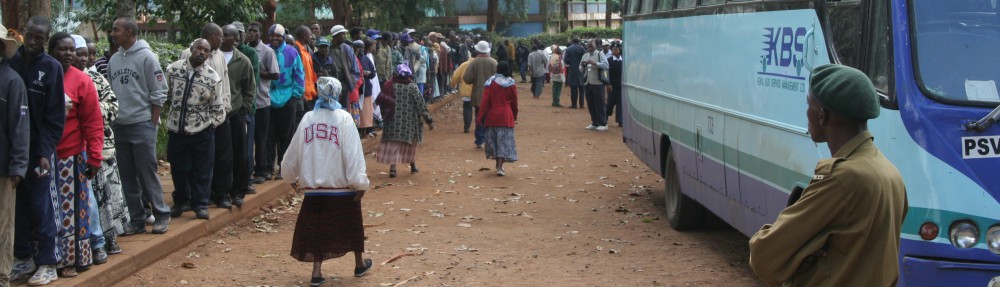
A thought about the International Crisis Group statement headined “Kenyans should come together” . . .

3387011018_0499c6bf57_o

Kenya election banner Kibaki Nakuru 2007

Yes, of course, they “should”.  As we Americans should also, for instance.  How is another question entirely.  Anyone who wants to “help” Kenyans should engage with them and see what they want and need toward that far off goal.

Needless to say, politics and these elections have not historically been involved in bringing Kenyans “together”.  Quite the opposite in fact.

“Shocking” news again from Kenya:  the more things don’t change the more they stay the same.  This election time is quite different than 2007 or 2013 in many ways and not in others.

In regard to post election mechanics (analog and digital), these change a lot each election.  Not as much as the law requires perhaps, but significantly.The process of voting by paper ballot, counting the paper ballots by hand and recording the vote by hand on paper on Form 34A and posting it on the door (or in some cases deciding not to) is fixed and well established, 2007, 2013, 2017.  Kenyans have and do “come together” over this process.  They always do it peacefully.

Not sure why people are seeming to find that to be a novelty.  A great and important thing yes–and it should not be taken for granted. Nor should it be misrepresented as “progress” or any form of “change” each time it is repeated.

So no, this peaceful turnout in long lines to vote by this same process in 2007, 2013 and again in 2017 is not, in fact, an act of faith at all as described by ICG.  It is an act of hope each time.  Arguably for many an act of love for country or subgroup.  Kenyans are broadly faithful, but not in the election process as a whole.

Here is the ICG statement.

Before Kenya’s vote, read Daniel Branch’s The Fire Next Time

If you missed it, amid all the international media scene setters, and very last minute diplomatic appeals, take 9 minutes for “The Fire Next Time: Why memories of the 2007-08 post election violence remain alive.” from Daniel Branch in The Elephant.

Much wisdom on why Kenya has remained stuck following “the debacle of 2007”.

Must read on election tensions in Kenya: “A Silent Panic”

ELECTION 2017: A Silent Panic in Kenya by Dauti Kahura in The Elephant.

A series of backstories of building tensions with the latest election approaching on the layers of accumulated grief and injustice.  This is the stuff you don’t hear if you don’t have a practiced ear to the ground in Kenya and may be glossed over in the usual discussion in foreign capitals and international press.  And material that is too topical for the traditional Kenyan media with political power at stake. 

Congratulations to The Elephant for “speaking truth to power”.

Latest Kenya election remarks from Amb. Godec emphasize need for change; corruption undermining democracy

imageU.S. Ambassador Godec spoke out strongly on corruption in pre-election remarks to students at Maseno University on Wednesday as reported by CapitalFM: “Vote so as to bring change to Kenya says U.S. envoy.”

While emphasizing he personally and the United States favored no candidate or party among Kenyans’ choices, Godec stated:

Corruption is undermining the future of Kenya.  It is creating huge problems and it is underming democracy., security and having a very bad effect and this needs to change.

We seem to be seeing a policy shift from the U.S.  We were strongly opposed to government corruption off and on under Moi after the Cold War and we were also opposed to corruption in 2005-06 with the Anglo Leasing and other scandals.

After getting burned, perhaps, for changing positions in 2007 to become soft on corruption under Kibaki and looking the other way as he stole re-election, we were back to being “against” to some degree on a “go forward” basis after the formation of the “Government of National Unity” in Kibaki’s second Administration.  We preached “the reform agenda” through passage of the referendum to approve the new constitution in 2010 (noting that one pesky problem:  Daily Nation reports that USAID Inspector General has found that US funding did go specifically to encourage “Yes” vote on referendum.)

After years now of being back on our heels for whatever reason, we have rediscovered the dignity required to speak up and now to take a “small dollar” but conspicuous and significant action in suspending a little over $20M in support for the looted Ministry of Health, and now open acknowledgement of that the magnitude of the problem has reached a point that it is a critical threat.

“Africa is a Command” – Bush to Obama to Trump

By electing President Obama we got through with race and became post-racial. Now that we have elected Trump we are surely done with “political correctness”, so lets us speak plainly. What is “Africa” as seen from Washington?

Well, surely Africa is a playground for so many characters, but that is nothing new at all, and we don’t really like to focus on that.  From Trump children big game hunting to politically engaged ministers and ex-diplomats involved in unusual investment schemes, Africa abides.  With election campaigns to run and autocrats to lobby for in Washington.  And missions and aid and economic investment programs continuing apace with varying degrees of pep and power in accordance with the visions and priorities of policy makers.

The thing that is new from U.S. vantage in this century is the overriding common legacy of the Bush and Obama administrations: AFRICOM (recognizing that the new command was primarily planned by the Bush Administration but did not “stand up” until Obama was almost in office).

I never had strong opinions about whether having a separate combatant command for Africa would be better or worse than than the status quo under CENTCOM, et al, that existed in my time working in Kenya and Somaliand in 2007-08.  It has escaped my attention if there are many Americans who see our policies in Africa during the Cold War as a highlight of our better angels, and I think on balance our aspirations for our relations in Africa in this century are higher than back in the past; nonetheless, largely staying out of Africa directly with our own military during the the Cold War and its initial aftermath may have reduced risks that are now potentially at play.

I think it is fair to say that ten years in the December 2006 Ethiopian operation to remove the ICU in Somalia with our support has not over time convinced all skeptics.  In fairness, perhaps, as with the French Revolution, it is still too early to tell.

So did having AFRICOM as a separate combatant command from late 2008 (with a new “whole-of-government” flavor and hardwired entre for USAID and State Department involvement) result in wiser judgment and better execution in terms of US national security and/or related and ancillary command objectives in recent years?

It is hard to judge because it is a big command (aside from the answer being, in substance, classified) but the experience with regard to the Libya intervention in particular is not altogether encouraging.

Would having CENTCOM engaged from Tampa rather than AFRICOM from Stuttgart have made a difference in some way to our consideration of intervention and our planning-perhaps more hard questions initially to Washington from a more “war wary” perspective as opposed to input from an entity with the bureaucratic equivalent of the “new car smell”?  [If inexperience was not a factor, what do we need to change to avoid future repetition if we agree that something went wrong on Libya?]

One way or the other, Trump takes office with AFRICOM at his command, a vast range of relatively small training interactions of a primarily “military diplomatic” nature all over, large exercises and larger programs with many militaries, active limited and largely low profile (from outside) “kinetic” operations  across a wide “arc of instability” and the war in Somalia with a new legal opinion, for what its worth, tying the fight against al Shabaab more explicitly to 9-11 and al Queda.  Along with a real live emergency in South Sudan and several other critical situations from a humanitarian and stability perspective.

I have declined to be persuaded by a dark view of the intentions behind standing up AFRICOM (versus the status quo ante and any realistic alternatives).  Perhaps this is merely self protective since I am, after all, not only American, but also worked for much longer in the defense industry than my brief foray in paid assistance work.  But it is my attempt at honest judgment from my own experience. Regardless, we are where we are, and Donald Trump will be giving the orders at the top to AFRICOM and whatever anyone had in mind, the fact that it is a military command rather than a civilian agency makes a great deal of difference in terms of the latitude that he inherited along with possession of the American White House.

Needless to say I hope it turns out that he has a yuge heart and bigly wisdom however fanciful that hope might look from what he has said and done so far.