Barack Obama, son of American anthropologist, retired President USA, stops in Kenya on way to South Africa after safari

Ten years after 2008 campaign, the “Birthers” have won for now in the U.S., but Obama remains a positive symbol with time for another act:

Former President Obama stopped in Kenya on his way to South Africa, his third visit to Kenya since arriving on the national political scene in the United States in 2004 as an Illinois state legislator through a speech at the Democratic Convention that nominated John Kerry to challenge the re-election of George W. Bush.

It is now ten years since I returned to the United States with my family from our year-long East Africa democracy assistance sojourn in Nairobi in the wake of the failed 2007 election, the post-election violence, and February 28 “peace deal”. The day we flew out of JKIA for Amsterdam en route to Atlanta on the way home to Mississippi I was first exposed to the “birther” conspiracy theory through a front page story in the Daily Nation.

Many may not remember fully now, but recognize that in its inception the “birther” conspiracy theory was not just the idea that then-Senator Obama was secretly born in Kenya, and secretly smuggled into the United States as an infant, and thus not technically eligible to be elected President. It also fit into the context of the claims that Obama was involved as a U.S. Senator from Illinois in 2007 in a conspiracy with Raila Odinga to steal Kenya’s election on behalf of Muslims, with killing of Christians and embellished from there into a narrative that rather than a loyal American Obama was essentially on the side of al-Queda and the global jihad to establish a sharia-enforcing caliphate. That Obama was in essence on the other side of the war being fought by Americans in the “surge” led by Bush and General Petraeus in Iraq as well as the fundamental underlying values of our democratic republic and Western democracy in general.

The conspiracy theories about the 2007 Kenyan election faded somewhat over time–partly because of the peace deal that put Odinga in Kibaki’s government as Prime Minister where he continued to be friendly to the West and partly because it became clearer that the election was stolen by Kibaki’s side which controlled the ECK (and not by the opposition which didn’t). Reports at the time from the American right at the Heritage Foundation think tank and National Review magazine (“Inside Kenya’s clumsily rigged election” Jan 4, 2008 National Review Online) noting the theft of the election helped American conservatives who cared about facts avoid getting sucked into nonsense about a Luo jihad involving “tribesman” Obama and “cousin” Raila.

While there remain a few holdouts who claim that “we can’t know” who won in Kenya’s 2007 election, they seem to be pretty well limited to personally interested parties at this point with the release of the State Department cables showing that our Ambassador Ranneberger himself saw tallies being changed at the ECK and claimed to have encouraged the late ECK Chairman Samuel Kivuitu to withstand the pressure to declare Kibaki the winner anyway, even though Ranneberger knew that the Chairman had no way to control the Committee which was thoroughly stacked by Kibaki in the weeks and months before the election.

Once it is recognized that the vote tallies were actually changed at the ECK, Americans–most especially rock-ribbed traditional stalwarts attracted to “the Tea Party” and/or Donald Trump’s “neopatriotism”–will understand that Kenyans had a duty not just a right to protest the 2007 election. Americans would not trust biometric voter registration (or tolerate secret voter lists) but most certainly the traditional American narrative would demand that we march on our county courthouses if our votes were simply changed by our election officials. Ranneberger’s pre-election cables to Washington made clear that as of that time, the Kenyan courts were not independent and would provide no recourse so that voters would be forced to go to the streets if there was fraud that became known.

Once you legitimize protesting the actions of the ECK, and recognize that the largest category of deaths in the Post Election Violence, per the Waki Commission, were those shot by Kibaki’s security forces, and the largest number that were identifiable by tribe were Luo, then the whole notion of some extraneous evil conspiracy somehow involving Obama and the global jihad as the reason for the post election violence becomes that much more irrational. The portion of violence in the Rift Valley that then-Assistant Secretary of State Jendayi Frazer insisted on calling “ethnic cleansing” in a January 2008 visit (a label not adopted in Washington) was conducted by Kalenjin militia in the pattern employed by KANU in 1992 and 1997. KANU was a religiously diverse secular party that sought to maintain single-party hegemony through compliant cadres among all major tribes and religious groupings in accordance with its political needs. No suggestion that Moi, who personally identified as a Protestant Christian, was a secret Muslim jihadi even though the victims may have been mostly Christians.

The International Republican Institute/University of California, San Diego exit poll funded by USAID (the one showing an Odinga presidential win by roughly six points that was embargoed for six months) gave more evidence in the details that the 2007 election contest was driven, as normal in Kenyan, by tribal rather than religious alignment with Odinga shown as winning a majority of self-identified Christians and of Muslims (although the margin was greater among Muslims). On the other hand, there was a “gender gap” with women favoring Kibaki and men Odinga.

It may also seem hard to remember now but by January 2009 Obama was sworn in to a wave of good feeling with high approval numbers. He had campaigned as a pragmatic moderate Democrat who was against dumb wars and only for smart ones, a Christian who grew up with limited religion who was popular with the irreligious left, the Christian left and made some real inroads courting what we call “Evangelicals” who were not part of the more politicized harder “Religious Right”. The inaugural celebrations seemed to suggest some real healing from the cultural rifts from “the Sixties” and “Vietnam” that featured so prominently in presidential campaigns throughout my lifetime, as well as a milestone to show that we had come so far in overcoming racial prejudice in the post-Civil Rights era that black/white racial issues were no longer much a part of those cultural rifts. Maybe we had more in common than our political leaders had been telling us since the rise of Fox News and the Bill Clinton impeachment saga; maybe this president could be a “uniter not a divider” where his predecessor had failed. In part this failure was because the Bush political operation ended up pulling a “bait-and-switch” by mobilizing gullible church networks to support the invasion of Iraq for regime change using a claimed causus belli of active chemical/biological and nuclear weapons programs then firing up the culture wars further to drive turnout to get re-elected over John Kerry. This was a bad error of moral judgment that has continued to reverberate through American politics.

Kerry was certainly a Yankee patrician from “central casting” — as Kenyans well know from the 2017 election — but was unquestionably accurate in pointing out in debate with Bush that we had gotten “stuck in Iraq”. Of course Kerry was too polite, patrician and/or patriotic to go for the jugular and trash Bush for Iraq the the way Donald Trump did in his 2016 campaign.

For saying that we were “stuck in Iraq” Kerry got pilloried as “unpatriotic” aside from the “Swift Boat” sliming he got over his military service in Vietnam–conveniently not a problem for Clinton, Bush, Cheney or Trump who all managed in various ways not to get sent, and unlike Kerry, did not volunteer to actually go to Vietnam. Nonetheless, the unhealed cultural wounds were still such almost 30 years after the fall of Saigon that Vietnam was a winner for Bush over Kerry in spite of Iraq.

Part of the reason that Obama took office with a waive of good feeling and better numbers than he had during the election was that McCain declined to play along with trashing Obama in the darker ways and treated him as a legitimate political adversary. It was good for the country and gave Obama a fair start in office.

“Birtherism,” though, in spite of McCain’s choice, became an enduring American movement which has had a profound effect on our politics and transformed the Republican Party with which I had been involved for much of my life.

Ultimately, the Birther Movement became a tool for Donald Trump as an outsider to gain “free media” and attention and admiration with those who were otherwise profoundly afraid of or opposed to the Obama presidency.

People like John McCain and George W. Bush or his family members in politics, whatever their faults and mistakes on policy choices (even the really big one, invading Iraq, which McCain acknowledges in his latest book, The Restless Wave) were too experienced, too educated, and too well advised to believe craziness about Obama being secretly smuggled into the U.S. as a Kenyan child (although the McCain campaign did check it out to make sure as did the McClatchy newspaper chain) and were morally constrained, in my judgment at least, from deliberately lying about it to hurt Obama. If you cannot buy that it was morals, at least we can agree that they were restrained by a judgment that it was better politics to stay out of that gutter. Hillary Clinton also stayed away (even if one credits the report that her adviser Sidney Blumenthal triggered the McClatchy review to make sure their was nothing to it).

Donald Trump was not similarly constrained and his hectoring of Obama put him in the front row of politics in America. He shared headlines with Obama even as Osama bin-Laden was being killed by the Navy under Obama’s command. Not one to accept defeat in an argument by being proven factually wrong, in this case by the release of Obama’s long form Hawaii birth certificate, Trump bided his time and cranked the Movement back up for his presidential campaign in 2015 and 2016, discarding it once he had seized the agenda and the Republican Party and the specific “birther” claim was no longer useful to him.

It has been a bit surreal for me to see this happen. Educated middle class Americans of my generation (Obama’s essentially) have a lot to answer for in our complacency I am afraid. Our democratic republic requires more attention and effort than we have delivered in recent years whatever our party or policy preferences.

Fortunately, just as Obama himself has, we hope, time for other acts in his public life as an American after elective politics, the Trump presidency too shall pass and the Birther Movement will be a strange chapter in political history books. It will leave scars and I expect that Trump will be willing to use other lies for domestic advantage that will manipulate gullible people and torque emotions on difficult and divisive social matters. But in the longer term I think we will rise to the occasion and get to a better range of equilibrium. We have significant long term challenges on poverty, education, healthcare and economic mobility and government debt that have been building up during our protracted wartime, but I think Americans getting more engaged and rolling up our sleeves to work on solutions.

Trump as an individual is something of a fluke. Most of the people who voted for him have little in common with him really. I know this because they are my peers, my extended family and friends to a great extent. He lost the national popular vote in a low turnout election. Trump won in large part because neither Obama nor the Clintons succeeded in building a Democratic Party that was seriously competitive in much of the country.

The big difference as of now is that Trump as president in our system still has far less power than the president in any of the East African countries. He will leave office at by the end of his lawful first term or his second if re-elected.

On balance, I think that we will see American policy in its relations with Kenya in the Trump years to continue to be largely a continuation of that under Obama, as reflected in the American approach to supporting both the 2013 election with John Kerry as Secretary of State and 2017 with Kerry as chief election observer and Rex Tillerson as Secretary of State, with Bob Godec as “our man in Kenya” throughout. Just as Obama’s relationship with Kenya in its policy aspects was primarily a continuation of the approach under George W. Bush.

There have been a few major inflection points in the American/Kenyan relationship in the last twenty years, but most have not been specific to whoever was president in either Washington or Nairobi.

The first,of course, was the al-Queda Embassy bombings in Kenya and Tanzania in 1998, kicking off the ongoing conflict between the U.S. and Kenya against various Islamist “violent extremists”. As reflected in the Mombasa rocket attack, the USS Cole bombing, the bombing in Kampala, the various attacks in Kenya, most notoriously the Westgate Mall and Garissa University killings, a persistent understood risk of terrorist incidents have been a regional “fact of life” since. For most Kenyans who are not well secured in their daily bread, and face many bigger daily risks of violent death, terrorism is not quite so central as is to Americans, but has still inevitably shaped both sides of the relationship over the last two decades. And in this context, after 9/11 and our ensuing land wars in South Asia, with the establishment of the Combined Joint Task Force-Horn of Africa base in Djibouti Kenya resumed its regional security role along the lines established in the 1970s and 80s when the United States was fighting the Cold War and Kenyatta and Moi wanted protection from Idi Amin and Siad Barre and the kind of relationship that would be useful to them in avoiding disruption to their domestic rule.

The next inflection point, albeit of lesser magnitude from an American standpoint, was the retirement of Moi and the transition to NARC and Kibaki.

Next was the demise of NARC and the failure of constitutional reform with the 2005 referendum. Relatedly the Anglo Leasing scandal showed security and counter-terrorism were for sale at high levels along with the baseline of corruption in the police and security services that let terrorists move about and in and out of the country. The Artur Brothers and the Standard flamboyantly highlighted the rot.

Next and finally was the start of the war in Somalia to save and reinstate the Transitional Federal Government and oust the ICU in December 2006.

Since that time the United States Government has continued to have and support all our other existing priorities in Kenya such as lifesaving humanitarian health support through PEPFAR and other lower profile programs, food assistance and small farm agricultural support, along with supporting all sorts of philanthropic type programs and the somewhat more controversial “big development” initiatives like Power Africa, frequently in cooperation with other donors.

In recent years we also started devoted more governmental focus to promoting international private financial investment, such as the 2015 U.S. Overseas Private Investment Corporation investment in the Dubai-based Abraaj Growth Markets Health Fund, L.P., that has been active in the Nairobi private healthcare market prior to recently entering liquidation under circumstances being investigated.

Nonetheless, in the meantime we have been at war in a country with a huge border with Kenya. A country during during much of these last 11 1/2 years which has been too dangerous to support a full diplomatic and aid presence and has thus had those parts of the effort supported from Kenya, as well as a smaller role for Kenya as a host for some U.S. defense forces in addition to those at our base in Djibouti. And from reading the newspapers back in the day and a few books it is apparent that Kenya provided some military support for the invasion by the Ethiopian military at the time to contain potential spread of terrorism.

And in 2011, during Kibaki’s second term, with the support of Prime Minister Odinga, Kenya entered the war directly and formally in its own right.

Roughly nine months later the Kenya Defense Forces were admitted into the AU’s AMISOM peacekeeping collaboration, allowing for financial reimbursement through the Western donors, and eventually drove al-Shabaab, now formally asserting affiliation with al Queda, out of their previous position of direct control of the port at Kismayo (not to say that al Shabaab did not continue to apparently benefit from the illicit charcoal and sugar trade through the port).

A few months before the Ethiopians were invited to restore the TFG in Mogadishu, our Ambassador Bellamy finished his service and Ambassador Ranneberger was similarly appointed by President Bush from the Foreign Service. Within a few months after the start of the war Ranneberger sent a cable to Washington explaining that his approach for “achieving U.S. objectives in Kenya’s elections” was to stay quiet on the debates on constitutional reform and election reform and “build capital” with the incumbent. With the perturbation of the 2008 crisis and the intervention for constitutional reform up through 2010, this has remained the baseline beat of our relationship over the years.

Will the recent moves by Kenya’s dominant new Jubilee Party to align with Communist Party of China structures and philosophy to accompany its huge borrowings from the Chinese State cause any serious rethink in Washington? I have no idea, but it certainly does not seem to have captured any particular place in the priorities of either the retired President Obama or current President Trump.
Timely new reading for the latest chapter in the Kenya struggle

Image

image

Brand new from Palgrave, Westen K. Shilaho’s Political Power and Tribalism in Kenya. Reading now.

“Preliminary Findings” released by Kenyan civil society coalition on election

Update 23 Aug – Here is the latest from the  Kura Yangu Sauti Yangu monitoring:    KYSYElectionDataUpdate-WhyDisputed-22Aug2017

Following the unlawful raid on AfriCOG in Nairobi yesterday, today the Kura Yangu Sauti Yangu election monitoring program which has been engaged since long before any of the International Election Observation Missions were constituted, released its Preliminary Findings.

Please read for yourself (especially if you have commented publicly so far on Kenya’s election).

How will the Iran nuclear deal play out in East Africa?

I wish I had a clear sense of how this might develop but I don’t.  It seems to me that there may be several areas of impact over the next few years:

+Diplomatic leverage of Museveni, Kenyatta, Kigame et al vis-a-vis the United States will be reduced as one of the main US “asks”–UN votes to maintain nuclear-related sanctions against Iran–drops away.

+While I do not foresee the current US administration raising expectations for other US priorities from these East African leaders, the next US administration might feel some greater freedom to address “the democratic recession,” declining press freedom, and other issues on the formal US policy list.

+Oil prices:  if a lot more Iranian oil gets to market both in the near term from the immediate impact of lifting sanctions and the longer term from the increase in capacity associated with ramped up foreign investment, the prospects for oil production in Uganda and Kenya will be impacted, especially as related to the 2021-22 election cycle.

+Iran will reassume a stronger role in trade and finance in the region and thus compete more strongly with Israel, Saudi Arabia and the Gulf States.

+Iran will presumably increase its regional naval presence.

+The fall of the Gaddafi regime in Libya and subsequent sad state of affairs in that country reduced one major “petrocash” player in East African politics; an Iran less cash-strapped by UN sanctions might have aspirations to finance East African politicians aside from its espionage/security/terrorism enagement.

New Developments on Iran’s Geopolitcal Efforts in Africa–another challenge for democracy?

Uganda, Iran and the Security-Democracy Trade Space?

High Level  U.S. Delegation Carries Requests to Museveni on Fair Elections and Iran Sanctions

Part Four of “The War for History”: yes, the exit poll discriminated against dead voters

Had I known before late afternoon on election day, 27 December, that “the whole reason” for the USAID-IRI exit poll was “early intelligence for the Ambassador” rather than as a tool to deter and detect potential fraud (as our consultant from UCSD and I were explicitly told some weeks before) I might have made more note of the fact that the exit poll by design generally excluded non-living voters as it was based on live interviews of people who had personally come to the polling place and cast ballots.

Admittedly if the purpose of the exit poll was to predict who the ECK would determine to be the winner, as opposed to simply how living Kenyans voted, this was a serious limitation.

One specific idiosyncrasy that afternoon that was immediately salient was the issue of release to the Ambassador of preliminary numbers reported and collated as of two hours before the polls were to generally close.  I have no statistical reference or otherwise scientific and peer reviewed material to cite for this observation, but it would have been my seat-of-the-pants judgment as the “person on the ground” with some practical experience in campaigns and elections and even with “machine politics” that deceased voters have a pronounced tendency to vote last in sequence among the various voting blocs.

For those wishing to observe the voting process rather than influence it, there are two related reasons why you will not want exit poll numbers to “get out” to actors in the process before the polls close.  One is that potential voters supporting the candidate who is “behind” are perceived to be subject to being discouraged.  Even if this is not a big enough factor to “matter” in the primary race at issue, it has been seen to impact the outcome of other races on the same ballot.  Another is that some voters who might not otherwise elect to turn out may be spurred to action by the perception that their candidate is trailing.  The dead voters are one identifiable bloc that may be particularly susceptible to an appeal of this type.

At the time, I didn’t have any numbers or details to go on that would support a specific adjustment for dead voters in the exit poll.  Some months later the Kreigler Commission estimated a figure of 1.2M decedents who were registered to vote on election day; in January 2010 as discussed in a previous post, Undersecretary of State Maria Otero was headlined in the Kenyan press on a visit saying “we are aware that more than two million dead people voted in 2007”. 

Had these types of numbers been available to me on election day I would have understood the stakes that much better.  Even though this type of voting in the United States peaked before I was born, we can easily see empirical evidence in history of a pronounced tendency of the dead voter bloc to support the party which controls the electoral mechanism, in this case in Nairobi, the ECK.  With the kinds of numbers on the voting role, if ODM/Odinga had roughly six percent more live votes as reflected in the exit poll, the percentage of the deceased who needed to be inspired to cast ballots would be much lower than the overall turnout figures.

In corresponding with a diplomat from an allied country (one with which the U.S. has a mutual defense treaty) before the ECK decision I was told that his expectation was that Odinga would win by roughly five percent.  I replied that this was interesting as I had decided that roughly five percent was probably the minimum threshold for a margin for Odinga that would result in him being accepted as the winner by the ECK.  In hindsight I was probably “drinking the KoolAid” of democratization a bit myself.


Choices and Consequences: Next for Kenyatta’s ICC Defense, October 8 Status Conference [updated]

The International Criminal Court has ruled that Kenya’s President Kenyatta must appear in the Hague for the status conference in his case on the confirmed charges relating to the Mungiki revenge attacks in the eastern Rift Valley during the post-election violence in early 2008. At the time in question he was KANU leader and Kibaki’s new Minster of Local Government following the January 8 appointment of the “upper half” of a new cabinet prior to the African Union sponsored mediation led by Kofi Annan.

The AU process as structured between ODM and PNU negotiating teams stalemated, with the active resistance of key Kibaki “hardliners” and parts of the PNU coalition, including KANU, but Annan was able to get a last minute deal signed off on by Kibaki and Odinga that ended the immediate crisis on February 28.  The settlement led to a Government of National Unity, with the addition of more cabinet ministers and a new, and ultimately temporary position of Prime Minister for Odinga, along with the agreement to appoint commissions to investigate the election itself and the post election violence.

The “Waki Commission” investigating the violence, in an unprecedented display of independence, provided a sealed envelope of key suspects to Annan for potential referral to the International Criminal Court in the event local prosecutions were not forthcoming, along with its extensive public report and redacted annex of persons credibly identified as having a possible individual responsibility for investigation.  (The “Kreigler Commission” followed the ordinary practice of presidential commissions from the Moi era and reported privately to the President, and then released a public report disclosing broad flaws in the overall administration of the election but ducking investigation of the central tally at the ECK headquarters in Nairobi as discussed in Ambassador Ranneberger’s cable here.)

Eventually, Annan turned the envelope over to the ICC, which authorized investigation. Charges were initiated by the Prosecutor against six and confirmed by the Court against four in January 2012, of which one was dismissed by the new Prosecutor.  So how has the defense of the cases been conducted since, or perhaps more descriptively, the counterattack?

Solo 7--Kibera

Solo 7–Kibera

Susanne Mueller’s article from the Journal of East African Studies earlier this year, “Kenya and the International Criminal Court (ICC): politics, the election and the law”, perhaps gives the clearest account of how the game has been played so far:

. . . The ICC began to examine the Kenya situation in 2008-09, well before the 2013 election.  This constituted a potential risk that continued to increase once the ICC received permission to start a formal investigation and the cases progressed.

The election came into play when two of the ICC indictees — Uhuru Kenyatta, a Kikuyu, and William Ruto, a Kalenjin — decided to run for president and deputy president… It was an opportunistic alliance of convenience as the ICC had accused both individuals of masterminding the 2007-08 ethnically targeted violence against each other’s communities. Ironically, this union, the negative ethnicity that accompanied it, and the ICC’s involvement also may have partly deterred violence in the 2013 election.

Winning the election was part of a key defense strategy to undercut the ICC by seizing political power, flexing it to deflect the ICC, and opening up the possibility of not showing up for trial if all else failed. The strategy entailed using a series of delaying tactics to ensure that the ICC trials would not start until after the defendants had won the election and gained power at the highest level. The tactics ranged from mobilizing international organizations against the ICC, making numerous legal challenges designed to delay the court, and the intimidation of potential witnesses, allegedly by defense sympathizers and go betweens, to keep them from assisting the ICC.

The tactics were part of a larger design to undercut the ICC. Demonizing opponents, politicizing ethnicity, and attacking the ICC as a tool of the West both before and during the presidential campaign served this end and victory in the election. Once they won the 2013 election, Kenyatta and Ruto came up with another tactic: asking for concessions based on their political power, including pleas to drop their cases or not be physically present at trials.

Mueller suggests that understanding the interplay between law and politics in this situation, while very much business as usual in Kenya where “the rule of law is still weak, politicized and hard to enforce [and] individuals are often sanctioned for trying” raises serious questions of much broader international application as the Kenyatta, Ruto and Sang cases play out on a global stage in the arena of treaties, international organizations and international human rights norms.

Within Kenya there have been two momentous court decisions since the 2007-08 election and ensuing violence.  Both were decided at the High Court (the Kenyan trial court, not the Court of Appeal or Supreme Court).  The first was the ruling that President Kibaki was not entitled to unilaterally nominate the new Attorney General and Chief Justice.  This led to the compromise whereby President Kibaki agreed to obtain the consent of the Prime Minister for a new selection for the Chief Justice, paving the way for the litigation of the CORD petition over the IEBC’s administration of the election process and the 2013 version of the central presidential vote tally (with the new Attorney General as amicus on the other side of the case).  The second was the lower court ruling that declined, eventually, shortly before the election date, to decide whether or not ICC crimes against humanity suspects were eligible to run for president under the integrity provisions of the new 2010 Kenyan constitution.  Thus in one instance a High Court stood up, and in another one stood aside, and ultimately the larger questions of power and violence at the highest levels within Kenya have been preserved for politics rather than law.

How will the Attorney General and the Kenyan State conduct itself on the international legal stage at its October 7 status conference, and how will Uhruru Kenyatta, as defendant first, and then President, conduct himself on October 8 at his status conference?  I suspect Kenyatta will go, in his own personal interest as a defendant, knowing that he remains a long way from actually facing trial so far, even though by attending he will be undermining some of the anti-ICC forces he has unleashed in his counterattack on the Court.

For me, one the biggest tart ironies of the whole saga is the recent role of the African Union in joining the attack on the Court.  The crimes alleged arose out of a purely Kenyan election dispute.  If the AU wanted to support the inviolate primacy of the Kenyan presidency, why did it not stay out of the matter in the first place in 2008?  The involvement of the ICC is the result of the settlement brokered by Kofi Annan as AU-endorsed emissary, which was agreed to personally by Kenya’s sitting president at the time!

So what matters in Kenya? David Ndii reminds us that most Kenyans do not have enough food . . .

Not to distract from the “news”, the big events like a second Nairobi Carrefour coming to Karen and competing with Nakumatt. . . but for anyone who is interested in Kenya and
has not actually lived there in recent years, I highly recommend David Ndii’s latest Friday column from Daily Nation, “On hunger, and a nation in need of a conscience“:

Hunger stalks this land. One third of the respondents to Ipsos Synovate’s latest opinion poll answered yes to the question whether they or other members of their households ever sleep hungry.

The facts are much worse that the poll’s finding.

The most comprehensive information on our food situation is in a report published by the Kenya National Bureau of Statistics in 2008 titled Food Insecurity Assessment in Kenya.

It shows that over half of Kenyans, 51 percent, consume less than what they require on a daily basis. They consume an average of 1,261 calories per day, against a requirement of 1,683 calories — a shortfall of 422 calories or 25 percent of the daily requirement.

Simply put, half of the country suffers from chronic hunger. . . .

Happy Saba Saba Day–and how is Kenya?

Happy Saba Saba Day–and how is Kenya?. (from July 7, 2012–would appreciate your comments here or by e-mail about what has and has not changed)

What to read if you are going to Kenya?

Kenya post-independence history is covered in two key current books for general audiences and I recommend both.

The more comprehensive is Charles Hornsby’s Kenya: A History Since Independence which I read a few months ago.  Charles brings the advantages of both scholarly training and deep personal experience including several years living in Kenya and much prior research and writing and “Kenya watching”, while at same time offers the independence that comes from earning his living separately, presently as a corporate compliance official.  Hornsby’s book is over 900 pages of deep detail including significant attention to economic policy and the business history that is so essentially a part of Kenya’s politics.   Hornsby’s work will give the basic background on the past interactions and alignments of most of Kenya’s current political figures during the Jomo Kenyatta, Moi and Kibaki years.

Historian Daniel Branch’s Kenya: Between Hope and Despair is also excellent and it is the book I recommended for a quick primer for a friend who was considering a short term election-related assignment in the country in late 2012.  At just under 400 pages it is a much quicker read and will well serve the needs of the shorter term generalist for a tighter summary of the key events; along with the crucial Chapter 12 (titled “Back to the Future”) of Hornsby’s history–with the best detailed summary I’ve read of the vital 2007 campaign and election–Branch’s book will give general readers some understanding of the lay of the land in public affairs in Kenya in a few short hours.


More impressions from observing voting in Nairobi

One big challenge is slowness of process–certainly no surprise at all which is why my civil society colleagues asked that the contingency plans for this be announced ahead of time by the IEBC (electoral commission). Poll openings at 8-10am appear common in Nairobi rather than scheduled 6am–again no surprise given the logistics involved. It certainly appears that in most cases a paper rather than electronic poll book is in use. Further it appears that complete absence of working electronic BVR for voter identification is common. Some polling streams never received hardware at all; others received too little or found it unusable for whatever reason.

Wholly manual voting then is normal, even though the voter registration was truncated to provide for the use of BVR. Given that the voting is inevitably slow and the turnout is huge, I heard from one fellow observer of polling station workers just taking down names of people who presented IDs and allowing them to vote because it would take too long to try to find and check off names on the paper lists.

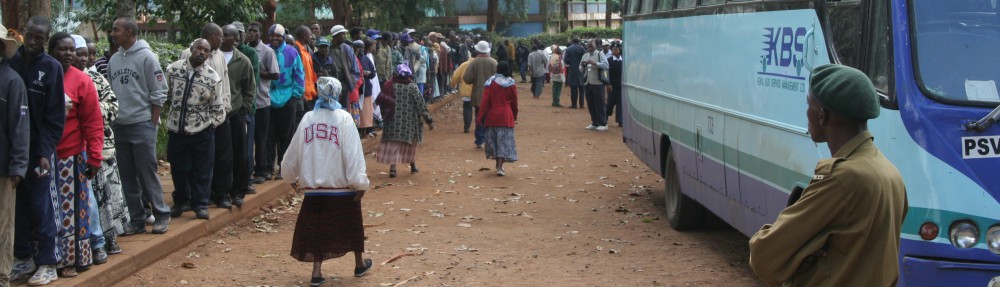
The voters are being in general extremely patient with hours of pre-dawn queuing and waiting in hot sun. Ordinary Kenyans in Nairobi certainly are demonstrating both peace and a commitment to the voting process itself.

The unexpected problem, to me and people I have spoken with, is that the ballot boxes were getting close to full with only a relatively small percentage of voters having voted. Presiding officers indicated no backup capacity, but were shaking the boxes to settle the cast ballots..