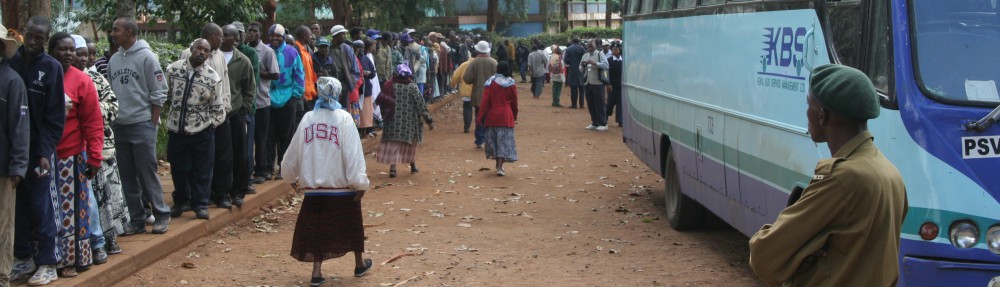
With DRC’s Kabila backing substitute candidate this year, time to review international observation experience from 2011 vote

[Updated Aug 9]

The Democratic Republic of Congo stands out as a wealthy country with mostly very poor voters, a fairly poor government, extremely poor governance, high corruption, pervasive political violence, a current humanitarian crisis on a Yemani scale and as a “honeypot” for some of the worst people in the world.

The announcement, at the filing deadline, that term-limited incumbent president Joseph Kabila would not be his faction’s candidate in the upcoming national elections (legally due last year) has generated some relief. See “Joseph Kabila, Congo strongman, will step down after 17 years in power” in the New York Times.

In Congress, Representative Ed Royce, chairman of the House Foreign Affairs Committee, said he approved of Mr. Kabila’s decision — “after 17 dark and bloody years” — to step down.

“Now, deadly government crackdowns must stop so the Congolese people can choose their next president in free, fair and transparent elections,” Mr. Royce said. “Any credible election will allow opposition candidates to run campaigns free from legal harassment, intimidation and physical harm.”

A decent election in December would be a huge “win” for Congolese and for international democracy advocates but sobriety is in order as to whether that becomes a realistic possiblity as the much-delayed date approaches.

At the time of the last election in 2011, Africa democratizers were buoyed by an understood success story in Ghana, the hope of an “Arab Spring”, the lull of violence in Iraq and more generally encouraging environment. As explained in my posts from that time, the U.S.- funded International Observation Mission (conducted by the Carter Center) found the election to fall short of adequacy by the applicable international standards and said so explicitly.

Initially standing up to Kabila over the failures of his alleged re-election and pushing for them to be addressed appeared to be U.S. policy.  If so, we apparently changed our mind for some reason.  Tolerating a bad election then leaves us in a more difficult position with seven years of water under that bridge.  The U.S. has stepped up recently to pressure Kabila to schedule the election, allow opposition and stand down himself.

In this vein, we need to be careful, and transparent, as things proceed to continue to evaluate realistically what is feasible and where we are really able and willing to assist.  In particular, the decision to initiate and fund one or more Election Observation Missions for a vote in these circumstances should involve serious soul-searching at the State Department (and/or USAID).

On the last election:

DRC: “We have to debunk the idea that it is peace versus transparent elections. The idea that lousy elections are going to bring piece is madness.”

Carter Center calls it as they see it in DRC

U.S. and other Weatern donors support review of election irregularities in DRC — offer technical assistance

State Department to Kabila on DRC Presidential Election: “Nevermind”?

Carter Center, NDI , EUEOM and other International Observers should follow up on Cambridge Analytica, other actors in Kenyan elections

To the best of my knowledge and recollection, none of the various Election Observation Mission reports from Kenya for the March 2013 election covered the role of SCL Group of Britain (subsequent parent of Cambridge Analytica) for Uhuru Kenyatta. Nor were other foreign contractors for either side addressed to a substantial degree. [I will check back on this and add reference to anything I find.]

Likewise, I do not believe that Cambridge Analytica, SCL or Harris Media were examined in the 2017 Election Observation reporting. [I covered the final reports from the EUEOM here (January) and the Carter Center here (March).]

With new revelations coming — in addition to The Star reporting from pre-election 2017 I mentioned in my last post — I think this warrants follow-up. NDI and ELOG still have 2017 final reports outstanding so they are presumably well situated to cover this important part of the factual background the election competition in Kenya.

Given the apparent “slow roll” on the duty to investigate the Msando murder from July 2017, together with new questions now coming up about the 2012 death of Romanian Dan Muresan while working in Kenya for Cambridge Analytica on Kenyatta’s original campaign for the 2013 presidency, Election Observation Missions, and the democracy assistance establishment in general, have a lot of unfinished business.

The concerns are not new. See this from June 2017 at Snopes.com: “Privacy advocates concerned about Kenyan Governments hiring of Cambridge Analytica“.

For one of the best pieces assessing the questions faced is Nanjala Nyanbola’s “Politics in the Digital Age: Cambridge Analytica in Kenya” at AlJazeera English.

Another must read is Nic Cheeseman and Brian Klaas’ cover feature “How to Rig an Election” in The Spectator.

Carter Center releases Final Report on Kenya’s Elections

Download: Carter Center: Kenya Final Report General and Presidential Elections 2017[pdf]

Read the whole thing — that is what we American taxpayers have paid for. In summary: “Regrettably, the elections represent a major setback in Kenya’s democratic development.”

Kenya 2013 election IRI Electoral Commission voter education poster

(h/t Daniel Finan of RFI English)

Update: (As of this morning, 8 March) I was not able to find the Final Report or related material on the Carter Center website.)

Most recently the Center had summarized: “The Carter Center said that the fresh presidential election was not fully competitive and marked by insecurity and political uncertainty. It called for national dialogue and reconciliation process to heal political and tribal rifts that were made worse by the 2017 elections.”

Raila on the Kenyan elections at CSIS

Catch the webcast, live Thursday morning 9:30-11:00 EST:

“Raila Odinga on the Kenyan Elections” with Amb. Mark Bellamy at the Center for Strategic and International Studies in Washington.

The link will also take you to the video for CSIS Africa programs addressing the Kenyan election in June, July, August and September.

Meanwhile, the AP has a story out this afternoon widely re-published in American newspapers: “After Kenyan vote drama, successionist talk hits the mainstream“.

The succession concern may likely have resonance in Washington given U.S. interests, although my sense is that the economic boycotts are the most salient message in Nairobi.  During the PEV period following the corrupted 2007 election, ODM backed off on threats of such economic boycotts which seemed risky as unprecedented and perhaps perceived to be “over the top”.

Vogue gives us “Three Nairobi Fitness Excursions Prove There’s Plenty of Life Beyond the Safari” for Americans who want to play around the city after their “humanitarian” trip to Kakamega from the U.S.

And the Carter Center has released a statement on the October 26 re-vote mirroring the State Department’s call for “national dialogue”: “Repeat poll polarized Kenya: Carter Center” headlined the Daily Nation.

Update: A Thursday story in The Star reports that  “British Army may pull out of Kenya, decision by end of month“.  The issue is KDF approval for leases of private land in Laikipia, the established practice, as opposed to a restriction to using only Kenyan government property.

For a good overview, see “The Kenya Election Crisis, Explained” at UNDispatch         by Kimberly Curtis.

Kenya cannot have a free and fair presidential election without consent of the President

This is the underlying reality that I have routinely pointed out privately as well as mentioned here.  No president in Kenya has ever lost a re-election.  Uhuru Kenyatta had a decision to make as to whether he was willing take a risk of losing at the polls or not. (In 2007 it was clear, as seen with hindsight, that Mwai Kibaki was not willing to take that risk.  He controlled the ECK accordingly.)

Peace Wall Kibera Nairobi Kenya 2008

Under the new Constitution adopted by virtue of the 2008 Post Election Violence settlement and with effectuation of some reform, the new Supreme Court to almost everyone’s surprise held its independence and applied the law to find that the IEBC did not meet the minimum requirements of the law in declaring the President re-elected without full and reliable results under required procedures.  Even in this context the Court was careful not to blame the President or the Executive branch for the use of state resources and the underlying irregularities and illegalities that were seemingly born as orphans within the IEBC.

Since the Supreme Court’s ruling the Court and the Judiciary have been under attack from the Executive just as the IEBC has been under attack by the opposition.  On balance, the international diplomatic community re-iterated its ongoing multi-year endorsement of the IEBC, consistent with the “Preliminary Statements” of the major international election observation missions in 2013 and on August 10, 2017.  On balance, the international diplomatic community has said little about protecting and preserving the hard won independence of the Judiciary.

Today, the Supreme Court fell.  The Interior Minister signaled an intent to order that today be a public holiday (“election day eve”?) and the driver of the Deputy Chief Justice was shot while running an errand in the Justice’s car.  When the Court convened to hear and decide the urgent matter of whether the presidential election nullified from August 8 could be conducted by the IEBC tomorrow in light of the Court’s previous ruling, only the Chief Justice and one associate showed up.

With a majority of the Supreme Court “missing in action” the Chief Justice determined that no quorum existed, the hearing could not be held so that so that there is no authority to determine the law separate from the President who has declared throughout that his one “irreducible minimum” requirement is that the presidential vote be held on October 26.

Then the High Court ruled on a separate challenge—reminiscent of Judge Leonola’s ruling in 2013 on AfriCOG’s petition to enjoin the vote tally by the IEBC after the “failure” of the results transmission system—that jurisdiction to challenge actions involving the presidential election rests only at the quorumless Supreme Court.

It is clear to all that the IEBC is not ready, and belated calls have been coming to postpone the vote but the bet on the IEBC was already placed and when the diplomatic community chose to leave it down in the face of the dramatic defection of Roselyne Akombe, whose name is now usually “one commissioner”,  the game may be over on that front.

I do not assume that writ large this outcome in Kenya constitutes the fruition of or is consistently underwritten by some coherent foreign policy agenda of the United States and/or the UK or other Western countries that have supported the ECK/IIEC/IEBC over the past 15 years.  This is the third U.S. administration to be involved in this scenario and going back even through the entirety of Kenya’s history the persistent thread is that we support the President (whether we like or respect him).

Uhuru Kenyatta has specific relationships of various sorts among certain American elites, but that is a very different—and perhaps contradictory—thing from the idea that Kenyatta’s behavior supports specific foreign policy objectives of the United States.  The great strength of the United States as a relatively open, chaotic society with turnover and diffusion of power is that much of what is often seen as “policy” from more repressive vantage points is more like “stuff that happens” seen from within our system.

[Nonetheless, I will have more detailed and informed opinions about the August elections when I finally get from USAID documents I requested in 2015 about our support for the IEBC in 2013.]


A must read and some thoughts on context as Kenyan presidential politics continues


  1. As a necessary corrective to fatalism, start with an important piece from Patrick Gathara in today’s Washington Post:

Raila Odinga and the surprising bright side to Kenya’s never ending election.

Events of the last few days are more twists, turns and wrenching associated with Kenya’s status as being stuck or frozen by the stolen election of 2007 and its aftermath, pending forward movement to truly realize a new system under the new constitution approved overwhelmingly in 2010, or back into a now-digitized/globalized version of a single party power structure based on elite-level tribal bargains.

Based on the 2013 election and Kenyan history, in the immediate run the continued retrenchment of democracy is surely likely, but we can hope otherwise.  And most importantly, Kenyans can keep their eyes on the horizon and recognize that much of the work of getting Kenya (back?) to the state of democratic openness that was preceived to have existed in the early times after the defeat of KANU at the polls in 2002 will remain regardless of who is president.

And the vital task of acheiving a transparent and trustwothy, bona fide independent electoral commission must not stop with the immediate “fresh election” regardless of when it is or whatever limited progress is obtained through current NASA demands for “irreducible minimums”.

ODM and Wiper and other parties made a mistake by waiting until early 2016 to focus on forcing reforms of the Issaak Hassan “Chickengate” IEBC of the badly administered 2013 election.  Even though agreement was obtained to replace the Commission with loss of life of protestors killed by police by mid-2016, the old Hassan Commission stayed in control until early this year, after budgets and plans (and some contracts apparently) were in place, assistance programs by the United States and others contracted–and apparently adjusted by demand of the incumbent ruling party.

The new Commission inherited Hassan’s staff and remains quite murky as to the extent that they are de facto independent enough to effectively manage and discipline that staff.  The selection process was messy and murky and the Vice Chair of the Commission turns out not to have resigned her job with the UNDP but rather taken “leave” of undisclosed terms while serving.  Are other Commissioners of uncertain independence from other players in administration of the elections? (I am not concluding that Dr. Akombe is not independent of the UNDP–just that there are unavoidable questions which neither the UNDP nor Dr. Akombe seem willing to address–nor Kenya’s media to take up.)

No incumbent president in Kenyan history has been found by Kenya’s election management body to have lost an election–certainly the opposition has always known it had an uphill battle to have real hope of winning, aside from the fact that the incumbents have strong support in their bases and were ahead by a few points in most polls as of late July.  In this environment, the failure to achieve deeper reform of the old IEBC by early 2017 was probably fatal to a real chance to win all other things being equal.

The surprising and gutsy decision of the Supreme Court of Kenya to rule that the IEBC’s conduct was just too far beyond the pale to pass legal muster gave everyone another chance, but of course it did not change any hearts and minds of people who were never willing to risk of losing office at the polls in a free and fair vote.

The United States and other donors attracted a lot of published advice from its own employees and through indirectly supported sources like the International Crisis Group stressing the importance of transparency for trust building but elected instead to continue to stay the course of underwriting the ECK-IIEC-IEBC and publicly promoting its output to Kenyans without re-consideration of the risks and costs of non-transparency and undisclosed failures with the electoral management process, such as the alleged bribery in 2007 that warranted undisclosed US “visa bans” and the subsequent “Chickengate” bribes and the bogus procurements of technology that left Kenyans exposed again in 2013.

This is not rocket science.  Kenyans who are increasingly divided by tribalism as their politicians offer and deliver less democracy and less other models of leadership, are more likely to accept and trust what they are openly shown and explained.

Trust and Accountability”-  Africa Center for Strategic Studies scholar discusses steps to a peaceful  election.

I will be prepared to more substantively address the 2017 vote/s once I get the documents I am due and expecting from my 2015 FOIA request about the 2013 election.  Until then, we can still decide to do what we know can be most helpful to build trust if we want to.

Update: do not miss this – “Against second rate democracy in Kenya” from Aziz Rana in the Boston Review.

Kenya’s “fresh election”: new statement from Carter Center EOM and background on UNDP election support to GOK

Today the Carter Center Election Observation Mission released an additional report discussing briefly the findings and proceedings of the Supreme Court of Kenya in deciding the presidential election petition but primarily focused on the negotiations and preparations for the “fresh election” scheduled by the IEBC for 26 October.

kenya-statement-supreme-court-ruling-100417kenya-statement-supreme-court-ruling-100417

There has been some public controversy and debate, as well as confusion, about the role of the UNDP in the funding and management of this years Kenyan election to a degree that was not apparent in the last two cycles.  The UN is a big presence in the Nairobi and Kenyan economic and political scene, so it hardly surprising that their role in the overall outside democracy assistance program would come into scrutiny where things went badly and the election was annulled.  Most recently there was an offer made by the IEBC to have the UNDP undertake ballot paper procurements, for instance, which was declined by the candidates.  (I am not ready to wade into the thickets of the controversy about the fact that the most public face of the Commission itself other than the Chairman has retained her employment with UNDP in a leave status while accepting appointment from the President and taking office as an IEBC Commissioner in January and related matters,)

From an EU report at the beginning of the year:

  • The UNDP-led “Strengthening the Electoral Processes in Kenya Project” aims to strengthen Kenya’s electoral institutions, systems and processes in Kenya in view of the 2017 elections.

Following the EU’s support to Kenya during the 2013 elections, the EU is capitalising on the lessons learnt from that period to provide a better electoral support mechanism for future elections. The EU’s financial contribution to “Strengthening the Electoral Processes in Kenya” aims to develop stronger legal and institutional structures that will lead to transparent, credible and peaceful elections, as well as leading to more informed participation in the electoral process. In particular, we expect:

  • a strengthened institutional and legal framework for the electoral processes;
  • a strengthened participation of voters, parties and candidates in the electoral process with emphasis on women, youth and disabled
  • the delivery of more efficient, transparent and peaceful elections
  • a strengthened electoral justice and increased compliance with the electoral framework

The programme supports activities that cover the whole country. Beneficiaries of it include the Independent Electoral and Boundaries Commission (IEBC), which will be the largest recipient of the programme’s assistance. Other beneficiaries include Kenyan institutions and organisations involved in the drafting of legislation, dispute resolution between political parties, media regulation, women’s empowerment and security, including:

  • the Office of the Registrar of Political Parties
  • the Kenya Law Reform Commission
  • the Judiciary and Political Parties Disputes Tribunal
  • the Director of Public Prosecutions
  • the Police Service
  • the National Cohesion and Integration Commission
  • the Parliament
  • other government agencies including county governments
  • civil society (including women movements) and media

The EU is contributing EUR 5 million to a projected total basket fund amount of EUR 21,5 million (US$24 million). The other donors to the “Strengthening the Electoral Processes in Kenya” project are currently DFID and USAID; some other donors might also join. To date (as of January 2017) US$14.65 million has been raised. The basket fund became operational in the second half of 2015, and activities will last till the end of 2018. The implementing partner is UNDP, with support from UNWOMEN.

Source: “EU support for democracy in Kenya” 17/1/2017

Kenya’s election “compromised and contaminated” or “compromised and bungled” by IEBC finds Supreme Court

The Supreme Court of Kenya’s long awaited reading of its full opinion on the presidential election petition this morning squarely hammered the discrepancies between the process requirements of the law and what the evidence showed  happened.

The Court found explicitly, for example, that the affidavit submitted by the IEBC asserting that all of the tally papers had security features was contradicted by the documentary evidence eventually produced by the IEBC under order of the Court in the hearing.

The Judiciary website seems to have been down from before the announcement so I will have to wait to read the opinion.

The Court made clear that there would be no basis for it to uphold a similarly compromised process in a fresh election.

The ball is squarely in the “court” of the IEBC and its advocates and funders to grapple with the “contamination” and its causes to find a solution.

(On the submission of the Preliminary Statements of Election Observation Missions as evidence to bolster the defense of the IEBC, the Court said they could not be considered as they did not go beyond looking at the voting and counting at a sample of polling stations.  This is good news in correcting one of the flaws from the original 2013 presidential petition litigation.)

Update: Business Daily: “”Supreme  Court says IEBC failures led to poll nullification”.   

Globe and Mail:  “Kenyan Court blasts Election Commission as political tensions rise”


FREE, FAIR AND CREDIBLE? Turning The Spotlight On Election Observers in Kenya | The Elephant

Published today in The Elephant: FREE,FAIR AND CREDIBLE? Turning The Spotlight On Election Observers in Kenya | The Elephant by Ken Flottman.

A classic example of why Kenyans are frustrated with the mix of international Election Observers and Media

Kenya 2007 election Kibaki Tena Kazi iendelee re-election

Can John Kerry help stop Kenya from slipping into Post-Election Violence Again?“, Newsweek, 10 Aug 2017:

Beyond the “Western patrician savior” headline:

. . . .

I know what it’s like to lose an election. I lost by one state the presidency of the United States, and I had a lot of reasons to complain about what happened in Ohio or in other states. But you gotta get over it and move on,” said Kerry Thursday at a press conference in Nairobi, where he has headed up the election observation mission from the Carter Center. Kerry was likely referencing issues with the voting system in Ohio that led to a recount and reduced margin of victory for Bush.

 The result—and perhaps more significantly, the aftermath—of Kenya’s presidential election is not yet clear. With almost 99 percent of the votes counted, incumbent Uhuru Kenyatta is in front with 54 percent of the vote, ahead of opposition leader Raila Odinga at 45 percent. Kenya’s electoral commission has said the result will be confirmed on Friday.

But Odinga has signaled he will not accept the result quietly. Odinga stated on Thursday that unknown figures had hacked into the electronic systems of the electoral commission—using the identity of Chris Msando, the commission’s IT chief who was tortured and murdered less than two weeks before the vote—and swayed the vote in favor of Kenyatta. Odinga has called for calm but has also not ruled out summoning his supporters to the streets.

Such a move would have a dreadful familiarity in Kenya. After the 2007 election, which Odinga lost to incumbent Mwai Kibaki amid allegations of rigging, supporters of both candidates clashed over several months in an ethnically charged conflict that left more than 1,000 people dead.

Kerry has led the Carter Center’s observation mission in Kenya, which saw observers deployed at more than 400 polling stations across the country, as well as 36 tallying centers. The center said in a preliminary statement on Thursday that despite some problems in the transmission of results from polling stations to tallying centers, the vote had been conducted in a peaceful and calm atmosphere. It urged candidates to wait for the official results before commenting and to “use established legal channels” to resolve any disputes and “ensure that their supporters remain calm” before and after the results have been confirmed.

Kerry himself said the vote appeared to have proceeded in a free and fair manner. “The process that was put in place is proving its value thus far,” he said. “Kenya has made a remarkable statement to Africa and the world about its democracy and the character of that democracy. Don’t let anybody besmirch that.

Former President Barack Obama also has urged Kenyans and their leaders to reject “tribal and ethnic hatred” and to “work together no matter what the outcome.” (emphasis added)

Facile comparison to very dissimilar 2007 situation (see my The Debacle of 2007 in The Elephant here.)  Exaggerated time period for that violence ten years ago (most of the violence was within one month of the election and the settlement was reached at the end of the second month).  No mention that following new the constitution in 2010 as a result of the 2008 settlement, the Odinga v Uhuru dispute of 2013 resulted in no widespread violence and much smaller numbers of opposition supporters killed by State for protesting.  No mention that the country in August 2008 was basically locked down by a massive and oppressive state security deployment.

No substantive focus on the main electoral problem: failure of results transmission system, as in 2013 (and mirroring 2007) yet bare assertion that 99 percent of vote counted.

Advocacy by Kerry beyond written statement of his Carter Center Mission that the election appeared to meet standards and to achieve the (Western) goal of an African success story and “Don’t let anybody besmirch that”. Etc.

Kenya Election Trump White House congratulates Kenyatta on fair and transpaent re-election