Carter Center, NDI , EUEOM and other International Observers should follow up on Cambridge Analytica, other actors in Kenyan elections

To the best of my knowledge and recollection, none of the various Election Observation Mission reports from Kenya for the March 2013 election covered the role of SCL Group of Britain (subsequent parent of Cambridge Analytica) for Uhuru Kenyatta. Nor were other foreign contractors for either side addressed to a substantial degree. [I will check back on this and add reference to anything I find.]

Likewise, I do not believe that Cambridge Analytica, SCL or Harris Media were examined in the 2017 Election Observation reporting. [I covered the final reports from the EUEOM here (January) and the Carter Center here (March).]

With new revelations coming — in addition to The Star reporting from pre-election 2017 I mentioned in my last post — I think this warrants follow-up. NDI and ELOG still have 2017 final reports outstanding so they are presumably well situated to cover this important part of the factual background the election competition in Kenya.

Given the apparent “slow roll” on the duty to investigate the Msando murder from July 2017, together with new questions now coming up about the 2012 death of Romanian Dan Muresan while working in Kenya for Cambridge Analytica on Kenyatta’s original campaign for the 2013 presidency, Election Observation Missions, and the democracy assistance establishment in general, have a lot of unfinished business.

The concerns are not new. See this from June 2017 at Snopes.com: “Privacy advocates concerned about Kenyan Governments hiring of Cambridge Analytica“.

For one of the best pieces assessing the questions faced is Nanjala Nyanbola’s “Politics in the Digital Age: Cambridge Analytica in Kenya” at AlJazeera English.

Another must read is Nic Cheeseman and Brian Klaas’ cover feature “How to Rig an Election” in The Spectator.

Who has done the best writing so far about the fake NGOs and “bots” in the Kenyan election campaign?

Asking for a friend.

FREE, FAIR AND CREDIBLE? Turning The Spotlight On Election Observers in Kenya | The Elephant

Published today in The Elephant: FREE,FAIR AND CREDIBLE? Turning The Spotlight On Election Observers in Kenya | The Elephant by Ken Flottman.

What Carter Center actually said in Preliminary Statement: “Given that the tallying process is ongoing, the Center is currently unable to provide an overall assessment.”

From the Carter Center Preliminary Statement (August 10):  Carter Center Prelim Stmt of Vote Tally and Transmission of Results

For a Kenyan view, see “IEBC results: We’ve more questions than answers” writes Muthoni Wanyeki in The East African on August 22.

It would be easier for Mr. Chebukati and Mr. Kerry to make their case to Mr. Odinga’s supporters with much greater transparency

There is a lot that Kenyan voters could be told that they have not been told about how their votes were represented to them by the IEBC over the last several days since they voted and all the ballots were counted Tuesday evening.  As assurances given to the voters in 2007 and again in 2013 in the immediate aftermath of voting those years did not in some substantial respects turn out to be factually sustainable, it is no suprise many Kenyans would want to verify rather than just trust now.

One would expect everyone involved this year to anticipate questions.  There were lots of prominently published warnings of the need for transparency (from the International Crisis Group among others).

Mr. Kerry was Secretary of State in 2013 and presumably has current clearances that would allow him as an individual, now post-government service, to make doublely sure he is fully briefed about the failed Results Transmission System of 2013, as well as other past problems, if he wasn’t before coming to Nairobi last weekend for the Carter Center.  Presumably he could also ask the current US and Kenyan governments to go through the details relating to procurement and use of KIEMS this year.  Then he could answer questions and demonstrate the kind of transparency that would build trust.

Alternatively Mr. Chebukati and the current U.S. government could answer questions irrespective of the Carter Center or other independent Election Obsevation Missions.

Mocking democracy: Government of Kenya announces “Kenyan Asian community backs President Kenyatta’s re-election”

Democracy Assistance

“URAIA Because Kenyans Have Rights”  — Democracy Assistance facade?


[Update: The Daily Nation, State Officials on the campaign trail“:  “The Jubilee administration has deployed civil servants and key government officials on vote hunting missions across the country in contravention of the law.”]

Let it not be said that there is any serious pretense that the Government of Kenya is neutral in the contest for political allegiance of potential “swing” ethnic groupings, rich in votes or money, in the current election, a contest for power between the Uhuruto ticket representing the current generation of the original KANU establishment led by the Kenyatta family and an opposition coalition led by Raila Odinga and Kalonzo Musyoka.

Here is the “latest news” from the Government of Kenya, Office of the President (www.president.go.ke): “Kenyan Asian community backs President Kenyatta’s re-election”.

This years’ “Jubilee Party” was literally formed at State House as the Uhuruto re-election vehicle, formally merging Uhuru Kenyatta’s TNA and Ruto’s URP, just as this meeting of State Officials and “Asian” Kenyan businesspeople and politicians for the re-election campaign was convened at State House.

Conduct of this sort, aside from being a clear form of corruption per se as a misappropriation of public resources for private gain, is explicitly against the mandatory Code of Conduct for the Kenyan political parties.  (On paper the campaign, in full swing for months, is not even to start until May 28.)

Will the Registrar of Political Parties and the Independent Electoral and Boundaries Commission take action?  The IFES led consortium of US based organizations both facilitating and underwriting the cost of the election, while also coordinating its “observation” at the expense of American (and in parts Canadian) taxpayers?  What about ELOG, the donor supported Kenyan observation group?

IFES has already beeen attacked by the Kenyan Government and ELOG is charged with continuing to do business in Nairobi on a permanent basis, so it would be a huge act of institutional courage for it to seriously challenge the conduct of the Office of the Presidency.  We have been in the mode of continuous institutionalized democracy promotion in Kenya for 15 years (!) now.  No matter how many  capacity building seminars we hold for the little people in the cities or the politicians in the resorts in the Rift Valley or at the beaches, if we let ourselves simply be mocked and pretend that this is working we will surely risk moral injury to our own democracy.

Read the whole campaign piece here:

The Asian community in Kenya has endorsed the re-election of President Uhuru Kenyatta.

Leaders of the community said they have taken the decision to rally behind the President because of his commitment to creating an enabling environment of business and development.

The leaders, who visited President Kenyatta at State House, Nairobi, said policies implemented by the Jubilee Government have enabled more business to thrive and made Kenya a preferred destination for investors.

At the meeting which was also attended by Deputy President William Ruto, representatives of the community assured the President that they would rally behind him to ensure the country’s development tempo is sustained.

“What we have seen in the last four years needs no magnification and my words can be supported by facts that can be seen and quantified, “said businessman Iqbal Rashid.

The businessman cited the upgrading of the old railway system with the Standard Gauge Railway, the upgrading of the Jomo Kenyatta International Airport and continuous improvement of the infrastructure connecting cities and towns.

He said the continued flow of investments into Kenya from all corners of the globe was as a result of the confidence in the leadership of President Kenyatta.

Women leaders Parveen Adam, Shamsha Fadhil and Farah Mannzoor thanked the President for championing an agenda that fosters inclusiveness as well as the prosperity and unity of all Kenyans.

They said women appreciate his efforts to spearhead the campaign to have the two third gender rule passed by the National Assembly.

Businessman Bismiahirahman Nirrahim said the Asian community has witnessed the transformative leadership of President Kenyatta which has helped in creating conducive environment for investments.

He cited the increased ease of doing business resulting from President Kenyatta’s policies including the policy to reduce the time it takes to register a new business.

Nirrahim said the youth and women empowerment program implemented by President Kenyatta’s Administration has also been a transformational policy that deserves praise.

President Kenyatta thanked the leaders for their support and assured them that he would continue working tirelessly to make Kenya a more prosperous country with shared prosperity.

He said the Asian community has been keen in developing Kenya saying the community has always been in the forefront championing the interests of the nation since the days of independence struggle.

“Like all of us you were part and parcel of the Kenyan struggle for Independence, the role you played cannot be ignored,” said President Kenyatta.

The President said he is a believer in an inclusive society adding that he would want to see the Asian community participate more in both social and economic development of the country.

“This is the government that believes in encouraging partnership and working together. Your success is our success,” said President Kenyatta.

Also present were the Chief of Staff and Head of Public Service Joseph Kinyua among other senior government officials.

Author

Gok

Update May 26:  See “Asian Kenyans seek to be declared a ‘tribe’ of their own” in today’s New York Times.
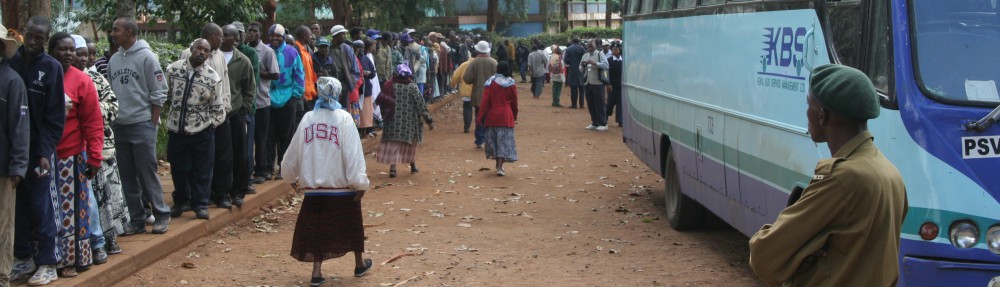
Kenya Election “must read” from Maina Kiai: Of suspect opinion polls and a false image of an efficient IEBC (Daily Nation)

“Of suspect opinion polls and a false image of an efficient IEBC”

Kiai has taken note of a transparently fake “NGO” that has been playing in this years’ campaign space to sell in advance whatever results are going to be announced.  As you would expect in Kenya this “group” does not even seriously try to be subtle enough to be plausible to sophisticated observers, but gets picked up in the Kenyan media in pari passu with bona five organizations without scrutiny (at least until Kiai’s column).

Let’s hope international reporters who “fly in” for Kenya’s election do their homework this time.

Here is Kiai on where things stand as time winds down for election preparation:

. . . .
IEBC’S CREDIBILITY

Something smells really fishy here, verging on being “fake news” meant to influence us with false information.

We clearly have not seen the end of that and we should all try to verify whatever is presented in the media.

And we have been here before. In the lead-up to the 2013 elections, the IEBC was polling as one of the top two institutions that Kenyans had confidence in, together with the Supreme Court, at the time led by Chief Justice Willy Mutunga.

But with all the shenanigans around procurement, gadget malfunctions, “server crashes” and a return to the discredited manual system for voter identification, tallying and transmission of results, the IEBC quickly lost its credibility.

The “chicken-gate” scandals involving the then chairman of the IEBC and the CEO further damaged the IEBC, even if the politicised Ethics and Anti-Corruption Commission eventually “cleared” the chairman.

ELECTORAL MALPRACTICE

I am not holding my breath that this IEBC will deliver credible, free and fair elections with the way it is operating.

It blames the courts for its unpreparedness, but this is more than about competence.

Like 2013, there is an emerging sense of willfulness in the way it is making decisions, short-cutting steps that could mitigate some of the emerging worries.

Incredibly, many of the key staff members who were involved in the previous mangled elections are still in place!

I am baffled that despite the court ruling that declares results final in the polling stations, the IEBC has not yet announced plans to ensure that returning and presiding officers are not only recruited transparently, but are based outside their home areas, to reduce ballot stuffing, especially given that we will probably use the easy-to-manipulate manual identification.

Now more than ever, these officials on the ground will determine the veracity of the election.

RIGGING

Rigging of elections has three basic strands.

The first is ballot stuffing, which is done at the polling stations by all sides (which then effectively balances out); the second is the changes by returning officers of results from polling stations under the guise of tallying, verifying and confirming the votes; and the third and most significant, is the massaging of figures done at the National Tallying Centre in Nairobi.

Note that the Krieglar report refused to go into the rigging at the National Tallying Centre, claiming that the evidence of ballot stuffing from both sides was enough to conclude that the 2007 election was irretrievably flawed.

Privately, Judge Krieglar was afraid that investigating the tallying at the KICC would present a different result from that announced and he did not want to be held responsible for more tensions when different results emerged.

OFFICIALS WITH INTEGRITY

Second, the argument that the National Tallying Centre should be retained to “correct” anomalies from the ground is facile and disingenuous.

It falsely assumes that the commissioners and senior staff are the only ones competent and with integrity, and should be trusted with “rectifying” obvious mistakes like more votes than voters registered.

It is the responsibility of the IEBC to recruit competent persons of integrity at all levels, rather than hire people whose work would need “rectification”.

Every time there is “rectification”, we simply get more rigging.

It is not harder to count the votes in Kenya than in other countries . . . it is just that so much goes in to obscuring those counts, done only at each polling station, so that freedom of action remains at “the center” in Nairobi.

Why has Uhuru Kenyatta’s government acted against USAID and IFES?

[Update: here is a Joint Statement by the heads of various donor country missions on international assistance for the Kenyan election.  And here is the text of the statement from U.S. Ambassador Robert Godec:

Nairobi, Kenya – The United States firmly rejects the recent unfounded allegations against the Kenya Electoral Assistance Program (KEAP) and its implementing partners.  The International Foundation for Electoral Systems (IFES) is a well-respected organization with deep expertise and experience in supporting democratic elections around the world.  IFES is registered in Kenya under the Companies Act and has legal standing to conduct programs here.  USAID provides elections assistance under our Development Assistance Grant Agreement with the Government of Kenya, which allows for the issuance of work permits for implementing partner staff, including IFES.

We are disappointed by the attempt to discredit the United States’ efforts to assist Kenyans in the conduct of free, fair, peaceful, and credible elections in 2017.  Our assistance was requested by the Government of Kenya and the Independent Electoral and Boundaries Commission (IEBC), adheres strictly to Kenyan law and regulations, and is provided under careful oversight by the Government of Kenya, IEBC, and USAID.   We do this important work transparently without favoring any party or candidate.

We call on everyone to focus on the issue at hand — ensuring that the voice of the Kenyan people is heard and respected in the upcoming elections.]

The Government of Kenya has announced action to terminate cooperation with the USAID Kenya Electoral Assistance Program being administered by the American INGO IFES, the International Foundation for Electoral Systems, claiming that the U.S. government is secretly seeking “regime change” and asserting as a weapon the notion that IFES, which has been working in Kenya since 2002, is “unregistered”.

Any reader of this blog will understand that my concerns about the role of IFES in Kenya’s 2007 and 2013 elections in supporting the ECK, IIEC and then IEBC are the opposite of those in Kenyatta’s attack.

While Kenyatta claims that assistance money is being used to support “regime change”, the reality has been entirely different:  the problem from 2007 and 2013 was that US tax dollars were spent in a way that ended up subsidizing corrupt electoral bodies who did not deliver sound elections–to the benefit of Kibaki (and Kenyatta) in 2007 and Kenyatta in 2013.   The problems were not disclosed publicly, putting us in the undesirable position of being “accessories” to the incumbent regime’s use of its existing power to shield itself from the risk of a fair vote.

Most recently I have been waiting for processing of documents for release under the Freedom of Information Act from USAID regarding our support of the IEBC’s technology systems in 2013.

I was in Washington this month at the African Studies Association and got a chance to catch up with people in and out of government who keep track of things in East Africa for a living.  I picked up on no indication that next year’s election in Kenya was yet high on anyone’s priority list for the U.S. government with all the immediate as opposed to future potential crises.  I also failed to detect a major policy shift for the U.S. to go from prioritizing first “stability” in Kenya as we have since 2007 (if not always since independence) as opposed to prioritizing “freedom” and/or “fairness” in the next election–much less a subversive agenda to oust Kenyatta through “regime change”.

The money we Americans spend on civic education in Kenya to bolster democracy is not inconsequential–you could do good things in civic education in one of our own states for $20M–but is only a small fraction of what we spend to assist Kenyans in the areas of health and food.  Security is our primary foreign policy priority in Kenya, and poverty-driven needs in health especially, and in food and agriculture, more traditional education and such are our main priority in assistance.

I am not sure how my government will react to being falsely accused in this situation.  Uhuru Kenyatta is personally ungrateful for our help in regard to civic education and otherwise for election assistance.  I suspect that he prefers to run his own re-election with as little attention paid to the process as possible.

Certainly the Government of Kenya, officially a middle income country, could do for its poor much of what we do if its politicians were willing.  We seem to have sentimental attachments to these programs in Kenya but I’m not sure that we ought not to focus more on places that are poorer and where governments are at least reasonably cooperative.

I will regret the loss of opportunity for Kenyans if the Government of Kenya does not change course.  Here is a statement from six Kenya civil society groups:

The value of life; the price of office–genocide and elections in East Africa

Muthoni Wanyeki asks in The East African if anyone cares that genocide is looming in South Sudan.

Meanwhile, Kenya is paying an average of about $343,000.00 “severance” to each of the outgoing Independent Electoral and Boundary Commissioners for leaving earlier this fall rather than completing their terms through November 2017.  No signs of accountability for the #Chickengate bribes to the IEBC by Smith & Ouzman that were prosecuted by the UK and no sign of accountability for corruption in the subsequent 2013 election technology procurements.

While the “buyout” has been negotiated, the incumbent IEBC staff without the “servered” Commission has been proceeding to undertake election preparations that will be fait accompli for the new Commission when it is appointed next year.  Accordingly, the chief executive has proceeded to report plans to spend an astounding 30Billion KSh to conduct the 2017 general election, while setting a target of 22 million registered voters. In other words and figures, roughly $13.40US per registered voter if the target is met or $19.60US per currently registered voter. (For comparative data from places like Haiti and Bosnia,see The Ace Project data on cost of registration and elections.)

Old KANU Office

Solo 7–Kibera

Taking back up my burden as a witness to catastrophe in Kenya (and Mississippi)

I’ve promised myself to go ahead and hammer home more of the details about the election fraud and cover up in Kenya in 2007 in more installments of my “War for History” series before saying much more about the next election or the latest trend in development assistance fashion or other things that would be more fun to write about now.

Part of what has happened is that I made a conscious choice to “turn the other cheek” when I was attacked by and on behalf of the International Republican Institute back in 2009 for being a former employee “whistleblower” of sorts or violating the “omerta” of that branch of the government organized NGO world.  I did not want to attack IRI for reasons both substantial and sentimental.  Sentimentally, I had friends there and still do and aside from meaningful relationships I liked pretty much everyone I worked with and it makes me sad to address painful subjects in this context.  More substantively, I believed in and invested in American democracy assistance through IRI and I do think that such assistance can be effective and of value in the right circumstances (if we conduct ourselves in a principled and committed way and hold ourselves accountable as necessary in any serious endeavor).  Thus, I have been circumspect in fighting back to try to defend or recover my own reputation recognizing that at some level that is part of the collateral damage associated with coming into contact with the sort of political “perfect storm” that hit Kenya and Washington during my time in Nairobi.  With the far far greater harm that came to those millions of Kenyans who had their vote misappropriated and those killed, maimed and displaced by the violence, whether state-sponsored, privately instigated and funded or spontaneous, getting a black-eye from some operatives in Washington is not something of consequence one way or the other.

After returning home from Kenya at the end of May 2008 I did over the months and years ahead a variety of interviews with people undertaking writing projects relating to that Kenyan election of 2007 (none at my instigation, but I would invariably say yes when asked).  I always assumed that someone would eventually publish their book tackling the hard story of what really happened with the election and de-cyphering in some real fashion what U.S. policy at the time was intended to be.  Unfortunately, that has still never yet happened, and here we are, in 2016 with yet another election notionally (and by law) only a year away.

So I have concluded that at this point I really need to go ahead and hit the rest of the key high points of what I know first hand as well as what I have teased out from FOIA. In particular, anyone working for IRI/NDI/IFES and any of the other organizations running election support operations or any type of observation-related endeavor for the 2017 Kenyan election really needs to know the ins-and-outs of what happened in 2007-08, especially since almost all the key players in Kenyan politics are the same (although perhaps half or so have switched sides between Government and Opposition).

I do need to call attention to two rules that I have continued to abide by in my role as a “witness” here: 1) I uphold the Code of Conduct I agreed to in working for IRI by not disclosing my political conversations with Kenyan politicians during my IRI service in any way that is recognizable to the individuals involved 2) I have not published or quoted stolen classified documents or otherwise violated any U.S. national security rules (as I have mentioned, I had a security clearance from my job in the U.S. based defense industry contemporaneously with my time in Kenya, but my clearance was unrelated to my unpaid “public service” leave for the NGO job in East Africa and I did not work on any classified programs or endeavors of any sort as an IRI employee.  My security clearance was renewed back home several months after Ambassador Ranneberger and I contradicted each other in the New York Times about his interactions with me in regard to the Kenyan election–I have assumed that this was because I told the truth).  I have noticed that it seems more and more people who do a lot of sensitive work for the U.S. government at taxpayer expense do cite some material from the “cablegate” leaks, but I have not crossed that threshold myself.

The Mississippi angle comes in from the fact that the experience of Hurricane Katrina (which made landfall on the Mississippi Gulf Coast eleven years ago today) had a great deal to do with me finding myself in the wake of the election disaster in Kenya in 2007.  The idea of taking leave from my job primarily supporting Navy shipbuilding to work in foreign assistance took shape from the Katrina experience.  I won’t try to explain in any depth now, but the point is that I took leave of my job as a middle-aged mid-career lawyer and moved my family to Kenya temporarily (at the expense of my wife’s job, by the way) with the serious expectation of doing work that was at least in some meaningful if incremental way beneficial to people who were less fortunate (as opposed to because it was the best job I could find in the Republican Party at the time, or because I needed to lay low and get out of the country for while, or some such).  Thus, I remain unrequited as I see democracy in Kenya continue to slog in the mud and the alleged benefits of the February 28, 2008 “peace deal” pissed away in favor of impunity for corruption as well as for killing.

Peace Wanted Alive

Solo 7 — Toi Market