Will Kamlesh Pattni’s court victory encourage Uhuru and Ruto on ICC cases?

"Magnate"

Obviously this is an irreverent question, and not the sort of thing that could be countenanced in academia or in diplomatic circles. But I just couldn’t help myself since I write about practical realities in politics and governance here, while watching the podcast of Maina Kiai and Joel Barkan discussing the “Implications of the Kenyan Election” @NED and a question from the audience has inquired about the latest Pattni ruling.

Last week we learned that Kamlesh “Paul” Pattni, one of Kenya’s wealthiest “men of business” (not like Uhuru, apparently, but very wealthy) had been the beneficiary of a big legal breakthrough as the media reported that High Court Justice Joseph Mbalu Mutava had ruled back in March that Pattni could not be prosecuted in the trial courts for the notorious Goldenberg corruption scandal.

“Judge defiant after clearing Pattni of Goldenberg scam”

The judge also observed that the report by Commission of Inquiry chaired by former Court of Appeal judge Samuel Bosire on the scandal on which the existing criminal case was anchored is flawed and that most witnesses had died or their memories have faded.

Pattni moved to the High Court in August last year seeking to quash the criminal proceedings at the magistrate’s court and stop the State from further criminal prosecution on the scandal estimated to have cost Kenya billions of shillings.

On Pattni’s prayer that the media be barred from reporting on the case, the judge said that the court could only intervene to set parameters of reporting to protect someone’s rights.

Last November, Justice Mutava’s conduct was put to question in a petition filed against him by Havi and Company Advocates on behalf of the International Centre for Policy and Conflict (ICPC). It sought to have the judge removed from office over his handling of the Pattni cases.

ICPC had argued that the whole matter had not been handled through the correct procedure and some court orders made were outside of the law.

The petitioner had faulted the judge’s handling of the case and accused him of being part of “an orchestrated cover-up to aid and abet Pattni’s criminal conduct”.

Justice Mutava was later transferred to Kericho from where he wrote the controversial judgment on Mr Pattni’ application for the case to be scrapped.

Continue reading

Is Uhuru on his way to being the next East African authoritarian American darling?

Uhuru Kenya presidential campaign rally trash

Before noting the choice of speakers for the Uhuruto inauguration, the idea that governance in Kenya might be in the process of falling in line with its East African neighbors has been much on my mind since the IEBC’s decision on the election on March 9.

Museveni as the featured speaker–and what he had to say–certainly fits this theme.  Museveni can readily castigate the ICC and “the West” for meddlesome advocacy of international standards, knowing that he has a mutual “security” relationship at a deeper level with the United States.  He gets criticized by the U.S. for changing the constitution to stay in power, and for taking and keeping control of the Ugandan electoral commission–but without discernible “consequences”.

Uhuru himself in his speech said nothing about corruption–a major theme in the KANU to NARC transition and the original Kibaki inauguration, and well understood to be the Achilles Heel for Kenya’s economy.  And as I have noted before, the Jubilee platform’s only “plank” relating to governance is a proposal for active state intervention in the civil society arena.

Museveni and his NRM have been associated with the KANU of Moi and of Uhuru and Ruto over the years and at some level Kenya post-Moi has been an outlier in the East African Community of Uganda, Rwanda, Burundi and Tanzania.  As well as Museveni, one naturally thinks of Rwanda’s Paul Kagame and the recently departed Meles Zenawi in Ethiopia as authoritarian heads of state who could count on strong support in Washington at a variety of levels–both in terms of underlying security relationships and friendships with American politicians who could be counted on for advocacy in the face of international controversy.

Uhuru himself, quite the contrary to his short-lived campaign rhetoric this year as an ICC indictee, has been a favorite Kenyan politician of many in the American establishment.  He talks the talk well.  He was educated in the U.S. and has been a frequent visitor.  A “family friend” of former Assistant Secretary of State Frazer by reputation.  Rich even by American standards, and a business owner whose inherited fortune was generationally cleansed from openly kleptocratic political origins.  Before the confirmation of the ICC charges but after the 2008 post-election violence when the issues with the alleged funding of the Mungiki attacks in Naivasha and Nakuru were well known, he was a primary lobbyist for the Kenyan government in the U.S. seeking things like a Millennium Challenge Corporation Compact.  Before the 2007 election, he entertained official American visitors including Senator Obama as the “Official Leader of the Opposition”.  He was singled out for positive recognition in a report by CIPE, the Center for International Private Enterprise (the National Endowment for Democracy’s core institute under the United States Chamber of Commerce) and was spoken of in government as a Kenyan who “says the right things”.

A U.S. foreign policy establishment view on how the United States should deal with a Kenyatta administration was offered in a Foreign Affairs piece by Bronwyn Bruton of the Atlantic Council just before the election:

. . . In all likelihood, the first round of voting will lead to a runoff election on April 10 between Raila Odinga, the current prime minister of Kenya’s hastily-constructed unity government, and Uhuru Kenyatta, Kenya’s deputy Prime Minster and the son of Kenya’s first president. The tightness of the race bodes ill; it is unlikely that either side will be able to score a quick victory, and it will not take much vote rigging to influence the election’s outcome. The losing party is virtually certain, therefore, to contest the results. Some violence, in other words, seems all but assured. The question is how long it will last, whether it will spread nationwide, and how many people will be displaced, injured, or killed

Most of the piece is behind the firewall so I won’t copy it here, but she goes on to argue that U.S. interests counsel what I would characterize as essentially a business as usual approach to Uhuru (and by implication of course Ruto) unless and until they end up eventually convicted by the ICC.  I shared this with a friend in Washington with the comment that this could be read as a Washington argument not to get too exercised if Uhuru helped himself to some extra votes to win–the risk of instability was very high and the downside to having Uhuru in office wasn’t that great.

The Carter Center has released another round of reporting on the election, “slamming” the IEBC, but concluding with a factually unsupported pronouncement that in spite of the electoral commission’s many failures their announced result happened to “reflect the will of the Kenyan people”.  This was language being tossed around in certain circles before the election with reference to Moi’s races back in the ’90s.  How to say an election is bad but the incumbent or other beneficiary of the state misconduct would have won anyway? The big difference in 2013, of course, should have been that the Kenyan voters had approved–with much U.S. support–a new constitution that was supposed to end the “first past the post” system that so benefited Moi and require a “runoff to majority”.  When you read the Carter Center report it is clear that there is no way they can offer any substantive assurance at all for the IEBC’s award of just enough to Uhuru to avoid that runoff.

But, there are interests at stake besides justice–there is also “stability”, and “peacekeeping” troops in Somalia, etc., etc.

So we shall see.  I hope for the best for Kenya, but the Uhuruto ascendancy looks to me like a big win for tribal chauvinism and a real step back in terms of democratic ideals.  Kenya is very different from either Rwanda or Ethiopia, and from Uganda, too.  Whatever excuses one makes for Kagame and Museveni in their own postwar environments, to me, ought not to apply to Kenyatta or Uhuru in Kenya.

At Easter, chicks come home to roost for U.S. for helping to underwrite impunity in Kenya; but “we” do not need Uhuruto

The United States looked the other way on a stolen 2007 election in Kenya.

Even though our Ambassador himself saw the changed tally forms at the Electoral Commission in Nairobi. We supported a “settlement” that created a temporary prime minister spot, without defined authority, for the apparent winner (not only did the exit poll done at the instance of the Ambassador and funded by USAID show a substantial win for the opposition candidate Odinga, but a separate State Department analysis in January concluded “advantage Raila.”).  “We” nonetheless called on Kenyans to accept the “results”. While we withdrew our congratulations to Kibaki and later asserted that we did not know who won, we were not willing to be publicly honest about what “we” had seen at the ECK as well as what else we did know.

To help pressure for a settlement, we eventually issued “visa ban” letters to three members of the Electoral Commission on the basis of evidence of bribery–but we never revealed this fact or the evidence–it only came to light through stolen cables published in the Daily Nation years later.

We rejected accountability for election theft–thus supporting impunity in this regard.  We supported, in concept, justice for the the post-election killings and mayhem. We had a hybrid position; let’s call it “limited, modified impunity”. Of course, the reality is that our supposed solution of “local tribunals” in Kenya for the post-election violence was always a complete pipe dream under the “power sharing” government we helped broker because that government was never going to implement any such thing.

Thus the role of the International Criminal Court as a last resort due to the initiative of the commission led by Justice Waki to provide the names to the ICC as a fallback.  We should pat ourselves on the back, I suppose, for helping to pay for the commission at least. Likewise, we have over the subsequent years now declined to go along with the aggressive activities of the Government of Kenya in requesting action from the UN Security Council to squelch the ICC’s prosecution, so we have at least refused to stand in the way of the ICC.  At the same time, we haven’t seemed to accomplish anything very noticeable on the protection of witnesses and the other core issues that enshrine impunity in Kenya.

Now, just like in 2007, we have helped pay for another flawed election, this time one which has ended up with a victory for the ticket of “Uhuruto” composed of the two leading politicians charged by the ICC for allegedly having key responsibility for the instrumental political killings of 2008. While it appears plausibly that Uhuruto on March 4 had a higher percentage of support than did Kibaki in 2007, it is also clear that there were substantial irregularities in the handling of the election, over a period of many months, by the “new and improved” IEBC–which was in fact caught even within the Kenya government itself, engaging in unlawful procurement corruption in regard to key technology–technology which was supposed to provide safeguards against the shambolic 2007 tallying process, but failed to be deployed or work.

So after an extraordinary sum of perhaps $240M was spent on an election with only somewhere around 14M registered voters (not sure exactly how many since the register was a series of 33,400 separate paper print outs which were reported by the IEBC to be unavailable for review in the Supreme Court)–we ended up with the same manual count fiasco as in 2007.  More system purchases were more opportunities to “eat”, not more reliability.

The IEBC was perceived as being corrupted on both sides instead of stacked completely only on one side like the ECK last time–but there was no one individual trusted like Kivuitu to let everyone down this time. In one respect that helped diffuse the prospect of violence because the voters this time were much more subdued and had lower expectations–and knew what could happen. And there were some other things different this time based on lower expectations from the “international community”–the observer groups spoke out early to bless the IEBC before it was anywhere close to completing its tally and gave it some cover for whatever it would chose to do. Last time, only IRI really did that–and it was rightly criticized for doing so as the count became problematic.  This time, private conversation before the election about what to say hearkened back to what observers had said in the first full blown observations of Kenya’s first multi-party elections in 1992 under Moi–the terminology “reflects the will of the Kenyan people” as a way to say the process run by the Government of Kenya could not stand scrutiny but the official candidate had a plurality anyway. The difference being that this time Kenyans had passed a new Constitution that was supposed to end the old first-past-the-post system in favor of a runoff-to-majority that meant that the opposition did not have to unite behind one candidate ahead of time to have any chance against a minority candidate supported by the State.

The U.S. knew, and Kibaki and his supporters, including Uhuru Kenyatta, knew that in 2007 we gave the Government of Kenya a pass on election rigging.  This time we didn’t step in and blow the whistle on procurement corruption or otherwise as the process moved towards its unsuccessful conclusion–and we gave the powers that be in Kenya no real reason so far as I know to believe that we had really changed the terms of the deal from 2007.

Now we have another incoherent vote count, but everyone is relieved that major violence did not erupt.  The new Electoral Commission argued to the Supreme Court that the Court could not set aside the IEBC’s pronounced premature results on the basis of the irregularities that had been revealed so far, or the known uncertainties, because to do so would create a constitutional crisis–the only way to have another election would be to use the same flawed register and the same flawed Electoral Commission itself.  In other words, the Court did not, according to the IEBC, really have the power to challenge its work and its decision which was now fait accompli.  The Court announced its ruling–at the last allowable moment (a few hours later than the two weeks permitted if it were as strict with itself as it was with those before it)–yet could not muster any explanation or reasoning whatsoever.  It declared itself to have the power, and to be exercising it, to ratify the IEBC’s result, but either couldn’t agree on why or was not comfortable saying until a future date–after the swearing in.

The bottom line here is that the United States has been helping to underwrite failure in Kenya for too long.  We got taken for a ride–again.  We ought to have more self respect.

The British government has groveled to “get right” with an incoming Uhuruto administration, but we simply do not need to do so.

We provide a disproportionate amount of aid to Kenya–officially roughly a Billion U.S. Dollars each year–unofficiallly I am sure there is more; not to mention extensive private aid that also helps alleviate the suffering of Kenyans left adrift by the corruption and bad priorities of their governments.  As far as I can see, we spend a lot of money in Kenya for sentimental rather than legitimate programmatic reasons.  And the restaurants and resorts are more upscale and Kenya is more oriented for tourism accompanying official travel and postings.  But a lot of the tourist infrastructure is owned by the Kenyatta and Moi families themselves.  We ought to grow up and take our responsibilities more seriously.

What has all this spending been adding up to aside from bad elections?  Kenya’s Human Development Index score for 2000 was .513 for a “Medium Human Development” ranking of 134th among the scored countries.  The 2012 score was .519, for a rank of 145th.  Among the 45 “Low Human Development” countries Kenya stands out, along with Zimbabwe for having by far the highest “Mean Years of Schooling”.  Yes, from 2000 to 2012 Kenya’s GDP per capita increased by roughly fifty percent–it just didn’t result in much relative overall human development progress for the country as a whole.

The Cold War has been over for almost 25 years.  What we have been doing has not been working very well and we can do better.
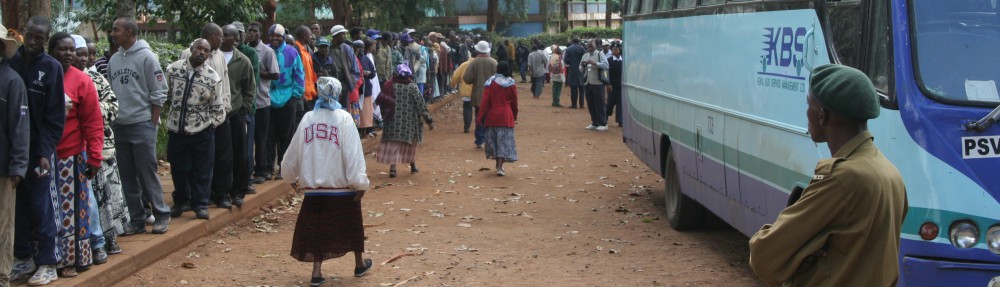
Initial thoughts on Kenya’s Supreme Court ruling

Congratulations to Kenyans on a peaceful resolution and Happy Easter.

First comment: we do all see that election violence in Kenya is not inevitable; what happened in 2007 has identifiable causes even if they have not been acknowledged or addressed, primarily the conduct of various politicians. People in Kenya do not simply run out and start killing their neighbors because their side lost an election. Having a credible Court helps a great deal, thanks to the passage of the new Constitution after all these years; kudos to those that made it happen through years of struggle.

Second: I am very proud of AfriCOG for carrying forward a tremendous amount of work in an unconscionably short amount of time to show that there were many unanswered questions about how the election was conducted and why, and how the votes cast at the polling stations were transformed into the March 9 “final results”. They carried a burden that should have been borne by an objective and independent IEBC, rather than facing a united front of the Government of Kenya aligned against scrutiny.

Third: I assume the Court announced what they agreed on unanimously, which was that the outcome was to deny the petitions. Whether or not all six justices individually agreed is something that we will probably never really know, but we will have to wait for the Court’s opinion in two weeks to learn more. Given the short amount of time and the schedule they have already been on, I suspect we will not get as much detail then as many have hoped for, but we will have to see.

Fourth: The Court ruled that each side was to bear its own costs–not the ordinary practice. I think this disposes of the claims by some on the Government side that the ruling indicates that the challenges were not substantial.

Africa Bureau under Frazer coordinated “recharacterization” of 2007 Kenya Exit Poll showing Odinga win (New Documents–FOIA Series No. 12)

Over the weekend I finally received the first documents from the State Department’s Africa Bureau from my September 2009 Freedom of Information Act request for State Department documents about the 2007 Exit Poll for the Kenyan Elections. This is the exit poll funded by the USAID, through the International Republican Institute (IRI) that I managed as East Africa Director for IRI. By letter dated March 5 (the day after the new Kenyan election) but not mailed for another week, the State Department released five documents, while stating that it was withholding one unidentified document in full “because it consists of pre-decisional deliberative process material.”

Long story short:

1) as described by the Embassy, “auxiliary to efforts in this regard by Kenya’s vibrant press, active civil society, and credible, proven electoral commission,” the U.S. government undertook several efforts to “preserve Kenya’s democratic success and contain the prospects of violence and voting irregularities if the presidential election is tight.”

2) one of these efforts was “Public Opinion Polling” described as follows:

* This USAID-funded program seeks to increase the availability of objective and reliable polling data and to provide an independent source of verification of electoral outcomes via exit polls. Implementer: IRI

3) after this same Exit Poll became a source of political contention because it showed the opposition candidate winning rather than the incumbent as named by the “credible, proven electoral commission”–the Africa Bureau engaged in a practice of mischaracterizing the USAID program and the Exit Poll.

For example: when the McClatchy newspapers ran a story on July 9, 2008 by Shashank Bengali reporting that “Kenya’s President Lost Disputed Election, Poll Shows” after the release of the exit poll results by the researchers from The University of California, San Diego at the Center for Strategic and International Studies, the Africa Bureau generated “AF Press Guidance” as follows:

Q: Please provide details on the U.S.-funded exit poll for elections in Kenya. Do we have a comment/reaction to the poll results?

* The International Republican Institute (IRI) provided funding to Strategic as a capacity building exercise for the organization.

* IRI did not have confidence in the results of the poll once they received them due to questions about the methodology, so the results of the poll were never officially released.

* Given the potentially significant nature of the results, however, IRI commissioned an audit of Strategic’s poll results. We have yet to see the results of that audit.

* Our Embassy in Nairobi was not informed by Strategic or IRI of the exit poll results by 3pm on Election Day.

It is simply false to suggest that IRI gave money, from USAID, to Strategic, a private Kenyan firm, simply as a “capacity building exercise” for either Strategic or for IRI, whichever is intended here. No, as described by the State Department before the exit poll became a “hot potato” after Kibaki was serving a second term based on the ECK’s announcement of an alleged election win on his behalf, we paid Strategic for their work “in providing an independent verification of electoral outcomes via exit poll” in the State Department’s own words. Strategic was hired based on already proven capacity having conducted the exit polls in 2002 and 2005. I have noted before that the Ambassador claimed this excuse–that the poll was only an “exercise” and never intended to be released–in a March 2008 on-line Q-and-A, but this is the first time I see this characterization stated from Washington.  See Lessons from the 2007 Kenyan Election and the new FOIA Cables–Part Three, here.

As I have noted, the concern that I was aware of and discussed within IRI during the immediate post-election in Nairobi was how people would react to the release of the poll, not about its “methodology”.

The guidance notes that IRI has “commissioned an audit” but doesn’t say when it was commissioned, or whether the State Department has asked to see it. [Note also that an “audit” could not fix the “methodology” of the poll if it had been flawed.  IRI released the poll the next month, in August 2008, the day before the technical consultants from UCSD were to testify about the poll before the Kriegler Commission investigating the elections.]

Finally, the statement that the Embassy “was not informed . . . of the exit poll results by 3pm on Election Day” is precious. They were informed of the results at closer to 5pm.

I’m quite curious about the “pre-decisional deliberative process material” that they decline to produce. Were they deliberating about whether to tell the truth about the USAID poll? Does this qualify for exemption? [Update: I appealed the withholding of this document to the State Department’s internal FOIA appeals board; the appeal remains pending as of March 2014.]

FREEDOM OF INFORMATION SERIES

“Media Zombie” stirs as Kenyan legal process moves forward [updated]

[Update: here is the Sunday Standard, “How Raila’s poll petition may change the whole game”]

“The many questions IEBC needs to clear with Kenyans over elections.” The Saturday Nation

The “media zombie” awakes with a recitation of damning basic questions about the systems employed by the IEBC.

AfriCOG and other Kenyan civil society groups were left as lonely voices before the election while the public relations of the IEBC and the rest of the Kenyan Government, propped up as best I can see so far by the “western donors” (with money from taxpayers like me) and the “aid industry” peddled false assurance. I will have to admit that the situation is significantly worse than I had realized.

And then beyond the systems that were not even seriously in place, we have the specifics of bogus numbers coming out with election challenge petitions by AfriCOG and by the CORD campaign filed today. So much like 2007 only worse in terms of a mass “overvote” in the presidential race.

“Halt the Party, It’s not yet Uhuru”, Wycliffe Muga in The Star.

In the New York Times, Jeffrey Gettleman notes the extreme pressure on Kenya’s judges:

The case is sure to be a test of Kenya’s recently overhauled judiciary. It is now much more widely respected, but some analysts have questioned whether all six Supreme Court justices will be able to withstand the pressure of refereeing such a high stakes contest for power. Even before the election, the chief justice received death threats, and analysts have raised questions about the independence of some of the other justices.

“Peace,” “Truth” and American commentary in the wake of the election

“Peace versus Truth: A Story of Unnecessary Trade-Offs”.

“Indictee for President!”  Michella Wrong writes in the New York Times Latitude blog on how “being prosecuted by the ICC helped Uhuru Kenyatta’s chances in the Kenyan election.”  I would go a little further back and identify the ICC indictment as the impetus for Uhuru’s launching of his TNA party and his run for President in the first place, through his emergence as the dominant Kikuyu candidate.  In other words, absent the ICC factor, I doubt Kenyatta would have run, or at least run seriously, and if he had, I doubt he would have gotten very far early on.

Here is Jendayi Frazer’s solo interview on PBS NewsHour last night: “Western Allies Have ‘Muted’ Response to Kenya’s Presidential Election”:  

GWEN IFILL: After all the violence in 2007 and 2008 after the last presidential election, we were all bracing to see if the same thing would happen this time. And so far it has not. Why do you think that is?

JENDAYI FRAZER: Right.

Well, I think the Kenyans learned lessons from 2007. And the civil society very much was guarding their country and guarding against future violence.

They also had this election under entirely new institutions. There’s a brand-new constitution. There’s a de-evolution of power from the center, from the presidency, to governors of 47 counties. There’s county assemblies. And so I think the diffusion of power, the expectations about their new institutions and the lessons learned from 2007 account for the lack of violence this time.

Frazer is right in identifying why the situation in 2013 was different and “the same thing” that happened in 2007-08 was not going to happen this year.  There is an irony, however, for her to invoke the work of Kenyan civil society, and the reforms of the new Constitution, in the context of her advocacy now in regard to this election when William Ruto was the leader of the “reds” who campaigned against the Constitution and  Uhuru Kenyatta was seen as a “watermelon”, nominally “green” or pro-Constitution on the surface, but “red” in substance.  The “Uhuruto” Jubillee Coalition took the position pre-election that it wished to restrict civil society if it took power.

Otherwise, there is much that is very telling in this solo interview about how the American media covers politics in the “developing world” and Africa in particular, and much that is telling about America’s official and unofficial interaction with foreign politicians and leaders.

It should be noted that for someone that served only a short time in the State Department, Frazier has positioned herself as a dominant figure in the Washington media in commenting on this election.  A plausible reason for this relates to the fact that she has deeper roots in the Kenyan scene than her service as Ambassador to South Africa and then Assistant Secretary of State for African Affairs in the Bush Administration.  These roots, however, are not discussed publicly in the context of her commentary on this Kenyan election.  By reputation in Kenya, Frazer is identified widely but privately as a close family friend of the Kenyattas,  Read the following exchange in this context:

GWEN IFILL: Uhuru Kenyatta, you have met him. You know something of him. What do we know about him, other than he’s the son of a very famous leader of the country, a very wealthy man and now is under this cloud?

JENDAYI FRAZER: Well, he’s also very much a person who respects the West. He was educated in the United States. He’s been pro-Western in his outlook.

He’s been the minister of finance before and the deputy prime minister. He’s always had strong relations with the United States. Now, the case against him is problematic. And as it was stated, it’s falling apart. The co-conspirators have all — that were charged with him are charged with attending a particular meeting at statehouse and in that meeting planning reprisals against the violence that was being meted out against the Kikuyus.

But the key eyewitness has now said that he lied and he’s been changing his testimony and has — and even said that he’s taken bribes. And so the case is falling apart.

There is much that is unsaid that may be of vital import.  One question is simply whether Dr. Frazer, especially as a private citizen engaging with this is in a position to be objective about Kenyatta personally beyond describing the basic relationship to the U.S.  Second, and relatedly, there is much more involved here than just the actual status of ICC prosecution’s case: there is also the bigger moral question of whether or not Kenyatta, and his running mate Ruto, are in fact innocent of being directly involved in deliberate killing of innocent Kenyans on the basis of their ethnicity for instrumental political reasons.

From a standpoint of pragmatic realpolitik, as well as for Western private and business interests, it might be convenient now for the ICC cases, especially the case against Kenyatta, to “go away” to protect the ability to do “business as usual”.  Frazer is right that Kenyatta has had ties in the U.S.–he would have been a favorite of some others in the U.S. but for the post-election violence in 2008.  But I do not believe that there are very many Kenyans at all–whether Kenyatta voters or not–who do believe that both Kenyatta and Ruto did not in fact do in essence, if not in exact detail that can be proven in court now, what they are accused of doing in terms of engaging in leadership of “militia” killings.  Kenyatta’s appeal in fact relates to the notion that the use of the Mungiki to kill in the eastern Rift Valley was in some notion “defensive” of Kikuyu killed by members of other tribes in other places further west in the Rift Valley (what Ruto is accused of being involved in).

Part of what is happening here is that by attacking the shortcomings of the ICC and the Western media among others, some are seeking to relieve themselves of some of the moral tension associated with the haunting question of whether “peace” is being bought by the (possible) election of “killers”.

In this context, here is a link to Dr. Frazer’s aggressive interview with Michelle Martin on NPR’s “Tell Me More” this afternoon.

Who would have the outrageous moral audacity to go to court to question 4100 votes out of 12M rather than defer to “crimes against humanity” suspects?

A simple question of what Kenyans chose to expect of and hope for themselves really, for them to answer.

Everyone is tired, no question. Most Kenyans are poor, and the breakdown of the IEBC process caused loss in the economy which hurts poor Kenyans the most. At the same time, the short term value of sweeping another electoral commission fiasco under the rug would be balanced by a huge cost in terms of the dreams of democracy that seemed to have been achieved in the 2002 vote.

The situation regarding the vote is less clear than in 2007, but the meaningful ability to go to court exists this time, unlike in 2007. Should the legal process be shelved now that it is finally available–and if so, will it be available again?

Taking Down My Last Post . . . Kenyan Election Is “Overeported” and “Under Researched” based on lack of transparency

The voting was over by Tuesday, March 5. The IEBC (the Kenyan replacement for the previous discredited Electoral Commission of Kenya or “ECK”) then has seven days to announce final results from the votes, which are cast by paper ballot and counted (only) at the individual polling stations around the country. The results at each of the more than 30,000 polling stations around the country are set out on multiple original official forms which are signed by the election official and the political party agents. One original is then posted on the door of the polling station where the counting has been done. This way the public can see the results while the armed guards at the door keep the public out of the room where the physical ballots are secured back in the sealed ballot box after counting.

Since the digital transmission of results failed for reasons that remain unexplained factually but much pontificated about, we are left with less information early than we would have hoped. But, as long as the forms remain available for each polling station, and are open to the public, we ought to be able to nail down how people voted–at least as the votes were counted.

Unfortunately, there is much pressure to rush and do something less than verification based on the actual documented count of the votes.

In 2007, the actual voting results were ultimately never released or disclosed, and while many court petitions were successfully adjudicated in parliamentary and local races, the Kreigler Commission appointed under the post election settlement to investigate the failed election passed on any further effort to actually determine the presidential votes as counted and announced at the polling stations. While there are alleged “official results” published by the ECK, they are only alleged aggregated numbers by parliamentary constituency, not by actual unit of voting and counting.

For my American readers, imagine results for the presidential election that are announced only in aggregate by Congressional District.

See my previous post for the results at the polling station where I observed. This information should be available for each polling station, and should then add up to what is reported as a matter derivatively on up the chain.

Closing out polling station and presidential count: amazing Kenyans exceed 80% turnout in spite of technology failure

Okay, congratulations are in order for a great job by presiding officers and polling clerks, and incredibly patient voters at the polling centre where I spent the late afternoon and on until finishing the presidential count and posting the signed off results on the door to be photographed at the stream I was covering.

Everyone got better at adapting to the absence of the technology and the cumbersome process and voters moved much faster through the remaining lines in late afternoon and early evening. Having stood in the hot son all day in huge lines surely motivated everyone to get done, but essentially no grousing was to be heard where I was at that point.

Turnout at the stream I closed was 626 valid votes cast for president from 755 registered voters. So over 80%. The boxes were jammed full of ballots but the system worked. Totals for president were Odinga 433, Kenyatta 170, Mudavadi 8, Kenneth 7 and the rest less. Dida was the only presidential candidate in that stream to get 0.

Will post “snaps” soon.