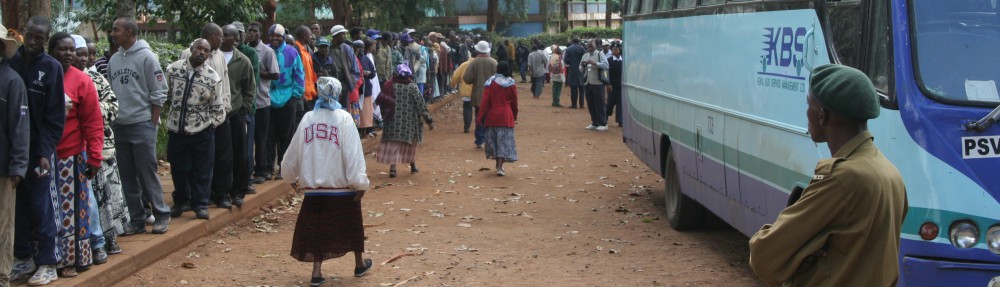
Worth reading on Kenyan pre-election violence, and challenge ahead for March election

“John Githongo: Former Anti-Corruption Czar on a mission to change Kenyan leadership” from November 2012 Think Business at “Kenyan Magazines”:

Based on Inuka Kenya’s mapping using information provided by credible Kenyan organisations and partners, more than 480 people have been killed since January 2012 in this violence. “It is pre-election violence associated with the new boundaries and the struggle for power. It is so insidious that it is almost passing unnoticed,” says John.

The new constitution, he adds, poses a lot of challenges for the transition process in terms of implementation. We have created new boundaries, instituted a system of devolved government and initiated new laws. Even the more developed economies have not attempted to implement the number of changes we are attempting to implement at the moment at one go. “We are a very versatile people but we will be tested in a way that is unprecedented.” He worries that the danger of things falling apart is that the disillusionment that might follow will cause Kenya to implode, not to explode, “Like an ice cream melting in the sun.”

“The biggest challenge the IEBC faces” by Wycliffe Muga in The Star.


AfriCommons Christmas

IMG_0126

Merry Christmas.

Election Observation as “Diplomacy or Assistance” continued–how I spent my pre-election Christmas in Kenya

In my Freedom of Information Act Series I have described how then-Ambassador Ranneberger got his predecessor, Ambassador Mark Bellamy removed from the International Republican Institute’s Election Observation Mission shortly before the last Kenyan election, implying an objection to Bellamy from the Kibaki government. While IRI capitulated in removing Bellamy, I was told to accept “no more b.s.” from Ranneberger in interfering with the IRI Election Observation.  As problems continued to arise, this is a letter I wrote to my USAID officer on December 22, 2007, five days before the voting:

I think that you and I have had a good working relationship over a period of months until just recently, reflecting efforts and intentions on both our parts.  The problem now is that we are in a position of working in part at cross purposes, regardless of how much effort we continue to put into trying to be cooperative.

Previously I thought that you had some real level of agreement with my basic position regarding IRI’s independence, in spite of the contradictory viewpoint of the Ambassador.  At this point, it seems clear that we just do not have a meeting of the minds about this.

As far as IRI is concerned a major line was crossed last week and we expected that there would be as a result of Lorne Craner’s intervention a recognition that IRI’s independence would be respected going forward.  Unfortunately, the only substantive change seems to be that we have one less delegate–one of the best qualified members of the team that we had selected.  And of course people in the State Dept. did know what our own plan was before the Ambassador intervened.  I find the whole situation embarrassing personally.

I have tried to move us to a situation where we agreed to document at least by e-mail the specific things we were doing in terms of direct involvement of the USG with the IRI EO.  I think this is the least we should do and was intended to move us forward in terms of making sure we all understood each other, both personally and contractually.  I am tired of suggestions, directions, demands, “markers”, etc. to do things that people are not comfortable putting in writing.  If it should not be put in writing, maybe it should not be part of how we conduct ourselves here.

There are a variety of basic things that USAID can do that would in fact help IRI do the best it can.  One easy and obvious one would be to add IRI to the distribution list for ECK events, recognizing that the ECK is not at the point of providing IRI with timely notice, or in many cases, any notice, of its activities.  The other would be to provide us security information to assist us in protecting the safety of our teams.  Certainly having ——– come over and brief the teams is a big help.

 As far as I am concerned, if IRI is not substantively independent, rather than just offering an appearance or representation of independence, then all of our work here is at best a waste of time in terms of actually providing assistance to the Kenyan people as per the MOU between USAID and the GOK.  At worst, we could undermine the ability of IRI to accomplish anything substantive in Kenya in the future and taint our election work elsewhere.  IRI adds value if we are independent; we do not add value if we are not independent. (emphasis added)

Please give consideration to this and let me know what you suggest.

At the end of the day IRI’s final report on the Election Observation found strong evidence of fraud, when it was released more than six months later in July, and IRI released the Exit Poll indicating an opposition win one more month later, in August 2008. By that time the election was long over and the President along with his initial appointees stayed in office. The next chance for Kenyans to vote will not be until  March 2013.

Election Observation–Diplomacy or Assistance?

“The Devil Made Him Do It”; Why I am going to boycott writing about Kenya’s presidential race

Reflecting on the state of the Kenyan presidential race in its closing weeks, I had come to the conclusion that there was very little I should say, because it seemed that there was just too much “backstory” and intrigue behind the scenes that was not in the media and I was not privy to.  It becomes misleading to pretend that what is apparent on the surface counts for more than it really does.  Certainly a crucial lesson from the 2007 election.

Today, as voter registration is wrapping up, Musalia Mudavdi has revealed and Uhuru Kenyatta has admitted that the two signed in the presence of their lawyers an agreement two weeks ago, on the “coalition” deadline, for Kenyatta to step aside in favor of Mudavadi for the TNA/URP/UDF–“Jubilee Alliance” nomination.  Facing a revolt within his TNA party, Uhuru now wants out of the deal on the basis that he signed under the pressure of powerful forces who claimed that such a move would be in the national interest of Kenya.

The Standard: “Uhuru rescinds decision to back Mudavadi”

Uhuru rescinded his support for Mudavadi as Jubilee presidential candidate and said the decision on who will carry the alliance mantle rests with delegates.
He confirmed authoring the document and signed it but claimed that he was coerced by ‘the devil’.
He said on Tuesday that powerful forces convinced him that his presidential bid was bad for the nation as Kenya would face international sanctions if he wins the elections and that Kenyans were not ready for another president from Mt Kenya.
He confirmed that MPs forced him to rescind his decision and said only delegates will sign.

In the meantime, the IEBC voter registration effort is wrapping up.  It appears that the final totals will be well short of the announced goal of 18 million voters, but in excess of the new fallback target the IEBC announced of 12 million (or 1/3 less).  The 2007 figure was 14,294,739 per the IRI/UCSD/USAID Exit Poll.

Jamhuri Day, Christmas and the Year Ahead

Happy Jamhuri Day to my friends and readers in Kenya (and Kenyans in the diaspora–even if you don’t get to vote this time!).

FRESH TEA
Fresh Tea

It has been a week since my last post, even though so much is happening on a day to day basis with the Kenyan election and lots of other news in the region–this reflects a few different things.  For one, perhaps what we could call a “Christmas armistice”.  I live in a peaceful place, and I am enjoying the “festive season” here with my family and am committed to a less digital Christmas.  We’ve survived another election here in the States (in spite of ourselves) and there are a several weeks left in the campaign in Kenya and this is a good time to step back a bit.  In particular, for my family, this is the last Christmas before my daughter goes off to college.  I took my son, our youngest, to get his driver’s license yesterday.  These are the things that can’t wait (and that are uniquely my responsibility).

For another, I have been at this blog steadily for three years.  It’s been through various evolutions and trends and this is an appropriate time for reflective recalibration about what I want it to be going forward.  And in the meantime, there are 601 posts out there for those interested.  And too many of those are just “news” and not real writing, and I do know that I want to get back to “better” rather than “more”.

A third is that I have both new freedom, and new constraints that I need to adjust to.  When I started this blog, and for the first two-and-a-half years, I was a lawyer in the defense industry.  For this reason, I always needed to keep a strong separation between my blog and my professional life.  When I attended the African Studies Association or participated in a “bloggers’ roundtable” at the Millennium Challenge Corporation I was on vacation from my job and generally didn’t talk about it much (both awkward and expensive).  When I was living in Kenya and working for the International Republican Institute I kept entirely away from the job from which I was on leave back home.  Now that I am an independent lawyer, I can synthesize what I know from my prior legal experience and otherwise what I do for a living with the blog to whatever extent I chose, so this is easier.  At the same time, I am also now available professionally as a consultant in matters involving East Africa and have accepted some work, so I need to avoid any conflicts arising out the transition from being purely an avocational commentator.

One thing I have reflected on this past week is the issue of how much is similar and how much is dissimilar between the 2007 campaign in Kenya and the 20012/13 campaign.  All of the major players are the same, although Kibaki will be transitioning from President to “retired President” as Moi is called, and is thus not a candidate himself.  I did get somewhat acquainted at that time and in that environment with Raila and Kalonzo and Mudavadi, and did meet Ruto although never sat down with him.  Uhuru and Dr. Willy Mutunga, who was then at the Ford Foundation and is now Chief Justice, were the only people that ever turned down a meeting request on my behalf when I was IRI Director (a nice symmetry in terms of KANU/Establishment versus Civil Society/Activist roles) so I do have some real sense of many of those involved.  On the other hand, a lot has changed in Kenya, for better and worse, since 2007/08.  So although I know much, much more about Kenya from what I have done from here since I moved back, I don’t want to fall into the trap of relying too much on past experience.

One thing this adds up to is that I do want to write more about “democracy promotion” or “assistance” as a subspecies of “foreign aid” in Africa beyond just the current and most recent past campaign in Kenya.  I also want to do more with East Africa as a region in interacting with the United States–I drafted a “year in review” summary regarding IGAD for a bar committee I am participating in which reminded me of interesting things to explore about how domestic politics in Kenya and in the U.S. will influence cooperation and integration among the East African and HOA states. And then there is Somaliland, which is near and dear to my heart, but I am very cautious in writing about.

For now, I’ll leave you with a few links:

“Uhuru Kenyatta did NOT donate 85 million to Mitt Romney’s campaign” says The Kenyan Daily Post.

Alex Thurston in the Sahel Blog: “Amb. Susan Rice as a Window into U.S. Africa Policy, 1993-Present”

Whither Somalia”–Mary Harper, Bronwen Bruton at USIP

When did Ruto and Uhuru fight? And why is the “Uhuruto” alliance allegedly so surprising?

Today is the third anniversary of the “AfriCommons Blog”, so let me celebrate by being a bit direct.

I lived in Nairobi with my family during the last Kenya elections campaign and the duration of the post-election violence. I certainly saw both Uhuru and Ruto in Nairobi during the uncertain post election period, and they were on local television as well–serving in Parliament together and carrying out their functions as members of the political class. Never saw either with a police rifle, a panga or a can of petrol. No recollection of seeing either of them in the slums or other types of neighborhoods where most of the violence in Nairobi took place.

Rather, the ICC has accused them of being involved in the incitement, organization and funding side of the organized part of the post election violence or PEV.

I don’t recall ever seeing any indication that the two had any type of personal animosity between them or couldn’t get along between themselves. Could be, but not necessarily obvious from the context of funding militias and gangs in the hinterlands on opposite sides of a political tussle. In terms of the political debate it was Martha Karua that squared off with Ruto during the ECK “vote counting” at the KICC and the post-election negotiations.

When I moved to Kenya in June 2007, less than seven months before the elections, Uhuru and Ruto, along with Mudavadi, Raila and Kalonzo were in ODM-K (later to become ODM) and all were running against each other for the opposition presidential nomination through their mutual coalition. Uhuru was KANU leader and titular Leader of the Opposition in Parliament. They were all rivals, but all against Kibaki. Uhuru and Kalonzo split off the main ODM, with Kalonzo running as ODM-K nominee as a “third party” and Uhuru switching sides to Kibaki/PNU, presumably at least in part because he could not hope to get re-elected to his seat in Parliament in Central Province otherwise. (And maybe he was looking to 2012/13.)

If there was a question of anyone not getting along personally, it was more about Kalonzo and Raila than Uhuru and Ruto.

It just seems naive to me to be especially surprised that Uhuru and Ruto would hook back up–and most especially so when they are in a serious jam together with the ICC charges.

Did Uhuru oppose Moi because of Moi’s role in the related violence in the Rift Valley around the 1992 and 1997 elections? Seems to me he stayed in KANU and was anointed as Moi’s candidate for the succession in 2002. Perhaps if he did, as accused, get involved in using the Mungiki in post-election violence in Naivasha and elsewhere, could it have been for instrumental political reasons rather than some atavistic “tribalism”? Has Ruto ever supported a non-Kalenjin candidate before? (hint: Uhuru in 2002)

Political ‘wedding day’ in Nairobi

Ballot for President with the Nine Nominees
PRESIDENTIAL BALLOT FROM 2007

Today was the deadline for filing of pre-election agreements between and among Kenya’s political parties. No big surprises in terms of the basic shape of the Odinga-led versus the Kenyatta-led groupings. As this is a non-partisan blog, and I don’t vote in Kenya as an American, I will not be suggesting how Kenyans should vote or endorsing anyone, but I’ll share a few quick thoughts “from where I sit”.

The agreement of Vice President Kalonzo Musyoka to be Raila’s running mate seems to have come down to the wire, although it is a bit hard for me to see how this would be too much of a surprise to people paying close attention.

Ostensible ODM Deputy Prime Minister Musalia Mudavadi, Raila’s running mate last time, joined Uhuru Kenyatta’s TNA grouping at the last minute, but he has been out of ODM and on to UDF for a long time and has long been seen as the potential “compromise” candidate to substitute for Uhuru and/or Ruto in the event the Kenyan courts were to ultimately disqualify either or both of them due to the ICC cases or some related complication. It would be risky for Uhuru and Ruto not to have someone suitable in that role.

On the Odinga side, the new CORD grouping has picked up Charity Ngilu and NARC along with Kalonzo which means he has picked up both sides of a division within “Eastern” politics and added a woman of longstanding political stature. With both Kalonzo and Moses Wetangula, CORD has two former Foreign Ministers, with Kalonzo in particular having been around a long time in diplomatic circles. He is someone with whom those in foreign capitals who are concerned with Kenya’s stability as a perceived regional anchor will be used to and comfortable with.

Absent the ICC situation, Uhuru and Ruto would be potentially attractive to some in the West as representing the notion of a mini “grand coalition” appeasing the elite of the combatants in the violence related to land and political boundaries in the Rift Valley that has normally coincided with Kenyan elections post-Cold War and they will be well funded to try to sell that pitch irrespective of the pending charges. I have a hard time seeing them get any traction, but I have been wrong before.

No disrespect intended to the other candidates–another post for later. The whole thing will be fascinating to watch, but scary due to the real dangers.

Good piece in today’s Financial Times from Katrina Manson in Nairobi.

Voter Registration challenges on Kenyan Coast

Nation: Voting problems on Coast. One is potential intimidation tactics discouraging voter registration, with the IEBC finding flyers calling for voters not to register or vote, and reports that youth, possibly associated with the separatist group the Mombasa Republican Council, have been seen copying down names of those registering. The second problem is that some politicians and local officials are reporting that groups of voters are being ferried from their home areas to register in other locations.

Obviously the IEBC will have large challenges. No surprise in that. A big question will be whether the IEBC will be seen as taking some level of decisive action to get in front of these situations, or not. In 2007 election, I was told afterwards that once it became clear that the ECK was both toothless, and not going to be an honest broker, the process degenerated as most of the players expected rigging and acted accordingly.