
The Foreign Policy establishment will continue to hold Beltway confabs and hearings about “Africa policy” but the author of “The Flight 93 Election” is running Policy Planning at State and Congress has neutered itself.

I think it is probably a sucker’s game to do too much mastication around the idea of what Trump II may do in or in relation to Africa by reference to the Kennedy through Biden 1961-2025 “A.I.D./USAID Era” of African relations.

Take a moment to read Michael Anton’s famous opinion piece in the Claremont Review of Books from July 2016 entitled “The Flight 93 Election”. This is the very same Michael Anton who is the Trump II Director of Policy Planning at the State Department.

As far as I am concerned the wood chippering of USAID, programs and especially people, is best understood in the intellectual “Cold Civil War” environment as a subspecies of “Defunding the Left” (something that I had some involvement in as a College Republican leader back in the”Reagan Revolution” days) rather than a more specific foreign policy pivot. The impact on Africa, Africans, and relations with African states specifically is just collateral damage in “The Third World” in Flight 93 terms.

Probably better to study the Eisenhower Administration—when decolonization was close enough to warrant standing up a separate Africa Bureau in the State Department but many in Congress addressing foreign policy represented segregated Jim Crow States and districts and the question of civil rights for Black Americans generally was much in contest. And perhaps a counterfactual to identify what a Goldwater Administration Africa policy might have been. [Recognizing that Eisenhower was seen as a proto-Communist by many of the ideological godfathers of the current Trump II core thought leaders.]

The most important American regarding Africa policy is likely Elon (“We’ll Coup Who We Want To“) Musk, and ProPublica has an expose about how aggressively the new Trump II State Department leaned on Gambia for Musk’s Starlink business.

Musk has used his X megaphone (the repurposed Twitter) to spread accusations of a genocide against white Afrikaners in snyc with the rest of the Trump Administration declaring same as the basis for the new program to designate Afrikaners as “refugees” and resettle them in the US. In the context of “The Flight 93 Election” view of seeing “Third World” immigration as the most daunting failure of the pre-Trump Conservative Movement and pre-Trump Republican Party as well as the ultimate goal of the Left “enemy within”, it makes perfect sense to affirmatively bring in Afrikaners while expelling “non-Western” refugees impacted by wars or terrorism elsewhere in Africa or “The Third World”.

Beyond the barriers of “culture” and “development” to finding time out from the Cold Civil War to develop an actual foreign policy strategy for Africa, the Trump II Administration will not be able to take this on without having first a strategy for China. I do not expect that four years will be long enough for Trump to make many of the necessary choices. So far the most important fork in the road in the Trump II China policy (and foreign policy writ large) is the announcement by Treasury Secretary Bessent that the US does not seek to decouple with China.

In the meantime, gutting the State Department means that more of the burden of diplomacy as well as development will be left to AFRICOM by default. Of course the Trump policy of refocusing the Pentagon on “warfighting” by a more lethal warrior class and enhanced technology cuts away from the likelihood that AFRICOM as a Combatant Command will be more rather than less dexterous and ultimately successful at diplomacy than it has been since starting to take up that burden at inception in 2008 as what the G.W. Bush Administration conceived as a “different kind of Combatant Command.”

Congress has elected to defer wholly to Trump II on Africa policy so far as the major changes have been effectuated with the demise of USAID. The Senate Foreign Relations Committee didn’t even hold a hearing (!) on the demise of USAID and the hearing in the House was not of any legal relevance in spite of the preponderance of the testimony debunking the basic rationale of Musk for the “woodchippering”.

Last week the Senate Committee solicited the thoughts of Joshua Meservy of the Hudson Institute, previously Heritage, and Michelle Gavin of the Council of Foreign Relations on “East Africa & The Horn: At a Turning Point or Breaking Point” but again, no real indication that Congress will do anything to get involved as opposed to deferring entirely to Trump II.

While some associated with the Trump II administration pay lip service to an approach of “trade not aid” in the aftermath of the death of aid, there is no evidence of comparative substance to the words. The UAE is the latest country after China to completely dwarf U.S. current and planned financial investment in Africa and like China provides a counter to previous U.S. expressed values on governance and the rule of law, and not just in relation to war and mineral smuggling in Sudan and Central Africa.

See “UAE Pouring Money into Africa, Seeking Resources Resources and Power” in the New York Times on May 17:

“In 2022 and 2023, the Emirates announced a total of $97 billion in investments in Africa — three times China’s total, according to fDi Markets, a database of foreign investments. U.S. investment in 2023 was about $10 billion.”

“Meanwhile, Mr. Trump has fast-tracked America’s exit from Africa, ending billions of dollars in funding, dismantling the U.S. Agency for International Development and ending all contributions to the African Development Bank. The State Department’s reorganization plan also calls for the elimination of most operations in the region.”
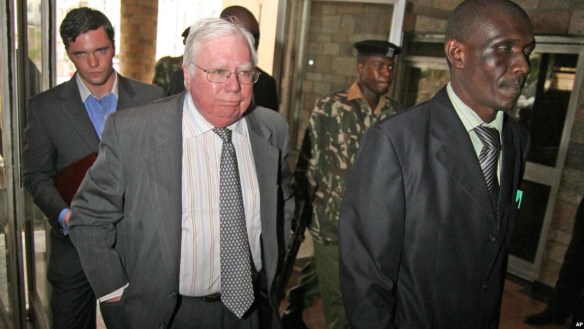
Birther John Corsi in Kenya to investigate Senator Obama
Jerome Corsi, bestselling “Obamanation” and “Where’s The Birth Certificate” author in Nairobi during early Birtherism era.

Republican senators remaining on Board of IRI following Rubio’s resignation to become Secretary of State are silent on takedown of USAID and NED — both as Senators and as Board members

Hard to understand why Senator Sullivan continues to serve as IRI Board Chair given that the Senate has not even had hearings relating to the “woodchippering” of USAID, the freeze of State Department foreign assistance funding and the separate impoundment of appropriated funds for NED.

Nor is he reportedly willing to speak in any detail to the press or offer any public defense of NED or IRI under attack from Elon Musk and his X platform and laying off most staff due to the defunding.

What is a Board Chairman for?

The others who sit in both the Senate and on the IRI Board are Tom Cotton, Joni Ernst and Lindsey Graham.

All USAID implementation partners are in a terrible conflict not of their own making starting from the Musk “woodchippering” of USAID and accompanying assault through X on the weekend after the Inauguration. But IRI is also one of the four NED “core institutions” and a “Government Organized NGO” pursuant to legislation. IRI and it Board Members themselves are targets of the X-led digital smear campaign in support of the elimination of U.S. foreign assistance. If IRI leadership is unwilling to speak up to defend IRI, who else should be expected to.

Why should it fall on people like me, as private citizens, and in my case one with a mixed experience working for IRI years ago, to advocate for the underlying value and values served by democracy assistance and “mending not ending” the enterprise?

Of course it does need to be noted that IRI does raise private donations as a nonpartisan 501(c)(3) charitable, religious, educational or scientific organization. During my time, no private funds were available for our East Africa program activities as opposed to things such as Board activities or Washington approved extras that were not allowable costs to the Government. So the Board may be able to sustain itself separately from the actual democracy assistance programs?

[Updated] Ruto term nears halfway point as USAID is strangled and Kenyan politics faces disruption from loss at Raila AUC vote Saturday

Update 2-15: Raila fell short to Djibouti’s candidate in the 7th round of voting.

If Raila Odinga doesn’t win his election for Chairman of the African Union Commission on Saturday then Ruto on one hand and the ODM Party on the other will have to face the question of how to repurpose Raila within Kenya’s political establishment. Will he return to the customary role as opposition presidential candidate? Will he and Ruto reach a deal on a new alternative role to keep him and his key loyalists “onside” with the Ruto presidency?

Is there any chance that he would take some “senior statesman” status within ODM and/or the opposition more broadly and not move toward a run for the Presidency in 2027?

What will be the impact of the demise of US democracy assistance, being cemented as this is written, have on the hugely delayed preparations for the 2027 elections?

Mzalendo reports today on claims that the Independent Electoral and Boundaries Commission—intended to be a permanent Government of Kenya institution under the 2010 Constitution—may have a selection panel in place by April of this year to start the process of selecting Commissioners. USAID has been the leading donor for process for decades.

See this piece from The Standard:

Addis setback, a political turning point for both opposition and government

He returns home empty handed, leaving his admirers divided and his detractors wary. There are those who want the Raila to take up his role of calling the government back to order.www.standardmedia.co.ke

Raila Odinga Kenya president campaign

Following Jimmy Carter funeral Donald Trump takes office and deploys “neutron bomb” to US foreign assistance

American “olds” of my generation (we who are 45-64 are the only age cohort who went for Trump in last year’s presidential election) may remember the 1970s controversy over President Carter’s decision to go forward with deployment of the neutron bomb in Western Europe.

To some sensitivities way back in the day, before we “beat the Vietnam syndrome”, the notion of a defensive nuclear weapon that could kill people without “nuking” physical infrastructure was distasteful even faced off against the Soviet Red Army across the Iron Curtain. This was before the peak of the “nuclear freeze” movement and the birth of the National Endowment for Democracy and the modern era of democracy assistance under “PeaceThroughStrength” during the Ronald Reagan administration.

If you are too young to remember the Cold War I think you probably had to be there but I will try to link back soon to some of my related blogs posts and list some other references.

On Friday an acting official on behalf of Secretary of State Rubio delivered the symbolic equivalent of such a weapon to direct immediate Stop-Work orders freezing funding for State Department and USAID funded Foreign Assistance (subject to a few advance waivers for Egypt and Israel, some emergency food assistance and security matters). All to be reviewed and restarted, modified or terminated on authority of Secretary Rubio to make sure they directly serve the strictures of the Trump/Rubio formulation of “America First” as opposed to, you know, helping other people in service to our national interests as per US statutes enacted during the Truman, Eisenhower, Kennedy and subsequent administrations up through 2024.

Of course it was never not America first but it was in some real sense at important times and in important ways “America +” (or so most of us Americans have always believed).

Secretary Rubio came off the Board of Directors of the International Republican Institute (a major State and USAID nonprofit foreign assistance implementor) as well as leaving the U.S. Senate this week to take the post under Trump.

Retrospective thoughts on Ruto in Washington – “Disneyfication”, “clientitus”, UAE concern, and the audacity of hope.

Foreign Policy Africa Brief:

Ruto’s divisive power. In the ContinentKiri Rupiah reports on the increasing divide in international and domestic opinion regarding Kenyan President William Ruto, noting the disconnect between the U.S. government’s embrace of Ruto and his low approval ratings at home.

His recent U.S. visit was overshadowed by criticism at home over tax hikes, wasteful expenses, and alleged government corruption. Ruto’s political career began murkily: The International Criminal Court charged him in 2011 with three counts of crimes against humanity related to the ethnic violence that followed Kenya’s 2007 election but later abandoned the case, and Ruto reinvented himself as a key U.S. ally. “In a tradition that changes cast but not much of the script, the US has named its new man in Africa,” Rupiah writes.

The Continent: “Washington completes the Disneyfication of William Ruto; in a tradition that changes cast, but not much of the script, the US has named its new man in Africa” by Kiri Rupiah, p.8

Personally, I am choosing to be hopeful, not that Ruto is not who he has shown himself to be through his participation in election violence and corruption, but rather that greater investment subsidized and supported by the US will help create badly needed jobs for Kenyans.

A visit to Washington this spring identified Ambassador Whittman as being seen in diplomatic circles as having a conspicuous case of “clientitus”.

After returning home, President Ruto admitted at the Prayer Breakfast that he had hitched a ride to Washington on a chartered jet provided by “friends”, who turned out to be the UAE—the same Emiratis who also back the RSF which is committing murder and mayhem in Sudan and melt most of the illicit smuggled gold from the region, along with hosting all sorts of sanction busting and money laundering. But they have a lot of cash to spend around Washington as well as Nairobi and anywhere else that cash is welcome.

I noted that former President Obama seemed to be staying slightly aloof to “Rutofest”, perhaps because of the Post Election Violence background?

And here is former Ambassador and Assistant Secretary of State Johnnie Carson for the United States Institute for Peace: “America’s Vital 21st Century Partnership with Africa—and Kenya’s Key Role”.

Kenya ICC Pawa254

A circle not an arc: Ruto and Biden re-enact Kenyan-American history with a reprise of the Kibaki-Bush State Dinner of 2003

Kenya 2007 PEV Make Peace Stop Violence

Before the exposure of the Anglo Leasing security sector corruption and other scandals Mwai Kibaki was in quite good books with the Bush Administration in Washington.

Kibaki’s 2002 election victory could be seen at the time as a feather in the cap for Bush’s “freedom agenda” in Africa. Kibaki was a core establishment insider who had served for 10 years as Daniel arap Moi’s vice president during Cold War era single party KANU rule, but had been democratically elected as titular head of a broad “opposition” coalition after the Bush Administration squeezed Moi to honor term limits and allow succession after 24 years and Moi chose his predecessor’s son Uhuru as his intended successor over more senior KANU leaders. (The best of both worlds for us Americans from a strictly diplomatic/foreign relations standpoint.)

Kibaki was used to dealing with the American government going back at least as far as arms purchases during the Gerald Ford Administration with Henry Kissinger as Secretary of State.

A lot has happened since October 2003, but not so much of it has been in Kenya. The biggest single change in Kenya has been population growth (with relatively flat human development). No big fluctuations on corruption or security, etc. and some worsening of an already challenging climate.

Ruto is another first term Kenyan president in very good books in Washington. An establishment protege of Daniel arap Moi who is seen as having had an oppositionist wrinkle to his 2022 election as President as the sitting incumbent Vice President by the fact that the outgoing incumbent President, his erstwhile running mate, Uhuru Kenyatta (also an American favorite while President and close to important Americans before taking office) tried to throw him over for his new “handshake” partner Raila Odinga.

Now, Ruto has a handshake deal of his own to back Odinga for the AU Commission chair as an alternative to domestic Kenyan opposition leadership.

The one big event in Kenya between 2003 and 2024 was Kibaki’s stolen 2007 re-election and the ensuing murder and mayhem as Kenya went “to the brink of civil war”. But as they say, “it’s been a minute”.

And since both the election fraud and the Post Election Violence successfully achieved their objectives it’s hard to find time to remember who was killing whom after so many years.

Externally, the current round of war in Somalia started a little more than two years after Kibaki’s 2003 State Dinner. The Second Kibaki Administration itself invaded Somalia in 2010 and 14 years later the beat goes on. And diplomatically we need Nairobi as a place from which to address any saving of Darfur and democratizing or at least stabilizing Southern/South Sudan as we did back in 2003. A new bonus is the chance to pay to get some of Kenya’s police force out of the country for awhile while also putting African boots on Haitian ground.

I guess the one word that I would choose to fit the Ruto-Biden State Dinner is “predictable”.

See “Disillusion grows in Kenya as Biden hosts Ruto for a historic state visit” in Semafor.

Book bitings: I read Ahmed Isaack Hassan’s memoir from his time at Kenya’s IIEC and IEBC and promised to engage.

I will do a series of posts here to accompany my agreement to engage with former Chairman Hassan after reading his memoir Referee of a Dirty Ugly Game: In the Theatre of Kenya’s Elections — an Insider’s Account. This is an introduction.

I learned a lot about the Chairman’s personal background, his family, his personal and professional networks, in particular involving his previous political service in unsuccessful constitutional reform endeavors in Mwai Kibaki’s first term, his law practice and work for the UN on Somalia. I learned his personal opinions about several politicians, and many actors in various positions in the Kenyan government and in the Kenyan social and business establishment.

I learned a lot about Ahmed Isaack Hassan, how he sees himself and wants to be seen.

Certainly Hassan has been presented by some who were involved with him in running, presenting and defending the 2013 election as a hero for getting through a process in which power was passed from Kibaki to Kenyatta and Ruto without Kenya “burning”. It is in this context a memoir of this sort fits.

To the extent that this was what Hassan was appointed to do then he did deliver and this is his chance to box his critics. Undoubtedly he was put “through the wringer” to an extreme degree and treated badly in various respects as so many people trying to fulfill positions of public trust are in Kenya and one has to have empathy for the impossible position. Thank God he wasn’t murdered like IT Director Chris Msando from the successor IEBC in 2017.

Unfortunately I did not learn as much as I hoped to about the questions that I raised in this blog and elsewhere about the specifics of the 2013 elections.

I learned that he had and has dismissive and negative opinions of organized civil society generally and people that I worked with to some extent and have liked and admired but I am not very clear why for the most part. Part of it may be that his deference as an insider himself to Kibaki and his establishment executive branch apparatus leads him to have little empathy for a role for outsiders. In particular he evinces no real concern for fraud in the 2007 presidential tally and no moral qualms – as opposed to concerns of international relations – implicated by the question of the participation of candidates in 2013 who were involved in the 2007-08 Post Election Violence.

In particular, the heavily redacted contract materials for IFES from the initial responses to my Freedom of Information Act requests several years ago were much more informative regarding some issues involved in the mechanics of the election and point the way to other sources.

This is the kind of thing that I would be grateful to engage on with the former Chairman.

Of course, ultimately there is a “glass half full or half empty” problem about the 2013 election that will not be fully reconcilable among Kenyans about their own democracy with their own perspectives and interests. On the other hand, for me as an outsider without a “dog in the hunt” directly it seems unequivocal that the glass is partly full of liquid and partly full of air and it is simply a matter of fact to identify what is what even though the significance and value derived from the facts will be a matter of individual judgment for Kenyans.

Sometimes people just have different values and priorities. But maybe 10 years after the fact there is more room for discourse and persuasion than there was in the heat of the struggle.

TO BE CONTINUED. . . .

What is Henry Kissinger’s legacy as a board member at the National Endowment for Democracy? (Updated 12-14-23)

Greetings and Happy Human Rights Day!

Henry Kissinger served on the board of the National Endowment for Democracy (NED) in the early years of the Endowment during the second Reagan Administration, from 1985 to 1989. Thus during the wind down and end of the Cold War.

For a good scene setter noting Kissinger’s role, see “Missionaries for Democracy: US Aid for Global Pluralism”, in the June 1, 1986 New York Times.

This position for Kissinger had escaped my attention until with the news of his death I looked back at the early 2009 press release from the International Republican Institute (IRI) announcing that Kissinger would receive that year’s IRI “Freedom Award”. (Given that IRI was promoting democracy in Cambodia, Bangladesh and East Timor among other places where Kissinger’s government service record in relation to democracy issues was well known by then to have been, shall we say politely “controversial”, I was a bit taken aback. Obviously Kissinger was a primo draw for a D.C. foreign policy establishment fundraising dinner but I was still surprised at the specific symbolism for IRI.)

I first visited NED in June 2007 as the new IRI Resident Director for East Africa on my way out to Nairobi. I met with Bronwyn Bruton, longtime DC Africa hand, who was managing the East Africa grant portfolio at NED which would fund much of our IRI work in Kenya (assuming approval at a meeting of the NED board which I also attended) along with her boss Dave Peterson who has been NED’s Africa Director dating back to Kissinger’s time on the board in 1988.

It was only in the summer of 2009, after I was back at Northrop Grumman in Mississippi and my dustup with Ambassador Ranneberger over the Kenya IRI/USAID exit poll and election observation had been on the front page of the New York Times that I attended a public Kenya program at NED and got to meet longtime President Carl Gershman and other executives. (I have written about that event previously in regards to Kenya.)

With Kissinger’s death the copyright on material he produced in his NED papers at Yale has passed from Dr. Kissinger to the University. I have spent time this weekend looking at what the Yale Library has digitized on-line of the six boxes. I have reached out to a couple of friends in the academic world who work with the study of democracy assistance to see if they are interested in collaborating with a layman/practitioner to study this.

Some interesting things I have learned so far: Kissinger was not on the initial board of directors when NED was established in 1984 following passage of the enabling legislation in December 1983, but was sent an invitation by Mr. Gershman in December 1984 following discussions that fall. Kissinger accepted in late January explaining that his response had been delayed by his travel schedule.

Most of the material is just copies of NED board correspondence, but there are slips and notes indicating his many scheduling conflicts between Kissinger & Associates business, corporate boards and the Center for Strategic and International Studies.

By late 1988 Kissinger had received a letter from NED’s outside general counsel noting that his three straight absences from board meetings would necessitate his removal by policy, but that there would an opportunity at the next meeting to present “extenuating circumstances” to excuse the attendance issue. After some confusion on whether he had automatically been removed, Kissinger submitted his letter of resignation because of his other time commitments in January 1989.

One is left with the impression that Kissinger might have been something of a foreign affairs celebrity/senior statesman board member who did not heavily engage with NED governance.

Perhaps ironically as to Kissinger, the big feather in NED’s cap in late 1988 was deploying a special Congressional appropriation along with other funds to support in Chile the “no (to General Pinochet)” campaign in the plebiscite that Pinochet had called on continued military rule.

NED funded usual Chilean civil society type programs as well as the funding to NDI for the campaign which among other things paid for three American political consultants, including Glen Cowan of Francis, McGinnis & Rees, who pioneered the NDI-funded PVT through the opposition parties and through the local “Committee for Free Elections”. NDI, according to their quotes in clips circulated by Mr. Gershman to his board, added private funding to the US Government funding provided through NED.

It might be that as a private citizen and businessman by 1988 Dr. Kissinger was no longer intensely interested in Chile or General Pinochet; perhaps he sort of informally recused himself from the NED board in the context of Reagan’s second term pivot reflected in Mr. Gershman’s description (“the basic concept was to promote a peaceful and stable democratic transition”). Maybe he now supported democracy in Chile affirmatively to the point he did not feel it necessary to show up? Without being able to ask him, maybe we can learn more going forward.

National Journal piece on NED and NDI Chile work cited favorably to NED board members

[This Chile work was the origin of the NDI-funded PVT programs that I have written about in Kenya’s 2013 and subsequent elections, as well as in the most recent elections in Malawi and DRC. There are some big differences between the late Cold War NED NDI Chile work in 1988 and the application of the tool by USAID in conjunction with their other democracy programing in 21st Century Africa.

Glenn Cowan joined Eric Bjornlund from NDI in forming Democracy International (DI) in 2003 and published an extensive Vote Count Verification User’s Guide for USAID following a wide consultation among implementors in 2010. They gave me a valued copy several years ago. I will hope to write more about this after catching up with old friends at DI and elsewhere.]

For more from NDI, see the 40th Anniversary retrospective at “NDI: BOLSTERING GENUINE ELECTIONS TO SECURE DEMOCRACY – THROUGH CITIZEN AND INTERNATIONAL ELECTION OBSERVATION”.

NED Memo of 9-87 announcing 1988 Board Meetings (January 1988 was Kissinger’s last, followed by January 1989 resignation.)

UPDATE: Continued research shows that Kissinger attended no more than one NED Board meeting after the spring of 1987, but executed a consent on June 28, 1988 approving the NED grants supported by those members who attended the June 5, 1987 meeting, including 6 grants to NDI, among them “Chile: Promoting Free and Fair Elections -$110,172”.

An Early Warning ignored: “it is possible to infer that a well-orchestrated plan was implemented to ensure a predetermined election result”

Struck me this week that 15 (!) years had gone by since the July and August release of the International Republican Institute Kenya 2007 Election Observation Mission final report and the Exit Poll following my family’s return to the US from my time in Kenya as Chief of Party on each of those USAID programs.

A quick catch up on-line generated a critical document that I had not noted previously. It is a report prepared by IFES for Open Society East Africa for submission to IREC, popularly known as the “Kreigler Commission” which was to investigate the failed election as a result of the February 28, 2008 “Peace Deal” and subsequent processes to implement the basic terms. The Commission reported privately to President Kibaki and then released a public report (see my key document links) that elided actual investigation of the ECK’s tally of the Presidential vote as such.

Lots of worthwhile material but here is key except, in context of US policy – as I was told by a “player” well after the fact – to back the result of the ECK full stop. Aside from the issue of such a policy making the USAID-funded IRI Election Observation Mission Program and the Exit Poll beside the point at best, it clarifies why the State Department should have known better than to have such a policy—and stick with it in being alone in initially congratulating Kibaki until the violence was raging (aside from the fact that Ambassador Ranneberger himself witnessed fraud in the central ECK tally operation with EU Chief Observation Delegate Lambsdorf as I have demonstrated through obtaining his January 2, 2008 cable to Washington through FOIA).

From “The Electoral Process in Kenya: A Review of Past Experience and Recommendations for Reform” IFES Final Report August 2008:

. . . .

Kenya 2007 election Kibaki Tena Kazi iendelee re-election

Early Warning Signs in Electoral Management

With the benefit of hindsight, it is possible to infer that a well-orchestrated plan was
implemented to ensure a predetermined election result:

a. President Kibaki’s decision to abrogate the IPPG agreement of 1997 on the
formula for appointments to the Electoral Commission ensured that all of the
Commissioners were appointed by him alone. The IPPG agreement had capped
the maximum number of Commissioners to 22 and reserved 10 seats to be filled
by persons appointed by the President after recommendations by opposition
parliamentary parties.

b. The allegations of questionable procedure in the appointment of returning
officers by Commissioners.

c. An offer from the International Foundation for Election Systems (IFES) to install a
computer program that would have enabled election officials in the
constituencies to submit results electronically to Nairobi and then on to a giant
screen available to the public, making it virtually impossible to change results,
was rejected.

d. The use of ECK staff in the Verification and Tallying Center was abandoned in
favor of casual staff recruited directly by the Commissioners.

e. The Commission refused to ensure that election officials in areas with large
predictable majorities for any of the candidates came from different areas so as
to reduce the likelihood of ballot stuffing.

Since opinion polls from the 2007 elections consistently indicated a very tight contest, the
neutrality of the ECK was always paramount, particularly in the event of a thin margin and a
too-close-to-call election. The new appointments made by President Kibaki to the ECK early in
2007 elicited protests from the opposition that he was fortifying the ECK with his supporters
despite the need for the electoral body to be perceived as fair and independent, a perception
crucial to political stability in a region where many political systems are unstable. Several actors
appealed to President Kibaki to consult the opposition prior to making appointments to the
Electoral Commission, with no perceptible effect.

These developments exacerbated problems within the ECK. Although the ECK had improved
substantially since 2002 in its ability to manage elections, the commission still clung to many
questionable practices. For example, votes were counted at the polling station without
transportation to a central tallying center, a process prone to abuse and manipulation by the
former regime. The unilateral appointments by the President meant that the ECK was now
perceived as subject to control, direction, and manipulation by the government.

Michael Horton of the Jamestown Foundation joins the advocacy for international recognition of Somaliland

Micheal Horton, a fellow at the Jamestown Foundation, who publishes occasionally at the Quincy Institute’s Responsible Statecraft, has written a piece entitled “How Somaliland is playing its geostrategic cards better than most” including advocacy for international recognition:

. . . .


The pressures that Somaliland faces will only increase in the months and years ahead. The ramifications of the possible dissolution of Ethiopia as a cohesive state will reverberate across the Horn of Africa. Somaliland, like other Horn of Africa nations, will be hard pressed to insulate itself from the fallout from the fragmentation of Africa’s second most populous country. Ethiopia’s civil war is also occurring at a time when developing and developed nations alike face rising energy costs and food inflation, as well as ongoing economic disruptions resulting from responses to COVID-19. Such challenges will test every country in the Horn of Africa and beyond.


More than ever, Somaliland deserves and needs international recognition for the great strides it has made to establish a democratic and durable government. The United States has an opportunity to solidify its relationship with a nation that has a proven record of adhering to the values and forms of governance that it supports. However, the window on this opportunity is likely to close. At some point in the near future, circumstances and necessity will force Somalilanders to choose a side. Aid from China may prove more convincing than empty rhetoric from Washington.

Following the paper “The U.S. Should Recognize Somaliland” by Joshua Meservey, the Heritage Foundation’s lead Africa analyst published in October, it is clear that there is real movement on the conservative side of the Washington foreign policy establishment for some U.S. initiative on the recognition issue, in spite of the reduced public engagement with Somaliland during the Trump Administration when the D.C. right had some real direct power in the various bureaucracies as well as the White House and top levels at State and Defense.

Personally, I do not disagree with Meservey’s or Horton’s basic arguments (not to say I agree with every detail of what they write or that they address all issues where I see challenges and risks) now that Somaliland has delivered on the long delayed parliamentary election.  I thought the previous “dual track” approach from the early Obama years made sense then and I was surprised not to see more progress since. (See “U.S.-Somaliland relationship continues to mature as U.S. leads donor delegation on preparation for municipal elections” from 2012.) Given that I poked a bit at now-Secretary Buttigieg’s 2008 advocacy (“Quick thoughts on Mayor Pete’s Somaliland vacation and related op-ed” and “Please note that in mid-2008 Hargeisa, Somaliland was safer and less repressive than Addis or Khartoum” ) I want to take note of both the progress in Somaliland and the risks of letting more years drift by on recognition as other changes take place in the region.

Khat Shop Hargiesa