One year out, do any Kenyans doubt that William Ruto would use violence to avoid being the first Kenyan president to be found by the Electoral Commission to have lost re-election at the polls?

I am too far removed from “the ground” in Kenya to be able to directly answer this question myself, but it is one that has to be asked by the UK and German governments leading this year’s democracy assistance “basket fund”, by all Kenyans of course, by foreigners and ex-pats working in democracy assistance or civil society efforts, etc.

To me, the factual underpinnings for any such belief (regarding election violence) seem conspicuously lacking from everything I know about Kenya, Kenyan politics, William Ruto specifically and his history since 1992’s re-election of Daniel arap-Moi when Ruto was a key KANU “Youth Winger”. That first multi -party and post-Cold War election was observed by the International Republican Institute (“IRI”) with funding from USAID after Moi rejected the request of George H.W. Bush’s Ambassador Hempstone to permit an International Election Observation Mission by the National Democratic Institute for International Affairs (“NDI”) and US democracy assistance involvement became a permanent feature.

Most recently the normal baseline of extrajudicial killings that appear to connect to issues of political power seems to be increasing. Again, I am at a great distance and not a source of facts or judgment about what Kenya’s main political players are doing just now, just a repository of the inconvenient context of recent decades in the lives of these men, their competition and their country (and mine).

Certainly for IRI, NDI and their funders at the National Endowment for Democracy the unique new context includes “January 6” which they denounced rightly and as was required of them at the time, with a new Trump II administration which “woodchippered” USAID, tried to eliminate NED, and has adopted the previously unprecedented practice of direct POTUS endorsement of some foreign presidential candidates on a seemingly ad hoc basis as to process, motive and timing.

Likewise the role of non-democratic actors in Kenya’s Presidential campaign will presumably be that much greater than in the past; those actors are unlikely to incentivize or pressure Ruto to adopt more thoroughly democratic norms.

Kenya 2007 election- Ambassador Ranneberger and Connie Newman at polling station Nairobi

Uganda Votes (updated)

A reminder of the link to the Uchaguzi “Citizen Election Watch–IT” site. And the “Uganda Watch 2011” site, which is a partnership including Citizen Election Watch–IT with funding from the multi-donor Deepening Democracy and the U.S.’s National Democratic Institute.

Also follow the hashtag #ugandavotes on Twitter.

[Update:  with voting concluded, the internet is alive early evening Uganda time with unverified vote totals being reported on Twitter directly and from SMS from various polling stations.  The dispersion of communication technology is continuing to have an impact–this is well beyond what was available in Kenya in December 2007.  Here is the initial Bloomberg story from Sarah McGregor an hour after polls closed.]

The BBC reports that voting has been proceeding smoothly after delayed poll opening.

Here are a couple of the overview articles from yesterday’s international press.

“Heads I Win, Tails You Lose”, Michael J. Wilkerson in Foreign Policy:

It’s hard to overstate Museveni’s advantage in Friday’s ballot. He has significantly more campaign funds — both legitimate and under the table — than the opposition. He has access to state resources to mobilize his supporters, and the loyalty of the security services. Uganda has seen record economic growth in recent years under his oversight. And Museveni has strong Western backing, winning praise for example for his innovative HIV/AIDS campaign and his commitment to fighting terrorism. (It also helps, of course, that he appointed the electoral commission.)

Sounds easy, right? Yet Museveni and his party, the National Resistance Movement (NRM), are leaving nothing to chance. Across Kampala, major billboards usually devoted to expensive advertisements for Coca-Cola, phone companies, or other big spenders have almost all been replaced with NRM campaign items. The party has even hired a helicopter to fly around the city dropping leaflets and blaring Museveni’s campaign song — a remixed version of his attempt to bond with young voters by rapping at a rally. And then there is Museveni’s use of government resources, like the presidential helicopter, to travel around the country and campaign.

Since it’s not officially reported, campaign spending is hard to gauge here. But Andrew Mwenda, editor of the Independent weekly magazine and consistent critic of Museveni’s regime, has an estimate: “Museveni has spent $350 million dollars on this election alone,” he told me.

Meanwhile, the government is effectively bankrupt. In January, parliament passed a supplemental budget increase of $260 million, yet just weeks later, Minister of Finance Syda Bbumba announced that the government was broke and ministries would be examining emergency cost-cutting measures. According to local newspaper reports, government officials confirm that money was diverted to NRM campaigns for the presidency and parliamentary seats, and $1.3 billion, or almost a third of the annual budget was spent in January alone. (Unsurprisingly, the IMF refused last week to sign off on Uganda’s economic policies, diplomatically describing them as “inconsistent” with previous agreements with the fund.)

“Uganda Will Deploy Security at All Polling Stations” by Sarah McGregor, Bloomberg.


Kenyans Vote (Updated)

UPDATE: Polls have closed at 5pm in Kenya, 10am Eastern in the US. See new Gettleman story “Kenyans vote on new constitution”.

Follow the voting and results through live updates with this Global Voices page as well as at Uchaguzi.

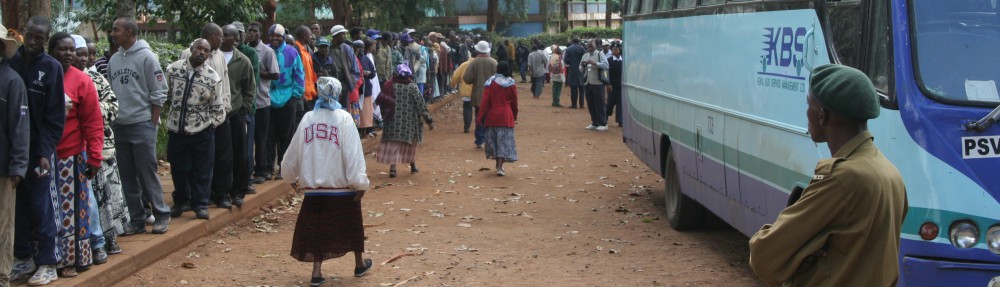
My sense going into the vote is that the constitution would pass by a good margin and the level of violence would be relatively lower than feared. Things do seem to be going smoothly so far. Violence in the past has either been state-supported or tied to the misconduct in counting the votes. With what seems to be a serious effort by the security services to work against violence this time, reflecting President Kibaki’s apparent commitment, the environment seems quite different for this vote.

See Gettleman in this morning’s NYTimes on the atmosphere in the Rift Valley prior to the voting, and this story from the BBC.

Kenya’s Referendum–Uchaguzi platform for citizen monitoring is up

Uchaguzi

Uchaguzi is a technology platform that allows citizens and civil society to monitor and report incidences around the electoral process.

Uchaguzi provides web and mobile-based channels for citizens and civil society to report on electoral offences such as intimidation, hate speech, vote buying, polling clerk bias, voting mis-information etc. The reports are then sent to the electoral authorities or security personnel for action.

Uchaguzi recognizes the need for empowering citizens in the protection of democracy by inspiring individual and collective action in enforcing transparency, accountability and efficient electoral service delivery.

Here is the BBC World Service on security preparations.