[Updated] Ruto term nears halfway point as USAID is strangled and Kenyan politics faces disruption from loss at Raila AUC vote Saturday

Update 2-15: Raila fell short to Djibouti’s candidate in the 7th round of voting.

If Raila Odinga doesn’t win his election for Chairman of the African Union Commission on Saturday then Ruto on one hand and the ODM Party on the other will have to face the question of how to repurpose Raila within Kenya’s political establishment. Will he return to the customary role as opposition presidential candidate? Will he and Ruto reach a deal on a new alternative role to keep him and his key loyalists “onside” with the Ruto presidency?

Is there any chance that he would take some “senior statesman” status within ODM and/or the opposition more broadly and not move toward a run for the Presidency in 2027?

What will be the impact of the demise of US democracy assistance, being cemented as this is written, have on the hugely delayed preparations for the 2027 elections?

Mzalendo reports today on claims that the Independent Electoral and Boundaries Commission—intended to be a permanent Government of Kenya institution under the 2010 Constitution—may have a selection panel in place by April of this year to start the process of selecting Commissioners. USAID has been the leading donor for process for decades.

See this piece from The Standard:

Addis setback, a political turning point for both opposition and government

He returns home empty handed, leaving his admirers divided and his detractors wary. There are those who want the Raila to take up his role of calling the government back to order.www.standardmedia.co.ke

Raila Odinga Kenya president campaign

Following Jimmy Carter funeral Donald Trump takes office and deploys “neutron bomb” to US foreign assistance

American “olds” of my generation (we who are 45-64 are the only age cohort who went for Trump in last year’s presidential election) may remember the 1970s controversy over President Carter’s decision to go forward with deployment of the neutron bomb in Western Europe.

To some sensitivities way back in the day, before we “beat the Vietnam syndrome”, the notion of a defensive nuclear weapon that could kill people without “nuking” physical infrastructure was distasteful even faced off against the Soviet Red Army across the Iron Curtain. This was before the peak of the “nuclear freeze” movement and the birth of the National Endowment for Democracy and the modern era of democracy assistance under “PeaceThroughStrength” during the Ronald Reagan administration.

If you are too young to remember the Cold War I think you probably had to be there but I will try to link back soon to some of my related blogs posts and list some other references.

On Friday an acting official on behalf of Secretary of State Rubio delivered the symbolic equivalent of such a weapon to direct immediate Stop-Work orders freezing funding for State Department and USAID funded Foreign Assistance (subject to a few advance waivers for Egypt and Israel, some emergency food assistance and security matters). All to be reviewed and restarted, modified or terminated on authority of Secretary Rubio to make sure they directly serve the strictures of the Trump/Rubio formulation of “America First” as opposed to, you know, helping other people in service to our national interests as per US statutes enacted during the Truman, Eisenhower, Kennedy and subsequent administrations up through 2024.

Of course it was never not America first but it was in some real sense at important times and in important ways “America +” (or so most of us Americans have always believed).

Secretary Rubio came off the Board of Directors of the International Republican Institute (a major State and USAID nonprofit foreign assistance implementor) as well as leaving the U.S. Senate this week to take the post under Trump.

Book bitings: how the National Endowment for Democracy was born in “strategic fuzziness” in 1983 (and why it is neither a “CIA cutout” nor a conventional NGO)

Kenya Election Day 2007

I very much enjoyed recently reading Democracy Promotion, National Security and Strategy: Foreign Policy in the Reagan Administration by Robert Pee, from 2016 in the Routledge Studies in U.S. Foreign Policy series.

“Robert Pee delivers a carefully crafted, nuanced, and comprehensive study of the rise of democracy promotion as a critical component of US foreign policy under the Reagan administration. The analysis is insightful and sophisticated, offering an excellent understanding of the sources of tensions that animate US democracy promotion’s purpose and practices from its inception to the present days.” Blurb from Dr. Jeff Bridoux from Aberystwyth University, UK.

I highly recommend Pee’s book for anyone involved in or interacting with American democracy assistance. The detailed story of how NED, and NDI, IRI and CIPE as three or the four NED core institutions, “happened” is illuminating and important.

A critical factor that is lost, if not deliberately swept under the rug, in much of the internet commentary that has been generated in contemporary environments, is the fundamental institutional role of Congress in establishing NED.

In the very earliest part of the new Reagan Administration from 1981 the question of democracy assistance was on the table as an aspect of the foreign policy challenges of the late Cold War. Most acutely because of the challenge presented by the Solidarity movement and related happenings in Poland on one hand and the civil war in El Salvador and the revolution in Nicaragua on the other. Within the Administration there were a variety of leading actors and voices reflecting a range of viewpoints. Key questions included consideration of what was beneficial and what was necessary in terms of intellectual and ideological commitments to freedom in the context of the risks of confrontation with the Soviet Union, the stability of the “containment” order and hopes for arms control and other negotiations. Reagan was elected as a critic of President Carter’s new formal policy emphasis on “human rights” as ineffectual in the context of the events such as the Soviet invasion of Afghanistan and the hostage-taking by students at the embassy in Iran. So something new and distinguishable was needed. While CIA director William Casey was one of those voices he was far from the only one.

In the meantime, aspirations for democracy assistance had been percolating in academia and civil society since the 1970s. It is essential to place this in the historical context of the post-Vietnam era, and in Pee’s emphasis the era post-Ramparts magazine expose in 1967 of widespread CIA cultural and intellectual subsidies.

In his famous Westminster address to the British Parliament of June 1982 President Reagan made the public commitment to a policy of democracy promotion. With that threshold crossed, the Administration had to come up with actual policy details and bureaucratic structure and the game was on. Reagan’s speech is well worth a re-read, especially to remind of the difficult Cold War context presented by Reagan’s dual commitment to both Strategic Arms Limitation talks with the Soviets and to Solidarity and Poland’s quest “to be Poland”.

Initially those voices of “conservative” caution and constraint who wished the national security structures of the White House to hold the reins won the initial bureaucratic struggle reflected in the Administration’s proposed “Project Democracy” legislation. But however hard it may be to remember this now, in 1983, Congress was a truly co-equal force on these types of foreign policy decisions and the Administration’s proposed “Project Democracy” approach died for lack of support.

In the post-Vietnam, post-Watergate environment, Reagan faced a “permanent” Democratic Party majority in the House of Representatives and a Senate with a range of important and influential thought and action leaders in both parties, with an ideological range in each that would be unthinkable today. Congressional debates on foreign policy were highly engaged and unpredictable. Seniority and Committee structures had greater weight.

And thus the National Endowment for Democracy happened in “strategic fuzziness” as Pee elucidates. At a specific time and place the sausage was made. The Administration had committed to democracy assistance as a new tool of foreign policy and Congress delivered a separate organization “endowed” with funding from Congressional appropriations but not in form a government agency nor reporting to the National Security Council. IRI and NDI which had been incorporated as nonprofits at the Republican and Democratic National Committees respectively earlier that year became “core institutions” of NED and CIPE was formed at the U.S. Chamber of Commerce to join the longstanding international “free labor union” arm of the AFL-CIO which became the other two “core institutions”.

NED was made subject by Congress to the Freedom of Information Act and to audit, but not reporting to the White House. Early gambits to restructure NED to bring it under Administration control were defeated. After forty years NED is a both a fixture of “Washington” and a unique creature born of a specific confluence of global events, policy aspirations and domestic democratic politics in the United States in 1983.

[In reference to my previous posts, this background can explain, in addition to more important things, why Carl Gershman as fledgling NED’s president would have been attracted to having use of Henry Kissinger’s perceived “stature” and “gravitas” inside-the-Beltway” in Washington as a NED board member even if Kissinger was not interested enough in the mission relative to his other priorities to be able to attend the meetings.]

Power as an aphrodisiac – Kissinger’s legacy at the National Endowment for Democracy (NED) was to add “a degree of prestige and credibility that we needed during our early period”

I wanted to follow up on my previous post “What is Henry Kissinger’s legacy as a board member at the National Endowment for Democracy?in light of some comments from one of my much younger friends in academia who also works with and studies democratization assistance. Here are excerpts from Kissinger’s NED files at Yale:

First, I want to make sure not to conflate or overly compress the time period of Kissinger’s service on NED’s Board (1985-89) during the Second Reagan Administration and the time period of the Second George W. Bush Administration when I worked for the International Republican Institute (IRI) in Kenya (2007-08) administering NED and USAID democracy assistance programs. Or the ensuing First Obama Administration when IRI gave Kissinger its 2009 “Freedom Award” and The New York Times published an investigation on the IRI Kenya presidential exit poll I had managed.

I privately noted back when it happened the irony of IRI choosing Kissinger as its recipient for this democracy award in 2009 in the context of IRI’s focused work in the 21st Century on democratization efforts in Cambodia, Bangladesh and East Timor for instance, in the wake of Kissinger’s record as US National Security Adviser and Secretary of State in the Nixon and Ford Administrations in the 1970s in regard to those specific countries. This background then led me in 2023 on Kissinger’s death to learn the overlooked (by me) fact that Kissinger had previously served on NED’s Board. This in turn led to my undertaking initial research – not with the implication that there was something “sinister” whereby Kissinger’s NED role might have been subversive of NED program goals as such – but rather to try to understand the history in light of the obvious dissonance or irony between Kissinger’s approach in Government and the democratization priorities of NED as an institution.

Going through the digitized portions of Kissinger’s NED files at Yale at least seems to confirm: “One is left with the impression that Kissinger might have been something of a foreign affairs celebrity/senior statesman board member who did not heavily engage with NED governance.”

Second, focusing then on the specific years (1985-89) that Kissinger actually served on the Board, we have the very tail end of the Cold War, with Kissinger pushed into resigning by early 1989 by the non-attendance policy, just a few months before the fall of the Berlin Wall. We don’t know one way or the other what Kissinger’s role might have been in regard to Post-Cold War NED democratization work, just that he was not able or willing to find much time in 1985-89 and that his departure was unrelated to the cataclysmic change in international relations and democratization about to take place. The one specific contraposition between Kissinger in the US Government in the First and Second Nixon Administrations and Kissinger on the NED Board involved support for electoral democracy in Chile.

As I noted in my previous post, Kissinger did not attend NED Board meetings approving the programming on the Pinochet plebiscite but did sign off on a solicited consent for the list of programs including Chile after the meeting. So nothing to indicate that Kissinger used his post-Government role at NED to oppose a restoration of democratic elections in Chile.

At the same time, I cannot imagine that there was not some bit of heartburn within the Democratic Party side of the bipartisan NED family about the irony of Kissinger’s role as to Chile even though so much more was still classified in those years than is public knowledge now. (Not to assume that all Democrats opposed Nixon and Kissinger’s Chile policy, or all Republicans excused it, but it did become a source of contention among Republicans and Democrats as well as Right and Left in U.S. politics during those 1970 to 1989 years.)

It is worth noting that the files contain some correspondence in which the NDI President at the time, Brian Atwood, chides NED President Carl Gershman over NED’s public relations approach, which Atwood saw as inappropriately attributing to NED the programing success of NDI on the Chile plebiscite.

It may be that NED was not really in a position to compete as a nonprofit corporation with profit making businesses for Kissinger’s board services, since they did not have fees or stock to offer in compensation. As to what Kissinger received for lending his name, I see it as just one more way in which he distanced his reputation from his extremely controversial policy record—most especially on “democracy”, “freedom” and such ideals. How could a democracy NGO like IRI give Kissinger it’s highest award? Why not, when he had already been a Board Member for the National Endowment for Democracy many years before? Even had Nixon lived much longer, it was much easier to give such an award to Kissinger than to Nixon even though Nixon had so much more involvement in electoral democracy than Kissinger ever did.

I write this on January 6, a date that will live in some degree of infamy in the annals of democratization in the United States. Last night driving home from a family trip I heard on BBC a discussion of the state of democracy in the world with a scholar noting V-DEM research showing democratic rescission has reached the level of 1986 – during the Cold War and Kissinger’s time on the NED Board. See the 2023 V-DEM Democracy Report “Defiance in tbe Face of Autocractization” here. How serious are Americans, especially inside the Washington establishment, about democracy as a priority among our various competing interests? Why haven’t we been more successful in our democratization efforts? Should we do anything different or should we rather double down on making sure not to entertain questions?

With NED turning 40 years old this year – and an obvious and immediate challenge to my children’s freedom and that of their generation worldwide – I would rather not risk “going along to get along” .

What is Henry Kissinger’s legacy as a board member at the National Endowment for Democracy? (Updated 12-14-23)

Greetings and Happy Human Rights Day!

Henry Kissinger served on the board of the National Endowment for Democracy (NED) in the early years of the Endowment during the second Reagan Administration, from 1985 to 1989. Thus during the wind down and end of the Cold War.

For a good scene setter noting Kissinger’s role, see “Missionaries for Democracy: US Aid for Global Pluralism”, in the June 1, 1986 New York Times.

This position for Kissinger had escaped my attention until with the news of his death I looked back at the early 2009 press release from the International Republican Institute (IRI) announcing that Kissinger would receive that year’s IRI “Freedom Award”. (Given that IRI was promoting democracy in Cambodia, Bangladesh and East Timor among other places where Kissinger’s government service record in relation to democracy issues was well known by then to have been, shall we say politely “controversial”, I was a bit taken aback. Obviously Kissinger was a primo draw for a D.C. foreign policy establishment fundraising dinner but I was still surprised at the specific symbolism for IRI.)

I first visited NED in June 2007 as the new IRI Resident Director for East Africa on my way out to Nairobi. I met with Bronwyn Bruton, longtime DC Africa hand, who was managing the East Africa grant portfolio at NED which would fund much of our IRI work in Kenya (assuming approval at a meeting of the NED board which I also attended) along with her boss Dave Peterson who has been NED’s Africa Director dating back to Kissinger’s time on the board in 1988.

It was only in the summer of 2009, after I was back at Northrop Grumman in Mississippi and my dustup with Ambassador Ranneberger over the Kenya IRI/USAID exit poll and election observation had been on the front page of the New York Times that I attended a public Kenya program at NED and got to meet longtime President Carl Gershman and other executives. (I have written about that event previously in regards to Kenya.)

With Kissinger’s death the copyright on material he produced in his NED papers at Yale has passed from Dr. Kissinger to the University. I have spent time this weekend looking at what the Yale Library has digitized on-line of the six boxes. I have reached out to a couple of friends in the academic world who work with the study of democracy assistance to see if they are interested in collaborating with a layman/practitioner to study this.

Some interesting things I have learned so far: Kissinger was not on the initial board of directors when NED was established in 1984 following passage of the enabling legislation in December 1983, but was sent an invitation by Mr. Gershman in December 1984 following discussions that fall. Kissinger accepted in late January explaining that his response had been delayed by his travel schedule.

Most of the material is just copies of NED board correspondence, but there are slips and notes indicating his many scheduling conflicts between Kissinger & Associates business, corporate boards and the Center for Strategic and International Studies.

By late 1988 Kissinger had received a letter from NED’s outside general counsel noting that his three straight absences from board meetings would necessitate his removal by policy, but that there would an opportunity at the next meeting to present “extenuating circumstances” to excuse the attendance issue. After some confusion on whether he had automatically been removed, Kissinger submitted his letter of resignation because of his other time commitments in January 1989.

One is left with the impression that Kissinger might have been something of a foreign affairs celebrity/senior statesman board member who did not heavily engage with NED governance.

Perhaps ironically as to Kissinger, the big feather in NED’s cap in late 1988 was deploying a special Congressional appropriation along with other funds to support in Chile the “no (to General Pinochet)” campaign in the plebiscite that Pinochet had called on continued military rule.

NED funded usual Chilean civil society type programs as well as the funding to NDI for the campaign which among other things paid for three American political consultants, including Glen Cowan of Francis, McGinnis & Rees, who pioneered the NDI-funded PVT through the opposition parties and through the local “Committee for Free Elections”. NDI, according to their quotes in clips circulated by Mr. Gershman to his board, added private funding to the US Government funding provided through NED.

It might be that as a private citizen and businessman by 1988 Dr. Kissinger was no longer intensely interested in Chile or General Pinochet; perhaps he sort of informally recused himself from the NED board in the context of Reagan’s second term pivot reflected in Mr. Gershman’s description (“the basic concept was to promote a peaceful and stable democratic transition”). Maybe he now supported democracy in Chile affirmatively to the point he did not feel it necessary to show up? Without being able to ask him, maybe we can learn more going forward.

National Journal piece on NED and NDI Chile work cited favorably to NED board members

[This Chile work was the origin of the NDI-funded PVT programs that I have written about in Kenya’s 2013 and subsequent elections, as well as in the most recent elections in Malawi and DRC. There are some big differences between the late Cold War NED NDI Chile work in 1988 and the application of the tool by USAID in conjunction with their other democracy programing in 21st Century Africa.

Glenn Cowan joined Eric Bjornlund from NDI in forming Democracy International (DI) in 2003 and published an extensive Vote Count Verification User’s Guide for USAID following a wide consultation among implementors in 2010. They gave me a valued copy several years ago. I will hope to write more about this after catching up with old friends at DI and elsewhere.]

For more from NDI, see the 40th Anniversary retrospective at “NDI: BOLSTERING GENUINE ELECTIONS TO SECURE DEMOCRACY – THROUGH CITIZEN AND INTERNATIONAL ELECTION OBSERVATION”.

NED Memo of 9-87 announcing 1988 Board Meetings (January 1988 was Kissinger’s last, followed by January 1989 resignation.)

UPDATE: Continued research shows that Kissinger attended no more than one NED Board meeting after the spring of 1987, but executed a consent on June 28, 1988 approving the NED grants supported by those members who attended the June 5, 1987 meeting, including 6 grants to NDI, among them “Chile: Promoting Free and Fair Elections -$110,172”.

Raila owes me for keeping the vote count verification Exit Poll showing him leading in 2007 from “going away”, but I did not do it for him personally

Over the years carrying my torch as a witness to what happened on my watch in democracy assistance in Kenya in 2007-08, I have always tried to be mindful of the notion that it has not been my business who Kenyan voters chose, including how they voted in the subsequent 2013, 2017 and 2022 elections in which Raila has continued to be a leading candidate. Rather, my job in 2007-08, and my purpose since, has been to address the facts honestly and support the democratic process so that the choices actually made by Kenyan voters themselves would be honored.

Thus, keeping the 2007 Exit Poll from meeting an untimely demise because it was diplomatically inconvenient was not a matter of “supporting” Raila versus Kibaki as a candidate or politician, but rather doing my job to support the democratic process and “observe” the election with integrity.

There was a little bit more involved in preserving the hope that the Exit Poll would be released and published during the early months of 2008 when I was finishing out my “public service leave” as International Republican Institute Resident Director for East Africa than I have written about over the years.  It is probably time to tell the story.

In summary, after the decision was made in Washington to my surprise and disappointment not to release the Exit Poll showing Raila winning by almost six points, there was still the notion that the original polling forms would be sent to Washington and the original data evaluated and re-entered in digital form to determine whether there were actual doubts or anomalies to justify the announcement that the poll was “invalid”. Initially, this was going to happen when staff from our Nairobi office traveled to Washington in March for IRI’s annual global meeting.  The meeting was intended to be mandatory for me as a Country Director and I was asked on behalf of IRI’s President to prepare a presentation on the process of dealing with the Exit Poll and the release decision.  I explained to my boss, the Africa Director, that this was a terrible idea since I emphatically objected to the decision to say the poll was “invalid” and not release it, but I did not want to get up in front of a bunch of young idealistic IRI employees working around the world and say that, nor surely did “the front office” want me to. I also had a major family conflict for the meeting which had been moved because someone in Washington had forgotten to make hotel reservations.  Since my leave from my job in the States was up June 1 and I had to move back in May anyway, I was comfortable declining and was able to beg off.

The original survey forms, which were in locked storage at the Country Director residence near our office, were going to be delivered to Washington by the other staff members making the trip for the March meeting.  But then those instructions were cancelled and there was no operative plan to re-enter the data or otherwise review the original forms in Washington or elsewhere.  The researchers from the University of California San Diego (UCSD) who were the critical consultants for the USAID-funded poll and had contributed additional funding supplementing that provided by USAID, wanted to do the data work, but IRI Washington did not want to let them without modifying their contract.  IRI would pay  $10,000 as compensation for the additional work, the same sum as the funding Dr. Clark Gibson of UCSD had provided pre-election, but UCSD would have to surrender the right to publish the results after a six month exclusive period for IRI that was provided in the original pre-election contract.  Dr. Gibson, as he told the New York Times declined because he thought “they were trying to shut me up”.

Given the fact that there was no path forward to complete the polling program and answer the questions that had been raised back in Washington without reference to the original data, I had to make a choice as Chief of Party for the polling program between honoring the existing contract with Dr. Gibson of UCSD or breaching it to follow instructions from my IRI superiors.  I elected to honor the program and the contract (and the election process itself as I saw it) and allowed the UCSD graduate student researcher to take possession of the survey forms (I had sent him, along with my wife, to retrieve them from the polling firm and bring them for safekeeping at the residence once things got “hot” when IRI announced from Washington that the poll was “invalid” and would not be released.  (As but one example of what I was concerned about, the possibility of a re-count of the underlying vote in the December 27 election had been eliminated, allegedly, by a fire in the warehouse where the ECK stored the ballot boxes just after the vote.)

Thus UCSD was able to verify the poll and release the results in presentations in Washington at the Center for Strategic and International Studies and Johns Hopkins University in July 2008 after the end of the six month embargo. And USAID reported in their Frontline newletter that the exit poll “disclosed that the wrong candidate had been declared the winner”.

The personal drama was that in April when I was working from the residence (my successor was in place running the office by then but had not yet been approved by USAID as Chief of Party so I was still needed for public meetings and reports and such) when I got a call from my Africa Director in Washington that my successor had not been able to find the survey forms in the office.  I explained that they had never been taken to the office, which seemed obviously less secure, so we had taken them to the residence.  That was a satisfactory answer and nothing further was said.  The fact that the forms were in San Diego at that moment was a “didn’t ask, didn’t tell”.

In May I was to turn over the residence to my successor.  The UCSD researcher was bringing the survey forms back from San Diego with him and put the boxes in checked baggage which was tied up in a big delay at Heathrow in London, so he arrived without them as I was getting ready to vacate the residence.  In the context of the tension between myself and the Ambassador and the non-release of the Exit Poll, I threw myself my own going away party with my family and the staff that reported to me, but I did get invited to a farewell dinner by the Serbian Ambassador and his wife who managed our IRI office for both the East Africa programs and Sudan. Starting out with a homemade Serbian aperitif I felt a bit woozy after a sip and excused myself. I woke up a few minutes later on the floor of the restroom with blood on the tile from striking the sink on the way down.

A cab was called to take me to Aga Khan hospital where I recovered for a few days while my wife and kids scrambled to finish getting everything out of the residence for turnover in my absence and I hoped that the boxes of survey forms would arrive in time to be back in the residence for my successor.  After a few anxious days the boxes arrived in the nick of time and I was soon out of the hospital and off with the family for a couple of weeks in Uganda before going back to Mississippi and my job as a lawyer in the defense industry. Testing at the hospital indicated that I did not have malaria, just some similar but completely temporary symptoms of who-knows-what.

At some point, IRI ended up hiring a survey firm in Oklahoma to review the Exit Poll and released it themselves in August 2008 just before the UCSD researchers testified about it to the Kreigler Commission which was conceptually charged with investigating the dispute as to the facts of the vote for president.  Raila wrote about how important the Exit Poll was to him in his autobiography, “The Flame of Freedom”.  He got part of the story wrong, but since he has continued to be a candidate for president over the succeeding elections, it has been in his interest not to be overly fastidious about all the details, just as the important thing for current democracy assistance efforts is keep learning and adapting from the lessons that become available.

If Raila ends up being president this time, I hope he does a great job in the spirit that his most loyal friends and supporters, some of whom are also my friends, have always hoped.  I also hope it is because he gets the most votes in a free and fair election that is not marred by violence or more corruption than we have already seen.

US Senate: more on collaboration by Moi’s former consultants Manafort and Stone with Wikileaks and Russian spy Kilimnik on behalf of Trump

For context see “Kenya’s Moi hired Paul Manafort and Roger Stone to lobby National Democratic Institute and others in 1992 election“.

Here is how The Los Angeles Times morning newsletter describes yesterday’s US Senate release:

‘A Grave Counterintelligence Threat’

President Trump‘s 2016 campaign eagerly capitalized on Russia’s efforts to meddle in the U.S. election four years ago, according to a Senate Intelligence Committee report from Republicans and Democrats that raises new concerns about connections between Trump’s top aides and Moscow.

As Russian military intelligence officers were releasing hacked Democratic Party emails through WikiLeaks, the report said, the Trump campaign “sought to maximize the impact of those leaks” and “created messaging strategies” around them. The report found that the Trump campaign “publicly undermined” the U.S. intelligence community’s conclusion that Russia was behind the email hack and “was indifferent to whether it and Wikileaks were furthering a Russian election interference effort.”

The 966-page document describes Paul Manafort, the president’s former campaign chairman who is serving prison time for financial crimes, as “a grave counterintelligence threat” because of his relationship with Konstantin Kilimnik, a business partner in Ukraine who is conclusively described as a “Russian intelligence officer.” Manafort and Kilimnik used encrypted messaging applications and codes to communicate, sometimes telling each other to look at the “tea bag” or the “updated travel schedule” when it was time to check the email account they shared, according to the report, which represents a rare bipartisan consensus on a hotly contested topic.

The report includes new details about Roger Stone communicating with Trump about Wikileaks and concerns about whether anyone encouraged Michael Cohen, the president’s former personal lawyer, to lie about Trump’s pursuit of a luxury skyscraper in Moscow during the campaign.

This fifth and final volume from the Senate Intelligence Committee’s investigation into Russian election meddling in 2016 arrives soon after Trump’s own intelligence officials have warned that Moscow is revisiting its playbookahead of the 2020 election by trying to undermine Joe Biden.

More at “Senate’s Russia Report Implicates More Than Trump’s Campaign“, Bloomberg Quint, Eli Lake, Aug. 19, 2019.

Old Party Office in Kibera

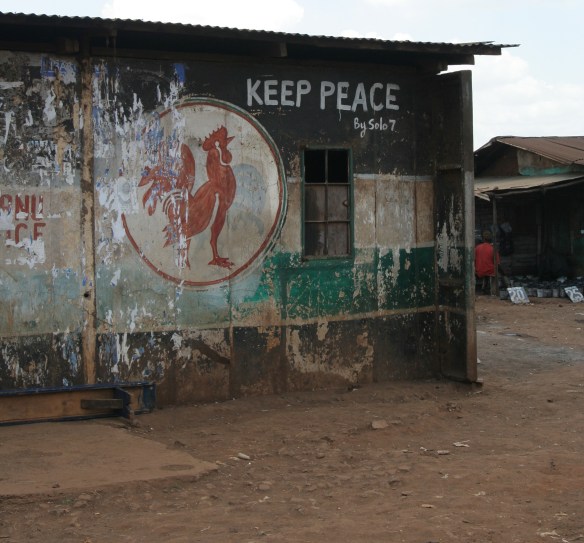
Solo 7–Kibera

Election Observation and Democracy Assistance: what is CEPPS?

CEPPS stands for the the Consortium for Elections and Political Process Strengthening; the members are the International Republican Institute (IRI), the National Democratic Institute (NDI) and the International Foundation for Election Systems (IFES).

Although CEPPS has been functioning as a USAID master funding mechanism for Cooperative Agreements for Democracy Assistance since the early post-Cold War era in 1995, it is only more recently that it has started to take on a more public face as an entity as opposed to the three constituent organizations. (See the explanation from their branding strategists here [with the colorful image of a Masaii woman voting])

While I have no idea why this has evolved in recent times, I will note that building up CEPPS as an “entity” with its own brand could be seen from outside as a way to establish an alternative structure directly tied to USAID in competition with funding for democracy assistance through the National Endowment for Democracy (NED).

IRI and NDI are two of four core NED institutions. IRI and NDI were incorporated by the leaders of the Republican and Democratic National Committees respectively, pursuant to the legislation establishing the National Endowment for Democracy as private organization, with a bipartisan board and Congressionally-appropriated funding and subject to the Freedom of Information Act. (The other two NED core institutions are the Center for International Private Enterprise [CIPE] affiliated with the United States Chamber of Commerce and the Solidarity Center affiliated with the American Federation of Labor-Congress of Industrial Organizations or AFL-CIO.)

IFES, on the other hand, which the branding material describes as a “core institution” of CEPPS, borrowing the NED terminology for the consortium members, is a more explicitly “private” entity created in 1987, four years later in than NED, during the second Reagan Administration, at the instance of then-USAID Director Peter McPherson as he describes in a 2017 interview on the IFES website. McPherson went to a American political campaign manager with a “bipartisan tone,” Cliff White (known publicly primarily for his role as Barry Goldwater’s 1964 campaign manager) to found the nonprofit because among the contractors USAID used there was a lack of technical expertise on the mechanics of organizing and holding elections. USAID provided an initial grant but IFES is not part of the Congressional mandate and annual budget appropriation process of NED and its four “core institutions” including IRI and NDI.

Readers will remember that IFES is a nonprofit corporation (like IRI and NDI) and was registered as such with the Kenyan government when President Kenyatta and his party leaders and government officials attacked IFES for not being registered as an “NGO” in late 2016 and early 2017 and allegedly being too cooperative with the opposition while managing the USAID election assistance and supporting the Independent Electoral and Boundaries Commission. Of course since IFES had been working on the same basis in essentially the same role with ECK since 2001 under Samuel Kivuitu’s Chairmanship and the IIEC and then IEBC under Issack Hassan, I saw this as pre-election “muscle flexing” by the incumbent President Kenyatta and his coalition directed at both the new Chebukati-led Independent Commission taking office in January to replace Hassan’s group after opposition protests and at IFES. The democracy donor diplomatic group led by US Ambassador Godec pushed back but Kenyatta’s Administration used its control of Immigration to force out the IFES Country Director and another key IFES employee. An outside replacement Country Director was “parachuted in” mid-March for the August 8 election.

See also “USAID is using a model for Kenya election assistance contracting that creates unnecessary conflicts of interest between organizations supporting election observation, voter education and embedded support to the Election Commission“.

Here is a discussion of USAID use of CEPPs from a review conducted by the Office of Inspector General for USAID focused on Europe, Eurasia and the Middle East released November 26, 2019, titled “Additional Actions Are Needed to Improve USAID’s Democracy, Human Rights and Governance Programs”:

CEPPS was founded in 1995 by the National Democratic Institute (NDI), the International Republican Institute (IRI), and the International Foundation for Electoral Systems (IFES), and holds a global Leader with Associate assistance award with the DRG Center to implement a variety of DRG activities, including political party assistance programs.

According to USAID officials, CEPPS received a series of global assistance awards from USAID for 1995 through 2020, which helped CEPPS partners develop a capacity to deliver political party assistance programming and establish a global footprint with a presence in every region in which USAID operates. The current global assistance mechanism was awarded in 2015 (a cooperative agreement) and provides missions the option to offer funding opportunities directly to CEPPS rather than develop a notice of funding opportunity locally.

Agency mission and headquarters personnel reported that, overall, CEPPS partners have excellent technical leadership and organizational experience to work collaboratively with host-country political leaders. CEPPS partners have developed strong work relationships with local stakeholders in many countries and are acknowledged as global leaders in the DRG sector. For example, in Ukraine, mission officials praised the NDI, IRI, and IFES Chiefs of Party as outstanding leaders who are highly accomplished and respected in their areas of expertise. They noted that the technical skills and positive reputations of these individuals are an asset for the mission and its DRG portfolio.

However, Agency officials also noted that missions often default to working with CEPPS partners through USAID’s global assistance award with the DRG Center—instead of pursuing opportunities to partner with other organizations that can provide similar services. Relying on CEPPS gives significant influence to a small group of partners to implement political party assistance programs and increases USAID’s reputational risk. Specific concerns reported to us by USAID officials include:

• NDI, IRI, and IFES have significant political connections and powerful benefactors on their boards of directors, including sitting Members of the U.S. Congress, former Ambassadors, and other political appointees. NDI and IRI in particular could be perceived as extensions of the U.S. Democratic and Republican Parties, respectively, by host-country stakeholders. For example, NDI’s website acknowledges that it has a “loose affiliation” with the U.S. Democratic Party and IRI’s current Chairman is a U.S. Senator in the Republican Party.

• In Georgia, CEPPS attempted to exclude a host-country democratic political party. In a 2017 letter to USAID/Georgia written on behalf of NDI and IRI, CEPPS stated that it would temporarily suspend assistance to a Georgian political party because of media reports of derogatory remarks made by party leaders about CEPPS partner staff, along with CEPPS’s disagreement with the party’s political platform and rhetoric. The mission responded to CEPPS’s letter by directing NDI and IRI to continue delivering assistance to the Georgian political party in compliance with USAID’s Political Party Assistance Policy.

Malawi 2019 Election – with Court annulment, a look back at USAID’s version of post election “Lessons Learned”

Update: the latest on the annulment of the election from Quartz Africa. And from The Guardian: “Malawi court annuls 2019 election results and calls for new vote.”

Here is what USAID has had to say as of June 27, 2019 on “Lessons From Malawi’s 2019 Elections”:

. . . .

In part due to considerable programmatic support – including USAID assistance – monitors observed commendable improvements in the MEC’s electoral preparation, voting process and results transmission system compared to previous elections.  Notably, as shown above, the MEC’s final result closely tracked with the USAID-supported non-partisan parallel vote tabulation, implemented by the Malawi Election Support Network (MESN) and National Democratic Institute (NDI).  

In addition, despite pre-electoral intimidation and violence against female candidates, 44 of Malawi’s 193 new parliamentarians are women, up from just 32 in 2014. 

Nevertheless, many voters have raised questions about the integrity of the process and Malawian opposition parties have petitioned to the courts to annul the results. While USAID/Malawi’s Democracy, Rights and Governance (DRG) team played a significant role in supporting the MEC to deliver a credible election, as well as civil society’s oversight of the process, more work remains to be done. USAID will continue to provide post election support, through NDI and International Foundation for Electoral Systems (IFES), to build confidence in Malawi’s political processes and improve citizen-state relations.


USAID Supported a Stronger Electoral Process…


In 2018, USAID joined DFID, European Union, Norway, Irish Aid, and UNDP by investing $1 million in the UNDP’s “Election Basket Fund,” which was established to pool international donor resources in support of the MEC’s election strategy, preparation, management, and tabulation. UNDP led the donor community in helping the MEC with critical institutional reforms and electoral preparations, registered 6.8 million voters through newly-issued biometric ID cards, engaged with political parties in preparation for the elections, supported women’s participation in the electoral process, strengthened the capacity of the Malawi Police Services to mitigate electoral violence, and supported election-day logistics and results transmission.

To complement the UNDP Basket Fund efforts, USAID and DFID jointly provided $4 million to the National Democratic Institute(link is external) (NDI) and the International Foundation for Electoral Systems(link is external)(IFES) to improve civil society and political party oversight and engagement. NDI and its partner MESN coordinated with the MEC on civic and voter education initiatives and mobilized long term observers.  Working with with Democracy Works Foundation, MISA Malawi and broad group of local actors, NDI produced three televised presidential debates and trained political party monitors for election day oversight.

Given the highly competitive race for president, strengthening citizen confidence in the results management process was critical.  On election day, MESN and NDI deployed over 900 observers to monitor all day and conduct a parallel vote tabulation to try to give Malawians greater confidence that the tally of ballots was transparent and accurate. NDI’s partner Institute for War and Peace Reporting (IWPR) and the Media Institute of Southern Africa (MISA) Malawi tracked and reported on media bias and established a fact-checker to combat fake news(link is external) on social media.

IFES helped the MEC to train judges on electoral dispute resolution, established an online election Early Warning/Early Response (EWER)(link is external) system to track and mitigate electoral violence, and  provided technical assistance on strategic communications in the lead-up to the elections, and throughout the voting and tabulation processes. 

In addition to these measures, USAID’s DRG team coordinated the US Government observer effort on election day. More than 80 observers from the US, UK, Ireland, Japan, Norway, Canada travelled together to visit polling and tabulation stations in 13 of Malawi’s 28 districts and submitted 240 observer reports.

But Challenges Remain …

. . . .

Through these and other efforts, the MEC and electoral stakeholders addressed many critical challenges from the 2014 election.  While observers noted a few logistical and organizational problems in some of the more than 5000 polling stations throughout Malawi, the consensus of the observer missions are reflected in the African Union’s Election Observer Mission preliminary statement, which concludes that:

 …the 2019 Tripartite Elections have provided Malawians with the opportunity to choose their leaders at various layers of government in accordance with the legal framework for elections in Malawi, and in accordance with the principles espoused in the various instruments of the AU. The elections took place in a peaceful environment and at the time of this statement, the mission had not notes any serious concerns with the process, either witnessed or observed.

Despite these efforts and a generally well conducted election, the public reaction post-election has been largely negative highlighting remaining gaps as well as a concerning level of mistrust between the public towards its democratic institutions and political actors.  Neither improved electoral transparency and preparations, election-day operations nor an independent PVT has assuaged the public’s concerns over election rigging.  Since the results were announced, Malawi has seen continued protests – some marred by violence – calling for the annulment of the results and resignation of MEC Commissioners.  Once again Malawi’s electoral outcome is in the hands of the courts.  

Implications for Future

Clearly, we need to do additional work to support both Malawi’s election management and to increase the citizenry’s trust in democratic institutions.  The trust issue is critical.  Afrobarometer’s recent study(link is external) underscores these issues in its June 2019 paper that shows that in 2017 only 57% of Malawians “agree” or “agree very strongly” that leaders should be chosen through regular, open, and honest elections. This means out of 34 African countries surveyed, Malawi’s trust in democratic systems is 3rd from the bottom – a concerning position for a democracy that has just completed its sixth election.


I hope this can be an occasion for a deeper and more open discussion about the learning opportunities than has happened from the problems over the years in Kenya.

Kenya’s Moi hired Paul Manfort and Roger Stone’s firm to lobby the National Democratic Institute and others ahead of 1992 election

Back in the 2008 presidential campaign between John McCain and Barack Obama, Senator McCain got some criticism for using Charlie Black, previously of the Black, Manafort, Stone & Kelly firm as a campaign consultant in part because of the firm’s background in lobbying in Washington for various dictators like Moi and Mobutu of African nations and Marcos of the Philippines. More recently, the spotlight has shifted to Paul Manafort and Roger Stone from that storied firm who have been convicted recently of multiple felonies related to their service to Donald Trump’s 2016 campaign and in Manafort’s case also involving money laundering associated with more recent work for a Russian oligarch in Ukrainian politics.

Washington reporting that I saw during the 2008 campaign noting the Black, Manafort Stone & Kelly work for Moi had a significant oversight in accepting spin that the Moi relationship had concluded with the end of the Cold War and the beginning of active U.S. support for democratization in Africa, including the push on Moi to legalize non-KANU parties, which came to fruition in the December 1991 legalization of political opposition.

My guess is that reporters relied on an incomplete aggregator rather than going directly to the original Foreign Agent Registration Act filings (online at http://www.fara.gov). Regardless, the point is that Black, Manafort Stone & Kelly made a third filing for Kenya under Moi for March 1, 1992 to February 28, 1993 that covers Moi’s December 29, 1992 re-election. Along with the U.S. Executive and Legislative branches, Black Manafort Stone & Kelly were to lobby the IMF and World Bank and “public interest and activist groups such as the Black Caucus, Africa Watch, Environmentalists, National Democratic Institute, Civil Rights Lawyers, African-American Institute, Article 19 (journalists) and other activists and public interest groups.”

[Another discrepancy is that the summary list on the Justice Department website lists an incorrect name, a successor firm, for the Black, Manafort Stone & Kelly, Inc. filing for 1992-93.]

As I have written previously, see “My Joel Barkan Tribute“, US Ambassador Smith Hempstone, a George H.W. Bush political appointee, wrote in his memoir Rogue Ambassador that he had recommended to Moi that Kenya allow the National Democratic Institute (NDI) to observe that first post-independence multi-party election featuring FORD-Kenya (Jaramogi Oginga Odinga), Ford-Asili (Kenneth Matiba) and the Democratic Party (Mwai Kibaki) among others challenging Moi’s KANU. Moi vetoed NDI for the Election Observation Mission but went ahead to invite “sister organization” the International Republican Institute (IRI) for whom I served years later in 2007-08 as Resident Director for East Africa in Nairobi.

IRI and NDI are private District of Columbia not-for-profit corporations established originally at the Republican and Democratic National Committees, respectively. Along with two other special purpose democracy assistance not-for-profits associated with two other parents, the United States Chamber of Commerce and AFL-CIO (an affiation of labor unions), these four “core institutes” receive funding from the National Endowment for Democracy or NED, pursuant to 1983 legislation. NED receives direct funding from the United States Government and is also able to raise private donations, as are the four “core institutes”.

It never came to my attention one way or the other whether Black, Manafort, Stone & Kelly consulted Moi on the decision to reject NDI in favor of IRI or what Moi’s considerations might have been in taking that position. Nor of the State Department, USAID and/or others in the US Government and in IRI in going along.

Moi was re-elected according to the Electoral Commission of Kenya with approximately 36% of the vote.

The election was seen as badly flawed but nonetheless representing “the will of the people”. Presumably that would mean a recognition that within a year of opposition being legalized and with State resources deployed on behalf of Moi, a good 2/3 of Kenyans wanted to replace him, but without a runoff or a pre-election “deal” among the fledgling opposition parties Moi would be able to keep power and claim to have switched from a single-party authoritarian system to a “democratic mandate” without giving up power or persuading a majority of Kenyans that he deserved it.

After Bill Clinton defeated President George H.W. Bush and Ross Perot in the November 1992 elections, Bush launched Operation Restore Hope, landing Marines and Navy Special Forces on the beach in Somalia December 9 leading UNITAF, a new UN humanitarian mission to replace UNISOM I, the ultimate predecessor of the current AMISOM which began in 2007. See an early official postmortem on Operation Restore Hope from the United States Institute for Peace here.

In Kenya after 27 years the Moi family remains prominent in political and business matters in Kenya with the son of Moi’s original benefactor Jomo Kenyatta eventually succeeding Moi as president in 2013 after a 2003-2013 interregnum under Mwai Kibaki who was Moi’s Vice President for the first ten years of his presidency from 1978 to 1988.