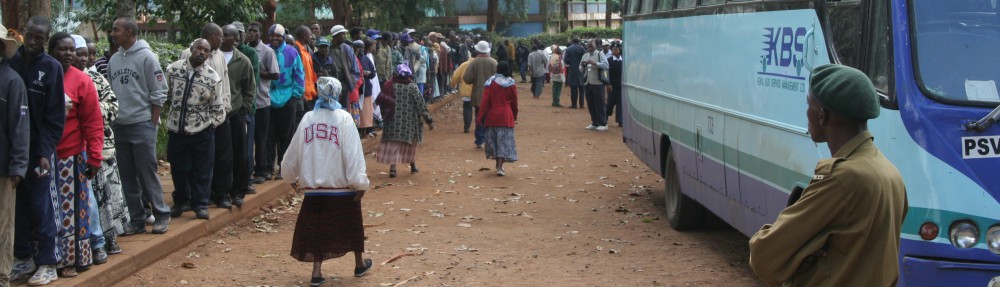
Kenya IEBC terminates Chief Election Officer over procurement irregularities

Kenya 2013 election IRI Electoral Commission voter education posterKenya, after three problematic general elections (2007, 2013, 2017), might finally be showing some initial stirrings of organic action to start to address fraud within the Election Commission. The Independent Electoral and Boundaries Commission has announced today the termination of Ezra Chiloba, Chief Election Officer, after a long suspension.

The last two elections were plagued by technology problems, with the 2017 vote annulled by the Supreme Court. The donors, including USAID which directly funded failed purchases in 2013, and funded a major embedded role with the IEBC for IFES throughout these years, have remained conspicuously mute on reforms and corruption issues involving the Electoral Commissions.

In the past, after opposition protests, the Commissioners from the 2007 and 2013 elections were given lucrative buyouts to pave the way for a new slate, and impunity for bribery and procurement fraud issues was the informal consensus policy among the Kenyan politicians and the Western donors supporting the election process.

After the buyout of the Commission led by Issack Hassan which had failings in the 2013 vote, Chief Election Officer Chiloba was carried over under the new Commission on through the 2017 vote. Since 2017 we have now seen three Commissioners resign in addition to Commissioner Akombe who fled country during the tensions following the Supreme Court’s annulment of the August presidential vote. The remaining Commissioners have now acted to fire Chiloba after internal audits and a report by Kenya’s Auditor General raised “charges . . . on major procurements.”

See today’s announcement:

The next step is to release to the public the audit reports indicating “charges” and refer the matters for legal proceedings.

In the meantime, several more months have gone by without any further release from the USAID FOIA office on my 2015 request for the documents from their support of the IEBC through IFES for the 2013 vote.
See “Election Assistance FOIA Update: Disappointed to see from USAID records that IFES was supporting Kenya IEBC/Kenyatta-Ruto defense of election petition by civil society and opposition“.

Democracy Assistance needs an external non-governmental watchdog

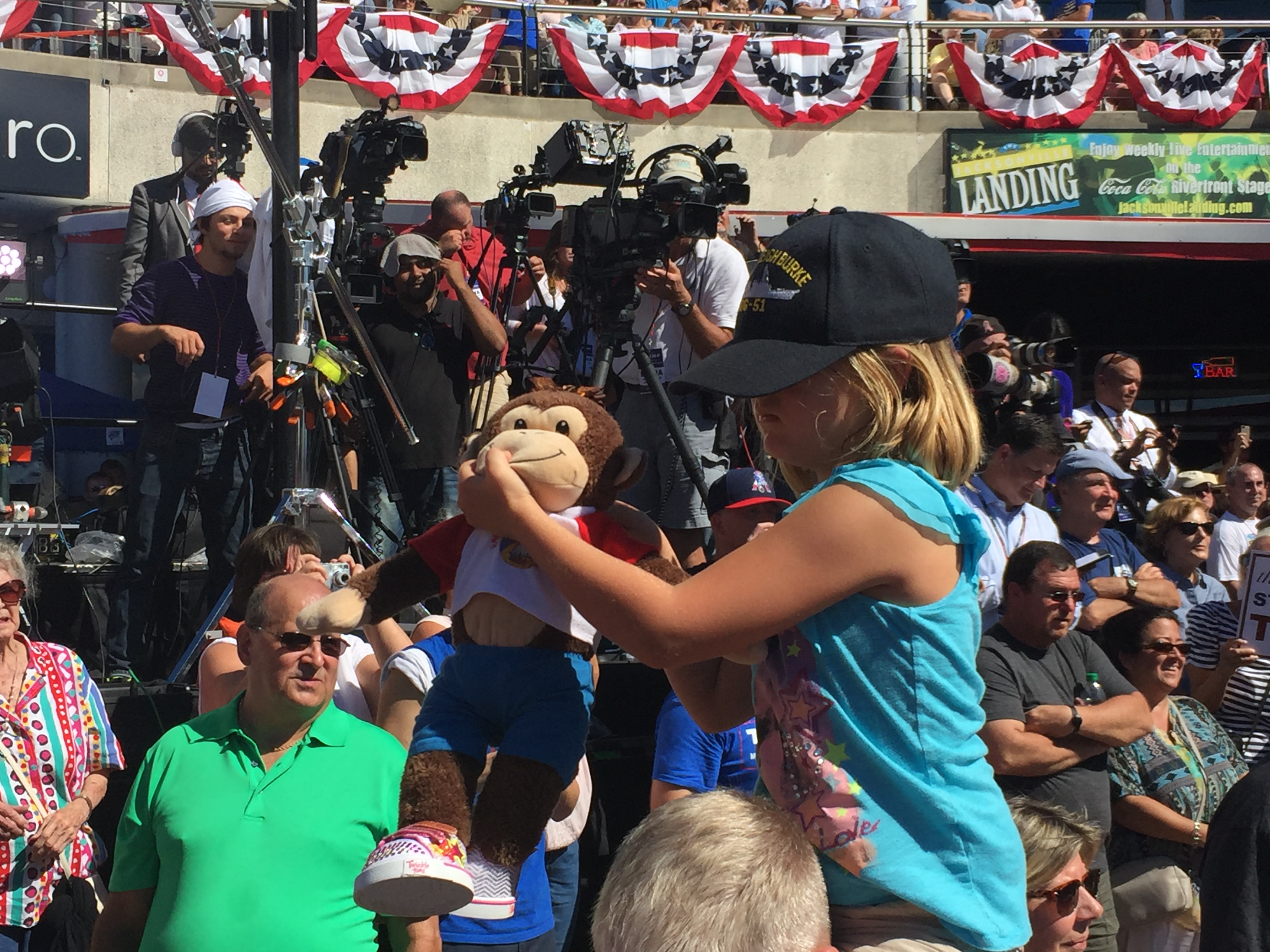
Democracy assistance needed - Presidential campaign rally Trump Floida Democray assistance needed

This recommendation for the creation of a democracy assistance “watchdog” organization is where I have ended up from my own experience as an election observer and a volunteer trainer. And especially my role as a “sentimentalist whistleblower” from my time as “East Africa Resident Director” for the International Republican Institute with the failed 2007 Kenyan election.

I recently had the chance to visit with a wise American friend from my Kenya time who is of the persuasion that we, the United States, would be better advised on balance not to try “democracy promotion” and to step back from being entangled in foreign politics. My accumulated years of watching democracy assistance in addition to my own search to understand what has happened in Kenya in spite of my best efforts force me to take this view seriously in a way that I would not have some years ago. Nonetheless, I am still in a “different place”and have an alternative suggestion. (When my friend stated that she would rather we spent the money on educating children I had to concede that would be better, but we have been around long enough to know that would not happen.)

Admittedly I have not been objective. This goes to the “sentimentalist” aspect of my speaking out about what went wrong on my watch in Kenya in 2007-08 and what I saw going wrong in 2013. Even though losing or limiting valued personal friendships was inevitable as a result of being a dissenter and agreeing to speak on the record to The New York Times about what happened I did it because I felt obligated and I have continued to feel affection for my former colleagues. Nonetheless, having been briefly an insider and otherwise around the democracy assistance community does give me a basis to continue to believe that most of the people involved in democracy assistance are relatively sincere and would prefer to accomplish more for the intended beneficiaries of the assistance.

Beyond that, the reality is that we are going to continue to do democracy assistance anyway. The question is just whether we want to get better at it or not.

Democracy assistance has solid bipartisan support from Republicans and Democrats in Congress whether or not the base voters of either party are persuaded conceptually. Yet we observe by consensus that we are in a period of global “democratic recession” suggesting that what we have been doing may be suboptimal. People outside Washington generally do not have time and other resources to be engaged unless they are either participants (and thus beneficiaries) of the system or ideologically engaged to a degree that inhibits having a place at the table in Washington.

One of the problems is the inability to develop the learning and community of practice that would be available if there was greater transparency. Transparency is not really in the immediate short term interests of implementing organizations like IRI, NDI and IFES which for perfectly natural reasons would rather stay out of the line of fire from beneficiary critics of donor policies and just find it easier, like any of us, not to have anyone looking over their shoulder.

It is clear to me that the values behind “open government” would be most compelling in the area of democracy assistance itself. Donor taxpayers and intended beneficiaries of democracy assistance ought to see what they are paying for, and intended to receive respectively. The practice of informal secrecy creates opportunities for incumbent host governments to manipulate and divert programming. Informal secrecy also creates opportunities to avoid scrutiny of irregular interference in democracy programming by donor diplomats or others who may have competing objectives. [The essence of my experience as I summarized in “The Debacle of 2007″ for The Elephant.]

See also: “President Trump’s new Assistant Secretary of State for Africa candidly explained why election observation and technical assistance have to be firewalled from diplomacy to have integrity“.

Meanwhile donor funds are available to tell positive, promotional stories as part of the donors’ general public diplomacy efforts even if the stories may gloss over the grittier realities that would need to be dealt with to actually improve an aspiring democracy– whether just to burnish images or to serve “stability” by avoiding angering voters who might be upset to know more about how their leaders are conducting themselves.

Existing watchdog organizations do not seem well equipped to work on foreign democracy assistance–partly because they have so many seemingly bigger fish to fry. In an era of “permanent war”, massive defense budgets and big expenditures in health and other programs and huge, growing deficits, democracy promotion programs are going to continue to be below the radar and outside the ordinary bandwidth of most groups like the Project on Government Oversight that do much of the best oversight in other areas. Related limitations apply for public interest journalism.

The Inspector General function is available to deal with certain specific wrongdoing within USAID programs and can deal with things like theft of funds from implementing organizations but a watchdog outside government could help all of us learn whether we are really doing the right things with our resources to help democratic development. While the USAID investigation process of my complaints regarding my experience in Kenya at least generated the informal confirmation of my concerns there was no remedy offered nor public reporting. Realistically democracy assistance gets into messy political questions that can only be addressed candidly in the first instance from outside of government.

There is new attention in Washington to “competing” with China in East Africa. In the bigger picture we have entangled our own economy deeply with China’s for too many years to simply change our minds now so our relationship with China will be nuanced. We do see that China has moved in a more rather than less authoritarian direction in recent years and that the Communist Party of China is doing more to directly collaborate with like minded ruling parties as we see with Jubilee in Kenya.

If we care about democracy in the long term the size of China as a power committed enough to its own authoritarianism to work to suppress its own expatriates and manipulate news coverage in Africa is concerning even if it does not succeed in propagating the CPC model.

But we do not need to be reactive: let’s do what we do better instead of playing catch up on their terms if competition with China is a motivator. It is the ballot box, not Bechtel Corporation (as an example) that gives the United States a comparative advantage over China. To mutually share the opportunities of democracy effectively, we need to generate more transparency and better oversight for our democracy assistance.

“The great observer gamble” is a “must read” on the Zimbabwe election and international election observation

An important election and election observation drama is playing out now in Zimbabwe, and “The great observer gamble” (free feature) in Africa Confidential is the key explainer.

Subhead: “After an eight-month charm offensive wooing bankers and diplomats, the government is failing the legitimacy test”

Please follow the link and read in full.

In this case the U.S.-funded joint NDI-IRI international observation mission made a difference in international understanding of the difficult realities of the election in the context of seemingly conclusory approvals from the regional SADC (of which Zimbabwe is a member) and the African Union.

I have no criticism of the NDI-IRI effort and as far as I can tell my old colleagues have upped their game in important ways in this situation from my previous experience in Kenya. At the same time I would note that with the incumbent government already under sanction and not an important U.S. ally, and in a fairly small (in population) country with lots of opposition support in the U.S., this was a case where it was easier to stick to the facts of the vote without getting caught in a diplomatic undertow.

An important question now is how IFES in supporting the Zimbabwe Election Commission will handle the announced election challenge litigation from the primary opposition. With a fraction of one percent margin over the 50 percent runoff threshold and a lot of delay and uncertainty with the central tally (aside from voter register and larger “playing field” issues, this looks quite a lot like Kenya 2013, which I have been looking into through the Freedom of Information Act.

Mnangagwa’s team may have done enough to allow the most enthusiastic business people and governments to step up re-engagement. Much will depend on the strength of the opposition’s case at the election tribunal and the credibility of its handling by the courts.

Africa Confidential

[Update – the judicial challenge has been file. As in Kenya the process is truncated by a 14 day deadline for the court to rule.]

[This is one of my photos from the IRI Kenya 2007 Observation, as we arrived at Olympic Primary School in Kibera, Nairobi. One of the Zimbabwean newspaper sites used a copy of this image with the gentleman on the left cropped out for their Zim coverage.]

Election Assistance FOIA update: disappointed to see from USAID records that IFES was supporting Kenya IEBC/Kenyatta-Ruto defense of 2013 election petition by civil society and opposition

Kenya EACC at Integrity Centre NairobiBack in 2015 I submitted a Freedom of Information request for USAID records relating to the election assistance through IFES for Kenya’s IEBC (the election commission).
The Mission in Kenya sent several hundred pages to the USAID FOIA office more than 30 months ago. A year ago I finally got the first release, simply a heavily redacted copy of the Cooperative Agreement itself funding the program.

I have just recently gotten the second release, the first substantive group of redacted copies of the underlying documents. From this I am starting to learn some information about the procurement of the failed Results Transmission System, but that matter remains somewhat sketchy so far.

Sadly I did see that IFES staff reported to USAID in the aftermath of the vote that they were busy working on the defense of the Supreme Court petition which impacted their availability to address questions about the systems issues.

I also learned that the election assistance donors were discussing amongst themselves the extent to which the UNDP, which administered “basket funding” for the election should cooperate with an investigative inquiry regarding procurements from the Ethics and Anti-Corruption Commission (EACC).

Kenya High Court Nairobi AFRICOG lawyer Harun Ndubi press conference 2013 election

I did learn that one prospective bidder for one Results Transmission System procurement reported to the USAID Mission December 2012 that the allowed time for proposals was insufficient, to no avail as USAID said the impending election date did not allow delay.

When I consulted with AfriCOG, the Kenyan civil society organization, on election observation, and court petitions were filed seeking first to enjoin the IEBC from proceeding with an informal/irregular alleged vote tally when the Results Transmission System failed, and then after the IEBC went ahead, to challenge the alleged results, I did not know the Results Transmission System was a U.S. Government procurement under the Agreement, nor of direct involvement of IFES in supporting the other side in the litigation.

Were Americans right to be so fearful of Odinga’s “People’s President” swearing in?

[Update Feb. 2: Here is a good overview from Martina Stevis-Gridnef in the Wall Street Journal, Kenya Crackdown on Media, Opposition Deepens“; Fr. Gabriel Dolan explains how the Kenyatta government has popularized the “National Resistance Movement by banning it, with good historical context.]

Since I elected to stay away from the 2017 election in Kenya myself, I have tried to avoid offering a lot of derivative commentary from afar, but have continued to be interested and concerned with how my American government representatives approach this on behalf of the American people.

Privately, I shared the worry that perhaps Raila was not being a good steward of the lives of his supporters given the risk of threatened action by the Kenyan governments’ security forces (and my inability to decipher what he was really aiming to accomplish).

Nonetheless, I also decided that it was not my place to lecture for several reasons. First, any Kenyan who would be deciding to attend or not attend the rally knew full well and far better than I the risks of running afoul of the GSU (General Service Unit, a paramilitary wing of the police, known for use for high profile political missions, such as sealing off Uhuru Park in the weeks after the 2007 election to prevent opposition rallies) or other force at the disposal of the “Commander in Chief President”.

Second, we ourselves have passed on doing our part to forthrightly deal with the detritus of the stolen 2007 election and the substandard and opaque election process that put the current Uhuruto regime in power in 2013.

Third, in this election cycle we did not give visible public support to reasonable reforms of the IEBC process. I am not willing to be too critical from afar without knowing more (although I don’t know more because our approach is intentionally more opaque than I think is appropriate or prudent) but in watching as an American back home we certainly gave the impression over the last couple of years that while we wanted things to go smoothly and would support negotiation of the disputes surrounding the IEBC in areas where they were pushed to the forefront by the opposition, we remained in the mode of supporting the old “Chickengate” IEBC team and staff, even while the investigation of procurement fraud directed by the April 2013 Supreme Court ruling never happened. Even when the British secured criminal convictions for the Chickengate bribes and paid money over to the Government of Kenya, we were mute as Kenyans enjoyed the customary impunity for corruption–and when Uhuru used the funds to do a “photo op” for the purchase of ambulances as if it was a charitable donation.

We allowed the incumbent administration to attack and potentially interfere with our assistance to the IEBC through IFES in the critical months before the election (see “The hardest job in Kenya . . .”) without obvious penalty, and stayed silent on reforms called for by the EU Election Observation Mission and others–aside from the opposition–in the wake of the Supreme Court’s September 1 ruling striking the presidential election of August 8 because of the IEBC deficiencies.

As it turned out the incumbent administration acted extra-legally to shut down private broadcasters (except the President’s own) but had the security forces pull back and did not initiate the feared violence. If we had any influence on that decision then I am pleased that our long years of support to Kenya’s various police and security services and governments of the day may have borne some positive fruit in that instance.

As far as the notion that Raila would be likely to unilaterally instigate violence in this situation, people in the State Department would do well to remember the analysis of Ranneberger’s own staff pre-election in 2007 that while there was hate speech on both sides the largest share was directed against Raila rather than on behalf of his candidacy or the opposition.

Invoking the so-called “ooga booga factor” to scare Westerners about Raila has been more than a cottage industry in Kenya (and in London and Washington PR shops) along side the ethnic hate speech to rally other ethnic groups against him in Kenya. And Raila is unavoidably controversial in some respects and gives his critics ammunition. But at present Raila is in a relatively physically powerless position in opposition; the Government of Kenya security forces are in the hands of “Uhuruto”, controversially elected in the first place as a “coalition of the killing” from the violence that was taking place exactly ten years ago.

In this context the “black propaganda” operation on behalf of the Uhuruto re-election campaign through Harris Media of Texas, United States, was particularly pernicious and even worse than 2007.

Let’s remember that then-Assistant Secretary of State Jendayi Frazer herself insisted that what was being done through the Kalenjin militias in the Rift Valley in early 2008 was “ethnic cleansing” and we all know the “revenge” attacks through the Mungiki against especially Luo and Luhya who had the misfortune of living and working in Naivasha and Nakuru were horrific. And that the largest share of the killing was done by the police and largest number of killed identified by ethnicity Luo per the Waki Commission. The ICC Prosecutor’s Office may have run a sloppy legal operation, but did they really get “the wrong guys” factually in the six indictments? Will O.J. someday find the real killers? (Do Raila and Kibaki–Commander in Chief then–and many other politicians also bear some real moral responsibility, too–surely so; does Kalonzo Musyoka? I personally would not vote for either ticket if they were running in my country, but they weren’t, and left us with our own problems.)

Fair minded representatives of the United States in current circumstances have to recognize that the threat of violence on behalf of an incumbent “Uhuruto” regime in full control of all military, paramilitary and other police forces is much greater than that presented by an opposition rally or ceremony.

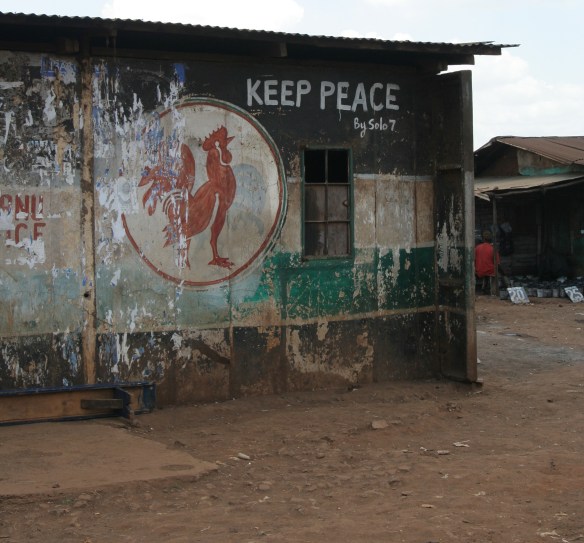
Old Party Office in Kibera

Remembering Paul Muite’s open questions about the IEBC’s integrity before Kenya’s previous elections

Back in February 2013 The Africa Report ran a feature entitled “Can Kenya’s judiciary and election commission pull it off?” on readiness for the general election on that March 4. In a blog post from that April after the Supreme Court upheld the election I discussed Hon. Willie Mutunga’s “judicial philosophy” in the context of what he had had conveyed in that Africa Report just before the vote.

With this year’s Supreme Court decision annulling the August 8 presidential vote with Paul Muite, one of Kenya’s most prominent lawyers–and sometimes “Central Province” politician and official–representing the Election Commission (IEBC) I thought it was worthwhile to highlight his pre-election integrity concerns when he was not litigating:

There is, however, nervousness about how the IEBC will fare.

Led by Ahmed Issack Hassan, the IEBC has enjoyed public confidence since August 2010 when it ran the referendum on the new constitution.

It then held several by-elections with textbook efficiency.

But troubles began last year over a tender for biometric voter registration kits.

After anomalies were exposed, the government intervened and awarded the tender to France’s Safran Morpho at almost double the stipulated cost.

The delayed voter registration was com- pressed to one month instead of three.

James Oswago, the IEBC chief executive, says it is absolutely committed to transparency: “In fact, I am not aware of any public procurement officer who has referred a controversial process to the government for arbitration. I did. You have not heard anybody going to court for corruption linked to this process.”

Unlike the old Electoral Commission of Kenya, whose top officials were in the president’s gift, the IEBC has nine one-term commissioners including Oswago, who acts as secretary to the board.

Each commissioner was selected after consultations between President Kibaki and Prime Minister Odinga, the two main rivals in the 2007 election, and then vetted by parliament.

“We have in place structures that invalidate a discretionary announcement – a rigged vote. You can accuse the commission of inefficiency or of lateness and so on, but not of rigging,” Oswago says confidently.

INTEGRITY QUESTIONS

But Paul Muite, a lawyer who is contesting the presidency himself, does not share such certainty: “The IEBC is not inspiring confidence. I am not sure that they have the capacity or political will to conduct credible elections.

“There are integrity questions regarding some commissioners […] the composition of the commissioners was motivated not by merit but by the coalition government’s need for ethnic and regional balance.”

Similarly, a report by South Consulting, which has been monitoring the coalition government for the Panel of Eminent African Personalities led by former United Nations secretary general Kofi Annan, raised questions about the IEBC’s capacity.

It questioned its capacity to act decisively on electoral disputes and pointed to its inability to censure rogue parties and politicians during the chaotic party primaries in January.

In January, the IEBC vetted and registered eight presidential candidates, rejecting two on technical grounds.

Among those approved was Uhuru Kenyatta, although he was facing a local case challenging his candidature on integrity grounds.

The case is unlikely to be decided before the presidential elections.

It seems the IEBC did not want to prejudge it, so was happy to let the courts decide.

Pressure is certain to build on the new and inexperienced IEBC as elections approach and then again in likely second round elections.

The courts, determined to uphold their independence, will probably act as a buffer against violent street protests.

The police force, overstretched as it is and caught in a maelstrom of reform, resistance and warring political factions, may not.

Voters may find themselves caught between these two institutions●

Read the original article on Theafricareport.com : Can Kenya’s judiciary and electoral commission pull it off? | East & Horn Africa

Follow us: @theafricareport on Twitter | theafricareport on Facebook

While Washington grapples with another Kenyan election mess, an update on my FOIA pursuit of our policy from 2007

Still no more documents from USAID from my 2015 request for material involving our support for the IEBC in the 2013 election, from which I finally learned in April of this year that USAID had tasked the American International Foundation for Electoral Systems with making sure the electronic Results Transmission System that failed worked:  “IFES will ensure this system is fully installed, tested and operational for the 2012 election.  Furthermore, IFES will fund essential upgrades and adjustments to this results transmission system.” 

In the meantime my Mandatory Declassification Review appeal relating to a document I originally requested from the State Department more than eight years ago relating to the January 3, 2008 post-election telephone conference between U.S. Secretary of State Rice and E.U. High Commissioner Javier Solano is now more than a year old:

September 15, 2016

Re: Case No. M-2016-04563

Dear Chairman:

I am appealing the decision to withhold in full all material identified in Case No. M-2016-04563.

Because all information was withheld in the response to my original FOIA request, FOIA Case No. F-2009-07810 and this Mandatory Declassification Review request, I have not been given much ability to evaluate and argue the details of the withholding on appeal. It is difficult to believe that every bit of information in the identified document responsive to my requests has been and continues to be necessarily kept secret in the interests of national defense or foreign policy.

In particular I note that I requested documentation on the telephone conversation between former Secretary Rice and former EU High Representative Javier Solana based on media reports containing public communications about that call, the subject matter of which was as I understand related to public diplomacy regarding the Kenyan election. Both our country and the E.U. had undertaken assistance programs to support democracy in Kenya, including neutral International Election Observation Missions and I was an NGO employee as Chief of Party for the USAID-funded observation on the U.S. side. It would seem that U.S. interests and law would counsel a tilt toward openness rather than secrecy in this specific context and I ask for your consideration in this regard.

Thank you.

Raila on the Kenyan elections at CSIS

Catch the webcast, live Thursday morning 9:30-11:00 EST:

“Raila Odinga on the Kenyan Elections” with Amb. Mark Bellamy at the Center for Strategic and International Studies in Washington.

The link will also take you to the video for CSIS Africa programs addressing the Kenyan election in June, July, August and September.

Meanwhile, the AP has a story out this afternoon widely re-published in American newspapers: “After Kenyan vote drama, successionist talk hits the mainstream“.

The succession concern may likely have resonance in Washington given U.S. interests, although my sense is that the economic boycotts are the most salient message in Nairobi.  During the PEV period following the corrupted 2007 election, ODM backed off on threats of such economic boycotts which seemed risky as unprecedented and perhaps perceived to be “over the top”.

Vogue gives us “Three Nairobi Fitness Excursions Prove There’s Plenty of Life Beyond the Safari” for Americans who want to play around the city after their “humanitarian” trip to Kakamega from the U.S.

And the Carter Center has released a statement on the October 26 re-vote mirroring the State Department’s call for “national dialogue”: “Repeat poll polarized Kenya: Carter Center” headlined the Daily Nation.

Update: A Thursday story in The Star reports that  “British Army may pull out of Kenya, decision by end of month“.  The issue is KDF approval for leases of private land in Laikipia, the established practice, as opposed to a restriction to using only Kenyan government property.

For a good overview, see “The Kenya Election Crisis, Explained” at UNDispatch         by Kimberly Curtis.

Don’t be confused: preparations for Kenya’s failed August election election were controlled by Kenya’s ousted “Chickengate” IEBC and its CEO and staff with support of international “partners”

From this blog late last year:

Meanwhile, Kenya is paying an average of about $343,000.00 “severance” to each of the outgoing Independent Electoral and Boundary Commissioners for leaving earlier this fall rather than completing their terms through November 2017. No signs of accountability for the #Chickengate bribes to the IEBC by Smith & Ouzman that were prosecuted by the UK and no sign of accountability for corruption in the subsequent 2013 election technology procurements.

While the “buyout” has been negotiated, the incumbent IEBC staff without the “servered” Commission has been proceeding to undertake election preparations that will be fait accompli for the new Commission when it is appointed next year.  

Accordingly, the chief executive has proceeded to report plans to spend an astounding 30Billion KSh to conduct the 2017 general election, while setting a target of 22 million registered voters. In other words and figures, roughly $13.40US per registered voter if the target is met or $19.60US per currently registered voter. (For comparative data from places like Haiti and Bosnia,see The Ace Project data on cost of registration and elections.)

Update: see Roselyne Akombe’s interview in the Saturday Nation, Credible Oct. 26 election not possible: Akombe” 

Friday Lizard Blogging

Enough democracy and elections for this week.  

If Kenyan Election Commission leader Roselyne Akombe’s loud public whistle was not enough to get the Western democracies to back off the “happy talk” about Kenya’s “fresh election” preparation [as the Chris Msando murder was not in July and August] then there is nothing more to say.  

It is worth remembering that when USAID solicited proposals for the Kenya Electoral Assistance Program 2017, it required IFES and the others to include an alternative plan for an election pushed back several months.  This is hard now, but Kenyans and their partners can give themselves a break here if there is enough good will and sobriety lurking somewhere beneath the surface.  And if not, then safer not to pretend.