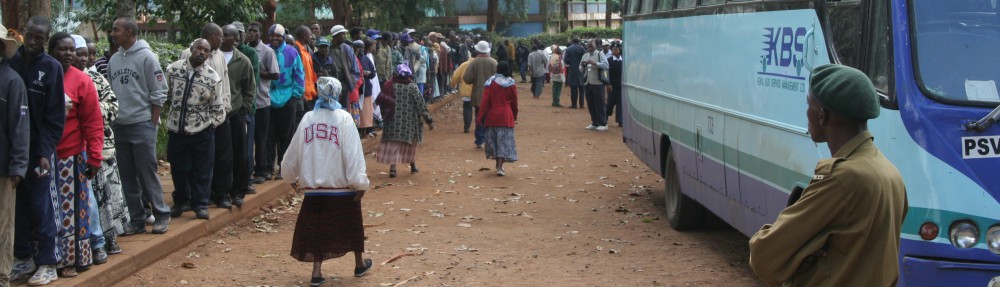
Kenya’s Moi hired Paul Manfort and Roger Stone’s firm to lobby the National Democratic Institute and others ahead of 1992 election

Back in the 2008 presidential campaign between John McCain and Barack Obama, Senator McCain got some criticism for using Charlie Black, previously of the Black, Manafort, Stone & Kelly firm as a campaign consultant in part because of the firm’s background in lobbying in Washington for various dictators like Moi and Mobutu of African nations and Marcos of the Philippines. More recently, the spotlight has shifted to Paul Manafort and Roger Stone from that storied firm who have been convicted recently of multiple felonies related to their service to Donald Trump’s 2016 campaign and in Manafort’s case also involving money laundering associated with more recent work for a Russian oligarch in Ukrainian politics.

Washington reporting that I saw during the 2008 campaign noting the Black, Manafort Stone & Kelly work for Moi had a significant oversight in accepting spin that the Moi relationship had concluded with the end of the Cold War and the beginning of active U.S. support for democratization in Africa, including the push on Moi to legalize non-KANU parties, which came to fruition in the December 1991 legalization of political opposition.

My guess is that reporters relied on an incomplete aggregator rather than going directly to the original Foreign Agent Registration Act filings (online at http://www.fara.gov). Regardless, the point is that Black, Manafort Stone & Kelly made a third filing for Kenya under Moi for March 1, 1992 to February 28, 1993 that covers Moi’s December 29, 1992 re-election. Along with the U.S. Executive and Legislative branches, Black Manafort Stone & Kelly were to lobby the IMF and World Bank and “public interest and activist groups such as the Black Caucus, Africa Watch, Environmentalists, National Democratic Institute, Civil Rights Lawyers, African-American Institute, Article 19 (journalists) and other activists and public interest groups.”

[Another discrepancy is that the summary list on the Justice Department website lists an incorrect name, a successor firm, for the Black, Manafort Stone & Kelly, Inc. filing for 1992-93.]

As I have written previously, see “My Joel Barkan Tribute“, US Ambassador Smith Hempstone, a George H.W. Bush political appointee, wrote in his memoir Rogue Ambassador that he had recommended to Moi that Kenya allow the National Democratic Institute (NDI) to observe that first post-independence multi-party election featuring FORD-Kenya (Jaramogi Oginga Odinga), Ford-Asili (Kenneth Matiba) and the Democratic Party (Mwai Kibaki) among others challenging Moi’s KANU. Moi vetoed NDI for the Election Observation Mission but went ahead to invite “sister organization” the International Republican Institute (IRI) for whom I served years later in 2007-08 as Resident Director for East Africa in Nairobi.

IRI and NDI are private District of Columbia not-for-profit corporations established originally at the Republican and Democratic National Committees, respectively. Along with two other special purpose democracy assistance not-for-profits associated with two other parents, the United States Chamber of Commerce and AFL-CIO (an affiation of labor unions), these four “core institutes” receive funding from the National Endowment for Democracy or NED, pursuant to 1983 legislation. NED receives direct funding from the United States Government and is also able to raise private donations, as are the four “core institutes”.

It never came to my attention one way or the other whether Black, Manafort, Stone & Kelly consulted Moi on the decision to reject NDI in favor of IRI or what Moi’s considerations might have been in taking that position. Nor of the State Department, USAID and/or others in the US Government and in IRI in going along.

Moi was re-elected according to the Electoral Commission of Kenya with approximately 36% of the vote.

The election was seen as badly flawed but nonetheless representing “the will of the people”. Presumably that would mean a recognition that within a year of opposition being legalized and with State resources deployed on behalf of Moi, a good 2/3 of Kenyans wanted to replace him, but without a runoff or a pre-election “deal” among the fledgling opposition parties Moi would be able to keep power and claim to have switched from a single-party authoritarian system to a “democratic mandate” without giving up power or persuading a majority of Kenyans that he deserved it.

After Bill Clinton defeated President George H.W. Bush and Ross Perot in the November 1992 elections, Bush launched Operation Restore Hope, landing Marines and Navy Special Forces on the beach in Somalia December 9 leading UNITAF, a new UN humanitarian mission to replace UNISOM I, the ultimate predecessor of the current AMISOM which began in 2007. See an early official postmortem on Operation Restore Hope from the United States Institute for Peace here.

In Kenya after 27 years the Moi family remains prominent in political and business matters in Kenya with the son of Moi’s original benefactor Jomo Kenyatta eventually succeeding Moi as president in 2013 after a 2003-2013 interregnum under Mwai Kibaki who was Moi’s Vice President for the first ten years of his presidency from 1978 to 1988.

“Livondo Tosha”? Akasha Brothers sentencing memo has “interesting” discussion about Stanley Livondo, Kibaki/PNU candidate to unseat Raila in Langata in ill-fated 2007 election

“Livondo Tosha”/”Make Peace” in Kibera, early 2008:

Kenya Kibera Post Election Violence Livondo Tosha Keep Peace

From the U.S. Attorney’s Memorandum to the U.S. District Court for the sentencing hearing for Baktash and Ibrahim Akasha, filed back on July 25. (Yesterday Baktash was sentenced to twenty five years, and The Star published a downloadable copy of the Memorandum. ) At page 23:

D. The Akashas’ Armed Confrontation with Stanley Livondo
Tensions escalated in the weeks after Ibrahim kidnapped Armstrong. Baktash began to receive threatening calls and text messages from a local politician associated with Armstrong— Stanley Livondo. Soon after, Livondo confronted Baktash at a shopping mall, and the two began to fight. Ibrahim intervened, drew his gun, and threatened to kill Livondo. The sight of Ibrahim’s gun caused panic in the shopping mall, and so Baktash, Ibrahim, Goswami, and Baktash’s bodyguard quickly fled. Before heading to the police station to ensure—with bribes—that there was no fallout from the incident, Baktash, Ibrahim, and Baktash’s bodyguard stashed their guns with Goswami. They retrieved the weapons later that day.

Armstrong as described in the Memorandum manufactured drugs in Congo and elsewhere and brought them into Kenya. He got into a relationship with the Akashas in this context from which he wanted out, leading to his kidnapping as discussed, and the threats to Baktash Akasha from Stanley Livondo.

Livondo was the candidate of Kibaki’s PNU in the December 2007 elections in Raila Odinga’s Langata Constituency who Amb. Ranneberger told me on December 15, 2007 “people were saying” might unseat Raila, which would disqualify Odinga for the presidency even if he beat Kibaki nationally in the presidential race.

See my discussion here from my post of July 2011, “Lessons from 2007 and new FOIA cables–Part Two”:

So on Saturday afternoon, December 15, 2007, I drove to the embassy residence in Muthaiga and was served tea . . .

. . . .

Ranneberger did let me know that he knew what Bellamy [his predecessor as U.S. Ambassador, Mark Bellamy] had been told as to why he had been dropped from the [International Republican Institute election observation] delegation.  In other words, he was letting me know, without taking responsibility for the situation himself, that he knew that “we” at IRI had lied to Bellamy.  This may not have put us in the best position to hold the “no more b.s.” line with Ranneberger going forward.   He didn’t say how he knew about the “story line” to Bellamy and I have no idea myself.  IRI was in a difficult situation not of our making on the Bellamy situation–would we cancel the Election Observation (as the only international NGO scheduled to observe, and raise lots of questions we couldn’t very well answer) or let the Ambassador interfere with the delegation? Regardless, once the directive from the top was given to lie to Bellamy about why he was off the list, IRI no longer had completely clean hands.

There are a variety of things from the more substantive part of the discussion that leave open questions in my mind now after what ultimately happened with the ECK and the election.  One in particular that stands out now in light of the FOIA disclosure.

The Ambassador told me that Saturday that “people are saying” that Raila Odinga, as the leading opposition candidate for president, ahead in the polls as the vote was nearing, might lose his own Langata parliamentary constituency (which under the existing system would disqualify him from becoming president even if he got the most votes nationally).  This was “out of the blue” for me because I certainly was not aware of anyone who thought that.  Odinga’s PNU opponent Stanley Livando had made a big splash and spent substantial money when he first announced, but he had not seemed to get obvious traction in the race.  Naturally, I wondered who the “people” Ranneberger was referring to were.  Ranneberger said that a Raila loss in Langata would be “explosive” and that he wanted to take Ms. Newman with him to observe voting there on election day.

Ranneberger also went on to say that he wanted to take Ms. Newman [lobbyist and former Asst. Sec. of State Constance Berry Newman, IRI’s lead delegate for our International Election Observation Mission at Ranneberger’s impetus, and his “great friend and mentor” and now lobbying associate at the firm Gainful Solutions] separately to meet with Kibaki’s State House advisor Stanley Murage on the day before the [Dec. 27] election with no explanation offered as to why.

After midnight Nairobi time I had a telephone call with the Africa director and the vice presidents in charge at IRI in Washington in the president’s absence.  I was given the option to “pull the plug” on the observation mission based on the concerns about Ranneberger’s approach following my meeting with him.   The Ambassador, rather than either IRI or USAID, had initiated the observation mission in the first place, and IRI was heavily occupied with other observations.  Nonetheless, based on assurances that Ms. Newman would be fully briefed on our agreement that she needed to steer clear of separate interaction with the Ambassador and that the Murage meeting must not happen, and my belief that it would be an “incident” in its own right to cancel the observation, we agreed to go forward with precautions.

I got the idea of commissioning a separate last-minute poll of the Langata parliamentary race.  I thought that the notion that Livondo might beat Raila in Langata seemed far fetched, but objective data from before the vote could prove important.  We hired the Steadman polling firm for this job, to spread the work.  Also Strategic was already heavily occupied with preparing for the exit poll, and  Steadman was the firm that Ranneberger had instructed his staff to call (too late as it happened) to quash the release of poll results that he knew  would show Raila leading back in October, so I thought that it was that much more likely that word would get back. Further, in the partisan sniping which I generally did not credit, Steadman was claimed by some in opposition to be more aligned with Kibaki so would be extra-credible to verify this race.  I also made sure that we scheduled an “oversample” for Langata for the national exit poll so that we would have a statistically valid measure of the actual election day results in the parliamentary race.

On to the new FOIA release:  On Tuesday, December 18, Ranneberger sent another cable to the Secretary of State entitled “Kenya Elections:  State of Play on Election”.  This cable says nothing about the “explosive” Langata parliamentary race issue that Ranneberger had raised with me on Saturday, three days earlier.  It concludes:  “Given the closeness of the election contest, the perceived legitimacy of the election outcome could determine whether the losing side accepts the results with minimal disturbances.  Our staff’s commendable response to the call for volunteers over the Christmas holiday allows us to deploy teams to all sections of the country, providing a representative view of the vote as a whole.  In addition, our decision to host the joint observation control room will provide much greater access to real-time information; allowing a more comprehensive analysis of the election process.”

Next, we have a cable from Christmas Eve, December 24, three days before the election.  The first thing that morning the IRI observation delegates were briefed on the election by a key Ranneberger aide.  I told him then that we had commissioned the separate Langata poll.  He said that the Ambassador would be very interested, and I agreed to bring results with me to the embassy residence that evening when the Ambassador hosted a reception for the delegation.  The results showed Odinga winning by more than two-to-one.

There are a number of noteworthy items that I will discuss later from this cable, but for today, let me note that  Ranneberger has added in this cable a discussion of the Langata race:

“11.  We have credible reports that some within the Kibaki camp could be trying to orchestrate a defeat of Odinga in his constituency of Langata, which includes the huge slum of Kibera.  This could involve some combination of causing disorder in order to disenfranchise some of his supporters and/or bringing in double-registered Kikuyu supporters of the PNU’s candidate from outside.  To be elected President a candidate must fulfill three conditions:  have a plurality of the popular vote; have at least 25 percent in 5 of the 8 provinces; and be an elected member of Parliament.  Thus, defeat of Odinga in his constituency is a tempting silver bullet.  The Ambassador, as well as the UK and German Ambassadors, will observe in the Langata constituency.  If Odinga were to lose Langata, Kibaki would become President if he has the next highest vote total and 25 percent in 5 provinces (both candidates will likely meet the 25 percent rule).

12.  The outside chance that widespread fraud in the election process could force us to call into question the result would be enormously damaging to U.S. interests.  We hold Kenya up as a democratic model not only for the continent, but for the developing world, and we have a vast partnership with this country on key issues ranging from efforts against HIV/AIDS, to collaboration on Somalia and Sudan, to priority anti-terrorism activities.

.  .  .

14.  As long as the electoral process is credible, the U.S.-Kenyan partnership will continue to grow and serve mutual interests regardless of who is elected.   While Kibaki has a proven track record with us, Odinga is also a friend of the U.S. . . .

15.  It is likely that the winner will schedule a quick inauguration (consistent with past practice) to bless the result and, potentially, to forestall any serious challenge to the results.  There is no credible mechanism to challenge the results, hence likely recourse to the streets if the result is questionable.  The courts are both inefficient and corrupt.  Pronouncements by the Chairman of the Electoral Commission and observers, particularly from the U.S., will therefore have be [sic] crucial in helping shape the judgment of the Kenyan people.  With an 87% approval rating in Kenya, our statements are closely watched and respected.  I feel that we are well -prepared to meet this large responsibility and, in the process, to advance U.S. interests.”  END

None of this material was mentioned in the briefing to the observation delegation or to me that day.  Long after the election, the Standard newspaper reported that the original plan of the Kibaki camp had been to rig the Langata parliamentary race, but at the last minute a switch was made to change the votes at the central tally, supposedly on the basis of the strength of early returns for Odinga in Western and Rift Valley provinces.

To be continued .  .  .  .

For my entire series of posts from 2011-2012 see my page “The Story of the 2007 Election Through FOIA“. And my summary story in The Elephant: “The Debacle of 2007: How Kenyan Politics Was Frozen and an Election Stolen With U.S. Connivance“.

Langata Ballot Specimens showing Kibaki versus Odinga for President and Livondo versus Odinga for Member of Parliament:

If Kenya’s remaining IEBC Commissioners have committed to stick with the 2017 OT-Morpho (n/k/a IDEMIA) “Election Management System” they should explain why they sole sourced that firm in March 2017 and disclose the contracts

At a briefing hosted this week by Kenya’s permanent internal election observation organization, ELOG, a Commissioner representing the IEBC indicated that the intention for the 2022 election was to reuse the KIEMS (“Kenya Integrated Election Management System”) system that was at the heart of the problems leading to the Supreme Court’s annulment of Kenya’s last presidential election.

Without scratching the surface into the deeper intrigues involving the re-election Of President Kenyatta and the technology involved, such as the pre-election abduction, torture and murder of acting ICT Director Chris Msando, or deported campaign consultants and police raids on data centres– not stuff for civil society seminars in Kenya–it would surely be the least Chairman Chebukati could do to explain why he and the Commission chose OT-Morpho/IDEMIA for the job in March 2013 in the first place.

Especially given that Kenya’s Parliament voted to debar IDEMIA and that Oberthur Technologies (OT) is subject to a world Bank debarment for bribery. Not to mention the firm’s strange role as a sole sourced substitute provider of problematic technology in 2013, when the Government of Canada stepped in to loan funds to the Government of Kenya to buy Biometric Voter Registration Kits after the supposedly independent IEBC had decided to go with a manual system instead. (According to what I’ve learned so far from a 2015 Freedom of Information Act request, IFES which was funded by USAID to assist the IEBC, reported back to USAID that the inability or unwillingness of the IEBC to resist this pressure from the Government to reverse its decision on the BVR system was a major setback in preparations for that election that reverberated through the failures with poll books and the Results Transmission in months ahead).

If the reasons for selecting OT-Morpho are to remain shrouded, the contracts themselves are public records and should be published. For some reason they do not appear to have been tabled in the 2017 Supreme Court cases about the presidential election–I am sure that was just an oversight and it is easily rectified now for the upcoming vote.

Uganda: As Museveni expands role of military in civilian sectors ahead of vote, Bobi Wine invokes Ukraine and Trump Administration is quiet, setting up risks for democracy assistance

Uganda billboard Museveni and Gaddafi

The East African had an important item looking ahead to Museveni’s next re-election campaign: “More military men don police uniform as Ugandan polls loom“:

Two weeks ago, Ugandans on social and mainstream media went into a frenzy after president Yoweri Museveni made a major shake-up of the police hierarchy, appointing four senior army officers to key positions, in a move interpreted as a preparation for the conduct of the 2021 elections.

The president named army men to the positions of Chief of Joint Staff, Crime Intelligence, Human Resource Development and Training, and Human Resource and Administration.

Civil society, the Uganda Law Society and opposition figures said that the appointment of the army officers to top positions in the police amounted to militarising the force, which could lead to impunity and brutality towards citizens.

The Uganda Law Society noted that the army did not have a good history working together with police.

Meanwhile, in the Financial Times, we have David Piling’s interview with Bobi Wine: “I will walk you around my ghetto.”

Recent opinion polls show Wine mounting a serious challenge, especially in Kampala. He is encouraged by events in places such as Ukraine, where Volodymyr Zelensky, a comedian with no political pedigree, recently won the presidency. “We have a funny saying: ‘If they did it, then we can did it’,” he says, grinning. “So if those people in Ukraine did it, then we also can did it.”

According to Ambassador Ranneberger’s cables to Washington from my FOIA research, in the run up to the 2007 Kenyan electoral debacle the Embassy reported to Washington that there was a desire on the part of the Kenya’s Orange Democratic Movement (ODM) to emulate Ukraine’s opposition to Soviet then Russian backed government culminating in what became known as “the Orange Revolution”.

—-

“Exit Polls and Orange Revolutions, Ukraine and Kenya“:

From Ben Barber, senior writer at USAID during the Orange Revolution in Ukraine, as quoted from a McClatchy piece on Egypt in a previous post:

The Ukraine’s Orange Revolution in 2004 might never have taken place if not for U.S. aid. First, the former communists in control of the Kiev government declared their candidate won an election. Then, a U.S.-funded think tank tallied up exit polls that showed the government had lied and it really lost the election.

Next, a Ukranian TV newsman trained by a U.S. aid program broadcast the exit polls and set up its cameras on the main square for an all night vigil. Up to one million people came to join the vigil. Then the Supreme Court — which had been brought to visit U.S. courts in action — ruled the election was invalid and the government had to step down.

Furthermore, U.S. legal, legislative, journalism and other trainers taught judges, prosecutors, legislators and journalists how to do their jobs in a democratic system.

From U.S. Ambassador Michael Ranneberger’s January 2, 2008 cable to Washington after witnessing fraud at the ECK  in the tally of presidential votes along with the head of the EU Election Observation Mission: “We have been reliably told that Odinga is basing his strategy on a mass action approach similar to that carried out in the Ukraine.”

In Kenya, however, unlike in Ukraine, the U.S.-funded exit poll was suppressed rather than broadcast.  The New York Times reported that USAID’s agreement with the International Republican Institute to fund the poll stipulated that IRI should consult with USAID and the Embassy before releasing the poll, taking into account technical quality and “other diplomatic considerations”.  (The USAID agreement was subquently, eventually, released to Clark Gibson of the UCSD, the primary author of the poll and consultant to IRI, under a FOIA request. I had the contract all along, of course, since I supervised the poll as IRI’s East Africa director but waited for the FOIA to write about this provision in the contact providing for Embassy diplomacy input with IRI on the release decision.)

Here is an account of the opposition approach in Ukraine from Wikipedia on the Orange Revolution:

Yanukovych was officially certified as the victor by the Central Election Commission, which itself was allegedly involved in falsification of electoral results by withholding the information it was receiving from local districts and running a parallel illegal computer server to manipulate the results. The next morning after the certification took place, Yushchenko spoke to supporters in Kiev, urging them to begin a series of mass protests, general strikes and sit-ins with the intent of crippling the government and forcing it to concede defeat.

In view of the threat of illegitimate government acceding to power, Yushchenko’s camp announced the creation of the Committee of National Salvation which declared a nationwide political strike.

Ranneberger noted in his cable that the situations in Ukraine and Kenya differed, but did not elaborate.  In Ukraine there was ultimately a re-vote and in Kenya the altered election results showing a Kibaki win stood, with a partially implemented power sharing agreement eventually leading to a new constitution. How was Kenya in 2007 different from Ukraine in 2004?  How would the U.S. react to a potentially disputed election in Uganda where Museveni has arguably even more control over the election management body than Kibaki did?

Malawi Election follow-up

See Opposition Protests in Malawi Threaten Mutharika’s Already Fragile Mandate, by Elliot Waldman, in World Politics Review, June 13, 2019.

My previous posts of May 25-27: #MalawiDecides2019: My inquiry to the Malawi Electoral Support Network, MESN, on PVT

(Noting “a hole in media reporting and public affairs announcements”:

Dear MESN,

Does your PVT receive funding from USAID (as per usual practice for these GNDEM PVT’s in Africa)? If so, what is the contractual arrangement for this funding? If not, how is the PVT funded? Thank you for a quick response given approaching deadlines!)

With Parliamanentary results released by Malawi Election Commission but final Presidential results announcement stayed, IFES works on Security and Conflict Prevention

Malawi Election Commission announces incumbent win in a ‘squeaker’–waiting on PVT

Malawi PVT released by MESN: Presidential results consistent with MEC official results, but top two candidates’ ranges overlap

I did receive a response from MESN on June 6 to my inquiry:

Thank you for your media inquiry about MESN and our observation of the
2019 Tripartite Elections. MESN receives funding from an array of
development funders. MESN’s funding for both long-term observation and
the parallel vote tabulation (PVT) comes from the United States Agency
for International Development (USAID) through the Malawi Electoral
Integrity Program (MEIP) managed by the Consortium for Elections and
Political Process Strengthening (CEPPS) . All questions about the
terms and conditions of funding agreement should be addressed to
USAID. I have attached for your information copies of our preliminary
and verification statements.

From our Embassy before the vote:

It might have been worthwhile for the Embassy to note in its May 23 Tweet that when “Both men were learning more about the system to validate the election results” the USAID Mission Director was visiting a USAID-funded program.

[You will notice if you read my previous posts I do not have any substantive criticism of how the PVT results were reported, rather I was inquiring about the funding prior to the reporting. I also noted in Zimbabwe that the reporting seemed to be carefully worded to avoid being misconstrued in the way that I have been concerned about in Kenya in 2013.]

Malawi PVT released by MESN – presidential results consistent with MEC official results, but top two candidates’ ranges overlap

Malawi PVT results from the Malawi Electoral Support Network  shows:

• Dr. Lazarus Chakwera (MCP) between 32.8% and 37.4%;

• Dr. Saulous Klaus Chilima (UTM) between 18.8% and 21.4%;

• Professor John Eugene Chisi (UP) between 0.3% and 0.5%;

• Mr. Reverend Hadwick Kaliya (Independent) between 0.2% and 0.4%;

• Mr. Peter Dominic Sinosi Driver Kuwani (MMD) between 0.3% and 0.5%;

• Mr. Atepele Austin Muluzi (UDF) between 4.3% and 5.7%; and

• Mutharika between 36.4% and 40.8%.

The PVT estimates, listed above, are consistent with the MEC’s official presidential results and therefore, the PVT can independently verify that the official results for the presidential election as announced by MEC reflect ballots cast and counted at polling streams. While PVT does not provide evidence that the presidential results have been manipulated, the PVT results data cannot definitively determine the order for the two leading candidates because of the overlap in the estimated ranges.

Read the whole release here.

Malawi Election Commission announces incumbent win in a “squeaker” – waiting on PVT

With the incumbent announced as winning with a narrower margin and a total of less than 39% of the vote, with turnout over 75%, there will be questions and frustrations.

Since the election is so close, the PVT is likely to show either of the top two candidates as a possible winner, although it could be pretty interesting if it shows something different. Since it has been done for days presumably it was ready for release some time ago.

Here is what was released for the last election in 2014.

State Department announces sanctions on head of DRC election commission and constitutional court for “significant corruption”

Good. Let me appreciate this action by the State Department to address a corrupt voting process and pull back from previous language that skipped over what seems to be the reality of what happened.

Here is the statement.

It would seem that collectively we (the U.S.) want to recognize Tshisekedi as fait accompli and “not Kabila”, and make the most of the opportunity for a better relationship and progress while still holding a small flame against election fraud for the future and not be “complicit” in covering it up. I very much approve of not being complicit in a cover up even if we are just trying to make the best of the situation with good intentions.

In Kenya in 2008 we issued private travel sanctions against two members of the election commission, the then ECK, for suspected bribery, but said nothing publicly. In that case there was violence from the election fraud and we had withdrawn our initial congratulations. We never disclosed the sanctions or the issue or evidence regarding the bribery but I learned of the matter from a Daily Nation story from a stolen cable from Wikileaks:

The Daily Nation– “What the cables say” (Feb ’08 US visa warning letters sent to ECK commissioners suspected of accepting bribes to fix vote tally) Mar 2 ’11 The link is apparently dead now; for discussion of the story please see Part Seven of my series on the page “The Story of the ’07 Election Through FOIA” under “The War for History Series: was Kenya’s election stolen?.

The public sanctions now, to me, are a step forward in responding to election corruption and I appreciate that we are taking this step. I also appreciate the many people influential in Washington who have spoken out publicly on the problem and laid the groundwork for this, noting Amb. Michelle Gavin at CFR and Joshua Meservey at Heritage. And of course Nic Cheeseman of Democracy in Africa and the University of Birmingham has been a ubiquitous friendly voice for the democratic process throughout.

As discussed in my previous post “Foreign Policy article gives insight on disagreements within Trump administration on backing off on criticism of flawed DRC vote” we learned a good bit about the intergovernmental back and forth on the U.S. side on these issues from the work of Robbie Gramer and Jeffcoate O’Donnell. (As I wrote I know there was some of this in Kenya 2007 but no one seems to have been willing to write about it yet and I only have pieces.)

So, what’s next?

Challenging Nigeria International Election Observation may present tests of character (2nd update on lobbying/funding) #NigeriaDecides

International Election Observation Mission members, including those from IRI/NDI, are arriving in Nigeria for the general election Saturday in a difficult environment.

Although invited by Nigeria’s government there has been at least one unwelcoming statement and no one could deny that this is a hard job simply from the stakes of the election, the instability in some areas, the poverty and underdeveloped infrastructure faced by large portions of the voting population and the simple relative newness of regular competitive elections.

International election observation, which focuses on civil and political rights, is part of international human rights monitoring and must be conducted on the basis of the highest standards for impartiality concerning national political competitors and must be free from any bilateral or multilateral considerations that could conflict with impartiality. It assesses election processes in accordance with international principles for genuine democratic elections and domestic law, while recognizing that it is the people of a country who ultimately determine credibility and legitimacy of an election process.

Quoted is the standard of independence and impartiality to which the USAID-funded NDI/IRI International Election Observation Mission is pledged under the Declaration of Principles for International Election Observation (Oct. 2005).

The IRI/NDI Nigeria 2015 Observation Mission was funded directly by the State Department so shifting back to USAID funding this time is one of the positive things that I see as having potential to help preserve independence and maintain clarity between an Assistance Observation and a Diplomatic Observation to the benefit of the process.

See my post “President Trump’s Asst. Sec. of State for Africa candidly explains why election observation and technical assistance have to be ‘fire-walled’ from diplomacy to have integrity” for a current discussion and further links.

The joint IRI/NDI EOM model has positives and negatives in terms of actual and perceived independence. In Nigeria where democracy assistance is confronted by “resource curse” funded problems and lobbyists working “both sides of aisle” in Washington at a unusual level for an “African election”, along with prominent American campaign consultants usually involved, the joint model seems to me to have some important advantages over IRI or NDI doing a nonpartisan mission on its own, in-spite of the tradeoffs (alternatively you could go with the Carter Center as an “outside the beltway” if politically connected choice, or Democracy International as a truly private entity).

IRI in Africa from my now distant view has come quite far from some of the vulnerabilities that we faced in the 2007 Kenya Election Observation–experience is the best “capacity builder” and institutional funding and attention are now much more appropriate to the scope of the job. Some of my old Kenyan friends and colleagues who did such a great job running things on the ground in 2007 have stayed on and climbed the ladder. And we can expect this election in Nigeria to be better than their 2007 election, observed by many involved this year, as well.

Since Nigerian elections are always high profile and “on the map” in Washington there is no danger of overlooking the situation from that front. This Observation is long-planned and expected and well-funded; there have been an ongoing series of pre-election missions with reports on preparations. Likewise these observations have been going on with regularity throughout this century–and we’ve even been through the scenario of an incumbent seeking re-election during the Boko Haram war.

At the same time, you need no expertise to know that national elections are always challenging in Nigeria and that while cumulative progress has been made in some areas there are some particular concerns that have been reported on and discussed by this Observation Mission and others in the donor governments and media.

Thus, there may be hard calls ahead for the Observers, both on concerns they have already highlighted and from unexpected events as the voting, counting and disclosing play out.

American lobbyist and Ellen Johnston Sirleaf advisor Riva Levinson articulated part of the present challenge well in The Hill in Washington over the weekend: “At Risk: Credibility of U.S. democracy promotion in Africa“. Johnston Sirleaf is in Nigeria as lead observer for the ECOWAS intergovernmental Election Observation Mission and was co-lead for the most recent IRI-NDI Mission, “ZIEOM” in Zimbabwe.

UPDATE (Feb 12): Riva Levinson and her firm KRL are “registered foreign agents” in Washington for Retail Express Limited of Lagos, Nigeria. The Foreign Agent Registration Act filing from September 30, 2018 identifies this client as a “limited partnership which supports the goals of the Senate President of Nigeria, Dr. Aubakar Bukola Saraki, to engage international stakeholders in support of free and fair national elections in February, 2019, seek a level playing field for opposition parties, and convey the core tenants of the Senate President’s vision for the future of the country.” (She also currently lobbies for the Ministry of Foreign Affairs of Liberia and the Ministry of Finance of Ghana.)

Sakari lost the now-opposition People’s Democratic Party (PDP) nomination to Atiku Abubarka but stayed in PDP, having defected from the All Progressives Congress (APC) of Pres. Buhari in July. The PDP itself hired Ballard Partners as its Washington lobbyists for a year at $1,080,000 two days before Retail Express hired KRL.

Recent former diplomat and Council on Foreign Relations Africa lead Amb. Michelle Gavin had a notably hard-hitting CFR blog post last week headlined: “The Truth About United States Complicity in DRC’s Fraudulent Election” although in the text she just covers the macro level issue of diplomatically blessing an election whose official result was contrary to all available evidence.

We in the U.S. got partially off the hook in the DRC where the incumbent Kabila did not invite U.S.-funded or other international observers beyond the African diplomatic groupings (although I learned from Levinson’s piece that we provided funding for the Catholic Church run ‘Parallel Vote Count’, a fact I totally missed in the news reporting. USAID’s website indicates we were also providing “technical assistance” to the election management body CENI itself (!) which again I missed somehow in the news reports. These facts may have informed Gavin’s view even if the journalists that I read did not take notice.)

Update II (Feb 18): As it turns out, the U.S. not-for-profit IFES continued USAID-funded work with CENI, along with its partner IRI in the Coalition for Electoral Process and Party Strengthening (CEPPS) according to a brief overview on IFES’s website, and continues to work with CENI toward local elections. CENI hired its own Washington lobbying firm in 2018, Avenue Strategies, founded by former DJ Trump campaign manager Corey Lewandowski (he left and set up a separate firm before the CENI contract). In January 2019 after CENI named Felix Tshisekedi as president-elect, Avenue Strategies also signed on to represent Tshisekedi as president-elect and now president.

Presumably, then, under the CEPPS mechanism USAID funded the third partner, NDI, for the work with the Catholic Church Parallel Vote Count. I will contact USAID to confirm the arrangement and see if they are willing to release any contractual details without a formal Freedom of Information Act request.

The Carter Center stood firm in calling out Kabila’s 2011″re-election” as failing to meet international standards. The State Department followed along in declining to bless the election and offering technical assistance to address irregularities back then, unlike the current situation which Levinson and Gavin question (although the diplomatic impetus for remediation at the presidential level in 2011 went away quickly).

See Dr. Carl LeVan’s Homepage “Development for Security” blog for an overview of the Nigeria election contest. Likewise, Amb. John Campbell’s “Nigeria’s Election: What to Know” at CFR.

Here is my piece from The Elephant in the wake of Kenya’s judicially annulled 2017 presidential election: “Free, Fair and Credible? Turning the Spotlight on Election Observers“.

[UPDATE III: here is the Preliminary Statement issued by the IRI/NDI Observation on February 25, after the delayed vote of February 23.]

International Election Observation Mission IRI Kenya Kibera Lavington Nairobi 2007

Foreign Policy article gives insight on disagreements within Trump administration on backing off on criticism of flawed DRC vote

Foreign Policy has published a piece reporting significant internal dissent from the reversal of the U.S. position from significantly negative to largely positive on the recent DRC election:

. . . .

In a series of preliminary statements crafted by the team and released by the State Department on Jan. 3, 10, and 16—before confirmation of the final results—the United States sharply condemned reports of election-related interference and violence. The Jan. 3 statement included a threat that people involved “may find themselves not welcome in the United States and cut off from the U.S. financial system.”

With the Constitutional Court’s decision to confirm the election later in the month and with news of widespread election fraud, the group drafted a new U.S. response on Jan. 23. It noted the election results rather than welcoming them—a diplomatic way of signaling displeasure—and condemned the “deeply flawed and troubling” election, according to a draft reviewed by FP. It also stated that Congo’s electoral commission “failed to live up to the responsibility” it had to carry out elections fairly and ivowed that the United States would “hold accountable” any figures engaged in election fixing or violent crackdowns on any ensuing protests.

But none of this language made it into the final statement. Instead, Washington welcomed the results and declared itself committed to working with Tshisekedi. The revised statement made only passing mention to “electoral irregularities.”

Michael Hammer, the U.S. ambassador to Congo, along with Michael McKinley, a senior career diplomat advising Secretary of State Mike Pompeo, pushed for the revised statement, according to three U.S. officials. The department’s third-ranking official, David Hale, ultimately signed off on it, the officials said.

Senior U.S. officials in other agencies and some State Department officials—including the special envoy for the region, Pham—were kept out of the final decision entirely and did not know that a shift in policy was in the works, officials told FP. They said some officials found out about the shift in policy only once the statement came out. It left some of them fuming.

“If we said we’ll hold the government accountable … and five days later we congratulate a bunch of thieves, what good are our threats?” one senior U.S. official said.

One former State Department official familiar with the process said the implications went beyond Congo. “It was just a stupid decision to release that statement, a statement that has much bigger bearing on U.S. government democracy promotion in Africa,” the former official said.

The State Department, USAID, and NSC all declined to comment for this story. A State Department spokesperson also did not respond to a request to interview the senior diplomats who FP was told were involved in the process. . . . .

This is the kind of thing I always had hoped to see about Kenya 2007 where the U.S. initially relied on what my FOIA research indicates was a pre-determined blessing of Kibaki’s alleged re-election even after Ambassador Ranneberger witnessed vote totals being changed by the Kibaki-controlled Electoral Commission of Kenya and reported some pre-knowledge of unlawful rigging plans and conduct. In the face of violence the initial congratulations were withdrawn and the State Department pivoted to support a negotiation to include the opposition in a sharing of power with Kibaki. I know that there were differing internal opinions but I have never seen this level of public reporting on the internal debate.

Some of this may reflect differences in the internal environment and reporters’ expectations and aspirations during the Bush and Trump administrations as well as “the times” more generally. Regardless, I am glad to know more about how my government made this decision and encouraged that the problems with the positive statement final statement on the were recognized by some of those involved.

On the Congressional side, here is the January 18 Statement from the incoming Republican Ranking Member on the Foreign Affairs Committee:

Washington D.C. – House Foreign Affairs Committee lead Republican Michael McCaul (R-TX) released the following statement on the fraudulent election in the Democratic Republic of Congo (DRC).

“After eighteen years of the Kabila regime, the Democratic Republic of the Congo had a historic opportunity to give its people a voice by holding free and fair elections. Millions of Congolese bravely went to the polls to cast their vote amid long lines, intimidation and violence. Unfortunately, the fraudulent vote count does not demonstrate the will of the people. 

“I commend the African Union’s call for transparency and credible election results. All parties must refrain from violence as this process continues. It’s imperative for the United States and the rest of the world to stand with the Congolese people to demand an accurate vote tally and I urge Secretary Pompeo to fully engage at this pivotal moment. All individuals who impede this democratic process must be held accountable.”

I would also like to know more about slightly more gradual process of walking back the substance of our objections to Kabila’s 2011 re-election vote during the Obama administration.

Lake Edward into Congo