Embassy Kenya: Six Years after Robert Godec’s Confirmation Hearing as Ambassador, no word on vote on his nominated successor

Flashback to six years ago, during the “lame duck” Congressional sessions following President Obama’s re-election:

NOMINATIONS OF ROBERT F. GODEC AND DEBORAH ANN McCARTHY WEDNESDAY, NOVEMBER 28, 2012 U.S. SENATE, COMMITTEE ON FOREIGN RELATIONS, Washington, DC Hon. Robert F. Godec, of Virginia, to be Ambassador to the Republic of Kenya Deborah Ann McCarthy, of Florida, to be Ambassador to the Republic of Lithuania

The committee met, pursuant to notice, at 2:25 p.m., in room SD–419, Dirksen Senate Office Building, Hon. Christopher A. Coons, presiding. Present: Senators Coons, Lugar, and Isakson.

OPENING STATEMENT OF HON. CHRISTOPHER A. COONS, U.S. SENATOR FROM DELAWARE Senator COONS. I call this hearing to order. I am honored to chair this hearing for the ambassadorial nominees to serve this Nation in Kenya and Lithuania, Ambassador Robert Godec and Ms. Deborah Ann McCarthy. Both nominees have impressive and long records of service and accomplishment in the Foreign Service of the United States, and I look forward to hearing about their priorities for advancing U.S. policies and interests in the countries to which they may soon go as our Ambassadors. I am also very pleased to be joined by my good friend and ranking member, Senator Isakson, of Georgia, and particularly honored that Senator Lugar, the ranking member of the full committee, has joined us today; and I understand Senator Durbin, of Illinois, may as well join us shortly. I apologize for the delay in getting started. We had a vote on the floor of the Senate.

As some know, Kenya has particularly important meaning for me. The first time I ever set foot in Africa was as a undergraduate spending a semester at the University of Nairobi, and I later volunteered at an orphanage in Ngong. My experience there was transformative, and changed my perspective on the world, and gave me a new sense of purpose and focus. And I returned to Kenya, for the first time in 25 years, just a few months ago.

In Nairobi, I had the opportunity to speak at the Kenyan National Prayer Breakfast, as Senator Isakson has, as well, this year, with President Kibaki and others, where I affirmed the centrality for the United States of the upcoming elections and our sincere hope that the violence and chaos of the 2007 elections can be averted. The United States, in my view, is, and should be, closely watching the process surrounding this election, and we’ll work closely with Kenyan officials to ensure the elections are peaceful, credible, and transparent. And I emphasized then, as I will again today, that we do not favor any particular outcome or candidate, but, instead, a free and fair process. Kenya has made remarkable progress in recent years in reforming its constitution, building democratic institutions, expanding press freedoms, and improving its economy. I was particularly impressed, during that visit with the younger generation of Kenyans, in the great potential that exists amongst entrepreneurs. There are many other things to be concerned about in the process toward the election, and I look forward to hearing about them in more detail from Ambassador Godec. Several factors may well influence the outcome of the election— ethnic tensions, the balloting registration process, the behavior of the police and security services, messaging of the candidates—all of which I hope we will get into in some more detail.

The other main area of concern for me regarding Kenya is its military involvement in Somalia, the ongoing security challenges, both within and without Kenya and its borders. Kenya is home to the largest diplomatic mission in Africa, from which a host of government agencies oversee bilateral and regional programs, and serves as a base for humanitarian relief, food security, and global health initiatives, and I’m eager to talk about that, as well as the potential for trade and investment in the region.

To serve as our next Ambassador in this critical post, in my view, President Obama has chosen wisely in nominating Ambassador Godec, who has served as Charge´ in Nairobi since August and has been received positively by government, civil society, and NGOs. Having built a strong career as the former Ambassador to Tunisia, he recently served as Principal Deputy Counterterrorism Coordinator in the State Counterterrorism Bureau. Prior to his service in Tunisia, he served as Deputy Assistant Secretary for Near Eastern Affairs. This is Ambassador Godec’s second time in Nairobi, following a posting from 1996 to 1999 as Economic Counselor.

PREPARED STATEMENT OF RICHARD G. LUGAR, U.S. SENATOR FROM INDIANA It is a pleasure to welcome Ambassador Godec once again before the committee, in this case as the President’s nominee to be Ambassador to Kenya. His stewardship as Charge´ over the last several months comes at a very challenging time for our large and important East Africa Embassy. He has brought deft and experienced management to Nairobi and effectively sustained our varied interests and priorities with Kenyans and the Kenyan Government at a critical time. Among the most important interests is United States support for a free and fair electoral process leading up to national elections in 2013, the first since the abhorrent violence that followed the 2007 elections. United States interests extend broadly in East Africa and recognize the commitment Kenya has made in Somalia under the AMISOM umbrella, as well as its long support for regional peace initiatives. Kenya also has been a key counterterrorism partner in a variety of areas that are of mutual concern with broad global potential for impact. These include Kenyan efforts fighting al-Shabab and building its own counterterror capabilities in maritime and border security. Our extensive cooperation extends to providing a regional platform for the Defense Threat Reduction Agency and the Center for Disease Control in securing biological materials that pose a threat to millions if neglected. I would like to thank Ambassador Godec for his expeditious review of a longstanding request incorporating DTRA into a large Embassy country team.

President Trump nominated Illinois State Senator Kyle McCarter to replace Godec back on March 28, 2018, and a confirmation hearing was finally held on July 31, 2018, but no public word has come about an actual vote by the Senate Foreign Relations Committee. McCarter was to make follow-up submissions about controversial tweets to the Senators. In the meantime, McCarter had announced prior to his nomination that he was not running for re-election to the State Senate and a Republican has been elected to succeed him in January. Trump’s Republicans gained three seats overall in the U.S. Senate.

Godec is now the longest serving U.S. Ambassador to Kenya, well exceeding Michael Ranneberger’s essentially double Bush-Obama term (even without including Godec’s six months as Charge d’Affaires).
My writing on my experience with the birth of “Birtherism” and Trump’s foreign policy

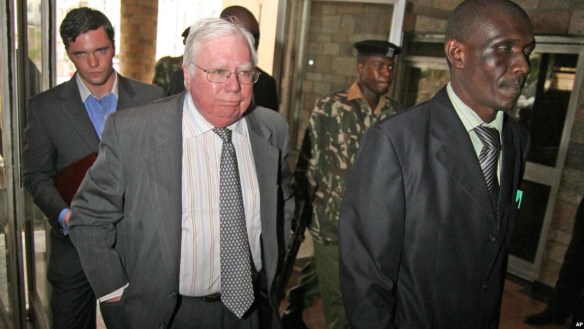
Birtherism is back in the news with statements by Jerome Corsi, author of The Obama Nation and Where’s the Birth Certificate?, that he expects to be indicted by the Grand Jury in the Special Counsel investigation of Russian interference in the American presidential election. News stories this week on Corsi’s role in the current investigation used photos from Corsi at Kenya Immigration in 2008 when he was expelled while investigating Obama while I was Regional Director for the International Republican Institute.

Update: Voice of America, Nov 23, “Roger Stone Associate in Plea Talks with Mueller“.

FILE – Jerome Corsi, center, who wrote “The Obama Nation: Leftist Politics and the Cult of Personality, follows an immigration department officer holding his passport.

Likewise, Michelle Obama made news in pre-tour snippets from her new memoir “Becoming” that she most especially found birtherism from Trump unforgivable on a personal basis because of “his loud and reckless innuendos putting my family’s safety at risk.” See “In Her New Book, Michelle Obama Denounces Trump’s Sexism and His Promotion of the ‘Birther’ Conspiracy” from The New York Times.

A few weeks ago I had a piece in The Elephant which ran with the title “From Birther to More of the Same: American foreign policy in the Age of Trump and it’s impact on Kenya.” Salim Lone, former Raila Odinga spokesman, commented: “As always, a very interesting and objective look at our elections and the role the U.S. has played here from Ken Flottman. He is on the dot for pointing out the continuity in Kenya of the Bush Obama Trump arc, but on matters election, I’d give Bush an upper hand.” (I would appreciate any thoughts or observations you might have.)

I wrote about Corsi more specifically and his role in the 2008 United States presidential campaign between the late International Republican Institute Chairman Senator John McCain and then Senator Barack Obama back in 20014 here:

“A few thoughts about ethnic polarization in Kenya as we wait on the ICC”

An important thing for outsiders to realize is how complex, and deliberately obscured, these things are in Kenyan politics–and how much of what is said in popular fora in the United States is at least misleading if not flatly wrong factually and in some cases deliberately malicious. (I have finally just now brought myself to read the whole Chapter 4 on “Kenya, Odinga, Communism and Islam” in Jerome Corsi’s book The Obama Nation which was published shortly after I returned from Kenya in the summer of 2008 during the American presidential campaign.  It was a major bestseller and thousands of Americans may have read more about Kenyan politics in that chapter than they have ever read elsewhere over their lifetimes.  Corsi . . . paints a picture of the Kenyan election and the post election violence that is very much at odds with my understanding and experience, as well as anything I heard expressed internally at the International Republican Institute, or through my family’s church in Kenya or from our missionary friends or at my children’s missionary supported school.  In other words, malicious.)

One of the most important and interesting things that I have learned (so far) from my Freedom of Information Act requests to the State Department relating to observation of the 2007 Kenyan election was that the Ambassador’s staff reported to him and up the chain during the campaign that while there was hate speech showing up on both sides of the ODM/Odinga and PNU/Kibaki contest, the greater weight of it was directed against Odinga.  This surprised me because I had relatively limited separate interaction with anyone else at the State Department besides the Ambassador and his personal approach and attitude in my dealings with him certainly gave no hint of this background from his staff in the context of his tactics in addressing the Kenyan campaign.

Barack Obama image New Orleans

Dr. Peter Pham gets new post-midterm Trump diplomatic appointment as Great Lakes Special Envoy [Updated]

Ahead of the long-overdue elections scheduled for next month in the Democratic Republic of the Congo, the State Department announced the nomination of Dr. Peter Pham, Africa Director at the Atlantic Council, to be Trump’s special envoy to the African Great Lakes Region.

U.S. names new envoy for Africa’s Great Lakes. (AFP)

Pham has a long background in academics and national security related policy/”think work” on Africa from the Right, which is a fairly limited universe. I became aware of Dr. Pham’s work initially as a “friend of IRI” in relation to my work on Somaliland as IRI country director in 2007-08. He was involved in publicly advising the Trump transition on Africa-related issues and was often identified as the frontrunner to be the nominee as Assistant Secretary of State. See “Trump Team’s Queries About Africa Point to Skepticism About Aid,” New York Times, Jan. 13, 2017, by Helene Cooper.

Pham and his deputy at the Atlantic Council, Bronwyn Bruton, have been prominent critics/skeptics of the initial 2006 invasion of Somalia and aspects of the subsequent “nation building” process there, and Pham has been seen as an advocate for Somaliland. Beyond that, I’m not as familiar with his background on the numerous various immediate issues in the Great Lakes, or how the election results and retirements will re-shape Congressional interests.

I will endeavor to read up.

In the meantime, I have not heard any public comment about any likely impact on a vote on the stalled nomination of Illinois State Senator Kyle McCarter to replace Ambassador Godec in Kenya.

Update: I had forgotten Pham’s controversial advocacy from November 2012 in the New York Times: To save Congo, let it fall apart“. A view that could be seen as very pro-Kagame/RPF and that is certainly at odds with many considered opinions and perhaps a tough starting point for a new diplomatic posting.

See also, from Foreign Policy: Pompeo to appoint new envoy for troubled central Africa region.”

Update II: Richard Dowden of the Royal African Society on Pham last year in African Arguments:

A one-time Washington outsider who challenged the consensus on US-Africa relations, Pham has reportedly been trying to broaden his connections in departments whose staffs are more likely to lean Democrat than Republican. He is working hard to establish relationships with experts across the spectrum, trying to build a policy consensus.

Pham has written profusely on Africa and rejects the previous approach – espoused by Bill Clinton, George W. Bush and Barack Obama – that insisted democracy and human rights should be the cornerstone of US support. Instead, he argues that economic growth should take precedence, though he has recently emphasized security and good governance too. He urges US companies to grasp business opportunities on the continent.

Monday at USIP:  What Really Works to Prevent Election Violence?

One in five elections worldwide is marred by violence—from burned ballot boxes to violent suppression of peaceful rallies, to assassinations of candidates. A USIP study of programs to prevent violence suggests focusing on improving the administration and policing of elections. The study, of elections in Kenya and Liberia, found no evidence that programs of voter consultation or peace messaging were effective there. Join USIP to discuss this important new report.

Source: What Really Works to Prevent Election Violence?

New Crisis Group report: “China Expands Its Peace and Security Footprint in Africa”

While AFRICOM has reached its tenth anniversary with talk of a drawdown of troop deployments on the Continent and HQ firmly in Stuttgart, Germany, China has used these years to grow out its African military and arm sales relationships, regional and international armed peacekeeping roles and to establish it’s first “overseas” military base in Djibouti.

The Crisis Group gives an overview of current Chinese defense/security/peacekeeping in Africa:

“At the 2018 Forum on China-Africa Cooperation and China-Africa Defence and Security Forum, Beijing showcased an increasingly strategic approach to its defence relations with African countries and its role in managing challenges to peace and security on the continent.
— Read on www.crisisgroup.org/asia/north-east-asia/china/china-expands-its-peace-and-security-footprint-africa

Should the United States offer to replace Ugandan and Burundian troops in AMISOM?

Hargeysa Somaliland Gate

This is in the nature of a “thought experiment” rather than an actual suggestion at this point, but here goes rough sketch of the basic points:

1) We all recognize–whether we are willing to publicly admit it–that Somalia is in a “permanent” war state although progress has been made from the lowest ebbs over the years. Somalia is like Afghanistan, Iraq, Libya, Syria and Yemen in the sense that it is a place in which perpetual fighting appears indefinitely sustainable pending some major change.

2) The current phase of the civil war in Somalia started in December 2006 with a full scale invasion by Ethiopia, with US support, at the invitation of the Transitional Federal Government (TFG), to displace the Islamic Courts Union (ICU) with a re-instated TFG. In early 2007 this gave way to the multilateral AMISOM “peace-keeping” military force of surplus Subsaharan African national troops seconded by their governments. Funding came from the EU and UN, passed through the African Union.

3) As we approach the 12th anniversary of the Ethiopian invasion with the Somali Federal Government (SFG) having significant influence but not consolidated military or civilian control of the country, we all know that there is no immediate prospect of a complete military defeat of Al Shabaab, the al Queda affiliate that coalesced in the breakdown of the ICU in the fighting in 2006-07. Al Shabaab at present no longer controls any major cities, following the Kenyan-led assault on Kismayo in 2012, but has sustaining financial support and territory, and seems to have wider influence in Kenyan territory in particular than in the past. Likewise the latest International Crisis Group report indicates increased influence in Tanzania.

4) Somalia has not had a clearly established national government since 1991– presumably before most of the foot soldiers on any of the sides were born.

5) Ugandan and Burundian troops have been provided to AMISOM by Museveni and Nkrurunziza, the “elected dictators” of Uganda and Burundi, respectively. Under this arrangement the United States provides training and support, and a patina of international legitimacy, to forces under the command of Musveni and Nkurunziza and they in turn loan out on a fully reimbursed basis some of those forces to the EU and UN through the AU.

6) Conceptually, the advantage to the United States from this arrangement, as I once heard it put a few years ago from a military perspective, is “better them than us.” The advantage to Museveni and Nkurunziza is leverage vis-a-vis the United States, the EU, the UK, the UN and the AU. For the AU the arrangement provides at no cost superficial prestige and legitimacy.

7) The disadvantage for the United States is that it also gives Museveni and Nkurunziza superficial prestige and legitimacy in spite of their repudiation of democratic values. It also gives a hint of reverse leverage in the relationship. Rwandan strongman Kagame has explicitly tried to exploit his dispensation of surplus troops to the UN mission in Darfur to ulterior advantage, for an example of the implications. This creates complications and risks in our relationships in East and Central Africa, whatever the perceived savings in regard to the Horn and Somalia.

8) Museveni and Nkurunziza do not have the mitigating factors on their side that buy indulgence for Kagame, whether legitimately or not. Kagame assuages our feelings of guilt or exposure to embarrassment for not taking action to try to stop the genocide in 1994 during the Rwandan civil war, by operating a micro-model of repressive developmentalism in tiny Rwanda. Those equities are simply not in play for Museveni or Nkurunziza who have chosen to become aggressively repressive anyway. Thus U.S. military partnership and EU funding Uganda and Burundi arguably become nakedly hypocritical and opportunistic.

9) Over the years of the fighting in Somalia the United States has significantly drawn down its forces in Iraq and in Afghanistan. We have now significantly increased our overall defense budget. It would seem that direct deployment of United States military personnel for the type of “peacekeeping” fighting engaged in by Ugandan and Burundian forces would be relatively easier now than in the earlier years if this iteration of the war in Somalia.

10) Meanwhile, questions have continued to grow about the sustainability of Museveni’s repressive government as he has continued to accelerate past the off ramps for peaceful transition. Thus, the quandary for the United States in using his forces in support of notionally democratic nation building outside the country while the idea of democratic nation building recedes within Uganda itself.

“Another Fine Mess” in Uganda? Time to read Helen Epstein on “America, Uganda, and the War on Terror” if you haven’t yet

I first bought a copy of “Another Fine Mess: America, Uganda and the War on Terror“, by Helen Epstein, then “hot off the press” as a “sizzling indictment” of our policy in Uganda while evacuated to the Florida Panhandle from hurricane Maria last year.

Helen Epstein Uganda Another Fine Mess

This year in Northeast Florida were have missed Florence but are watching our neighbors in the Carolinas with concern. Meanwhile our neighbors in Uganda are suddenly on the radar screen in a heightened way.  Museveni’s political repression has struck an international nerve through the popular musician turned Member of Parliament and opposition by-election campaigner Bobi Wine.

See “Ugandan politician confronts diplomat over torture allegation” from VOA Africa.

Earlier this week Bobi Wine agreed to be represented pro bono in Washington by the Vanguard Africa Group.

Epstein’s book from the Columbia Global Reports series is a quick read (and inexpensive) so there is really no excuse to duck it if you are an American concerned about Uganda. Helen Epstein is an American with “skin in the game” in Uganda. She has lived there and worked with the failing health systems — her “active voice” as a critic comes not from the abstract but the specific. You do not have to agree with her about everything, or think she has figured out all our governmental secrets or inside-the-beltway motivations, but you would be foolish not to take her seriously and account for what she has to say.

Update: let me add here a couple of key blurbs for Epstein’s book from other writers who I have relied on and who will be well familiar to readers here:

William Easterly: “As her new book reveals, Helen Epstein is an eloquent advocate of human rights and democracy for Africans, as well as a courageous critic of how U.S. aid supports oppressive dictators like Yoweri Museveni in Uganda.”

Michela Wrong: “For decades, Western policy-makers have hailed Uganda’s Yoweri Museveni as a benign autocrat, a charming African Bismarck and trusted partner in the fight against Islamic fundamentalism. Another Fine Mess reveals a far darker side to this key African ally, while exposing the cynicism at the heart of American policy in Africa’s Great Lakes Region. This gripping, iconoclastic, angry book raises a host of uncomfortable questions.”

I want to note that Epstein highlights my old friend the late Joel Barkan’s investigation of Uganda’s economic issues for the World Bank.  I was fortunate to have the opportunity to discuss this work with Joel a few years ago. Joel also prepared a prescient warning for American policy makers back in 2011 at CSIS of the risk of instability in Uganda with Museveni’s advancing age, elimination of term limits and need to transition.

[Note: Some of my Washington friends took a bit of umbrage about some of Helen’s real time reportage on Kenya’s last election–fine. If we were more transparent we would not risk being misunderstood; I was not in Kenya for the 2017 vote and at the end of the day we will have to see what the record shows. In that regard I am still working on 2007 and 2013. Uganda is Epstein’s lived experience in a different way.]

Democracy Assistance needs an external non-governmental watchdog

Democracy assistance needed - Presidential campaign rally Trump Floida Democray assistance needed

This recommendation for the creation of a democracy assistance “watchdog” organization is where I have ended up from my own experience as an election observer and a volunteer trainer. And especially my role as a “sentimentalist whistleblower” from my time as “East Africa Resident Director” for the International Republican Institute with the failed 2007 Kenyan election.

I recently had the chance to visit with a wise American friend from my Kenya time who is of the persuasion that we, the United States, would be better advised on balance not to try “democracy promotion” and to step back from being entangled in foreign politics. My accumulated years of watching democracy assistance in addition to my own search to understand what has happened in Kenya in spite of my best efforts force me to take this view seriously in a way that I would not have some years ago. Nonetheless, I am still in a “different place”and have an alternative suggestion. (When my friend stated that she would rather we spent the money on educating children I had to concede that would be better, but we have been around long enough to know that would not happen.)

Admittedly I have not been objective. This goes to the “sentimentalist” aspect of my speaking out about what went wrong on my watch in Kenya in 2007-08 and what I saw going wrong in 2013. Even though losing or limiting valued personal friendships was inevitable as a result of being a dissenter and agreeing to speak on the record to The New York Times about what happened I did it because I felt obligated and I have continued to feel affection for my former colleagues. Nonetheless, having been briefly an insider and otherwise around the democracy assistance community does give me a basis to continue to believe that most of the people involved in democracy assistance are relatively sincere and would prefer to accomplish more for the intended beneficiaries of the assistance.

Beyond that, the reality is that we are going to continue to do democracy assistance anyway. The question is just whether we want to get better at it or not.

Democracy assistance has solid bipartisan support from Republicans and Democrats in Congress whether or not the base voters of either party are persuaded conceptually. Yet we observe by consensus that we are in a period of global “democratic recession” suggesting that what we have been doing may be suboptimal. People outside Washington generally do not have time and other resources to be engaged unless they are either participants (and thus beneficiaries) of the system or ideologically engaged to a degree that inhibits having a place at the table in Washington.

One of the problems is the inability to develop the learning and community of practice that would be available if there was greater transparency. Transparency is not really in the immediate short term interests of implementing organizations like IRI, NDI and IFES which for perfectly natural reasons would rather stay out of the line of fire from beneficiary critics of donor policies and just find it easier, like any of us, not to have anyone looking over their shoulder.

It is clear to me that the values behind “open government” would be most compelling in the area of democracy assistance itself. Donor taxpayers and intended beneficiaries of democracy assistance ought to see what they are paying for, and intended to receive respectively. The practice of informal secrecy creates opportunities for incumbent host governments to manipulate and divert programming. Informal secrecy also creates opportunities to avoid scrutiny of irregular interference in democracy programming by donor diplomats or others who may have competing objectives. [The essence of my experience as I summarized in “The Debacle of 2007″ for The Elephant.]

See also: “President Trump’s new Assistant Secretary of State for Africa candidly explained why election observation and technical assistance have to be firewalled from diplomacy to have integrity“.

Meanwhile donor funds are available to tell positive, promotional stories as part of the donors’ general public diplomacy efforts even if the stories may gloss over the grittier realities that would need to be dealt with to actually improve an aspiring democracy– whether just to burnish images or to serve “stability” by avoiding angering voters who might be upset to know more about how their leaders are conducting themselves.

Existing watchdog organizations do not seem well equipped to work on foreign democracy assistance–partly because they have so many seemingly bigger fish to fry. In an era of “permanent war”, massive defense budgets and big expenditures in health and other programs and huge, growing deficits, democracy promotion programs are going to continue to be below the radar and outside the ordinary bandwidth of most groups like the Project on Government Oversight that do much of the best oversight in other areas. Related limitations apply for public interest journalism.

The Inspector General function is available to deal with certain specific wrongdoing within USAID programs and can deal with things like theft of funds from implementing organizations but a watchdog outside government could help all of us learn whether we are really doing the right things with our resources to help democratic development. While the USAID investigation process of my complaints regarding my experience in Kenya at least generated the informal confirmation of my concerns there was no remedy offered nor public reporting. Realistically democracy assistance gets into messy political questions that can only be addressed candidly in the first instance from outside of government.

There is new attention in Washington to “competing” with China in East Africa. In the bigger picture we have entangled our own economy deeply with China’s for too many years to simply change our minds now so our relationship with China will be nuanced. We do see that China has moved in a more rather than less authoritarian direction in recent years and that the Communist Party of China is doing more to directly collaborate with like minded ruling parties as we see with Jubilee in Kenya.

If we care about democracy in the long term the size of China as a power committed enough to its own authoritarianism to work to suppress its own expatriates and manipulate news coverage in Africa is concerning even if it does not succeed in propagating the CPC model.

But we do not need to be reactive: let’s do what we do better instead of playing catch up on their terms if competition with China is a motivator. It is the ballot box, not Bechtel Corporation (as an example) that gives the United States a comparative advantage over China. To mutually share the opportunities of democracy effectively, we need to generate more transparency and better oversight for our democracy assistance.

Carter Center releases final report on Kenya 2017 elections, finds “major setback in democratic development”, urges momentum on IEBC reform, transparent technology

Here is the link to the Carter Center press release and the full report at 172 pages is here.

I am still reviewing the full report, but in summary:

Kenya’s 2017 general electoral process was marred by incidents of unrest and violence throughout the extended electoral period and by harsh attacks by top political leaders on electoral and judicial authorities that seriously undermined the independence of the country’s democratic institutions and the rule of law. The confrontational tactics and actions of Kenya’s political leaders polarized the country and exposed the deep tribal and ethnic rifts that have long characterized its politics. Regrettably, the elections represent a major setback in Kenya’s democratic development.

As far as pre-election deficiencies the report notes the late appointment of the IEBC Commissioners leaving inadequate preparation time overall, as well as highlighting a voter register that was improved but still had major inadequacies.

The report, while noting the ELOG parallel sample results as consistent with the IEBC’s announced results, emphasizes the problems with post- voting results transmission and announcement (in the context of that confrontational rhetoric and polarized environment):

Unfortunately, for unexplained reasons, the IEBC did not utilize the full seven-day period provided by the law to consolidate and post all the official polling station results forms. Instead, the IEBC hastily declared the final presidential election results on Aug. 11, just three days after election day, based on the constituencylevel results forms, and prior to the receipt of all polling-station level results forms. Worse still, election authorities failed to ensure that parties had timely access to official polling-station level results in the days following the announcement of official results, which made it impossible for parties and observers to fully verify and cross-check the results against their internal data and reports in time to include any key evidence in court petitions.

In its press release the Carter Center recognizes the opportunity presented by the decrease in tension under the “handshake” but urges momentum on needed reforms and recommendations spelled out in the report. The existing IEBC was to host a “national stakeholders” conference this week with over 300 invitees with some of these areas touched on in the agenda, but I cannot imagine much bankable progress until there is a full commission and resolution of procurement fraud questions raised by a finalized internal audit report.

As the Center cautions:

Recent political posturing over the 2022 presidential election and the upcoming national census and boundary delimitation process raises concerns that an electoral reform process could be delayed.

To move electoral reform forward, parliament should move swiftly to ensure that the requisite number of IEBC commissioners are in place. Meaningful reform cannot be implemented without a fully functioning commission.

“The great observer gamble” is a “must read” on the Zimbabwe election and international election observation

An important election and election observation drama is playing out now in Zimbabwe, and “The great observer gamble” (free feature) in Africa Confidential is the key explainer.

Subhead: “After an eight-month charm offensive wooing bankers and diplomats, the government is failing the legitimacy test”

Please follow the link and read in full.

In this case the U.S.-funded joint NDI-IRI international observation mission made a difference in international understanding of the difficult realities of the election in the context of seemingly conclusory approvals from the regional SADC (of which Zimbabwe is a member) and the African Union.

I have no criticism of the NDI-IRI effort and as far as I can tell my old colleagues have upped their game in important ways in this situation from my previous experience in Kenya. At the same time I would note that with the incumbent government already under sanction and not an important U.S. ally, and in a fairly small (in population) country with lots of opposition support in the U.S., this was a case where it was easier to stick to the facts of the vote without getting caught in a diplomatic undertow.

An important question now is how IFES in supporting the Zimbabwe Election Commission will handle the announced election challenge litigation from the primary opposition. With a fraction of one percent margin over the 50 percent runoff threshold and a lot of delay and uncertainty with the central tally (aside from voter register and larger “playing field” issues, this looks quite a lot like Kenya 2013, which I have been looking into through the Freedom of Information Act.

Mnangagwa’s team may have done enough to allow the most enthusiastic business people and governments to step up re-engagement. Much will depend on the strength of the opposition’s case at the election tribunal and the credibility of its handling by the courts.

Africa Confidential

[Update – the judicial challenge has been file. As in Kenya the process is truncated by a 14 day deadline for the court to rule.]

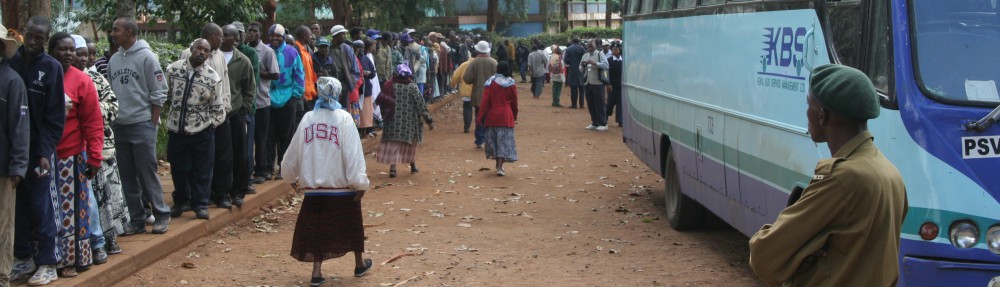
[This is one of my photos from the IRI Kenya 2007 Observation, as we arrived at Olympic Primary School in Kibera, Nairobi. One of the Zimbabwean newspaper sites used a copy of this image with the gentleman on the left cropped out for their Zim coverage.]