2013 Kenya Exit Poll — academic study published (updated)

Professors Clark Gibson, James Long and Karen Ferree have now published an article from their 2013 Kenyan election exit poll in The Journal of East African Studies.

The Star has an analysis in Wednesday’s edition. This is the front page, but the story is not yet up online. (Update: Here is The Star story, “Uhuru didn’t get 50% in 2013–U.S. academics“.)

See my May post with the video from an original presentation at Johns Hopkins SAIS here.

A Guest Post on the State of Kenya@50: “Where Did The Time Go and What Do We Have to Show For It?”

Following is a “guest post” from Andrew J. Franklin, an American now leaving Kenya after more than thirty years of Kenya’s fifty year independent history. This was originally written back in May, after the election failures but months before the Westgate fiasco, about which we learned more damning information with the report this week from the review by the NYPD:
Kenya Map at Nairobi School

“It’s mid-May, do you know where your election results are?”

Good question! As Kenya prepares to celebrate 50 years of Independence – and, remarkably for Africa, largely free of tribal massacres, wars, natural and/or manmade disasters, successive failed or successful military coups d’etat, vicious secret police operations or state sponsored “disappearances – this steadily failing state is increasingly unable to conduct normal run of the mill governmental functions.

The GOK was able to carry out a national census until the late 1990s, deliver mail and inland cables, find the owners of automobiles allegedly involved in traffic offenses, pay pensions, etc. The more international assistance and support for the GOK and its myriad associated agencies, parastatals, universities and authorities the faster state operations have deteriorated.

The incredible investment in “IT” prior to the 2013 General Elections was not only supposed to prevent or mitigate electoral fraud but was also a belated recognition of just how bad government administration had become.

The IEBC was unable to organize or conduct “voter education” prior to the March 4th polls and is probably unable to find all 120,000 (?) temporary workers hired for these elections; media reports indicate that election- related pay owed to the police, NYS recruits and prison warders has still not been paid.

In essence it is an amazingly foolish leap of faith to expect the IEBC to release any election results for President, Governors and members of the National Assembly and Senate. The longer these results are kept from the public the greater will be arguments that these elections were stolen; 50% of the country is already on a slow boil and the new administration is clearly not able to handle long simmering insecurity in Mandera, Garissa and Wajir Counties or in Western Kenya where criminal gangs are terrorizing the populace.

Reports of a resurgence of Mungiki in and around Nairobi as well as continuing MRC related activity in the “Coast Province” counties – including Lamu – show that the state of national insecurity is more serious than anyone will publicly admit. The heavy handed response on Tuesday, 14/05/2013, by some 400 “security personnel” drawn from the disparate forces within the “National” Police Service to only 250 noisy demonstrators – and 15 or so pigs and piglets – outside Parliament showed an usual lack of any police command and control.

Meanwhile the Obama Administration seems blissfully unaware or unconcerned of the situation in Kenya; our bureaucrats just seem to be hunkering down and covering their asses.

Reports that the police fired live ammunition to “break up the crowd of peaceful demonstrators” after tear gas and water cannon proved “ineffective” indicates a lack of discipline or concern for innocent bystanders or onlookers in offices, shops or even the carparks in the vicinity of Parliament right smack in the CBD!

The use of live ammunition to quell demonstrations in Kisumu in the aftermath of the Supreme Court decision on March 30th elicited little comment in the domestic media and certainly no public protests from the US Embassy. Apparently the rubber bullets procured by the NPS prior to the elections are still in their original packing?

The bottom line is that “Something’s happening here. What it is, is very clear…” To Some!

Andrew J. Franklin, J.D.
Former U.S. Marine, resident of Nairobi since March, 1981
Carter Center quietly publishes strikingly critical Final Report from Kenya Election Observation

Another reversal on a Kenya election observation? Without additional fanfare that I have picked up on, the Carter Center published on the web on October 16th their Final Report on the Election Observation Mission for Kenya’s March 4 elections.

I admit to being pleasantly surprised upon wading through the details to find much more direct acknowledgment of the shortcomings of the process, especially the tallying and reporting of results, than I would have expected from the previous media reporting on the various communications about this observation mission over the months since the vote, as well as a major change in conclusions.

Read it for yourself if you are interested in Kenyan elections and the extent to which the announced presidential result in this most recent election was or wasn’t reliable, but the bottom line here is that the Carter Center has commendably stepped back from their previous assurance from April 4, a month after the election, that “in spite of serious shortcomings” the IEBC’s improvised paper-based tally process “presented enough guarantees to preserve the expression of the will of the Kenyan voters”.  In the Final Report the tally/tabulation process is discussed in Pages 51-58, concluding in summary, “Overall, Kenya partially fulfilled its obligations to ensure that the will of the people, as expressed through the ballot box, is accurately recorded and communicated.” (p. 57).

The report itemizes and discusses five categories of “Challenges in Tabulation”:

I.  Failure of Electronic Transmission of Provisional Results

II. Inadequate Publication of Tabulation Procedures

. . . .

Therefore, the available instructions appeared to be insufficient to guarantee the integrity and accuracy of numerical tabulation. . . . (p. 54)

III. Inadequate Observer and Election Agent Access to National Tally Center

. . . .

However, the national tally center did not provide enough transparency for observers or party agents to assess the overall integrity of tally of presidential results.  Unfortunately, the Center regrets the IEBC decision to confine party agents and observers to the gallery of the national tally center, making effective and meaningful observation impossible.

The Center observed many of the same kind of discrepancies in the tally procedures that had generated so much criticism and speculation in 2007; results announced at the national tally center differed from those announced at constituency level, missing tally forms, inconsistencies between presidential and parliamentary tallies, instances of more votes than registered voters, discrepancies between turnouts of the presidential and parliamentary elections, and expulsion of party agents from the tally space at the national tally center.

. . . . (p. 54, footnotes omitted)

IV. Discrepancies Between the Published Voter Register and Announced Results

The Center’s examination of reported final results for the presidential election, recorded on form 36, showed noteworthy discrepancies. . . .  (p. 55)

V. Nonpublication of Detailed Election Results

One of Kenya’s core obligations concerns promoting transparency in elections and other public processes. . . . The Center remains concerned that the IEBC has not published detailed official results disaggregated at the polling station level. (p.55)

For more information on the Kenya election vote count, although not cited by the Carter Center, please see the audit performed by the Mars Group Kenya, noting the “missing” status of the Form 34s recording the tallies from each of 2,627 polling streams.

See Africa Confidential: “Carter’s quiet doubts“.

Previously:

*Are “free and fair” elections passé in Kenya?

*Carter Center calls it as they see it in the DRC

*Why would we trust the Kenyan IEBC vote tally when they engaged in fraudulent procurement practices for key technology?

Two “must reads” from Kenya ahead of the opening of the PEV trials at the ICC

3451378449_800db9e485_o
“Why Uhuru and Ruto must attend trials in The Netherlands” by George Kegoro in the Daily Nation.

.  .  .  .
I have found possible answers to this question in the record of the first presidential debate that was organised by the Kenyan media in the run-up to the March elections. The moderator, NTV’s Linus Kaikai, explored the question of the trials with Mr Kenyatta against the fact that he was seeking to become president of Kenya. Specifically Mr Kaikai wanted to know how Mr Kenyatta would juggle between attending his trial and the duties of presidency if he was elected to office.

On the night, Mr Kenyatta provided well-considered answers to questions surrounding their cases and the presidential bid. Referring to himself and his running mate Mr Ruto, Mr Kenyatta indicated that “it is our intention to follow through [the cases] and ensure that we clear our names”. He added that he considered accountability before the ICC as a necessary step towards ensuring that the kind of problems that Kenya faced in 2007 would not recur.

In his own words: “At the same time, we are offering ourselves for leadership in this country, a position that we believe and want to pass on to Kenyans, an agenda that will first and foremost ensure that the kind of problems of 2007 are put to an end.”

Asked whether the cases would affect his capacity to run the country, he said, “many Kenyans are faced with personal challenges and I consider this as a personal challenge”.

He said he considered that since personal challenges did not affect the capacity of other people to continue with their day-to-day jobs, they should not prevent him from doing so as well.

On that night, Mr Kenyatta concluded: “I will be able to deal with the issue of clearing my name while at the same time ensuring the business of government is implemented”.

Earlier, during the same debate, in answer to a question about his understanding of the problem of tribalism and how he would be different from Kenya’s first three presidents, Mr Kenyatta answered that “we have a new Constitution now” and added that “my job as president is to ensure that the Constitution is implemented”.
.  .  .  .

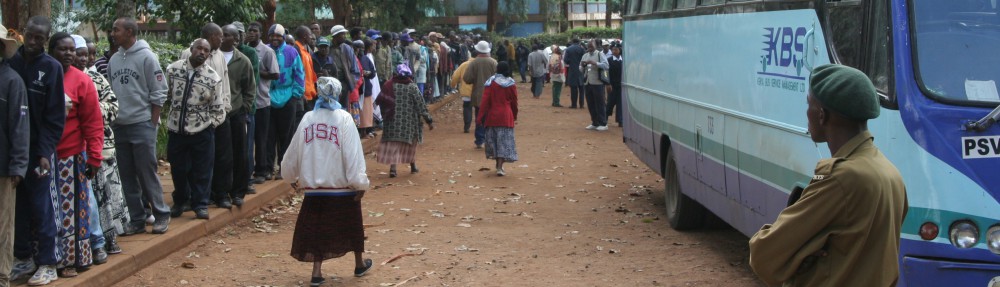
Kenya Bus Service (KBS) and Security at Polling Place

“The Eagle Has Landed: Kenya and the ICC” by John Githongo in The Star.

. . . .

. . . History is being made.

The ICC has redefined Kenya’s foreign policy totally and turned domestic politics inside out. Immediately after the post-election violence in 2008, Kenyans were clamouring for the ICC to intervene given the horrors that had just taken place.

Accountability, justice, impunity, reconciliation and other such words were the primary fodder of political discourse as we headed into the referendum on the constitution in 2010. Indeed, it can be argued that even among those most strongly opposed to the new constitutional dispensation, the dark looming cloud of the ICC and all its implications, especially the public mood that accompanied it through 2008 into 2010, all served to soften them up to demonstrate their pro-change, reformist credentials at a time when the country’s leadership and the messy albeit negotiated coalition arrangement was particularly unsatisfactory to the population.

If it hadn’t been for the ICC, perhaps more of the so-called ‘watermelons’ who pretended to support the new constitution while secretly being opposed to it, would have come out into the open with their true position.

.  .  .  .

. . . Parts of the Kenyan population are in just such a trap: caught between our preaching about and, yes, belief in, good governance and accountability; and its realities when brought to bear in our tribalised, politicised and fragmented political economy. Grimly put – ‘it hurts like hell when it is my tribesman who is being held accountable’. It hurts so much it leads to some of the most gibbering rationalisations of absurdity possible.

Continue reading →

Kenya’s ELOG delivers major report on election

The Elections Observation Group (ELOG) has published yesterday a lengthy report for the first time on its observation of the March 4 Kenyan election.  Having criticized the lack of transparency of aspects of ELOG’s observation and Parallel Vote Tabulation (PVT) program in the immediate post-election period, and cited criticism of their public communications in characterizing the PVT I wanted to quickly recognize the level of their follow-up here in their first release since March 9.

I will need more time with the report before discussing it in detail here as it runs to 78 pages plus attachments (and in the meantime I have recently rejoined the corporate world so I am back to avocational status on Kenya projects) but this deserves real attention and goes far beyond what has been published by the other major observation groups.

In the meantime, here is ELOG’s conclusion:

This report has delved deep into the electoral process starting the journey from the troubled times of 2007/2008 when the country burnt.  It has given an insight into the insidious political problems that Kenya has had to grapple with.

The report analyses the ills that the country must heal before it finally gets out of the political woods.  From negative ethnicity fueled by the “tyranny of numbers” to weak or unreliable institutions, the country has major problems to fix to ensure free and fair elections that are beyond reproach.

The report also makes it clear that although the restored faith in the judiciary and the fear of the ICC may have averted the violence that engulfed the nation after the 2007 general elections, faith in the IEBC and the judiciary was eroded following the Supreme Court ruling on the presidential petition filed by former Prime Minister Raila Odinga.

All stakeholders need to put in extra work and resources to help enhance the public understanding of their civil rights while enhancing the efficiency of all institutions charged with conducting elections in Kenya.

Peace Wall

“After the Dust Has Settled” shiny new Kenyan institutions left dingy

Dr. Stephanie Burchard has a piece in the current issue of the Institute for Defense Analyses’ Africa Watch entitled “After The Dust Has Settled: Kenya’s 2013 Elections”, noting the unexplained failure of the IEBC to release election results that were required in mid-March until mid-July.  The key takeaway:

Unfortunately, after all that has happened since, it is unclear how much respect or trust Kenyans continue to have in their political institutions.  Politicians seem wary of Kenya’s political institutions.  Raila Odinga promised that he and CORD would boycott future elections until changes within the IEBC take place.  Even more troubling, public trust in Kenya’s new institutions appears to be eroding.  In early July a national survey conducted by Ipsos Synovate revealed that confidence in Kenya’s new political institutions, including the Supreme Court and the electoral commission, had fallen precipitously over the course of the past few months.  In particular, confidence in the IEBC had fallen by 30 percentage points–from a high of 62 percent in February to 32 percent less than five months later.


Bonus reading on the American foreign assistance political and policy process: from the Lugar Center, “Lessons for the Next QDDR” by Diana Ohlbaum and Connie Veillette.


“Choosing Peace Over Democracy”

“Kenya’s 2013 Elections: Choosing Peace Over Democracy” has been published in the new Journal of Democracy by James D. Long, Karuti Kanyinga, Karen E. Ferrer and Clark Gibson.  Important and worthwhile reading for anyone interested in Kenyan politics or democratic process in Africa or the developing world more generally.

This is the first of formal publications using the exit poll and other polling data that were presented by Professors Gibson and Long at Johns Hopkins’ SAIS on May 2 and widely covered in the Kenyan media.  See my post with the video:
“Fraud and Vote Patterns in Kenya’s 2013 Election: Evidence from an Exit Poll”–Gibson and Long event in Washington Thursday.

Long and Gibson were the researchers who also carried out the 2007 IRI/USAID/UCSD Kenyan exit poll that showed an opposition victory.

Voting Procedure

134 days after election, Kenya’s IEBC fails to produce election results in Parliament

Daily Nation, July 16, “IEBC fails to submit final poll tally” :

The electoral commission failed to furnish Parliament with the final results of the March 4 General Election Tuesday amid claims that some commissioners refused to sign the report.


The commission was expected to submit the final tally to the Justice and Legal Affairs committee at a meeting scheduled with the team at Parliament Buildings Tuesday. The committee was to relay the report to Parliament.


Independent Electoral and Boundaries Commission chairman Issack Hassan and chief executive James Oswago appeared before the committee but were turned away after the chairman indicated that the tally was not ready for submission as per the request from Parliament. . . .

Here is the Standard story.


Are “free and fair” elections passe in Kenya?

Uganda Debt NetworkHappy American Independence Day–it has now been a full four months since Kenya’s 2013 election, yet the results have still not been released by the Independent Electoral and Boundaries Commission.

The 2012 Kenyan Constitution mandates in Article 81: “The electoral system shall comply with the following principles––

(e) free and fair elections, which are—

(i) by secret ballot;
(ii) free from violence, intimidation, improper influence or
corruption;
(iii) conducted by an independent body;
(iv) transparent; and
(v) administered in an impartial, neutral, efficient, accurate
and accountable manner.

Thus “free and fair” is the legal standard in Kenya. So what standard did the international observer missions that issued their reports on Kenya’s elections without waiting for the official results apply?

Note this from Mienke Mari Stetytler’s “Observing the observers: how the Kenyan election was verified” republished in the Daily Maverick this week:

One month after the election, on April 4th, the Carter Center released its postelection statement. “In spite of serious shortcomings in the Independent Electoral and Boundaries Commission’s management of technology and tabulation of final election results, the paper-based procedure for counting and tallying presented enough guarantees to preserve the expression of the will of Kenyan voters.”
Kenneth Flottman, an independent elections consultant, noted that not one of the observer missions referred to the elections as “free and fair” in their preliminary or post-election reports. “Holding back on calling the election ‘free and fair’ reflects the reality of the known problems with the election,” Flottman said. “At its most crass, this is a way to say that the government in power cheated some, but the opposition probably would have lost anyway.”

He conceded that “there is a tendency to apply lower standards to achieve a ‘free and fair’ election in Africa compared to other regions [of the world]. If anything, this makes the decision not to apply the label to this election in Kenya more noteworthy.”

David Pottie, associate director of the Carter Center’s democracy programme, contested this view. “It isn’t that African elections are held to a different (higher or lower) standard than countries elsewhere in the world,” Pottie said in an e-mail. “Rather, the Carter Center bases its assessment on a) Kenya’s international obligations and b) Kenya’s constitutional and legal framework.” He added that “free and fair” is no longer the “language of choice in international public law”.

Peter Visnovitz, EU election observation mission spokesperson, agreed: “The ‘free and fair’ phrase fell out of use because defining an election as ‘free and fair’ is very black and white—it requires a yes or no answer. Whereas, in fact, electoral processes are complex and it is very difficult to come up with a concept of ‘fair’ that would please everyone.”

Ilona Tip, operations director at EISA’s South African office in Johannesburg, explained that phrases like “transparent and credible” or “the expression of the will of voters” are now preferred.

.  .  .  .

“The long, long vote count” –new reporting from Kenya in Africa Confidential

Election Observers

The new “free article” from this month’s Africa Confidential says better what I have been getting at about the extraordinary delay in releasing the results from the Kenyan election, along with new independent reporting on the facts:

. . . In the longer term, such doubts could prompt a re-evaluation of foreign election monitoring missions in Africa. Some on the European Union mission, for example, had serious doubts about the integrity of the process, but it quickly endorsed Kenyatta’s election. By that stage, the EU had contributed more than 50 million euros (US$66 mn.) to the cost of the elections, reckoned to total over $400 mn. One diplomat in Nairobi joked that it was a case of ‘responsibility without power’, meaning that the EU would be blamed for a messy result due to its financial involvement but had no power to change anything.

The IEBC found that a million more votes were cast in the presidential election than in any other, Africa Confidential has learned, although all were held on the same day. Opposition and civil society activists have raised questions about such discrepancies for several months.

An unnamed electoral commissioner quoted in the Nairobi daily The Star appears to confirm their suspicions: ‘We are having sleepless nights reconciling the presidential results and those of the other positions. Over a million votes must be reconciled with the others and if the requirement is not changed, then it will cast the IEBC in a negative light.’

Kenyatta’s supporters reject the concerns, arguing that it is natural that voters were more worried about selecting the national president than candidates for other positions. Few neutrals see this as credible. In the past, dramatically higher turnouts in presidential elections than in others on the same day have been taken as a sign of ballot-box stuffing.

It seems far-fetched that over a million Kenyans would queue for several hours to vote and then ignore all of the ballots apart from the presidential one, especially since there was great excitement about the contests for new, powerful positions such as senator and governor. None of the many election observers we asked said they had seen significant numbers of voters putting a ballot paper in the presidential box but not the others.

. . . .

Please read the whole piece; this is important for the future of Kenya and for future elections everywhere.