To eliminate redundancy with constrained budgets and growing demand: Is it time to merge IRI and NDI?

Donkey

Mara Herd

This is a post I started a few years ago and let sit.  I usually avoid writing about things that directly mention the International Republican Institute other than as specifically necessary in regard to the 2007 election in Kenya and some advocacy for people arrested in Egypt.   It’s awkward for a lot of reasons to write about IRI,  the most personally important of which is my deep affection for people that work there.  And to the extent I have criticisms it would be my desire that they become better rather than that they be harmed.

Nonetheless, I think the structure of democracy assistance is something we need to think about and almost everyone who is in a position to be engaged is also in a position to feel constrained from speaking freely or has an unavoidable conflict of interest.  And its is an especially challenging time for the effort to share or support democracy so I am going to suck it up and proceed:

—————–

In an era of hyperpartisanship in the U.S. we are also faced with a divided government and a real question about our collective ability to do the basic business of governance in terms of passing budgets, for instance.

More specific to democracy support, the old notion that “politics stops at the water’s edge” is long dead. Every issue anywhere is contested space between Democrats and Republicans in grappling for power. [The attack on the U.S. government facility in Benghazi, Libya in September 2012 being perhaps the most conspicuous example.] There are profound divisions in a few areas of policy and culture between the Republican and Democratic base voters.  Nonetheless, it is also clear, ironically perhaps, that in the present moment there is not any clearly identified and coherent policy difference between the parties on foreign affairs as such. Now in the early stages of the 2013-16 presidential campaign, Republican Senator Rand Paul appears to be his party’s front runner for the nomination. The traditional Republican foreign policy establishment has less disagreement on specific points of foreign policy with the Obama Administration than with Senator Paul. And much of its membership would presumably in private vote for a Democrat seen as somewhat more hawkish and interventionist than Obama, such as for instance Hillary Clinton, than for Paul. Some piece of the base of the Democratic Party might well feel obligated to vote for Paul over Clinton in a general election if it came to it.

Referencing the policies of the most recent Republican Administration, which was in office when I worked for IRI in East Africa, there is no reason to think that Jeb Bush, for instance, believes in the “Bush Doctrine” and certainly Ron Paul doesn’t.  Foreign policy was important in the 2008 Democratic primaries and in the 2008 general election and there was at that time a sharp perceived difference between Obama/Biden and McCain/Palin over the aspects of foreign policy that were important to most voters and that difference was essential to Obama’s election.  Not so much in 2012 in either the Republican primaries or in the general election.  All presidential elections matter with great intensity for Washington foreign policy people because they decide who gets what jobs (like do you go to the State Department or stay at IRI or NDI or some think tank) and in general everyone is either Democrat or Republican and either wins completely or loses completely, heads or tails, each time.  For most American voters the relationship of parties and elections to foreign affairs is completely different.

The traditions of the Democratic and Republican foreign policy establishment in Washington are based on the Cold War, like the structure of the National Endowment of Democracy itself, with IRI and NDI along with the overseas arms of the U.S. Chamber of Commerce and the AFL-CIO as its “core” “private” institutes. Relatedly this tradition and structure is also critically Eurocentric. Going on a quarter century after the fall of the Soviet Union the terms of the contest between a democratic Washington and an authoritarian Moscow are very different in Europe itself today–and much less of immediate relevance in, say, Africa. The old days of the American Democrats supporting the democratic left in Europe and the American Republicans supporting the right–both as a pro-American alternative to Soviet-aligned Communists–are interesting history that we should learn more from, but they are history.  And we are not nearly so Eurocentric now in our policies and relationships in Africa, Asia and Latin America, so we have different types of opportunities to support democracy and its related values in those regions rather than dividing everyone up as pro-Western Bloc versus pro-Eastern Bloc.

In practice today, I don’t see the Democratic Party in power in Washington really aligned with the “democratic left” in other countries, given the lack of need to shore up against Marxist/Communist forces (among other reasons) nor much particular interest in the Republican Party in supporting more rightist or conservative parties abroad per se.  Generally Republican and Democrat campaign and media consultants, like lobbyists, seem to work for whoever they come to terms with commercially in any given emerging or frontier market rather than on the basis of some coherent party related framework.

Formally, IRI and NDI are completely overlapping as they are both non-partisan.  Occasionally they are said to be “affiliated” with their respective parties, but more frequently they are said to have “no connection” to parties.  Ultimately this is simply confusing and unclear–and not really consistent with the principles that the organizations are trying to teach to others.  In Germany where the government funds overseas institutes of the parties, the law is different and the government provides funding for the parties themselves in a way that would presumably be unconstitutional in the United States.  So you don’t have a counterpart to this strange melange of “nonpartisan Republican” or “nonpartisan Democratic” even though the German organizations are said to be a model for setting up IRI and NDI back in the early 1980s.

In my personal experience, I had the clear impression that IRI was quite serious about being legally compliant in terms of the 501(c)(3) nonpartisan formalities [and this was noteworthy in an  a organization that did not have an overall compliance component at that time–I am not going to be a whistleblower or even a public critic on this but have noted that they have gotten in at least a little difficulty with the government for ignoring cost accounting regulations that I told them they shouldn’t ignore when I worked for them].  I have no reason to assume that NDI is not equally serious.  In the case of IRI, with the chairman running for president two different times during his tenure, they know that the Democrats have had incentive to catch them if they were to get tangled with a Republican campaign; and of course everything is potentially tit-for-tat in that regard for the other side.

At the same time, both parties have an incentive to make as much use of “their” respective unaffiliates as permissible on a mutally backscratching basis.  While there are certain cultural and stylistic differences in how this plays out–as any observer of the current American political scene can well imagine–I don’t think this warrants the whole separate infrastructure of two duplicate organizations.  For instance, unaffliliated Republicans could still do programming at the Republican National Convention and unaffiliated Democrats could still do programming at the Democratic National Convention even if it was under the umbrella of one unaffiliated nonpartisan organization instead of two separate unaffiliated nonpartisan organizations. And the unaffiliated Republicans could apply a conservative orientation to have programming that is solid, on-message stuff supporting the party line; and the unaffiliated Democrats could be liberal-minded and have a “soft power” approach that involves people on both sides at the convention of their side.

Continue reading

Another year goes by: Eight years after Oscar Foundation murders, Kenya is a “place where human rights defenders can be murdered with impunity”

The fifth sixth eighth anniversary of the “gangland style” execution of Oscar Foundation head Oscar Kingara and his associate John Paul Oulu in their car near State House in Nairobi was this past Thursday Sunday.  From the New York Times report the next day:

“The United States is gravely concerned and urges the Kenyan government to launch an immediate, comprehensive and transparent investigation into this crime,” the American ambassador to Kenya, Michael E. Ranneberger, said in a statement on Friday. It urged the authorities to “prevent Kenya from becoming a place where human rights defenders can be murdered with impunity.” (emphasis added)

The slain men, Oscar Kamau Kingara and John Paul Oulu, had been driving to a meeting of human rights activists when unidentified assailants opened fire. No arrests have been reported.

Last month, the two activists met with Philip Alston, the United Nations special rapporteur on extrajudicial executions, and provided him with “testimony on the issue of police killings in Nairobi and Central Province,” Mr. Alston said in a statement issued in New York on Thursday.

“It is extremely troubling when those working to defend human rights in Kenya can be assassinated in broad daylight in the middle of Nairobi,” Mr. Alston said.

Mr. Alston visited Kenya last month and said in a previous statement that killings by the police were “systematic, widespread and carefully planned.”

.  .  .  .

Unfortunately, in these five years nothing has been done about the murders, and no action was taken on the underlying issue of widespread extrajudicial killings by the police.  Kenya in fact proved itself to be a place where human rights defenders can be murdered with impunity.  The government spokesman who made inflammatory (and baseless according to the embassy) attacks on the victims just before the killings is now a governor, and the Attorney General who stood out as an impediment to prosecuting extrajudicial killing (and was banned from travel to the U.S.) is a Senator. (See also the State Department’s Kenya Country Report on Human Rights Practices, 2013)

Below is the March 19, 2009 statement to the Congressional Record by Senator Russ Feingold who is now the President’s Special Envoy for the Great Lakes Region of Africa and the DRC, courtesy of the Mars Group:

Mr. President, two human rights defenders, Oscar Kamau Kingara and John Paul Oulu, were murdered in the streets of Nairobi, Kenya two weeks ago. I was deeply saddened to learn of these murders and join the call of U.S. Ambassador Ranneberger for an immediate, comprehensive and transparent investigation of this crime. At the same time, we cannot view these murders simply in isolation; these murders are part of a continuing pattern of extrajudicial killings with impunity in Kenya. The slain activists were outspoken on the participation of Kenya’s police in such killings and the continuing problem of corruption throughout Kenya’s security sector. If these and other underlying rule of law problems are not addressed, there is a very real potential for political instability and armed conflict to return to Kenya.

In December 2007, Kenya made international news headlines as violence erupted after its general elections. Over 1,000 people were killed, and the international community, under the leadership of Kofi Annan, rallied to broker a power-sharing agreement and stabilize the government. In the immediate term, this initiative stopped the violence from worsening and has since been hailed as an example of successful conflict resolution. But as too often happens, once the agreement was signed and the immediate threats receded, diplomatic engagement was scaled down. Now over a year later, while the power-sharing agreement remains intact, the fundamental problems that led to the violence in December 2007 remain unchanged. In some cases, they have even become worse.

Mr. President, last October, the independent Commission of Inquiry on Post-Election Violence, known as the Waki Commission, issued its final report. The Commission called for the Kenyan government to establish a Special Tribunal to seek accountability for persons bearing the greatest responsibility for the violence after the elections. It also recommended immediate and comprehensive reform of Kenya’s police service. Philip Alston, the UN Special Rapporteur on extrajudicial killings, echoed that recommendation in his report, which was released last month. Alston found the police had been widely involved in the post-election violence and continue to carry out carefully planned extrajudicial killings. The Special Rapporteur also identified systematic shortcomings and the need for reform in the judiciary and Office of the Attorney General.

Continue reading

Kenya Government “pranks” U.S. into reassuring on unrequited “partnership” while suppressing protesters (updated)

The more things change, the more they stay the same.

Kenya’s government is led by Uhuru Kenyatta and William Ruto, who barely left KANU in form, and not at all in substance. Not surprisingly, as in the past, protests against the government are in general not allowed and protesters are normally teargassed, beaten and arrested. The fact that this is unlawful behavior by the government does not change the facts on the ground, whether under the 2010 “reform” constitution backed by the United States and the Kenyan voters, or under the old Lancaster House constitution as amended. This was the case during the Kibaki interlude when I lived in Kenya in 2007-08, and it has most certainly been the case during the original Kanu regimes and the current Jubilee revival.

The most recent conspicuous episode was on Thursday, February 13.

For people protesting against the Kenyan government to get the attention of the media they need to engage in something especially catchy beyond the usual shedding tears and blood and getting arrested. Last year, for instance, protesters made international news by releasing pigs in front of parliament to protest the extra-legal raises that the MPs, or “MPigs” were giving themselves. Of course the protesters were teargassed, beaten and arrested, but at least they made the news.

Unfortunately, after the fact the use of the pigs became something of a distraction to the issue of the financial avarice in parliament. Nairobi is a cosmopolitan capital in its own way, and for many, naturally, there is a right way to get teargassed, beaten and arrested, and a wrong way to get teargassed beaten and arrested. Everyone is a lot more used to greedy politicians than to real pigs turned loose in front of parliament. So this time organizers of the February 13 protest assured that they would not use any such animal stunts. (This time they had foam dolls to depict an infantile “diaper mentality”.)

With the build up of publicity and momentum for the announced and pre-cleared protest, the police blinked and announced to the media at the last minute that the protest was purportedly “cancelled” because of unspecified alleged terrorism concerns. Overlapping with this some Kenyan media outlets carried what the Standard headlined: “National Security Advisory Committee Statement on plans to destabilize government”:

Continue reading

Turning Point in Kenya? Update on opposition to Kenyan anti-NGO and Media Bills

“Freedom of Expression is Your Right”–Subversive NGO Solganeering in Kenya’s Neighbor Uganda
"Freedom of expression is your right"

Opposition to controversial Kenya Media Bill heats up” Sabahi Online via AllAfrica.com

Cuts in foreign funding for NGOs intended to silence critics–Human Rights Watch” from Trust.org

William Ruto and his Ethiopian host had chilling message on media freedom” from Macharia Gaitho in The Daily Nation.

Kenya attempts to silence civil society“, Freedom House Spotlight on Freedom.

For perspective (not just to say I warned you so) see my post about Kenyatta and media freedom from December 2009:  “More Government of Kenya action to muzzle media”:

The Standard reports that it has been enjoined  from publishing stories regarding Deputy Prime Minister Uhuru Kenyatta and the purchasing of government vehicles.  Uhuru sought the temporary injunction to protect his interests and reputation.  Seems like a classic case of a high gov’t official using prior restraint to avoid challenge to his job performance.

This is to me another example of fact that the media environment in Kenya is not quite as free as international commentators frequently suggest.  While there is quite a bit of reporting on corruption, the fact remains that it hasn’t dented impunity, and there is a great deal that is known but not reported, and many stories get started but never followed to conclusion.

After the paramilitary raid on the Standard Group in mid-2006, the US eventually made peace with impunity for this attack on the media.  By the summer of 2007, then-Internal Security Minister Michuki–who famously said of the Standard raid that the Standard, having “rattled a snake” should have expected “to get bitten” for its reporting–was the featured speaker at the Ambassador’s Fourth of July celebration, talking of his recent security cooperation tour in the US.  With this background for its critics in the Government, the press can’t help but wonder how far it can go.

And from March of this year: “Attacks on Kenyan Civil Society prefigured in Jubilee ‘manifesto'”

Kenyan Opinion Highlights–five columns of note (updated)

These are four  five recent columns from the Kenyan papers on different aspects of the current malaise in public affairs.  Each makes a general point which I think is of undoubtedly valid, but adds some perspective, analogy or point of fact that struck me as unique and particularly worthy of your attention if you missed it at the time:

“Media bang! NGOs pow! Who’s next?” from Muthoni Wanyeki in The East African.

“We expected better from ‘Defence Force'” from Wycliffe Muga in The Star.

“The Jubilee government’s ‘infantry thinking’ is leading it to intolerance” from Matuma Mathiu in the Daily Nation.

“Religious leaders are letting Kenyans down” from Fr. Gabriel Dolan in the Daily Nation.

“Protect media freedom for development” from Apollo Mboya in the Standard.

“Do not be afraid. The government will protect you.” KANU Revivalists offer alternative to democratic values in Kenya

Shortly after I arrived in Kenya in mid-2007, Kenya’s parliament passed a media regulation bill which faced a storm of international diplomatic criticism as well as domestic protest.

President Kibaki at the time backed down and sent the bill back to Parliament where it was ultimately somewhat watered down. New legislation passed last week goes much further than what was dared under the first Kibaki Administration, in spite of the new constitution. This time there doesn’t seem to be much reaction from international governments–we give our aid money quietly and tiptoe so as not to step on important toes since we have been aggressively accused of imperialism and racism for not intervening to stop the ICC prosecutions of The Now Elected for the mayhem after the 2007 election–but the international media is much more aware of these issues than they were in 2007.

And if the media bill has been put in some limbo, it has been followed by the introduction of the Jubilee bill to assert more state control over civil society and restrict and channel foreign funding to non-governmental organizations. The Uhuruto team had not shown its cards on attacking the media during the election campaign, but civil society was always a known target. See Attacks on Kenyan Civil Society prefigured in Jubilee Manifesto, my post from March this year.  More freedom for the media and for civil society means more restraints on politicians in control of government.  Restricting civil society can help maximize the opportunity to control the media, and vice versa.

Kenyans are confronted once again by the hard choice of whether they are willing to challenge their “leaders” in governmental power to maintain their individual freedoms as citizens.

Uhuru Kenyatta stayed with KANU throughout his life through the formation of TNA as a vehicle for his presidential campaign in this year’s race.  Other than running in elections himself, he has not given much indication over the years that I am aware of being concerned for opening the democratic space and by running as “Moi’s Project” as the KANU nominee in 2002 he chose the old banner.  Of course when you are one of the richest men in Africa, and your mother is one of the richest women, because of what your father took for himself and his family when he was the one-party ruler, you find yourself with plenty of freedom of speech and freedom to politically organize regardless of the details of the system that confront the small people.

In the wake of the Westgate attack, and the desire of the government to avoid scrutiny or challenge, I am reminded poignantly of what Kibaki said when he first ventured out thirteen days after he had himself sworn in for his second term:

January 9, 2008–13 days after the 2007 election (NBC News):

Kibaki made his first trip to a trouble spot, addressing more than 1,000 refugees in western Kenya, many of whom had fled blazing homes, pursued by rock-throwing mobs wielding machetes and bows and arrows.
“Do not be afraid. The government will protect you. Nobody is going to be chased from where they live,” Kibaki said at a school transformed into a camp for the displaced in the corn-farming community of Burnt Forest. “Those who have been inciting people and brought this mayhem will be brought to justice.”
He indicated he would not consider demands for a new election or vote recount.
The election “is finished, and anybody who thinks they can turn it around should know that it’s not possible and it will never be possible,” he said.

Perhaps for those Kenyans that feel sure that the government will always protect them, there is no need for these things of a free media, civil society, the questioning of elections.  Kenya could just go back to the Chinese model of the one party state.  Kenyans who prefer a freer, more empowered citizenship as a matter of values, or who don’t feel they can count on the government to always protect them will have to decide to engage to protect those rights which are of course expressed in law in the new constitution.  See “CIC (Commission for the Implementation of the Constitution) says new media law unconstitutional”, Daily Nation.

Kenyan Media

Kenyan Media

Two “must reads” from Kenya ahead of the opening of the PEV trials at the ICC

3451378449_800db9e485_o
“Why Uhuru and Ruto must attend trials in The Netherlands” by George Kegoro in the Daily Nation.

.  .  .  .
I have found possible answers to this question in the record of the first presidential debate that was organised by the Kenyan media in the run-up to the March elections. The moderator, NTV’s Linus Kaikai, explored the question of the trials with Mr Kenyatta against the fact that he was seeking to become president of Kenya. Specifically Mr Kaikai wanted to know how Mr Kenyatta would juggle between attending his trial and the duties of presidency if he was elected to office.

On the night, Mr Kenyatta provided well-considered answers to questions surrounding their cases and the presidential bid. Referring to himself and his running mate Mr Ruto, Mr Kenyatta indicated that “it is our intention to follow through [the cases] and ensure that we clear our names”. He added that he considered accountability before the ICC as a necessary step towards ensuring that the kind of problems that Kenya faced in 2007 would not recur.

In his own words: “At the same time, we are offering ourselves for leadership in this country, a position that we believe and want to pass on to Kenyans, an agenda that will first and foremost ensure that the kind of problems of 2007 are put to an end.”

Asked whether the cases would affect his capacity to run the country, he said, “many Kenyans are faced with personal challenges and I consider this as a personal challenge”.

He said he considered that since personal challenges did not affect the capacity of other people to continue with their day-to-day jobs, they should not prevent him from doing so as well.

On that night, Mr Kenyatta concluded: “I will be able to deal with the issue of clearing my name while at the same time ensuring the business of government is implemented”.

Earlier, during the same debate, in answer to a question about his understanding of the problem of tribalism and how he would be different from Kenya’s first three presidents, Mr Kenyatta answered that “we have a new Constitution now” and added that “my job as president is to ensure that the Constitution is implemented”.
.  .  .  .

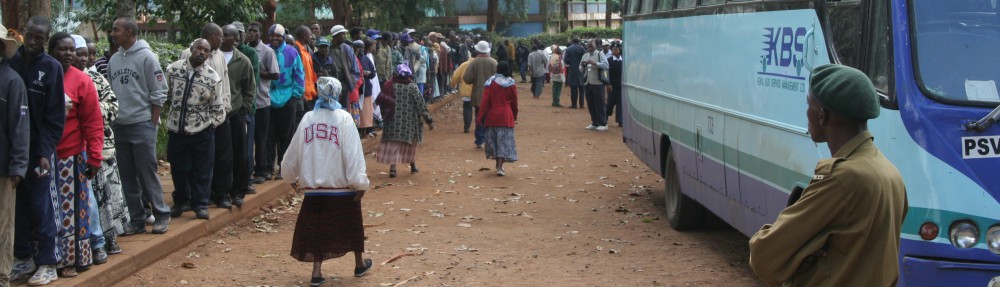
Kenya Bus Service (KBS) and Security at Polling Place

“The Eagle Has Landed: Kenya and the ICC” by John Githongo in The Star.

. . . .

. . . History is being made.

The ICC has redefined Kenya’s foreign policy totally and turned domestic politics inside out. Immediately after the post-election violence in 2008, Kenyans were clamouring for the ICC to intervene given the horrors that had just taken place.

Accountability, justice, impunity, reconciliation and other such words were the primary fodder of political discourse as we headed into the referendum on the constitution in 2010. Indeed, it can be argued that even among those most strongly opposed to the new constitutional dispensation, the dark looming cloud of the ICC and all its implications, especially the public mood that accompanied it through 2008 into 2010, all served to soften them up to demonstrate their pro-change, reformist credentials at a time when the country’s leadership and the messy albeit negotiated coalition arrangement was particularly unsatisfactory to the population.

If it hadn’t been for the ICC, perhaps more of the so-called ‘watermelons’ who pretended to support the new constitution while secretly being opposed to it, would have come out into the open with their true position.

.  .  .  .

. . . Parts of the Kenyan population are in just such a trap: caught between our preaching about and, yes, belief in, good governance and accountability; and its realities when brought to bear in our tribalised, politicised and fragmented political economy. Grimly put – ‘it hurts like hell when it is my tribesman who is being held accountable’. It hurts so much it leads to some of the most gibbering rationalisations of absurdity possible.

Continue reading

Kenya’s ELOG delivers major report on election

The Elections Observation Group (ELOG) has published yesterday a lengthy report for the first time on its observation of the March 4 Kenyan election.  Having criticized the lack of transparency of aspects of ELOG’s observation and Parallel Vote Tabulation (PVT) program in the immediate post-election period, and cited criticism of their public communications in characterizing the PVT I wanted to quickly recognize the level of their follow-up here in their first release since March 9.

I will need more time with the report before discussing it in detail here as it runs to 78 pages plus attachments (and in the meantime I have recently rejoined the corporate world so I am back to avocational status on Kenya projects) but this deserves real attention and goes far beyond what has been published by the other major observation groups.

In the meantime, here is ELOG’s conclusion:

This report has delved deep into the electoral process starting the journey from the troubled times of 2007/2008 when the country burnt.  It has given an insight into the insidious political problems that Kenya has had to grapple with.

The report analyses the ills that the country must heal before it finally gets out of the political woods.  From negative ethnicity fueled by the “tyranny of numbers” to weak or unreliable institutions, the country has major problems to fix to ensure free and fair elections that are beyond reproach.

The report also makes it clear that although the restored faith in the judiciary and the fear of the ICC may have averted the violence that engulfed the nation after the 2007 general elections, faith in the IEBC and the judiciary was eroded following the Supreme Court ruling on the presidential petition filed by former Prime Minister Raila Odinga.

All stakeholders need to put in extra work and resources to help enhance the public understanding of their civil rights while enhancing the efficiency of all institutions charged with conducting elections in Kenya.

Peace Wall

Ironies in Open Government: Was the Kenya PVT a “Parallel Vote Tabulation” or “Private Vote Tabulation”?

Kenya Pre-election Poll

So now we have results of both a “Parallel Vote Tabulation” and an Exit Poll for the March 4, 2013 Kenyan election.

The irony here is that the Exit Poll was privately funded, yet we have, courtesy of the video of the initial university presentation by the researchers Dr. Clark Gibson, Professor at the University of California, San Diego, and Dr. James Long, visiting scholar at Harvard and appointed as Asst. Professor at the University of Washington, quite a bit more detail about the Exit Poll data than we do about the PVT.  The PVT, however, was funded at least in substantial part, apparently, by yours truly and the rest of the American taxpayers through USAID through NDI. (This is the best information available to me–please correct me if I am wrong.)

I mean no disrespect to any of the people involved at NDI or ELOG–or at USAID for that matter.  I am sure everyone did their best on the PVT.  But when do we see the details instead of just a conclusion?  

After all the controversy about the delay in the release of the USAID-funded IRI Exit Poll in 2007-08, I am just very much surprised that everyone involved this time did not chose to try to get in front of any problems and controversies by being more transparent.

I do not want to weigh in to any of the back and forth as to “which is better” between an Exit Poll and a PVT–in fairness they have their relative strengths and weaknesses–it is best to have both.  So let’s get the data out on the table for study and see what we can learn.

AfriCOG’s Seema Shah asks in Foreign Policy: “Are U.S. election watchdogs enabling bad behavior in Kenya?”

UPDATE: See Dr. Shah’s article “Kenya: Supreme Court’s Disappointing Judgement” from Think Africa Press via allAfrica.com.

Stanley Livondo for Senator

From Transitions–the Democracy Lab Blog at Foreign Policy.com:  “Are U.S. election watchdogs enabling bad behavior in Kenya?”:

In recent testimony to Congress, three American non-profit electoral assistance organizations, all of whom worked on Kenya’s general election in March — the International Foundation for Electoral Systems (IFES), the National Democratic Institute (NDI), and the International Republican Institute (IRI) — reported that last month’s presidential vote was “credible,” thereby negating the still-increasing amounts of evidence that the electoral process was fundamentally flawed. Their view was based largely on a recent ruling by Kenya’s Supreme Court, which upheld the presidential election result. The three groups also cited the “acceptance” of the Court’s decision by presidential runner-up Raila Odinga.

And that’s just where the problems begin.

The Kenyan Supreme Court’s detailed judgment reveals numerous problems. Legal scholars have decried its reliance on questionable outside sources and its lack of academic rigor while civil society groups have lambasted it for its refusal to engage with the vast array of evidence presented. These criticisms cast doubt on the Court’s independence, thereby threatening public confidence in the judiciary.  .  .  .

Meanwhile, Odinga’s call for peace in the aftermath of the ruling is hardly an acceptance of the veracity of the Court’s statement. Rather, he made it clear that he did not understand how the Court could have looked at the “massive malpractices” documented by his team and still deliver its ruling. In fact, he said, “In the end, Kenyans lost their right to know what indeed happened.” His call for Kenyans to move forward should not be confused with a conclusion that the election was free and fair. His recent statement that the IEBC cannot be trusted to run another election says it all.

As part of its testimony, IFES also somewhat condescendingly said, “ultimately, the new Kenyan president, Mr. Kenyatta, was elected by a margin of 8,000 votes, or 7/100ths of a percent of the total votes cast, making it inevitable that the result would be challenged.” This statement implies that a legal challenge was inevitable, presumably because Odinga would have challenged any close result, even one set in the context of an open, verifiable, and transparent electoral process. The fact remains, though, that the lack of transparency set itself up to be challenged. In fact, the petition against the veracity of the results was brought by civil society groups, (a fact not even mentioned to the U.S. Congress), and focused on the myriad discrepancies, errors, omissions, and inexplicable alterations noted throughout the electoral process.

.  .  .  .

These organizations go on to claim that the main problem with the management of the election was the failure of the electronic voter identification and results transmission systems, which IFES describes as “a failure of project management.” IFES in fact claims that it was “the paper register and paper ballots [which] ultimately…ensured the integrity of the Kenyan election.” What these statements leave out is that both the electronic systems were specifically put in place as critical checks on the manual process. They were meant to prevent instances of multiple voting, ballot box stuffing, and the alteration of the manual forms as happened in 2007. Indeed, the alteration of manual forms was at the heart of the problem in this election as well. These issues seem to go well beyond problems of “project management.”

.  .  .  .

IFES even credits the election commission with ensuring that this election “was not a repeat of the 2007 vote.” Such statements wrongly imply that the default in Kenya is violence. And while it is true that there was very little conflict this time around, the problems with the process were very much a repeat of the last election, minus the politicians’ calls for violence. Instead of praising the election commission, these organizations should have called on them to answer the unresolved questions about the process, especially those related to the voter registry.

Would these sorts of problems be tolerated in the United States? It seems doubtful. Why is Kenya being held to such a low standard? Given the context of Kenyan electoral history and the country’s efforts to reform the electoral system, it is even more important to point such weaknesses out. Endorsement of this election by the United States as credible makes it seem as if the problems that transpired during this election are negligible, when in fact many Kenyans are still wondering whether their votes were actually counted at all.

To their credit, NDI and IFES have emphasized the need to take stock of the election and focus on lessons learned. It will be interesting to see what those exercises find. In the end, though, Congress has barely heard enough to truly know if the election was in fact free, fair and credible. The 2013 election was not free and fair, and it was not truly different from the one in 2007. A look beyond this testimony is critical for them — and anyone — interested in the entire story behind the Kenyan election.

Dr. Seema Shah is a public policy researcher for the Africa Center for Open Governance in Kenya. Her focus is on elections and ethnic violence.

Some thoughts that I would add from my perspective as the former IRI country director from 2007-08:  As in the past national elections, IFES was not in a “watchdog” role at all, but rather was on the inside working directly with the IEBC as they had previously worked with the ECK in 2002 and 2007.  They did not speak out at all in 2007 about the problems so I think its fair to say that they have not seen that as within their role.  NDI was also not a watchdog as they did polling which was not released and worked internally with ELOG, intended to be a new Nairobi-based permanent African observation group. IRI did various voter education programs.  The three organizations accounted together for an “8 figure” U.S. tax dollar expenditure on their respective efforts but the actual Election Observation function was awarded by USAID to the Carter Center–which amazingly enough was not testifying at the hearing in the House Foreign Affairs Committee on Africa, Global Health and International Organizations.

Nor were there any other witnesses!

As a practical matter I think what that tells us is that the hearing was not really so much about Kenya or this particular election, but rather an opportunity to pitch a “success story” in the context of the current U.S. foreign affairs budget process.  In 2008 there were serious hearings in both the House and Senate about the Kenyan election–presumably because of the ongoing violence.  Without the violence, the Kenyan election process itself apparently did not warrant focus from Congress even though we spent so much more money this time.  Unfortunately, I do think that  part of the end result of this sort of sales pitch in Congress is collateral damage, in fact, “enabling bad behavior in Kenya.”

New material is now uploaded at AfriCOG and InformAction’s “The Peoples Court” website.