Challenging Nigeria International Election Observation may present tests of character (2nd update on lobbying/funding) #NigeriaDecides

International Election Observation Mission members, including those from IRI/NDI, are arriving in Nigeria for the general election Saturday in a difficult environment.

Although invited by Nigeria’s government there has been at least one unwelcoming statement and no one could deny that this is a hard job simply from the stakes of the election, the instability in some areas, the poverty and underdeveloped infrastructure faced by large portions of the voting population and the simple relative newness of regular competitive elections.

International election observation, which focuses on civil and political rights, is part of international human rights monitoring and must be conducted on the basis of the highest standards for impartiality concerning national political competitors and must be free from any bilateral or multilateral considerations that could conflict with impartiality. It assesses election processes in accordance with international principles for genuine democratic elections and domestic law, while recognizing that it is the people of a country who ultimately determine credibility and legitimacy of an election process.

Quoted is the standard of independence and impartiality to which the USAID-funded NDI/IRI International Election Observation Mission is pledged under the Declaration of Principles for International Election Observation (Oct. 2005).

The IRI/NDI Nigeria 2015 Observation Mission was funded directly by the State Department so shifting back to USAID funding this time is one of the positive things that I see as having potential to help preserve independence and maintain clarity between an Assistance Observation and a Diplomatic Observation to the benefit of the process.

See my post “President Trump’s Asst. Sec. of State for Africa candidly explains why election observation and technical assistance have to be ‘fire-walled’ from diplomacy to have integrity” for a current discussion and further links.

The joint IRI/NDI EOM model has positives and negatives in terms of actual and perceived independence. In Nigeria where democracy assistance is confronted by “resource curse” funded problems and lobbyists working “both sides of aisle” in Washington at a unusual level for an “African election”, along with prominent American campaign consultants usually involved, the joint model seems to me to have some important advantages over IRI or NDI doing a nonpartisan mission on its own, in-spite of the tradeoffs (alternatively you could go with the Carter Center as an “outside the beltway” if politically connected choice, or Democracy International as a truly private entity).

IRI in Africa from my now distant view has come quite far from some of the vulnerabilities that we faced in the 2007 Kenya Election Observation–experience is the best “capacity builder” and institutional funding and attention are now much more appropriate to the scope of the job. Some of my old Kenyan friends and colleagues who did such a great job running things on the ground in 2007 have stayed on and climbed the ladder. And we can expect this election in Nigeria to be better than their 2007 election, observed by many involved this year, as well.

Since Nigerian elections are always high profile and “on the map” in Washington there is no danger of overlooking the situation from that front. This Observation is long-planned and expected and well-funded; there have been an ongoing series of pre-election missions with reports on preparations. Likewise these observations have been going on with regularity throughout this century–and we’ve even been through the scenario of an incumbent seeking re-election during the Boko Haram war.

At the same time, you need no expertise to know that national elections are always challenging in Nigeria and that while cumulative progress has been made in some areas there are some particular concerns that have been reported on and discussed by this Observation Mission and others in the donor governments and media.

Thus, there may be hard calls ahead for the Observers, both on concerns they have already highlighted and from unexpected events as the voting, counting and disclosing play out.

American lobbyist and Ellen Johnston Sirleaf advisor Riva Levinson articulated part of the present challenge well in The Hill in Washington over the weekend: “At Risk: Credibility of U.S. democracy promotion in Africa“. Johnston Sirleaf is in Nigeria as lead observer for the ECOWAS intergovernmental Election Observation Mission and was co-lead for the most recent IRI-NDI Mission, “ZIEOM” in Zimbabwe.

UPDATE (Feb 12): Riva Levinson and her firm KRL are “registered foreign agents” in Washington for Retail Express Limited of Lagos, Nigeria. The Foreign Agent Registration Act filing from September 30, 2018 identifies this client as a “limited partnership which supports the goals of the Senate President of Nigeria, Dr. Aubakar Bukola Saraki, to engage international stakeholders in support of free and fair national elections in February, 2019, seek a level playing field for opposition parties, and convey the core tenants of the Senate President’s vision for the future of the country.” (She also currently lobbies for the Ministry of Foreign Affairs of Liberia and the Ministry of Finance of Ghana.)

Sakari lost the now-opposition People’s Democratic Party (PDP) nomination to Atiku Abubarka but stayed in PDP, having defected from the All Progressives Congress (APC) of Pres. Buhari in July. The PDP itself hired Ballard Partners as its Washington lobbyists for a year at $1,080,000 two days before Retail Express hired KRL.

Recent former diplomat and Council on Foreign Relations Africa lead Amb. Michelle Gavin had a notably hard-hitting CFR blog post last week headlined: “The Truth About United States Complicity in DRC’s Fraudulent Election” although in the text she just covers the macro level issue of diplomatically blessing an election whose official result was contrary to all available evidence.

We in the U.S. got partially off the hook in the DRC where the incumbent Kabila did not invite U.S.-funded or other international observers beyond the African diplomatic groupings (although I learned from Levinson’s piece that we provided funding for the Catholic Church run ‘Parallel Vote Count’, a fact I totally missed in the news reporting. USAID’s website indicates we were also providing “technical assistance” to the election management body CENI itself (!) which again I missed somehow in the news reports. These facts may have informed Gavin’s view even if the journalists that I read did not take notice.)

Update II (Feb 18): As it turns out, the U.S. not-for-profit IFES continued USAID-funded work with CENI, along with its partner IRI in the Coalition for Electoral Process and Party Strengthening (CEPPS) according to a brief overview on IFES’s website, and continues to work with CENI toward local elections. CENI hired its own Washington lobbying firm in 2018, Avenue Strategies, founded by former DJ Trump campaign manager Corey Lewandowski (he left and set up a separate firm before the CENI contract). In January 2019 after CENI named Felix Tshisekedi as president-elect, Avenue Strategies also signed on to represent Tshisekedi as president-elect and now president.

Presumably, then, under the CEPPS mechanism USAID funded the third partner, NDI, for the work with the Catholic Church Parallel Vote Count. I will contact USAID to confirm the arrangement and see if they are willing to release any contractual details without a formal Freedom of Information Act request.

The Carter Center stood firm in calling out Kabila’s 2011″re-election” as failing to meet international standards. The State Department followed along in declining to bless the election and offering technical assistance to address irregularities back then, unlike the current situation which Levinson and Gavin question (although the diplomatic impetus for remediation at the presidential level in 2011 went away quickly).

See Dr. Carl LeVan’s Homepage “Development for Security” blog for an overview of the Nigeria election contest. Likewise, Amb. John Campbell’s “Nigeria’s Election: What to Know” at CFR.

Here is my piece from The Elephant in the wake of Kenya’s judicially annulled 2017 presidential election: “Free, Fair and Credible? Turning the Spotlight on Election Observers“.

[UPDATE III: here is the Preliminary Statement issued by the IRI/NDI Observation on February 25, after the delayed vote of February 23.]

International Election Observation Mission IRI Kenya Kibera Lavington Nairobi 2007

Foreign Policy article gives insight on disagreements within Trump administration on backing off on criticism of flawed DRC vote

Foreign Policy has published a piece reporting significant internal dissent from the reversal of the U.S. position from significantly negative to largely positive on the recent DRC election:

. . . .

In a series of preliminary statements crafted by the team and released by the State Department on Jan. 3, 10, and 16—before confirmation of the final results—the United States sharply condemned reports of election-related interference and violence. The Jan. 3 statement included a threat that people involved “may find themselves not welcome in the United States and cut off from the U.S. financial system.”

With the Constitutional Court’s decision to confirm the election later in the month and with news of widespread election fraud, the group drafted a new U.S. response on Jan. 23. It noted the election results rather than welcoming them—a diplomatic way of signaling displeasure—and condemned the “deeply flawed and troubling” election, according to a draft reviewed by FP. It also stated that Congo’s electoral commission “failed to live up to the responsibility” it had to carry out elections fairly and ivowed that the United States would “hold accountable” any figures engaged in election fixing or violent crackdowns on any ensuing protests.

But none of this language made it into the final statement. Instead, Washington welcomed the results and declared itself committed to working with Tshisekedi. The revised statement made only passing mention to “electoral irregularities.”

Michael Hammer, the U.S. ambassador to Congo, along with Michael McKinley, a senior career diplomat advising Secretary of State Mike Pompeo, pushed for the revised statement, according to three U.S. officials. The department’s third-ranking official, David Hale, ultimately signed off on it, the officials said.

Senior U.S. officials in other agencies and some State Department officials—including the special envoy for the region, Pham—were kept out of the final decision entirely and did not know that a shift in policy was in the works, officials told FP. They said some officials found out about the shift in policy only once the statement came out. It left some of them fuming.

“If we said we’ll hold the government accountable … and five days later we congratulate a bunch of thieves, what good are our threats?” one senior U.S. official said.

One former State Department official familiar with the process said the implications went beyond Congo. “It was just a stupid decision to release that statement, a statement that has much bigger bearing on U.S. government democracy promotion in Africa,” the former official said.

The State Department, USAID, and NSC all declined to comment for this story. A State Department spokesperson also did not respond to a request to interview the senior diplomats who FP was told were involved in the process. . . . .

This is the kind of thing I always had hoped to see about Kenya 2007 where the U.S. initially relied on what my FOIA research indicates was a pre-determined blessing of Kibaki’s alleged re-election even after Ambassador Ranneberger witnessed vote totals being changed by the Kibaki-controlled Electoral Commission of Kenya and reported some pre-knowledge of unlawful rigging plans and conduct. In the face of violence the initial congratulations were withdrawn and the State Department pivoted to support a negotiation to include the opposition in a sharing of power with Kibaki. I know that there were differing internal opinions but I have never seen this level of public reporting on the internal debate.

Some of this may reflect differences in the internal environment and reporters’ expectations and aspirations during the Bush and Trump administrations as well as “the times” more generally. Regardless, I am glad to know more about how my government made this decision and encouraged that the problems with the positive statement final statement on the were recognized by some of those involved.

On the Congressional side, here is the January 18 Statement from the incoming Republican Ranking Member on the Foreign Affairs Committee:

Washington D.C. – House Foreign Affairs Committee lead Republican Michael McCaul (R-TX) released the following statement on the fraudulent election in the Democratic Republic of Congo (DRC).

“After eighteen years of the Kabila regime, the Democratic Republic of the Congo had a historic opportunity to give its people a voice by holding free and fair elections. Millions of Congolese bravely went to the polls to cast their vote amid long lines, intimidation and violence. Unfortunately, the fraudulent vote count does not demonstrate the will of the people. 

“I commend the African Union’s call for transparency and credible election results. All parties must refrain from violence as this process continues. It’s imperative for the United States and the rest of the world to stand with the Congolese people to demand an accurate vote tally and I urge Secretary Pompeo to fully engage at this pivotal moment. All individuals who impede this democratic process must be held accountable.”

I would also like to know more about slightly more gradual process of walking back the substance of our objections to Kabila’s 2011 re-election vote during the Obama administration.

Lake Edward into Congo


Trump’s State Department has spotted “democracy” in the DRC. Obama saw it in Ethiopia in 2015. My eyes are not as sharp.

Western Uganda red dirt road and travellers

Four things can be and are true: 1) the announced presidential election results in the Democratic Republic of the Congo are not believed to be plausible by well informed and reasonably neutral/objective outsiders; 2) the Government of the DRC, including the CENI, had and continues to have ample means to persuade skeptics but has not shown serious interest (like in Kenya 2007); 3) the outcome was a fait accompli once announced and once the courts declined formally to overturn it nothing serious was going to be done about it; 4) the DRC/Zaire/Belgian Congo has never been a bona fide electoral democracy at a national/presidential level yet.

As far as the exercise of the proverbial “license to lie” by diplomats who saw Laurent and Felix on parade dressed in their new democratic finery, at least the Westerners among them were embarrassed enough to tell on themselves anonymously to the Western press. Not that this changes the substance of anything, but it makes me personally feel a little better as an American reading about all this. If I am going to be lied to by officials in my government, as an incident to their job of lying overseas to foreigners, at least I prefer that the lie not be intended to actually deceive. As The Economist says: “Calling Mr. Tshisekedi the winner fools no one.”

“Today we are gathered to honor the fresh air, green sky and blue grass of Governor Sonko’s Nairobi and dance with President Kenyatta and family who are truly shocked there is corruption going on here . . .”

But who knows? Maybe positive changes toward democracy will break out in Kinshasa in the future like they seem to have just lately in Addis. We can hope. And if not toward democracy, there are, God knows, many other things that have much room to change for the better in the DRC.

Has our choice to invest ourselves in technology robbed us of the ability to be taught by the next Rev. Dr. Martin Luther King, Jr.?

Some thoughts from the King holiday this week:

MLK became a Christian teacher for me through his writings when I was a young lawyer and a newly adoptive Mississippian in the 1990’s. I also learned a lot of the history of Civil Rights and the South through Taylor Branch’s voluminous King biographies among my other more Mississippi-specific reading. I used material from Rev. King to guest teach a couple of my Sunday School classes in Mississippi.

This was not that long ago by the timeframes of my life but before smartphones and “social media.” Also before any of us knew of Barak Obama, before my year in Kenya, and while I was still a “lifelong” Republican if drifting away in part because of some of the demands of my own faith.

King’s ministry and leadership had a long arc with a slow rise. We have learned that the FBI tried to stop him at an intermediate point but failed. His influence in some important respects peaked over years after his murder. He did not convince the majority of Southern whites in his lifetime that he was substantially right about the biggest things, but eventually he did.

Now he is a statute off the mall in Washington and a great source of quotes for all occasions and whatever purpose but we can hardly stop and think and/or pray and talk through the differences in how we see our country around us.

I am afraid that today someone like King would be delegitimized and marginalized long before he or she could lead us to change.

Likewise, the less currently “popular” parts of his message might further overwhelm those that were eventually heard. And we could not hear a Christian minister today as we eventually came to hear him.

Today, it would not seem feasible to pass morally challenging legislation like the Civil Rights Act and the Voting Rights Act with bipartisan support and against bipartisan opposition because we do not allow ourselves to accept leadership of that type from outside politics and the people that we elect are not leaders at that level.

And now we find ourselves beset with contentions and backlash after years in which many of us assumed that continued steady if slow progress was assured. We have what seems to me an extraordinary partisan divide in which the vast majority of Republicans see racial discrimination against African-Americans as mostly a solved issue and “reverse discrimination” as more salient while the vast majority of Democrats see it in a more “traditional” frame.

As a moderately conservative white adoptive Southerner, “my people” are now very much oriented to the Republican side of politics but I cannot understand my day-to-day world in a way that inverts the racial discrimination burden and it is a struggle for me to know how to address myself to this gap of perception. We made tremendous progress during my lifetime and it is vital to recognize that–and to recognize the toil, sacrifice and courage of those like King that were necessary for the country to accomplish that. But you cannot just declare “peace with honor” and pretend that things cannot come apart because you do not want to deal with the challenge any more.

  • We have work to do.
  • In Sudan, is the International Criminal Court an impediment to progress toward democracy and/or human rights now?

    I am no expert on Sudan and the International Criminal Court practice, such as it is, is not my field in law.

    But I am an observer of various related neighborhoods and did a bit of work in Sudan back in 2007-08. Also, over the years I have never quite seen answers develop to some of the conceptual uncertainties I looked at about the idea of an international criminal court while in law school. And, of course, there is my experience with the multifaceted failure of the ICC’s attempt to prosecute a few symbolic “most responsible” members of Kenya’s political elite for the instrumental murder and mayhem that was part of the competition for power in Kenya in December 2007-February 2008.

    Thus, some questions:

    1) Does the ICC indictment against Bashir hinder the prospects for Sudanese to get Bashir out of power through popular protest?

    2) Are we all agreed that the ICC is not ready to prosecute a case against Bashir even though the facts of the case are many years old and the charges themselves have been pending for almost ten years? If so, is this not hugely important to weighing the practical value of the Bashir case to the Sudanese people today?

    You can watch the discussion from a March 2009 event from the Overseas Development Institute and the Royal African Society on the ICC’s decision here.

    3) How many Member States have declined to act on the Bashir warrant when he was in their jurisdiction? How many have attempted to act? How many Member States have honored the spirit of the case against Bashir during its pendency?

    4) What diplomatic efforts have the Prosecutors been making during the pendency of the Bashir case? Is diplomacy by a Prosecutor a form of informal pleas bargaining? Is it really the case that the ICC cannot plea bargain? Is it in the larger interests of justice for a jurisdiction to have a prosecuting authority that cannot plea bargain? What about pardon authority?

    5) What are the lessons from the failed cases against Uhuru Kenyatta and William Ruto? And more broadly from the overall success of the perpetrators of political violence in Kenya in avoiding prosecution, avoiding other penalties or sanctions, keeping the political gains achieved through violence and obtaining further support from Member State governments and other governments which notionally supported accountability?

    I recognize that this is a very tough time for human rights and humanitarianism as reflected in this post on counter-humanitarianism, 2019’s biggest challenge: the humanitarian sell-out” from Christina Bennett at the Overseas Development Institute. All the more reason those of us who care about people in the hands of angry rulers need to ask ourselves the hard questions.

    Update: The International Crisis Group has a new report out titled “Prospects for a peaceful transition in Sudan improving” (h/t The Official blog of David Shinn) which notes the ICC issue and discusses the idea of bargaining through the UN Security Council’s deferral process:

    The UN Security Council might also offer to request the ICC defer investigation or prosecution of Bashir’s case for one year, pursuant to the Rome Statute’s Article 16, were he to resign or to leave office in 2020; the deferral could be extended provided Bashir stayed out of – and did not interfere in any way with – Sudanese politics. The downsides to deferring his case would be enormous, but without a pledge along these lines, Bashir is unlikely to step down.

    One problem with this is that 3 of the Permanent Members of the Security Council are Non-Members of the ICC. China and Russia are hardly advocates of human rights, rule of law or democracy and the present United States administration expresses opposition to the existence of the ICC as such, escalating the complications associated with U.S. diplomacy involving ICC cases. What are the interests of the CCP here? Reports indicate that the Bashir regime has brought in Russian “Wagner Group” mercenaries.

    Of course in the Kenyan cases, unsuccessfully pursuing a Security Council deferral was the major diplomatic priority for Kenya’s Government for a period of years, as well as attacks on the Court though the African Union, IGAD and whatever other fora could be found. The diplomacy failed, but the Prosecution failed anyway, with loss of life and other large costs left to the witnesses and victims.

    Update Jan 16: World Politcs Review has a new piece from Richard Downey of CSIS.

    McCarter heads for confirmation as Trump’s next Ambassador in Nairobi

    The Senate Foreign Relations Committee has voted to favorably report the nomination of Illinois State Senator Kyle McCarter as Ambassador to Kenya to replace outgoing Ambassador Robert Godec.

    This should assure McCarter’s confirmation by the full Senate.

    (Updated) Tea Leaves and Poker Hands: Bolton at Heritage on Africa

    In a relatively short speech Thursday morning at Washington’s Heritage Foundation, President Trump’s current National Security Advisor John Bolton was said to announce the administration’s “new Africa policy”. Amb. Bolton stuck out during the George W. Bush Administration as both an aggressive hardliner by reputation on policy and as willing to fight hard within the bureaucracy. So no surprise that Bolton says we are not going to let the spigot run on aid projects or peacekeeping missions that are not “winning”, and will target programs more strategically to better match quids and pros, and such.

    Overall, Bolton calls the policy “Prosper Africa”. He emphasizes concerns about the perceived unhealthy influence of China and Russia in Africa and frames U.S. interests as focused on competition among external powers. We want Africa to “prosper” through a growing middle class and business deals creating jobs and other benefits in both the U.S. and partner countries and in so doing to strengthen our influence and reduce that of our competitors. We intend to (continue to) play favorites, but in a more explicit and direct way, emphasizing “anchor” governments like Kenya (still our sentimental favorite African country) rather than focusing directly on poverty alleviation or “Sustainable Development Goals” as a global construct.

    It seems to have raised eyebrows that Bolton did not mention PEPFAR and democracy and elections among other categories of assistance that we have emphasized both with rhetoric and dollars under Trump’s most recent predecessors. Contra some initial reactions, I anticipate that any major expenditure of political capital by the Administration with Congress to engineer large cuts to popular existing programs is not in the offing.

    In fact, when the White House issued a press release “fact sheet” later in the afternoon reporting that it “was issuing” President Trump’s “new Africa policy” it explicitly mentioned “democracy” twice and otherwise sanded down Bolton’s sharper edges. Democracy, especially, as well as our health programs, are a comparative advantage for the United States vis-a-vis the PRC if we want to re-frame our rationale more explicitly in terms of traditional geopolitical competition.

    The origins of U.S. development assistance philosophy come from offering a competing model to communism, especially following World War II and to some extent even earlier. Likewise U.S. overt explicit democracy assistance programs were established during the Reagan Administration. So talking more openly and frankly about our concerns about China’s role in Africa in the context of a recalibrated overall relationship that accounts for the Chinese Communist Party’s changes under Xi does not at all have to lead to a retreat from development or democracy assistance.

    What plays out over the next two years from any of this remains to be seen.

    Instructive are today’s two votes in the Republican led Senate approving resolutions calling for an end to support for Saudi Arabian war efforts in Yemen and condemning the role of the Crown Prince in the murder of American resident Jamal Khashoggi. The peak of unilateral latitude for the Trump Administration has already passed, even before the new Democratic controlled House is seated in the new Congress in January.

    Testimony before the U.S. Senate Armed Services Committee, Subcommittee on Emerging Threats, by Judd Devermont, now Africa Diector at venerable Center for Strategic and International Studies, and recently national intelligence officer for Africa, gives a fuller and more nuanced picture of the range of Chinese involvement in Africa. Not all of it is necessarily contradictory to our immediate interests or longer term hopes, even though there are important concerns.

    From my personal standpoint, I am still struck by the fact that according to what I read in the newspapers, combined with a letter from Washington, the Chinese hacked my security clearance file–and that of nearly every other clearance holder–from the Office of Personnel Management in Washington during the last Administration. (I also read they “wired” the African Union headquarters, among many other examples.) As for the Russians, they were screwing around in our own Republican Party and to some extent with our general election campaign.

    Thus, we most need to be competent, purposeful and mature in conducting our own business in an environment which can be expected to punish complacency. Get through this temporary period of governance by Tweet and tabloid huckster hush money and get our own democracy back on a more even keel. Then we can more effectively deepen our relationships among African countries and with African citizens for the long run. In the meantime, I hope and expect that we will continue most of the incrementally helpful things we have been doing in Africa and not rock the boat too dramatically.

    In the meantime, worth noting, for instance, is the presence of Somaliland’s Foreign Minister at Bolton’s speech.

    What to make of the policy being announced by Bolton at Heritage instead of by the Secretary of State in an official or semi-official venue? Probably the same reason there are not details and documents: a point of the event is to stamp Bolton’s ideological role within the Administration, the Republican Party, and “The Movement” (big “C” Conservatism with American characteristics is how I might describe it). This is “framing” and “vision” with various audiences rather than actual “policy” as such.

    It takes cognizance especially of the geopolitical struggle most compelling on a day-to-day basis in the White House: “red” versus “blue” in the rest of the United States. Thus the focus on competition with “Obama” as a symbol of “blue” who did not announce his “new Africa policy” until nearly the end of his first term. Bolton is a guy with seven pictures of himself on his Twitter profile who tried to mount his own run for President: he obviously enjoys the spotlight and enjoys being a lightening rod for the arena. More substantively, it announces the drawing of a line of demarcation against the perceived “feckless liberalism” of Obama and the perceived namby-pamby do-gooder “compassionate conservatism” that sometimes fuzzed the focus of G.W. Bush in Africa. “Africa” is to be normalized as a geographic space.

    Realism of course tells us that the Americans who will make the day to day decisions that actually determine our role in the various African countries do not report to Bolton and that any deep reorientation of policy will require more time and attention than Trump and his cabinet as a whole likely have left in this term. This could tell us much more about what to expect if Trump were re-elected or if the next Administration involved a similar role for Bolton and like-minded officials.

    Realism also notes the Administration lost votes on two foreign policy resolutions in the Senate between Bolton’s speech and the White House press release.

    How can Americans heal from “Birtherism”?

    Some thoughts:

    1. First, admit the scope of the problem. Birtherism has in fact done significant damage to the United States and our national interests, and to our character and moral fibre, from it’s beginning in 2008.

    2. It has done great harm to the Republican Party as an institution, not just to Obama and the Democratic Party against whom it was directed. Because we only have two parties that control essentially all political power in the United States and have established themselves in a semi-official role in a “two-party system,” the distortion of debate and behavior in the Republican Party by the widespread influence of Birtherism at the grassroots, radiating up, has been and continues to be a problem that impacts every American and weakens our country.

    3. Disagreements based on a bizarre and untenable conspiracy theory are a diversion from our ability to properly respect each other and discuss/debate substantive issues, solve policy problems and do the business of self-governance.

    4. The price of paranoia accumulates over time. It morphs in ways that we cannot rationally predict. It preys not just on prejudice, but also to an extent on the lack of education and lack of experience with and exposure to the world, taking advantage of people who are vulnerable. Otherwise responsible Republican elected officials who “ducked” having the courage to repudiate Birtherism in its early years probably assumed it would fade away, not anticipating that Donald Trump would rejuvenate Birtherism as a key tool for his successful insurgent campaign for the presidency.

    5. Americans of both parties and none will have to “grow up” enough to be willing to voluntarily re-build guardrails for democratic competition that “re-norm” truthfulness and erring on the side of caution when it comes to the amplitude of vitriol in the “permanent campaign” between Republicans and Democrats, as well as related ideological contests.

    6. In particular, Republican Senators and Congressmen and state level elected officials and Party officials who shrugged their shoulders or said the equivalent of “well, you never know” should have a “come to Jesus”, take responsibility and make affirmative steps.

    George H.W. Bush’s legacy in Kenya

    George H.W. Bush was of a generation of America’s traditional elite who not only fought World War II, but also collectively oversaw the transition from Jim Crow racial segregation and discrimination through the Civil Rights era while managing the American response to decolonization in Africa and forming relations with the newly independent African states during the Cold War.

    Most notably it was during the G.H.W. Bush presidency that Secretary of State James Baker gave permission to Assistant Secretary of State Herman Cohen to begin supporting democratization in Africa as a distinct element of U.S. policy. (See Cohen’s Intervening in Africa: Superpower Peacemaking in a Troubled Continent, a memoir published in 2000). Part of the initial impetus was to help Soviet leader Gorbachev buy latitude by de-escalating tensions at a time of transition for the Russians.

    Although U.S. democratization policy did not fare so well in Russia itself, I do think that we were helpful during the Bush Administration and beyond in bringing some African conflicts to a close and in Kenya, an established U.S. regional security partner, in pushing for a political liberalization through legalization of non-KANU parties and forcing President Moi to actually run for re-election in 1992.

    President Bush’s politically-appointed Ambassador Smith Hempstone was fondly remembered during my time in Kenya with the International Republican Institute (2007-08) for having challenged Moi and his circle on political liberty issues. He was seen as having provided aid and comfort to actors in “the Second Liberation” within the context of the basic Kenyan-American security relationship. Hempstone was a journalist and newspaperman, not a diplomat, so needless to say he was not quite a cultural/professional favorite in the State Department itself but he knew his way around both East Africa and Washington with enough background and pedigree in both places to successfully test what he could get away with.

    It is worth remembering today that Bush appointed Hempstone (who died in 2006) and stuck with him when it might have been easier to assuage Moi by replacing him with someone who would not “rock the boat” or speak too plainly. My late friend Joel Barkan and others I got to know in the democracy community were admirers of Hempstone’s fortitude at a crucial moment of inflection for Kenya. See “My Joel Barkan Tribute“.

    Also see the Foreign Affairs review of Hempstone’s memoir “Rogue Ambassador.”

    Caring about democracy in Kenya can be discouraging, but there is no doubt that most Kenyans are in fact freer now than they were prior to the Bush/Baker/Hempstone period. While Kenyans fought their own fight, I think that we made the correct choice to be supportive under Bush’s presidency.

    My writing on my experience with the birth of “Birtherism” and Trump’s foreign policy

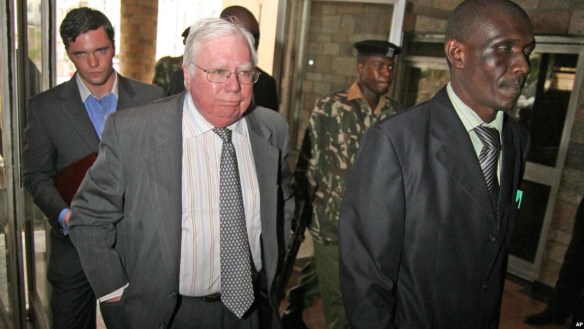
    Birtherism is back in the news with statements by Jerome Corsi, author of The Obama Nation and Where’s the Birth Certificate?, that he expects to be indicted by the Grand Jury in the Special Counsel investigation of Russian interference in the American presidential election. News stories this week on Corsi’s role in the current investigation used photos from Corsi at Kenya Immigration in 2008 when he was expelled while investigating Obama while I was Regional Director for the International Republican Institute.

    Update: Voice of America, Nov 23, “Roger Stone Associate in Plea Talks with Mueller“.

    FILE – Jerome Corsi, center, who wrote “The Obama Nation: Leftist Politics and the Cult of Personality, follows an immigration department officer holding his passport.

    Likewise, Michelle Obama made news in pre-tour snippets from her new memoir “Becoming” that she most especially found birtherism from Trump unforgivable on a personal basis because of “his loud and reckless innuendos putting my family’s safety at risk.” See “In Her New Book, Michelle Obama Denounces Trump’s Sexism and His Promotion of the ‘Birther’ Conspiracy” from The New York Times.

    A few weeks ago I had a piece in The Elephant which ran with the title “From Birther to More of the Same: American foreign policy in the Age of Trump and it’s impact on Kenya.” Salim Lone, former Raila Odinga spokesman, commented: “As always, a very interesting and objective look at our elections and the role the U.S. has played here from Ken Flottman. He is on the dot for pointing out the continuity in Kenya of the Bush Obama Trump arc, but on matters election, I’d give Bush an upper hand.” (I would appreciate any thoughts or observations you might have.)

    I wrote about Corsi more specifically and his role in the 2008 United States presidential campaign between the late International Republican Institute Chairman Senator John McCain and then Senator Barack Obama back in 20014 here:

    “A few thoughts about ethnic polarization in Kenya as we wait on the ICC”

    An important thing for outsiders to realize is how complex, and deliberately obscured, these things are in Kenyan politics–and how much of what is said in popular fora in the United States is at least misleading if not flatly wrong factually and in some cases deliberately malicious. (I have finally just now brought myself to read the whole Chapter 4 on “Kenya, Odinga, Communism and Islam” in Jerome Corsi’s book The Obama Nation which was published shortly after I returned from Kenya in the summer of 2008 during the American presidential campaign.  It was a major bestseller and thousands of Americans may have read more about Kenyan politics in that chapter than they have ever read elsewhere over their lifetimes.  Corsi . . . paints a picture of the Kenyan election and the post election violence that is very much at odds with my understanding and experience, as well as anything I heard expressed internally at the International Republican Institute, or through my family’s church in Kenya or from our missionary friends or at my children’s missionary supported school.  In other words, malicious.)

    One of the most important and interesting things that I have learned (so far) from my Freedom of Information Act requests to the State Department relating to observation of the 2007 Kenyan election was that the Ambassador’s staff reported to him and up the chain during the campaign that while there was hate speech showing up on both sides of the ODM/Odinga and PNU/Kibaki contest, the greater weight of it was directed against Odinga.  This surprised me because I had relatively limited separate interaction with anyone else at the State Department besides the Ambassador and his personal approach and attitude in my dealings with him certainly gave no hint of this background from his staff in the context of his tactics in addressing the Kenyan campaign.

    Barack Obama image New Orleans