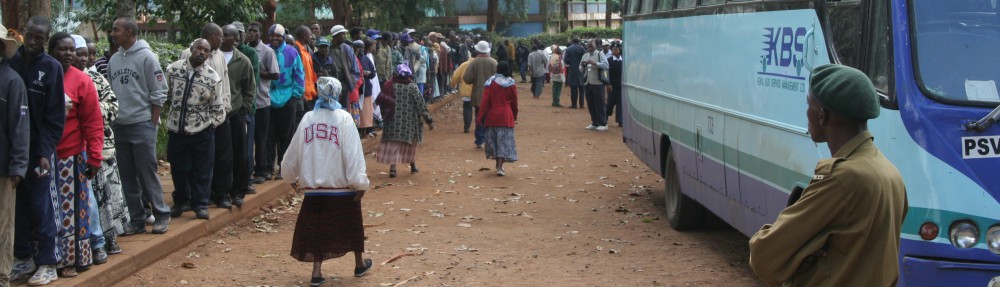
It’s my blog and I’ll be naive if I want to . . .

An advantage of being an American “Kenya junky” as an amateur, rather than a careerist is that I am free in a way that I could not afford to be if I was on someone’s payroll or looking for something next as opposed paying my own minimal expenses of making my thoughts and occasional research available for anyone interested.

So, to my last post teasing a suggestion that Amb. Kyle McCarter could offer some sort of “maverick” departure as an individual “breath of fresh air” to the United States Government’s role in Kenya away from pretenses of recent years — the attempts to clothe whoever ends up in power in whatever Kenyan institution with democratic and even “developmental” legitimacy irrespective of how nakedly imperious their actual behavior.

Do I seriously believe that McCarter, appointed by Donald Trump of all people, could play that role? I do. Do I believe it is likely? Of course not, I am just finding a survivor’s hope, as well as offering a “thought experiment” about what could be and suggesting that it makes sense to keep the door open while paying attention and working with earned wariness but not cynicism.

Is Washington finally losing patience with governance by UhuRuto? If so, what is seen as “the way forward”?

I touched a few bases while briefly in Washington recently. I was left with the impression of general “benign neglect” on Kenya, which would be expected given the overwhelming number of more immediate crisis situations around East Africa, such as the South Sudan “civil war/state failure” situation, escalating tensions between the Kagame and Museveni regimes, the uncontained Ebola crisis, etc. And always the war in Somalia.

Nonetheless, there are those who work or engage with Kenya more specifically on a less seasonal basis who will unavoidably have noticed how badly the Government of Kenya has been underperforming just as a factual matter regardless of the diplomatic angles of the day.

All this is to lay the groundwork for my great interest in a couple of news items today:

1). First was the report that Ambassador McCarter had said in Kisimu that the U.S. was putting on hold financing for the Bechtel Mombasa-Nairobi expressway due to concerns about corruption risk and debt levels escalating costs such that the intended value to the Kenyan people was not delivered. Here is the version from “Kenyans.co.ke” which has been running a bunch of pieces bringing up events from political inflection points from years past with no specific explanation of the timing, such as the piece I posted about last week taken off from my June 2017 piece in The Elephant on “The Debacle of 2007: How Kenyan Politics was Frozen and a Election Stolen with U.S. Connivance“.

As a private American “friend of Kenya” and taxpayer I am quite gratified by this willingness to change policy to address current “facts on the ground” and to actually “walk the talk” on “anti-corruption” even if it involves possibly giving up a big subsidized project for a very big well-connected private business owned by a group of Americans.

I have been concerned about this project for the reasons identified by the Ambassador but have not wanted to say much without being close enough to have details and not wanting to be seen as an inveterate naysayer or unduly skeptical about things where I am not that well informed.

Maybe Ambassador McCarter can end up being a “breath of fresh air” and is actually serious in his talk of zero tolerance for corruption in a way that would be different from the ordinary diplomacy where we run hot-and-cold at best. If no one explained to him as a political appointee from outside Washington that “zero” among diplomats ends up as shorthand for a wide range of dollar values in varying circumstances explained in the addendums and codicils, as opposed to just “zero” as it might mean to a businessman in downstate Illinois, then maybe Kenyan cartel leaders need to be worried a bit after all?

And if people in Washington have their hands full or are not focused on the immediate situation in Kenya, and with what we read about how national security policy management is working in Washington these days, it may well be that McCarter has that much greater practical latitude “on the ground”? Likewise, usually an Ambassador in Kenya will have the potential distraction of career considerations not dissimilar to people working in the government in Washington; this would not seem to be a challenge for McCarter. (And maybe he isn’t looking to be a lobbyist for a neighboring warlord in a black hat, and an oil and gas consultant and an investor-broker in USAID-funded health business, for instance.)

There are obvious sociocultural and political barriers to how McCarter will be perceived in Washington and among Americans who typically engage with foreign policy on Kenya or are “Kenyanists” or “Africanists” with focus on Kenya, but open minds are warranted. And maybe that works both directions.

Part of what is so striking here is how much Uhuru Kenyatta has in the past seemed to be arguably “Donald Trump’s signature African leader”–not so much that they are seen to really know each other or have some personal rapport, but rather that in the face of general lack of signs of personal interest in Africa from Trump we still have Uhuru at least included in meetings and doing photo ops with Trump in Europe, Canada and Washington, if not yet Mar-a-Lago, during the first two years of the Administration. Even though he was such a favorite of some in the Bush-Obama years.

So surely putting the Bechtel deal on hold suggests that there is finally heightened willingness to openly acknowledge that governance is simply not now what it was cracked up to be from our previous public diplomacy in recent years.

2) Next is Macharia Gaitho in the Daily Nation publishing today’s column: “Either rebels in Jubilee ranks join opposition, or Uhuru steps down” calling out Jubilee’s divide:

The politicians who contrive to insert his name [Deputy President Ruto’s] into every issue do the DP no favours at all. It does not help his image or his 2022 presidential election prospects when his name is used to fly cover for disreputable leaders caught on the wrong side of the law.

. . . .

As an elected member in his own right, a Majority Leader [Sen. Kipchumba Murkomen] does owe a duty to his constituents. Where conflicted, however, he could consult internally within the government and party organs.If his concerns are not adequately addressed, then the honourable thing would be to relinquish the Majority Leader role so that he can, in good conscience, speak out for his people both inside and outside Parliament.

As it is, what we are seeing from Mr Murkomen’s now frequent outbursts are the hallmark of rebellion. This is rebellion not from one disaffected individual, but a powerful Ruto faction in Jubilee that is unhappy with the path pursued by President Kenyatta.

Jubilee cannot govern effectively when it has such a powerful opposition within; hence the rudderless, dysfunctional government seemingly sabotaging its own efforts.

This is not a healthy situation. Maybe, it would be best for Mr Ruto and his cohorts to resign and go officially into opposition or for President Kenyatta to throw up his hands in surrender and leave the burden of leadership to those more able.

Now I don’t know and haven’t asked, but there have been recent times when Gaitho has seemed to be carrying a message, such as the time when he explained that Raila’s fellowship at Yale was intended to be a perk to ease into a honorable retirement, not a springboard to run yet again in 2017. Different Kenyan columnists are in this role at different times it has seemed over the years. See “Six years an Ambassador: Godec’s Kenya valedictory with Macharia Gaitho”.

This background made me figuratively “perk up my ears” when I read the Gaitho blast after the news on the Bechtel expressway deal.

As a practical matter, there are certain ironies any time it is suggested that “regular order” of some type is suddenly warranted in Kenyan politics. Uhuru Kenyatta himself as KANU leader and Leader of the Opposition in 2007, crossed the aisle to support “Kibaki Tena” without resigning, when party godfather, retired President Moi who picked Uhuru from relative obscurity to nominate as his successor in 2002, realigned his fortunes, so to speak, to be with Kibaki while being appointed as Kibaki’s diplomatic representative for Southern Sudan. So I think Ruto might scoff at Gaithos’s advice now, and I doubt Uhuru’s mother would be good with him resigning at this point with all the family has going on at stake. Too much water under the bridge for too many years to expect anyone “in government” to go formally into “opposition” voluntarily–reform can happen but not nearly so easily or cheaply.

A necessary and complimentary read is the latest from Rasna Warah in the East African Review with what needed to be said on the most egregious act of contempt toward what we used to call “the reform agenda”: “In whose interest? Reflecting on the High Court judgment against John Githongo?”

Kenya 2007 election Kibaki Tena Kazi iendelee re-election

Malawi PVT released by MESN – presidential results consistent with MEC official results, but top two candidates’ ranges overlap

Malawi PVT results from the Malawi Electoral Support Network  shows:

• Dr. Lazarus Chakwera (MCP) between 32.8% and 37.4%;

• Dr. Saulous Klaus Chilima (UTM) between 18.8% and 21.4%;

• Professor John Eugene Chisi (UP) between 0.3% and 0.5%;

• Mr. Reverend Hadwick Kaliya (Independent) between 0.2% and 0.4%;

• Mr. Peter Dominic Sinosi Driver Kuwani (MMD) between 0.3% and 0.5%;

• Mr. Atepele Austin Muluzi (UDF) between 4.3% and 5.7%; and

• Mutharika between 36.4% and 40.8%.

The PVT estimates, listed above, are consistent with the MEC’s official presidential results and therefore, the PVT can independently verify that the official results for the presidential election as announced by MEC reflect ballots cast and counted at polling streams. While PVT does not provide evidence that the presidential results have been manipulated, the PVT results data cannot definitively determine the order for the two leading candidates because of the overlap in the estimated ranges.

Read the whole release here.

Malawi Election Commission announces incumbent win in a “squeaker” – waiting on PVT

With the incumbent announced as winning with a narrower margin and a total of less than 39% of the vote, with turnout over 75%, there will be questions and frustrations.

Since the election is so close, the PVT is likely to show either of the top two candidates as a possible winner, although it could be pretty interesting if it shows something different. Since it has been done for days presumably it was ready for release some time ago.

Here is what was released for the last election in 2014.

With Parliamentary results released by Malawi Election Commission, but final Presidential results announcement stayed, IFES works on security and conflict prevention

Update: It is worth looking carefully at the MESN Detailed Preliminary Statement from the PVT. In general it suggests the voting was well conducted. I would flag the seven percent of the sampled polling stations where the results were not posted. See the USAID-funded research paper from Posner and Osofu at UCLA I linked below for why they identify the lack of posting of results as one of their indicators of potential fraud. I have never seen any legitimate excuse for not posting the results at the polling station and it certainly seems fundamental to me. I would note that seven percent is, to my recollection, a much better performance than what the Carter Center observers were seeming in their Preliminary Statement in Kenya in 2013, although that was not structured as a “PVT” sample as such.

——

Malawi’s election results being delayed after vote forgery claims” Quartz Africa

Under the USAID Malawi Electoral Integrity Program with CEPPS (the Consortium for Electoral Party and Process Strengthening)–the program under which NDI is providing “technical support” to the Parallel Vote Tabulation discussed in my last post–IFES is doing the work it has described in an April 2019 summary for the continent here:

Malawi Through the Consortium for Elections and Political Process Strengthening (CEPPS), IFES is supporting the 2019 tripartite elections under the “Malawi Electoral Integrity Program.” Particularly, IFES’ activities are focused on addressing electoral security through violence monitoring and incident reporting for more effective conflict mitigation and resolution, and by strengthening cooperation and information exchange between civil society, multiparty liaison committees and governmental electoral security actors, including the Malawi Election Commission (MEC). IFES will strengthen existing conflict mitigation and mediation platforms, support targeted interventions in areas identified as lhotspots, and raise public awareness about electoral violence, conflict mitigation and mediation tools available to the public. IFES will coordinate with the United Nations Development Programme on its “Malawi Electoral Cycle Support” program to build stronger linkages among the MEC and local stakeholders involved in conflict prevention.

CEPPS is a consortium among IRI, NDI and IFES which provides for a master funding arrangement between USAID and the group under which USAID then enters specific subsidiary agreements for individual programs such as the polling program in Kenya that funded Exit Polls through IRI for the 2005 and 2007 elections, or the Kenya Election and Political Process Strengthening Program for 2011-15 which was led by the coalition with separate workshares for IFES, NDI and IRI, with NDI supporting the PVT through the domestic observation group ELOG (set up as a permanent successor to 2007’s KEDOF domestic observation group at the recommendation of the 2008 Kreigler Commission report).

As an example of a different permutation, for the 2017 election, USAID solicited proposals for agreements involving one overall organization, with sub-agreements for other workshare. In that case the program was awarded to IFES, with the IRI and NDI work (including the PVT piece) under subagreements with IFES rather than directly with USAID as I understand it (this is based on the USAID solicitation and award announcements; the agreement is not published).

I have not watched Malawi closely and do not have any idea of the specific contractual arrangements of the MEIP program for this year.

With the presidential results finalization delayed, this will put everyone under significant pressure and may involve some hard judgment calls. We will all have to hope for the best as far as both the election and any negative situations regarding violence or insecurity.

Update: as a bonus, here is a 2015 paper from Daniel Posner and George Ofosu of UCLA, “Domestic Election Observers and Electoral Fraud in Malawi’s 2014 Election“.

Abstract

We present findings from a field experiment that estimates the causal effect of domestic election observers on election day malfeasance and downstream aggregation fraud in Malawi’s 2014 general elections. Our analyses leverage the random assignment of election observers to 1,049 polling stations located in a nationally representative sample of 90 constituencies. Since these polling stations already had observers assigned by other domestic monitoring organizations, our results speak to the marginal impact on electoral fraud of having an additional observer. We find that polling stations to which an additional observer was deployed had systematically lower rates of turnout and overvoting, and fewer votes for the presidential candidate who ultimately won the election—all results consistent with the deterrence of electoral fraud by the presence of the additional observer. We also find that the presence of the additional observer increases the likelihood that election results are not publicly posted, and that the non-posting of results is associated with an increased likelihood of aggregation fraud on behalf of the winning party, which we measure by comparing polling station-level election tallies with the official results reported by the Malawi Electoral Commission. We interpret this finding as suggesting that the presence of the additional observers may have displaced fraud from election day to the aggregation phase, and that the non-posting of the results may have been part of a conscious strategy to mask these efforts.

#MalawiDecides2019 — my inquiry to the Malawi Electoral Support Network (MESN) on PVT

Sent this evening as there seems to be a hole in the media reporting and public affairs announcements on this:

To: mesnsecretariate@gmail.com

Dear MESN,

Does your PVT receive funding through USAID (as per usual practice for these GNDEM PVTs in Africa)?  If so, what is the contractual arrangement for this funding? If not, how is the PVT funded?  Thank you for a quick response given approaching deadlines!

Ken Flottman

Note 1: GNDEM is the “Global Network of Domestic Election Monitors”

Note 2: MESN notes on its website its thanks to its “partners” including NDI and UNDP Malawi. USAID notes on its website for Malawi that it is funding various activities under an Election Integrity Support program, but without details. It would be typical for USAID, as recently in the Democratic Republic of the Congo, and Kenya from my own experience in 2007 and 2013, to fund IFES to embed within the Electoral Management Body and NDI to manage a PVT working through a Domestic Election Observation Mission. The US, the UK and the EU have also contributed to an Election Basket Fund managed by UNDP Malawi which would likely be a funder of the Domestic Election Observation Mission itself.

Update: See this photo from the MESN Facebook page from the last election in 2014. https://m.facebook.com/mesnmalawi/photos/a.261493504031064/261481734032241/?type=3&source=54. It shows as examples of “independent” PVTs in Africa the USAID-funded PVTs managed by NDI through ELOG to “build confidence” in Kenya’s IIEC and IEBC in the 2010 Constitutional Referendum and 2013 General Election, respectively, following the disastrous 2007 elections.

No response from MESN yet but an American academic friend who is a Malawi scholar of high regard and is observing the election confirms that we are funding the PVT and NDI is supporting.

Update May 23: Although NDI’s website for Its Malawi work just takes the program up to 2014, going back on their Twitter TL to April 12 they identify the assistance program name and that it receives funding from both USAID and the UK’s DFID:

New story published in Kenya news site on 2007 election from my 2017 piece in The Elephant

Raila Poll Victory That Sparked Controversy in US Senate May 23, 2019 Kenyans.co.ke

The piece focuses on the Exit Poll and is a bit convoluted. It does not link to my piece in The Elephant although it has added a reference after I responded on Twitter. (h/t to a friend in Nairobi for sending me the link).

In honor of this, let me re-post here my page with my 2014-16 War For History series which is not easily accessible on the site now.

THE WAR FOR HISTORY Page:

THIS IS A SERIES OF POSTS STARTING FROM OCTOBER 2014 to SEPTEMBER 2016

. . . it grapples with the struggle to bury and obscure, both immediately at the time and over the years since, a clear view of the election fraud and the resulting murder and mayhem in Kenya in 2007 and 2008.

For a summary of the story told in these posts, see my piece from June 2017 in The Elephant: The Debacle of 2007–How Kenyan politics was frozen and an election stolen with U.S. connivance.

♠The War for History: was Kenya’s 2007 election stolen or only “perceived to be” stolen?

♠Part Two of “The War for History”: my e-mails to Joel Barkan of January 2, 2008

♠Part Three of “The War for “History”: continuing my e-mail reports to Joel Barkan

♠Part Four of “The War for History”: “yes, the exit poll discriminated against dead voters”

♠Part Five of “The War for History”: “sitting on” the exit poll in January and February 2008

♠(Part Six): Why “The War for History” matters now–authoritarian momentum in East Africa

♠”The War for History” part seven: what, specifically, happened with Kenyans’ votes?

♠”The War for History” part eight: “the way not forward; lessons not learned” from Kenya’s failed 2007 election assistance

♠”The War for History” part nine: from FOIA, a readout of new Vice President Kalonzo Musyoka’s February 2008 meeting with John Negroponte

♠”The War for History” part ten: what was going on in the State Department on Kenya’s failed election; recognizing change at IRI and how the 2007 exit poll controversy turned into a boon for IRI in Kenya

♠”The War for History” part eleven: what did I mean in “part ten” in referring to Ranneberger “trying to quash” poll results showing Odinga taking the lead in the presidential race in September 2007?

♠”The War for History” part twelve: why did Ranneberger and Lambsdorf react so differently to the election fraud they witnessed together?

♠Kenya 2007 Election–How bad were we?–“The War For History” part thirteen

♠The War for History part fourteen: dare we learn from 2007-08 in Kenya or is it too soon to reckon with the whole story?

♠The War for History part fifteen: why the conventional wisdom that Kenya was “on the brink of civil war” in 2008 is wrong

♣The missing USAID news: “Kenya’s President Lost Disputed Election, Poll Shows”–the War for History part 16

♣The rest if the inside story of how the how IRI’s 2007 Election Observation and Exit Poll was subverted–the War for History part 17

I was amazed by what Ambassador Ranneberger admitted and what he denied to the New York Times (War for History series part 18)

The simple truth of the allegedly “contested” Kenya 2007 exit poll–what IRI reported to USAID (FOIA series part 14, War for History series part 19)

News from “The War for History” as Citizen TV owner admits to Parliament that suppressed reporting of voting results in 2007 showed Odinga win over Kibaki

What Will Jendayi Do? Reading “tea leaves” on Kenya’s next presidential race (revised)

[This post is revised to reflect a correction and revision from the East African.]

The East African made an editorial slap at Michael Ranneberger and Jendayi Frazer in its “Cry havoc, and let slip the U.S. ex-diplomats” last Saturday to which I added a link in my last post regarding ex-Ambassador Michael Ranneberger’s deal with Salva Kiir:

Michael Ranneberger, whose controversial tenure as United States ambassador to Kenya is well remembered, is the managing partner at Gainful Solutions.

Comparing his posture back then, his flip from the high priest of justice and human rights, to the devil’s advocate cannot escape attention.

Former assistant secretary for African affairs Jendayi Frazer, is another US top gun diplomat who is well known for her consultancy services across East and Central Africa since leaving US government service.

At issue here is whether American diplomacy, as represented by Frazer and Ranneberger, subscribes to any universal values at all. It is obvious that the duo are exploiting the networks made during their career, to make hay today.

In an ideal world, the stakes in South Sudan are so high, that they should be adequate incentive for anybody to think beyond the short-term gains an individual could make out of the situation.

Ultimately, however, external interference cannot be discussed without examining the role of the African politician who has been a willing accomplice by shunting aside the national interest in favour of self-preservation. [this is EA revised text]

Dr. Frazer usually makes appearance in the media in Nairobi for business dealings related to the Jubilee Administration, along with one appearance a few months ago meeting with controversial Mombasa Governor Joho identified as a discussion on “countering violent extremism” on a MasterCard Foundation trip.

REVISION NOTE:

[(East African) EDITOR’S NOTE: This article has been corrected to remove the association earlier made between big infrastructure projects in Uganda and Ms Jendayi Frazer. Ms Frazer has not been involved in any infrastructure deals in Uganda and her name was inadvertently mentioned in that segment of the leader. We regret the error.]

See also.

Editorial criticism of Ranneberger and Frazer of this type is not the East African’s usual approach, as reflected in the defection of many of their Nation Media Group opinion columnists to The Elephant’s East African Review, as well as to The Standard, in the wake of the handling of coverage of the Uhuruto re-election fiasco in 2017-18 and Jubilee crackdowns on the media. Some years ago the East African passed up a friend’s offer to put together my experience and investigation from this blog on how Ranneberger and to some extent Frazer played the 2007 Kenyan election while they were in the State Department from my “War for History” series.

So kudos to the East African now for calling this issue out editorially, even if the news departments have not been covering these developments in the past. Maybe that can change.

One of my questions in looking at the current Kenyan presidential race has been how Dr. Frazer will play it, especially given that there is no way to know now who will be in power then in Washington. Assuming that the current “handshake” holds and that Frazer’s first relationship is with the Kenyattas, would she affirmatively step up for Raila in the face of a serious challenge from Ruto in a competitive “two-horse” presidential race? Or would she approach this differently? (She was firm in her position that what was done in the Rift Valley in the wake of the 2007 election fraud was “ethnic cleansing” even though “Main State” would not adopt her terminology, so it would arguably seem pretty awkward for her to support Ruto, wholly aside from the current corruption situation with Ruto). She was vital to the Uhuruto ticket in the 2013 race and to its perception and reception in Washington in the Obama years thereafter to my way of thinking. Getting called out publicly in the East African and not just having dealings with Uhuru and Kagame is a wild card.

When The Star had me write some columns in the spring of 2013, they headlined the one dated March 23 challenging Dr. Frazer’s support of the Uhuruto defense in the Supreme Court of the IEBC’s questionable numbers to avoid a runoff after “failure” of the Results Transmission System in the election petition by civil society and the opposition as “Jendayi Frazer lacks moral authority“. Read the whole piece if you are interested in Kenyan elections or U.S. democracy assistance, but I concluded:

The thing that is most striking to me about this now, in light of the current litigation about the manual vote tally by the IEBC in this election, is that Jendayi Frazer was the head of the Africa Bureau at the State Department during 2007-08 when the previous Exit Poll was withheld and the misleading “press guidance” put out [by the Africa Bureau as I had just learned from FOIA]. Today, as a private citizen, Dr. Frazer is aggressively arguing in the Kenyan press and in the press back in Washington to once again uphold the disputed work of the Kenyan election officials against the concerns raised by the opposition. I cannot justify how this was handled when she was in charge in 2007 and 2008.

When I had the opportunity to meet Dr. Frazer the first time later I did apologize to the extent of noting that the phrasing of the headline itself was not something that I myself would personally have written, although I stand by the content of what I did write. When I published “The Debacle of 2007: How Kenyan Politics Was Frozen and an Election Stolen with U.S. Connivance(again, the headline is not mine) in The Elephant in June 2017, I focused primarily on my direct dealings with Ranneberger. Frazer’s exact role as his superior and the intentions of any formal policy beyond the law as such have never been made fully clear. Ranneberger’s cables as provided under FOIA from before and immediately after the election leave gaps and questions as to what was reported to Washington before Frazer and later Rice were dispatched to Nairobi starting several days after the vote during the post-election violence (although it would be unfair to Ranneberger to make assumptions from that circumstance alone, and various facts were misrepresented in Washington after the vote regardless.)

More broadly, I have agreed with some of Dr. Frazer’s many policy approaches and disagreed with some. What I would think about her personal integrity regarding the 2007 election would depend on whether she was acting per instructions of policy or making it herself. In 2013, I did not appreciate her public role and have not qualified my reaction based on anything I seen since.

At the same time, Frazer seems to have been a primary architect of some policy approaches in Africa that were quite positive and that left the U.S. in better stead in the G.W. Bush years in Africa than elsewhere, in spite of conspicuous controversy regarding Somalia. Arguably with PEPFAR and other initiatives there was some actual “compassionate conservatism” undertaken in SubSaharan Africa even as the anti-compassionate forces reflecting the Vice President’s approach changed the direction of the Bush Administration foreign policy elsewhere in the wake of 9-11. Post-Bush Administration she is relatively ubiquitous in elite U.S. institutions associated with Africa, especially as an African-American as well as her various “Afrocapitalism” engagements. So in that regard she earned respect and a willingness on my part not to assume the worst even if there are some things that look bad.

Ultimately, in spite of the fact that she tends to be quite assertive in her positions, I find her to be a bit of an enigma really. Regardless, anyone as involved in as many things in as many places as she is is going to be wrong some of the time. As a diplomat that involvement may not always be optional absent resigning, but it is a choice for a private citizen.

“Freedom Under Threat”: New report on the spread of laws restricting NGOs in Africa from Freedom House

The new report “Freedom Under Threat: the Spread of Anti-NGO Measures in Africa was released today. It provides a valuable review of recent developments in counter-democracy push back from governments in power in numerous countries.

In Kenya, here is a good, straightforward recitation of the approach taken after the “UhuRuto” election of 2013 with a Jubilee Party platform calling for a crackdown on independent NGOs said to be modeled after post 2005 repressive measures established by the Meles Zenawi government in Ethiopia (see “Attacks on Kenyan civil society prefigured in Jubilee ‘manifesto’“) and the legal “pitched battle” since:

In Kenya, meanwhile, the new government elected in 2013 made six successive attempts to modify the PBO Act—a progressive law passed by Parliament and signed by the outgoing president just months prior to the elections.49 All of the attempts were loudly opposed by NGOs and the political opposition, and the High Court ordered the government on October 31, 2016, to publish the original PBO Act in the official gazette to bring it into operation.50 The government refused to comply, prompting NGOs to request that two cabinet secretaries—overseeing the Ministry of Devolution and Planning and the Ministry of Interior and Coordination of National Government—be held in contempt of court.51 The court ruled in the NGOs’ favor on May 12, 2017. Rather than implement the court order, however, the government continues to apply the outdated NGO Act of 1990, and it is unclear how the situation will be resolved. The broad-based Civil Society Reference Group, an alliance of over 1,500 leaders of national and international NGOs that ran a multiyear campaign for the adoption of the PBO Act,52 continues to insist on its implementation. Indeed, Kenya represents an interesting case study of the pitched battles that have characterized the struggle between governments on the continent that seek to narrow democratic space on the one hand and civil society sectors that seek to preserve democratic gains on the other.

The moves by African rulers appear related to or inspired by authoritarian trends elsewhere:

Although no attempt is made in this report to analyze laws outside Africa, there are parallels between anti-NGO measures adopted across the continent since 2006 and those adopted in Russia and China—two influential global actors that have forged close ties with African governments. Sudan’s anti-NGO law coincided with the first of several Russian laws,6 closely followed by Rwanda’s measure in 2008. Russia’s second wave of legal restrictions coincided with those of several African countries—notably Ethiopia, Zambia, and Mozambique—while China’s 2016 and 2018 regulations came alongside measures by several other African governments surveyed in this report. It is difficult to establish specific links between the African laws and those adopted by the two global powers, but the close relationships built in Africa since 2000—particularly by China—support a modeling hypothesis.

South Sudan: new Salva Kiir—Rannenberger Foreign Agent filing shows $1.2M non-refundable retainer “already paid” and $3.7M flat fee (contra Reuters)

  1. COMPENSATION

6. The Consultant will charge the Client a flat fee of $3.7 million dollars for the services (the “Compensation”) for this two-year Contract.

7. The parties acknowledge that $1.2 million dollar’s of the Compensation has already been paid to the Consultant as ofthe date hereof, as a non-refundable retainer. The Consultant will invoice Client quarterly for amounts due.

Here is the May 7 filing with the Justice Department, by Gainful Solutions with a new “Exhibit AB” which includes both a letter purportedly canceling the April agreement, dated May 2, and the substitute agreement dated May 5.

The widely-reprinted Reuters story from my update to my previous post indicated that the new agreement did not mention compensation.

On May 2 Gainful Solutions filed a “Short Form” Foreign Agent registration act for Ambassador Timothy Towell as an additional lobbyist and business agent with the title of “consultant” at compensation “to be determined” to go with the previous filings for Ranneberger, Soheil Nazari-Kangarlou and Constance Berry Newman.

Note: The Justice Department has these filings incorrectly posted on its FARA.gov database under “Sudan” instead of “The Republic of South Sudan”.

Update: Politico reported on the contract change here in their “Influencers” newsletter, noting the compensation and identifying dropping reference to the hybrid court as the main change.

And read: “EDITORIAL: Cry havoc, and let slip the U.S. ex-diplomats” in The East African.

Amb. To Kenya Michael Ranneberger with late Kenyan diplomat Bethuel Kiplagat, defending Kiplagat’s controversial appointment by President Kibaki to head Kenyan TJRC