Choices and Consequences: Next for Kenyatta’s ICC Defense, October 8 Status Conference [updated]

The International Criminal Court has ruled that Kenya’s President Kenyatta must appear in the Hague for the status conference in his case on the confirmed charges relating to the Mungiki revenge attacks in the eastern Rift Valley during the post-election violence in early 2008. At the time in question he was KANU leader and Kibaki’s new Minster of Local Government following the January 8 appointment of the “upper half” of a new cabinet prior to the African Union sponsored mediation led by Kofi Annan.

The AU process as structured between ODM and PNU negotiating teams stalemated, with the active resistance of key Kibaki “hardliners” and parts of the PNU coalition, including KANU, but Annan was able to get a last minute deal signed off on by Kibaki and Odinga that ended the immediate crisis on February 28.  The settlement led to a Government of National Unity, with the addition of more cabinet ministers and a new, and ultimately temporary position of Prime Minister for Odinga, along with the agreement to appoint commissions to investigate the election itself and the post election violence.

The “Waki Commission” investigating the violence, in an unprecedented display of independence, provided a sealed envelope of key suspects to Annan for potential referral to the International Criminal Court in the event local prosecutions were not forthcoming, along with its extensive public report and redacted annex of persons credibly identified as having a possible individual responsibility for investigation.  (The “Kreigler Commission” followed the ordinary practice of presidential commissions from the Moi era and reported privately to the President, and then released a public report disclosing broad flaws in the overall administration of the election but ducking investigation of the central tally at the ECK headquarters in Nairobi as discussed in Ambassador Ranneberger’s cable here.)

Eventually, Annan turned the envelope over to the ICC, which authorized investigation. Charges were initiated by the Prosecutor against six and confirmed by the Court against four in January 2012, of which one was dismissed by the new Prosecutor.  So how has the defense of the cases been conducted since, or perhaps more descriptively, the counterattack?

Solo 7--Kibera

Solo 7–Kibera

Susanne Mueller’s article from the Journal of East African Studies earlier this year, “Kenya and the International Criminal Court (ICC): politics, the election and the law”, perhaps gives the clearest account of how the game has been played so far:

. . . The ICC began to examine the Kenya situation in 2008-09, well before the 2013 election.  This constituted a potential risk that continued to increase once the ICC received permission to start a formal investigation and the cases progressed.

The election came into play when two of the ICC indictees — Uhuru Kenyatta, a Kikuyu, and William Ruto, a Kalenjin — decided to run for president and deputy president… It was an opportunistic alliance of convenience as the ICC had accused both individuals of masterminding the 2007-08 ethnically targeted violence against each other’s communities. Ironically, this union, the negative ethnicity that accompanied it, and the ICC’s involvement also may have partly deterred violence in the 2013 election.

Winning the election was part of a key defense strategy to undercut the ICC by seizing political power, flexing it to deflect the ICC, and opening up the possibility of not showing up for trial if all else failed. The strategy entailed using a series of delaying tactics to ensure that the ICC trials would not start until after the defendants had won the election and gained power at the highest level. The tactics ranged from mobilizing international organizations against the ICC, making numerous legal challenges designed to delay the court, and the intimidation of potential witnesses, allegedly by defense sympathizers and go betweens, to keep them from assisting the ICC.

The tactics were part of a larger design to undercut the ICC. Demonizing opponents, politicizing ethnicity, and attacking the ICC as a tool of the West both before and during the presidential campaign served this end and victory in the election. Once they won the 2013 election, Kenyatta and Ruto came up with another tactic: asking for concessions based on their political power, including pleas to drop their cases or not be physically present at trials.

Mueller suggests that understanding the interplay between law and politics in this situation, while very much business as usual in Kenya where “the rule of law is still weak, politicized and hard to enforce [and] individuals are often sanctioned for trying” raises serious questions of much broader international application as the Kenyatta, Ruto and Sang cases play out on a global stage in the arena of treaties, international organizations and international human rights norms.

Within Kenya there have been two momentous court decisions since the 2007-08 election and ensuing violence.  Both were decided at the High Court (the Kenyan trial court, not the Court of Appeal or Supreme Court).  The first was the ruling that President Kibaki was not entitled to unilaterally nominate the new Attorney General and Chief Justice.  This led to the compromise whereby President Kibaki agreed to obtain the consent of the Prime Minister for a new selection for the Chief Justice, paving the way for the litigation of the CORD petition over the IEBC’s administration of the election process and the 2013 version of the central presidential vote tally (with the new Attorney General as amicus on the other side of the case).  The second was the lower court ruling that declined, eventually, shortly before the election date, to decide whether or not ICC crimes against humanity suspects were eligible to run for president under the integrity provisions of the new 2010 Kenyan constitution.  Thus in one instance a High Court stood up, and in another one stood aside, and ultimately the larger questions of power and violence at the highest levels within Kenya have been preserved for politics rather than law.

How will the Attorney General and the Kenyan State conduct itself on the international legal stage at its October 7 status conference, and how will Uhruru Kenyatta, as defendant first, and then President, conduct himself on October 8 at his status conference?  I suspect Kenyatta will go, in his own personal interest as a defendant, knowing that he remains a long way from actually facing trial so far, even though by attending he will be undermining some of the anti-ICC forces he has unleashed in his counterattack on the Court.

For me, one the biggest tart ironies of the whole saga is the recent role of the African Union in joining the attack on the Court.  The crimes alleged arose out of a purely Kenyan election dispute.  If the AU wanted to support the inviolate primacy of the Kenyan presidency, why did it not stay out of the matter in the first place in 2008?  The involvement of the ICC is the result of the settlement brokered by Kofi Annan as AU-endorsed emissary, which was agreed to personally by Kenya’s sitting president at the time!

Ahead of Washington Summit, Setback for Kenya’s Attorney General in pre-trial defense of President Kenyatta at ICC


Counting-the original tally

Counting-the original tally; December 27, 2007

“ICC acts tough on Uhuru’s assets, phone records” Daily Nation, July 30.

The International Criminal Court has directed that the Kenyan government be compelled to provide the property and financial records associated with President Uhuru Kenyatta if the government was not ready to fully cooperate.

In a ruling on Tuesday, the judges further unanimously endorsed the prosecution’s revised request that Attorney-General Githu Muigai had contested during the status conference on July 9.

The AG seems to have lost his argument, as the Trial Chamber V (B) ruled that the prosecution’s request was right within the provisions of the Rome Statute of cooperation.

.  .  .  .

The judges further directed the prosecution to “pursue all possible means to get Mr Kenyatta’s telephone records.

. . . .

Of the items that Ms Bensouda had requested she was only able to obtain the details of four the vehicles Mr Kenyatta owned or regularly used between November 1, 2007 and April 1, 2008. These were obtained with the consent of the accused.

In fact, Lands secretary Charity Ngilu, in a letter that was read to the court, said that “doing the best with the resources and time available to us, we have not located any land, title or property registered under the name of Uhuru Muigai Kenyatta.”

. . . .

. . . .

The Chamber also trashed arguments by the AG that the “work of prosecution investigators was being outsourced to the Kenyan government”. The judges, Kuniko Ozaki, Geoffrey Henderson and Robert Fremr, also validated the extensive requests by ICC prosecutors.

“It is a reasonable investigative premise that an accused with access to substantial resources may choose to act through various intermediary entities, as this would in particular, reduce the traceability of transactions intended to further a criminal purpose,” they said.

Githu had dismissed the request by Prosecution Chief Fatou Bensouda as irrelevant to the charges and too broad. The wide-ranging requests, which were made public for the first time late Tuesday seeks disclosure of the President’s records for about three years beginning June 1, 2007 to December 15, 2010.

“Investigations inquiries may not be confined merely to the immediate period of the violence,” the judges ruled. “In the context of certain records, a longer time period may also be justified for comparison purposes where pattern of activity may be significant in revealing unusual communication or transactions.”

This is the second time the ICC Judges are asking the Kenyan authorities to use compulsion to comply with its cooperation obligations to the court. The judges have threatened to refer Kenya to the Assembly of State Parties if it declines to disclose the records.

Already, a separate chamber has issued orders to the govern- ment to compel nine witnesses to testify against Deputy President William Ruto and his co-accused, journalist Joshua Sang. Uhuru’s trial is set to begin on October 7.

. . . .

If you are in Washington for the Africa Summit or otherwise on August 7 you can have dinner with H.E. Kenyatta at the Grand Hyatt from 7-9pm, sponsored by the Corporate Council on Africa, for $200 if you are not a member of the Council, or $100 if your are.  Members (only) may wish to join H.E. Teodoro Obiang of Equitorial Guinea, starting at 6pm that night at the St. Regis.  Perhaps with a good driver you can catch both.  To register follow the links here; the Council is also hosting several less controversial events surrounding the Summit.


My Joel Barkan tribute

I have been very much saddened by the sudden passing of Joel Barkan, the dean of American Kenya experts and a real friend to me during these years since we got together through the 2007 Kenyan election tragedy. Joel and his career are eloquently remembered here by his colleagues at CSIS–please take a moment for this.

Joel and I last corresponded two days before he died from a pulmonary embolism on January 10. He was having a wonderful time with his family in Mexico City and looking forward to going on to Colorado to ski. I was getting ready to observe the referendum in Egypt and got a chance to thank him again for providing me an introduction to the leadership of Democracy International a few years ago. Joel was always palpably excited about the time he and his wife Sandy got to spend with their adult children and I know that he had a fulfilling family life as well as an amazingly productive career. It’s just hard to accept that he is suddenly not here and I want to express my deepest condolences both to his family and to those many friends who knew him so much longer than I was privileged to.

It is especially sad that two of the friends that I came to admire and respect through the 2007 Kenyan exit poll saga have now passed away. See my tribute to Dr. Peter Oriare here.

When then-Ambassador Ranneberger listed the people he wanted the International Republican Institute to invite to observe the 2007 Kenyan election, Joel was the only person on both the Ambassador’s list and on IRI’s. Fortunately Joel agreed to come for the election and was our primary Kenya expert for our observation mission. On January 10, 2008, during the post election violence with no negotiation process under way, Joel was a panelist at a well-attended and high profile Washington event, Kenya: A Post Election Assessment, (program information and the video here) at the Wilson Center and co-sponsored by CSIS. Joel cited the IRI/USAID exit poll suggesting an opposition win, noting that it was “unfortunate” that it had not been released, although it had been covered by Slate magazine. IRI was chagrined–for whatever reason–that the exit poll had been brought into the discussion in Washington; I explained to the IRI Washington office that I had provided Joel the information on the embargoed poll results when he asked about them since he was our subject matter expert on the election observation and another member of the delegation had already gotten themselves engaged on the poll. Later, Joel supported the formal release of the poll results by the University of California, San Diego, researchers at CSIS once IRI’s contractual six month period of exclusivity with the University were up, in spite of pressure to stop it. IRI finally published the poll themselves the next month, but Joel still got attacked for doing what he thought was the only right and appropriate thing. Fortunately, Joel had thick skin and deep respect from those who knew him and his work.

Ironically, perhaps, it was Joel who served as the initial Democracy and Governance advisor for USAID for East Africa back in 1992 when IRI was selected to observe the initial post Cold War multi-party election in Kenya. Joel sent me a copy of Ambassador Smith Hempstone’s memoir, Rogue Ambassador from those years when he served as President George H.W. Bush’s political appointee in Nairobi. Hempstone explains that he had recommended to Moi that NDI be invited to observe that election. Moi refused to accept NDI but would agree to IRI. (Although Hempstone’s book does not mention it, during that 1992 election and into the next year Moi was represented in the United States by famed GOP consultant Charlie Black. Black was IRI Chairman McCain’s consultant in his own presidential bid in the US. during the 2008 contretemps in Kenya. With the average American democracy assistance worker too young to have much memory of the Cold War, much less have played in it, Joel’s institutional memory of both Kenyan politics and American policy was a tremendous resource, freely shared with those who cared about being right about Kenya.)

So Joel and I bonded initially over the shared experience of watching the post-vote fiasco unfold at the Electoral Commission of Kenya, then the shared conviction that a mistake was being made by not releasing the exit poll, and ultimately the common experience of attracting opprobrium for being seen as out of step with powers that were at IRI. He taught me a great deal, and will inspire me always. I will continue to miss him.

Canadian High Commissioner misses the point in warning Kenyan politicians about ICC pullout

A diplomat has warned that the move last week by law makers to have Kenya pull out of the Rome Statute could jeopardise future search for international justice for Kenyans.

Canadian High Commissioner in Nairobi David Angell said pulling out of the Rome Statute, that established the International Criminal Court (ICC), would deal a blow to any future victims of violence that Kenyan judicial system would not handle.

“Canadian envoy warns in Kenyan ICC pull-out” Daily Nation

What search for international justice? Kenya’s last Parliament did not follow suspect William Ruto’s “Don’t be vague, go to The Hague” lead out of a preference for “international” justice over trying the suspects locally–rather it was an excuse for not prosecuting anyone themselves. Likewise the last Parliament did not then turn around and vote in December 2010 to withdraw from the ICC as soon as the charges came down against Ruto, Uhuru Kenyatta, Sang and the three others in consideration of the interests of “justice”. If the members of Kenyatta and Ruto’s Jubilee coalition who voted again to withdraw from the ICC on the eve of Ruto’s trial were in the least concerned about a “search for international justice” for victims of election violence–past or present–they would not have done so.

Kenyatta and Ruto as KANU leaders were on the side of election violence in Kenya in 1992 and 1997 and they certainly have not done anything to express remorse or “search for justice”–international or otherwise–for the victims. The very idea that there should be such a search for justice for victims of electoral violence is an affront to the political order in Kenya and on this Kenyatta and Ruto can easily circle the parliamentary wagons against the threat to their private sovereignty and that of their cohort.

The High Commissioner ought to appreciate that he is speaking to an audience which has, over many years, shown that it takes these thing deadly seriously. If the Canadians want to step into the current diplomatic vacuum in Nairobi to address the situation, I certainly applaud the intention, but they if they want to have influence they need to speak of things that their audience cares about.

Two “must reads” from Kenya ahead of the opening of the PEV trials at the ICC

3451378449_800db9e485_o
“Why Uhuru and Ruto must attend trials in The Netherlands” by George Kegoro in the Daily Nation.

.  .  .  .
I have found possible answers to this question in the record of the first presidential debate that was organised by the Kenyan media in the run-up to the March elections. The moderator, NTV’s Linus Kaikai, explored the question of the trials with Mr Kenyatta against the fact that he was seeking to become president of Kenya. Specifically Mr Kaikai wanted to know how Mr Kenyatta would juggle between attending his trial and the duties of presidency if he was elected to office.

On the night, Mr Kenyatta provided well-considered answers to questions surrounding their cases and the presidential bid. Referring to himself and his running mate Mr Ruto, Mr Kenyatta indicated that “it is our intention to follow through [the cases] and ensure that we clear our names”. He added that he considered accountability before the ICC as a necessary step towards ensuring that the kind of problems that Kenya faced in 2007 would not recur.

In his own words: “At the same time, we are offering ourselves for leadership in this country, a position that we believe and want to pass on to Kenyans, an agenda that will first and foremost ensure that the kind of problems of 2007 are put to an end.”

Asked whether the cases would affect his capacity to run the country, he said, “many Kenyans are faced with personal challenges and I consider this as a personal challenge”.

He said he considered that since personal challenges did not affect the capacity of other people to continue with their day-to-day jobs, they should not prevent him from doing so as well.

On that night, Mr Kenyatta concluded: “I will be able to deal with the issue of clearing my name while at the same time ensuring the business of government is implemented”.

Earlier, during the same debate, in answer to a question about his understanding of the problem of tribalism and how he would be different from Kenya’s first three presidents, Mr Kenyatta answered that “we have a new Constitution now” and added that “my job as president is to ensure that the Constitution is implemented”.
.  .  .  .

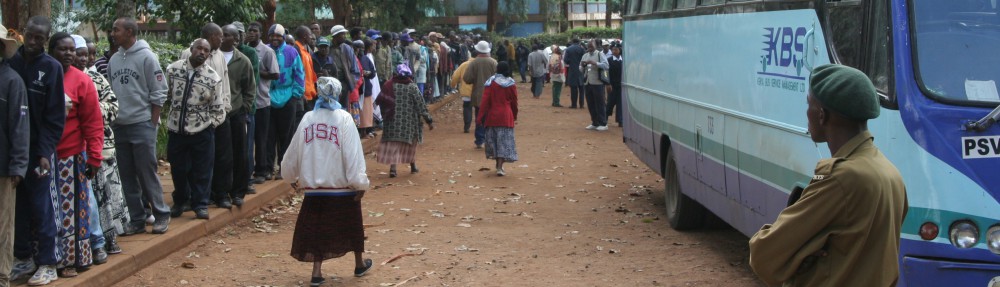
Kenya Bus Service (KBS) and Security at Polling Place

“The Eagle Has Landed: Kenya and the ICC” by John Githongo in The Star.

. . . .

. . . History is being made.

The ICC has redefined Kenya’s foreign policy totally and turned domestic politics inside out. Immediately after the post-election violence in 2008, Kenyans were clamouring for the ICC to intervene given the horrors that had just taken place.

Accountability, justice, impunity, reconciliation and other such words were the primary fodder of political discourse as we headed into the referendum on the constitution in 2010. Indeed, it can be argued that even among those most strongly opposed to the new constitutional dispensation, the dark looming cloud of the ICC and all its implications, especially the public mood that accompanied it through 2008 into 2010, all served to soften them up to demonstrate their pro-change, reformist credentials at a time when the country’s leadership and the messy albeit negotiated coalition arrangement was particularly unsatisfactory to the population.

If it hadn’t been for the ICC, perhaps more of the so-called ‘watermelons’ who pretended to support the new constitution while secretly being opposed to it, would have come out into the open with their true position.

.  .  .  .

. . . Parts of the Kenyan population are in just such a trap: caught between our preaching about and, yes, belief in, good governance and accountability; and its realities when brought to bear in our tribalised, politicised and fragmented political economy. Grimly put – ‘it hurts like hell when it is my tribesman who is being held accountable’. It hurts so much it leads to some of the most gibbering rationalisations of absurdity possible.

Continue reading →

I am concerned that a move by the ICC to try Uhuru, Ruto and Sang “locally” would needlessly cost additional lives

3451378449_800db9e485_o

The Kenyan government, after years of lack of success in its various diplomatic efforts to block the ICC prosecutions of key figures in the political killings involved with the 2007-08 elections, achieved a potential breakthrough at the most recent AU meeting in Addis.  By getting a section of African strongmen and politicians to agree that the ICC shoe that they had promised to wear was pinching too tightly when it was not deferring to them as Heads of State as opposed to only pursuing lessor suspects out of power, the Government of Kenya raised the stakes for those nations that advocate a law-based international order and for the ICC as the only institution that remains with any potential to substantively express any tangible disapproval of the post-election murder and mayhem in Kenya in 2007-08.

It is in this context that the ICC will have to decide whether or not to accept a panel recommendation to move the trials from The Hague to Kenya or Tanzania.

Let me say that I am no fan of the decision to locate the ICC in The Hague in the first place.  Nothing against the Dutch and I do understand that The Hague has symbolism as a seat of the international law of nations.  Of course the criminal trials of individuals is something quite different and if anything in some ways undercut by the association.  We are confronted now with a situation in which the indictees have taken power in a member state–in a campaign initiated in the context of their defense to the ICC charges–and wish to avoid trial by mutating the individual criminal charges into a matter of the international relations of sovereign states.

So by all means move the Court to Botswana or Belize or some other more suitable location when it becomes logistically rational to do so, but these trials are supposed to be about the loss of life and limb in the “extra-electoral” context of the Kenyan fight for political power and it makes no sense to physically conduct the trial in such a way as to put more lives in the same type of jeopardy.

First, as a general proposition, witnesses against the President and Deputy President will never be able to live in safety in Kenya for any time in the foreseeable future after being identified and choosing to testify (they may wish to accept the danger of living in Kenya after testifying but this should not be asked or expected of them); this is the cold reality that should be readily evident to anyone who has paid attention to politics in Kenya over the years.  If it is understood that witnesses cannot testify in Kenya then why split up the trials over more than one location?  This process has already taken too long to no one’s benefit and supposedly the ICC has problems with resources and funding and a big backlog of cases already.

Second, estimates of the loss of life related to the most recent Kenyan elections with all priority on “peace” or stability over all else were still more than 500 people.  The police made extra-legal pronouncements restricting lawful civic expression and assembly; the country was basically shut down, the military was deployed and people were shot for breaking no law.  A trial in Kenya would be extremely expensive and quite dangerous by any informed reckoning.  The suspects on trial would be in charge of the “security” forces.  How many innocent lives will be lost for this?  No one can know ahead of time but it is grossly irresponsible not to count on some people who have no role in the trials dying for holding them in Kenya.

The whole point of the ICC is that it is “international”.  Thirty three other nations in Africa beside Kenya are members.  The reason for these cases being at the ICC was the tactical decision to vote in the “duly elected” Kenyan Parliament to “don’t be vague, go to The Hague.”  If “The Hague” no longer has the stomach for this, they should declare now that the task is too hard and walk away and make clear that Kenya, in spite of the work of the Waki Commission arising out of the AU-sponsored 2008 post-election settlement and the vote of its own parliament, is a zone of impunity, at least for suspects who arise above a political ceiling on potential accountability.  Otherwise, these trials need to be brought to fruition and be heard and appealed and done with purposeful speed and as few diversions as feasible.

We all know that the crimes alleged happened.  We saw them and heard them and see and feel their effects today.  Those of us who lived through this time in Kenya heard various bits and pieces of the details as these things were happening.  If the suspects or any of them are tried and acquitted then anyone who believes that they are in fact innocent of the roles alleged can celebrate that and all of us can finally mourn justice for these crimes along with the dead.

“The West” is not a Country either–the U.S. and U.K. do not have the same interests in Kenya

The Star reports that:

President Uhuru Kenyatta is set to hold talks with UK’s Prime Minister David Cameron during his three day visit, the first to a western capital since his election.

Human rights activists in the UK are reportedly organising to hold demonstrations to protest what they say is a ‘hypocritical manner’ manner in which the British government has made a U-turn against in its stand towards the Kenyan government.

In the U.K., unlike in the U.S., the Kenyan election stirred a significant discussion in the national legislature, in this case the House of Commons. Here is the link to the Hansard or transcript from March 20.

The biggest difference in interests is that Kenya, a British colony within the lifetimes of current political leaders, is important to the British economy. Kenya is not very important to the U.S. economy. It might be someday, and the U.S. would notionally like to be more engaged economically in East Africa, and not only because the Chinese are; nonetheless, as of today the level of trade and investment is not a higher order immediate interest for the United States.

Further, in the global system that the U.S. has helped create, the U.S. does not really have the same relationships to even the largest companies that may be headquartered in the U.S. as the British and some other European nations still have with their business champions. Not to say that the State Department doesn’t want to sell Boeing v. Airbus, but there is no American equivalent of BAE, for example. Further, it is British rather than American companies that are the key players in Kenya in banking and finance, tea, horticulture, tobacco, printing, public relations consulting, etc.

As of the last few years, roughly 60% of the roughly 5,000 Americans living in Kenya, according to the State Department, were connected to missionary work. The British, not as much as far as I know. Moreover, there are perhaps five times as many British passport holders in Kenya as Americans.

The United States has a reported official established presence of more than two dozen federal agencies in Kenya, so we do have interests, but they are heavily weighted toward “global” security matters, along with international crime/drugs, etc., and what we might call diplomatic and security logistics. In other words, it is convenient for people to locate in and transit out of Nairobi to support a variety of functions that don’t relate uniquely to Kenya. Its an easier place to fly in and out of and has lifestyle appeal, along with being a locus of the same type of thing for people in other agencies, from other governments and international organizations. It is not that this geographic interest doesn’t matter, its just that it really is not of first order importance. A lot of the aid programs that we conduct in Kenya could easily be moved to other countries that are even more in need if less convenient, for instance.

When al Qaeda wanted to attack Americans and U.S. interests in East Africa, they bombed our Embassies in Kenya and Tanzania–not some critical infrastructure or something or someplace else that the Embassies are there to protect.

Kenya is a tourist destination with direct flights of modest duration from the U.K., but still no U.S. direct flights. In the U.S., Kenya is on the tourism “map” along with other various other locations in Africa, but at a much lower relative level; the British are Kenya’s greatest source of tourists. The British newspapers cover Kenya in a completely different way, and to a much greater extent, than American papers.

I have referred to Kenya as Americans’ favorite African country, but this is within the context of the whole “Africa is a Country” perception problem. It was one of the British princes who had the bad form to be quoted to the effect that “Americans don’t do geography”. The British still know their way around their former empire and distinguish Kenya from its neighbors much more readily than do Americans.

Certainly the British MPs wax eloquent about the key importance of training the British military in Kenya, noting that this was said to have played a major role in allowing Britain to mount its Falklands Islands operations some thirty years ago. Of course, realistically, the UK military in this century is primarily derivative and it is hard to see that the world would be so much different if the British had to train in one of the other former colonies–the U.S. for instance–instead of in Kenya. Military training in Kenya is surely good for British political and military morale, but i think it is the economic issues that really make Kenya uniquely important for the UK, whereas for the U.S. the scales tip overwhelming to the “security” direction.

Obviously the International Criminal Court is another area of difference. The British are members, along with other Western European nations, whereas the U.S. is with the Chinese and Russians in standing outside (whether we are nominally favorable or nominally derogatory seems to depend on which of our parties is in power but we seem to have a fixed commitment to stay out). In this sense, the election of Uhuru Kenyatta and William Ruto is in one particular respect inconvenient for the British in a way that is not as challenging for the United States, but given the ordinary primacy of the specific over the general, and the immediate dollar or pound over longer term security in democratic politics, it is not really surprising that the UK has been more aggressive and quicker in seeking publicly to “get right” with Uhuru Kenyatta following his elevation to the Kenyan Presidency than has the United States.

When did Ruto and Uhuru fight? And why is the “Uhuruto” alliance allegedly so surprising?

Today is the third anniversary of the “AfriCommons Blog”, so let me celebrate by being a bit direct.

I lived in Nairobi with my family during the last Kenya elections campaign and the duration of the post-election violence. I certainly saw both Uhuru and Ruto in Nairobi during the uncertain post election period, and they were on local television as well–serving in Parliament together and carrying out their functions as members of the political class. Never saw either with a police rifle, a panga or a can of petrol. No recollection of seeing either of them in the slums or other types of neighborhoods where most of the violence in Nairobi took place.

Rather, the ICC has accused them of being involved in the incitement, organization and funding side of the organized part of the post election violence or PEV.

I don’t recall ever seeing any indication that the two had any type of personal animosity between them or couldn’t get along between themselves. Could be, but not necessarily obvious from the context of funding militias and gangs in the hinterlands on opposite sides of a political tussle. In terms of the political debate it was Martha Karua that squared off with Ruto during the ECK “vote counting” at the KICC and the post-election negotiations.

When I moved to Kenya in June 2007, less than seven months before the elections, Uhuru and Ruto, along with Mudavadi, Raila and Kalonzo were in ODM-K (later to become ODM) and all were running against each other for the opposition presidential nomination through their mutual coalition. Uhuru was KANU leader and titular Leader of the Opposition in Parliament. They were all rivals, but all against Kibaki. Uhuru and Kalonzo split off the main ODM, with Kalonzo running as ODM-K nominee as a “third party” and Uhuru switching sides to Kibaki/PNU, presumably at least in part because he could not hope to get re-elected to his seat in Parliament in Central Province otherwise. (And maybe he was looking to 2012/13.)

If there was a question of anyone not getting along personally, it was more about Kalonzo and Raila than Uhuru and Ruto.

It just seems naive to me to be especially surprised that Uhuru and Ruto would hook back up–and most especially so when they are in a serious jam together with the ICC charges.

Did Uhuru oppose Moi because of Moi’s role in the related violence in the Rift Valley around the 1992 and 1997 elections? Seems to me he stayed in KANU and was anointed as Moi’s candidate for the succession in 2002. Perhaps if he did, as accused, get involved in using the Mungiki in post-election violence in Naivasha and elsewhere, could it have been for instrumental political reasons rather than some atavistic “tribalism”? Has Ruto ever supported a non-Kalenjin candidate before? (hint: Uhuru in 2002)

The Michuki Rule

Much is being said and written about John Michuki with his passing this week.  The best I have read so far is here from Charles Onyango-Obbo: “Michuki was the bad guys’ good guy, and he was not afraid to take action.”

To some, Michuki gets some real credit for the fact that Kenya’s economy isn’t worse (Ken Opalo’s blog: “Michuki was among the group of super-wealthy conservative elites who at independence took over power and managed to quiet the more radical elements of the independence movement. Under their watch Kenya emerged as a capitalist enclave even as its many neighbors flirted with communism and African Socialism, with disastrous consequences.”)  I am not an enthusiast of that view.  My perspective would be to say that perhaps a bit of credit is due, in the sense that Kenya could certainly have done worse, but it could also be said that Michuki and his cronies helped assure the triumph of neo-colonialism over a robust national market economy, helped assure the growth of tribalism over the development of national identity and more generally stymied the opportunity for a competitive democratic system and political liberty.  As far as the economy, lets not forget that State ownership has been a big presence in Kenya’s economy even if less than in some others.  Likewise, privatization remains a highly politicized and extremely opaque process that seems to tie to the funding of election campaigns rather than to “technocratic” considerations (witness “Mobiltelea” and the Safaricom deal rushed through at the end of 2007 and unaddressed since).  In other words, to me not going Communist/Socialist is not nearly enough to justify the costs imposed on Kenyans by KANU and its successor as served, with effectiveness, by Hon. Michuki.  By any account, the Cold War has been over for a long time.

I did not meet Hon. Michuki and I do recognize that he was an accomplished man with friends beyond his politics and I appreciate that his command of “the Michuki Rules” was missed on the roads and highways during my time in Kenya in 2007 and 2008.  At the same time, the Standard raid cast a shadow over the Kenyan election campaign when I arrived in mid-2007 and he was the identified proponent of the raid (I give him his due for the courage  to “own” the raid, when others, including the President were relatively speaking “shrinking violets,” but the conduct was indefensible).  LIkewise, Michuki was the Minister of Internal Security when the country became insecure with the election crisis and the security forces protected Uhuru Park instead of the public, and he issued the order banning live broadcasting.  I respected his abilities, but I wished that he had stuck to his positive strengths when I was working to assist Kenyans in their democratic processes.

Most recently, Michuki has been Environment Minister and will be remembered in this last role for spurring the cleanup of the Nairobi River–certainly a task of government for the “common good”.  Here is a clip from NTV covering his recognition at a UN environment meeting he would have hosted:

Time to move on a decision on Uhuru and Ruto eligibility to run for president . . .

The slow grind of the cumbersome ICC process has finally reached the point now, four years after the post-election violence, that charges should be “confirmed” against Uhuru Kenyatta and William Ruto. And of course the suspects have appealed this preliminary step in the march toward a possible trial as early as sometime in 2013. In the meantime Uhuru and Ruto are offering themselves to save the country from a Raila Odinga presidency in the latest campaign which is already the primary focus of the political elite with an election date that can be expected to take place before the accused finally face trial for “crimes against humanity”.

Kenya’s judicial branch should address and answer in short order the question of whether or not those facing “confirmed” ICC charges of “crimes against humanity” are eligible to run for, and be elected and sworn in as, President of Kenya prior to being convicted. The suspects will be campaigning in the meantime, and the longer it goes on the more dangerous it becomes–and if there is to be no relief from the Kenyan courts, Kenyans deserve to know now rather than later.

Muthoni Wanyeki explains in the East African why Uhuru and Ruto must not be allowed to run for the presidency:

Kenyans are tired of being thrown the sops of reforms (even reforms we desperately wanted) in lieu of individual, personal responsibility for wrongdoing by politicians and public officers. We’ve had enough.

The relative good behaviour we’ve seen from the suspects since the ICC’s intervention is a testament to this fact. Accountability works. The fear of consequence works.

So we must insist that, pending a determination of innocence, they not be allowed to vie for elective office either.

The Sunday Nation has the latest from the campaign trail:

The impending trial of four Kenyans at the International Criminal Court is likely to be a pivotal issue in the next General Election with two of the accused already showing their intention to turn it into a referendum on the trials.

At the rallies they addressed in Eldoret on Friday and in Kiambu on Saturday, Deputy Prime Minister Uhuru Kenyatta and Eldoret North MP William Ruto painted the race to succeed President Kibaki as a battle to stop Prime Minister Raila Odinga from ascending to the presidency.

That emotive pitch to their supporters in their respective backyards is likely to provide the key story line of the succession battle in the months to come.

Mr Kenyatta and Mr Ruto, who have both said they will be running for president, are in a loose alliance of politicians identified with their opposition to Mr Odinga.

However, they have yet to find a formula to pick one candidate to run against the PM.

The duo have consistently attempted to cast the PM as having something to do with the trials, although they have not provided proof for their claims. (READ: Uhuru blames violence on Raila)

Political analyst Karuti Kanyinga warns that such mobilisation could easily take the country back to the dark days of 2007.

Prof Kanyinga points out that the efforts by politicians to use the International Criminal Court (ICC) as an election issue threatens stability.

“The continuing mobilisation of communities and grouping of leaders along ethnic lines is a stark reminder that this can easily push the country to the precipice,” he says.

“The offhand attitude of the leaders towards the ICC ruling and a similarly cavalier attitude to the new Constitution and its institutions are likely to fail the country yet again.”

On Saturday, a group of ODM MPs defended the Prime Minister against attacks by MPs allied to Mr Kenyatta and Mr Ruto.

Assistant minister Alfred Khangati said these individuals were being dishonest because most of them had supported the ICC process in Parliament.

“They were loud in saying let’s go to The Hague and now they are accusing Mr Odinga of scheming for the downfall of some of those whose charges have been confirmed by the court,” Mr Khangati said during the burial of Paul Luyali Khaniri, brother to assistant minister George Khaniri at Kapsotik in Vihiga. . . .

Here is an assessment of the legal and political dynamics of determining the candidate eligibility question from The African.org Blog of the Institute for Strategic Studies:

At the moment, the mood of Kenyans about their suitability or eligibility for presidency are mixed. Whilst a section of Kenyans argue that they can contest, a good section of people hold the view that the named presidential hopefuls need not even attempt it because the ruling questions their integrity for the post of presidency. The possibility of a legal battle ensuing is thus very high in the event of any attempt to bar them from contesting in the next elections and would require legal and academic brains to scrutinise all the laws of the land in search of legislation that may bar or exonerate the two. Already there are on-going debates about the section of the new constitution that may hold the key to prevent them from vying for presidency. Within the growing debate, chapter six of the new constitution has been prominently quoted in this regard.

The chapter provides for leadership, integrity and specifically requires state officers to bring “honour to the nation and dignity to the office”, and to “promote public confidence in the integrity of the office.” It also outlines the guiding principles of leadership and integrity to include “personal integrity, competence and suitability.” Within the interpretation of this provision, the real contention may emerge around the definition of integrity and its immediate relevance to the context of the ICC. A section of Kenyans have already begun arguing that the provision for integrity relates to economic crimes and not cases such as the ICC thus preparing the ground for what appears to be an emerging heated debate. Another key issue, which will need to be resolved, relates to whether confirmation of charges necessarily constitutes guilt against the backdrop that in reading out the ruling, Judge Trendafilova emphasised that the burden of prove of guilt lies on the prosecutor should the trial commence.

In the event of a court ruling barring or permitting the two to contest the presidency, the emerging culture of constitutionalism and rule of law will be certainly tested as well. Already, the respect surrounding the High Court ruling on the date for the next election has raised hopes about the rule of law, respect for the supremacy of the new constitution, and the independence of the emerging structures of the state. If a court decision bars the two from contesting in the presidency and all avenues for redress get fully utilised, they may probably take the matter to the “courts” of public opinion which may end up securitizing the sensitivities surrounding the loyalty of people them. However, given the stern warning by the Judge during the ruling against inciting people, their leverage in exploiting the passions of ardent supporters is dealt a huge blow.