Back to Nairobi (updated)

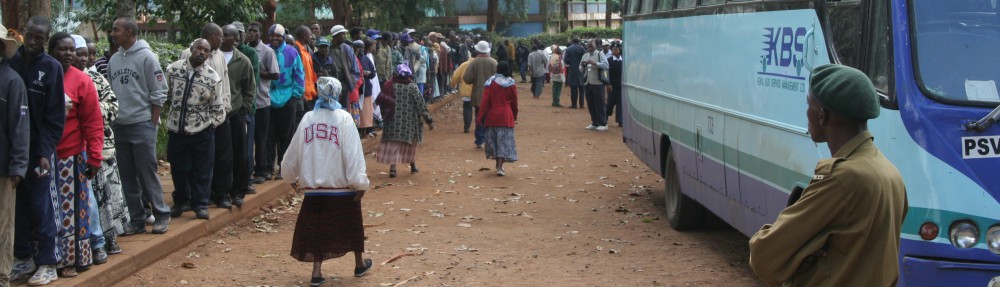
IMG_7525Now that I am back in Nairobi for the election, I am frantically learning as much as I can “on the ground”, but would love to hear from you. Feel free to drop me an e-mail. Asante.

I have had a lot to say here about Kenyan politics over the past three and a half years, so if you are new to the blog enjoy, but I am here to help quietly and listen for the most part so don’t expect a lot of commentary in this forum prior to the vote. It is interesting to hear so many people who know more than I do have strongly held contradictory opinions and expectations. I have no expectations, just hopes and prayers. Other than that, I will say that I think that fear is unhelpful but complacency is a killer. I am not persuaded by anyone who claims much certainty regarding how things will go.

More links for Kenya’s Election; Chief Justice’s “bombshell” press conference; Debate loses a “horse”

Kenya Voting: "Curriculum Cooking"

AllAfrica.com has put together a special feature page on the Kenyan elections that is a good source for the latest stories from the main Kenyan media sources:  “Kenya Decides: 2013 Elections”. (h/t @GeorgetownDG)

On Thursday, February 28, the Institute for Security Studies Nairobi office will host a “Seminar on Kenya’s 2013 Elections: issues, actors and scenarios.”  Register on-line through the link.

IRIN has published on on-line “multimedia documentary” entitled “No Ordinary Elections” which does a nice job of informing an international audience of the basic context of the upcoming Kenyan election and includes good interviews discussing humanitarian concerns and preparations in general terms.  A work of art in internet publishing.

In the latest developments, there is a lot of buzz in the human rights community regarding the announcement by Chief Justice Mutunga at a press conference today that he had received a letter threatening judges and others regarding any ruling against the candidacy of Uhuru Kenyatta purporting to be from a Mungiki-associated group, Further, as reported in the Star story “Chief Justice Raises Concern Over Threats to Judges”:

The CJ also revealed that he was asked by an immigration officer at the JKIA to seek travel clearance from the Head of Civil Service Francis Kimemia a day after the letter was posted.

“I was stopped at the Jomo Kenyatta International Airport (JKIA) by an Immigration Officer, who insisted that I could not travel because I had not been cleared by Mr. Francis Kimemia, the Permanent Secretary, Head of the Public Service, and Secretary to the Cabinet.” Mutunga said.

The CJ further asked Inspector General of police David Kimaiyo to take the necessary steps to protect judges from threats and intimidation so as not to give constitutional rulings. “The Judiciary will not flinch from interpreting the constitution as required. The constitution must be guarded jealously,” He said.

From The Standard: CJ Mutunga bombshell”.

From the Daily Nation: “Chief Justice Speaks Out on Threatening Letter.”

Obviously a lot of difference among the media houses in how to report this.  Thus the need to read widely to put together the pieces in getting the facts and understand the interests.

While I would completely reserve judgement as to exactly what to make of the threatening letter, the “immigration” harassment is disturbing in light of Kenya’s short but unduly “colorful” history involving politics at these highest levels.  Certainly the President himself should address this if he wants to reassure the country at a time in which no one needs any more tension than can be helped.

This has overshadowed the other big political story of the day, that Uhuru Kenyatta’s campaign has announced that he will drop out of the second presidential debate scheduled for Monday, complaining of the allegedly unfair amount of emphasis on the charges he faces from the International Criminal Court and “ganging up” by the other candidates on this point.

My sense of the political strategy here would be that Kenyatta feels he is in solid position to make a runoff, and not in striking distance to win in the first round, so there is nothing major to be gained from another debate, while there are risks from undesired questions and unscripted situations.  He has plenty of money and media access as a top candidate so he probably doesn’t feel a need to share the stage to  communicate whatever he wants to say in the last days of the campaign.  Likewise, part of his approach since the ICC charges have been confirmed has been to portray himself as a victim of other politicians and interests, so claiming that he was treated unfairly in the debate fits with that theme, too.

How is IGAD’s “diplomatic observation” regarding Kenya’s election process helpful?

Africa Review reports on the statement of the Inter-Governmental Authority on Development (IGAD) from this week’s visit to Nairobi by executive secretary Mahboub Maalim (himself a Kenyan) and others from the Addis headquarters under the headline “IGAD confident of peaceful Kenya election”:

In his statement, Mr Maalim said: “Igad has come to the conclusion that Kenya’s election is not an event. It is a process and that March 4th is not the end; it is the beginning of a process that could last till June 2013. Kenyans must therefore brace themselves for the long haul.”

Mr Maalim said the Independent Electoral and Boundaries Commission (IEBC) and the judiciary are crucial for the success of the polls.

“The efficiency of the IEBC during the voter registration process must be lauded. We expect that the same efficiency will apply to the March 4 poll. This is critical if Kenya is to avoid petitions arising from IEBC system failure. The efficiency and believability of the Supreme Court in dealing with the presidential election petitions is also critical. This will determine whether or not the transition is successful,” the Igad executive secretary said.

He said IEBC should be encouraged to conduct a systems dry-run with peer reviewers to seal any loopholes that would affect its efficiency.

Dr Kimani said the recent party nominations in Kenya were inclusive, open and transparent and that it was what the rest of the region had expected.

Igad brings together six countries in the Horn of Africa – Djibouti, Ethiopia, Kenya, Somalia, Sudan and Uganda – for development and drought control in their region

“Party nominations were inclusive, open and transparent”. Wow, that is certainly a unique perspective that contradicts the reporting in the Kenyan and international press, the reporting of Kenyan civil society umbrella KPTJ, and, for example, the reporting of the Center for Multi-Party Democracy-Kenya which is a well established and leading presence in Nairobi on these matters. So who is right here? Might it be relevant that IGAD is an organization of governments that are all far more “challenged” in terms of democratic practices in general, and elections specifically, than even Kenya in the wake of power-sharing and the debacle of 2007, along with the Government of Kenya itself?

I am all for whomever exhorting peace, although I am substantially skeptical that official pronouncements of this type have actual impact on ultimate behavior. Likewise, I am all for encouragement, hope and reasoned, well-grounded optimism in the context of pushing for the best election possible from where things really stand today. But this type of statement about the primaries is a “diplomatic” position rather than an observation or representation of fact. It undermines the credibility of whatever else is said in the same statement as being connected to the facts. At best it is unhelpful–it might be dangerous.

A few links to set the scene as we approach 30 days to Kenya’s vote . . .

Jay Naidoo of The Daily Maverick writes from “the Mukuru Kwa Reuben slum, one of the largest in Nairobi” with an unknown population size: “I have a right to a toilet–it’s human dignity”.

An update on the preparation for Kenya’s citizen digital “crowdsourced” monitoring/mapping effort, using the Ushahidi software: “Uchagazi Community Next Steps”.

H/t to the UN Dispatch blog for noting another official pre-election delegation in Nairobi: “Kenya: UN official stresses need for peaceful and transparent elections”:

“Kenya’s elections will be watched closely around the world,” Under-Secretary-General for Political Affairs Jeffrey Feltman said during a visit to Nairobi, the capital.

“Let me take this opportunity to appeal to all Kenyans to exercise their democratic right and participate actively – but peacefully – in the elections,” he said. “Let me also underscore the responsibility shared by leaders at all levels to abide by legal mechanisms and to send a clear message to supporters that violence of any kind would be unacceptable.”

Mr. Feltman, who oversees UN support to elections globally in his capacity as Focal Point for UN Electoral Assistance, commended the electoral authorities for their preparations and underscored the readiness of the UN to continue providing financial and technical assistance to the electoral process.

In the category of “open government initiatives,” and “what’s good for the goose is good for the gander,” the Project on Government Oversight (US) is asking citizens to push the White House to finally fill the vacancy for the the Inspector General for the State Department:

Inspectors general are independent watchdogs within federal agencies that are essential to a well-functioning government. They conduct audits and investigations that identify wasteful government practices, fraud by individuals and government contractors, and other sorts of government misconduct. Congress and the public rely on their reports to hold agencies and individuals accountable for wrongdoing, identify a need for legislation, and evaluate the effectiveness of government programs and policies.

Unfortunately, President Obama went his entire first term without nominating an inspector general for the State Department. At over five years, the State Department opening is the longest running vacancy among federal agencies.


Wycliffe Muga in The Star on “Why we should not dismiss foreigners”, with an example from his own experience in Kenya, but perhaps a universal lesson.

In the category of “it could be worse”: “Is a military coup Museveni’s last line of defense against NRM rebels?” asks Gaaki Kigambo in The East African.


“And the beat(ings) go on . . .”; as 2007 bleeds into 2013, what would it take for Human Rights Watch and others to make Kenyan politics less deadly?

The latest Kenya release from Human Rights Watch, dated yesterday, decries the terrible beating of Kenyan activist Okiya Omtatah Okoiti.

Omtatah, executive director of Kenyans for Justice and Development (KEJUDE) Trust, a local NGO that advocates for transparency and accountability, was attacked by two unidentified men in central Nairobi. He lost six teeth and suffered serious injuries to his face and the back of his head, which required surgery. Omtatah told Human Rights Watch and ARTICLE 19 that the attackers demanded that he withdraw a lawsuit he filed to demand accountability in the procurement of biometric voter registration (BVR) kits because of corruption associated with the process.

“This vicious attack was clearly meant not just to intimidate Omtatah but to seriously injure him – and perhaps even to kill him,” said Leslie Lefkow, deputy Africa director at Human Rights Watch. “The aim seems to be to stop his work on corruption in the procurement of biometric voter registration kits for the upcoming elections.”

Certainly this is a crucial and timely issue in working toward integrity in the upcoming Kenyan election and in protecting an activist who took a big risk in pursuing legal action against election-related corruption. So kudos to Human Rights Watch and Article 19 for calling attention to the attack. Unfortunately, it is hard to imagine that anything will actually happen as a result of this statement that “[t]he Kenyan authorities should promptly and thoroughly investigate a serious physical assault . . . and bring appropriate charges.” Of course, they should–that goes without saying; of course. they won’t.

Why won’t they? Are they confident they can wait it out and the outside actors and international players who care about Omtatah now will move on to the next outrage, the next victim, without really disrupting the vicious cycle?

Why would I suggest this? Not to be gratuitously critical of Human Rights Watch or any of the many organizations trying to support human rights defenders. Rather I say this on the basis of my own hard-earned experience with well-intentioned failure in dealing with election fraud and violence in Kenya in 2007/08. I moved my family to Kenya for a year to help support democracy in the last election cycle–we were able to take in a couple of displaced families for a few months after the election, and help a few others a bit, but nothing that I did in my NGO work really changed anything as far as upholding democracy. My organization, IRI, issued a report noting the election fraud, in July 2008, and in August 2008 released the exit poll showing that voters at the polls on election day reported favoring the opposition, before the mark-ups of the tallies for the incumbent at the Electoral Commission in Nairobi afterwards. But these reports were months too late to really matter. It is going to take more to make a difference in the brutal world of Kenyan politics.

So how does Human Rights Watch yesterday describe what happened with the 2007/08 election situation:
Continue reading

Godec Confirmation Hearing

The U.S. Senate Foreign Affairs Committee will conduct confirmation hearings on the nomination of Ambassador Robert F. Godec for Ambassador to Kenya on Wednesday, November 28.

Godec has been serving in Nairobi since late summer following the resignation of Ambassador Scott Gration. Gration and his wife are staying in Nairobi.

Kenyan Election Violence: why would anyone expect the Kenyan Police to play a positive role in March 2013?

(As an aside, here is a headline to pause over from the Daily Nation“Sudan’s Islamists need new blood: vice president”.)

On Kenya’s police, Jeffrey Gettleman has an outstanding story in the New York Times: “Police Killing in Kenya Deepens Aura of Menace”.  Gettleman ties a compelling story of what amounts to the “typical” extrajudicial execution of two bothers in Nairobi’s slums to the massacre of new police recruits in Samburu:

The two episodes were hundreds of miles apart and technically had nothing to do with each other. But beneath them was the same rotten root: a spectacularly dysfunctional national police force.

“On a scale of 1 to 10, I would give our police a 2,” said Macharia Njeru, the chairman of Kenya’s new police oversight board, citing corruption allegations, human rights abuses, extrajudicial killings, failed inquiries and lost public trust.

“The list is endless,” Mr. Njeru said.

.  .  .  .

“On the face of it, it’s quite clear that the police leadership totally failed,” Mr. Njeru said. “The senior commanders were sleeping on the job.”

Kenya’s news media have characterized the massacre as the single most disastrous episode for the Kenyan police since independence in 1963. Unlike Kenya’s thriving business community, its booming safari industry or its reforming judiciary, Mr. Njeru said, the national police service has intentionally been kept weak for decades so it could be manipulated by politicians.

The concept of the various reforms under the new Constitution is great, but surely it is time to face the fact that it is simply too late for deep substantive change.   Of course every effort should be made by Kenya’s international supporters to intervene and step up as well as possible, but let us not kid ourselves.  It has been almost 59 months since the 2007 election disaster–the Kenyan police are still in the state they are in, with less than four months to go to March 4, 2013 because the Kenyan powers that be chose the status quo instead of reform (and for obvious reasons).

Again, please remember that current Kenyan Police Commissioner Mathew Iteere was the commander of the Kenya Police’s GSU (“General Service Unit”) branch during the 2007 election and its aftermath.

Let’s see what the Kenya Police official website has to say about the status of reforms today:

.  .  .  the Government has made some important steps. A task force appointed in March 2003 is drawing a road map for the Police Reforms. The Commissioner of Police is committed to a Police Force whose members are motivated, people friendly, open, relaxed and honest with one another and the public; know their role and mandate and be proud of their job; appreciated by the public…

The just concluded Constitutional review holds a promise for the establishment of an emancipated Police Service, that will operate in conformity with democratic transformation from the current practice of Regime Policing to Democratic Policing (Community Policing)

These measures augur well with the Police Reforms as well as the goodwill of citizens. An international survey conducted in January 2003 placed Kenyan’s as the most optimistic citizens in the world. The Government will do well to tap into this optimism. It is the energy that will drive the nation’s transformation to Its desired destination.

For citizen’s security:this is the moment.

Yes, 2003 was in fact “the moment”.  Let’s not let 2013 be remembered as a different kind of “moment”.

BVR Kits start arriving in Nairobi

The first two air deliveries of Biometric Voter Registration kits arrived in Nairobi from France today.  Here is the story from The Star, with some additional background:

The IEBC met with President Kibaki on Monday during which they sought to assure him of their preparedness to oversee the election.

The meeting with Kibaki followed a similar one with Prime Minister Raila Odinga where the government undertook to pay the entire cost of procuring the kits from its own resources but with the expectation that the government of Canada would sign off the concessionary loan to refund the cost which has now risen to more than Sh9 billion.

The manufacturer, Morpho Inc of France, had demanded full payment before delivering the kits. At the time, the government had only paid 40 per cent of the cost. Government then signed a loan facility of Sh7.2 billion with Standard Chartered Bank to pay for the 15,000 kits to clear the balance.

The Daily Nation reports that the IEBC is expected to announce the new compressed voter registration schedule tomorrow: 

A massive campaign to mobilise voters is expected to be put in place so as to attract a large number of Kenyans to register within one month due to time constraints.

“We want Kenyans to respond within a month because we will not extend the registration period. We will use the media and other available means to enhance our campaigns to target as many people as possible. We also expect politicians campaigning for various positions to pass this message to the targeted population,” Mr Hassan told a previous media briefing.

The delayed delivery of the equipment has been a major concern in the country forcing the shifting of various crucial timelines.

Upcoming Nairobi Seminar

Institute for Security Studies and Hanns Seidel Foundation Seminar, Nairobi
Oil and Gas Discoveries in Kenya and the Region: Opportunities and Challenges
Tuesday 6 November 2012
10h00 to 13h00

East Africa, and Kenya in particular, is increasingly developing into an important hydrocarbon region. With proven reservoirs and heightened exploration activity, the region is hoping for an oil boom and the attendant profits. In ideal circumstances, the oil and gas resources in Kenya and the region should become engines of stability, economic growth and improved governance. Looking at experiences elsewhere on the continent, however, there is a danger of the ‘resource curse’ syndrome, which counsels about the perils of hydrocarbons turning into sources of instability and ecological catastrophe. Indeed, the dismal track record of Africa’s oil producers has led to concerns about the possibility of Kenya and the greater region falling victim to Africa’s paradox of plenty. There are already emerging concerns about territorial disputes relating to Kenya and the region linking to the discovery of natural resources.

As Kenya in particular draws increasing interest from major oil companies, the question is: what are the short- and medium-term projections for oil and gas discoveries, and what are the geostrategic implications? Significantly, what policy options should Kenya pursue to avoid past development failures associated with petroleum and to militate against potential conflict? This seminar will examine these questions, among others, with the aim of offering policy recommendations on improving outcomes of oil and gas production in Kenya and the region.

At the ISS office at Braeside Gardens on Gitanga Road in Lavington.

Link to register is here.

Sunday music: Sauti Sol


Nairobi’s Sauti Sol featured on NPR’s Weekend Edition for a “sunny” but authentic appeal: “Native Sons Sing Straight to Kenya’s Youth”.

Here is “Blue Uniform”, video with lyrics, at Ghalfa.com.

At the Ghalfa Blog: “Sauti Sol is the Finest Kenyan Band to Walk the Earth:  Here’s Why”:

They have cross demographic appeal

Whether you are from the hilly valleys of Kakamega, or from the concrete jungle in Nairobi, Sauti Sol don’t leave you feeling alienated. Why? They sing in fluent English, Kiswahili and their native Luhya dialect. That’s a rare triple threat that you don’t get from many Nairobi bands, ESPECIALLY those from suburbia.

They have cross border appeal

These guys top charts from Kenya to the Netherlands. They also have mzungu fans screaming their name at international festivals such as South by South West in Austin, Texas. But don’t take my word for it, just take a look at the video . . . for their spellbinding performance of ‘Awinja’ at SXSW earlier this year . . .