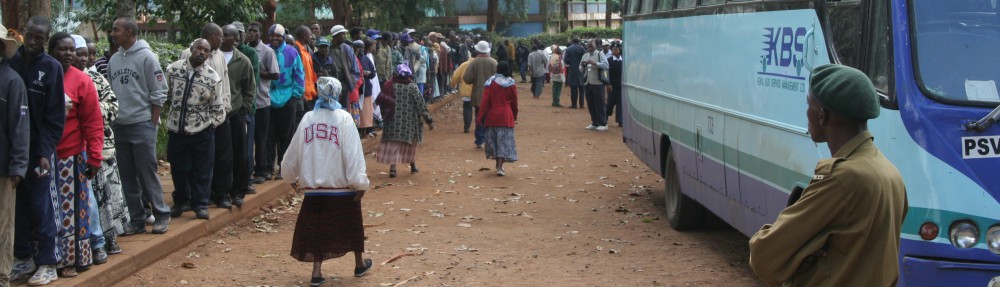
Happy Saba Saba Day–and how is Kenya?

Today is the final “Saba Saba Day” in Kenya under the “Government of National Unity.” The presidential campaigns are in full swing and new political parties, alliances and temporary coalitions are announced and denounced weekly.

So how is Kenya?

To be positive, there are lots of important things right in Kenya (as always).

For one thing, there is energy in politics and some real hope that votes will be counted and thus that Kenyans will chose their leaders going forward under the new Constitution.  Of course it must be remembered that Kenyans were more hopeful in 2007.  An improvement politically is a lack of complacency or naiveté.

The economy in the aggregate continues to grow and attract increased foreign investment.  Over the last couple of years taking note of Africa as the last great investment frontier has gotten so commonplace as to be, finally, cliché.

Kenya has tremendous advantages in reference to serving international investors over most other Sub-Saharan African countries at the inception.  Aside from Indian Ocean coastline which makes Kenya a natural gateway for Asian trade, Kenya speaks global English and is home to Nairobi which was already well-established during the era of what I have called “the aid bubble” as the favored location for internationals.  Whatever happens in South Sudan, Sudan and Somalia in the next few years, a lot of the international support/involvement will come through and be “back officed” in Nairobi.  Kenya has been the key regional military ally of the United States throughout its history, while separately serving as “Americans’ favorite African country” in the popular imagination, and attracting a lion’s share of private tourism and aid/mission activity.  And of course there are close ties to Great Britain and British companies of long-standing and plenty of interchange with the rest of Europe.  Nairobi has been an attractive draw for white African businessmen, especially since the mid-90s, and has become more Continue reading

A third year has gone by since the murders of Kenyan civil rights activists Oscar Kingara and J.P. Oulu

From March 2011::Five Years After the Kenyan Government’s Raid on the Standard and Two Years After the Oscar Foundation Murders, Impunity Reigns and a “Local Tribunal” for Post Election Violence Remains a Pipe Dream

As I have previously written, I have to miss the frenzy of reading the Wikileaks diplomatic correspondence, but the Kenyan newspapers are full of articles related to a few of the cables newly leaked.  Much of this is Kenyan politicians dishing on each other to curry favor at the U.S. Embassy, and probably in some cases news to Kenyan voters who don’t have the same access to their leaders as Americans do.

One of the main impacts of the leaks in Kenya, that I would not necessarily have realized, is the degree to which the well-publicized cables give the Kenyan media cover to report facts that are quite well known but that they would not otherwise dare print for fear of libel suits and official displeasure.  Certainly much of what Kenyan politicos tell the Embassy they will have told reporters, or reporters will have learned independently, but couldn’t report until the State Department’s internal “news bureau” was stolen and partially put out on the internet.

Some of the material dates back to the Government’s raid on the Standard media house on March 2, 2006.  Enough of this outrageous incident (really series of incidents) has long been well known that in any country with leadership at all serious about press freedom and the rule of law there would be some people in jail.  Nonetheless, total impunity for each and every player in all of the multiple criminal acts remains the status quo.  While U.S. Ambassador Bellamy was sharply critical at the time, there is no indication that this has been on the public diplomacy agenda since.

It is in this context that observers of the Kenyan scene have to realize that the notion of a Kenyan “Local Tribunal” that would try the kingpins of the Post Election Violence identified by the Waki Commission report was always a pipe dream.

We have a recent report on the killing of former Foreign Minister Ouko, said to have taken place at State House in Nakuru–no action.  We have the circumstances crying out for investigation in the murders of civil rights activists Oscar Kingara and J.P. Oulo–two years have gone by today with no action.

While I agree completely with the notion that as a wholly conceptual matter, a Kenyan tribunal rather than the International Criminal Court would be the best place to try the suspects for the Post Election Violence, it is also quite clear that that was never going to happen.  The will is simply not there–the Government of Kenya has a well established policy of impunity which has served the interests at stake very successfully for many years.  It will not change of its own accord, or through simple persuasion or jawboning.  A “Local Tribunal” in Kenya, if there ever were such a thing, would be a platform for deal making to preserve impunity, not a court of law.  Because the United States is not a member of the ICC, it may well be that we are not so credible as leading advocates of the ICC as the appropriate venue for the election-related trials–nonetheless, I think we should stop indulging political frivolity in the context of these grave crimes.

Related Post on local tribunal.

“Tribute to Dr. Peter Oriare: Media Scholar of Great Repute” and a friend to me, to the International Republican Institute, and to Americans who believe in democracy

Dr. Peter Oriare

“Tribute to Dr. Peter Oriare, Media Scholar of Great Repute”

“University of Nairobi mourns committed teacher”

My friend, Dr. Peter Oriare, was in his own way one of those who got hurt because of the election misconduct in 2007. I was very sad to hear on my return from Washington that while I was at the African Studies Association meeting, Peter died back in Nairobi.  At 45 he was too young, the proud father of young children.  I would greatly encourage anyone interested in Kenyan democracy to read the tribute and story linked above.

I am thankful to have known and worked with Peter.  I certainly relied on him in Kenya.   Along with the local staff at the International Republican Institute in Nairobi he was one of the people that made my year working in Kenya an experience that I will always treasure.  When I arrived in Nairobi in June of 2007, we had funded only our baseline National Endowment for Democracy programming working with parliamentary candidates and our ongoing USAID polling program for which I was approved as Chief of Party the week before.  The current polling program had been in place since an exit poll for the 2005 constitutional referendum,and had most recently included a public opinion survey from that spring which we were just then briefing to prospective presidential candidates.  Peter worked with Strategic Public Relations and Research and was our primary point of contact with the firm as well as teaching and working to finish his doctorate at the University of Nairobi.

When I took over as the fourth American to lead the IRI office under that 2005 polling program, my ability to do my job depended on Peter’s expertise and continuity. Peter had worked with everyone in the IRI office and had been our primary local polling expert partner since 2000, before the IRI office opened in 2002.  The polling program was touted as a major success story for both USAID and for the International Republican Institute in Kenya and Peter was the single most consistent element.  Peter had a strong relationship not only with IRI and the USAID Democracy and Governance program locally but with others in the international democracy community.  He led important work in media monitoring for the 2007 election that was crucial to the international understanding of the situation in Kenya.

Peter believed in transparency and he advocated internally for release of the presidential “horse race” figures from our September 2007 public opinion survey which showed Kibaki leading when most polls were showing Raila as having pulled ahead, and when our contract with USAID was amended to add the 2007 exit poll, he expected to release it as well.  The established policy reason that IRI did not release the “horse race” numbers comparing the presidential candidates in our pre-election public opinion surveys–that we wanted to support democracy by informing the public, policy makers and politicians with out having a direct impact on the race itself–obviously did not come into play on the exit poll when people would have already voted when it would be released.

I pushed Peter and Strategic hard in negotiating the contract for the exit poll in the fall of 2007.  We had a modest amount of additional funding from USAID, and some money from Dr. Clark Gibson at the University of California, San Diego–and we had overhead in Washington and Nairobi.  Because it was obviously a close race, we needed results that were methodologically sound and statistically valid at the provincial level and not just the national level, to be able to evaluate the presidential threshold of 25% of the vote in five provinces.   I needed substantially more work from Strategic than they had done in the 2002 and 2005 exit polls, which were universally accepted as successful, but in elections that were not as close.  Ultimately we agreed on the additional work for very little additional money given Kenya’s inflation, and the poll was well executed as millions of Kenyas voted peacefully.

The preliminary results called in by cellphone–which were  obtained by USAID and given to the Ambassador on election day–even though such reporting was entirely outside the scope of anything in the USAID agreement with IRI and I didn’t want anything to get out while the polls were still open–had Raila ahead by a margin of roughly 8 points.  When the actual surveys were obtained and coded and necessary adjustments made for situations such as the seizure of some questionnaires by police–some of which were recovered and some not–the final figure was roughly 6 points.  This was the number in Nairobi in mid-January, 2008 with all the surveys back and coded.  That  was the number on February 7 when someone “inside the Beltway” in Washington decided to throw Peter under the bus by publishing internationally a statement from IRI that poll was “invalid” after State Department and USAID officials were questioned about it by then Subcommittee Chairman Feingold at his hearing in the Senate.  That was the number when I turned over the original questionnaires to my successor in Nairobi in May 2008; the number when the results were released in July at CSIS in Washington by UCSD after IRI’s six month embargo; and the number soon thereafter when the New York Times called me working on their story and asked for an interview.   It was still the number when IRI released the results in August–reconfirmed by a firm in Oklahoma–the day before the UCSD testimony at the Kriegler Commission;  and it is still the number  today, when the poll has been used in published work from scholars in Asia and Europe, as well as in Africa and the United States.

Peter had every right to be proud of his work on this exit poll and it was rightly noted by Rosemary Okello in her tribute as a part of his positive legacy for Kenyan democracy, and for polling and scholarship everywhere.

This is what I wrote in recommending Peter on Linked-In in 2009:

Peter is a true professional, with a strong commitment to his work and high values. He is calm under pressure. He offers deep knowledge and experience and I would be very pleased to have the opportunity to work with him again in the future. July 6, 2009

Top qualities: Personable , Expert

Ken hired Peter in 2007, and hired him/her more than once.

_______________________________________________________________________

THE Book on Recent Kenyan Politics to Read in 2011

The Politics of Betrayal; Diary of a Kenyan Legislator by former journalist and MP Joe Khamisi was published early this year and made a big stir in Nairobi with portions being serialized in The Nation.  Khamisi is definitely not your average politician in that he got a journalism degree from the University of Maryland, worked for years as a journalist, and became managing director of the Kenya Broadcasting Corporation and worked in the foreign service before being elected to parliament from Bahari on the Coast in 2002.

Khamisi was part of the LDP, the Liberal Democratic Party, and in 2007 became an ODM-K insider with Kalonzo.  While there is inherent subjectivity in a political memoir from one particular actor, Khamisi’s background in journalism serves him well.  While I cannot vouch for his accounts of specific incidents that I do not have any direct knowledge of, and I do not necessarily agree with his perspective on some things and people, he seems to try to be fair and there is much that he writes that rings true to me from my own interactions and observations in the 2007 campaign.

From his chapter on “The Final Moments” of the 2007 race, at page 223:

It needs to be said at this point that Kalonzo’s appointment as Vice President was neither an afterthought by Kibaki, nor a patriotic move by Kalonzo to save the country from chaos.  It was not a miracle either.  It was a deliberate, calculated, and planned affair meant to stop the ODM from winning the presidency.  It was conceived, discussed and sealed more than two months before the elections.  It was purely a strategic political move; a sort of pre-election pact between two major political players.  It was s survival technique meant to save Kibaki and Kalonzo from possible humiliation.

In our secret discussions with Kibaki, we did not go beyond the issue of the Vice Presidency and the need for an alliance between ODM-Kenya and PNU.  We, for example, did not discuss the elections themselves; the mechanisms to be used to stop Raila; nor did we discuss whether part of that mechanism was to be the manipulation of the elections.  It appeared though that PNU insiders had a far wider plan, and the plan, whatever it was, was executed with the full connivance of the ECK .  What happened at the KICC tallying centre–even without thinking about who won or lost–lack transparency and appeared to be a serious case of collusion involving the ECK and officials at the highest levels of government.  It was not a coincidence that the lights went off at the very crucial moment when the results were about to be announced; nor was it necessary for the para-military units to intervene in what was purely an administrative matter.  The entire performance of ECK Chairman Kivuitu and some of the Commissioners was also suspect and without doubt contributed to the violence that followed.

IRIN Africa | KENYA: “Perfect storm” brewing among urban poor

IRIN Africa | KENYA: “Perfect storm” brewing among urban poor | Kenya | Children | East African Food Crisis | Economy | Food Security | Urban Risk.

“Incredible Shrinking Kibera”–a lesson that should inspire humility in Western capitals

When we see popular uprisings in Tunisia, Egypt and Libya that no one in the United States or the West more generally seems to have anticipated we ought naturally to be drawn to some soul searching about how much we really know about societies and countries in Africa–and how what we do know gets filtered and reported back to policy makers and the public at home.

My experience in East Africa and what I have learned since certainly suggested caution and humility to me.  One particular glaring example I can highlight is the fiasco of what I will call “Incredible Shrinking Kibera”.  First let’s start with the setting:  right in the heart of Nairobi, one of the most cosmopolitan African capitals in many respects–a city that is a magnet for Western expats, in particular offices of international organizations and NGOs on a regional or Africa-wide basis, as well as a huge regional diplomatic presence.  Lots of tourists from the UK and the US in particular.  Yet, it has turned out that Western conventional wisdom about Nairobi has included numbers for the population of the Kibera informal settlement (“the largest slum in Africa”) that are vastly beyond those cited in Kenya’s new census.  Either the conventional wisdom about 1 million people, or perhaps many more, living in Kibera was vastly inflated, or the new Kenya census finding only a fraction of that population is completely flawed–or both if the real population is, say, double the census figure and less than half the “conventional wisdom”.   If Kenya can’t get anywhere close in a census, even in Nairobi, then how serious can we really be about drawing new boundaries and electoral districts and free and fair elections with equal voting rights for all citizens next year?  If the census is close, then a lot of us in the West have been shown to be either seriously misinformed about something that shouldn’t be so hard to know, or of “spinning” beyond the bounds of a fair representation of the facts.  I myself have referenced the “conventional wisdom” without the skepticism that I should have had.

I was fortunate to have a friend in Kibera and thus an introduction to one family and community in one neighborhood there, as well as being involved in a pre-election survey of the Langata parliamentary constituency in December 2007 and in observing a bit of the voting in one of the more upscale areas on election day with our international delegates.  I started to scratch the surface.  Personally, my family and I had more connection to Kawangware.  Wherever you live in Nairobi, if you are interested, you can pick a nearby informal settlement and start getting acquainted.

Here is a good blog about Kibera:

“Slum Tourism in Kibera: Education or Exploitation?” Brian Ekdale

4) Don’t assume you understand Kibera after spending a couple of hours there. I’ve been there 10 months and still learn new things every day. Kibera is a very complex place. People like to say 1 million residents, but population figures are contested. Not every organization is doing what they say they are doing. Not everyone is impoverished (I know some who have good jobs but would rather financially support their families and neighbors than move to a wealthy area and leave behind those that helped raise them). Now that you’ve been there, go back and read those articles and watch those videos I mentioned in #2.

5) Don’t think Nairobi is a city of contradictions. Sure, you can get a mocha and french toast at Nairobi Java House, go on a Kibera tour in the late morning, and then grab some upscale Indian food at Yaya Centre for lunch without traveling very far. But understand the Java House/Yaya/Westgate life does not exist in spite of Nairobi’s slum population, they exist because of Nairobi’s slum population. Cheap labor built those massive structures. Cheap labor stocked the shelves. And cheap labor keeps them running. That labor walks home at night to sleep in Kibera, or Korogocho, or Mathare, etc.

Maziwa Fresh by AfriCommons
Maziwa Fresh, a photo by AfriCommons on Flickr.

Does KSh4,500 for a bag of maize approach a “tipping point”?

There are a lot of good things happening in Kenya that are helping to lay the groundwork for a positive future.   Right now, however, the combination of the plummeting shilling and high inflation focused especially on basic food items and other household necessities, along with an especially severe regional drought is causing suffering and raises questions for the intermediate future as we head into another election year.

Increasing numbers of refugees are flowing to Kenya from Somalia due to drought aside from the fighting, in a situation in which Kenya is already well beyond current capacity under existing refugee arrangements.

The basic situation of high and inflating cost of food staples, drought and refugees is “the usual crisis” in Kenya–its not less severe because it doesn’t get solved but we all somewhat get used to it as “background” and pay more attention to “the next new thing”.  Now however, it is getting worse.  Will Kenyan politicians continue to see this as a challenge primarily for Western donors while focusing on the election?  Is there a “tipping point” where this moves out of the background and disrupts the usual course of things in Nairobi, for better or worse?

“Severe food crisis hits region”, IRIN Global

In Kenya, rising inflation rates have also adversely affected poor households’ ability to buy food. Prices of the main staple, maize, have tripled from about 1,300 shillings (US$14.4) in January to 4,500 ($50) for a 90kg bag.

Recently, the government announced the removal of tax on imported maize in a bid to cushion consumers. But millers say rising global maize prices mean the measure will have little impact on the commodity’s prices locally.

“The problem has been compounded by the fact that the Kenyan shilling has been on a free-fall, trading at an all-time low [about 90 shillings to the US dollar] not experienced in the country for almost two decades. I do not see the cost of maize dropping any time soon,” said a miller who requested anonymity.

The recent March to May “long rains” in Kenya were poor for the second or third successive season in most rangelands and cropping lowlands, with many of these areas receiving 10-50 percent of normal rains, noted the Famine Early Warning Systems Network (FEWSNET).

The consequences include declining water and pasture, and subsequent livestock deaths. In the predominantly pastoralist north, a low milk supply has contributed to malnutrition levels soaring above 35 percent. The GAM rate in northwestern Turkana has hit 37.4 percent, the highest ever in the district.

Nationally, at least 3.2 million people are currently food insecure – up from a projection of 2.4 and 1.6 million in April and January, respectively.

Even in Kenya’s coastal region, thousands are food insecure, says the Kenya Red Cross Society’s (KRCS) region manager, Gerald Bombe.

“There is a need to import maize and distribute food and water to the hardest hit areas,” added Kevin Lunani, a local leader in the coastal Kisauni region.

Figures I read recently would place Kenya as the largest recipient of U.S. aid outside the greater Middle East/North Africa and Afghanistan/Pakistan–in other words greater than any other country in Latin America, Sub Saharan Africa or elsewhere in Asia, for the 2008-2011 period.  I don’t have time to dive into the numbers for serious comparisons, but accepting the general point that Kenya is a particular favorite as a major target of aid for the U.S. we need to ask whether we are accomplishing what we want to accomplish.

Key New Report from AFRICOG on Kenyan Privatization Ahead of 2012 Election

AFRICOG, the African Centre for Open Government, in Nairobi has released “Deliberate Loopholes” an extensive report on the the privitization/divestiture of Telkom Kenya and Safaricom.  Just as the Safaricom deal went through just before the 2007 election in spite of ODM litigation to block it, new deals are coming with the 2012 election approaching, including likely sale of the Government of Kenya’s stake in 11 more hotels, for example:

“Deliberate Loopholes”describes some of the lapses that occurred in the privatisation of Telkom Kenya and Safaricom: the title refers to the deliberate evasions and subterfuges that created a fertile climate for asset stripping and corruption by senior officials whose identity continues to remain shrouded behind the veil of secrecy provided by international tax havens and off-shore financial centres. The preliminary findings of this study were presented to Parliament’s Public Accounts Committee (PAC), which took the matter to the floor of the House.

AfriCOG’s interest in this area stems from its mandate to build and entrench an anti-corruption culture through informed and determined public action, both in the public and private sectors. Effective privatisation requires a robust regulatory environment. Regulators need to be independent in delivering on their mandate and achieving outcomes that protect the public interest and advance Kenya’s development. However, these bodies face the constant reality or threat of capture by special interests.

Kenya is currently engaged in an extensive series of privatisation exercises, with around 23 majorpublic enterprises slated for or engaged in some sort of privatisation. The unanswered questions surrounding the sale of the Laico Grand Regency Hotel are still fresh in the public’s memory. By providing objective information on the privatisation of Telkom Kenya and Safaricom, AfriCOG aims to promote public knowledge and vigilance on other public divestment ventures. Furthermore, the general public has a huge stake in privatisation considering the significant investments that citizens have made in building these institutions in the first place and the gains that ordinary investors hope to make from their divestiture.

Given the market dominance of the entities involved and the endemic corruption that plagues Kenya, it is perhaps inevitable that many of these exercises have been shrouded in political controversy. From experience, large scale privatisation is a process that can be particularly prone to political corruption, or the theft of public resources to fund elections. Since 2012 portends a particularly hard-fought and conflictual election,
heightened scrutiny against possible abuse of privatisation of state-owned enterprises with the aim of financing politics would be prudent.

Fuel Distribution Crisis Hits Kenya, and Other Economic News

“Kenya oil industry in chaos as fuel shortage bites”, reports the Daily Nation:

Motorists stood in long queues on Wednesday as one of the most severe and bizarre fuel shortages hit many parts of the country.

Many people ran out of fuel on the road while others were forced to leave their vehicles at home and take public transport. (IN PICTURES: Nairobi fuel crisis)

Petrol stations were forced to close after running out of fuel due to panic purchases.

The absence of petrol at the pump, particularly after the government confirmed that there was 19 million litres in storage tanks in Nairobi, is a commentary on the chaos in fuel distribution.

On Wednesday, the government passed the buck to the oil companies, accusing them of creating a shortage by refusing to order adequate stocks over the Labour Day holiday.

Today’s Star also reports that Prime Minister Odinga, speaking at Great Lakes University in Kisumu, said that the private sector is the only source for vital job growth:

He said the country must create a conducive environment for the private sector to thrive as a solution to the unemployment crisis. He said the private sector is the engine of economic growth thus the need for both local and foreign investors to increase investments that can create jobs for the youth.
Raila said the 750,000 graduates who join the labour market every year from schools, colleges and universities cannot find employment in the public service with about 50,000 job opportunities only every year.
He assured Kenyans that available positions in the public service will be distributed fairly among all the communities in the country in accordance with the constitution.
On education, the PM decried low levels of research in the country saying privave sector has refused to fund research unlike in other countries.
He said, the country needs to invest more on research work to provide more job opportunities.

The Star also reports additional international funding, from Germany, for geothermal power development:

THE 280 MW Olkaria geothermal power project by KenGen yesterday got a Sh7.4 billion boost from Germany’s Development Bank KFW to fund consultancy services and part of the steam field drilling works.

The money will fund extension of Olkaria one and Olkaria IV power station project targeted for completion by end of 2013. The overall cost of the project is Sh83 billion and is being co-funded by KenGen, World Bank, European Investment Bank, Japan International Corporation Agency and French Development Agency, AFD. “Development of renewable energy is excellent for development of Kenya and for the environment,” remarked KFW Director General for Middle East and Africa Doris Koehn during the loan agreement signing ceremony held yesterday at KenGen offices in Nairobi.

Cola Wars return to Kenya

Miracle Cafe

Nairobi’s Business Daily reports that Coke is getting competition in Kenya:

Two international soft drinks manufacturing companies have set up local operations in a major shift tipped to shake up the industry currently in the tight grip of global giant Coca-Cola.

US multinational Pepsi Cola, and London based SABMiller are in the process of establishing a manufacturing presence in Nairobi even as market data points to a flattening market for soft drinks.

PepsiCo, which stopped bottling in Kenya under competitive pressure from Coca-Cola in the 1970s, is putting up a Sh2.4 billion plant off Thika and Baba Dogo roads while SABMiller has taken control of family owned Crown Foods, the bottlers of Keringet brand of drinking water.

PepsiCo has acquired 14 acres of land at Nairobi’s Ruaraka estate through SBC Kenya Ltd, a Franchise Bottler and Distributor of Pepsi products it bought in 2009, from where it will produce at least six of its brands.

.  .  .  .

PepsiCo made a marketing re-entry into Kenya late last year relying on imports to serve the local market with its brands such as Pepsi Cola, Pepsi Diet, Mirinda, Evervess Soda Water and Seven Up. Importing the soft drinks is more expensive than having a local production unit.

“We have already recruited 120 Kenyans — engineers, architects and technicians — to handle the development phase. We expect to have about 300 employers on board once it is completed,” said Mr Moldenhauer.

.  .  .  .

The soft drinks market is estimated at about 17 million litres annually and PepsiCo is upbeat that the sector has great potential for growth after shrugging off a heavy battering from the global economic crisis, high power costs and water rationing in most of 2009.