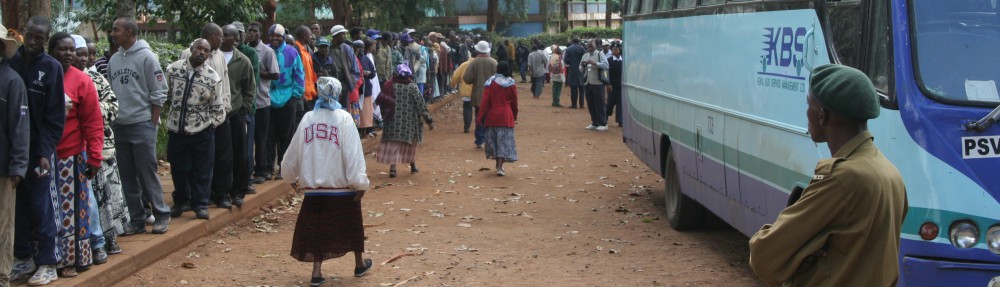
Mpeketoni: Terrorism and Politics as Ususal

Muthoni Wanyeki’s column this week in the East African strikes me as hitting exactly the right point:  “Mpeketoni: Get on with finding out who and why”.  Take time to read it.

The Jubilee Government was in a tizzy about stopping Raila Odinga from leading opposition CORD rallies around the country before the Mpeketoni attacks just over a week ago.  The attacks then became the focus of attention for Kenyans and the Kenyan media, with Uhuru Kenyatta deflecting things back to Raila and CORD by as much as accusing them of undertaking the attacks and explicitly denying a role for Al Shabaab.

Any reasonable observer recognizes that the Mpeketoni attacks in a sensitive area very near the border have less ambiguity about them as an incidence of terrorism than most of the individual bombings routinely attributed to Al Shabaab in Nairobi or even the Westgate attack last year. Yes, the methodological details vary–as they did in each of these from the previous Al Shabaab World Cup attack in Kampala.  Here is former Marine and security expert Andrew Franklin, who has written here previously, discussing Al Shabaab and Mpeketoni, along with unfulfilled security reform, on KTN.

With the victims largely now out of sight and out of mind in the hinterlands the media has moved on to the incessant tribal politics that makes for easy punditry in lieu of actual investigation and in-depth reporting.

I have never been a big fan of rallies in Kenyan politics–not in 2007 campaign when I was trying to help support a better process, not in 2011-12 when they were used to try to stop the ICC, and again, not in the 2013 campaign.  Nonetheless, I am pretty well inured to the fact that the usual suspects in Kenyan politics, on whatever side they happen to be at any given time, use these rallies as a primary means to connect directly to their supporters and to get national media for their messages.  I wish Kenya’s politics was a little more creative, but then, the political class as it exits always wins, so I guess they don’t feel a lot of incentive to change.  Regardless, the rallies are not in and of themselves generally dangerous except to the extent the security forces are engaged to make them so.

Tribal animosities were clearly more raw and pervasive in the spring of 2013 when I was in Nairobi for the election than they were when I left in May 2008 during the immediate post-election period.  It appears that the last year has not seen marked improvement.  An obvious reason why all this should be expected is that the parts of the February 28, 2008 election peace deal that were to address the underlying issues have not been implemented and the politics of 2011-2013 were so explicitly tribal.

Why haven’t they been implemented?  One reason is that the February 28, 2008 deal was made by Kibaki and Raila with Kofi Annan after the larger mediation process between PNU and ODM broke down.  PNU was a coalition of parties and not all of them ever supported the deal from the inception.  Uhuru Kenyatta’s KANU being one such at the time.  Raila and Kibaki cooperated to support the passage of the new constitution in 2010, but the Truth, Justice and Reconciliation Commission plodded along on the backburner.  The biggest single thing to galvanize government attention during the remainder of Kibaki’s second term was the fight to block the ICC, and, of course, Raila was running for president again, along with Saitoti and Uhuru and some others.  By the time the TJRC report was finalized, the new State House was not prepared to accept it as written.

Rallies will come, and rallies will go.  The question is whether the long term work of protecting Kenyans from the persistent threat of terrorism and the long term work of “tribal” reconciliation will be taken up or yet again deferred for some future generation.

Uhuru Park March 3, 2013

After the Rally  (Uhuru Park)


Kenya’s persistent national security corruption continues to burden Somali endeavors

In the wake of the incomprehensible looting at Westgate, Ben Rawlence, Open Society fellow and former Human Rights Watch researcher has published a candid look at the context in “Kenya’s Somali Contradiction” at Project Syndicate:

. . . if the Kenyan government’s aim was, as it claimed, to destroy al-Shabaab, the intervention has been a spectacular failure . . . In fact, retaliation against the militant group was little more than a convenient excuse to launch the so-called Jubaland Initiative, a plan to protect Kenya’s security and economic interests by carving out a semi-autonomous client state . . .

. . . the United Nations monitoring group on Somalia and Eritrea reported in July that Kenya’s Defense Forces have actually gone into business with al-Shabaab.  .  .  . [T]he Kenyan state’s endemic corruption constantly undermines its policymakers’ goals.  Indeed in Kismayu, Kenya’s officials have reverted to their default occupation — the pursuit of private profit. . . .

Read the full piece.

if the Kenyan government’s aim was, as it claimed, to destroy al-Shabaab, the intervention has been a spectacular failure. But there is much more to the story. In fact, retaliation against the militant group was little more than a convenient excuse to launch the so-called Jubaland Initiative
Read more at http://www.project-syndicate.org/commentary/kenya-s-contradictory-strategy-in-somalia-by-ben-rawlence#rC0Jau4qyOYbHqeO.99

Going back to my time in Kenya during the 2007 presidential campaign, it is well to remember that the multimillion dollar Anglo Leasing scandal that was subject to John Githongo’s whistleblowing involved corrupt contracts that were to have provided for the purchase of passport security technology, a forensic lab, security vehicles and a Navy vessel, among more than a dozen national security procurements.

Ultimately the exposure of the scandal proved to be a huge missed opportunity for the U.S. and the international community as a whole to address a pervasively corrupt security apparatus that we have continued to help underwrite.  While everyone was grateful for Githongo’s courage, we didn’t match it with courage of our own to take risks for reform and we ended up letting the Kenyan people rather than the Kibaki administration bear the burden.  See my post “Part Five–Lessons from the Kenyan 2007 election and new FOIA cables”.

Unfortunately corruption does not fix itself.

Uganda Debt Network

Leaders

Furthermore, contrary to claims that securing Kismayo put al-Shabaab at a disadvantage, the United Nations Monitoring Group on Somalia and Eritrea reported in July that the Kenyan Defense Forces have actually gone into business with al-Shabaab. The group’s profits from illicit charcoal (and possibly ivory) exported from Kismayo have grown since Kenya took control.

CommentsView/Create comment on this paragraphThis highlights a fundamental problem: the Kenyan state’s endemic corruption constantly undermines its policymakers’ goals. Indeed, in Kismayo, Kenyan officials have reverted to their default occupation – the pursuit of private profit. Instead of working to achieve the diplomatic objective of defeating al-Shabaab, Kenya’s military, politicians, and well-connected businessmen have been lining their own pockets.

Read more at http://www.project-syndicate.org/commentary/kenya-s-contradictory-strategy-in-somalia-by-ben-rawlence#rC0Jau4qyOYbHqeO.99

if the Kenyan government’s aim was, as it claimed, to destroy al-Shabaab, the intervention has been a spectacular failure. But there is much more to the story. In fact, retaliation against the militant group was little more than a convenient excuse to launch the so-called Jubaland Initiative,
Read more at http://www.project-syndicate.org/commentary/kenya-s-contradictory-strategy-in-somalia-by-ben-rawlence#rC0Jau4qyOYbHqeO.99

My piece on police reform in The Star: “Could Kimaiyo be Kenya’s Kivuitu of 2013?”

“Could Kimaiyo be Kenya’s Kivuitu of 2013?”

.  .  .  .

. . . [H]e is in a new position set down on top of an old and dysfunctional organisation that he has inherited and that he does not have time to change before the election.

The news already reports a rift over appointment authority between Kimaiyo and the chair of the new National Police Service Commission—the kind of kinks in a new system that should be expected and that inevitably take time.

Ultimately, Kimaiyo even on paper, is only one member of the National Security Council. Even though he has some additional theoretical authority, he is to implement rather than set the government’s security policy.

Like Samuel Kivuitu in the weeks before the election in 2007, he has respect and credibility from his past, but he is one man only, one vote on security policy, and not fully in control of what will happen even within the police service at this point. This should be a sobering thought in light of what we all saw play out in the last election.

Follow the link to read the whole piece from the Star.

FYI, this was submitted for publication before the back and forth in the campaigns about alleged involvement of civil servants in politics.

Please also read this from Pheroze Nowrojee in the Star, “Of Civil Servants and our Politics”:

The Inspector-General of Police, David Kimaiyo issued a public statement that politicians should not discuss land ownership in their campaigns. He did not suggest that there was any breach of the law by any politician. Yet he called for a gag. He was stepping into the political arena. He was abridging the Bill of Rights. Kimaiyo too was way out of line.

New Development in Reading the Pre-Election Kibaki Tea Leaves: GOK repays DfID for “education scandal”

I don’t want to make everything that happens in Kenyan government and politics in early 2013 “about” the Kibaki succession, because, of course, there are the “down ticket” races that matter, too.  Nonetheless, I was fascinated to see the news in the Standard this afternoon that the Kenyan government had repaid the British official aid agency DFID for losses on the “education scandal” that was current news at the time I started this blog just more than three years ago: “Kenya repays stolen fee education cash”.

The “education scandal” and the “maize scandal” were the two big breaking new corruption eruptions under the Government of National Unity that served to remind everyone that simply adding part of ODM to the second Kibaki Adminstration in April 2008 did not in itself solve anything regarding corruption.  The “maize scandal” was a new and insidious plot for the corpulent corrupt to “eat” off of hunger in the food crisis in 2009; the “education scandal” was the revelation of an older and ongoing insidious plot for the elite to steal from school children, dating to the inception of “free primary education” early in the first Kibaki Adminstration.

Why repay the money now?  One suggestion might be that this is an indication that Kibaki does have concern about his post-presidential reputation, his “legacy”.  Perhaps there is something to this.

Of course, Kibaki is a master of not communicating his intentions, conducting affairs behind closed doors and letting Western (and Kenyan) observers who feel compelled to do so offer speculative analysis and opinion to substitute for actual knowledge about what he is up to.  So who knows?

Amazingly, to me anyway, I have read otherwise trenchant reports and analysis of various aspects of the Kenyan situation that include unembellished lines to the effect that Kibaki will not be a major factor in the upcoming election as he is concluding his second and final term.  To me, it is quite obvious that H.E. Mwai Kibaki will remain the most important individual in the 2013 Kenyan presidential election until he passes the mace to his successor.  With the new constitution, partially implemented, he has less direct and formal power in the 2013 election than he had in the 2007 election.  He remains, nonetheless, far more powerful than any other single individual, even Uhuru Kenyatta or Raila Odinga certainly, and more by far than any one member of his inner circle.  How he will use that power, and how much we will even ever know about how he uses that power, are in question.

Would it be hard for Kibaki to hand off the presidency to Raila Odinga this time?  The polls show Odinga leading but Uhuru in range with just a few weeks to go, so in some ways the race is similar to 2007.  Not to suggest that Kibaki would prefer Uhuru in the way that he preferred himself in 2007, just taking note of the parallels.  Some people have suggested that he might prefer Saitoti or later Mudavadi to either Raila or Uhuru, but did they really know something or were they going on guesses, rumours or even misinformation? Certainly the dynamic of having a possible runoff and the need to win in the counties makes things different and more complicated this time.  It will be interesting to watch.

In the meantime, congratulations to DfID and I will hope that President Kibaki does in fact want to leave office with the best possible reputation on governance and corruption issues in these closing weeks.  UPDATE: (I do think that it must be noted that there is no indication here of an intent to actually recover “stolen” funds, rather that the Kenyan taxpayers are taking up the burden from the British taxpayers.)

Here is news from Saturday, Jan. 12 that President Kibaki has refused to assent to the hugely controversial Retirement Benefits bill passed by the 10th Parliament on their way out of office, awarding themselves a big gratuity of 9.6M KSh on leaving office, along with post-parliamentary benefits such as state burial and security, diplomatic passports and airport VIP lounge access.

Election Observation as “Diplomacy or Assistance” continued–how I spent my pre-election Christmas in Kenya

In my Freedom of Information Act Series I have described how then-Ambassador Ranneberger got his predecessor, Ambassador Mark Bellamy removed from the International Republican Institute’s Election Observation Mission shortly before the last Kenyan election, implying an objection to Bellamy from the Kibaki government. While IRI capitulated in removing Bellamy, I was told to accept “no more b.s.” from Ranneberger in interfering with the IRI Election Observation.  As problems continued to arise, this is a letter I wrote to my USAID officer on December 22, 2007, five days before the voting:

I think that you and I have had a good working relationship over a period of months until just recently, reflecting efforts and intentions on both our parts.  The problem now is that we are in a position of working in part at cross purposes, regardless of how much effort we continue to put into trying to be cooperative.

Previously I thought that you had some real level of agreement with my basic position regarding IRI’s independence, in spite of the contradictory viewpoint of the Ambassador.  At this point, it seems clear that we just do not have a meeting of the minds about this.

As far as IRI is concerned a major line was crossed last week and we expected that there would be as a result of Lorne Craner’s intervention a recognition that IRI’s independence would be respected going forward.  Unfortunately, the only substantive change seems to be that we have one less delegate–one of the best qualified members of the team that we had selected.  And of course people in the State Dept. did know what our own plan was before the Ambassador intervened.  I find the whole situation embarrassing personally.

I have tried to move us to a situation where we agreed to document at least by e-mail the specific things we were doing in terms of direct involvement of the USG with the IRI EO.  I think this is the least we should do and was intended to move us forward in terms of making sure we all understood each other, both personally and contractually.  I am tired of suggestions, directions, demands, “markers”, etc. to do things that people are not comfortable putting in writing.  If it should not be put in writing, maybe it should not be part of how we conduct ourselves here.

There are a variety of basic things that USAID can do that would in fact help IRI do the best it can.  One easy and obvious one would be to add IRI to the distribution list for ECK events, recognizing that the ECK is not at the point of providing IRI with timely notice, or in many cases, any notice, of its activities.  The other would be to provide us security information to assist us in protecting the safety of our teams.  Certainly having ——– come over and brief the teams is a big help.

 As far as I am concerned, if IRI is not substantively independent, rather than just offering an appearance or representation of independence, then all of our work here is at best a waste of time in terms of actually providing assistance to the Kenyan people as per the MOU between USAID and the GOK.  At worst, we could undermine the ability of IRI to accomplish anything substantive in Kenya in the future and taint our election work elsewhere.  IRI adds value if we are independent; we do not add value if we are not independent. (emphasis added)

Please give consideration to this and let me know what you suggest.

At the end of the day IRI’s final report on the Election Observation found strong evidence of fraud, when it was released more than six months later in July, and IRI released the Exit Poll indicating an opposition win one more month later, in August 2008. By that time the election was long over and the President along with his initial appointees stayed in office. The next chance for Kenyans to vote will not be until  March 2013.

Election Observation–Diplomacy or Assistance?

BVR Kits start arriving in Nairobi

The first two air deliveries of Biometric Voter Registration kits arrived in Nairobi from France today.  Here is the story from The Star, with some additional background:

The IEBC met with President Kibaki on Monday during which they sought to assure him of their preparedness to oversee the election.

The meeting with Kibaki followed a similar one with Prime Minister Raila Odinga where the government undertook to pay the entire cost of procuring the kits from its own resources but with the expectation that the government of Canada would sign off the concessionary loan to refund the cost which has now risen to more than Sh9 billion.

The manufacturer, Morpho Inc of France, had demanded full payment before delivering the kits. At the time, the government had only paid 40 per cent of the cost. Government then signed a loan facility of Sh7.2 billion with Standard Chartered Bank to pay for the 15,000 kits to clear the balance.

The Daily Nation reports that the IEBC is expected to announce the new compressed voter registration schedule tomorrow: 

A massive campaign to mobilise voters is expected to be put in place so as to attract a large number of Kenyans to register within one month due to time constraints.

“We want Kenyans to respond within a month because we will not extend the registration period. We will use the media and other available means to enhance our campaigns to target as many people as possible. We also expect politicians campaigning for various positions to pass this message to the targeted population,” Mr Hassan told a previous media briefing.

The delayed delivery of the equipment has been a major concern in the country forcing the shifting of various crucial timelines.

Kibaki gets ahead of news on Kismayu, as Kenyan forces conduct assault from beach [updated Sat. Sept. 29]

[Update Sept. 29–Reuters reports that al-Shabab announced they had pulled most of their fighters out of Kismayu overnight Friday, continuing the pattern of avoiding heavy direct fighting.]

Friday afternoon, Sept. 28: BBC News–Somali militants hold Kismayo under Kenyan force attack:

Kenyan and Somali forces launched a beach assault on al-Shabab’s last major stronghold, but by late afternoon were still some miles from the city centre.

Clashes were reported just north of the city and residents report Kenyan shelling of al-Shabab positions.

Kenyan troops are part of a force trying to wrest control of the country for the new UN-backed president.

The BBC’s Gabriel Gatehouse in Nairobi says it is probably a matter of when, not if Kismayo falls. . . .

Simultaneously in the Daily Nation, published hours earlier: “Kibaki commends Kenyan forces over Kismayu victory”:

President Kibaki has commended the Kenya Defence Forces (KDF) for capturing Kismayu terming it a defining moment for Somalia and the region.

The seizure of the port city in southern Somalia is a “game changer”, the President who is also the Commander in-Chief of Kenya Defence Forces said Friday.

“This is a game changer for the people of Somalia, it is a defining moment.

Here is The Standard story: “How KDF took Kismayu”.

It is interesting to note in the context of an amphibious assault that as I understand it, the Kenyan Navy, unlike the ground forces, is not directly integrated into the AMISOM forces.

Update: From Jeffrey Gettleman’s New York Times report, also from Nairobi:

On Friday evening, one Kismayu resident said that the environment inside the town was “very tense” and that “we don’t know where to hide.” The resident, who did not want to be identified, said the Kenyan army was rapidly approaching but that the Shabab were still in control of the city center.

Some analysts predicted that once nightfall came, the Shabab would sneak away under the cover of darkness. Other analysts said that, if cornered, the Shabab fighters who remained in the town might stand and fight.

Kenya’s invasion of Somalia is the most aggressive step it has ever taken against another country. Kenyan officials said they needed to go into Somalia to protect their borders after a wave of kidnappings, and the first troops rolled in last year. But they have also acknowledged that Somalia’s relentless chaos was hindering Kenya’s fast-growing economy and that the invasion was a long-planned objective to secure the coastline and allow Kenya to move ahead with an ambitious, new, multibillion dollar port on the Indian Ocean, not far from the Somali border.

It is not clear what may happen next. Setting up an inclusive, widely accepted local administration for Kismayu will be crucial for any pacification efforts. But Kismayu has always been a tricky place to rule .  .  .  .

Key current events and questions in the Kenyan Presidential election

Waiting for the Hurricane Isaac to visit us here on the Gulf Coast I have been drafting a long post/essay on the potential impact on the Kenyan election of the outcome of the U.S. elections and corresponding with a friend who is getting ready to go to Kenya.

Before polishing that up, I wanted to catch up on the Kenyan presidential race itself.

Under the new Constitution we are seeing the first Kenyan election under a “run-off for majority” rather than a “first past the post” system. Under this new system, any candidate who dominates the Kikuyu vote is almost guaranteed a spot in a run-off as long as there is more than one other candidate of any significance at all in the first round.

For months the polls have continued to reflect a race dominated by Raila Odinga and Uhuru Kenyatta. Odinga has a significant lead but less than an outright majority and Kenyatta has a large margin for second place, or the spot in a runoff as the prevailing Kikuyu, anti-Odinga or non-Luo alternative. Among claimants to be the choice of the Kikuyu/Central Province “old guard” establishment, Kenyatta alone shows strongly in the public opinion polls. In this regard the race has remained relatively stable for weeks.

Deputy Prime Minister Musalia Mudavadi and Vice President Kalonzo Musyoka both have significant support, but do not rival Uhuru in the polling. MP William Ruto running as a fellow ICC “victim” and champion of Kalenjin Rift Valley interests is not getting much national traction and none of the alternative Kikuyu candidates has shown themselves as a threat in the polls so far.

Details of “parties” and alliances and alignments shift weekly if not daily, but the main specific potential “game changer” of the past few months seems to have remained the untimely death in a helicopter crash of Internal Security Minister George Saitoti. Saitoti, on one hand, could be seen as one more candidate among the pack with Kalonzo and Mudavadi–I would see him, however, as a much stronger contender against Uhuru specifically. If I had been advising Uhuru’s campaign (for the record I don’t know who he is using in this capacity outside Kenya this time) I would have been much more focused on Saitoti than the others.

Saitoti was a Kikuyu-speaker of mixed ethnicity representing a near-Nairobi Rift Valley district, with a strong background in the Moi administration, within which he had gotten rich. As Kibaki‘s Internal Security Minister he had a more substantive portfolio and was more of an insider than the Vice President. Kalonzo had run separately in 2007 under the ODM-Kenya splinter and did not publicly endorse Kibaki until after the election. He provided crucial service in the pinch to the Kibaki campaign in that role, but assuming the truth to what then-MP and Kalonzo associate Joe Khamisi wrote in his book The Politics of Betrayal–that Kalonzo cut a pre-election deal with Kibaki through Stanley Murage–it’s hard to see that he would have earned himself a lot of respect. And of course Mudavadi had been against Kibaki (and thus for Uhuru with Moi) in 2002, and then been a member of Raila’s Pentagon against Kibaki in 2007. So its difficult to see that simply abandoning Raila and ODM in 2012 would be enough to give Mudavadi a serious claim on Kibaki’s affections to the point of the President throwing him Uhuru’s base with Uhuru still in the race.

Saitoti, running under the same PNU (“Party of National Unity“) label under which Kibaki claimed re-election, seems to me to have been in a different category of potential even if he had not yet moved out in the polls. Another interesting factor for Saitoti would have been his role as Minister of Internal Security in dealing with the major outside players such as the Western powers and Museveni. PNU was a bit illusive in 2007 as some hybrid of “party”, “coalition” and “committee to re-elect the president”, but nonetheless elected a section of MPs in its own name. With Saitoti dead there have been purported “PNU” endorsements of Uhuru already.

Obviously the prospect of electing a new president of Kenya on the eve of his trial for crimes against humanity by the ICC is disturbing/offensive to Kenya’s ally the United States and the European powers and many of Kenya’s other friends. An article in the Daily Nation yesterday highlights the seemingly difficult spot that Kibaki is in with the competing claims to his support in the context of the ICC indictment against Uhuru.

Kibaki plays his cards close and I doubt most of us will ever know much of what he ends up doing in regard to the 2013 election. I would encourage interested observers to make sure to remember that the Kenyan administration hosted Sudan’s Omar al-Bashir–under indictment from the ICC and with well-established pariah status to celebrate the new Kenyan Constitution and inaugurate the “new era” two years ago.

As for Kalonzo and Mudavadi, assuming that Uhuru stays in the race they are potentially in a position of serving as important “placeholders” to assure Uhuru a spot in a run-off against Raila. But then in the run-off, would they stay lock-step in the anti-Raila position, or could they be peeled away? Obviously it would be very hard personally for Kalonzo to support Raila after 2007 but Mudavadi has supported Raila once. Would their first round voters follow them in a run-off regardless?

And of course the biggest question of all. The stakes are higher in the presidential race than in 2007. Will the IEBC come through with a credibly complete and accurate count of the votes and what will happen if not?

Here we go again–checking in on Kenya’s presidential campaign

I appreciate your indulgence during an informal hiatus–I am transitioning to my new private law practice (and we have raccoons in the attic at my house, school is out, etc.). It has also been useful to step back a bit from posting to catch up on some long form reading and allow reflection on context and larger themes.

Zzzzzs

It strikes me that in Kenya we are once again seeing the campaign mode where there is big political news every day, but almost all of it is ephemeral and not really worth writing about separately from the daily news reports. In the bigger picture, there are indications of real uncertainty this time that were not as much present in the last campaign.

Last cycle the action was more clearly organized in two blocs with the early questions being (a) the ODM nomination and whether “the opposition” would stay together in ODM or fragment and (b) who would get the highest spot on Kibaki’s coattails through his choice of a party and otherwise how he would put his re-election campaign together.

It was not until well into September last time that Kibaki’s announced the formation of the “Party of National Unity” as a not quite defined hybrid of a party or a coalition of parties. By about that time, according to the later Congressional Research Service reports, Kibaki insiders acknowledged that he wouldn’t win the election. Nonetheless, what seemed to many outside his inner circle as lethargy, or even indecisiveness and lack of motivation, was likely “quiet confidence”. He controlled the Electoral Commission if he wanted to and as President was master of his own destiny.

At the time of the announcement of PNU as Kibaki’s vehicle in September the latest possible time for the elections was late December, with Kibaki having the option to dissolve Parliament early and have an early election. Compare to this season’s announcement by Deputy Prime Minister Uhuru Kenyatta of TNA, “The National Alliance”–there seems to be very little likelihood of a pre-December election and the IEBC has announced a set date of March 4, 2013. Reports have surfaced of discussions of further delay in recognition that the reach of the ambitions for a technologically advanced process may exceed the grasp of the IEBC as a new, internally divided and subsidiary player within Kenyan governance.

So Kenyatta, who is the only “establishment” candidate of who seriously contends with Odinga as the dominant “opposition” candidate in national polls in recent months, is not “laying back” as was Kibaki. In part this surely because he has “heel biting” from various other people from the core and periphery of the Kibaki camp, but I think it also derives from the same underlying underlying uncertainty that leaves some of these others with hopes of becoming themselves the anti-Odinga contender. Will some outside force remove Kenyatta from the race?

Intoxication from the ICC process is giving way to the reality of an “overhang hangover”–the ICC has been clear that it intends to proceed as its track record indicates, with “deliberate speed” during the campaign. It has only been a little more than fours years since the crimes against humanity took place in Kenya’s post election period, for heaven’s sake. From whence came the notion that the ICC process might be near finality before the next Kenyan election unless the result was a dismissal of all charges at an early stage? Nonetheless, there are other possibilities.

For instance, what will Mutunga do? Would he provoke a showdown between Kenya’s newly partially reformed judicial branch and the executive branch and the Kenyatta scion over the standards in the new constitution to qualify for election? And if so, who would win?

Perhaps the most deeply symbolic event in Kenyan politics since the August 2010 referendum on the new constitution was the invitation of Sudan’s al Bashir to the subsequent ceremonies without regard to Kenya’s obligations as an ICC member party. It was as if the “owners” we’re saying to the “reformers”: “you have your new law, just don’t read too much into it”. But maybe they won’t have the final word this time.

Toi Market-Nairobi

Kenya in 2012–More institutions, more institutional dysfunction; Uganda in 2012–Specializing in regional military role

Yet again, we have a major list of political appointments from President Kibaki announced, apparently unilaterally, with Prime Minister Odinga objecting that he was not consulted.  In this case “county administrators” for the 47 counties — new units of government under the new Constitution.  The President’s office identifies the job description of these new officials as, among other things, coordinating security, presumably including the upcoming elections when the first county governors are to be elected:

Prime Minister Raila Odinga has rejected President Kibaki’s appointment of 47 county commissioners, saying he was not consulted.

He also wondered what their job would be since the Constitution says it’s governors who will be running counties.

The Commission on the Implementation of the Constitution (CIC) said the appointments should be done afresh because the President did not follow the spirit of the law in making them.

Five Orange Democratic Movement Cabinet ministers have also opposed the selection, many arguing that they were not fair to all tribes.

On Sunday, Mr Odinga’s spokesman, Mr Dennis Onyango, said: “The PM says he was not consulted. He also does not understand what their specific roles are because the Constitution says that governors will be in charge of the counties. He feels their appointment is a recipe for chaos in the counties,” Mr Onyango stated.

While making the appointments on Friday, State House explained that they were in line with Section 17 of the Sixth Schedule of the Constitution.

The sections says: “Within five years after the effective date, the national government shall restructure the system of administration commonly known as the provincial administration to accord with and respect the system of devolved government established under this Constitution.”

The county commissioners will coordinate security, national government functions and delivery of services, according to the announcement from the President Press Service (PPS).

.  .  .  .

President Kibaki has now come out more personally in advance of ICC pre-trial proceedings scheduled next month in the Hague to try another “Hail Mary” to get the post-election violence cases from the last election pulled away from the ICC by constituting a new international crime jurisdiction in a fledgling East African regional court that has no such authority now.

“Has our new Constitution already failed us?” Muthoni Wanyeki in The East African:

.  .  .  .

Going by the behaviour of our politicians as they swing into the campaigns, our new Constitution has already failed us. The idea was that diminishing executive powers, restoring separation of powers and instituting devolution would lessen the intensity of the scramble for the presidency. Well it hasn’t. It is still do-or-die.

Democracy everywhere is an ideal, rather than a reality. And devolution has done nothing yet other than take the battle for the executive spoils of devolution down to the community level all across the country. And create a new battle, for retention of executive spoils, at the centre.

It is hard not to be pessimistic. But it is vital to not get hot and bothered about the electoral farce; we need instead to work to ensure the fallout every five years is not of the 2007 and 2008 variety. This is where the intentions and plans of our security services matter. And this is where the love-hate relationships between all the would-be pilots matter as well. How they group in formation is critical. It tells us who’s in and who’s out — and who among us is likely to be targeted this time round.

In this sense, all the movements away from ODM could, potentially, be worrying. If Raila Odinga is painted as the “enemy” and that portrait extends to his entire ethnicity, we know where to look for the fire next time. We are meant to have an early warning system now. Is it working?

Meanwhile, in Uganda, hope for a “deeper” democracy continue to become more distant in the short run at least, but the Ugandan military continues to grow into a role as a regional force for multinational missions:

U.S. trains African soldiers for Somalia mission, form the Washington Post:

KAKOLA, Uganda — The heart of the Obama administration’s strategy for fighting al-Qaeda militants in Somalia can be found next to a cow pasture here, a thousand miles from the front lines.

Under the gaze of American instructors, gangly Ugandan recruits are taught to carry rifles, dodge roadside bombs and avoid shooting one another by accident. In one obstacle course dubbed “Little Mogadishu,” the Ugandans learn the basics of urban warfare as they patrol a mock city block of tumble-down buildings and rusty shipping containers designed to resemble the battered and dangerous Somali capital. . . .

“Hundreds of Somali’s Complete Military Training” reports IRIN:

IBANDA, 14 May 2012 (IRIN) – Over 600 Somali troops completed six months of military training in southwestern Uganda on 10 May and are heading home to boost the forces fighting Al Shabab.

Col Winston Byaruhanga, head of Bihanga military training school in Ibanda District, told IRIN the 603 soldiers who trained alongside 248 Ugandans will help bring peace and stability to the country.

“These soldiers will significantly reinforce the Transitional Federal Government (TFG) and contribute to more stable conditions to deliver aid and bring the country on the way to development,” Byaruhanga told IRIN.  .  .  .