Part Four of “The War for History”: yes, the exit poll discriminated against dead voters

Had I known before late afternoon on election day, 27 December, that “the whole reason” for the USAID-IRI exit poll was “early intelligence for the Ambassador” rather than as a tool to deter and detect potential fraud (as our consultant from UCSD and I were explicitly told some weeks before) I might have made more note of the fact that the exit poll by design generally excluded non-living voters as it was based on live interviews of people who had personally come to the polling place and cast ballots.

Admittedly if the purpose of the exit poll was to predict who the ECK would determine to be the winner, as opposed to simply how living Kenyans voted, this was a serious limitation.

One specific idiosyncrasy that afternoon that was immediately salient was the issue of release to the Ambassador of preliminary numbers reported and collated as of two hours before the polls were to generally close.  I have no statistical reference or otherwise scientific and peer reviewed material to cite for this observation, but it would have been my seat-of-the-pants judgment as the “person on the ground” with some practical experience in campaigns and elections and even with “machine politics” that deceased voters have a pronounced tendency to vote last in sequence among the various voting blocs.

For those wishing to observe the voting process rather than influence it, there are two related reasons why you will not want exit poll numbers to “get out” to actors in the process before the polls close.  One is that potential voters supporting the candidate who is “behind” are perceived to be subject to being discouraged.  Even if this is not a big enough factor to “matter” in the primary race at issue, it has been seen to impact the outcome of other races on the same ballot.  Another is that some voters who might not otherwise elect to turn out may be spurred to action by the perception that their candidate is trailing.  The dead voters are one identifiable bloc that may be particularly susceptible to an appeal of this type.

At the time, I didn’t have any numbers or details to go on that would support a specific adjustment for dead voters in the exit poll.  Some months later the Kreigler Commission estimated a figure of 1.2M decedents who were registered to vote on election day; in January 2010 as discussed in a previous post, Undersecretary of State Maria Otero was headlined in the Kenyan press on a visit saying “we are aware that more than two million dead people voted in 2007”. 

Had these types of numbers been available to me on election day I would have understood the stakes that much better.  Even though this type of voting in the United States peaked before I was born, we can easily see empirical evidence in history of a pronounced tendency of the dead voter bloc to support the party which controls the electoral mechanism, in this case in Nairobi, the ECK.  With the kinds of numbers on the voting role, if ODM/Odinga had roughly six percent more live votes as reflected in the exit poll, the percentage of the deceased who needed to be inspired to cast ballots would be much lower than the overall turnout figures.

In corresponding with a diplomat from an allied country (one with which the U.S. has a mutual defense treaty) before the ECK decision I was told that his expectation was that Odinga would win by roughly five percent.  I replied that this was interesting as I had decided that roughly five percent was probably the minimum threshold for a margin for Odinga that would result in him being accepted as the winner by the ECK.  In hindsight I was probably “drinking the KoolAid” of democratization a bit myself.


Part Three of “The War for History”: Continuing my email reports to Joel Barkan

Continuing with my Jan. 2-3, 2008 e-mails reporting back to Joel Barkan in Washington from Nairobi:

When I reported the call [to me from Ranneberger] to Washington, Lorne eventually and reluctantly made the decision to scratch Bellamy (he was not told the truth to my chagrin).  Lorne then called Asst. Sec. Frazer on his way to the airport to tell her to get her Ambassador in line, then when he landed in Thailand he called the Ambassador to tell him to stop interfering in our EO.

After the Ambassador first raised his objection to Bellamy a few days earlier we had research Bellamy’s record and found no problems and checked out the political perception in Kenya and also found no problems.  Likewise, we had confirmed with the State Dept in Washington and confirmed that they had no issues with Bellamy being a delegate.  Likewise, we had confirmed that USAID was not objecting (and that they acknowledged they had no right to).

In the meantime, I had gotten a call from the Embassy that next Friday afternoon to come to Ambassador’s residence to see him on Saturday afternoon.  When I visit him, he in a fashion apologized for getting spun up with me, but reiterated that it was vital to the credibility of our whole delegation that Bellamy be struck because he was absolutely “perceived as anti-govenment”.  Whether he intended to or not, he left me with the distinct impression that the “perception” had been conveyed straight from the horse’s mouth, so to speak (one of the provisions in our international agreement covering EOM standards prohibits allowing a government or other party any ability to veto members of our delegations).

Further, the Ambassador told me that “people” were saying that Raila might lose Langata.  He said that he would be personally observing the voting in Langata and wanted to take Connie with him for part of the day.  He also said that he wanted to take Connie privately to meet with Stanley Murage before the election.

When I reported this to DC, needless to say alarm bells went off.  We nixed letting Connie go off observing separately with the Ambassador and insisted that Connie would not be available for any off-schedule private meetings.  Serious consideration was given to cancelling the EO and I think it would have been cancelled if I didn’t say that I thought that I could manage the situation here.

When I told Sheryl about the Murage gambit she audibly gasped on the other end of the phone but didn’t comment.  She

Continue reading

Part Two of “The War for History”: My emails to Joel Barkan on January 2, 2008

In the immediate aftermath of the 2007 Kenya election I exchanged emails with Joel Barkan who had just returned to Washington from the IRI/USAID Election Observation Mission. On January 2, 2008 Joel was trying to understand why the exit poll had not been released “to calm Raila’s people and perhaps prevent tomorrow’s march.” He wrote:You know, if this is not released before six months out, both IRI and probably the embassy will be accused of a cover up.  I would reflect again on how this should be played . . .“.  This is my response:

Joel,

My e-mail shows that I responded to this message, but the “sent” box does not reflect this.  There was a connection problem and my copy of the text will not come up.  What I drafted was long and I will attempt to reconstruct in some fashion:

I completely agree with your thoughts.  At the urging of our polling firm and UCSD I argued this as vigorously as I knew how within IRI to no avail.  I see a major embarrassment in the works as time passes.

This was a much better poll than our previous exit polls in 2002 and 2005 in which we had expressed pride thanks to the tireless work of James Long/UCSD.  The previous sampling was 3,000 in 55 constituencies. {Ed. note: 2007 sample size was 5500 in 179 constituencies in 71 districts out of a total of 212 constituencies in 72 districts}

My original agreement with IRI DC was that we should not release data to anyone while the polls were still open even though USAID had said that they would like preliminary data that Strategic said would be available around 3pm.  This was consistent with agreed US practice to avoid influence on voting.  In spite of this, Sheryl pressed me while I was still at polling place on the afternoon/evening of the election saying that the primary reason for funding the poll was for “early intelligence”.  She got the data by calling Strategic directly.

I sent Sheryl an e-mail confirming that she had gotten the data from Strategic and that I understood that the data was for “internal use of USAID only” and not to go to anyone else.

Frankly, I was concerned that the data would get to the Kibaki camp and that they would make tactical use of it.

Background:  On Thursday, two week before the election, I got a message from Sheryl that the Ambassador needed a copy of our last delegate list asap and she sent me a fax for him.  I sent the list, noting that it was to be released to media the next day.  On my way to lunch I got a call on my cell from the Ambassador raising hell about Mark Bellamy being on the list, saying that he was “laying down a marker” and that he would hold me “personally responsible” as IRI’s “person on the ground” even though I had in previous conversations explained that I had little or no influence over the delegate selection in DC.

More to follow:  Just got an e-mail from our press office with a mention of our failure to release the poll in Slate.

Ken

A few thoughts about ethnic polarization in Kenya as we wait on the ICC

image

I want to touch here briefly on what I have seen and heard in regard to ethnic “issues”–prejudice, discrimination, suspicion, solidarity, hate speech, and such–in Kenya.

An important thing for outsiders to realize is how complex, and deliberately obscured, these things are in Kenyan politics–and how much of what is said in popular fora in the United States is at least misleading if not flatly wrong factually and in some cases deliberately malicious. (I have finally just now brought myself to read the whole Chapter 4 on “Kenya, Odinga, Communism and Islam” in Jerome Corsi’s book The Obama Nation which was published shortly after I returned from Kenya in the summer of 2008 during the American presidential campaign.  It was a major bestseller and thousands of Americans may have read more about Kenyan politics in that chapter than they have ever read elsewhere over their lifetimes.  Corsi has a Ph.D in Political Science from Harvard, so he is certainly credentialed far beyond me, but he paints a picture of the Kenyan election and the post election violence that is very much at odds with my understanding and experience, as well as anything I heard expressed internally at the International Republican Institute, or through my family’s church in Kenya or from our missionary friends or at my children’s missionary supported school.  In other words, malicious.)

One of the most important and interesting things that I have learned (so far) from my Freedom of Information Act requests to the State Department relating to observation of the 2007 Kenyan election was that the Ambassador’s staff reported to him and up the chain during the campaign that while there was hate speech showing up on both sides of the ODM/Odinga and PNU/Kibaki contest, the greater weight of it was directed against Odinga.  This surprised me because I had relatively limited separate interaction with anyone else at the State Department besides the Ambassador and his personal approach and attitude in my dealings with him certainly gave no hint of this background from his staff in the context of his tactics in addressing the Kenyan campaign.

The bottom line here is there is plenty of this “negative ethnicity” to go around and most of it you will never see in the newspaper or otherwise in the media–even in Kenya, much less of course internationally.  My personal experiences before the election in 2007 involved going to lunch with young middle class professional Kenyans–essentially strangers to me–who would openly and unashamedly if privately express the type of stereotypes about members of other tribes that you or I might hear in a private club in New Orleans about “the blacks” (if you are “white like me” anyway).

The attacks on Kikuyu in parts of the Rift Valley that underlie the ICC charges against Ruto and Sang were sick and sickening (as were those in 1992 and 1997) and so were the attacks in Naivasha and elsewhere that underlie the ICC charges against Kenyatta.  So was the post election violence in Nairobi and Kisumu and other places that were not covered in the ICC charges. The families in Nairobi that I knew that suffered personally from the violence in those early weeks of 2008 were from various “tribes”.  The families that sheltered in our compound happened to be Luhya and Luo; my staff were diverse but Kikuyu were more represented than others.  All of us who were there are all colored emotionally I am sure by our personal experiences in that searing time.

Whether Ocampo as ICC prosecutor used good judgment choosing to bring charges against only six individuals as “most responsible” I do not have enough information to evaluate.  To be frank, there are aspects of Ocampo’s approach as a lawyer and public figure during those last years of his tenure at the ICC that I am not personally enthused about.  To be fair, as a real man and a real lawyer, he was never going to be as “big” as so many Kenyans looked for him to be when they were painting his picture on matatus and such, and he realistically never had any chance for more than some very small success against the dragon of impunity in Kenya.  Just as the Government of Kenya was never really going to prosecute the post election killers, the Government of Kenya was never really going to cooperate with the prosecution by the ICC.  Now we will have to see if the Trial Chamber is willing to pursue enforcement of the Government’s obligations or not.

Personally, I am not inclined to believe that the facts of the charges against the remaining three ICC defendants are based on either mistaken identity, or on some massive international conspiracy to frame them.  I could be wrong of course.  As far as Uhuru, I tend to credit the observation of a Kikuyu friend who said “I don’t support Raila, but its an open secret” that Uhuru did the gist of what he is accused of doing.  I heard things about these matters in Nairobi in “real time” in early 2008 from the same types of general discussion that covered a lot of other important information that you won’t ever see in a Kenyan newspaper.  But all hearsay.  Maybe if the cases are dismissed, someday we will find out who really did it.

The most important question though is whether Kenyans want to treat each other differently badly enough to change the underlying kind of prejudice that makes a dangerous minority of Kenyans vulnerable to the hate speech from the politicians who will continue to use it until it stops working for them. Better democracy and effective governance for broader development in Kenya will depend on this change.

My Joel Barkan tribute

I have been very much saddened by the sudden passing of Joel Barkan, the dean of American Kenya experts and a real friend to me during these years since we got together through the 2007 Kenyan election tragedy. Joel and his career are eloquently remembered here by his colleagues at CSIS–please take a moment for this.

Joel and I last corresponded two days before he died from a pulmonary embolism on January 10. He was having a wonderful time with his family in Mexico City and looking forward to going on to Colorado to ski. I was getting ready to observe the referendum in Egypt and got a chance to thank him again for providing me an introduction to the leadership of Democracy International a few years ago. Joel was always palpably excited about the time he and his wife Sandy got to spend with their adult children and I know that he had a fulfilling family life as well as an amazingly productive career. It’s just hard to accept that he is suddenly not here and I want to express my deepest condolences both to his family and to those many friends who knew him so much longer than I was privileged to.

It is especially sad that two of the friends that I came to admire and respect through the 2007 Kenyan exit poll saga have now passed away. See my tribute to Dr. Peter Oriare here.

When then-Ambassador Ranneberger listed the people he wanted the International Republican Institute to invite to observe the 2007 Kenyan election, Joel was the only person on both the Ambassador’s list and on IRI’s. Fortunately Joel agreed to come for the election and was our primary Kenya expert for our observation mission. On January 10, 2008, during the post election violence with no negotiation process under way, Joel was a panelist at a well-attended and high profile Washington event, Kenya: A Post Election Assessment, (program information and the video here) at the Wilson Center and co-sponsored by CSIS. Joel cited the IRI/USAID exit poll suggesting an opposition win, noting that it was “unfortunate” that it had not been released, although it had been covered by Slate magazine. IRI was chagrined–for whatever reason–that the exit poll had been brought into the discussion in Washington; I explained to the IRI Washington office that I had provided Joel the information on the embargoed poll results when he asked about them since he was our subject matter expert on the election observation and another member of the delegation had already gotten themselves engaged on the poll. Later, Joel supported the formal release of the poll results by the University of California, San Diego, researchers at CSIS once IRI’s contractual six month period of exclusivity with the University were up, in spite of pressure to stop it. IRI finally published the poll themselves the next month, but Joel still got attacked for doing what he thought was the only right and appropriate thing. Fortunately, Joel had thick skin and deep respect from those who knew him and his work.

Ironically, perhaps, it was Joel who served as the initial Democracy and Governance advisor for USAID for East Africa back in 1992 when IRI was selected to observe the initial post Cold War multi-party election in Kenya. Joel sent me a copy of Ambassador Smith Hempstone’s memoir, Rogue Ambassador from those years when he served as President George H.W. Bush’s political appointee in Nairobi. Hempstone explains that he had recommended to Moi that NDI be invited to observe that election. Moi refused to accept NDI but would agree to IRI. (Although Hempstone’s book does not mention it, during that 1992 election and into the next year Moi was represented in the United States by famed GOP consultant Charlie Black. Black was IRI Chairman McCain’s consultant in his own presidential bid in the US. during the 2008 contretemps in Kenya. With the average American democracy assistance worker too young to have much memory of the Cold War, much less have played in it, Joel’s institutional memory of both Kenyan politics and American policy was a tremendous resource, freely shared with those who cared about being right about Kenya.)

So Joel and I bonded initially over the shared experience of watching the post-vote fiasco unfold at the Electoral Commission of Kenya, then the shared conviction that a mistake was being made by not releasing the exit poll, and ultimately the common experience of attracting opprobrium for being seen as out of step with powers that were at IRI. He taught me a great deal, and will inspire me always. I will continue to miss him.

Two “must reads” from Kenya ahead of the opening of the PEV trials at the ICC

3451378449_800db9e485_o
“Why Uhuru and Ruto must attend trials in The Netherlands” by George Kegoro in the Daily Nation.

.  .  .  .
I have found possible answers to this question in the record of the first presidential debate that was organised by the Kenyan media in the run-up to the March elections. The moderator, NTV’s Linus Kaikai, explored the question of the trials with Mr Kenyatta against the fact that he was seeking to become president of Kenya. Specifically Mr Kaikai wanted to know how Mr Kenyatta would juggle between attending his trial and the duties of presidency if he was elected to office.

On the night, Mr Kenyatta provided well-considered answers to questions surrounding their cases and the presidential bid. Referring to himself and his running mate Mr Ruto, Mr Kenyatta indicated that “it is our intention to follow through [the cases] and ensure that we clear our names”. He added that he considered accountability before the ICC as a necessary step towards ensuring that the kind of problems that Kenya faced in 2007 would not recur.

In his own words: “At the same time, we are offering ourselves for leadership in this country, a position that we believe and want to pass on to Kenyans, an agenda that will first and foremost ensure that the kind of problems of 2007 are put to an end.”

Asked whether the cases would affect his capacity to run the country, he said, “many Kenyans are faced with personal challenges and I consider this as a personal challenge”.

He said he considered that since personal challenges did not affect the capacity of other people to continue with their day-to-day jobs, they should not prevent him from doing so as well.

On that night, Mr Kenyatta concluded: “I will be able to deal with the issue of clearing my name while at the same time ensuring the business of government is implemented”.

Earlier, during the same debate, in answer to a question about his understanding of the problem of tribalism and how he would be different from Kenya’s first three presidents, Mr Kenyatta answered that “we have a new Constitution now” and added that “my job as president is to ensure that the Constitution is implemented”.
.  .  .  .

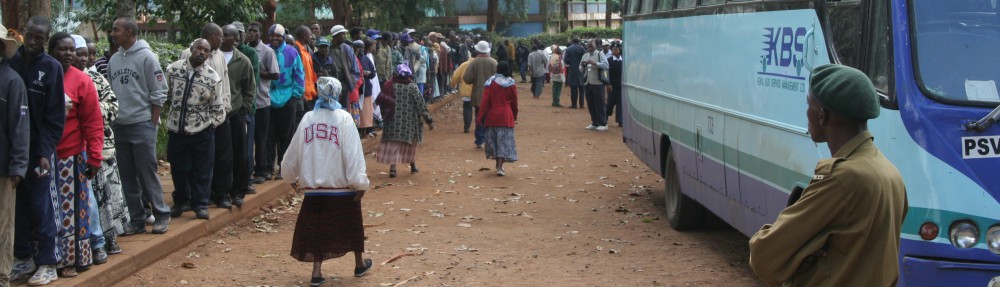
Kenya Bus Service (KBS) and Security at Polling Place

“The Eagle Has Landed: Kenya and the ICC” by John Githongo in The Star.

. . . .

. . . History is being made.

The ICC has redefined Kenya’s foreign policy totally and turned domestic politics inside out. Immediately after the post-election violence in 2008, Kenyans were clamouring for the ICC to intervene given the horrors that had just taken place.

Accountability, justice, impunity, reconciliation and other such words were the primary fodder of political discourse as we headed into the referendum on the constitution in 2010. Indeed, it can be argued that even among those most strongly opposed to the new constitutional dispensation, the dark looming cloud of the ICC and all its implications, especially the public mood that accompanied it through 2008 into 2010, all served to soften them up to demonstrate their pro-change, reformist credentials at a time when the country’s leadership and the messy albeit negotiated coalition arrangement was particularly unsatisfactory to the population.

If it hadn’t been for the ICC, perhaps more of the so-called ‘watermelons’ who pretended to support the new constitution while secretly being opposed to it, would have come out into the open with their true position.

.  .  .  .

. . . Parts of the Kenyan population are in just such a trap: caught between our preaching about and, yes, belief in, good governance and accountability; and its realities when brought to bear in our tribalised, politicised and fragmented political economy. Grimly put – ‘it hurts like hell when it is my tribesman who is being held accountable’. It hurts so much it leads to some of the most gibbering rationalisations of absurdity possible.

Continue reading

“The West” is not a Country either–the U.S. and U.K. do not have the same interests in Kenya

The Star reports that:

President Uhuru Kenyatta is set to hold talks with UK’s Prime Minister David Cameron during his three day visit, the first to a western capital since his election.

Human rights activists in the UK are reportedly organising to hold demonstrations to protest what they say is a ‘hypocritical manner’ manner in which the British government has made a U-turn against in its stand towards the Kenyan government.

In the U.K., unlike in the U.S., the Kenyan election stirred a significant discussion in the national legislature, in this case the House of Commons. Here is the link to the Hansard or transcript from March 20.

The biggest difference in interests is that Kenya, a British colony within the lifetimes of current political leaders, is important to the British economy. Kenya is not very important to the U.S. economy. It might be someday, and the U.S. would notionally like to be more engaged economically in East Africa, and not only because the Chinese are; nonetheless, as of today the level of trade and investment is not a higher order immediate interest for the United States.

Further, in the global system that the U.S. has helped create, the U.S. does not really have the same relationships to even the largest companies that may be headquartered in the U.S. as the British and some other European nations still have with their business champions. Not to say that the State Department doesn’t want to sell Boeing v. Airbus, but there is no American equivalent of BAE, for example. Further, it is British rather than American companies that are the key players in Kenya in banking and finance, tea, horticulture, tobacco, printing, public relations consulting, etc.

As of the last few years, roughly 60% of the roughly 5,000 Americans living in Kenya, according to the State Department, were connected to missionary work. The British, not as much as far as I know. Moreover, there are perhaps five times as many British passport holders in Kenya as Americans.

The United States has a reported official established presence of more than two dozen federal agencies in Kenya, so we do have interests, but they are heavily weighted toward “global” security matters, along with international crime/drugs, etc., and what we might call diplomatic and security logistics. In other words, it is convenient for people to locate in and transit out of Nairobi to support a variety of functions that don’t relate uniquely to Kenya. Its an easier place to fly in and out of and has lifestyle appeal, along with being a locus of the same type of thing for people in other agencies, from other governments and international organizations. It is not that this geographic interest doesn’t matter, its just that it really is not of first order importance. A lot of the aid programs that we conduct in Kenya could easily be moved to other countries that are even more in need if less convenient, for instance.

When al Qaeda wanted to attack Americans and U.S. interests in East Africa, they bombed our Embassies in Kenya and Tanzania–not some critical infrastructure or something or someplace else that the Embassies are there to protect.

Kenya is a tourist destination with direct flights of modest duration from the U.K., but still no U.S. direct flights. In the U.S., Kenya is on the tourism “map” along with other various other locations in Africa, but at a much lower relative level; the British are Kenya’s greatest source of tourists. The British newspapers cover Kenya in a completely different way, and to a much greater extent, than American papers.

I have referred to Kenya as Americans’ favorite African country, but this is within the context of the whole “Africa is a Country” perception problem. It was one of the British princes who had the bad form to be quoted to the effect that “Americans don’t do geography”. The British still know their way around their former empire and distinguish Kenya from its neighbors much more readily than do Americans.

Certainly the British MPs wax eloquent about the key importance of training the British military in Kenya, noting that this was said to have played a major role in allowing Britain to mount its Falklands Islands operations some thirty years ago. Of course, realistically, the UK military in this century is primarily derivative and it is hard to see that the world would be so much different if the British had to train in one of the other former colonies–the U.S. for instance–instead of in Kenya. Military training in Kenya is surely good for British political and military morale, but i think it is the economic issues that really make Kenya uniquely important for the UK, whereas for the U.S. the scales tip overwhelming to the “security” direction.

Obviously the International Criminal Court is another area of difference. The British are members, along with other Western European nations, whereas the U.S. is with the Chinese and Russians in standing outside (whether we are nominally favorable or nominally derogatory seems to depend on which of our parties is in power but we seem to have a fixed commitment to stay out). In this sense, the election of Uhuru Kenyatta and William Ruto is in one particular respect inconvenient for the British in a way that is not as challenging for the United States, but given the ordinary primacy of the specific over the general, and the immediate dollar or pound over longer term security in democratic politics, it is not really surprising that the UK has been more aggressive and quicker in seeking publicly to “get right” with Uhuru Kenyatta following his elevation to the Kenyan Presidency than has the United States.

At Easter, chicks come home to roost for U.S. for helping to underwrite impunity in Kenya; but “we” do not need Uhuruto

The United States looked the other way on a stolen 2007 election in Kenya.

Even though our Ambassador himself saw the changed tally forms at the Electoral Commission in Nairobi. We supported a “settlement” that created a temporary prime minister spot, without defined authority, for the apparent winner (not only did the exit poll done at the instance of the Ambassador and funded by USAID show a substantial win for the opposition candidate Odinga, but a separate State Department analysis in January concluded “advantage Raila.”).  “We” nonetheless called on Kenyans to accept the “results”. While we withdrew our congratulations to Kibaki and later asserted that we did not know who won, we were not willing to be publicly honest about what “we” had seen at the ECK as well as what else we did know.

To help pressure for a settlement, we eventually issued “visa ban” letters to three members of the Electoral Commission on the basis of evidence of bribery–but we never revealed this fact or the evidence–it only came to light through stolen cables published in the Daily Nation years later.

We rejected accountability for election theft–thus supporting impunity in this regard.  We supported, in concept, justice for the the post-election killings and mayhem. We had a hybrid position; let’s call it “limited, modified impunity”. Of course, the reality is that our supposed solution of “local tribunals” in Kenya for the post-election violence was always a complete pipe dream under the “power sharing” government we helped broker because that government was never going to implement any such thing.

Thus the role of the International Criminal Court as a last resort due to the initiative of the commission led by Justice Waki to provide the names to the ICC as a fallback.  We should pat ourselves on the back, I suppose, for helping to pay for the commission at least. Likewise, we have over the subsequent years now declined to go along with the aggressive activities of the Government of Kenya in requesting action from the UN Security Council to squelch the ICC’s prosecution, so we have at least refused to stand in the way of the ICC.  At the same time, we haven’t seemed to accomplish anything very noticeable on the protection of witnesses and the other core issues that enshrine impunity in Kenya.

Now, just like in 2007, we have helped pay for another flawed election, this time one which has ended up with a victory for the ticket of “Uhuruto” composed of the two leading politicians charged by the ICC for allegedly having key responsibility for the instrumental political killings of 2008. While it appears plausibly that Uhuruto on March 4 had a higher percentage of support than did Kibaki in 2007, it is also clear that there were substantial irregularities in the handling of the election, over a period of many months, by the “new and improved” IEBC–which was in fact caught even within the Kenya government itself, engaging in unlawful procurement corruption in regard to key technology–technology which was supposed to provide safeguards against the shambolic 2007 tallying process, but failed to be deployed or work.

So after an extraordinary sum of perhaps $240M was spent on an election with only somewhere around 14M registered voters (not sure exactly how many since the register was a series of 33,400 separate paper print outs which were reported by the IEBC to be unavailable for review in the Supreme Court)–we ended up with the same manual count fiasco as in 2007.  More system purchases were more opportunities to “eat”, not more reliability.

The IEBC was perceived as being corrupted on both sides instead of stacked completely only on one side like the ECK last time–but there was no one individual trusted like Kivuitu to let everyone down this time. In one respect that helped diffuse the prospect of violence because the voters this time were much more subdued and had lower expectations–and knew what could happen. And there were some other things different this time based on lower expectations from the “international community”–the observer groups spoke out early to bless the IEBC before it was anywhere close to completing its tally and gave it some cover for whatever it would chose to do. Last time, only IRI really did that–and it was rightly criticized for doing so as the count became problematic.  This time, private conversation before the election about what to say hearkened back to what observers had said in the first full blown observations of Kenya’s first multi-party elections in 1992 under Moi–the terminology “reflects the will of the Kenyan people” as a way to say the process run by the Government of Kenya could not stand scrutiny but the official candidate had a plurality anyway. The difference being that this time Kenyans had passed a new Constitution that was supposed to end the old first-past-the-post system in favor of a runoff-to-majority that meant that the opposition did not have to unite behind one candidate ahead of time to have any chance against a minority candidate supported by the State.

The U.S. knew, and Kibaki and his supporters, including Uhuru Kenyatta, knew that in 2007 we gave the Government of Kenya a pass on election rigging.  This time we didn’t step in and blow the whistle on procurement corruption or otherwise as the process moved towards its unsuccessful conclusion–and we gave the powers that be in Kenya no real reason so far as I know to believe that we had really changed the terms of the deal from 2007.

Now we have another incoherent vote count, but everyone is relieved that major violence did not erupt.  The new Electoral Commission argued to the Supreme Court that the Court could not set aside the IEBC’s pronounced premature results on the basis of the irregularities that had been revealed so far, or the known uncertainties, because to do so would create a constitutional crisis–the only way to have another election would be to use the same flawed register and the same flawed Electoral Commission itself.  In other words, the Court did not, according to the IEBC, really have the power to challenge its work and its decision which was now fait accompli.  The Court announced its ruling–at the last allowable moment (a few hours later than the two weeks permitted if it were as strict with itself as it was with those before it)–yet could not muster any explanation or reasoning whatsoever.  It declared itself to have the power, and to be exercising it, to ratify the IEBC’s result, but either couldn’t agree on why or was not comfortable saying until a future date–after the swearing in.

The bottom line here is that the United States has been helping to underwrite failure in Kenya for too long.  We got taken for a ride–again.  We ought to have more self respect.

The British government has groveled to “get right” with an incoming Uhuruto administration, but we simply do not need to do so.

We provide a disproportionate amount of aid to Kenya–officially roughly a Billion U.S. Dollars each year–unofficiallly I am sure there is more; not to mention extensive private aid that also helps alleviate the suffering of Kenyans left adrift by the corruption and bad priorities of their governments.  As far as I can see, we spend a lot of money in Kenya for sentimental rather than legitimate programmatic reasons.  And the restaurants and resorts are more upscale and Kenya is more oriented for tourism accompanying official travel and postings.  But a lot of the tourist infrastructure is owned by the Kenyatta and Moi families themselves.  We ought to grow up and take our responsibilities more seriously.

What has all this spending been adding up to aside from bad elections?  Kenya’s Human Development Index score for 2000 was .513 for a “Medium Human Development” ranking of 134th among the scored countries.  The 2012 score was .519, for a rank of 145th.  Among the 45 “Low Human Development” countries Kenya stands out, along with Zimbabwe for having by far the highest “Mean Years of Schooling”.  Yes, from 2000 to 2012 Kenya’s GDP per capita increased by roughly fifty percent–it just didn’t result in much relative overall human development progress for the country as a whole.

The Cold War has been over for almost 25 years.  What we have been doing has not been working very well and we can do better.

Jamhuri Day, Christmas and the Year Ahead

Happy Jamhuri Day to my friends and readers in Kenya (and Kenyans in the diaspora–even if you don’t get to vote this time!).

FRESH TEA
Fresh Tea

It has been a week since my last post, even though so much is happening on a day to day basis with the Kenyan election and lots of other news in the region–this reflects a few different things.  For one, perhaps what we could call a “Christmas armistice”.  I live in a peaceful place, and I am enjoying the “festive season” here with my family and am committed to a less digital Christmas.  We’ve survived another election here in the States (in spite of ourselves) and there are a several weeks left in the campaign in Kenya and this is a good time to step back a bit.  In particular, for my family, this is the last Christmas before my daughter goes off to college.  I took my son, our youngest, to get his driver’s license yesterday.  These are the things that can’t wait (and that are uniquely my responsibility).

For another, I have been at this blog steadily for three years.  It’s been through various evolutions and trends and this is an appropriate time for reflective recalibration about what I want it to be going forward.  And in the meantime, there are 601 posts out there for those interested.  And too many of those are just “news” and not real writing, and I do know that I want to get back to “better” rather than “more”.

A third is that I have both new freedom, and new constraints that I need to adjust to.  When I started this blog, and for the first two-and-a-half years, I was a lawyer in the defense industry.  For this reason, I always needed to keep a strong separation between my blog and my professional life.  When I attended the African Studies Association or participated in a “bloggers’ roundtable” at the Millennium Challenge Corporation I was on vacation from my job and generally didn’t talk about it much (both awkward and expensive).  When I was living in Kenya and working for the International Republican Institute I kept entirely away from the job from which I was on leave back home.  Now that I am an independent lawyer, I can synthesize what I know from my prior legal experience and otherwise what I do for a living with the blog to whatever extent I chose, so this is easier.  At the same time, I am also now available professionally as a consultant in matters involving East Africa and have accepted some work, so I need to avoid any conflicts arising out the transition from being purely an avocational commentator.

One thing I have reflected on this past week is the issue of how much is similar and how much is dissimilar between the 2007 campaign in Kenya and the 20012/13 campaign.  All of the major players are the same, although Kibaki will be transitioning from President to “retired President” as Moi is called, and is thus not a candidate himself.  I did get somewhat acquainted at that time and in that environment with Raila and Kalonzo and Mudavadi, and did meet Ruto although never sat down with him.  Uhuru and Dr. Willy Mutunga, who was then at the Ford Foundation and is now Chief Justice, were the only people that ever turned down a meeting request on my behalf when I was IRI Director (a nice symmetry in terms of KANU/Establishment versus Civil Society/Activist roles) so I do have some real sense of many of those involved.  On the other hand, a lot has changed in Kenya, for better and worse, since 2007/08.  So although I know much, much more about Kenya from what I have done from here since I moved back, I don’t want to fall into the trap of relying too much on past experience.

One thing this adds up to is that I do want to write more about “democracy promotion” or “assistance” as a subspecies of “foreign aid” in Africa beyond just the current and most recent past campaign in Kenya.  I also want to do more with East Africa as a region in interacting with the United States–I drafted a “year in review” summary regarding IGAD for a bar committee I am participating in which reminded me of interesting things to explore about how domestic politics in Kenya and in the U.S. will influence cooperation and integration among the East African and HOA states. And then there is Somaliland, which is near and dear to my heart, but I am very cautious in writing about.

For now, I’ll leave you with a few links:

“Uhuru Kenyatta did NOT donate 85 million to Mitt Romney’s campaign” says The Kenyan Daily Post.

Alex Thurston in the Sahel Blog: “Amb. Susan Rice as a Window into U.S. Africa Policy, 1993-Present”

Whither Somalia”–Mary Harper, Bronwen Bruton at USIP

Updated 3 Sept: ICC “Confirmation” hearings underway for Ruto, Kosgey and Sang

A good way to keep up with the proceedings is through the website ICC Kenya Monitor.

The website includes a “watch now” link for the live proceedings using Microsoft Player, detailed daily summaries and various links and resources.

Keep in mind that rulings are not expected until late this year as to whether the charges will be “confirmed” by the judges so as to go forward toward trial in 2012.