(Updated) Tea Leaves and Poker Hands: Bolton at Heritage on Africa

In a relatively short speech Thursday morning at Washington’s Heritage Foundation, President Trump’s current National Security Advisor John Bolton was said to announce the administration’s “new Africa policy”. Amb. Bolton stuck out during the George W. Bush Administration as both an aggressive hardliner by reputation on policy and as willing to fight hard within the bureaucracy. So no surprise that Bolton says we are not going to let the spigot run on aid projects or peacekeeping missions that are not “winning”, and will target programs more strategically to better match quids and pros, and such.

Overall, Bolton calls the policy “Prosper Africa”. He emphasizes concerns about the perceived unhealthy influence of China and Russia in Africa and frames U.S. interests as focused on competition among external powers. We want Africa to “prosper” through a growing middle class and business deals creating jobs and other benefits in both the U.S. and partner countries and in so doing to strengthen our influence and reduce that of our competitors. We intend to (continue to) play favorites, but in a more explicit and direct way, emphasizing “anchor” governments like Kenya (still our sentimental favorite African country) rather than focusing directly on poverty alleviation or “Sustainable Development Goals” as a global construct.

It seems to have raised eyebrows that Bolton did not mention PEPFAR and democracy and elections among other categories of assistance that we have emphasized both with rhetoric and dollars under Trump’s most recent predecessors. Contra some initial reactions, I anticipate that any major expenditure of political capital by the Administration with Congress to engineer large cuts to popular existing programs is not in the offing.

In fact, when the White House issued a press release “fact sheet” later in the afternoon reporting that it “was issuing” President Trump’s “new Africa policy” it explicitly mentioned “democracy” twice and otherwise sanded down Bolton’s sharper edges. Democracy, especially, as well as our health programs, are a comparative advantage for the United States vis-a-vis the PRC if we want to re-frame our rationale more explicitly in terms of traditional geopolitical competition.

The origins of U.S. development assistance philosophy come from offering a competing model to communism, especially following World War II and to some extent even earlier. Likewise U.S. overt explicit democracy assistance programs were established during the Reagan Administration. So talking more openly and frankly about our concerns about China’s role in Africa in the context of a recalibrated overall relationship that accounts for the Chinese Communist Party’s changes under Xi does not at all have to lead to a retreat from development or democracy assistance.

What plays out over the next two years from any of this remains to be seen.

Instructive are today’s two votes in the Republican led Senate approving resolutions calling for an end to support for Saudi Arabian war efforts in Yemen and condemning the role of the Crown Prince in the murder of American resident Jamal Khashoggi. The peak of unilateral latitude for the Trump Administration has already passed, even before the new Democratic controlled House is seated in the new Congress in January.

Testimony before the U.S. Senate Armed Services Committee, Subcommittee on Emerging Threats, by Judd Devermont, now Africa Diector at venerable Center for Strategic and International Studies, and recently national intelligence officer for Africa, gives a fuller and more nuanced picture of the range of Chinese involvement in Africa. Not all of it is necessarily contradictory to our immediate interests or longer term hopes, even though there are important concerns.

From my personal standpoint, I am still struck by the fact that according to what I read in the newspapers, combined with a letter from Washington, the Chinese hacked my security clearance file–and that of nearly every other clearance holder–from the Office of Personnel Management in Washington during the last Administration. (I also read they “wired” the African Union headquarters, among many other examples.) As for the Russians, they were screwing around in our own Republican Party and to some extent with our general election campaign.

Thus, we most need to be competent, purposeful and mature in conducting our own business in an environment which can be expected to punish complacency. Get through this temporary period of governance by Tweet and tabloid huckster hush money and get our own democracy back on a more even keel. Then we can more effectively deepen our relationships among African countries and with African citizens for the long run. In the meantime, I hope and expect that we will continue most of the incrementally helpful things we have been doing in Africa and not rock the boat too dramatically.

In the meantime, worth noting, for instance, is the presence of Somaliland’s Foreign Minister at Bolton’s speech.

What to make of the policy being announced by Bolton at Heritage instead of by the Secretary of State in an official or semi-official venue? Probably the same reason there are not details and documents: a point of the event is to stamp Bolton’s ideological role within the Administration, the Republican Party, and “The Movement” (big “C” Conservatism with American characteristics is how I might describe it). This is “framing” and “vision” with various audiences rather than actual “policy” as such.

It takes cognizance especially of the geopolitical struggle most compelling on a day-to-day basis in the White House: “red” versus “blue” in the rest of the United States. Thus the focus on competition with “Obama” as a symbol of “blue” who did not announce his “new Africa policy” until nearly the end of his first term. Bolton is a guy with seven pictures of himself on his Twitter profile who tried to mount his own run for President: he obviously enjoys the spotlight and enjoys being a lightening rod for the arena. More substantively, it announces the drawing of a line of demarcation against the perceived “feckless liberalism” of Obama and the perceived namby-pamby do-gooder “compassionate conservatism” that sometimes fuzzed the focus of G.W. Bush in Africa. “Africa” is to be normalized as a geographic space.

Realism of course tells us that the Americans who will make the day to day decisions that actually determine our role in the various African countries do not report to Bolton and that any deep reorientation of policy will require more time and attention than Trump and his cabinet as a whole likely have left in this term. This could tell us much more about what to expect if Trump were re-elected or if the next Administration involved a similar role for Bolton and like-minded officials.

Realism also notes the Administration lost votes on two foreign policy resolutions in the Senate between Bolton’s speech and the White House press release.

How can Americans heal from “Birtherism”?

Some thoughts:

1. First, admit the scope of the problem. Birtherism has in fact done significant damage to the United States and our national interests, and to our character and moral fibre, from it’s beginning in 2008.

2. It has done great harm to the Republican Party as an institution, not just to Obama and the Democratic Party against whom it was directed. Because we only have two parties that control essentially all political power in the United States and have established themselves in a semi-official role in a “two-party system,” the distortion of debate and behavior in the Republican Party by the widespread influence of Birtherism at the grassroots, radiating up, has been and continues to be a problem that impacts every American and weakens our country.

3. Disagreements based on a bizarre and untenable conspiracy theory are a diversion from our ability to properly respect each other and discuss/debate substantive issues, solve policy problems and do the business of self-governance.

4. The price of paranoia accumulates over time. It morphs in ways that we cannot rationally predict. It preys not just on prejudice, but also to an extent on the lack of education and lack of experience with and exposure to the world, taking advantage of people who are vulnerable. Otherwise responsible Republican elected officials who “ducked” having the courage to repudiate Birtherism in its early years probably assumed it would fade away, not anticipating that Donald Trump would rejuvenate Birtherism as a key tool for his successful insurgent campaign for the presidency.

5. Americans of both parties and none will have to “grow up” enough to be willing to voluntarily re-build guardrails for democratic competition that “re-norm” truthfulness and erring on the side of caution when it comes to the amplitude of vitriol in the “permanent campaign” between Republicans and Democrats, as well as related ideological contests.

6. In particular, Republican Senators and Congressmen and state level elected officials and Party officials who shrugged their shoulders or said the equivalent of “well, you never know” should have a “come to Jesus”, take responsibility and make affirmative steps.

Embassy Kenya: Six Years after Robert Godec’s Confirmation Hearing as Ambassador, no word on vote on his nominated successor

Flashback to six years ago, during the “lame duck” Congressional sessions following President Obama’s re-election:

NOMINATIONS OF ROBERT F. GODEC AND DEBORAH ANN McCARTHY WEDNESDAY, NOVEMBER 28, 2012 U.S. SENATE, COMMITTEE ON FOREIGN RELATIONS, Washington, DC Hon. Robert F. Godec, of Virginia, to be Ambassador to the Republic of Kenya Deborah Ann McCarthy, of Florida, to be Ambassador to the Republic of Lithuania

The committee met, pursuant to notice, at 2:25 p.m., in room SD–419, Dirksen Senate Office Building, Hon. Christopher A. Coons, presiding. Present: Senators Coons, Lugar, and Isakson.

OPENING STATEMENT OF HON. CHRISTOPHER A. COONS, U.S. SENATOR FROM DELAWARE Senator COONS. I call this hearing to order. I am honored to chair this hearing for the ambassadorial nominees to serve this Nation in Kenya and Lithuania, Ambassador Robert Godec and Ms. Deborah Ann McCarthy. Both nominees have impressive and long records of service and accomplishment in the Foreign Service of the United States, and I look forward to hearing about their priorities for advancing U.S. policies and interests in the countries to which they may soon go as our Ambassadors. I am also very pleased to be joined by my good friend and ranking member, Senator Isakson, of Georgia, and particularly honored that Senator Lugar, the ranking member of the full committee, has joined us today; and I understand Senator Durbin, of Illinois, may as well join us shortly. I apologize for the delay in getting started. We had a vote on the floor of the Senate.

As some know, Kenya has particularly important meaning for me. The first time I ever set foot in Africa was as a undergraduate spending a semester at the University of Nairobi, and I later volunteered at an orphanage in Ngong. My experience there was transformative, and changed my perspective on the world, and gave me a new sense of purpose and focus. And I returned to Kenya, for the first time in 25 years, just a few months ago.

In Nairobi, I had the opportunity to speak at the Kenyan National Prayer Breakfast, as Senator Isakson has, as well, this year, with President Kibaki and others, where I affirmed the centrality for the United States of the upcoming elections and our sincere hope that the violence and chaos of the 2007 elections can be averted. The United States, in my view, is, and should be, closely watching the process surrounding this election, and we’ll work closely with Kenyan officials to ensure the elections are peaceful, credible, and transparent. And I emphasized then, as I will again today, that we do not favor any particular outcome or candidate, but, instead, a free and fair process. Kenya has made remarkable progress in recent years in reforming its constitution, building democratic institutions, expanding press freedoms, and improving its economy. I was particularly impressed, during that visit with the younger generation of Kenyans, in the great potential that exists amongst entrepreneurs. There are many other things to be concerned about in the process toward the election, and I look forward to hearing about them in more detail from Ambassador Godec. Several factors may well influence the outcome of the election— ethnic tensions, the balloting registration process, the behavior of the police and security services, messaging of the candidates—all of which I hope we will get into in some more detail.

The other main area of concern for me regarding Kenya is its military involvement in Somalia, the ongoing security challenges, both within and without Kenya and its borders. Kenya is home to the largest diplomatic mission in Africa, from which a host of government agencies oversee bilateral and regional programs, and serves as a base for humanitarian relief, food security, and global health initiatives, and I’m eager to talk about that, as well as the potential for trade and investment in the region.

To serve as our next Ambassador in this critical post, in my view, President Obama has chosen wisely in nominating Ambassador Godec, who has served as Charge´ in Nairobi since August and has been received positively by government, civil society, and NGOs. Having built a strong career as the former Ambassador to Tunisia, he recently served as Principal Deputy Counterterrorism Coordinator in the State Counterterrorism Bureau. Prior to his service in Tunisia, he served as Deputy Assistant Secretary for Near Eastern Affairs. This is Ambassador Godec’s second time in Nairobi, following a posting from 1996 to 1999 as Economic Counselor.

PREPARED STATEMENT OF RICHARD G. LUGAR, U.S. SENATOR FROM INDIANA It is a pleasure to welcome Ambassador Godec once again before the committee, in this case as the President’s nominee to be Ambassador to Kenya. His stewardship as Charge´ over the last several months comes at a very challenging time for our large and important East Africa Embassy. He has brought deft and experienced management to Nairobi and effectively sustained our varied interests and priorities with Kenyans and the Kenyan Government at a critical time. Among the most important interests is United States support for a free and fair electoral process leading up to national elections in 2013, the first since the abhorrent violence that followed the 2007 elections. United States interests extend broadly in East Africa and recognize the commitment Kenya has made in Somalia under the AMISOM umbrella, as well as its long support for regional peace initiatives. Kenya also has been a key counterterrorism partner in a variety of areas that are of mutual concern with broad global potential for impact. These include Kenyan efforts fighting al-Shabab and building its own counterterror capabilities in maritime and border security. Our extensive cooperation extends to providing a regional platform for the Defense Threat Reduction Agency and the Center for Disease Control in securing biological materials that pose a threat to millions if neglected. I would like to thank Ambassador Godec for his expeditious review of a longstanding request incorporating DTRA into a large Embassy country team.

President Trump nominated Illinois State Senator Kyle McCarter to replace Godec back on March 28, 2018, and a confirmation hearing was finally held on July 31, 2018, but no public word has come about an actual vote by the Senate Foreign Relations Committee. McCarter was to make follow-up submissions about controversial tweets to the Senators. In the meantime, McCarter had announced prior to his nomination that he was not running for re-election to the State Senate and a Republican has been elected to succeed him in January. Trump’s Republicans gained three seats overall in the U.S. Senate.

Godec is now the longest serving U.S. Ambassador to Kenya, well exceeding Michael Ranneberger’s essentially double Bush-Obama term (even without including Godec’s six months as Charge d’Affaires).

My writing on my experience with the birth of “Birtherism” and Trump’s foreign policy

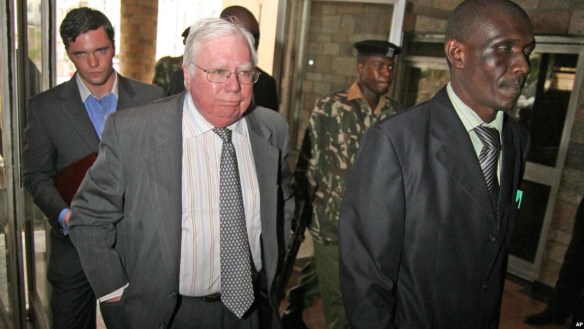
Birtherism is back in the news with statements by Jerome Corsi, author of The Obama Nation and Where’s the Birth Certificate?, that he expects to be indicted by the Grand Jury in the Special Counsel investigation of Russian interference in the American presidential election. News stories this week on Corsi’s role in the current investigation used photos from Corsi at Kenya Immigration in 2008 when he was expelled while investigating Obama while I was Regional Director for the International Republican Institute.

Update: Voice of America, Nov 23, “Roger Stone Associate in Plea Talks with Mueller“.

FILE – Jerome Corsi, center, who wrote “The Obama Nation: Leftist Politics and the Cult of Personality, follows an immigration department officer holding his passport.

Likewise, Michelle Obama made news in pre-tour snippets from her new memoir “Becoming” that she most especially found birtherism from Trump unforgivable on a personal basis because of “his loud and reckless innuendos putting my family’s safety at risk.” See “In Her New Book, Michelle Obama Denounces Trump’s Sexism and His Promotion of the ‘Birther’ Conspiracy” from The New York Times.

A few weeks ago I had a piece in The Elephant which ran with the title “From Birther to More of the Same: American foreign policy in the Age of Trump and it’s impact on Kenya.” Salim Lone, former Raila Odinga spokesman, commented: “As always, a very interesting and objective look at our elections and the role the U.S. has played here from Ken Flottman. He is on the dot for pointing out the continuity in Kenya of the Bush Obama Trump arc, but on matters election, I’d give Bush an upper hand.” (I would appreciate any thoughts or observations you might have.)

I wrote about Corsi more specifically and his role in the 2008 United States presidential campaign between the late International Republican Institute Chairman Senator John McCain and then Senator Barack Obama back in 20014 here:

“A few thoughts about ethnic polarization in Kenya as we wait on the ICC”

An important thing for outsiders to realize is how complex, and deliberately obscured, these things are in Kenyan politics–and how much of what is said in popular fora in the United States is at least misleading if not flatly wrong factually and in some cases deliberately malicious. (I have finally just now brought myself to read the whole Chapter 4 on “Kenya, Odinga, Communism and Islam” in Jerome Corsi’s book The Obama Nation which was published shortly after I returned from Kenya in the summer of 2008 during the American presidential campaign.  It was a major bestseller and thousands of Americans may have read more about Kenyan politics in that chapter than they have ever read elsewhere over their lifetimes.  Corsi . . . paints a picture of the Kenyan election and the post election violence that is very much at odds with my understanding and experience, as well as anything I heard expressed internally at the International Republican Institute, or through my family’s church in Kenya or from our missionary friends or at my children’s missionary supported school.  In other words, malicious.)

One of the most important and interesting things that I have learned (so far) from my Freedom of Information Act requests to the State Department relating to observation of the 2007 Kenyan election was that the Ambassador’s staff reported to him and up the chain during the campaign that while there was hate speech showing up on both sides of the ODM/Odinga and PNU/Kibaki contest, the greater weight of it was directed against Odinga.  This surprised me because I had relatively limited separate interaction with anyone else at the State Department besides the Ambassador and his personal approach and attitude in my dealings with him certainly gave no hint of this background from his staff in the context of his tactics in addressing the Kenyan campaign.

Barack Obama image New Orleans

Dr. Peter Pham gets new post-midterm Trump diplomatic appointment as Great Lakes Special Envoy [Updated]

Ahead of the long-overdue elections scheduled for next month in the Democratic Republic of the Congo, the State Department announced the nomination of Dr. Peter Pham, Africa Director at the Atlantic Council, to be Trump’s special envoy to the African Great Lakes Region.

U.S. names new envoy for Africa’s Great Lakes. (AFP)

Pham has a long background in academics and national security related policy/”think work” on Africa from the Right, which is a fairly limited universe. I became aware of Dr. Pham’s work initially as a “friend of IRI” in relation to my work on Somaliland as IRI country director in 2007-08. He was involved in publicly advising the Trump transition on Africa-related issues and was often identified as the frontrunner to be the nominee as Assistant Secretary of State. See “Trump Team’s Queries About Africa Point to Skepticism About Aid,” New York Times, Jan. 13, 2017, by Helene Cooper.

Pham and his deputy at the Atlantic Council, Bronwyn Bruton, have been prominent critics/skeptics of the initial 2006 invasion of Somalia and aspects of the subsequent “nation building” process there, and Pham has been seen as an advocate for Somaliland. Beyond that, I’m not as familiar with his background on the numerous various immediate issues in the Great Lakes, or how the election results and retirements will re-shape Congressional interests.

I will endeavor to read up.

In the meantime, I have not heard any public comment about any likely impact on a vote on the stalled nomination of Illinois State Senator Kyle McCarter to replace Ambassador Godec in Kenya.

Update: I had forgotten Pham’s controversial advocacy from November 2012 in the New York Times: To save Congo, let it fall apart“. A view that could be seen as very pro-Kagame/RPF and that is certainly at odds with many considered opinions and perhaps a tough starting point for a new diplomatic posting.

See also, from Foreign Policy: Pompeo to appoint new envoy for troubled central Africa region.”

Update II: Richard Dowden of the Royal African Society on Pham last year in African Arguments:

A one-time Washington outsider who challenged the consensus on US-Africa relations, Pham has reportedly been trying to broaden his connections in departments whose staffs are more likely to lean Democrat than Republican. He is working hard to establish relationships with experts across the spectrum, trying to build a policy consensus.

Pham has written profusely on Africa and rejects the previous approach – espoused by Bill Clinton, George W. Bush and Barack Obama – that insisted democracy and human rights should be the cornerstone of US support. Instead, he argues that economic growth should take precedence, though he has recently emphasized security and good governance too. He urges US companies to grasp business opportunities on the continent.

Barack Obama, son of American anthropologist, retired President USA, stops in Kenya on way to South Africa after safari

Ten years after 2008 campaign, the “Birthers” have won for now in the U.S., but Obama remains a positive symbol with time for another act:

Former President Obama stopped in Kenya on his way to South Africa, his third visit to Kenya since arriving on the national political scene in the United States in 2004 as an Illinois state legislator through a speech at the Democratic Convention that nominated John Kerry to challenge the re-election of George W. Bush.

It is now ten years since I returned to the United States with my family from our year-long East Africa democracy assistance sojourn in Nairobi in the wake of the failed 2007 election, the post-election violence, and February 28 “peace deal”. The day we flew out of JKIA for Amsterdam en route to Atlanta on the way home to Mississippi I was first exposed to the “birther” conspiracy theory through a front page story in the Daily Nation.

Many may not remember fully now, but recognize that in its inception the “birther” conspiracy theory was not just the idea that then-Senator Obama was secretly born in Kenya, and secretly smuggled into the United States as an infant, and thus not technically eligible to be elected President. It also fit into the context of the claims that Obama was involved as a U.S. Senator from Illinois in 2007 in a conspiracy with Raila Odinga to steal Kenya’s election on behalf of Muslims, with killing of Christians and embellished from there into a narrative that rather than a loyal American Obama was essentially on the side of al-Queda and the global jihad to establish a sharia-enforcing caliphate. That Obama was in essence on the other side of the war being fought by Americans in the “surge” led by Bush and General Petraeus in Iraq as well as the fundamental underlying values of our democratic republic and Western democracy in general.

The conspiracy theories about the 2007 Kenyan election faded somewhat over time–partly because of the peace deal that put Odinga in Kibaki’s government as Prime Minister where he continued to be friendly to the West and partly because it became clearer that the election was stolen by Kibaki’s side which controlled the ECK (and not by the opposition which didn’t). Reports at the time from the American right at the Heritage Foundation think tank and National Review magazine (“Inside Kenya’s clumsily rigged election” Jan 4, 2008 National Review Online) noting the theft of the election helped American conservatives who cared about facts avoid getting sucked into nonsense about a Luo jihad involving “tribesman” Obama and “cousin” Raila.

While there remain a few holdouts who claim that “we can’t know” who won in Kenya’s 2007 election, they seem to be pretty well limited to personally interested parties at this point with the release of the State Department cables showing that our Ambassador Ranneberger himself saw tallies being changed at the ECK and claimed to have encouraged the late ECK Chairman Samuel Kivuitu to withstand the pressure to declare Kibaki the winner anyway, even though Ranneberger knew that the Chairman had no way to control the Committee which was thoroughly stacked by Kibaki in the weeks and months before the election.

Once it is recognized that the vote tallies were actually changed at the ECK, Americans–most especially rock-ribbed traditional stalwarts attracted to “the Tea Party” and/or Donald Trump’s “neopatriotism”–will understand that Kenyans had a duty not just a right to protest the 2007 election. Americans would not trust biometric voter registration (or tolerate secret voter lists) but most certainly the traditional American narrative would demand that we march on our county courthouses if our votes were simply changed by our election officials. Ranneberger’s pre-election cables to Washington made clear that as of that time, the Kenyan courts were not independent and would provide no recourse so that voters would be forced to go to the streets if there was fraud that became known.

Once you legitimize protesting the actions of the ECK, and recognize that the largest category of deaths in the Post Election Violence, per the Waki Commission, were those shot by Kibaki’s security forces, and the largest number that were identifiable by tribe were Luo, then the whole notion of some extraneous evil conspiracy somehow involving Obama and the global jihad as the reason for the post election violence becomes that much more irrational. The portion of violence in the Rift Valley that then-Assistant Secretary of State Jendayi Frazer insisted on calling “ethnic cleansing” in a January 2008 visit (a label not adopted in Washington) was conducted by Kalenjin militia in the pattern employed by KANU in 1992 and 1997. KANU was a religiously diverse secular party that sought to maintain single-party hegemony through compliant cadres among all major tribes and religious groupings in accordance with its political needs. No suggestion that Moi, who personally identified as a Protestant Christian, was a secret Muslim jihadi even though the victims may have been mostly Christians.

The International Republican Institute/University of California, San Diego exit poll funded by USAID (the one showing an Odinga presidential win by roughly six points that was embargoed for six months) gave more evidence in the details that the 2007 election contest was driven, as normal in Kenyan, by tribal rather than religious alignment with Odinga shown as winning a majority of self-identified Christians and of Muslims (although the margin was greater among Muslims). On the other hand, there was a “gender gap” with women favoring Kibaki and men Odinga.

It may also seem hard to remember now but by January 2009 Obama was sworn in to a wave of good feeling with high approval numbers. He had campaigned as a pragmatic moderate Democrat who was against dumb wars and only for smart ones, a Christian who grew up with limited religion who was popular with the irreligious left, the Christian left and made some real inroads courting what we call “Evangelicals” who were not part of the more politicized harder “Religious Right”. The inaugural celebrations seemed to suggest some real healing from the cultural rifts from “the Sixties” and “Vietnam” that featured so prominently in presidential campaigns throughout my lifetime, as well as a milestone to show that we had come so far in overcoming racial prejudice in the post-Civil Rights era that black/white racial issues were no longer much a part of those cultural rifts. Maybe we had more in common than our political leaders had been telling us since the rise of Fox News and the Bill Clinton impeachment saga; maybe this president could be a “uniter not a divider” where his predecessor had failed. In part this failure was because the Bush political operation ended up pulling a “bait-and-switch” by mobilizing gullible church networks to support the invasion of Iraq for regime change using a claimed causus belli of active chemical/biological and nuclear weapons programs then firing up the culture wars further to drive turnout to get re-elected over John Kerry. This was a bad error of moral judgment that has continued to reverberate through American politics.

Kerry was certainly a Yankee patrician from “central casting” — as Kenyans well know from the 2017 election — but was unquestionably accurate in pointing out in debate with Bush that we had gotten “stuck in Iraq”. Of course Kerry was too polite, patrician and/or patriotic to go for the jugular and trash Bush for Iraq the the way Donald Trump did in his 2016 campaign.

For saying that we were “stuck in Iraq” Kerry got pilloried as “unpatriotic” aside from the “Swift Boat” sliming he got over his military service in Vietnam–conveniently not a problem for Clinton, Bush, Cheney or Trump who all managed in various ways not to get sent, and unlike Kerry, did not volunteer to actually go to Vietnam. Nonetheless, the unhealed cultural wounds were still such almost 30 years after the fall of Saigon that Vietnam was a winner for Bush over Kerry in spite of Iraq.

Part of the reason that Obama took office with a waive of good feeling and better numbers than he had during the election was that McCain declined to play along with trashing Obama in the darker ways and treated him as a legitimate political adversary. It was good for the country and gave Obama a fair start in office.

“Birtherism,” though, in spite of McCain’s choice, became an enduring American movement which has had a profound effect on our politics and transformed the Republican Party with which I had been involved for much of my life.

Ultimately, the Birther Movement became a tool for Donald Trump as an outsider to gain “free media” and attention and admiration with those who were otherwise profoundly afraid of or opposed to the Obama presidency.

People like John McCain and George W. Bush or his family members in politics, whatever their faults and mistakes on policy choices (even the really big one, invading Iraq, which McCain acknowledges in his latest book, The Restless Wave) were too experienced, too educated, and too well advised to believe craziness about Obama being secretly smuggled into the U.S. as a Kenyan child (although the McCain campaign did check it out to make sure as did the McClatchy newspaper chain) and were morally constrained, in my judgment at least, from deliberately lying about it to hurt Obama. If you cannot buy that it was morals, at least we can agree that they were restrained by a judgment that it was better politics to stay out of that gutter. Hillary Clinton also stayed away (even if one credits the report that her adviser Sidney Blumenthal triggered the McClatchy review to make sure their was nothing to it).

Donald Trump was not similarly constrained and his hectoring of Obama put him in the front row of politics in America. He shared headlines with Obama even as Osama bin-Laden was being killed by the Navy under Obama’s command. Not one to accept defeat in an argument by being proven factually wrong, in this case by the release of Obama’s long form Hawaii birth certificate, Trump bided his time and cranked the Movement back up for his presidential campaign in 2015 and 2016, discarding it once he had seized the agenda and the Republican Party and the specific “birther” claim was no longer useful to him.

It has been a bit surreal for me to see this happen. Educated middle class Americans of my generation (Obama’s essentially) have a lot to answer for in our complacency I am afraid. Our democratic republic requires more attention and effort than we have delivered in recent years whatever our party or policy preferences.

Fortunately, just as Obama himself has, we hope, time for other acts in his public life as an American after elective politics, the Trump presidency too shall pass and the Birther Movement will be a strange chapter in political history books. It will leave scars and I expect that Trump will be willing to use other lies for domestic advantage that will manipulate gullible people and torque emotions on difficult and divisive social matters. But in the longer term I think we will rise to the occasion and get to a better range of equilibrium. We have significant long term challenges on poverty, education, healthcare and economic mobility and government debt that have been building up during our protracted wartime, but I think Americans getting more engaged and rolling up our sleeves to work on solutions.

Trump as an individual is something of a fluke. Most of the people who voted for him have little in common with him really. I know this because they are my peers, my extended family and friends to a great extent. He lost the national popular vote in a low turnout election. Trump won in large part because neither Obama nor the Clintons succeeded in building a Democratic Party that was seriously competitive in much of the country.

The big difference as of now is that Trump as president in our system still has far less power than the president in any of the East African countries. He will leave office at by the end of his lawful first term or his second if re-elected.

On balance, I think that we will see American policy in its relations with Kenya in the Trump years to continue to be largely a continuation of that under Obama, as reflected in the American approach to supporting both the 2013 election with John Kerry as Secretary of State and 2017 with Kerry as chief election observer and Rex Tillerson as Secretary of State, with Bob Godec as “our man in Kenya” throughout. Just as Obama’s relationship with Kenya in its policy aspects was primarily a continuation of the approach under George W. Bush.

There have been a few major inflection points in the American/Kenyan relationship in the last twenty years, but most have not been specific to whoever was president in either Washington or Nairobi.

The first,of course, was the al-Queda Embassy bombings in Kenya and Tanzania in 1998, kicking off the ongoing conflict between the U.S. and Kenya against various Islamist “violent extremists”. As reflected in the Mombasa rocket attack, the USS Cole bombing, the bombing in Kampala, the various attacks in Kenya, most notoriously the Westgate Mall and Garissa University killings, a persistent understood risk of terrorist incidents have been a regional “fact of life” since. For most Kenyans who are not well secured in their daily bread, and face many bigger daily risks of violent death, terrorism is not quite so central as is to Americans, but has still inevitably shaped both sides of the relationship over the last two decades. And in this context, after 9/11 and our ensuing land wars in South Asia, with the establishment of the Combined Joint Task Force-Horn of Africa base in Djibouti Kenya resumed its regional security role along the lines established in the 1970s and 80s when the United States was fighting the Cold War and Kenyatta and Moi wanted protection from Idi Amin and Siad Barre and the kind of relationship that would be useful to them in avoiding disruption to their domestic rule.

The next inflection point, albeit of lesser magnitude from an American standpoint, was the retirement of Moi and the transition to NARC and Kibaki.

Next was the demise of NARC and the failure of constitutional reform with the 2005 referendum. Relatedly the Anglo Leasing scandal showed security and counter-terrorism were for sale at high levels along with the baseline of corruption in the police and security services that let terrorists move about and in and out of the country. The Artur Brothers and the Standard flamboyantly highlighted the rot.

Next and finally was the start of the war in Somalia to save and reinstate the Transitional Federal Government and oust the ICU in December 2006.

Since that time the United States Government has continued to have and support all our other existing priorities in Kenya such as lifesaving humanitarian health support through PEPFAR and other lower profile programs, food assistance and small farm agricultural support, along with supporting all sorts of philanthropic type programs and the somewhat more controversial “big development” initiatives like Power Africa, frequently in cooperation with other donors.

In recent years we also started devoted more governmental focus to promoting international private financial investment, such as the 2015 U.S. Overseas Private Investment Corporation investment in the Dubai-based Abraaj Growth Markets Health Fund, L.P., that has been active in the Nairobi private healthcare market prior to recently entering liquidation under circumstances being investigated.

Nonetheless, in the meantime we have been at war in a country with a huge border with Kenya. A country during during much of these last 11 1/2 years which has been too dangerous to support a full diplomatic and aid presence and has thus had those parts of the effort supported from Kenya, as well as a smaller role for Kenya as a host for some U.S. defense forces in addition to those at our base in Djibouti. And from reading the newspapers back in the day and a few books it is apparent that Kenya provided some military support for the invasion by the Ethiopian military at the time to contain potential spread of terrorism.

And in 2011, during Kibaki’s second term, with the support of Prime Minister Odinga, Kenya entered the war directly and formally in its own right.

Roughly nine months later the Kenya Defense Forces were admitted into the AU’s AMISOM peacekeeping collaboration, allowing for financial reimbursement through the Western donors, and eventually drove al-Shabaab, now formally asserting affiliation with al Queda, out of their previous position of direct control of the port at Kismayo (not to say that al Shabaab did not continue to apparently benefit from the illicit charcoal and sugar trade through the port).

A few months before the Ethiopians were invited to restore the TFG in Mogadishu, our Ambassador Bellamy finished his service and Ambassador Ranneberger was similarly appointed by President Bush from the Foreign Service. Within a few months after the start of the war Ranneberger sent a cable to Washington explaining that his approach for “achieving U.S. objectives in Kenya’s elections” was to stay quiet on the debates on constitutional reform and election reform and “build capital” with the incumbent. With the perturbation of the 2008 crisis and the intervention for constitutional reform up through 2010, this has remained the baseline beat of our relationship over the years.

Will the recent moves by Kenya’s dominant new Jubilee Party to align with Communist Party of China structures and philosophy to accompany its huge borrowings from the Chinese State cause any serious rethink in Washington? I have no idea, but it certainly does not seem to have captured any particular place in the priorities of either the retired President Obama or current President Trump.
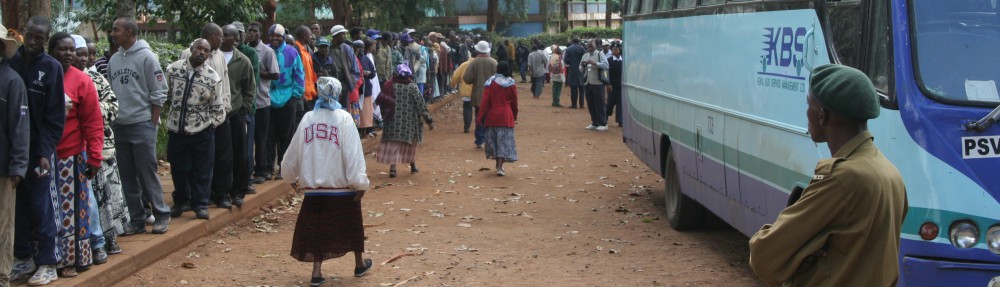
Must Kenyans bear a “model” cross?

In his sermon, Archbishop Welby said reconciliation was the only way that the country could retain its status as a model nation for Africa, and that disagreements can only be sorted out through understanding.

“Kenya has been a good model of peace and reconciliation across Africa,” he said. “Reconciliation is a supreme gift of Jesus, and is so costly it caused Jesus to die on the cross.”

(From the Sunday Nation, Talks in the air as Uhuru, Raila meet” featuring the visit of the Archbishop of Canterbury to Nairobi.)

As a Christian, I embrace the message of the Archbishop on the value and centrality of reconciliation for Kenyans, as for the rest of us. I am just not sure that the purpose or motivation needs to involve further taking up the burden of being a “model nation” as that term has been used. Kenyans need reconciliation among themselves, for themselves–really to become a nation in a more meaningful sense than they are now.

The history and immediate circumstances of Kenya are rather specific. The spiritual and temporal challenges of reconciliation in Kenya certainly have a fair bit in common with those faced by Americans. I am sure others elsewhere, in places that I have not lived, including in various other nations on the African continent have substantial commonality in their experiences, needs and circumstances.

It is natural–almost reflexive and inevitable perhaps–for leaders from the UK to call on Kenya’s leaders to bear the burdens of being exemplars for the region. And are Kenya’s elitemost not to able to be motivated by the extra status of ruling the country that is recognized as a sort of head boy for the whole neighborhood? To me this sort of thinking has been a fixture of Anglo American establishment orthodoxy toward Kenya and effectively served the interests of Anglo American foreign policy as the current relationships were worked out during the 1950s, ’60s and ’70s. While it has arguably worked out better in some important respects for quite a few Kenyans than many possible alternatives might have, it is decidely shopworn and insufficient now for the future.

The cross of being a “model nation” has always been in another sense the burden borne by most Kenyans in carrying on their backs in parade profoundly corrupt and frankly greedy “prefects”. Kenyans have more valid dreams than this. In reality the Kenya of Kenyatta/Moi/Kibaki/Kenyatta (and the rest of the usual immune suspects) is not something that could (or should) be replicated anywhere else, and it is not even a viable model for Kenya on into the 21st Century. There are too many more people without jobs or enough to eat, with many many more coming.

And let us be clear that a specific cost of being used as a “model” by outsiders: truth.  One of the main reasons Kenyan elections are so bad but so uniquely expensive is that we pretend that they are better than they are, to serve the idee fixe of the model.  We still cannot come to grips with talking openly among ourselves even about our role in the disaster of 2007, to go along with our role in mitigating the crisis in 2008-10.

See my post from August 2012: Didn’t we learn from the disaster in 2007? Kenya does not need to be anyone’s “model” anything; it does need truth in it’s election.

The Cold War is long over and the Anglo American orientation to Kenya as it evolved up into the 1970s might well be due for a serious refresh, especially with more aggressive Chinese and French mercantilism offering competing opportunities for Kenya’s rentier class and Western technology, along with global oil proceeds routed through the Gulf Monarchies greatly expanding the reach and toxicity of militarized jihadist ideology since the early days of al Qaeda activity in East Africa more than twenty years ago now.

Regardless, the United States and the United Kingdom are not going to be leading the reconciliation of Kenyans, much less any of the other outside influencers.  We can provide moral support or detract from opportunities by supporting an inadequate status quo.

In the case of the United States we all know enough now about Donald Trump to know that America will not have anything along the lines of foreign policy in any traditional sense during his presidency.  This means overall inertia within the military in an expanding role and within the bureaucracy in other areas in a receding role.  It also means a greater latitude for non-state actors such as the aggressively “libertarian” billionaires who helped make Trump president, such as the eccentric quant fund mogul Robert Mercer who will be of note to Kenyans through his role as an investor in Cambridge Analytica of Kenyatta’s 2013 and 2017 campaigns.

Trump has explained that it is not necessary to fill many of the policy and other positions in the State Department because he himself “is the one that matters” for policy.  Presumably in the case of a crisis in Kenya cataclysmic enough to require decisions on his part regarding U.S. policy, Trump would be inclined to rely on the Pentagon.  Otherwise perhaps he would also reach out to friends who have business interests as he referred to in his lunch with African leaders alongside the UN General Assembly.

Trump and his cronies aside, if Kenyans are able to find ways to reconcile and seek specific support from the United States, they will find many Americans including even within Congress who will wish to be of assistance for the reasons that we otherwise wish to help with the needs of Kenyans for food and medicine, for instance.

In first instance , however, Kenyans are in the same boat as everyone else and have to decide how they value reconciliation and love frankly, versus greed, power, hate, heirarchy and other alternative priorities.

A classic example of why Kenyans are frustrated with the mix of international Election Observers and Media

Kenya 2007 election Kibaki Tena Kazi iendelee re-election

Can John Kerry help stop Kenya from slipping into Post-Election Violence Again?“, Newsweek, 10 Aug 2017:

Beyond the “Western patrician savior” headline:

. . . .

I know what it’s like to lose an election. I lost by one state the presidency of the United States, and I had a lot of reasons to complain about what happened in Ohio or in other states. But you gotta get over it and move on,” said Kerry Thursday at a press conference in Nairobi, where he has headed up the election observation mission from the Carter Center. Kerry was likely referencing issues with the voting system in Ohio that led to a recount and reduced margin of victory for Bush.

 The result—and perhaps more significantly, the aftermath—of Kenya’s presidential election is not yet clear. With almost 99 percent of the votes counted, incumbent Uhuru Kenyatta is in front with 54 percent of the vote, ahead of opposition leader Raila Odinga at 45 percent. Kenya’s electoral commission has said the result will be confirmed on Friday.

But Odinga has signaled he will not accept the result quietly. Odinga stated on Thursday that unknown figures had hacked into the electronic systems of the electoral commission—using the identity of Chris Msando, the commission’s IT chief who was tortured and murdered less than two weeks before the vote—and swayed the vote in favor of Kenyatta. Odinga has called for calm but has also not ruled out summoning his supporters to the streets.

Such a move would have a dreadful familiarity in Kenya. After the 2007 election, which Odinga lost to incumbent Mwai Kibaki amid allegations of rigging, supporters of both candidates clashed over several months in an ethnically charged conflict that left more than 1,000 people dead.

Kerry has led the Carter Center’s observation mission in Kenya, which saw observers deployed at more than 400 polling stations across the country, as well as 36 tallying centers. The center said in a preliminary statement on Thursday that despite some problems in the transmission of results from polling stations to tallying centers, the vote had been conducted in a peaceful and calm atmosphere. It urged candidates to wait for the official results before commenting and to “use established legal channels” to resolve any disputes and “ensure that their supporters remain calm” before and after the results have been confirmed.

Kerry himself said the vote appeared to have proceeded in a free and fair manner. “The process that was put in place is proving its value thus far,” he said. “Kenya has made a remarkable statement to Africa and the world about its democracy and the character of that democracy. Don’t let anybody besmirch that.

Former President Barack Obama also has urged Kenyans and their leaders to reject “tribal and ethnic hatred” and to “work together no matter what the outcome.” (emphasis added)

Facile comparison to very dissimilar 2007 situation (see my The Debacle of 2007 in The Elephant here.)  Exaggerated time period for that violence ten years ago (most of the violence was within one month of the election and the settlement was reached at the end of the second month).  No mention that following new the constitution in 2010 as a result of the 2008 settlement, the Odinga v Uhuru dispute of 2013 resulted in no widespread violence and much smaller numbers of opposition supporters killed by State for protesting.  No mention that the country in August 2008 was basically locked down by a massive and oppressive state security deployment.

No substantive focus on the main electoral problem: failure of results transmission system, as in 2013 (and mirroring 2007) yet bare assertion that 99 percent of vote counted.

Advocacy by Kerry beyond written statement of his Carter Center Mission that the election appeared to meet standards and to achieve the (Western) goal of an African success story and “Don’t let anybody besmirch that”. Etc.

Kenya Election Trump White House congratulates Kenyatta on fair and transpaent re-election

Initial Trump budget proposes to eliminate United States Institute of Peace, Wilson Center and African Development Foundation 

Of the laundry list of independent U.S. Government agencies Trump’s initial “skinny budget” submission to Congress proposes to eliminate, the USIP and the Wilson Center are specifically active on issues relating to democracy, war and peace in East Africa and the African Development Foundation is the one Africa-specific agency.

See this story in The Atlantic.

Trump did not expect to win U.S. election, did not understand risk and continues to avoid costs by renegotiating terms of service; but his approach should be comforting to Kenyan pols

The fundamental premise of the Trump campaign was that if Americans would elect Trump he would switch sides and become a patriot, serving the nation to make it “great again” and serving some, albeit conspicuously not all, segments of Americans.  He would, he claimed, do unto others on behalf of “us” what he had spent the first roughly seventy years of his life doing to more or less everyone he encountered regardless of creed.

Trump believed the polls well enough to recognize it was always a long shot, as ultimately reflected in his losing popular vote totals (the biggest total vote loss ever for an Electoral College winner, on low turnout).  Not expecting to win, Trump did not take serious steps to prepare to actually enter public service or to game out his alternatives.

Having caught some breaks, he ended up getting the Electoral College and is now having to spend some substantial part of his time, and some attention on becoming a president. (Although not to the point so far of taking the situation seriously enough to moderate his behavior on Twitter or otherwise seek self discipline or gravitas in most situations day to day.)

How did Trump end up winning?  While Trump’s style of bluster and aggressive and open dishonesty on the stump was not widely endearing, most Republicans were going to vote for anyone their party nominated period, at least so long as they campaigned as at least somewhat illiberal, assuring that Trump would be in a close general election almost no matter what.  So in that way, the key threshold actors were the “leaders” of the Republican Party (full disclosure: I identified as a Republican from childhood, served in the Party for years and did not affirmatively quit until 2013.)  In other words, Reince Priebus and Paul Ryan were the two Americans who had the most formal responsibility and actual power to determine the legitimacy and acceptability of Donald Trump as a prospective President of the United States (and the new ruling and defining authority in the Republican Party).

In the campaign, Trump’s staff and the Republican Party that he affiliated with to run for the presidency put together a tactical effort to target likely Clinton voters and dissuade them from voting that proved brilliantly effective for the America of now.  America and Americans have been profoundly changed by Rupert Murdoch with Roger Ailes and Osama Bin Laden since the Clintons’ last successful campaign outside of New York.  The Republican side understood that Facebook and email was far more important to the emotions that would drive the behavior of plausibly likely voters than a “ground game” of a generation ago when Bill Clinton got re-elected in 2006.

Ultimately Hillary Clinton was the Bob Dole of 1996–the candidate who would have won the general election eight years earlier had she been nominated then, but was no longer after waiting eight years in step with the times.

Some state governments managed to reduce voting by what they might call “undesirables” who were likely to vote for Clinton, while the Trump and Clinton campaigns combined to fire up “the deplorables”.  Beyond that Trump got consequential help from Putin and at the last minute from the FBI Director, but there is no way to prove what would have happened without their actions nor are we likely to have much clarity about Comey’s intentions.  (It is believable to me that Comey acted for reasons related to internal matters within the FBI, the Justice Department and the Government more broadly while expecting that Clinton would win anyway–presumably someday he will present an explanation in a book, by which time the consequences of Trump’s rise to power will be clearer.)

So now, like the proverbial dog who finds that the car he was chasing has stopped, Trump is confronted with what to do with his prize from winning the chase.  The biggest hassle seems to be that taking the job threatens to cost Trump a lot of money as well as well as quite a bit of time spent in Washington away from his homes in New York, New Jersey and South Florida and some living in public housing.  He has declared that any limitations on his business activities, and his residence, are to be negotiated or announced over time rather than governed by existing law and past practice.

Having no foreign policy experience and having been condemned publicly and privately by much of the cohort from previous Republican administrations, he seemed caught off guard by having to pick a nominee for Secretary of State.

Having Mitt Romney come to dinner at Trump Tower and contradict all of his previous expositions about Trump’s unfitness was a tour de force reminder of Trump’s tactical brilliance in accumulating personal power for himself and humiliating rivals and was important to firmly seizing control of the GOP from what we might call “the 20th Century Republicans.”  It was not useful to finding someone that would be useful to Trump as Secretary.  As the story has been told to us by the president’s people through the news media, man for all of Washington’s seasons Robert Gates was able to suggest to Trump his client Rex Tillerson who quickly became the natural choice for Trump.  This might even be true even if it hardly seems likely to be fully explanatory.

Tillerson is surely better suited to be Secretary of State than Trump is to be President. (For that matter, better suited to be President.)  The questions about Tillerson relate to problems about his relationship with a nefarious foreign autocrat with control of the worlds largest nuclear arsenal–as with Trump.  Beyond business relationships,  which include some other nefarious but less dangerous (to Americans and others if not to their own subjects) autocrats he seems to be a person of more conventional decency than Trump.  (Full disclosure, I’m an Eagle Scout, too.)

Tillerson is a surely a loyal company man, having spent his entire career with Exxon Mobile, and it seems plausible to me that he could effectuate a switch of “companies” to work for the United States Government to run the State Department rather than running Exxon Mobile, in a way that for Trump, who so far as I know has never worked for anyone other than his father and himself, was never plausible to me.  The problem with Trump’s Putin tilt and undisclosed interests and finances, and with Trump’s character, and with Trump’s willingness to actually change careers and orientation to serve as President of the United States will continue to be there whether or not Tillerson steps further forward out of the shadows to represent us as our chief diplomat.

Confronted with the idea of a less than ideal market to divest his business interests Trump has made it clear that he puts his own pocketbook first and Anerica second (at the very best) by refusing to divest.  So now we know that Trump simply refuses to be an actual patriot after all.  Contra our founding fathers who staked their “lives, fortunes and sacred honor” on the idea of America, Trump, who has, to be direct, no obvious prior personal experience with honor, has said that a small reduction in his alleged $10B net worth is too high a price to pay to be a full-time President.

I do think that Trump will be well received by Kenya’s politicians, as well as those in many other countries on the continent, and I’m assuming his call with Uluru Kenyatta today went fine.  Trump’s personal approach to public office will be more familiar and comfortable to Kenya’s leaders than that of Bush or Obama and his socioeconomic background more reassuring than someone as relatively exotic and self-made as Obama.