USIP issues special report on “Community Policing and Violent Extremism in Tanzania”

Excerpts From Lillian Dang, “Community Policing and Violent Extremisn in Tanzania” USIP Special Report no. 442, March 2019

ASSESSMENT OF COMMUNITY POLICING IN PRACTICE

The strengths include the expansion of police presence in local communities, the establishment of regular communication channels between police and local government leaders, and official endorsement of the establishment of civilian security groups. Unfortunately, the community policing approach has been stunted by a lack of resources, inconsistent application, and an overemphasis on intelligence gathering.

Rather than use the [Tanzanian Police Force] TPF’s community policing structure as a means of building trust between police and citizens and improving the delivery of policing services to local communities, community policing in practice focuses primarily on intelligence gathering from local communities.

Local communities view the police ambivalently—as a provider of security but also as a driver of insecurity. A common theme across the three regions was a lack of trust in police among local communities due to police corruption, abuse of authority, and excessive use of force. . . . CSO representatives appear to have more positive working relationships with the police than the general public because of their interest in solving the same problems.

——–

Reporting from regional workshops hosted by local CSOs with communities and with local police

ZANZIBAR

Zanzibar is a challenging environment for an Islamist VEO because of the comparatively high level of scrutiny by community members to outside actors, en- trenched and highly competitive political parties, and well-established Muslim groups and clerics. For example, the Office of the Mufti in Zanzibar has been particularly concerned with the arrival of Salafist preachers since 2016 on the islands, and the propagation of what is viewed as an extremist—and potentially competitive—interpretation of Islam. The Office of the Mufti is regulating madrassa teachers and curricula to prevent the spread of extremist religious teaching. Further, while political competition in Zanzibar (and Tanzania more generally) has resulted in violence, it continues to provide an agreed-upon means for individuals to gain and wield power. Within this environment, it would be difficult for an Islamist VEO to recruit from among the population, particularly for high-level operators, most of whom are likely already devoted to one of the political parties.

TANGA

Bordering Kenya to the north, with a vast eastern coastline, the Tanga Region is a transit point for transnational narcotic trafficking, illegal migration, and human trafficking. According to community stakeholders, economic motivations related to poverty, family breakdown, homelessness, drug dependency, and unemployment push young men into illicit smuggling activities, including drug trafficking within the country. heroin addiction among the youth population is a major driver of criminality. Family breakdown and conflicts related to land are the other major sources of insecurity.

Violent extremism was a more prominent theme in the Tanga workshops and interviews than in the Zanzibar meetings.

Notwithstanding concerns about violent extremism, community stakeholders still ranked drug use, family breakdowns, and land conflicts above violent extremism as the major drivers of insecurity in Tanga. Despite the low priority assigned to violent extremism by community stakeholders, the assessment team found the presence of violent extremism risks to be more pronounced in Tanga than in Zanzibar or Morogoro. . . .

In contrast to Zanzibar’s Muslim community, where the close monitoring of outside actors helps to identify and isolate Islamist VEOs before they take root, Tanga may be less resilient to this form of violent extremism. As a porous border region, Tanga is vulnerable to the undetected entrance of new actors and groups, including potential VEOs. With a mixed Christian and Muslim population, there is no overarching religious institution that is regulating the entrance and ac- tivities of religious-based . . . . Although interfaith dialogues have helped ease interreligious tensions that have flared between Muslim and Christian communities in Tanga in recent years, mainstream Christian and Muslim leaders have limited influence among fundamentalist religious groups, some of whom have been associated with violence. Given these factors, Tanga is a region more vulnerable to Islamist VEOs than the neighboring islands of Zanzibar.

MOROGORO

In the inland Morogoro Region, stakeholders from local communities and police representatives agreed that land conflicts are the major driver of violence and insecurity.

Corrupt local government leaders contribute to land conflicts by taking bribes to favor one party over another in disputes and to facilitate land usurpation by wealthy and well-connected investors. A number of community stakeholders cited corruption in ward land tribunals as a driver of conflict.

Interviews conducted outside of the workshop did identify violent extremism risks, however. . . . These risks were associated with the training in weapons, explosives, and martial arts that boys and young men receive in mosques and madrassas. Religious leaders also discussed potential recruitment by unknown VEOs inside some mosques of the Ansār Sunna. One Muslim community leader stated that a group he referred to pejoratively as “al-Shabaab” supports violent jihad and recruits from Ansār Sunna mosques. However, according to another Muslim leader when discussing the group in the same interview, “They have select mosques that they go to. It depends on the leaders of the mosque. They don’t disclose their mission.” The use of the term “al-Shabaab” suggests that the local community sees the group as associated with violent extremism rather than a mainstream political agenda.

A police representative confirmed these views, stating that terrorism suspects have been detected in Morogoro, although such information is not disclosed to the public. . . . A recent report by the International Crisis Group identified Morogoro as a region where militants have reportedly planted sleeper cells.

It is difficult to determine the risk of violent extremism in Morogoro given the hesitancy of community stakeholders and police representatives to discuss matters pertaining to violent extremism and terrorism openly. Even so, community stakeholders seem not to be aware of violent extremism risks; their major security concerns are quite different, focusing on land conflicts, criminality, and gender-based violence.

Trump’s State Department has spotted “democracy” in the DRC. Obama saw it in Ethiopia in 2015. My eyes are not as sharp.

Western Uganda red dirt road and travellers

Four things can be and are true: 1) the announced presidential election results in the Democratic Republic of the Congo are not believed to be plausible by well informed and reasonably neutral/objective outsiders; 2) the Government of the DRC, including the CENI, had and continues to have ample means to persuade skeptics but has not shown serious interest (like in Kenya 2007); 3) the outcome was a fait accompli once announced and once the courts declined formally to overturn it nothing serious was going to be done about it; 4) the DRC/Zaire/Belgian Congo has never been a bona fide electoral democracy at a national/presidential level yet.

As far as the exercise of the proverbial “license to lie” by diplomats who saw Laurent and Felix on parade dressed in their new democratic finery, at least the Westerners among them were embarrassed enough to tell on themselves anonymously to the Western press. Not that this changes the substance of anything, but it makes me personally feel a little better as an American reading about all this. If I am going to be lied to by officials in my government, as an incident to their job of lying overseas to foreigners, at least I prefer that the lie not be intended to actually deceive. As The Economist says: “Calling Mr. Tshisekedi the winner fools no one.”

“Today we are gathered to honor the fresh air, green sky and blue grass of Governor Sonko’s Nairobi and dance with President Kenyatta and family who are truly shocked there is corruption going on here . . .”

But who knows? Maybe positive changes toward democracy will break out in Kinshasa in the future like they seem to have just lately in Addis. We can hope. And if not toward democracy, there are, God knows, many other things that have much room to change for the better in the DRC.

In Sudan, is the International Criminal Court an impediment to progress toward democracy and/or human rights now?

I am no expert on Sudan and the International Criminal Court practice, such as it is, is not my field in law.

But I am an observer of various related neighborhoods and did a bit of work in Sudan back in 2007-08. Also, over the years I have never quite seen answers develop to some of the conceptual uncertainties I looked at about the idea of an international criminal court while in law school. And, of course, there is my experience with the multifaceted failure of the ICC’s attempt to prosecute a few symbolic “most responsible” members of Kenya’s political elite for the instrumental murder and mayhem that was part of the competition for power in Kenya in December 2007-February 2008.

Thus, some questions:

1) Does the ICC indictment against Bashir hinder the prospects for Sudanese to get Bashir out of power through popular protest?

2) Are we all agreed that the ICC is not ready to prosecute a case against Bashir even though the facts of the case are many years old and the charges themselves have been pending for almost ten years? If so, is this not hugely important to weighing the practical value of the Bashir case to the Sudanese people today?

You can watch the discussion from a March 2009 event from the Overseas Development Institute and the Royal African Society on the ICC’s decision here.

3) How many Member States have declined to act on the Bashir warrant when he was in their jurisdiction? How many have attempted to act? How many Member States have honored the spirit of the case against Bashir during its pendency?

4) What diplomatic efforts have the Prosecutors been making during the pendency of the Bashir case? Is diplomacy by a Prosecutor a form of informal pleas bargaining? Is it really the case that the ICC cannot plea bargain? Is it in the larger interests of justice for a jurisdiction to have a prosecuting authority that cannot plea bargain? What about pardon authority?

5) What are the lessons from the failed cases against Uhuru Kenyatta and William Ruto? And more broadly from the overall success of the perpetrators of political violence in Kenya in avoiding prosecution, avoiding other penalties or sanctions, keeping the political gains achieved through violence and obtaining further support from Member State governments and other governments which notionally supported accountability?

I recognize that this is a very tough time for human rights and humanitarianism as reflected in this post on counter-humanitarianism, 2019’s biggest challenge: the humanitarian sell-out” from Christina Bennett at the Overseas Development Institute. All the more reason those of us who care about people in the hands of angry rulers need to ask ourselves the hard questions.

Update: The International Crisis Group has a new report out titled “Prospects for a peaceful transition in Sudan improving” (h/t The Official blog of David Shinn) which notes the ICC issue and discusses the idea of bargaining through the UN Security Council’s deferral process:

The UN Security Council might also offer to request the ICC defer investigation or prosecution of Bashir’s case for one year, pursuant to the Rome Statute’s Article 16, were he to resign or to leave office in 2020; the deferral could be extended provided Bashir stayed out of – and did not interfere in any way with – Sudanese politics. The downsides to deferring his case would be enormous, but without a pledge along these lines, Bashir is unlikely to step down.

One problem with this is that 3 of the Permanent Members of the Security Council are Non-Members of the ICC. China and Russia are hardly advocates of human rights, rule of law or democracy and the present United States administration expresses opposition to the existence of the ICC as such, escalating the complications associated with U.S. diplomacy involving ICC cases. What are the interests of the CCP here? Reports indicate that the Bashir regime has brought in Russian “Wagner Group” mercenaries.

Of course in the Kenyan cases, unsuccessfully pursuing a Security Council deferral was the major diplomatic priority for Kenya’s Government for a period of years, as well as attacks on the Court though the African Union, IGAD and whatever other fora could be found. The diplomacy failed, but the Prosecution failed anyway, with loss of life and other large costs left to the witnesses and victims.

Update Jan 16: World Politcs Review has a new piece from Richard Downey of CSIS.

Merry Christmas and a Peaceful but Festive New Year

This is my tenth “Festive Season” greeting from the blog.

Kenya has a superficial political consensus on “no party” elite politics–while there are a lot of disadvantages for most Kenyans versus a more “recommended” approach to government and governance, at least it leaves a little space to celebrate the non-political holidays in the meantime.

So from my family to yours, Merry Christmas and best wishes for 2019.

Monday at USIP:  What Really Works to Prevent Election Violence?

One in five elections worldwide is marred by violence—from burned ballot boxes to violent suppression of peaceful rallies, to assassinations of candidates. A USIP study of programs to prevent violence suggests focusing on improving the administration and policing of elections. The study, of elections in Kenya and Liberia, found no evidence that programs of voter consultation or peace messaging were effective there. Join USIP to discuss this important new report.

Source: What Really Works to Prevent Election Violence?

New Crisis Group report: “China Expands Its Peace and Security Footprint in Africa”

While AFRICOM has reached its tenth anniversary with talk of a drawdown of troop deployments on the Continent and HQ firmly in Stuttgart, Germany, China has used these years to grow out its African military and arm sales relationships, regional and international armed peacekeeping roles and to establish it’s first “overseas” military base in Djibouti.

The Crisis Group gives an overview of current Chinese defense/security/peacekeeping in Africa:

“At the 2018 Forum on China-Africa Cooperation and China-Africa Defence and Security Forum, Beijing showcased an increasingly strategic approach to its defence relations with African countries and its role in managing challenges to peace and security on the continent.
— Read on www.crisisgroup.org/asia/north-east-asia/china/china-expands-its-peace-and-security-footprint-africa

As we remember the Rev. Dr. Martin Luther King, Jr., an ungoverned preacher, Paul Kagame moves to govern Rwanda’s churches

A regulated church modulated by a political military autocrat — or even a majoritarian elective republic — would not have allowed a prophetic, challenging voice like that of the Reverend Martin Luther King, Jr. to be heard.

It was hard enough in the relative free-for-all of American Protestantism of the 1950s and ’60s. This is addressed in King’s 1963 “Letter from Birmingham Jail” which has had renewed attention in light of the anniversary of his assassination and a new spirit of contention and race-baiting in post-2008 American politics.

I rediscovered the “Letter from Birmingham Jail” as an adult in the early years of this century, before Obama or Trump or my connection to Kenya, and was inspired to use it as the basis for a Sunday School lesson in my defacto nearly all white Mississippi church knowing that it would still challenge all of us as it still will today.

Today’s AP story: “Rwanda closes thousands of churches in bid for more control” (h/t @Smith_JeffreyT). Read and make up your own mind as to Kagame’s objectives.

Aside from his own record as an RPF military leader in the early 1990s and what I see as the ruthlessness expansiveness of his continued consolidation of power over Rwandans, I am concerned that Kagame represents a dangerous force more broadly in East Africa and beyond because of the notion of outsiders with extraneous interests aligning with him to use his rule as a model — or excuse — for things that are flatly against our values. Like a surrender of religious liberty to the State, as one example.

[See yesterday’s CBC story about Canadian journalist Judi Rever’s new book In Praise of Blood which is being seen by many as offering revelatory revision on Kagame’s record during the genocide. I am adding it to my reading list recognizing that I have no independent background or insight on events then in Rwanda but perhaps some in how East African history is shaped and used in the West. Helen C. Epstein’s Another Fine Mess; America, Uganda and the War on Terrorwhich I intend to review– offers insight into Kagame’s background and role as a Ugandan soldier/insurgent under Museveni.]

Update April 7: Statement from Acting Secretary of State John Sullivan – “Commemoration of the 24th Anniversary of the 1994 Genocide in Rwanda“:

We stand today with the people of Rwanda in commemorating the 1994 genocide during which more than 800,000 men, women, and children were brutally murdered. On this solemn occasion, we remember those who lost their lives and honor the courage of those who risked their lives to save others.

The United States values its strong partnership with Rwanda, and we are inspired by the remarkable progress that Rwanda has made in rebuilding since 1994. We are proud to support Rwanda as it continues to fight impunity for atrocities, lift millions of its people out of poverty, and build a peaceful and prosperous future for its citizens.

We also honor the contributions of Rwandans such as Godelieve Mukasarasi, recipient of the Department’s 2018 International Woman of Courage Award, who have dedicated their lives to fighting for a culture of peace and non-violence in Rwanda. We are inspired by their bravery and dedication to justice and reconciliation.

Wishing you a peace filled Christmas and a happy Festive Season

FREE, FAIR AND CREDIBLE? Turning The Spotlight On Election Observers in Kenya | The Elephant

Published today in The Elephant: FREE,FAIR AND CREDIBLE? Turning The Spotlight On Election Observers in Kenya | The Elephant by Ken Flottman.

A thought about the International Crisis Group statement headined “Kenyans should come together” . . .

3387011018_0499c6bf57_o

Kenya election banner Kibaki Nakuru 2007

Yes, of course, they “should”.  As we Americans should also, for instance.  How is another question entirely.  Anyone who wants to “help” Kenyans should engage with them and see what they want and need toward that far off goal.

Needless to say, politics and these elections have not historically been involved in bringing Kenyans “together”.  Quite the opposite in fact.

“Shocking” news again from Kenya:  the more things don’t change the more they stay the same.  This election time is quite different than 2007 or 2013 in many ways and not in others.

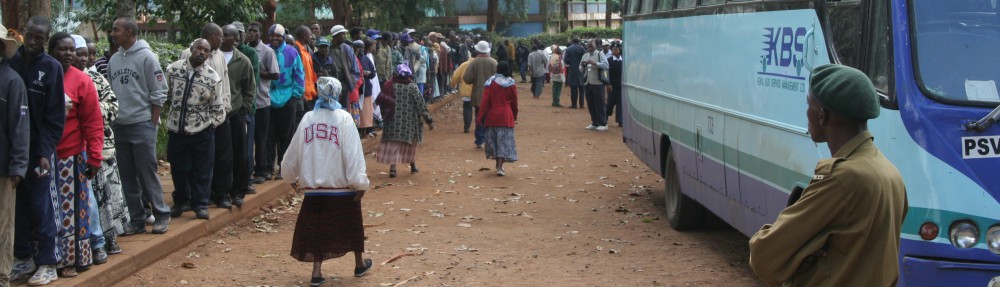
In regard to post election mechanics (analog and digital), these change a lot each election.  Not as much as the law requires perhaps, but significantly.The process of voting by paper ballot, counting the paper ballots by hand and recording the vote by hand on paper on Form 34A and posting it on the door (or in some cases deciding not to) is fixed and well established, 2007, 2013, 2017.  Kenyans have and do “come together” over this process.  They always do it peacefully.

Not sure why people are seeming to find that to be a novelty.  A great and important thing yes–and it should not be taken for granted. Nor should it be misrepresented as “progress” or any form of “change” each time it is repeated.

So no, this peaceful turnout in long lines to vote by this same process in 2007, 2013 and again in 2017 is not, in fact, an act of faith at all as described by ICG.  It is an act of hope each time.  Arguably for many an act of love for country or subgroup.  Kenyans are broadly faithful, but not in the election process as a whole.

Here is the ICG statement.