A thought about the International Crisis Group statement headined “Kenyans should come together” . . .

3387011018_0499c6bf57_o

Kenya election banner Kibaki Nakuru 2007

Yes, of course, they “should”.  As we Americans should also, for instance.  How is another question entirely.  Anyone who wants to “help” Kenyans should engage with them and see what they want and need toward that far off goal.

Needless to say, politics and these elections have not historically been involved in bringing Kenyans “together”.  Quite the opposite in fact.

“Shocking” news again from Kenya:  the more things don’t change the more they stay the same.  This election time is quite different than 2007 or 2013 in many ways and not in others.

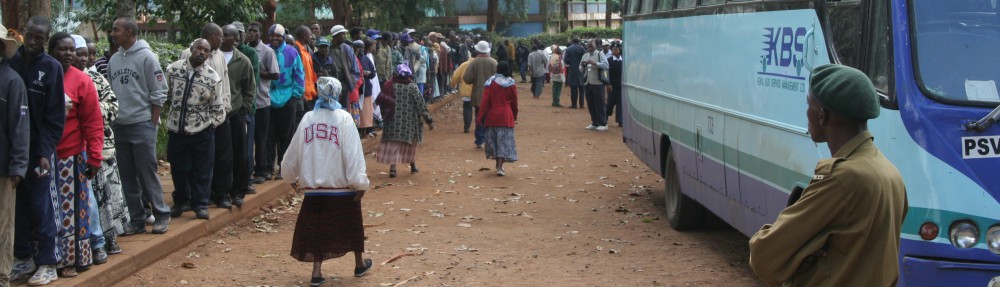
In regard to post election mechanics (analog and digital), these change a lot each election.  Not as much as the law requires perhaps, but significantly.The process of voting by paper ballot, counting the paper ballots by hand and recording the vote by hand on paper on Form 34A and posting it on the door (or in some cases deciding not to) is fixed and well established, 2007, 2013, 2017.  Kenyans have and do “come together” over this process.  They always do it peacefully.

Not sure why people are seeming to find that to be a novelty.  A great and important thing yes–and it should not be taken for granted. Nor should it be misrepresented as “progress” or any form of “change” each time it is repeated.

So no, this peaceful turnout in long lines to vote by this same process in 2007, 2013 and again in 2017 is not, in fact, an act of faith at all as described by ICG.  It is an act of hope each time.  Arguably for many an act of love for country or subgroup.  Kenyans are broadly faithful, but not in the election process as a whole.

Here is the ICG statement.

[Updated 11 Aug] Kenya election updates 

My update is to just say Kenyan IEBC is not done with their job, but I’m done saying anything at all about this election process so far.  Since I’m not involved it doesn’t help to offer public commentary.

Before Kenya’s vote, read Daniel Branch’s The Fire Next Time

If you missed it, amid all the international media scene setters, and very last minute diplomatic appeals, take 9 minutes for “The Fire Next Time: Why memories of the 2007-08 post election violence remain alive.” from Daniel Branch in The Elephant.

Much wisdom on why Kenya has remained stuck following “the debacle of 2007”.

Kenyan election – amid uncertainty, unfortunate there was no Kalonzo v. Ruto debate [updated 7 Aug]

Today [Sunday 6 Aug.] the IEBC announced for the first time that over 25% of its more than 40,000 polling stations do not have network coverage.  Satellite phones have only been provided, apparently, to the 290 constituency tally centres.

So with a very messy voter register again–see AfriCOG report here–the election is entirely dependent on the KIEMS system.   The procurement of the system remains deliberately shrouded, the techical director murdered–with offers of assistance from the FBI and Scotland Yard spurned.  And now the connectivity bombshell.

Along with the deployment by the Kenyatta administration of twice the security personnell as Kibaki deployed in 2013 in the wake of 2007.

So no need to pretend that this is a normal election in which voters could have standard expectations.  Still, the contrast between the coalitions and the generational consequences at issue might have been best captured by a debate between Kalonzo and Ruto.

Update Monday 7 Aug: seemingly keen to signal that there has been no end to the use of the assets of the Government of Kenya for the Uhuruto re-election campaign, the official website of the Office of the Presidency today features this piece dated Saturday to  correspond with the end of the campaign:  “President Kenyatta: I served Kenya diligently–vote for me again“.  Last year Kenyatta and Ruto launched the Jubilee Party as their re-election vehicle at State House in a telling contrast from Kibaki’s 2007 launch of his PNU re-election vehicle at his private Silver Spring Hotel in Nairobi.

The unwillingness or inability of Kenya’s other institutions, including the media, to stand up to the “re-KANUization” of the State by the Executive’s Party is one of the most troubling indicators of the deteriorization of democratic health from the seeming breakthough of the 2003-05 with the NARC coalition defeat of KANU.

Update: here is a VOA overview.

“Kenya: The Economic Stake of the Kenyatta Family; The Royal Family Jewels” – that CIA report after Jomo’s passing


The CIA Africa Review for September 1978 at pages 12-18 covers “The Economic Stake of the Kenyatta Family”. I have embedded it below for downloading in its recently declassified form from the CIA CREST database at the Agency online FOIA reading room. This report is related to the story in The Standard noted in my post “Standard covers newly declassified CIA report on Kenyatta family wealth acquisition during Jomo’s rule”.  I thought you should read it in full for yourself:

1 Sept 78 Kenyatta wealth – The Royal Family Jewels

The report discusses the acquisition of vast acreage, in significant part grabbed through control of British funding for the buyout of former colonists, along with stakes in large Western companies in Kenya such as Lonrho and Ford Motor Company, along with mines and other enterprises. It also says that Mama Ngina and Sister Margaret were at the time probably the largest traders in charcoal and illicit ivory.

The CIA observed that Kenya appeared to be headed to balance of payments problems which would necessitate austerity measures which could trigger political instability. Resentment was already high about the cost of the Kenyatta family’s self-dealing. The risk was exacerbated by the desire of the incoming Moi faction to deal themselves in.

Kenya vote: target turns from “will of the people” to “free and fair, peaceful and credible” to “fair, orderly, credible and nonviolent”

Old KANU Office

Solo 7–Kibera

In the 2013 Kenyan election John Kerry was the American Secretary of State, speaking to Kenya’s elections that year in his role as lead American diplomat.  The U.S. provided key funding as well as embedded technical support for the IEBC in that election, including funding for the failed procurement of an electronic results transmission system.

It was suggested that the election, in spite of a certain disarray and incomplete results, reflected “the will” of Kenyan voters–and was subsequently upheld by Kenya’s Supreme Court (with preliminary observer statements from the Carter Center and EU as evidence offered by the IEBC in litigating against the challenges).

Likewise as Secretary of State Kerry addressed Kenya’s 2017 elections during his official visits in 2015 and 2016.  The second quote above, “free and fair, peaceful and credible”, comes from Secretary Kerry in Kenya last year.  The new terminology for the 2017 vote, “fair, orderly, credible and nonviolent”, comes now from former Secretary Kerry, wearing a new hat as co-leader of the independent International Election Observation Mission being conducted by the U.S. based NGO, The Carter Center. (See Daily Nation 14 July “Ex-Secretary of State insists on fair election“)

Over the years I have written and noted the potential distinctions involved in the decision of international observers to suggest that a particular election “reflected” or corresponded to a standard labeled “the will of the people” on one hand, and on the other to label an election “free and fair.”

An overview and “gateway” is my post “An insider’s explanation of the difference between a ‘free and fair’ election and a ‘will of the people’ election — Kriegler deputy’s memoir“.   The issue is discussed in relation to the internationally supported South African election of 1994 discussed in the recent memoir referred, and on into 2007 and 2013 in Kenya, with Kreigler and IFES re-engaged in a different context.

See especially my post “Are free and fair elections passe in Kenya?“.

The most important point for Kenyans is that the 2010 Constitution adopts explicitly as law a “free and fair” standard.  Peace, order and nonviolence are good and important societal goals.  Many of us are skeptical that tolerating corruption or other substandard conduct in administration of elections is somehow a useful tool to serve peace, order or nonviolence (just as war, disorder and violence do not clean up the election process).

Must read on election tensions in Kenya: “A Silent Panic”

ELECTION 2017: A Silent Panic in Kenya by Dauti Kahura in The Elephant.

A series of backstories of building tensions with the latest election approaching on the layers of accumulated grief and injustice.  This is the stuff you don’t hear if you don’t have a practiced ear to the ground in Kenya and may be glossed over in the usual discussion in foreign capitals and international press.  And material that is too topical for the traditional Kenyan media with political power at stake. 

Congratulations to The Elephant for “speaking truth to power”.

Mocking democracy: Government of Kenya announces “Kenyan Asian community backs President Kenyatta’s re-election”

Democracy Assistance

“URAIA Because Kenyans Have Rights”  — Democracy Assistance facade?


[Update: The Daily Nation, State Officials on the campaign trail“:  “The Jubilee administration has deployed civil servants and key government officials on vote hunting missions across the country in contravention of the law.”]

Let it not be said that there is any serious pretense that the Government of Kenya is neutral in the contest for political allegiance of potential “swing” ethnic groupings, rich in votes or money, in the current election, a contest for power between the Uhuruto ticket representing the current generation of the original KANU establishment led by the Kenyatta family and an opposition coalition led by Raila Odinga and Kalonzo Musyoka.

Here is the “latest news” from the Government of Kenya, Office of the President (www.president.go.ke): “Kenyan Asian community backs President Kenyatta’s re-election”.

This years’ “Jubilee Party” was literally formed at State House as the Uhuruto re-election vehicle, formally merging Uhuru Kenyatta’s TNA and Ruto’s URP, just as this meeting of State Officials and “Asian” Kenyan businesspeople and politicians for the re-election campaign was convened at State House.

Conduct of this sort, aside from being a clear form of corruption per se as a misappropriation of public resources for private gain, is explicitly against the mandatory Code of Conduct for the Kenyan political parties.  (On paper the campaign, in full swing for months, is not even to start until May 28.)

Will the Registrar of Political Parties and the Independent Electoral and Boundaries Commission take action?  The IFES led consortium of US based organizations both facilitating and underwriting the cost of the election, while also coordinating its “observation” at the expense of American (and in parts Canadian) taxpayers?  What about ELOG, the donor supported Kenyan observation group?

IFES has already beeen attacked by the Kenyan Government and ELOG is charged with continuing to do business in Nairobi on a permanent basis, so it would be a huge act of institutional courage for it to seriously challenge the conduct of the Office of the Presidency.  We have been in the mode of continuous institutionalized democracy promotion in Kenya for 15 years (!) now.  No matter how many  capacity building seminars we hold for the little people in the cities or the politicians in the resorts in the Rift Valley or at the beaches, if we let ourselves simply be mocked and pretend that this is working we will surely risk moral injury to our own democracy.

Read the whole campaign piece here:

The Asian community in Kenya has endorsed the re-election of President Uhuru Kenyatta.

Leaders of the community said they have taken the decision to rally behind the President because of his commitment to creating an enabling environment of business and development.

The leaders, who visited President Kenyatta at State House, Nairobi, said policies implemented by the Jubilee Government have enabled more business to thrive and made Kenya a preferred destination for investors.

At the meeting which was also attended by Deputy President William Ruto, representatives of the community assured the President that they would rally behind him to ensure the country’s development tempo is sustained.

“What we have seen in the last four years needs no magnification and my words can be supported by facts that can be seen and quantified, “said businessman Iqbal Rashid.

The businessman cited the upgrading of the old railway system with the Standard Gauge Railway, the upgrading of the Jomo Kenyatta International Airport and continuous improvement of the infrastructure connecting cities and towns.

He said the continued flow of investments into Kenya from all corners of the globe was as a result of the confidence in the leadership of President Kenyatta.

Women leaders Parveen Adam, Shamsha Fadhil and Farah Mannzoor thanked the President for championing an agenda that fosters inclusiveness as well as the prosperity and unity of all Kenyans.

They said women appreciate his efforts to spearhead the campaign to have the two third gender rule passed by the National Assembly.

Businessman Bismiahirahman Nirrahim said the Asian community has witnessed the transformative leadership of President Kenyatta which has helped in creating conducive environment for investments.

He cited the increased ease of doing business resulting from President Kenyatta’s policies including the policy to reduce the time it takes to register a new business.

Nirrahim said the youth and women empowerment program implemented by President Kenyatta’s Administration has also been a transformational policy that deserves praise.

President Kenyatta thanked the leaders for their support and assured them that he would continue working tirelessly to make Kenya a more prosperous country with shared prosperity.

He said the Asian community has been keen in developing Kenya saying the community has always been in the forefront championing the interests of the nation since the days of independence struggle.

“Like all of us you were part and parcel of the Kenyan struggle for Independence, the role you played cannot be ignored,” said President Kenyatta.

The President said he is a believer in an inclusive society adding that he would want to see the Asian community participate more in both social and economic development of the country.

“This is the government that believes in encouraging partnership and working together. Your success is our success,” said President Kenyatta.

Also present were the Chief of Staff and Head of Public Service Joseph Kinyua among other senior government officials.

Author

Gok

Update May 26:  See “Asian Kenyans seek to be declared a ‘tribe’ of their own” in today’s New York Times.

Latest Kenya election remarks from Amb. Godec emphasize need for change; corruption undermining democracy

imageU.S. Ambassador Godec spoke out strongly on corruption in pre-election remarks to students at Maseno University on Wednesday as reported by CapitalFM: “Vote so as to bring change to Kenya says U.S. envoy.”

While emphasizing he personally and the United States favored no candidate or party among Kenyans’ choices, Godec stated:

Corruption is undermining the future of Kenya.  It is creating huge problems and it is underming democracy., security and having a very bad effect and this needs to change.

We seem to be seeing a policy shift from the U.S.  We were strongly opposed to government corruption off and on under Moi after the Cold War and we were also opposed to corruption in 2005-06 with the Anglo Leasing and other scandals.

After getting burned, perhaps, for changing positions in 2007 to become soft on corruption under Kibaki and looking the other way as he stole re-election, we were back to being “against” to some degree on a “go forward” basis after the formation of the “Government of National Unity” in Kibaki’s second Administration.  We preached “the reform agenda” through passage of the referendum to approve the new constitution in 2010 (noting that one pesky problem:  Daily Nation reports that USAID Inspector General has found that US funding did go specifically to encourage “Yes” vote on referendum.)

After years now of being back on our heels for whatever reason, we have rediscovered the dignity required to speak up and now to take a “small dollar” but conspicuous and significant action in suspending a little over $20M in support for the looted Ministry of Health, and now open acknowledgement of that the magnitude of the problem has reached a point that it is a critical threat.

US State Dept clears another possible $250M+ sale of light attack aircraft for Kenya; Human Development Index shows Kenya at 146 of 188 countries with “region’s worst jobs crisis”

Update: see Daily Nation: “Analysts skeptical of impact in Somalia of Kenya arms purchases“.

From the Defense Security Cooperation Agency release:

. . . .
This proposed sale contributes to the foreign policy and national security of the United States by improving the security of a strong regional partner who is a regional security leader, undertaking critical operations against al-Shabaab, and a troop contributor to the African Union Mission in Somalia (AMISOM).

The proposed sale of the MD 530F helicopters, weapons, ammunition, support items and technical support will advance Kenya’s efforts to conduct scout and attack rotary wing aircraft operations in support of their AMISOM mission. The MD 530F will also replace Kenya’s aging MD500 fleet, which is the current reconnaissance platform supporting Kenyan ground forces. This sale will significantly enhance the Kenyan Army’s modernization efforts and increase interoperability with the U.S. Armed Forces and other partners in the region. Additionally, a strong national defense and dedicated military force will assist Kenya in its efforts to maintain stability in East Africa.

Kenya will have no difficulty absorbing this equipment into its armed forces.

The proposed sale of this equipment and support will not alter the basic military balance in the region.

The principal contractor will be MD Helicopters, Mesa, AZ. There are no known offset agreements proposed in connection with this potential sale.
. . . .

The $418M L3 Air Tractor sale approved by the State Department in January remains pending for U.S. Congressional approval after objections raised by Rep. Ted Budd of North Carolina.

Kenya had the largest military spending in the East African region in 2016 at $908M as reported by SIPRI.  Finalization of these two sales of attack aircraft this year would account for dollars equivalent to roughly 60% of last year’s spending.

Here is the headline story from Business Daily: UN report shows Kenya’s jobs crisis worst in region“.  The full UN Human Development Index report and related material can be downloaded here.

It may be worth noting that the United States spends quite a lot of money through many institutions scattered across our country and in many others on the study of and writing reports about the factors driving security threats from the types of things we are concerned about in East Africa.  I am not an expert on this and do not have time to read most of this as an interested amateur, but generally speaking I think the research tends to highlight concerns related to the Human Development Index factors and in particular the jobs crisis over any problems with lack of military hardware.  Perhaps I misunderstand.