Election Observers and the “Emperor With No Clothes” Phenomenon

Surely there is embarrassment over the allegation made by observers that hundreds of thousands of Kenyan voters confused the green ballots for National Assembly and blue ballots for Senator, and made similar improbable errors, due to “lack of civic education”.

This was offered as an explanation for huge numbers of “invalid ballots,” which turned out to be the bogus data from the IEBC from their electronic reporting system before it was taken down.

In other words, when the Kenyan IEBC reported something that did not make sense–and clearly was contradictory to what actual observers SAW in the field with their own eyes since it did not really happen–some self described International Election Observers, rather than point out that they did not see what the IEBC was reporting, instead, sought to concoct specific explanations for why the voters instead of the electoral commission (or hackers or whomever caused the data fault) was responsible.

Who would have the outrageous moral audacity to go to court to question 4100 votes out of 12M rather than defer to “crimes against humanity” suspects?

A simple question of what Kenyans chose to expect of and hope for themselves really, for them to answer.

Everyone is tired, no question. Most Kenyans are poor, and the breakdown of the IEBC process caused loss in the economy which hurts poor Kenyans the most. At the same time, the short term value of sweeping another electoral commission fiasco under the rug would be balanced by a huge cost in terms of the dreams of democracy that seemed to have been achieved in the 2002 vote.

The situation regarding the vote is less clear than in 2007, but the meaningful ability to go to court exists this time, unlike in 2007. Should the legal process be shelved now that it is finally available–and if so, will it be available again?

Kenyan High Court, while finding no jurisdiction to examine IEBC’s process because it touches on the election of a President, states that civil society case raises issue that should be examined in appropriate forum

My personal heroes with Kenyan civil society, the African Centre for Open Governance, went to the Kenyan High Court this morning with a petition seeking equitable relief to direct the IEBC to follow the election law, focusing on the verification of actual voting by polling station as discussed in my previous post.

The court ordered argument on jurisdiction alone at 11:00am in front of a three judge panel appointed by the Supreme Court, with ruling to be announced at 3:00. The ruling was not announced until 4:30. The court ruled essentially that any challenge to IEBC procedure related to the presidential election such that it could only be brought in the Supreme Court of Kenya. IEBC’s lawyer also argued that the Supreme Court could only hear the case after the IEBC declares an election result, although that would presumably be a decision for the Supreme Court itself. Thus the High Court “struck off” the case, finding no jurisdiction to act.

However, the Court did state that they had reviewed the affidavits and other evidence presented in support of the petition and found that they raised issues that were “not idle” and should be pursued in the appropriate forum. And ruled that each side to bear its own costs.

Things remain with the IEBC the time being.

Taking Down My Last Post . . . Kenyan Election Is “Overeported” and “Under Researched” based on lack of transparency

The voting was over by Tuesday, March 5. The IEBC (the Kenyan replacement for the previous discredited Electoral Commission of Kenya or “ECK”) then has seven days to announce final results from the votes, which are cast by paper ballot and counted (only) at the individual polling stations around the country. The results at each of the more than 30,000 polling stations around the country are set out on multiple original official forms which are signed by the election official and the political party agents. One original is then posted on the door of the polling station where the counting has been done. This way the public can see the results while the armed guards at the door keep the public out of the room where the physical ballots are secured back in the sealed ballot box after counting.

Since the digital transmission of results failed for reasons that remain unexplained factually but much pontificated about, we are left with less information early than we would have hoped. But, as long as the forms remain available for each polling station, and are open to the public, we ought to be able to nail down how people voted–at least as the votes were counted.

Unfortunately, there is much pressure to rush and do something less than verification based on the actual documented count of the votes.

In 2007, the actual voting results were ultimately never released or disclosed, and while many court petitions were successfully adjudicated in parliamentary and local races, the Kreigler Commission appointed under the post election settlement to investigate the failed election passed on any further effort to actually determine the presidential votes as counted and announced at the polling stations. While there are alleged “official results” published by the ECK, they are only alleged aggregated numbers by parliamentary constituency, not by actual unit of voting and counting.

For my American readers, imagine results for the presidential election that are announced only in aggregate by Congressional District.

See my previous post for the results at the polling station where I observed. This information should be available for each polling station, and should then add up to what is reported as a matter derivatively on up the chain.

Closing out polling station and presidential count: amazing Kenyans exceed 80% turnout in spite of technology failure

Okay, congratulations are in order for a great job by presiding officers and polling clerks, and incredibly patient voters at the polling centre where I spent the late afternoon and on until finishing the presidential count and posting the signed off results on the door to be photographed at the stream I was covering.

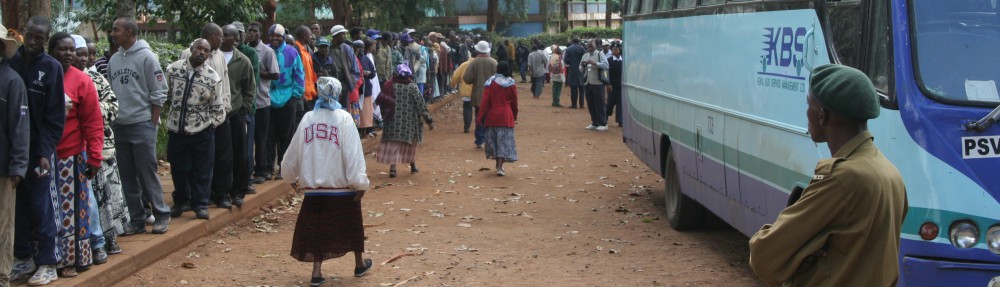
Everyone got better at adapting to the absence of the technology and the cumbersome process and voters moved much faster through the remaining lines in late afternoon and early evening. Having stood in the hot son all day in huge lines surely motivated everyone to get done, but essentially no grousing was to be heard where I was at that point.

Turnout at the stream I closed was 626 valid votes cast for president from 755 registered voters. So over 80%. The boxes were jammed full of ballots but the system worked. Totals for president were Odinga 433, Kenyatta 170, Mudavadi 8, Kenneth 7 and the rest less. Dida was the only presidential candidate in that stream to get 0.

Will post “snaps” soon.

More impressions from observing voting in Nairobi

One big challenge is slowness of process–certainly no surprise at all which is why my civil society colleagues asked that the contingency plans for this be announced ahead of time by the IEBC (electoral commission). Poll openings at 8-10am appear common in Nairobi rather than scheduled 6am–again no surprise given the logistics involved. It certainly appears that in most cases a paper rather than electronic poll book is in use. Further it appears that complete absence of working electronic BVR for voter identification is common. Some polling streams never received hardware at all; others received too little or found it unusable for whatever reason.

Wholly manual voting then is normal, even though the voter registration was truncated to provide for the use of BVR. Given that the voting is inevitably slow and the turnout is huge, I heard from one fellow observer of polling station workers just taking down names of people who presented IDs and allowing them to vote because it would take too long to try to find and check off names on the paper lists.

The voters are being in general extremely patient with hours of pre-dawn queuing and waiting in hot sun. Ordinary Kenyans in Nairobi certainly are demonstrating both peace and a commitment to the voting process itself.

The unexpected problem, to me and people I have spoken with, is that the ballot boxes were getting close to full with only a relatively small percentage of voters having voted. Presiding officers indicated no backup capacity, but were shaking the boxes to settle the cast ballots..

More concerns about Kenya’s readiness for elections

The Standard this afternoon: Nation Dialogue report questions readiness for credible election.

The full report from South Consulting for the team led by Kofi Annan is here.Among the conclusions:

*The IEBC is also highly rated by Kenyans. Over 90 per cent of respondents said they have confidence in the IEBC, and a similar number believe that the IEBC is independent enough to conduct the next elections. However, there are concerns that the IEBC has been inconsistent with deadlines. While the eventual levels of registration achieved are respectable by any standards, the Commission had to lower its targets and expectations on voter registration to what was achievable. Furthermore, the requisite managerial capacity of the IEBC to conduct elections is yet to be properly tested. Elections comprise several tasks, all rolled into one major task, and carried out in a few days. On account of this, the Commission should carefully test and review its systems and address any weaknesses before the actual date of the election. This is important to ensure there are no feelings of false security.

*Confidence in the police and in political parties remains relatively low compared to the Judiciary and the IEBC. Although public confidence in the police and political parties is relatively low, the appointment to of an Inspector General of Police alongside the promise to undertake fundamental reforms is likely to draw public trust. Gaining this trust is critical, given the poor level of preparedness that the police have shown in halting the violence taking place in some parts of the country.

*Political parties continue in their old ways; some are allegedly recruiting members through fraud. Parties are still tied to individuals who founded them, and some are still based on ethnic identities and loyalties. As a result of this party primaries conducted in January failed to demonstrate any clear break with the past. The behaviour of political parties has detracted from requirements of the Political Parties Act, 2011, and the Elections Act, 2011, which legislators have mutilated or watered down to serve their political survival interests.

*Party hopping, formation of alliances by elites who do not consult members, and founding parties on ethno-regional platforms is happening in spite of the law and the new Constitution. Unfortunately, responsible public officials are yet to apply sanctions on political parties and the key leaders. Without injurious consequences for their actions, politicians will continue ignoring the rule of law and by that weaken the foundation of a credible election.

Meanwhile, The Nation reports on a dispute between the new Inspector General of the Police and the chair of the National Police Service Commission which resulted in intervention by the Permanent Secretary in the Office of the President and comment from the Independent Police Oversight Authority.

I am working on a more detailed discussion of the problems with the readiness of the Kenya Police Service where reforms have just started to scratch the surface due to delayed implementation of the mandates that were called for by the new constitution. In the meantime, here is the link to the full report released by Amnesty International on January 30 entitled “Kenya Police Reform: A Drop in the Ocean.”

President Obama releases message to Kenyans on election

President Obama’s Message to the People of Kenya
February 5, 2013

Habari yako. Over the years, I have been greatly moved by the warmth
and spirit – the strength and resolve – of the Kenyan people. And I’ve
been grateful for my connection to Kenya, and the way you’ve welcomed
me and my family to your beautiful country – from my father’s village
in Alego, to bustling Nairobi.

In my visits, I’ve seen your progress. Kenya has lifted people from
poverty, built an emerging democracy and civil society, and sustained
a spirit of hope in the face of great difficulty. After the turmoil of
five years ago, you’ve worked to rebuild communities, reform
institutions and pass a new constitution.

Now, Kenya must take the next step in March, with the first national
elections under your new constitution.

We all know what makes for successful elections. Kenya must reject
intimidation and violence, and allow a free and fair vote. Kenyans
must resolve disputes in the courts, not in the streets. Above all,
the people of Kenya must come together, before and after the election,
to carry on the work of building your country.

The choice of who will lead Kenya is up to the Kenyan people. The
United States does not endorse any candidate for office, but we do
support an election that is peaceful and reflects the will of the
people.

This election can be another milestone toward a truly democratic Kenya
defined by the rule of law and strong institutions. If you take that
step, and reject a path of violence and division, then Kenya can move
forward towards prosperity and opportunity that unleashes the
extraordinary talents of your people – especially young people. If you
continue to move forward, you can build a just Kenya that rejects
corruption, and respects the rights and dignity of all Kenyans.

This is a moment for the people of Kenya to come together, instead of
tearing apart. If you do, you can show the world that you are not just
a member of a tribe or ethnic group, but citizens of a great and proud
nation. I can’t imagine a better way to mark the 50th anniversary of
Kenyan independence. And I say to all of you who are willing to walk
this path of progress-you will continue to have a strong friend and
partner in the United States of America. Kwaheri
 

[Updated] International Crisis Group releases key up-to-date guide to Kenyan election preparations

Toi Market-Nairobi

Update– the Associate Press reports “Analysts: Political Party Polls in Kenya a Failure”:

Political party primaries to select candidates for Kenya’s March national elections have been fraught with irregularities, disorganization and disgruntled losers, increasing the chances of conflict during the upcoming vote, analysts said Friday.

That’s bad news for those trying to avoid a repeat of what happened after Kenya’s 2007 elections, when a dispute over who won the presidency led to weeks of violence that left more than 1,000 people dead. The primary voting this week did little to instill confidence that officials are ready for another national vote.

.  .  .  .

Kennedy Masine, an official of the local Election Observer Group, described Thursday’s attempt to hold nominations as a “phenomenal failure.” . . .]

I’ve now finished an initial reading of the ICG report released yesterday entitled “Kenya’s 2013 Elections.”  It’s an important resource for two key reasons: 1) it is strikingly up to date for this kind of thing, with lots of new information, including footnote references for events even this week; 2) it is relatively comprehensive, covering a lot of ground in substantial detail.  It gives fair, sober assessment of the status of the major areas of reforms that were identified as needed in the wake of the disaster in 2007-08.  I hope it will be updated quickly once things shake out further with the primaries over the next few days.

In fact, you could take this report and prepare a “grade card” for implementation of the “reform agenda” over the course of the Government of National Unity.  Without being cynical or fatalistic, it would simply have to be quite low so far.  Regardless, by gathering a lot of the information that a lot of us have been thinking about in various areas in one place, the report could also be used as a road map to realistically “play to strengths” in the terms of the existing Kenyan institutions and develop last minute contingency plans and “gap fillers” in those areas where reforms and preparation are clearly going to be getting an “incomplete”, such as policing.  Surely it is clear by now that there need to be plans in place for how to provide extraneous security support beyond the Kenya Police Service in the event of a crisis triggered by major failure of the election itself.

Here is the Executive Summary with a list of recommendations.

An interesting point of reference is the NDI Kenya Pre-Election Mission of May 2012, to see what has been accomplished and not accomplished in the meantime.

Worth reading on Kenyan pre-election violence, and challenge ahead for March election

“John Githongo: Former Anti-Corruption Czar on a mission to change Kenyan leadership” from November 2012 Think Business at “Kenyan Magazines”:

Based on Inuka Kenya’s mapping using information provided by credible Kenyan organisations and partners, more than 480 people have been killed since January 2012 in this violence. “It is pre-election violence associated with the new boundaries and the struggle for power. It is so insidious that it is almost passing unnoticed,” says John.

The new constitution, he adds, poses a lot of challenges for the transition process in terms of implementation. We have created new boundaries, instituted a system of devolved government and initiated new laws. Even the more developed economies have not attempted to implement the number of changes we are attempting to implement at the moment at one go. “We are a very versatile people but we will be tested in a way that is unprecedented.” He worries that the danger of things falling apart is that the disillusionment that might follow will cause Kenya to implode, not to explode, “Like an ice cream melting in the sun.”

“The biggest challenge the IEBC faces” by Wycliffe Muga in The Star.