Could Rwanda’s Kagame get thrown out of the “smoke filled room”?

The Chairman of the House Foreign Affairs Committee, Rep. Ed Royce (R. Calif.)  has released a letter yesterday “decrying targeted killings of Rwandan regime critics abroad” in which “the Chairman urged Secretary Kerry to reevaluate U.S. engagement with Rwanda, including future assistance”:

Dear Mr. Secretary: I am writing to express my deep concern over the numerous attempted attacks and killings of Rwandan dissidents living outside that country. Any functioning and responsible democracy allows the voices of opposition to be heard. Yet in Rwanda there is a systematic effort to silence – by any means necessary – the voices of those who question the regime in Kigali.   .  .  .  .

This really strikes me as a potentially major setback for Kagame.  In addition to the support Kagame has had from those who were at the helm in the U.S. executive branch 20 years ago during the 1994 genocide and Kagame’s ascension, he has also had an extra level of support in recent years from some House Republicans and others in the Republican Party.  Part of it is the same type of thing that kept Museveni and the Ethiopian regime of Meles Zenawi in favor with some on the “right” in American politics well after most people who pay attention to Africa got over the notion that this class of rulers represented a “renaissance generation” of semi-democratic leadership.  Kagame has lost a lot of his American support over the last few years over the exposure of his actions in relation to the DRC and his growing authoritarianism, even though continuing to solidify his stature as a “go to” source for troops for the U.S. and Europe in the region and a secure landingpad for global investment endeavors. (h/t Cameron Hudson @cch7c on the Royce letter)

Kagame may have finally gone too far to stomach for both the Republican and Democrat mainstream in Washington.

A next question will be what reaction we see from the global elite, what some might refer to as “the Davos crowd”, including the wealthy investor/philanthropist/celebrity networks which have patronized Kagame.  In fact, the World Economic Forum last year was the venue for Kagame to announce with “homeless billionaire” Nicolas Berggruen, Nigerian investor Tony Elumelu and former U.S. official Jendayi Frazer the launch of the “East African Exchange” in Kigali.

As reported at the time in Africa Mining Intelligence, “Kigali, Future minerals trading platform” : “[A] commodities exchange in East Africa that will deal initially with farm goods and minerals covering the entire Great Lakes region, will be set up in Kigali, capital of Rwanda . . . The inauguration of the East African Exchange (EAX) will be seen to by a consortium whose most prominent figure is Jendayi Frazer who was a U.S. assistant secretary of state for African affairs under George W. Bush.”

Continue reading

The Year Ahead in Tanzanian Politics

Commentary in the East African suggests that former prime minister Edward Lowassa is the man to beat in the race to succeed Jakaya Kikwete as president next year.  Lowassa resigned in 2007 over a scandal involving a power generation contract.  (The energy sector has continued to suffer from corruption scandals.)

Mr Lowassa seems to have gathered many supporters who have stuck with him through his troubled career. In 1995, he was among the more than 15 CCM aspirants for the presidency but he was stopped in his tracks by then retired president Julius Nyerere, who found him to have enriched himself rather too fast.

Mr Lowassa was eliminated by Nyerere’s fiat and that contest within the party was eventually won by Benjamin Mkapa (over Kikwete), who also won the election.

It remains to be seen whether the power-plant scandal will be resuscitated to haunt Mr Lowassa’s campaign or whether he will use this campaign to reiterate what he has said in party caucuses — that whatever he had done he had done with the full knowledge of Kikwete and with his approval and/or instructions.

For a deeper look at the state of Tanzania’s ruling party and the potential restructuring of government under a new constitution, see Hanno Bankamp’s piece in Think Africa Press, “CCM’s Identity Crisis: Comebacks, Constitution and Corruption in Tanzania”.

In late news, Tanzania’s Attorney General appealed to members of the Constituent Assembly–assigned to review and revise the latest daft constitution for a referendum in advance of the 2015 election–not to use bribery in the election of their Chairman and Vice Chairman.


The U.S. “official” infatuation with Kenya, in numbers

I’ve spent some time looking at “Official Development Assistance” (“ODA”) numbers for Africa to test my perception that the U.S. seems, for some reason that is hard to pin down, to give an inordinate amount of “development” money to Kenya.

At play Monkeys at play on UN vehicle

Sure enough. Going through the ODA summaries by country from the OECD, for each of 47 countries in continental Africa, we find plenty of verification of this. The U.S. is the leading bilateral ODA donor for 25 of the 47, including Kenya (Kenya’s number two donor is Japan). Kenya is the number three recipient of bilateral ODA from the U.S. for a 2010-2011 annual average (the most recent listing) of $642M, behind only the Democratic Republic of Congo at $1,053M and Ethipia at $791M.

On a per capita basis this is $15.53 for DRC, $15.43 for Kenya and $9.34 for Ethiopia. What about “need” based on poverty? PIn the DRC the Gross National Income (GNI) per capita is $190; in Ethiopia $400. Kenya, on the other hand, has a GNI per capita of $820, more than double that of Ethiopia and well more than four times that of the DRC.

Across the continent as a whole, Kenya ranks ninth in per capita U.S. ODA. Three countries of those getting more per capita are special cases: Liberia and South Sudan, post-conflict states where the U.S. has a special historic relationship and responsibility relating to the founding of the country itself and Libya, an immediate post-conflict situation where the U.S. government was instrumental in supporting the removal of the prior regime. All of the recipients ahead of Kenya except for the DRC have relatively small populations.

Among the five countries of the East African Community, Kenya receives both the largest amount and the most per capita in ODA from the U.S., even though its GNI per capita is by far the largest:

Country        GNI Per Capita      U.S. Bilateral ODA      Per Capita      Rank/Reference

Burundi           $250                             $48M                      $5.58        2 (1-Belgium 161M)

Kenya             $820                              $642M                   $15.43       1 (2-Japan $139M)

Tanzania         $540                             $546M                    $10.74          1 (2-UK $219M)

Rwanda           $570                             $167M                   $15.32           1 (2-UK $121M)

Uganda           $510                              $388M                   $11.24           1 (2-UK $163M)

————-
And a sampling of other countries of interest:

Somalia           —-                                 $90M                      $9.38           2 (2-UK $107M)

C.A.R.           $470                                $16M                      $3.56           3 (1-France $29M)

Malawi          $340                                $140M                    $9.69           1 (2-UK $126M)

Mali               $610                                $232M                  $14.68          1 (2-Canada $106M)

Niger             $360                                  $97M                     $6.02          1 (2-France $56M)

Chad              $690                                $124M                    $10.75       1 (2-France 45M)

[Updated June 3] “Kenya’s Elections: Observing the observers”

The new June issue of Africa in Fact published by Good Governance Africa based in South Africa has an article, “Kenya’s Elections: Observing the observers” by Mienke Mari Steytler.  I hope you will take time to read it.

The article included some observations on the work of the Election Observation Missions from interviews in Nairobi with yours truly as an independent consultant and responses and comments from others.  Here is one example:

The EU and the Commonwealth missions are also known for their independence and diplomacy, but others—particularly groups representing intergovernmental bodies—are less critical and independent, according to Mr Flottman. The AU mission had 69 observers and visited 400 polling stations throughout the country. The IGAD/ EAC/COMESA coalition deployed 55 observers to this year’s election.

Kenya is a member of the AU, IGAD, the EAC and COMESA, and they share geopolitical interests. Mr Flottman emphasised that observer missions representing the regional groupings are unlikely “to challenge any position of government”. For instance, the IGAD coalition mission declared the party nominations stage a success, Mr Flottman said. “They said the primaries were good. This is a nonsense statement. No one said that, come on.”

“Observer missions from the AU, SADC [Southern African Development Community], EAC, ECOWAS [Economic Community Of West African States]…because they are intergovernmental bodies, there is the ‘you rub my back, I’ll rub yours’ approach to certifying elections,” EISA’s Mr Owuor said, supporting Mr Flottman’s view. “In other words they were not very critical in an effort not to offend the current government.”


Update: on the issue of the use of the term “free and fair”, see The Star, “March 4 polls free, fair – EU”:

EUROPEAN Union election observers have said that the March 4 general elections in Kenya were “overally successful, free and fair” despite reported flaws.

They have however said the processing of the final results by the Independent Electoral and Boundaries Commission “lacked the necessary transparency as party agents and election observers were not given adequate access to the tallying centres”.

Speaking yesterday in Nairobi while releasing the final report, EU elections observation mission chief observer Alojz Peterle said there are several lessons from the difficulties that arose during the process.


Here is the link to the entire issue for pdf download:  Africa in Fact:  June 2013–Elections: Make Them Count.

So who is “Good Governance Africa”?  Here is an interview by Africa in Fact editor Constanza Montana of John Endres, CEO of this “new kid on the block” of organizations working to improve governance in Africa.

Update:  See also this recent piece from Think Africa Press by Dr. Judith Kelley at Duke: “Watching the Watchmen: The Role of Election Observers in Africa”:

. . . There are certainly sometimes questions about the conduct of outside observers.

Elections in Kenya unfortunately often provide a case in point and the latest is no exception. The EU monitors have been dragging their feet, with their final report now overdue. EU observer mission spokesman, Peter Visnovitz, reportedly promised the report would be made public by 4 May, but we are still waiting. Furthermore, in its initial press release (before the counting was complete), the EU was positive despite noting that the biometric voting process disenfranchised more than 3 million voters.

Why is the EU taking so long for its final assessment? The Kenyan Star claims that an internal report revealed strong reservations about the processing of the results. Meanwhile, the International Crisis Group (ICG) noted numerous problems and criticised the swiftness with which international observer groups pronounced all well in Kenya’s vote.

Earlier commotion around international observers in Kenya includes their muted response to the problems in the 1992 election; the mission was eager to send positive signals to calm fears of upheavals and resume aid. Their conduct in Kenya’s 2007 election also drew criticism from the UN Independent Review Commission; the body reported that monitors had at times based their claims on misunderstandings.

Time for an African solution?

International observers are clearly not perfect. But the final part of Obasanjo’s argument – that cure for the problem is for African monitoring groups to take over from international missions – rests on equally shaky grounds.

It is true that African groups have become more active. The AU, SADC, ECOWAS, and the electoral Institute of South Africa (EISA), among others, all now feature election observer missions. The AU started as far back as 1989, and the other groups have joined in the last 10 years or so.

That, however, is where the argument stalls. By and large, these groups are not ready to take over as the sole option for election observation on the continent. They have limited resources and experience, their sponsors or member-states are often not particularly democratic themselves, and most importantly, because these organisations are even more embroiled in politics on the continent, they are often more biased than non-African observers.

EAC: Complaining of “lack of democracy and ideological disorientation” holding back Africa, does Museveni have any self-awareness at all?

American President George W. Bush meets with P...

American President George W. Bush meets with President Yoweri Museveni of Uganda Friday, July 11, 2003 in Entebbe, Uganda. (Photo credit: Wikipedia)

From the Daily Monitor, “Museveni faults Africa” 

President Museveni has said the “lack of democracy and an Ideological disorientation” are some of the 10 bottlenecks that have kept Uganda and many African countries listed as Least Developed Countries.

The President told the East African Legislative Assembly meeting in Rwanda that the continent suffers an “ideological disorientation whereby the reactionaries fragment the African people into sectarianism of tribe, religion and gender chauvinism”.

The statement does not, however, elaborate what he meant by absence of democracy. He added that Africa continues to lag behind despite being “favoured by God and nature.”

For a different take on Museveni’s “State of the EAC Address” see this report from the EAC website.  The discussion here picks up on Museveni’s call to go beyond economic integration to “Political Federation”.

GADDAFI AND MUSEVENI
Gaddafi and Museveni

Related articles

•  Uganda: new links for ongoing themes . . . (africommons.com)

 More on Moi, KANU and Ruto meetings with Museveni (africommons.com)

•  Uganda’s Independent features CSIS report on risk of instability with NRM decline, Museveni succession (africommons.com)

 Another Ugandan weapons procurement scandal? (africommons.com)

 Enough to drive one to drink . . . Museveni on Gaddafi (and Western company bribes to Gaddafi) (africommons.com)


Is Uhuru on his way to being the next East African authoritarian American darling?

Uhuru Kenya presidential campaign rally trash

Before noting the choice of speakers for the Uhuruto inauguration, the idea that governance in Kenya might be in the process of falling in line with its East African neighbors has been much on my mind since the IEBC’s decision on the election on March 9.

Museveni as the featured speaker–and what he had to say–certainly fits this theme.  Museveni can readily castigate the ICC and “the West” for meddlesome advocacy of international standards, knowing that he has a mutual “security” relationship at a deeper level with the United States.  He gets criticized by the U.S. for changing the constitution to stay in power, and for taking and keeping control of the Ugandan electoral commission–but without discernible “consequences”.

Uhuru himself in his speech said nothing about corruption–a major theme in the KANU to NARC transition and the original Kibaki inauguration, and well understood to be the Achilles Heel for Kenya’s economy.  And as I have noted before, the Jubilee platform’s only “plank” relating to governance is a proposal for active state intervention in the civil society arena.

Museveni and his NRM have been associated with the KANU of Moi and of Uhuru and Ruto over the years and at some level Kenya post-Moi has been an outlier in the East African Community of Uganda, Rwanda, Burundi and Tanzania.  As well as Museveni, one naturally thinks of Rwanda’s Paul Kagame and the recently departed Meles Zenawi in Ethiopia as authoritarian heads of state who could count on strong support in Washington at a variety of levels–both in terms of underlying security relationships and friendships with American politicians who could be counted on for advocacy in the face of international controversy.

Uhuru himself, quite the contrary to his short-lived campaign rhetoric this year as an ICC indictee, has been a favorite Kenyan politician of many in the American establishment.  He talks the talk well.  He was educated in the U.S. and has been a frequent visitor.  A “family friend” of former Assistant Secretary of State Frazer by reputation.  Rich even by American standards, and a business owner whose inherited fortune was generationally cleansed from openly kleptocratic political origins.  Before the confirmation of the ICC charges but after the 2008 post-election violence when the issues with the alleged funding of the Mungiki attacks in Naivasha and Nakuru were well known, he was a primary lobbyist for the Kenyan government in the U.S. seeking things like a Millennium Challenge Corporation Compact.  Before the 2007 election, he entertained official American visitors including Senator Obama as the “Official Leader of the Opposition”.  He was singled out for positive recognition in a report by CIPE, the Center for International Private Enterprise (the National Endowment for Democracy’s core institute under the United States Chamber of Commerce) and was spoken of in government as a Kenyan who “says the right things”.

A U.S. foreign policy establishment view on how the United States should deal with a Kenyatta administration was offered in a Foreign Affairs piece by Bronwyn Bruton of the Atlantic Council just before the election:

. . . In all likelihood, the first round of voting will lead to a runoff election on April 10 between Raila Odinga, the current prime minister of Kenya’s hastily-constructed unity government, and Uhuru Kenyatta, Kenya’s deputy Prime Minster and the son of Kenya’s first president. The tightness of the race bodes ill; it is unlikely that either side will be able to score a quick victory, and it will not take much vote rigging to influence the election’s outcome. The losing party is virtually certain, therefore, to contest the results. Some violence, in other words, seems all but assured. The question is how long it will last, whether it will spread nationwide, and how many people will be displaced, injured, or killed

Most of the piece is behind the firewall so I won’t copy it here, but she goes on to argue that U.S. interests counsel what I would characterize as essentially a business as usual approach to Uhuru (and by implication of course Ruto) unless and until they end up eventually convicted by the ICC.  I shared this with a friend in Washington with the comment that this could be read as a Washington argument not to get too exercised if Uhuru helped himself to some extra votes to win–the risk of instability was very high and the downside to having Uhuru in office wasn’t that great.

The Carter Center has released another round of reporting on the election, “slamming” the IEBC, but concluding with a factually unsupported pronouncement that in spite of the electoral commission’s many failures their announced result happened to “reflect the will of the Kenyan people”.  This was language being tossed around in certain circles before the election with reference to Moi’s races back in the ’90s.  How to say an election is bad but the incumbent or other beneficiary of the state misconduct would have won anyway? The big difference in 2013, of course, should have been that the Kenyan voters had approved–with much U.S. support–a new constitution that was supposed to end the “first past the post” system that so benefited Moi and require a “runoff to majority”.  When you read the Carter Center report it is clear that there is no way they can offer any substantive assurance at all for the IEBC’s award of just enough to Uhuru to avoid that runoff.

But, there are interests at stake besides justice–there is also “stability”, and “peacekeeping” troops in Somalia, etc., etc.

So we shall see.  I hope for the best for Kenya, but the Uhuruto ascendancy looks to me like a big win for tribal chauvinism and a real step back in terms of democratic ideals.  Kenya is very different from either Rwanda or Ethiopia, and from Uganda, too.  Whatever excuses one makes for Kagame and Museveni in their own postwar environments, to me, ought not to apply to Kenyatta or Uhuru in Kenya.
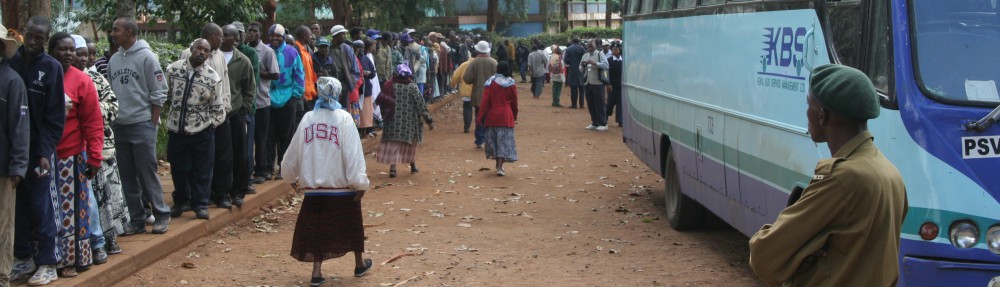
Election Observers and the “Emperor With No Clothes” Phenomenon

Surely there is embarrassment over the allegation made by observers that hundreds of thousands of Kenyan voters confused the green ballots for National Assembly and blue ballots for Senator, and made similar improbable errors, due to “lack of civic education”.

This was offered as an explanation for huge numbers of “invalid ballots,” which turned out to be the bogus data from the IEBC from their electronic reporting system before it was taken down.

In other words, when the Kenyan IEBC reported something that did not make sense–and clearly was contradictory to what actual observers SAW in the field with their own eyes since it did not really happen–some self described International Election Observers, rather than point out that they did not see what the IEBC was reporting, instead, sought to concoct specific explanations for why the voters instead of the electoral commission (or hackers or whomever caused the data fault) was responsible.

Carter Center release; Initial observations on the “Frazer v. Carson” controversy

The Carter Center 2013 EOM Pre-Election Statement was released today based on the work so far of 14 long term observers, who will later be joined by short term observers from 19 countries. Not surprisingly, the Statement has no particular revelations pro or con for those following the election situation. While it primarily exhorts good future behavior, the statement generally praises the IEBC on its internal preparatory work while stressing concerns about the adequacy of voter education to date. It praises the IEBC’s willingness to work with judiciary, while noting the huge volume of cases that might arise from election challenges. Discussion of security seems to me quite generic under the circumstances, but read it for yourself.

The environment for comment from “outsiders” is difficult given the growing tension in the closing days of the campaign. With yesterday’s incident with an American academic/investor who was a George W. Bush administration Assistant Secretary of State for African Affairs accusing the serving American Assistant Secretary of State for African Affairs of “essentially meddling” in the Kenyan election for noting that while Kenyans should freely elect their choice of candidates such choices did have “consequences” in their external relationships, I would think it becomes that much more challenging for the Carter Center or other observers to push on any particular pre-election issues.

My initial reaction to Jendayi Frazer’s high profile “denouncement” of her successor is to say that while I would strongly defend Ms. Frazer’s right as a private citizen in the United States to dissent from and critique American foreign policy (as I have done myself), I personally think her comments were quite unfortunate under the circumstances. To me, if her concern was to try to improve on American performance by criticizing current officials’ actions, she would have done better to hold her tongue in public for less than two weeks until the vote was over. The timing of her attack on Johnnie Carson, combined with her specific characterization of the ICC’s case against Uhuru Kenyatta, in the context of her own highly controversial role in 2007-08 in the last election, could suggest that perhaps Ms. Frazer herself was seeking to be a public player in the Kenyan campaign rather than advocating for “non-interference”.

Part of the situation here is that Frazer has a bully pulpit by virtue of her time in the government position before Carson was appointed to serve the current administration. When she speaks in this way, as a practical matter she is identified in the media and otherwise primarily as a recent former senior appointee in the State Department, rather than as someone launching business enterprises, as a professor or any other role or roles that she may play as a private citizen in the context of East Africa today, as opposed to her role five years ago.

More to the point for me is how disappointing Frazer’s statement is for people in Kenya who have supported the rights of the victims of the 2007-08 post-election violence and supported “the reform agenda” and the long, hard and dangerous work of seeking some small measure of justice in whatever legal venue. Kenya is in fact a member of the ICC even if the United States is not; the ICC is involved only because Kenya’s parliament, including Uhuru Kenyatta and William Ruto, voted “don’t be vague, go to the Hague”. Kenya’s government committed to cooperate with the ICC before what Frazer calls a weak case was in fact confirmed to go forward to trial by the Court.

Given that the United States is again the leading donor in the $100 million effort to support the Kenyan election process, I personally don’t think that Carson’s statement was outside the boundaries of appropriate diplomacy in the context of the characterization of the President’s immediately proceeding statement being given in the Kenyan campaign, vis-a-vis the statements of the European donors. There is really no precedent that fits the situation with the Kenyan election and the candidates facing ICC trial and I doubt anyone is very clear about what the consequences of electing an ICC indictee as president would be — but it doesn’t seem controvertible to me to note that there would certainly be some.

Warnings to Take Seriously for Kenya’s March Election . . . and something to enjoy

The Council on Foreign Relations has just published a “Contingency Planning Memorandum No. 17” regarding “Electoral Violence in Kenya” by Joel Barkan, of CSIS and professor emeritus from the University of Iowa.

Well worth a careful review. Joel Barkan is a dean among the community of American scholars of Kenyan and East African politics who has also worked on the democracy and governance assistance side with USAID in Kenya during the birth pangs of 1992 and made the transition to the policy world in Washington through his post at the CSIS Africa Program and activities such as helping to spearhead the “Kenya Working Group” to put together a broad range of people in Washington working on Kenya issues to generate necessary focus within the U.S. government. Joel was our “resident expert” among the Election Observation delegates for the International Republican Institute observation for the 2007 Kenyan election and had the singular position of being independently identified as someone we wanted as a delegate by both IRI staff and as a “suggestion” to me from Ambassador Ranneberger.

Someday, when a careful history is written of the last Kenyan election and its aftermath, Joel will be noted as one of those who helped the United States get its diplomatic response turned around in part so that we were then able to assist in addressing the crisis presented by the failed election. He spoke out from Kenya and immediately afterwards back in Washington about the obvious failure of the ECK central tally in Nairobi–and raised in Washington the failure to release and use the IRI/USAID exit poll data as a clear indicator that the ECK’s announced numbers did not justify the intransigence being shown by Kibaki and his networks of “hardliners”. Thus, Joel is an obvious person to pay attention to in preparing for the 2013 election.

Let me also flag the comment to my last post entitled “Countdown to Chaos” from Andrew J. Franklin, an American former Marine who has lived in Kenya since the 1970s. I don’t know Mr. Franklin personally yet outside the blog, but this is a warning “straight from the ground” in Kenya, from someone with involvement in the security business. It is a lot easier for expats in Kenya to keep their heads down and say nothing, so I take his cautions with extra gravity.

In closing, let me refer you to a video from bloggingheadstv.com with Mark Leon Goldberg of UN Dispatch and Wycliffe Muga of Nairobi’s The Star. Regular readers will have noticed that I cite Wycliffe Muga’s Star columns frequently as having noteworthy insight. I didn’t get to meet nearly as many Kenyan journalists as I would have liked while working the last election, in part because I wasn’t wanting to be in the media myself and in part because I was just too busy with the immediate demands of the job with the programs I was responsible for. Nonetheless, I did get to meet Wycliffe in person early on and got tutored in some important intricacies of Kenyan politics, both historically and in terms of the current situation in Mombasa at that time where he was living then. I will call Wycliffe a friend, like Joel, in the interest of disclosure and because I like them both–but please don’t assume that either of them necessarily ever agree with me on anything I write here!

I think it might be fair to call Wycliffe something of an “Ameriphile”, which of course I appreciate as an American myself. In this bloggingheadstv discussion, Wycliffe perhaps provides a “shot in the arm” for those of us who might get discouraged by some of our more feckless foreign policy moments and expresses appreciation for what the United States did ultimately do in applying muscle to leverage a mediated settlement of the Kenyan 2007-08 election crisis, as well as, in particular, health assistance in the form of PEPFAR.

;

Jamhuri Day, Christmas and the Year Ahead

Happy Jamhuri Day to my friends and readers in Kenya (and Kenyans in the diaspora–even if you don’t get to vote this time!).

FRESH TEA
Fresh Tea

It has been a week since my last post, even though so much is happening on a day to day basis with the Kenyan election and lots of other news in the region–this reflects a few different things.  For one, perhaps what we could call a “Christmas armistice”.  I live in a peaceful place, and I am enjoying the “festive season” here with my family and am committed to a less digital Christmas.  We’ve survived another election here in the States (in spite of ourselves) and there are a several weeks left in the campaign in Kenya and this is a good time to step back a bit.  In particular, for my family, this is the last Christmas before my daughter goes off to college.  I took my son, our youngest, to get his driver’s license yesterday.  These are the things that can’t wait (and that are uniquely my responsibility).

For another, I have been at this blog steadily for three years.  It’s been through various evolutions and trends and this is an appropriate time for reflective recalibration about what I want it to be going forward.  And in the meantime, there are 601 posts out there for those interested.  And too many of those are just “news” and not real writing, and I do know that I want to get back to “better” rather than “more”.

A third is that I have both new freedom, and new constraints that I need to adjust to.  When I started this blog, and for the first two-and-a-half years, I was a lawyer in the defense industry.  For this reason, I always needed to keep a strong separation between my blog and my professional life.  When I attended the African Studies Association or participated in a “bloggers’ roundtable” at the Millennium Challenge Corporation I was on vacation from my job and generally didn’t talk about it much (both awkward and expensive).  When I was living in Kenya and working for the International Republican Institute I kept entirely away from the job from which I was on leave back home.  Now that I am an independent lawyer, I can synthesize what I know from my prior legal experience and otherwise what I do for a living with the blog to whatever extent I chose, so this is easier.  At the same time, I am also now available professionally as a consultant in matters involving East Africa and have accepted some work, so I need to avoid any conflicts arising out the transition from being purely an avocational commentator.

One thing I have reflected on this past week is the issue of how much is similar and how much is dissimilar between the 2007 campaign in Kenya and the 20012/13 campaign.  All of the major players are the same, although Kibaki will be transitioning from President to “retired President” as Moi is called, and is thus not a candidate himself.  I did get somewhat acquainted at that time and in that environment with Raila and Kalonzo and Mudavadi, and did meet Ruto although never sat down with him.  Uhuru and Dr. Willy Mutunga, who was then at the Ford Foundation and is now Chief Justice, were the only people that ever turned down a meeting request on my behalf when I was IRI Director (a nice symmetry in terms of KANU/Establishment versus Civil Society/Activist roles) so I do have some real sense of many of those involved.  On the other hand, a lot has changed in Kenya, for better and worse, since 2007/08.  So although I know much, much more about Kenya from what I have done from here since I moved back, I don’t want to fall into the trap of relying too much on past experience.

One thing this adds up to is that I do want to write more about “democracy promotion” or “assistance” as a subspecies of “foreign aid” in Africa beyond just the current and most recent past campaign in Kenya.  I also want to do more with East Africa as a region in interacting with the United States–I drafted a “year in review” summary regarding IGAD for a bar committee I am participating in which reminded me of interesting things to explore about how domestic politics in Kenya and in the U.S. will influence cooperation and integration among the East African and HOA states. And then there is Somaliland, which is near and dear to my heart, but I am very cautious in writing about.

For now, I’ll leave you with a few links:

“Uhuru Kenyatta did NOT donate 85 million to Mitt Romney’s campaign” says The Kenyan Daily Post.

Alex Thurston in the Sahel Blog: “Amb. Susan Rice as a Window into U.S. Africa Policy, 1993-Present”

Whither Somalia”–Mary Harper, Bronwen Bruton at USIP