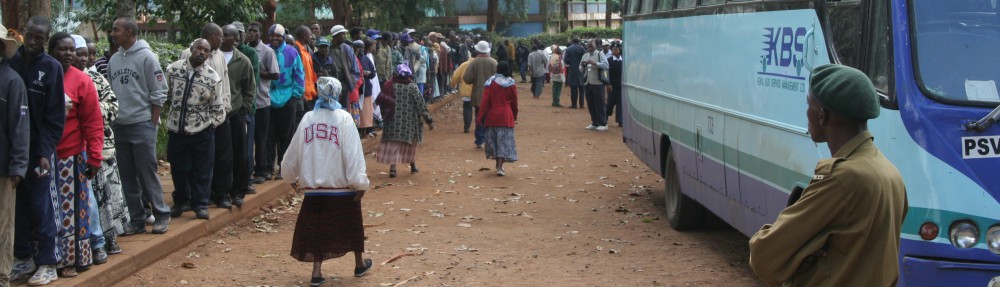
State Department announces sanctions on head of DRC election commission and constitutional court for “significant corruption”

Good. Let me appreciate this action by the State Department to address a corrupt voting process and pull back from previous language that skipped over what seems to be the reality of what happened.

Here is the statement.

It would seem that collectively we (the U.S.) want to recognize Tshisekedi as fait accompli and “not Kabila”, and make the most of the opportunity for a better relationship and progress while still holding a small flame against election fraud for the future and not be “complicit” in covering it up. I very much approve of not being complicit in a cover up even if we are just trying to make the best of the situation with good intentions.

In Kenya in 2008 we issued private travel sanctions against two members of the election commission, the then ECK, for suspected bribery, but said nothing publicly. In that case there was violence from the election fraud and we had withdrawn our initial congratulations. We never disclosed the sanctions or the issue or evidence regarding the bribery but I learned of the matter from a Daily Nation story from a stolen cable from Wikileaks:

The Daily Nation– “What the cables say” (Feb ’08 US visa warning letters sent to ECK commissioners suspected of accepting bribes to fix vote tally) Mar 2 ’11 The link is apparently dead now; for discussion of the story please see Part Seven of my series on the page “The Story of the ’07 Election Through FOIA” under “The War for History Series: was Kenya’s election stolen?.

The public sanctions now, to me, are a step forward in responding to election corruption and I appreciate that we are taking this step. I also appreciate the many people influential in Washington who have spoken out publicly on the problem and laid the groundwork for this, noting Amb. Michelle Gavin at CFR and Joshua Meservey at Heritage. And of course Nic Cheeseman of Democracy in Africa and the University of Birmingham has been a ubiquitous friendly voice for the democratic process throughout.

As discussed in my previous post “Foreign Policy article gives insight on disagreements within Trump administration on backing off on criticism of flawed DRC vote” we learned a good bit about the intergovernmental back and forth on the U.S. side on these issues from the work of Robbie Gramer and Jeffcoate O’Donnell. (As I wrote I know there was some of this in Kenya 2007 but no one seems to have been willing to write about it yet and I only have pieces.)

So, what’s next?

Challenging Nigeria International Election Observation may present tests of character (2nd update on lobbying/funding) #NigeriaDecides

International Election Observation Mission members, including those from IRI/NDI, are arriving in Nigeria for the general election Saturday in a difficult environment.

Although invited by Nigeria’s government there has been at least one unwelcoming statement and no one could deny that this is a hard job simply from the stakes of the election, the instability in some areas, the poverty and underdeveloped infrastructure faced by large portions of the voting population and the simple relative newness of regular competitive elections.

International election observation, which focuses on civil and political rights, is part of international human rights monitoring and must be conducted on the basis of the highest standards for impartiality concerning national political competitors and must be free from any bilateral or multilateral considerations that could conflict with impartiality. It assesses election processes in accordance with international principles for genuine democratic elections and domestic law, while recognizing that it is the people of a country who ultimately determine credibility and legitimacy of an election process.

Quoted is the standard of independence and impartiality to which the USAID-funded NDI/IRI International Election Observation Mission is pledged under the Declaration of Principles for International Election Observation (Oct. 2005).

The IRI/NDI Nigeria 2015 Observation Mission was funded directly by the State Department so shifting back to USAID funding this time is one of the positive things that I see as having potential to help preserve independence and maintain clarity between an Assistance Observation and a Diplomatic Observation to the benefit of the process.

See my post “President Trump’s Asst. Sec. of State for Africa candidly explains why election observation and technical assistance have to be ‘fire-walled’ from diplomacy to have integrity” for a current discussion and further links.

The joint IRI/NDI EOM model has positives and negatives in terms of actual and perceived independence. In Nigeria where democracy assistance is confronted by “resource curse” funded problems and lobbyists working “both sides of aisle” in Washington at a unusual level for an “African election”, along with prominent American campaign consultants usually involved, the joint model seems to me to have some important advantages over IRI or NDI doing a nonpartisan mission on its own, in-spite of the tradeoffs (alternatively you could go with the Carter Center as an “outside the beltway” if politically connected choice, or Democracy International as a truly private entity).

IRI in Africa from my now distant view has come quite far from some of the vulnerabilities that we faced in the 2007 Kenya Election Observation–experience is the best “capacity builder” and institutional funding and attention are now much more appropriate to the scope of the job. Some of my old Kenyan friends and colleagues who did such a great job running things on the ground in 2007 have stayed on and climbed the ladder. And we can expect this election in Nigeria to be better than their 2007 election, observed by many involved this year, as well.

Since Nigerian elections are always high profile and “on the map” in Washington there is no danger of overlooking the situation from that front. This Observation is long-planned and expected and well-funded; there have been an ongoing series of pre-election missions with reports on preparations. Likewise these observations have been going on with regularity throughout this century–and we’ve even been through the scenario of an incumbent seeking re-election during the Boko Haram war.

At the same time, you need no expertise to know that national elections are always challenging in Nigeria and that while cumulative progress has been made in some areas there are some particular concerns that have been reported on and discussed by this Observation Mission and others in the donor governments and media.

Thus, there may be hard calls ahead for the Observers, both on concerns they have already highlighted and from unexpected events as the voting, counting and disclosing play out.

American lobbyist and Ellen Johnston Sirleaf advisor Riva Levinson articulated part of the present challenge well in The Hill in Washington over the weekend: “At Risk: Credibility of U.S. democracy promotion in Africa“. Johnston Sirleaf is in Nigeria as lead observer for the ECOWAS intergovernmental Election Observation Mission and was co-lead for the most recent IRI-NDI Mission, “ZIEOM” in Zimbabwe.

UPDATE (Feb 12): Riva Levinson and her firm KRL are “registered foreign agents” in Washington for Retail Express Limited of Lagos, Nigeria. The Foreign Agent Registration Act filing from September 30, 2018 identifies this client as a “limited partnership which supports the goals of the Senate President of Nigeria, Dr. Aubakar Bukola Saraki, to engage international stakeholders in support of free and fair national elections in February, 2019, seek a level playing field for opposition parties, and convey the core tenants of the Senate President’s vision for the future of the country.” (She also currently lobbies for the Ministry of Foreign Affairs of Liberia and the Ministry of Finance of Ghana.)

Sakari lost the now-opposition People’s Democratic Party (PDP) nomination to Atiku Abubarka but stayed in PDP, having defected from the All Progressives Congress (APC) of Pres. Buhari in July. The PDP itself hired Ballard Partners as its Washington lobbyists for a year at $1,080,000 two days before Retail Express hired KRL.

Recent former diplomat and Council on Foreign Relations Africa lead Amb. Michelle Gavin had a notably hard-hitting CFR blog post last week headlined: “The Truth About United States Complicity in DRC’s Fraudulent Election” although in the text she just covers the macro level issue of diplomatically blessing an election whose official result was contrary to all available evidence.

We in the U.S. got partially off the hook in the DRC where the incumbent Kabila did not invite U.S.-funded or other international observers beyond the African diplomatic groupings (although I learned from Levinson’s piece that we provided funding for the Catholic Church run ‘Parallel Vote Count’, a fact I totally missed in the news reporting. USAID’s website indicates we were also providing “technical assistance” to the election management body CENI itself (!) which again I missed somehow in the news reports. These facts may have informed Gavin’s view even if the journalists that I read did not take notice.)

Update II (Feb 18): As it turns out, the U.S. not-for-profit IFES continued USAID-funded work with CENI, along with its partner IRI in the Coalition for Electoral Process and Party Strengthening (CEPPS) according to a brief overview on IFES’s website, and continues to work with CENI toward local elections. CENI hired its own Washington lobbying firm in 2018, Avenue Strategies, founded by former DJ Trump campaign manager Corey Lewandowski (he left and set up a separate firm before the CENI contract). In January 2019 after CENI named Felix Tshisekedi as president-elect, Avenue Strategies also signed on to represent Tshisekedi as president-elect and now president.

Presumably, then, under the CEPPS mechanism USAID funded the third partner, NDI, for the work with the Catholic Church Parallel Vote Count. I will contact USAID to confirm the arrangement and see if they are willing to release any contractual details without a formal Freedom of Information Act request.

The Carter Center stood firm in calling out Kabila’s 2011″re-election” as failing to meet international standards. The State Department followed along in declining to bless the election and offering technical assistance to address irregularities back then, unlike the current situation which Levinson and Gavin question (although the diplomatic impetus for remediation at the presidential level in 2011 went away quickly).

See Dr. Carl LeVan’s Homepage “Development for Security” blog for an overview of the Nigeria election contest. Likewise, Amb. John Campbell’s “Nigeria’s Election: What to Know” at CFR.

Here is my piece from The Elephant in the wake of Kenya’s judicially annulled 2017 presidential election: “Free, Fair and Credible? Turning the Spotlight on Election Observers“.

[UPDATE III: here is the Preliminary Statement issued by the IRI/NDI Observation on February 25, after the delayed vote of February 23.]

International Election Observation Mission IRI Kenya Kibera Lavington Nairobi 2007

Corruption in Kenya: Joe Khamisi has given us the history; Father Dolan reports brilliantly from the latest passing winds of faux “war”

I do not have the stomach to blog about official high level anti-corruption conferences in Kenya any more–the whole pageant is just too twisted for a relatively simple person such as myself.

If you have not yet read Joe Khamisi’s Kenya: Looters and Grabbers; 54 Years of Corruption and Plunder by the Elite, 1963-2017 (Jodey Pres 2018) you must. It sets the stage in the colonial era and proceeds from independence like a jackhammer through scandal, after scandal after scandal upon scandal.

Read a great review by Tom Odhiambo of the University of Nairobi in the Daily Nation here:

. . . The Kroll Report, for instance is available online for those curious about the rip-offs of the 1980s into the early 2000s. The Goldenberg scam report is in the public domain. Anglo-leasing scam is still fresh in the minds of many. 

There are numerous other reports on misappropriation of public resources in parastatals, annexation of public land, seizure and transfer into private ownership of public motor vehicles, for instance.

However, for the first time a Kenyan chronicles the looting of national resources in a book, in a language, style and tone that is easily accessible to the public. This is not some report by an NGO or government watchdog, full of figures, graphs and illustrations to show the enormity of the theft. 

No, this is a collection of narratives of daring, outrageous and unbelievable self-service by the Kenyan elite at the buffet of state and non-state resources.

These are tales that highlight how the Kenyan elite – political, economic, bureaucratic or even clerical – evacuated the moral high ground long time ago and thus don’t really care about the moralising about corruption; how they have behaved as a ‘members’ only club, irrespective of tribe or religion or political leaning; how they have gradually morphed into a powerful class that will use any means at their disposal to maintain their privilege; and how they have consequently impoverished the country.

Looters and Grabbers should scare any Kenyan who reads it. For it begins at the beginning: with the land grabbing frenzy of the years after the end of colonialism. . . .

Fortunately, on latest elite public posturing and strutting we have Fr. Gabriel Dolan. His latest Sunday Standard column lays it out: “Media houses failing the graft war more than judiciary”:

The annual war on corruption has been launched with fireworks but may prove once more to be nothing more than a damp squib. For all the threats and promises, what we are witnessing appears more like passing wind in a crowded room with everyone blaming someone else for the foul smell. Those with powers and microphones are demanding accountability and justice. Every arm of government wants justice to flow down like a river, but each of them wants to decide who is going to get wet. So the battle will most likely conclude with a cease fire as the windows are opened, the stench is released and normal services resume.  

It is good to stand back and take the long view of proceedings. Most of the mega corruption scandals for the last 55 years are the handiwork of the political class and their cronies. Yet, these same individuals, families and gangs are now shouting loudest about ending corruption and bringing culprits to book. Isn’t that strange, almost funny if there were not so much at stake! But this should make you suspicious about what is really going on. 

Failure to replace petty thieves with mega looters in our institutions of correction is entirely the fault of the Judiciary according to vox populi and the ranting classes. . . . Instead of baying for the blood of the mega thieves, the anger is projected onto the Judiciary and they are the new scapegoats to blame for the looting of the nation. Therein is another reason to be extremely sceptical about pronouncements on corruption.  

What makes this all the more shameful and ridiculous is that the media have become enthusiastic collaborators in lynching the Judiciary. . . .

Yet painful as it is to admit, media houses have let the public down more than any other institution in their failure to pursue and investigate mega corruption. Investigative journalism is fast disappearing and most publications are more likely to give attention to love triangles than to the maize scandal. Entertainment is valued more than education. . . . .

Reporting truth to the masses empowers them and does more than anything else to democratise societies. However, in recent years we have witnessed editors, cartoonists and popular columnists axed from our dailies because they dared to challenge, expose and ridicule the government of the day. . . . .

If owners and editors permitted their best journalists to do proper, consistent, thorough and impartial investigations of the scandals we would rise early to buy our copies and the three arms of government would be worried. 

MILSPEAK will never die; and a COMBATANT COMMAND may never be great at Public Diplomacy – AFRICOM and a “Failed Communication”

When General Thomas Waldhauser, the outgoing AFRICOM Commander, went before the Senate Armed Services Committee (“SASC”) for public testimony on the AFRICOM Annual Posture Statement relating to the legislative budget process–a performative function for the Senators and the Senate and the Military–someone seems to have failed to scrub the presentation with an appreciation for how it would look to use an “infographic” to publicly describe to the world–especially to interested citizens in the 53 “partner” states of the AFRICOM Area of Operations (“AOR”)–one of the “U.S. strategic interests in Africa” as to “decrease potential for Africa to become a failed continent”.

Some of us who are “olds” (surely this term is a bit insensitive 🧐) and have spent at least some of our formative years before the pervasiveness of global public communications seem to forget that we Americans live in a global fishbowl of our own making.

General Waldhauser will have spent his career with military electronic communications but will have climbed some ranks before civilian application reached the point that “public” in Washington was automatically realtime “public” nearly everywhere.

Security issues, especially terrorism and civil unrest, have cross-border components that may be magnified by the large number of independent countries in the geographic areas involved, but this sort of loose, broad brush talk that might be useful for selling a budget in a competitive bureaucratic marketplace is embarrassing and counterproductive from the standpoint of official communications and “public diplomacy” because it makes AFRICOM look out of touch and patronizing.

In this way, AFRICOM seems to have accidentally put itself at cross purposes in communications with what is supposed to be the “New Africa Strategy” as announced by the National Security Advisor that is intended to reflect a shift of emphasis to American trade and investment with and in African countries. Since the end of the Cold War we have focused on securing the global “lanes of trade”, especially the world’s only “blue water Navy”, facilitating trade between China as well as India, Japan, the EU and others and African countries, without much real policy focus on our own economic participation beyond aid and philanthropy.

Now that China is so much richer, seems to be re-doubling domestic repression and investing heavily in quickly building out both traditional and “new technology” military tools, while leaning on our longstanding allies in Southeast Asia and showing other geopolitical ambitions, we wish to increase our own economic participation in Africa’s growth for the kind of normal geopolitical reasons that we had de-emphasized in recent years.

In competing against the United States, as well as against Japan, Europe and the UK and other more developed democratic powers in Africa, the PRC naturally wants to sell the idea that the Chinese Communist Party offers some sort of South-South mutual respect to African borrowers and customers in spite of its huge actual size and command structure and the way it treats its own ethnic minorities. Whereas the United States Government has the task not only of assuring African markets of our respect and compatibility, but also of encouraging and persuading, rather than directing, U.S. domiciled companies and investors to go take on risk and invest in African countries.

So clumsy negative hyperbole is not the thing we are looking for here. I have a distaste for some of the slick overproduced happy talk “success stories” that get funded within the rubric of “development assistance” and we need straight honesty from our military leaders about the status of wars we are fighting, but we should avoid being carelessly negative when expressing our aspirations.

I do think on this one that the buck really ought to stop with General Waldhauser — he himself in his many-hatted role should have personally known better and not stepped in that hole. Much of the articulated reason to have AFRICOM–as opposed to not having AFRICOM–was that it was to be a “different type of Command” which integrated personnel from the State Department and USAID directly into its structure to be better at things like diplomacy than the Commands dating to the Cold War, presumably based on lessons learned.

UPDATE: Sept. 8

Investigative reporting from Amanda Sperber in The Nation : “Inside the secretive US air campaign in Somalia“.

From the Longwar Journal (Foundation for Defense of Democracies): “US military intensifies airstrikes against al Shabaab in Somalia“.

Foreign Policy article gives insight on disagreements within Trump administration on backing off on criticism of flawed DRC vote

Foreign Policy has published a piece reporting significant internal dissent from the reversal of the U.S. position from significantly negative to largely positive on the recent DRC election:

. . . .

In a series of preliminary statements crafted by the team and released by the State Department on Jan. 3, 10, and 16—before confirmation of the final results—the United States sharply condemned reports of election-related interference and violence. The Jan. 3 statement included a threat that people involved “may find themselves not welcome in the United States and cut off from the U.S. financial system.”

With the Constitutional Court’s decision to confirm the election later in the month and with news of widespread election fraud, the group drafted a new U.S. response on Jan. 23. It noted the election results rather than welcoming them—a diplomatic way of signaling displeasure—and condemned the “deeply flawed and troubling” election, according to a draft reviewed by FP. It also stated that Congo’s electoral commission “failed to live up to the responsibility” it had to carry out elections fairly and ivowed that the United States would “hold accountable” any figures engaged in election fixing or violent crackdowns on any ensuing protests.

But none of this language made it into the final statement. Instead, Washington welcomed the results and declared itself committed to working with Tshisekedi. The revised statement made only passing mention to “electoral irregularities.”

Michael Hammer, the U.S. ambassador to Congo, along with Michael McKinley, a senior career diplomat advising Secretary of State Mike Pompeo, pushed for the revised statement, according to three U.S. officials. The department’s third-ranking official, David Hale, ultimately signed off on it, the officials said.

Senior U.S. officials in other agencies and some State Department officials—including the special envoy for the region, Pham—were kept out of the final decision entirely and did not know that a shift in policy was in the works, officials told FP. They said some officials found out about the shift in policy only once the statement came out. It left some of them fuming.

“If we said we’ll hold the government accountable … and five days later we congratulate a bunch of thieves, what good are our threats?” one senior U.S. official said.

One former State Department official familiar with the process said the implications went beyond Congo. “It was just a stupid decision to release that statement, a statement that has much bigger bearing on U.S. government democracy promotion in Africa,” the former official said.

The State Department, USAID, and NSC all declined to comment for this story. A State Department spokesperson also did not respond to a request to interview the senior diplomats who FP was told were involved in the process. . . . .

This is the kind of thing I always had hoped to see about Kenya 2007 where the U.S. initially relied on what my FOIA research indicates was a pre-determined blessing of Kibaki’s alleged re-election even after Ambassador Ranneberger witnessed vote totals being changed by the Kibaki-controlled Electoral Commission of Kenya and reported some pre-knowledge of unlawful rigging plans and conduct. In the face of violence the initial congratulations were withdrawn and the State Department pivoted to support a negotiation to include the opposition in a sharing of power with Kibaki. I know that there were differing internal opinions but I have never seen this level of public reporting on the internal debate.

Some of this may reflect differences in the internal environment and reporters’ expectations and aspirations during the Bush and Trump administrations as well as “the times” more generally. Regardless, I am glad to know more about how my government made this decision and encouraged that the problems with the positive statement final statement on the were recognized by some of those involved.

On the Congressional side, here is the January 18 Statement from the incoming Republican Ranking Member on the Foreign Affairs Committee:

Washington D.C. – House Foreign Affairs Committee lead Republican Michael McCaul (R-TX) released the following statement on the fraudulent election in the Democratic Republic of Congo (DRC).

“After eighteen years of the Kabila regime, the Democratic Republic of the Congo had a historic opportunity to give its people a voice by holding free and fair elections. Millions of Congolese bravely went to the polls to cast their vote amid long lines, intimidation and violence. Unfortunately, the fraudulent vote count does not demonstrate the will of the people. 

“I commend the African Union’s call for transparency and credible election results. All parties must refrain from violence as this process continues. It’s imperative for the United States and the rest of the world to stand with the Congolese people to demand an accurate vote tally and I urge Secretary Pompeo to fully engage at this pivotal moment. All individuals who impede this democratic process must be held accountable.”

I would also like to know more about slightly more gradual process of walking back the substance of our objections to Kabila’s 2011 re-election vote during the Obama administration.

Lake Edward into Congo


For the record, I assume (1) that Raila extracted concessions for 2022 for the “handshake” and (2) that the Kenyattas and Washington will want to keep Ruto in tandem to avoid violence in the Rift Valley

Of course, I’m not involved and its all secret and my guesses could be completely wrong.

As U.S. Mission in Kenya passes from Godec to McCarter, Africa Confidential explains how Kenyan politics is still “frozen” in 2005-07 “time warp”

Africa Confidential ‘s free January Kenya article is a must read for anyone in Washington charged with engagement on Kenya over the next three years.

“Three’s a crowd”

Kenya’s political landscape in 2019 will be dominated by two-way competition between Deputy President William Ruto of the ruling Jubilee Party and former Prime Minister Raila Odinga of the Orange Democratic Movement (ODM), as each man positions himself for the presidential election of 2022. Each will be trying to cobble together a winning coalition by buttressing his ethnic stronghold and winning over the ‘swing’ votes in regions such as Maasailand, Kisii, Luhyaland and the Coast.

President Uhuru Kenyatta‘s mantra is that the time for party politics is over and that all leaders should concentrate on economic development, based on his signature ‘Big Four Agenda’ (food security, affordable housing, manufacturing, and affordable healthcare), and reconciliation, based on the ‘Building Bridges Initiative’ agreed between him and Odinga last March. He will continue to state this line, arguing that he wants a legacy of an ethnically united Kenya, and will continue to reach out to former opposition leader Odinga and his Luo people.

Both Odinga and Ruto will on the surface claim they support the Big Four and Building Bridges even as they continue their individual campaigns and trade acerbic barbs. Many Kenyan pundits say the only person who has not grasped the new reality is Kenyatta, as he continues to insist on a politics-free country until 2022. . . .

Relatedly a friend got me a copy from Kenya of John Onyando’s recently published “Kenya: The Failed Quest for Electoral Justice” which I am reading with great interest. (Hoping this will be published internationally soon.) Most significantly so far I finally have an insider’s account of one of the key mysteries from the current, post-2002 era in Kenyan politics: what happened to cause the dropping of the Prime Ministry in the final maneuvering for the 2010 Constitutional referendum? Preserving an exceptionally powerful unitary executive Presidency was the key issue in Kibaki’s dumping of his MOU with Raila, et al, and the defeat of the “Wako Draft” constitution at the 2005 Referendum by what became the “Orange Democratic Movement”. Thus it was a bit of a shock to see Raila and ODM leading the “Yes” campaign along with Kibaki in 2010 for a new draft constitution where even the weak Prime Minister position that Odinga then held was completely excised.

[Here is my blog post from March 13, 2010 showing what I knew about the jockeying at the time: the ODM side wanted to go forward with Parliamentary approval of the draft as it was, while PNU (and Ruto) wanted to retreat to Naivasha to consider “amendments” with “retired President” Moi saying he would oppose the referendum without amendment. Ultimately the Naivasha retreat happened and the private vote Onyando’s book describes was facilitated.]

Any explanation of why the Prime Ministry “went away,” as it was put, was one of the more conspicuous gaps in Raila’s autobiography “The Flame of Freedom“.

On paper the 2010 Constitution as passed at the referendum in July of that year does have a variety of intricate mechanisms of reductions of individual power for His Excellency the President at the national government level, but since they are not self-executing and there is no Prime Minister or other potentially independent power center, once the 2013 election was decided for the Uhuruto ticket, Kenyatta has as one would expect largely worked around them, if not explicitly eviserated them legislatively using his control of Parliament.

According to Onyando, by the time of the final politicians’ cut on the 2010 draft constitution arising from the February 2008 National Accord to settle the Post Election Violence, the Opposition/ODM/Raila side had already lost Ruto to Kibaki/Kenyatta to the point that the President’s side gained three votes aligned with Ruto among those allocated to the Opposition among the group. Thus the Kibaki/Kenyatta side was able to write out any direct sharing of executive power under the new dispensation to follow the Government of National Unity. Raila went along on the basis that there was enough reform with partial devolution to 47 new counties and other provisions to warrant a “yes” versus a “no”.

It is noteworthy that even Africa Confidential is offering their current 2019 assessment without reference to specific terms of the Uhuru-Raila “handshake” of March 2018. I am not comfortable doing any real handicapping of the 2022 race myself or saying too much about current Kenya politics without being privy to the actual details of the deal.

Along these lines, this week saw on Wednesday both the first anniversary of Raila’s mock swearing in at Uhuru Park and the tenth anniversary of publication of the New York Times piece, “A Chaotic Kenyan Vote and a Secret U.S. Exit Poll“.

Looking back on my personal experience it is notable to me that Ambassador Ranneberger and I contradicted each other on at least three separate points of fact in our respective interviews with The Times on the 2007 Kenyan election controversy (mine with Mike McIntire in the U.S. and his with Jeffrey Gettleman in Kenya) but I did not lose my security clearance, and had it renewed the next year when it came up so I was able to continue my career as an attorney working on U.S. Navy shipbuilding programs. I suspect I might have had some difficulty if it were not recognized that I had in fact been honest. Had I been a Kenyan (or Chinese for example) citizen it would have been unthinkable to hope to “get away” with being truthful in contradiction to a senior public official in this way without expecting to loose my job and likely go to jail or be killed.

All this is to say that my experience with Kenyan politics over these last many years has richened my gratitude for the freedom and security my family and I have experienced as Americans and my wish for the same someday for Kenyans. (In case you are new to the blog, here is my piece from The Elephant that they headlined “The Debacle of 2007: How an Election Was Stolen, and Kenyan Politics Frozen, With U.S. Connivance“).