Economist’s Boabob Blog features UCSD work on “smart” election monitoring

More great work to fight election fraud from my former colleagues on the USAID/UCSD/IRI Kenya exit poll, Clark Gibson and James Long:

“African elections:  How to save votes”

COULD smartphones help reduce electoral fraud in Africa and in other regions? At a recent forum hosted by the Brookings Institution on the ways that wireless technologies are affecting politics in various countries, Clark Gibson, a professor at the University of California, San Diego (USCD), presented findings from experiments in Afghanistan and Uganda which suggest that they can. Local researchers were deployed to polling stations armed with digital cameras and smartphones to take photographs of the publicly posted election tallies. The research found that this alone can cut electoral fraud by up to 60%.

The experiment was first developed during the 2010 Afghan elections by James Long and Michael Callen, then UCSD graduate students, with funding from the Development Innovation Ventures section at the United States Agency for International Development. . . . The research concluded that as a result electoral rigging was cut by 25% in the polling stations in the treatment group and the theft of ballot boxes and other election materials was reduced by 60%.

Mr Gibson replicated the experiment during the Ugandan presidential election last year, using a bigger sample of 1,000 polling stations scattered all around the country.  .  .  . using a special app developed by engineers at Qualcomm, a big technology company based in San Diego, the researchers this time were able immediately to send their data back to a server at UCSD. Academics there could then check to see if the voting numbers had been falsified by looking for give away number-patterns. They found again that vote tampering and ballot-box theft were much lower among polling stations that had received warning that a photo would be taken of their tally than among those that did not.

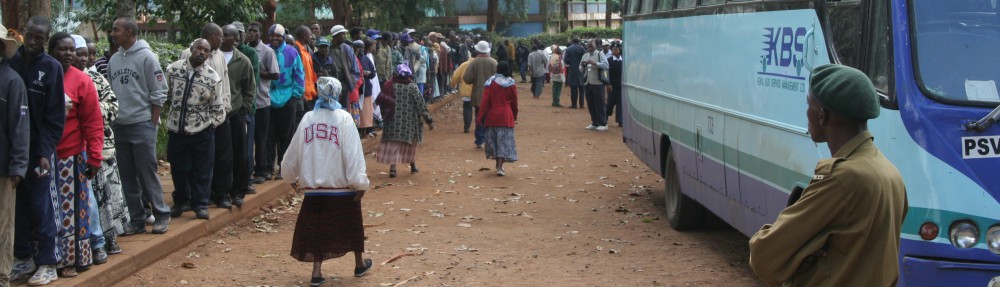
The technology is relatively cheap—smartphones cost around $250—and allows  more locals to get involved in monitoring elections. There is a great hunger for democracy in Africa and elsewhere, says, Mr Gibson, you can tell just by looking at the queues of voters who turn out on election day. Nothing is more dispiriting than to learn that their vote has been manipulated.

Unfortunately we didn’t have funding for separate electronic verification efforts in Kenya in 2007, but this should be that much cheaper and more readily feasible in Kenya for 2012/13. Knowing what happened last time there is no excuse not to have digital image verification this time.

History–Kenyatta, the Kenyan military and GSU; origins of U.S. military assistance

From 1975 intelligence briefing for President Gerald Ford’s Nation Security Adviser Brent Scowcroft:

2. Nairobi has traditionally maintained one of the smaller armies in sub-Saharan Africa, (see table). The Kenyan leaders — especially President Kenyatta — have not wanted a large standing army. Tribal considerations have been a major factor in this decision. The army has long been the only significant institution in Kenya not under direct control of the Kikuyu, Kenyatta’s tribe. Kenyatta, however, has been gradually but effectively changing the balance to favor the Kikuyu through reorganizations and promotions. Apparently as a counterweight to the army, Kenyan leaders also have made sure that the elite paramilitary General Service Unit remains heavily armed, mobile, and dominated by the Kikuyu.

3. The Kenyans have in the past been able to take some comfort in a mutual defense pact with Ethiopia and a long-standing tacit agreement with the UK that provides for British assistance on request in the event of major internal trouble or an external attack on Kenya. Nairobi now realizes that the chances of Ethiopian assistance have been diminished by Addis Ababa’s internal instability, its problems with Somalia, and by troubles with insurgencies in Eritrea and other provinces. Nairobi also believes, rightly in our view, that it can no longer count on British assistance in the event of an emergency.

[Map of the Horn of Africa]

The Kenya-Uganda Balance

4. Relations between Kenya and Uganda, never smooth since Idi Amin came to power in 1971, have reached their nadir in the last few months. In February, Amin laid claim to part of western Kenya. Nairobi responded by stimulating a series of virulent anti-Amin demonstrations and a boycott at Kenya’s harbors of goods destined for Uganda.

5. The Kenyans later eased the boycott, but imposed a number of economic restrictions on Kampala. They cut in half Uganda’s fuel allotment from the Nairobi refinery and are requiring cash payment for petroleum products and other goods. The sanctions appear to be hurting the Ugandan economy. This may have provoked the mercurial Amin into launching some cross-border forays by helicopter -borne Ugandan troops this month — allegedly in search of rustled cattle. Amin has followed this up with verbal threats against Kenya that he has linked to criticism of Secretary Kissinger’s trip to Africa and charges of collusion between Washington and Nairobi.

6. Other factors have contributed to tensions between Kenya and Uganda. Nairobi newspapers have frequently published stories of alleged atrocities by Uganda perpetrated against Kenyans. Such stories have recently gained increased credibility among Kenyans by the well publicized disappearance in Kampala a few months ago of a Kenyan student, now widely presumed to have died at the hands of Ugandan security police.

7. Kenyan leaders have long been uneasy about Amin’s erratic behavior. Their concerns have been heightened by Amin’s accumulation of Soviet weapons, by the presence of Soviet advisers in Uganda, and by Amin’s ties to radical Arab states and Somalia. Kenya is concerned that Amin might make some supportive military move if Mogadiscio instigated a renewal of insurgency in northeast Kenya — it supported such an effort in the 1960s — or ordered the Somali army into action against Ethiopia or Kenya.

8. Amin is probably planning to keep alive the threat of additional cross-border raids to keep Nairobi off balance and to emphasize for domestic consumption the “threat” to Uganda. The Kenyans are nervous over reports that Amin has been stirring up his senior officers with threats to “crush Kenyatta.” Nairobi fears that the likelihood of some erratic move by Amin — a terrorist incident, an assassination attempt against Kenyatta, or the seizure of some Kenyan territory — will increase when Amin ends his term as chairman of the Organization of African Unity in July. Our judgment is that these concerns in Nairobi are exaggerated, but we cannot completely rule out such actions because of Amin’s personality.

9. The Kenyans are being careful not to push Amin too far publicly. President Kenyatta has returned the two Ugandan helicopters and several soldiers captured during the recent incursions, although he has privately issued a stern warning to Amin. Nairobi may ease the current economic restrictions once it feels it has made its point. Amin is already complaining loudly about a fuel shortage, and the Kenyans are probably wary about giving him grounds for justifying some military move by claiming he is being economically strangled.

10. Nonetheless, Nairobi has recently begun providing limited covert support for a group of Ugandan exiles in Kenya who have been plotting the overthrow of Amin. The group does not appear well organized, and the effort could backfire on Nairobi by providing justification for Amin to take counteraction against Kenya. For example, Amin might respond to any Kenyan-supported attempt to unseat him with a greater show of force on the border. In such a case, a major border incident could arise from a miscalculation by either side.

11. Kenyan concerns about Amin are compounded by his overwhelming superiority both in weapons and number of troops. Although Kenyan units are better trained and disciplined than Ugandan forces, Kenyan leaders are uneasy over an official assessment questioning the will of the army to defend the nation’s borders. Some army officers are concerned that the attention Nairobi is paying to Uganda will divert it from what they see as the far more serious Somali threat.

12. Recognizing its military inferiority, Kenya has approached the US and other potential sources for military assistance, especially aircraft. (Kenya continues, however, to turn down Soviet offers of military assistance.) Kenya has tried to interest the British in providing troops or aircraft for a joint exercise or some other show of force, preferably near the border, but London apparently has turned Nairobi down.

.  .  .  .

The Horn of Africa

15. Kenya’s policy toward the Horn of Africa countries continues to be marked by an alliance with Ethiopia, its partner in a 13-year-old defense pact, and by a deep distrust of Somalia, which claims about one fifth of Kenya as well as a large part of Ethiopia and all of the neighboring FTAI. Kenya supports Paris’ announced intention to grant independence to the FTAI, and has called for OAU and UN guarantees for the independence and territorial integrity of the state.

16. The likelihood of military conflict between Ethiopia and Somalia over the FTAI has sharpened Kenya’s worries about its security and the intentions of the Mogadiscio government. Kenya fears it would be drawn into such a conflict because of its defense pact with Addis Ababa.

17. Nairobi also believes that a successful Somali takeover of the FTAI would encourage Mogadiscio to reassert its claims to the northeastern part of Kenya inhabited primarily by ethnic Somalis and to press a new insurgency effort there. The Kenyans already suspect that Amin’s recent claims to parts of Kenya were made in collusion with Somali President SIAD in an effort to keep the Nairobi government off balance. We have no hard evidence to support the Kenyan suspicions, but relations between Amin and SIAD are relatively close.

Source: Ford Library, National Security Adviser, Presidential Country Files for Africa, Box 3, Kenya. Secret; Noforn; Nocontract; Orcon. Prepared jointly by the Central Intelligence Agency, The Defense Intelligence Agency, and the Bureau of Intelligence and Research. Sent to Scowcroft on May 7 by B.E. Layton, Acting National Intelligence Officer for South and Southeast Asia and Africa, Central Intelligence Agency.
Comparison Table of Military Forces

Somalia  Kenya  Uganda

Air Force
Personnel 750 760 2,000
Bombers 3 6 None
Jet Fighters 50 3 68
SAM Battalions 4 None Unknown
Helicopters 12 None 9

Are we watching the early stages of a broader conflict in the Greater Horn of Africa?

Now that Kenya has initiated a full-fledged ground war in Southern Somalia, the obvious and necessary question becomes “what are the near term unintended consequences?”. It is hard to be too clear about what is “unintended” because Kenya’s intentions, on either the military or the political side, are not altogether clear in the first place, but here is one possibility that few would desire:

Simon Allison posits in South Africa’s Daily Maverick: “Kenya’s Somali raid threatens to explode into regional conflict”, noting Kenya’s confrontation with Eritrea regarding alleged arms flights to supply Al Shabaab:

. . . This begs the question: what does Eritrea have to gain by funding a Somali Islamic fundamentalist militia?

The answer lies neither in Somalia nor Eritrea, but in the country that looms large between them: Ethiopia. Ethiopia is Eritrea’s nemesis, having occupied Eritrea for decades until Eritrea achieved its modern independence with a hard-fought and vicious civil war. But Eritrea can’t relax, ever, because it has the one thing that land-locked Ethiopia wants more than anything else in this world: a port. And rapprochement is not the style of Eritrea’s slightly mad President Isaias Afwerki, whose militaristic foreign policy has left Eritrea in the international wilderness.

Instead, Afwerki has fomented instability in Somalia, hoping the chaos next door will keep Ethiopia and its military occupied. Ethiopia is deeply involved in the Somali conflict itself, and its troops make frequent cross-border raids to chase rebels who are agitating against the Ethiopian government in the ethnically Somali province of the Ogaden. As International Crisis Group’s Somalia expert Rashid Abdi explains: “Eritrea definitely has been supportive of Al Shabaab for a long time and this support is not ideological. It’s essentially meant to counter Ethiopia’s influence in Somalia.”

So while we don’t know if it really was Eritrea sending planeloads of weapons to Al Shabaab during the current conflict with Kenya, this nonetheless represents the first step in turning what is a domestic conflict into a larger, regional issue. In a way, it doesn’t really matter if Eritrea was involved or not, as long as Kenya thinks they were, they will be implicated.

Kenya has said it will pursue its claims against Eritrea, saying that it has a “series of options” to deal with them. It’s unclear what these options are, but it’s unlikely that any of them will ease tensions in the Horn of Africa. And whenever Eritrea gets involved in something, it’s not long before Ethiopia follows suit – on the opposite side, of course. So what started out as a Somali issue might just turn into something much, much bigger, not forgetting that Uganda and Burundi are already involved as they are the only countries to have contributed troops to the African Union mission in Somalia.

Kenya hoped its Somali incursion would be quick and easy. But its troops are getting bogged down in the mud and are struggling to even find the enemy. And on the diplomatic front, as the incursion starts looking more and more like an invasion, other countries are inevitably getting involved, making it even less likely that Kenya can extricate itself from Somalia quickly or easily.

(Updated 10-12) Ugandan Parliament Votes to Suspend Oil Deals on Corruption Charges

BBC News is reporting that the Ugandan parliament has asserted its independence by acting to freeze new oil agreements after bribery allegations are brought forward by an MP:

Uganda’s parliament has voted to suspend all new deals in the oil sector following claims that government ministers took multi-million dollar bribes.

MP Gerald Karuhanga said in parliament on Monday that UK-based Tullow Oil paid bribes to influence decisions.

Tullow said it rejected the “outrageous and wholly defamatory” allegations.

The vote is a big blow to President Yoweri Museveni, who has been in power since 1986, analysts say.

The BBC’s Joshua Mmali in the capital, Kampala, says it means the government will not be able to sign new oil deals until a petroleum law is enacted.

.  .  .  .

Update–from Wednesday’s Daily Monitor:

The British High Commission in Kampala yesterday said the country’s Metropolitan Police is at liberty to start investigations into allegations that Tullow, one of London’s 100 listed companies, paid bribes to senior Uganda government officials. “Bribery of foreign public officials is of course an offence under UK law, and it would therefore be for the British Police to decide whether to open an investigation into allegations made against a British company,” a spokesperson for the High Commission said in reply to our email enquiries.

UK’s 2010 Bribery Act imposes “strict liability” on UK corporations or business firms that fail to make “adequate processes” to prevent bribe payments. In yesterday’s statement, the High Commission said it was following the ongoing oil debate in Parliament “with interest”, but understand that “Tullow Oil totally rejects those allegations”.

The Company had by press time not replied to specific questions this newspaper raised based on allegations in Parliament that the firm between June 1 and July 16, 2010 paid out up to $100m (Shs280b) to “experts”, among them powerful ministers, for “professional services” from accounts with Bank of Valetta in Malta.

.  .  .  .

East Africa ranks fourth of five regions in 2011 Mo Ibrahim Foundation Governance Rankings–Tanzania, Uganda and Kenya each move up from 2010

2011 Governance Rankings for East Africa
Rank (of 53-followed by raw score)

4th Seychelles 73
13th Tanzania 58
20th Uganda 55
23rd Kenya 53
25th Rwanda 52
29th Djibouti 49
31st Comoros 47
34th Ethiopia 46
37th Burundi 45
47th Eritrea 35
48th Sudan 33
53rd Somalia 8

Here is a link to a summary brochure of the East Africa findings.

Here is my post from last year’s release.  Tanzania has moved up from 15 to 13, Uganda from 24 to 20 and Kenya from 27 to 23.

Museveni defends Gaddafi while inflation soars in Uganda

Museveni reiterated his defense of Gaddafi this week in The Daily Monitor:

President Museveni has reiterated his criticism of the West and attacked Nato for disorganising a friend, whose 42-year rule faces a humbling end.

Speaking at the annual Muslims Iftar dinner at State House, Entebbe on Saturday, Mr Museveni addressed himself on two fundamental issues: The economic crisis at home and the battle for Libya. He accused the West of greed and defended Col. Gaddafi’s mistakes even though, he said, the Libyan leader attempted to go behind his back to hijack his chiefs in Kampala.

“Gaddafi had his own mistakes, he came here and organised my chiefs without telling me. We cancelled that meeting and I warned chiefs because it was wrong,” Mr Museveni said. “But Gaddafi built a mosque for us and as a leader, he had his mistakes, but those Europeans have more mistakes and problems. They think the rest of us are fools except themselves. When there are riots in Africa, they call them pro-democracy and in London, they call them, criminals.”

While inflation in Uganda has hit a 20-year high of 21.4%:

Ugandans will be bracing themselves for even harder times ahead as the continued depreciation of the local currency, rising prices for fuel, essential commodities and food combined to push inflation to a new 20-year high, further threatening the economy’s growth.The Consumer Price Index (CPI) released by the Uganda Bureau of Statistics yesterday indicates that inflation rose from a revised rate of 18.8 per cent in July to 21.4 per cent in August.

This represents a 2.6 percentage point rise, which, though lower than the 3.1 percentage point increase registered in July, still dragged the battered economy over another double digit threshold.

The Director for Macro-Economics Statistics at Ubos, Dr Chris Ndatira Mukiza, said food inflation, which rose to 42.9 per cent from 40.7 per cent, remains the main driver of inflation.

Back in May when Museveni was sworn in for another five year term after 25 years in power, Think Africa Press noted “For the first time in decades, inflation has hit the two digit mark to settle at 11%,” and asked “President Museveni:  Africa’s Marie Antoinette?

One is reminded of Marie-Antoinette of France. Are these leaders in touch with reality? Do they understand the condition of ordinary people of Uganda? And how many Ugandans really depend on land, and how productive is that land? What percentage of farmers are producing for the market? Even for those who have access to land, can they get all that they need from that land? In any case, the root of this inflation can be traced to the colossal amount of money poured into the country during the recent election campaigns. And this was largely by President Museveni himself.

Meanwhile, aside from the famine, business is moving . . .

Upsidedown Freightcar

The latest on financing for the latest iteration of the Rift Valley Railroad, from “African Capital Markets News”:  a mix of public and well-connected private entities will have various debt and equity investments going forward:

The International Finance Corporation (www.ifc.org) and 6 leading international finance institutions provided $164 million in financing to Rift Valley Railways International (www.riftvalleyrailways.com) to rehabilitate the Kenya-Uganda railway today (2 August). The aim is to boost cross-border trade and investment in East Africa. Other key shareholders are Kenya’s TransCentury, which listed on the Nairobi Stock Exchange on 14 July, and Uganda’s Bomi Holdings Ltd, reportedly owned by Charles Mbire. The financing is part of a $287m capital expenditure programme to improve the operating company’s infrastructure and rolling stock.
Other institutions participating in the package include: African Development Bank ($40m), Germany’s KfW Bankengruppe ($32m), Dutch Development Bank FMO ($20m), Kenya’s Equity Bank ($20m), Cordiant’s Infrastructure Crisis Fund ($20m) and the Belgian Investment Company for Developing Countries ($10m). The balance of the funding for the $287 million capital expenditure programme is being contributed by shareholders and generated through operations.
IFC is the largest financier to Rift Valley Railways and provides a $32m loan, of which $10m is already disbursed, and an additional $10m in equity to be committed. RVRI is a portfolio company of Citadel Capital, an Egypt-based private equity firm with $8.7 billion in investments across 14 countries in Africa.

We can certainly hope that this combination of interests and expertise will get the job done this time.

Meanwhile, Time features a story on “The Repatriate Generation” about African business executives leaving the North to return to Africa:

Such bonanzas — opportunities in troubled places with huge needs — are increasingly being sought out by a fast-growing group: Africans who have returned home after years of living, working and studying in the West. Though still a small subculture, African executives who have abandoned high-flying careers on Wall Street, in the City of London and in other financial hubs are becoming a force across the continent, their impact far outstripping their numbers. By moving home, they and others are bucking the trend of generations of Africans who headed west in search of brighter prospects, better education and decent jobs — and stayed abroad for good. Millions of African families have been kept afloat for decades by remittances from relatives working abroad as everything from street cleaners to physicians. Now with economic prospects and, in some cases, political stability improving in Africa while both are declining in the West, some of those relatives have concluded they are better off back home. “There is a momentum among young, upwardly mobile people to come home,” says Rolake Akinola, a Nigerian business analyst with years of work experience in London. “We call ourselves the Repatriate Generation.”

Working on(or over?) the Railroad–“What is emerging as one of Kenya’s most infamous privatisation scandals” and “the new scramble for Africa”

Today’s Corruption News–Education Funds, Rift Valley Railways, Maize and More

The latest on the Rift Valley Railways saga–how business is done in Kenya

Uganda’s Independent features CSIS report on risk of instability with NRM decline, Museveni succession

“American Group Predicts Instability Over Succession”  Independent(Kampala) July 22:

Election year 2016 will be a turning point for Uganda, according to a report by the powerful American policy solutions provider, the Centre for Strategic and International Studies (CSIS).

As a sign of likely instability, the June 30 report notes that “the NRM is on a long-term trajectory of decline, and thus its survivability by the end of President Museveni’s current presidential term is certainly in doubt.”

Titled “Assessing risks to stability in Sub-Saharan Africa”, the report was commissioned by the Unites States of America’s military Africa Command, AFRICOM, which plans for America’s strategic security interests on the continent. The US government often uses the CSIS reports to project the future and strategise for change. The report is based on events that have toppled regimes that appeared to have a firm grip on power in Egypt, Tunisia, and led to a western-backed armed rebellion in Libya.

. . . .

The report is based on studies in 10 countries; Angola, Botswana, Ethiopia, Ghana, Kenya, Rwanda, Senegal, Sudan, and Uganda, that it describes as “undergoing the growing pains of democracy”.

It notes: “In Ethiopia, Uganda, Rwanda, Sudan, and Angola – democracy has little meaning beyond the ritualistic holding of elections in which political space is severely constrained and the winner is generally predetermined”.

Joel Barkan, a professor of political science at the University of Iowa and a specialist on politics and development policy in sub-Saharan Africa whose books about the politics of Sub-Saharan African countries are recommended readings in many universities, wrote the Uganda section of the report.

He notes that change is inevitable by all means either through anointment of a successor by Museveni himself or through the overthrow of Museveni or his chosen successor.

He says the style of Museveni’s governance has grave implications for the future stability of the country because it is highly personalised that the running of the country to a greater extent revolves around Museveni’s personal position.

At the centre of the report lies a big question on whether Museveni will run for a fifth elected term in 2016 at the age of 73 or who will be his successor if he decides to step down and how the succession will be managed not to create disputes both within the party and the country at large.

Although he seems to have an insatiable desire to remain in power, Barkan counsels, Museveni should be realistic enough to know he does not have much time left and the sooner he drafts his end game the better for him and his country.

The CSIS Africa Program homepage for the “Stress Testing African States” reports provides an overview and gateway to the details of the studies.

Another good new read:  “A Middle-Income Uganda:  Aiming for Mediocrity and Failing” at the LSE Africa blog.

Wycliffe Muga: Tobiko Is Not Fit To Hold DPP Position

I was surprised to learn, quite recently, that Uganda has a Ministry of Ethics and Integrity. It reminded me of a Tanzania-based expatriate I once met who assured me that her work was in advising a Tanzanian Ministry with an equally improbable name: the ‘Ministry of Beekeeping’ (I have since learned, incidentally, that this may have been a private joke of hers, as what Tanzania actually has is a Ministry of Natural Resources and Tourism, within which there is a ‘Forestry and Beekeeping Division’.)

All the same, I have to wonder what that Ugandan ministry, concerned as it is with ‘ethics and integrity’ would have made of the appointment of Keriako Tobiko as the Director of Public Prosecutions – something which seems imminent at the time of writing.

The question is, After all that we have heard, can we really believe that this is a man of sound ethics and undoubted integrity? Were the accusations made by Prof Yash Pal Ghai, merely a figment of the good professor’s imagination, or is it actually true that Tobiko considered the entire constitution-making process as little more than a ladder that he could use to get access to the top political circles, and thus ascend to high office?

At other times, these accusations may not have mattered all that much. In the first place, Kenyans were previously accustomed to a childlike obedience to the dictates of the imperial presidency. In the second place, doing the dirty work for those higher up than you – or even just having the unmistakable capacity for doing so – was a recognized path to advancement in both the Moi era, and the early years of the Kibaki presidency. But times have changed, and there is – I think – a critical mass of Kenyans who are determined that we should no longer live in a country where those in power more or less do as they please, and the rest of us just have to put up with it.

In the circumstances, accepting the appointment as DPP will most likely prove to be not so much a victor’s laurel on Tobiko’s head, as a crown of thorns. As long as he holds this office, every step he takes will judged against his seemingly irregular appointment, and unflattering assumptions will be made as to his motives for every serious decision he takes.

And there is no question that this is an irregular appointment. Nobody can say at this point whether he is guilty or innocent of all or any of these accusations. But it is clear enough that they bear looking into.

.  .  .  .

via Tobiko Is Not Fit To Hold DPP Position–The Star (Nairobi).

Former U.S. Diplomat Calls for Military Action Against Sudan Over Abyei and South Kordofan

The situation in Sudan seems to continue to worsen.  Aside from the tragic consequences in Sudan, another round of war there does not bode well for reform in Kenya and Uganda, especially in regard to the upcoming Kenyan election.

From the Sudan Tribune at allAfrica.com, “Former U.S. Envoy calls for Military Action Against Country”:

A former US envoy to Sudan has called for taking military action against the Khartoum government in order to prevent further escalation of violence in Abyei and South Kordofan regions.

The sense of relief that prevailed after the January referendum on South Sudan independence was conducted smoothly and in a largely peaceful environment has dissipated last month when north Sudan army seized control of the fertile, oil-producing region of Abyei, the ownership of which is also claimed by South Sudan whose vote for independence in the referendum will see it become the world’s newest nation on July 9.

Concurrently, violence erupted in the country’s north-south border state of South Kordofan after the northern army attempted to disarm local fighters aligned with South Sudan. Over 60,000 people have been displaced, according to UN figures, and hundreds have been killed, according to local NGOs as the northern army carried out aerial bombardment and heavy artillery in the area.

Roger Winter, the former U.S special envoy to Sudan, on Wednesday addressed a hearing of the House Foreign Affairs Subcommittee on Africa, Global Health and Human Rights, about the recent upsurge of violence in Abyei and South Kordofan.

Winter called for an immediate military action against Khartoum in order to strengthen South Sudan army and halt attacks on civilians.

“Take a military action against a Khartoum military target now,” Winter said, adding that the goal would be “to strengthen the SPLA in meaningful ways as a deterrent against Khartoum aggression, provocation and attacks against civilians”

Winter blamed the current situation on the approach adopted by the former US special envoy to Sudan Scott Gration, chiding his “seemingly intimate relationship” with the leadership of north Sudan’s ruling National Congress Party (NCP).

“Perhaps the eccentricities of General Gration’s approach to being Special Envoy for Sudan are related to the Administration’s commitment to ‘reach out’ to the Arab and Islamic world,” Winter said.

“His seemingly intimate relationship with the NCP leadership led to his many public references to that leadership as ‘my friends’,” he stressed.

Winter said that any commitments made by the Khartoum government are unreliable and that the government’s actions had led to the death of three million people. . . .

The full hearing line up from Thursday afternoon is here.

In “The Man for a New Sudan” in June 2008, the NY Times profiled Winter:

For the past quarter century — as head of a nongovernmental organization called the U.S. Committee for Refugees, as an official at the federal Agency for International Development and, most recently, as a special representative to the State Department for Sudan, a post created for him — Winter has fought in the back rooms of Washington and in the African bush to bring peace to Sudan. It’s not evenhandedness that makes him effective; it’s his total commitment to the people of south Sudan and a conviction, which has only grown with the years, that the government in Khartoum is, in essence, a brutal cabal. After two decades of fighting for their rights at negotiating tables, he has gained the southerners’ complete trust. “He’s simple and clear,” Edward Lino, the southern government’s chairman in Abyei, told me. “He doesn’t mince words. He’s a great man” who also “has great, great push.”

Update–Here is Rebecca Hamilton today in “Trouble in Khartoum” in Foreign Policy:

Northern Sudan will be a different country in geographic, ethnic, religious, political, cultural, and economic terms once the south separates. And the viability of the new northern nation is also in question, as is the survival of Sudan’s ruling National Congress Party.

“The NCP are being weakened day by day. They know they don’t have acceptance in the north,” says International Crisis Group analyst Fouad Hikmat.

Northern opposition parties blame NCP policies for the loss of the south, which is where most of Sudan’s oil lies. Moreover, well-connected Sudanese say there is dissatisfaction within the army, in addition to the armed insurgencies and political discontent in peripheral areas across northern Sudan.

Much of the current fighting may be strategic posturing as final deals are being hashed out over the division of wealth and territory between north and south in advance of July 9. But the ominous developments over the past three weeks are perhaps best understood as being driven by the NCP playing to its fiercely nationalistic domestic audience inside northern Sudan. . . .