The Foreign Policy establishment will continue to hold Beltway confabs and hearings about “Africa policy” but the author of “The Flight 93 Election” is running Policy Planning at State and Congress has neutered itself.

I think it is probably a sucker’s game to do too much mastication around the idea of what Trump II may do in or in relation to Africa by reference to the Kennedy through Biden 1961-2025 “A.I.D./USAID Era” of African relations.

Take a moment to read Michael Anton’s famous opinion piece in the Claremont Review of Books from July 2016 entitled “The Flight 93 Election”. This is the very same Michael Anton who is the Trump II Director of Policy Planning at the State Department.

As far as I am concerned the wood chippering of USAID, programs and especially people, is best understood in the intellectual “Cold Civil War” environment as a subspecies of “Defunding the Left” (something that I had some involvement in as a College Republican leader back in the”Reagan Revolution” days) rather than a more specific foreign policy pivot. The impact on Africa, Africans, and relations with African states specifically is just collateral damage in “The Third World” in Flight 93 terms.

Probably better to study the Eisenhower Administration—when decolonization was close enough to warrant standing up a separate Africa Bureau in the State Department but many in Congress addressing foreign policy represented segregated Jim Crow States and districts and the question of civil rights for Black Americans generally was much in contest. And perhaps a counterfactual to identify what a Goldwater Administration Africa policy might have been. [Recognizing that Eisenhower was seen as a proto-Communist by many of the ideological godfathers of the current Trump II core thought leaders.]

The most important American regarding Africa policy is likely Elon (“We’ll Coup Who We Want To“) Musk, and ProPublica has an expose about how aggressively the new Trump II State Department leaned on Gambia for Musk’s Starlink business.

Musk has used his X megaphone (the repurposed Twitter) to spread accusations of a genocide against white Afrikaners in snyc with the rest of the Trump Administration declaring same as the basis for the new program to designate Afrikaners as “refugees” and resettle them in the US. In the context of “The Flight 93 Election” view of seeing “Third World” immigration as the most daunting failure of the pre-Trump Conservative Movement and pre-Trump Republican Party as well as the ultimate goal of the Left “enemy within”, it makes perfect sense to affirmatively bring in Afrikaners while expelling “non-Western” refugees impacted by wars or terrorism elsewhere in Africa or “The Third World”.

Beyond the barriers of “culture” and “development” to finding time out from the Cold Civil War to develop an actual foreign policy strategy for Africa, the Trump II Administration will not be able to take this on without having first a strategy for China. I do not expect that four years will be long enough for Trump to make many of the necessary choices. So far the most important fork in the road in the Trump II China policy (and foreign policy writ large) is the announcement by Treasury Secretary Bessent that the US does not seek to decouple with China.

In the meantime, gutting the State Department means that more of the burden of diplomacy as well as development will be left to AFRICOM by default. Of course the Trump policy of refocusing the Pentagon on “warfighting” by a more lethal warrior class and enhanced technology cuts away from the likelihood that AFRICOM as a Combatant Command will be more rather than less dexterous and ultimately successful at diplomacy than it has been since starting to take up that burden at inception in 2008 as what the G.W. Bush Administration conceived as a “different kind of Combatant Command.”

Congress has elected to defer wholly to Trump II on Africa policy so far as the major changes have been effectuated with the demise of USAID. The Senate Foreign Relations Committee didn’t even hold a hearing (!) on the demise of USAID and the hearing in the House was not of any legal relevance in spite of the preponderance of the testimony debunking the basic rationale of Musk for the “woodchippering”.

Last week the Senate Committee solicited the thoughts of Joshua Meservy of the Hudson Institute, previously Heritage, and Michelle Gavin of the Council of Foreign Relations on “East Africa & The Horn: At a Turning Point or Breaking Point” but again, no real indication that Congress will do anything to get involved as opposed to deferring entirely to Trump II.

While some associated with the Trump II administration pay lip service to an approach of “trade not aid” in the aftermath of the death of aid, there is no evidence of comparative substance to the words. The UAE is the latest country after China to completely dwarf U.S. current and planned financial investment in Africa and like China provides a counter to previous U.S. expressed values on governance and the rule of law, and not just in relation to war and mineral smuggling in Sudan and Central Africa.

See “UAE Pouring Money into Africa, Seeking Resources Resources and Power” in the New York Times on May 17:

“In 2022 and 2023, the Emirates announced a total of $97 billion in investments in Africa — three times China’s total, according to fDi Markets, a database of foreign investments. U.S. investment in 2023 was about $10 billion.”

“Meanwhile, Mr. Trump has fast-tracked America’s exit from Africa, ending billions of dollars in funding, dismantling the U.S. Agency for International Development and ending all contributions to the African Development Bank. The State Department’s reorganization plan also calls for the elimination of most operations in the region.”
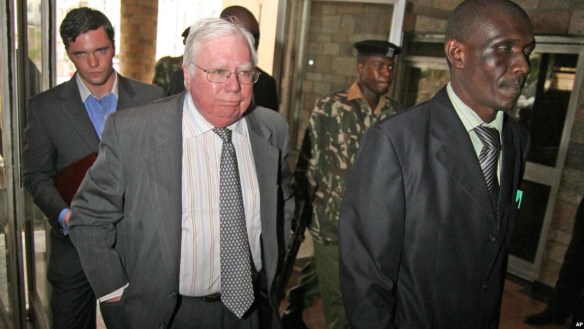
Birther John Corsi in Kenya to investigate Senator Obama
Jerome Corsi, bestselling “Obamanation” and “Where’s The Birth Certificate” author in Nairobi during early Birtherism era.

Republican senators remaining on Board of IRI following Rubio’s resignation to become Secretary of State are silent on takedown of USAID and NED — both as Senators and as Board members

Hard to understand why Senator Sullivan continues to serve as IRI Board Chair given that the Senate has not even had hearings relating to the “woodchippering” of USAID, the freeze of State Department foreign assistance funding and the separate impoundment of appropriated funds for NED.

Nor is he reportedly willing to speak in any detail to the press or offer any public defense of NED or IRI under attack from Elon Musk and his X platform and laying off most staff due to the defunding.

What is a Board Chairman for?

The others who sit in both the Senate and on the IRI Board are Tom Cotton, Joni Ernst and Lindsey Graham.

All USAID implementation partners are in a terrible conflict not of their own making starting from the Musk “woodchippering” of USAID and accompanying assault through X on the weekend after the Inauguration. But IRI is also one of the four NED “core institutions” and a “Government Organized NGO” pursuant to legislation. IRI and it Board Members themselves are targets of the X-led digital smear campaign in support of the elimination of U.S. foreign assistance. If IRI leadership is unwilling to speak up to defend IRI, who else should be expected to.

Why should it fall on people like me, as private citizens, and in my case one with a mixed experience working for IRI years ago, to advocate for the underlying value and values served by democracy assistance and “mending not ending” the enterprise?

Of course it does need to be noted that IRI does raise private donations as a nonpartisan 501(c)(3) charitable, religious, educational or scientific organization. During my time, no private funds were available for our East Africa program activities as opposed to things such as Board activities or Washington approved extras that were not allowable costs to the Government. So the Board may be able to sustain itself separately from the actual democracy assistance programs?

Following Jimmy Carter funeral Donald Trump takes office and deploys “neutron bomb” to US foreign assistance

American “olds” of my generation (we who are 45-64 are the only age cohort who went for Trump in last year’s presidential election) may remember the 1970s controversy over President Carter’s decision to go forward with deployment of the neutron bomb in Western Europe.

To some sensitivities way back in the day, before we “beat the Vietnam syndrome”, the notion of a defensive nuclear weapon that could kill people without “nuking” physical infrastructure was distasteful even faced off against the Soviet Red Army across the Iron Curtain. This was before the peak of the “nuclear freeze” movement and the birth of the National Endowment for Democracy and the modern era of democracy assistance under “PeaceThroughStrength” during the Ronald Reagan administration.

If you are too young to remember the Cold War I think you probably had to be there but I will try to link back soon to some of my related blogs posts and list some other references.

On Friday an acting official on behalf of Secretary of State Rubio delivered the symbolic equivalent of such a weapon to direct immediate Stop-Work orders freezing funding for State Department and USAID funded Foreign Assistance (subject to a few advance waivers for Egypt and Israel, some emergency food assistance and security matters). All to be reviewed and restarted, modified or terminated on authority of Secretary Rubio to make sure they directly serve the strictures of the Trump/Rubio formulation of “America First” as opposed to, you know, helping other people in service to our national interests as per US statutes enacted during the Truman, Eisenhower, Kennedy and subsequent administrations up through 2024.

Of course it was never not America first but it was in some real sense at important times and in important ways “America +” (or so most of us Americans have always believed).

Secretary Rubio came off the Board of Directors of the International Republican Institute (a major State and USAID nonprofit foreign assistance implementor) as well as leaving the U.S. Senate this week to take the post under Trump.

“A Few Thoughts on the Kenyan Election”

A Kenyan friend recently checked in to ask what I had written about the Kenyan election. I had to say “very little”. I have been committed to my more unique role as a witness to what went wrong in 2007-08 and tried to avoid the risk of being just another opinionated outsider missing the real conduct and motivations of the opaque competition for power through the election.

Nonetheless, I did send a private email memo to a few friends in Kenya and Washington back on May 15, 2022 (shortly before Raila and Ruto chose running mates) titled “A Few Thoughts on the Kenyan Election”:

1. First big election in Africa after the end of the Post-Cold War peace in Europe.

2. In this environment, the democratic Western players are less able to credibly claim to speak for a notional international community.

3. So on balance, not much reason to indulge Kenyatta now the way we did Kibaki in 2007. Unless we can be sure that the Kenyattas have a deal with Ruto to assure no major violence, why would we signal that we would be willing to look the other way if they steal it for Raila? Major violence would be riskier and more unpredictable now than back in 2007. On the other hand, if they do steal it, the last thing we would want to do is risk instabilty on behalf of a few votes for Wm. Ruto.

4. Obviously Obama and Trump and their administrations overestimated Uhuru for 15 years, but if we really cared about the details of Kenyan politics we would have gotten serious about injecting some competence into Kenyatta’s BBI fiasco.

5. There are still a few weeks left in a 4 1/2 year campaign so Raila could get it together, but who really thinks that’s highly likely? Under the circumstances, it isn’t that hard to see why ordinary Kenyans would be attracted to a candidate who is even more corrupt and more ruthlessly ambitious, but presents as having some basic discipline and competence, among the actual choices. Especially if you have lived through recent American elections.

6. The American humorist Will Rogers (from the era of my grandparents on the small family farm in Kansas during the Great Depression) was famous for the phrase: “I never met a man I didn’t like”. We have never met a President of Kenya we didn’t like.

UhuruRuto Kenya 2013 billboard Nairobi

Just my honest, private thoughts at the time, for what it is worth.

New report that Trump Administration learned of staggering procurement corruption at top of DRC’s Election Commission “a few weeks before” 2018 election, stayed mum

In a must read story of “Africa in DC”, Buzzfeed’s Albert Samaha peels back several layers of the story of how DRC strongman Joseph Kabila managed his 2016-19 election problem with the new Trump Administration: “A Secretive Company Needed to Convince Washington That Congo’s Election Would Be “Free and Fair.” It Found A Friendly Ear Among Trump Allies.

Previous reporting disclosed internal dissent within the State Department, including an early 2019 story from Robbie Graemer and Jeffcoate O’Donnell I noted here: “Foreign Policy article gives insight on disagreements within Trump Administration on backing off on criticism of flawed DRC vote.”

Kabila’s innovation was to turn directly to his Israeli surveillance and security contractors to broker the hiring of lobbyists connected to the Trump Administration, such as Robert Stryk’s Sonoran Policy Group who repped the Kenyatta-Ruto Administration in Washington during its 2017 re-election effort. Kenyatta hired Stryk through the Kenyan foreign ministry rather than through surveillance contractors. One could suggest that the use of outside-the-Beltway intermediaries raised eyebrows and ultimately loosened tongues.

Update: Here is a link to the U.S. Foreign Agent Registration Act filing of Mer Security and Communications, Ltd of Halon, Israel for the Government of the DRC for the 2018 election. And the filing of Stryk’s Sonoran Policy Group for their subcontracted portion, including lobbying the National Security Council, and hosting “the Cobalt Reception”. (Further on Sonoran Group, see “Trump-linked lobbyist turns from Gulf Arabs to more toxic clients,” al-Monitor, Feb. 19, 2020.)

You owe it to yourself to read Samaha’s whole story, but the thing that is most profoundly disappointing to me is the report that my government learned about massive corruption at the CENI in time to say something before the vote but elected not to.

This casts new color to the internal debate within the U.S. government over what to say and do, and what to disclose, when CENI subsequently announced “results” that lacked credibility.

The excuse for not speaking to government-sponsored election fraud is supposedly the fear of instability from aggrieved voters faced with intransigent incumbents—a real concern—but how can we claim to be serious about democracy support when we chose to keep quite on obviously debilitating fraud before the vote? A key question for me about the Kenyan election disaster in 2007 has always been how much we knew about Kibaki’s intentions before the election, having documented through FOIA that Ambassador Ranneberger personally witnessed the wrongful changing of tallies at the Kenyan IEBC but still encouraged Kenyans to accept the vote without disclosure.

Update: Assistant Secretary of State Tibor Nagy appears to have effectively announced the “climb down” by the State Department on supporting Tshisekedi as the de facto president at a CSIS dinner in Washington on January 30, 2019, while still asserting “In addition, we will continue to voice our disapproval of the poor implementation of a flawed electoral process, which was far below the standards of a fully democratic process. We will hold accountable those most responsible for undermining D.R.C.’s democratic processes and institutions.” Nagy celebrated a peaceful transition of power “that few thought possible”. “Ultimately, the Congolese people have the final word. After President Kabila left office, there have been no meaningful protests to the election outcome. Felix Tshisekedi has vowed to unite the country, reform the security forces and justice sector, fight corruption, and spur greater U.S. investment and it is in our interest to help him succeed.”

On March 21, 2019 the Treasury Department announced personal sanctions against the two top officials of CENI:

Under Nangaa’s leadership, CENI officials inflated by as much as $100 million the costs for the electronic voting machine contract with the intent to use surplus funds for personal enrichment, bribes, and campaign costs to fund the election campaign of Kabila’s candidate. Nangaa, with other CENI officials, awarded an election-related contract and doubled the award amount on the understanding that the winning company would award the extra funds to a DRC company controlled by CENI leadership. Nangaa approved the withdrawal of CENI operation funds for non-authorized budget items for personal use by DRC government employees. Nangaa ordered CENI employees to fabricate expense receipts to cover spending gaps resulting from CENI funds being used for personal gain. Nangaa delivered bribes to Constitutional Court justices to uphold a decision by the CENI to delay DRC’s 2016 elections.

Consider in light of the ultimately similar context from Kabila’s alleged 2011 “re-election” during Secretary Clinton’s State Department tenure as I warned about in a post here on August 8, 2018: “With DRC’s Kabila Backing a Substitute Candidate This Year, Time to Review the International Observation Experience from 2011 Vote”:

At the time of the last election in 2011, Africa democratizers were buoyed by an understood success story in Ghana, the hope of an “Arab Spring”, the lull of violence in Iraq and more generally encouraging environment. As explained in my posts from that time, the U.S.- funded International Observation Mission (conducted by the Carter Center) found the election to fall short of adequacy by the applicable international standards and said so explicitly.

Initially standing up to Kabila over the failures of his alleged re-election and pushing for them to be addressed appeared to be U.S. policy. If so, we apparently changed our mind for some reason. Tolerating a bad election then leaves us in a more difficult position with seven years of water under that bridge. The U.S. has stepped up recently to pressure Kabila to schedule the election, allow opposition and stand down himself.

In this vein, we need to be careful, and transparent, as things proceed to continue to evaluate realistically what is feasible and where we are really able and willing to assist.  In particular, the decision to initiate and fund one or more Election Observation Missions for a vote in these circumstances should involve serious soul-searching at the State Department (and/or USAID).

On the last election:

DRC: “We have to debunk the idea that it is peace versus transparent elections. The idea that lousy elections are going to bring piece is madness.”

Carter Center calls it as they see it in DRC

U.S. and other Western donors support review of election irregularities in DRC — offer technical assistance

State Department to Kabila on DRC Presidential Election: “Nevermind”?

Deal with the reality that the Kenyattas are richer than the Trumps to understand politics in Kenya, in the US, and the relations between us

Uhuru  Kenyatta “UhuRuto” Kenya presidential campaign

I am not going to invest a great deal of time mapping this out because the substance is obvious but details are deliberately obscured. If you are at all serious as a “Kenya Watcher” and are familiar with the basic public news trail on the Trump Organization, it is quite apparent that the net business wealth of the Trumps and the Jared Kushners is simply not at the US dollar value level of the Kenyatta family business empire (assuming as I do that the Trumps are not holding hundreds of millions of dollars of hidden assets overseas).

If you doubt me, work it up and show me that there is real reason to doubt the disparity.

These facts are critical to understanding the realities of the value of the presidency in Kenya and the relatively modest value of the presidency in the United States, even for a politician with perhaps an unprecedented view of the acquisitive opportunities.

If Trump were to get re-elected and get favorable dispensations from the Internal Revenue Service and his private sector creditors, and daughter Ivanka or son Eric were to be elected President in the future, and the Kenyattas fall off the pace somewhat in the next generation, then we can talk about the two families as “dollar peers”. As it stands, Donald Trump is a “first gen president” who had a father and grandfather who made a collective fortune that Donald did not succeed in breaking even with.

As an American I like to hope that a billion dollars still cannot buy everything a billion dollars could buy in Kenya, and that this will still be true even if Donald Trump actually becomes a billionaire someday through his children.

Meanwhile in the USA, former Trump Director of National Intelligence raises threat to survival of the American democratic experiment in the conduct of this election

Trump’s ex-spy chief warns American democracy may not survive November electionIntelnews September 18, 2020.

Dan Coats, former U.S. Senator from Indiana, served as Trumps Director of National Security from the beginning of the Administration until resigning last year. His warning came in a New York Times op ed Thursday:

We hear often that the November election is the most consequential in our lifetime. But the importance of the election is not just which candidate or which party wins. Voters also face the question of whether the American democratic experiment, one of the boldest political innovations in human history, will survive.

Our democracy’s enemies, foreign and domestic, want us to concede in advance that our voting systems are faulty or fraudulent; that sinister conspiracies have distorted the political will of the people; that our public discourse has been perverted by the news media and social networks riddled with prejudice, lies and ill will; that judicial institutions, law enforcement and even national security have been twisted, misused and misdirected to create anxiety and conflict, not justice and social peace.

If those are the results of this tumultuous election year, we are lost, no matter which candidate wins. No American, and certainly no American leader, should want such an outcome. Total destruction and sowing salt in the earth of American democracy is a catastrophe well beyond simple defeat and a poison for generations. An electoral victory on these terms would be no victory at all. The judgment of history, reflecting on the death of enlightened democracy, would be harsh.

The most urgent task American leaders face is to ensure that the election’s results are accepted as legitimate. Electoral legitimacy is the essential linchpin of our entire political culture. We should see the challenge clearly in advance and take immediate action to respond.

The most important part of an effective response is to finally, at long last, forge a genuinely bipartisan effort to save our democracy, rejecting the vicious partisanship that has disabled and destabilized government for too long. If we cannot find common ground now, on this core issue at the very heart of our endangered system, we never will.

Our key goal should be reassurance. We must firmly, unambiguously reassure all Americans that their vote will be counted, that it will matter, that the people’s will expressed through their votes will not be questioned and will be respected and accepted. . . .

US Senate: more on collaboration by Moi’s former consultants Manafort and Stone with Wikileaks and Russian spy Kilimnik on behalf of Trump

For context see “Kenya’s Moi hired Paul Manafort and Roger Stone to lobby National Democratic Institute and others in 1992 election“.

Here is how The Los Angeles Times morning newsletter describes yesterday’s US Senate release:

‘A Grave Counterintelligence Threat’

President Trump‘s 2016 campaign eagerly capitalized on Russia’s efforts to meddle in the U.S. election four years ago, according to a Senate Intelligence Committee report from Republicans and Democrats that raises new concerns about connections between Trump’s top aides and Moscow.

As Russian military intelligence officers were releasing hacked Democratic Party emails through WikiLeaks, the report said, the Trump campaign “sought to maximize the impact of those leaks” and “created messaging strategies” around them. The report found that the Trump campaign “publicly undermined” the U.S. intelligence community’s conclusion that Russia was behind the email hack and “was indifferent to whether it and Wikileaks were furthering a Russian election interference effort.”

The 966-page document describes Paul Manafort, the president’s former campaign chairman who is serving prison time for financial crimes, as “a grave counterintelligence threat” because of his relationship with Konstantin Kilimnik, a business partner in Ukraine who is conclusively described as a “Russian intelligence officer.” Manafort and Kilimnik used encrypted messaging applications and codes to communicate, sometimes telling each other to look at the “tea bag” or the “updated travel schedule” when it was time to check the email account they shared, according to the report, which represents a rare bipartisan consensus on a hotly contested topic.

The report includes new details about Roger Stone communicating with Trump about Wikileaks and concerns about whether anyone encouraged Michael Cohen, the president’s former personal lawyer, to lie about Trump’s pursuit of a luxury skyscraper in Moscow during the campaign.

This fifth and final volume from the Senate Intelligence Committee’s investigation into Russian election meddling in 2016 arrives soon after Trump’s own intelligence officials have warned that Moscow is revisiting its playbookahead of the 2020 election by trying to undermine Joe Biden.

More at “Senate’s Russia Report Implicates More Than Trump’s Campaign“, Bloomberg Quint, Eli Lake, Aug. 19, 2019.

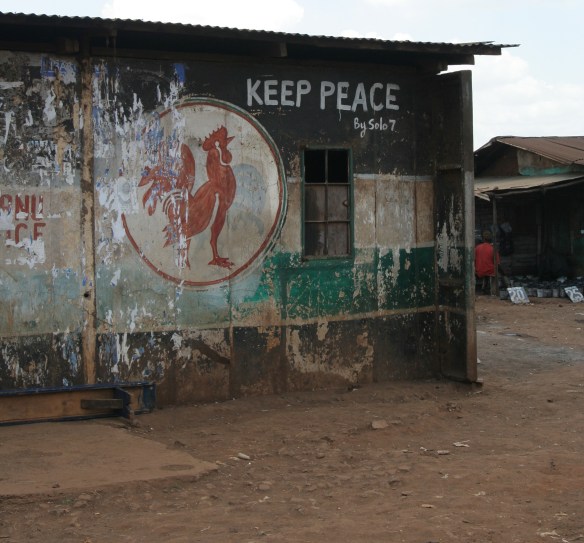
Old Party Office in Kibera

Solo 7–Kibera

Retired Admiral Stavridis publishes op-ed demonstrating American “National Security Establishment” view of “Africa’s Security and the Power Struggle”

I highly commend to my friends who are Africanists or African, or Americans who have not been directly involved in the “national security” professions, a short op-ed piece today from Admiral James Stavridis (Ret.):

Africa’s Security and the Power Struggle

The immediate policy debate in Washington being addressed is consideration of reductions to AFRICOM to be redeployed in support of the Trump Administration’s National Security Strategy of greater emphasis on “Great Power Competition” relative to “Violent Extremism”/”Global Terrorism” so Adm. Stavridis provides an “ionospheric” look at the Continent and its future in support of his argument.

Adm. Stavridis retired from the Navy in 2013 after an extremely accomplished career. He served as Commander of the U.S. Southern Command from 2006 to 2009, then served as Commander of the European Command and Supreme Allied Commander. The perspective of a recent former SOUTHCOM and EUCOM Commander on AFRICOM is clearly invaluable to understanding that way of seeing the world.

Stavridis graduated from the Naval Academy in 1976 and climbed the ladder as a distinguished Surface Warfare Officer, along with UN/NATO deployments to Bosnia and Haiti in the 1990s. He ultimately commanded the Enterprise Carrier Strike Group “conducting combat operations in the Arabian Gulf in support of both Operation Iraqi Freedom and Operation Enduring Freedom”.

Along the way, he did his PhD in International Relations at Tufts, along with other graduate degrees from Tufts, and the National and Naval War College. After retirement he served as the Dean of Tufts’ Fletcher School of Law and Diplomacy. So he is simply put a superstar by background and experience.

Today he is the Operating Executive for The Carlyle Group, the famous global defense-focused equity fund [NASDAQ: CG] and the Chair of the “Board of Counselors” of McClarty Associates, the famous Washington-based global consulting firm [“We know diplomacy; We provide diplomatic solutions”].

By way of disclosure, I retired from 12+ years as a defense industry lawyer working primarily in Navy shipbuilding around the time Stavridis retired from the Navy. I was on unpaid “public service leave” for my East Africa democracy assistance work at the International Republican Institute. So Stavridis’ perspective is all “second nature” for me but will not be intuitive to those from other places and backgrounds.

[Longtime readers or those who otherwise follow Kenyan elections closely might remember that McClarty Associates Vice Chairman John Negroponte was Deputy Secretary of State during the 2007-08 election crisis in Kenya. Negroponte met with representatives of the ODM opposition seeking release of the embargoed USAID-funded International Republican Institute exit poll done with the University of California, San Diego, showing an Odinga win. I learned through FOIA that Kalonzo Musyoka met with Negroponte the same day:

The War for History” part nine: from FOIA, a new readout of Vice President Kalonzo Musyoka’s February 2008 meeting with John Negroponte:

The Kalonzo-Negroponte meeting was the same day as U.S. Senate hearings on the Kenyan election, lobbying by ODM with IRI and Negroponte for release of the USAID/IRI exit poll and that evening’s announcement that IRI found the poll “invalid”. (My FOIA did not result in any documents regarding the ODM-Negroponte meeting.)

From my e-mail to Joel Barkan in 2012:

Kalonzo meeting with Negroponte was in Washington on Feb 7, 08–also included [Kenyan Ambassador] Ogego and a staffer from Kenyan embassy. He said power sharing would be a set back for democracy as Kibaki win was “evident” from review at ECK. Would be willing to step aside as VP for Raila, but the Kenyan people would not support it as it would be “undemocratic”. Kalonzo assured that the violence was now under control, but that the U.S. should continue to call it “ethnic cleansing”. According to Salim Lone interview in Standard back in December ’08 he and ODM delegation met with Negroponte that day to push for release of exit poll before meeting with IRI.

Like George W. Bush in 2007, Donald Trump is more popular in Kenya than he is at home

While Donald Trump is not as unpopular in the United States right now as George W. Bush was during the time of my service as East Africa Resident Director for the International Republican Institute in Nairobi, Trump is more popular in Kenya than at home, as Bush was then (Bush was conspicuously popular in the early aftermath of 9-11, won re-election in 2004 and was not highly unpopular until on into his second term; Trump is steadily, but not extremely unpopular in terms of raw approval numbers, per his apparent strategy tied to our Electoral College system, although a slight overall majority would like the Senate to remove him from office in the current impeachment trial).

See: Trump Ratings Remain Low Around Globe, While Views of US Stay Mostly Favorable; Trump foreign policies receive little support” from the Pew Center for Research.

Update: At the same time, we have to note a similar situation with China’s Xi Jinping:

Publics in most of the countries surveyed lack confidence in Xi Jinping. His highest ratings come mostly from countries in Africa and the Middle East, including 61% in Nigeria, 58% in Kenya, 52% in South Africa, 44% in Tunisia and 41% in Lebanon. Filipinos and Russians generally voice confidence in the Chinese president as well.

Some thoughts:

1) the United States has been generally popular in Kenya in part because we have kept closely linked in our policy positions at the Government to Government level while also getting credit for moral support for “the Second Liberation” once the Cold War ended. We have shown a level of diplomatic finesse at a “10,000 foot level” in achieving what we have wanted from the relationship. There are always issues and problems, such as overhang from the perception that we tried to sell a bad election in 2017 and have been too supportive of the Jubilee Administration in the context of bad economic performance, but we manage.

2) the bottom line. We spend a greatly disproportionate amount of foreign assistance dollars in Kenya relative to poorer, less advantaged countries within Africa in the context of poverty relief. We do a lot to help alleviate some of the worst consequences of extreme inequality, corruption and bad policy priorities from Kenya’s governments. Some of this is for obvious foreign policy reasons as part of our diplomacy, some of it is because people prefer to live in Nairobi to Blantyre, say. Some of it is because as a more developed country with a well educated albeit small middle class and some real infrastructure, along with a lot of poverty and other challenges, Kenya is one of the most logistically easy places to do a lot of things within the “assistance” field.

As a brutal example of the role of US assistance in providing for basic needs that Kenya’s government is unwilling to meet, see Max Bearak in the Washington Post: Kenya’s blood banks go dry after US ended aid.

3) Trump solves a couple of things that were tricky for President Obama during his time: because he has not visited Kenya himself and has no obvious personal connection to the region beyond the ubiquitous “friends trying to get rich” he is more generically “American” as opposed to the son of a “Luo tribesman” as propagandists in the US described Obama. Obama faced certain misunderstandings and disappointed expectations, and maybe overcompensated in certain areas. On the “culture war” issues, Trump has returned on abortion to the strong “no” position under Bush and then some, and seems to calibrate mixed messages on sexual minorities rights which was a particular area where my sense is that Obama unsuccessfully “spent” some personal political capital in Kenya in his second term. Trump has emphasized in his campaigns and general messaging his relationships with Americans who are involved with these issues in Kenya such as his impeachment defense counsel Jay Sekulow of the East African Centre for Law and Justice. See “American Center for Law and Justice opens Nairobi branch, campaigning against draft Constitution” from May 2010.

4) Trump has tried numerous times to make large, draconian cuts in foreign assistance, but he has failed in Congress (and Kenya has not experienced any extraordinary and arguably illegal blocks like Ukraine did earlier this year) but all this is “inside baseball”–as long as the money comes the President gets credit symbolically.

5) The Trump Administration has promoted a high degree of personal Trump-Kenyatta interaction both in Washington and at the G-7 and other non-African venues. Kenyatta is very wealthy and comes from family wealth like Trump, and similarly graduated from an private American Northeastern college. Kenyatta is no Zelensky, left to twist for a meeting. Kenyatta may not be exceptionally popular as an individual right now in Kenya, but the obvious benefits to Trump’s image in the minds of Kenyans are not dependent on that kind of specifics.

6) Without getting too “deep in the weeds” I think Trump got a break and the US has benefited from having former Illinois State Senator Kyle McCarter as Trump’s political appointment for Ambassador. Having a career civil servant and experienced diplomat in the position would lead to Trump keeping his distance presumably, but McCarter has little in common with Trump in background, style or personality (nor are his politics as a former elected official from the “Tea Party” wing of the Republican Party all that much like Trump’s unless he has changed his mind about quite a few things). At the same time, his missionary background and status with Trump and the GOP and other organizations give him entre beyond conventional diplomacy. So arguably McCarter is in a unique role to broker between Washington and Kenya and not typical of the type of political appointments we have seen from Trump in other Embassies.