Concerns on effectiveness of education aid in East Africa

The Guardian‘s Claire Provost reports on a new
Independent Commission on Aid Impact evaluation of UK education aid
for Tanzania, Rwanda and Ethiopia, which finds too much attention paid to increased enrollments and not enough to actual educational performance:

“The quality of education being provided to most children in these countries is so low that it seriously detracts from the development impact of DfiD’s educational assistance,” said the report, which failed to find evidence that DfiD was considering “basic preconditions for learning” such as whether students and teachers actually attend class after the first day.

“To achieve near-universal primary enrolment but with a large majority of pupils failing to attain basic levels of literacy or numeracy is not, in our view, a successful development result. It represents poor value for money both for the UK’s assistance and for national budgets,” said the report giving the programmes an “amber-red” rating signifying that they need significant improvements.

DfiD funding for education in the three countries is expected to top £1bn over the 2005-2015 period. The majority of this has been delivered through “budget support” – money given directly to recipient country governments. While this has helped DfiD to concentrate on promoting policy reforms, said ICAI, the department should now consider a more “hands-on approach”.


This seems to be consistent with what both the UK and the US have seen in Kenya, with the “education scandal” over a course of years under the “free primary education” initiative following the 2002 elections and on into the current Government of National Unity.  Direct budget support has serious risks and limitations.  For one thing, foreign funding does not necessarily change the priorities that may be reflected in the lack of local funding in the first place.  A separate ICAI report found that budget support can be effective in the right conditions, but in practice varied widely by country–India, for instance, showed better results.

Encouragingly, the current UK international development secretary, Andrew Mitchell, expressed willingness to apply the learning from the independent evaluation, and acknowledged a previous over-emphasis on increased enrollment in and of itself.

Here is the link to the ICAI reports.


“Competition for Military Superiority” between Uganda and Kenya not a sign of political maturity

British Helicopter

British Helicopter at base near Nanyuki


The Daily Nation reports on new data on Ugandan and Kenyan defense spending from SIPRI, “Arms race hots up in East Africa”:

Competition for military superiority in the East African Community has seen Uganda’s arms expenditure surpass Kenya’s for the first time this year, a new global arms report shows.

Kampala spent US$1.02 billion (Sh83 billion) — much more than Kenya’s US$735 million (Sh61 billion), the Stockholm International Peace Research Institute (Sipri) says. The institute does research into conflict and arms control.

The most advanced

In particular, Uganda’s acquisition of six SU-30MK Russian jets is said to have elevated its air force to one of the most advanced in East and Central Africa.

The reasons for the increased budget, according to the report, include competition for regional military superiority, especially with Kenya, and the threat of a spillover from potential conflict between Sudan and South Sudan.

Others included the operation in Somalia against Al-Shabaab where the region’s armies, including Kenya’s, are fighting under the African Mission in Somalia (Amisom), and against Joseph Kony’s rebels in the DR Congo are quoted as reasons for Uganda’s ballooning military expenditure.

The friction with Kenya over Migingo Island almost sparked a confrontation and this is also cited as justification for more military spending by Kampala.

Kenya’s military expenditure has also been going up in the last decade. The country spent only Sh14 billion on the military in 2000 compared to more than Sh60 billion today.  .  .  .

There are plenty of positive opportunities for competition and national pride within the East African Community, but acquisition of military hardware in support of governing egos is not something that is affordable for either country in the context of need, and supports the temptations of saber rattling for political gamesmanship.  Any type of military confrontation within the EAC would be an absurd tragedy.  Since the U.S. and our European allies are heavily engaged in interacting with the Ugandan and Kenyan militaries, perhaps we can be positively influential in dissuading this type of behavior in conjunction with our support for less tangible types of political reform.

A little Kenyan-American history: Kissinger, Waiyaki, Kibaki; getting the F-5s, safaris and slums

History–Kenyatta, the Kenyan military and GSU; origins of U.S. military assistance

More Kenyan-American diplomatic history: Kenyatta’s health and succession; status of whites; military assistance

(Updated 10-12) Ugandan Parliament Votes to Suspend Oil Deals on Corruption Charges

BBC News is reporting that the Ugandan parliament has asserted its independence by acting to freeze new oil agreements after bribery allegations are brought forward by an MP:

Uganda’s parliament has voted to suspend all new deals in the oil sector following claims that government ministers took multi-million dollar bribes.

MP Gerald Karuhanga said in parliament on Monday that UK-based Tullow Oil paid bribes to influence decisions.

Tullow said it rejected the “outrageous and wholly defamatory” allegations.

The vote is a big blow to President Yoweri Museveni, who has been in power since 1986, analysts say.

The BBC’s Joshua Mmali in the capital, Kampala, says it means the government will not be able to sign new oil deals until a petroleum law is enacted.

.  .  .  .

Update–from Wednesday’s Daily Monitor:

The British High Commission in Kampala yesterday said the country’s Metropolitan Police is at liberty to start investigations into allegations that Tullow, one of London’s 100 listed companies, paid bribes to senior Uganda government officials. “Bribery of foreign public officials is of course an offence under UK law, and it would therefore be for the British Police to decide whether to open an investigation into allegations made against a British company,” a spokesperson for the High Commission said in reply to our email enquiries.

UK’s 2010 Bribery Act imposes “strict liability” on UK corporations or business firms that fail to make “adequate processes” to prevent bribe payments. In yesterday’s statement, the High Commission said it was following the ongoing oil debate in Parliament “with interest”, but understand that “Tullow Oil totally rejects those allegations”.

The Company had by press time not replied to specific questions this newspaper raised based on allegations in Parliament that the firm between June 1 and July 16, 2010 paid out up to $100m (Shs280b) to “experts”, among them powerful ministers, for “professional services” from accounts with Bank of Valetta in Malta.

.  .  .  .

Part Six–What did the U.S. Ambassador report to Washington the day after the Kenyan election?

See the previous posts in this series:  Part One, Two , Three , Four and Five.

There were additional machinations with the Ambassador’s approach to IRI up through election day that I think raised legitimate concern about what his objectives and intentions were in regard to the election, as reflected in my complaint to USAID, but for present purposes, I will skip ahead to the next cable I have received, a report by the Ambassador to the Secretary of State and others on December 28, 2007 entitled “Kenya’s Elections – A Positive Process Thus Far”  [Ed.  Note:  the group of cables I have been discussing is limited to five items from the Central Foreign Policy files in Washington,  whereas the Africa Bureau has made no response to the Department FOIA office as to its records on the same FOIA request, including those kept at the embassy in Nairobi.  Follow up: In October 2011, two years after my request was filed, my status inquiry finally indicated that documents from the Africa Bureau were under review for release.]

So what did the Ambassador say on the day after election?  Here is his summary:

“The relatively smooth and peaceful way in which the elections were carried out on December 27 represents a victory first and foremost for the Kenyan people and their democracy.  Herculean efforts by the Electoral Commission of Kenya (ECK), the responsible statements made by the leaders of the main parties, the constructive role played by the media, and strong U.S. support and observation all contributed to this positive outcome.  All observers share a relatively positive view of how the election process was carried  out.  I have made an informal positive statement to the Kenyan media.  It is, however, too early to make final pronouncements.  Septel will provide text of a proposed draft statement that can be issued by Washington on December 29 .  The vote counting will not be completed until the 29th.  The potential for last minute fraud cannot be ruled out.  The electoral process in some areas was characterized by delays and problems with voting procedures and electoral registers, but these were largely resolved in a way that did not disenfranchise voters, who turned out in record numbers.  Initial informal results show opposition candidate Raila Odinga leading President Kibaki by between 3 and 8 points, but this reporting is uneven and not systematic.  The election is still, in our view, too early to call.”

. . .  The most striking impressions from all observers about election day are the peacefulness and orderliness of the process.  Even the most problematic and contentious constituencies completed voting in an acceptable fashion.

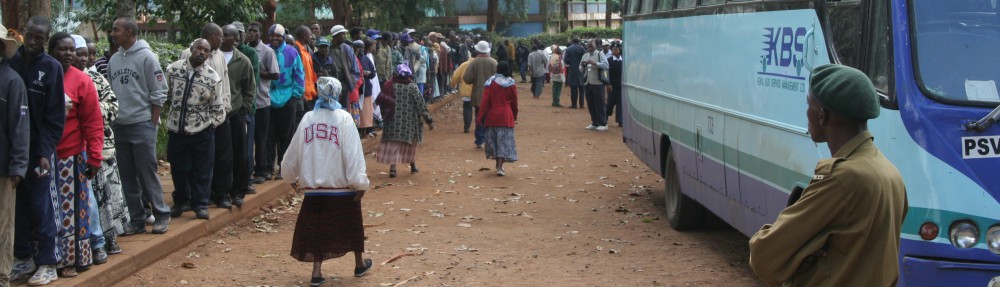
For example, I observed the opening of the polls in the Kibera slum, which is a key part of Langata constituency, where presidential candidate Raila Odinga was a candidate for Parliament.  This race was ground zero in the election process given widespread fears that extra-legal efforts would be made to defeat Odinga there, thus making him ineligible to become President (since whoever is elected President must also be an elected member of Parliament).  At 0600 there was already over 5,000 people lined up to vote at the largest polling station in Langata, which is Olympic School in the Kibera slum.  The bigger problem was confusion over voting procedures.  People had begun lining up since just after midnight.  [Ed. Note:  Why?  According to one account I have been provided this was done in the context of the exposure of organized efforts to bus in large numbers of people to disrupt the voting.]  . . . Calls from us to ECK were instrumental in getting senior ECK officials to act quickly to resolve the issues [the need for more full copies of the electoral register for the polling station], and I was able to make some reassuring statements to the media.  ECK Chairman Kivuitu went to Kibera himself to calm people.  In another remarkable testament to the professionalism of ECK officials, all those waiting to vote were eventually processed, and by late evening Kibera was quiet (a truck standing by with riot police was not needed).  .  .  .

“One embarrassing stumble by the ECK actually became on the the day’s best examples of Kenya’s maturing commitment to a responsible democratic process.  The ECK inexplicably failed to include Raila Odinga’s name in the voting register in his own polling station in his Langata constituency, resulting in a potential crisis when Odinga was turned away.  Instead of inflaming the Kibera slum, Odinga simply drove to ECK headquarters and officially protested the omission.  The ECK offered no excuses and acted immediately to amend the register to include Odinga’s name.  There were a few quick press conferences and the situation ended peacefully with Odinga casting his vote.

That the voting process was so relatively smooth and peaceful despite delays and organizational problems testifies to the commitment of the Kenyan people to democratic values.  The leadership of the President and the opposition candidates in calling for peaceful elections and respect for the results was also crucial to this positive outcome.

The other remarkable aspect of the elections was the unprecedented high turnout (which will average somewhere between 65 and 80 percent).  Not surprisingly, Kibaki’s team produced a record turnout of around 85% in his home area of Central Province, and Odinga produced a high turnout in his home area of Nyanza Province.  Many people waited in line for six hours or more.  Some of the turnout was clearly the result of increased participation by youth.  It appears that Odinga will profit from youths’ perception that he represents a younger generation (though he is 63 to Kibaki’s 76, and both are from the same political class) and that he will be more decisive against corruption.

The electoral process thus far deserves a strong statement of support, and clearly meets a high standard for credible, transparent, free and fair elections.  I made an informal statement last night that was carried extensively on Kenyan television.  It is, however, too early to make definitive pronouncements.  The ECK will likely not announce final results until December 29.  The EU and Kenyan domestic observation missions will make statements on the 29th.  By COB Washington time on the 29th we will send a proposed draft for a statement by Washington.  IRI will make a largely positive statement the afternoon of the 28th.

The ballot counting process is carried out in three stages, each fraught with the potential for fraud.  First, the ballots are counted at each polling station in front of party agents.  Party agents were given copies of the results and they were also posted publicly at each station.  My observations and those of our observers indicate that this counting process was generally transparent and efficient.  Second, the ballots were taken to central tally stations in each of the 210 constituencies.  Observations indicate that this process has also been carried out well.  Finaly, the ballots and results of the tally stations are, where possible, being called or sent by e-mail to the ECK and then physically carried to ECK headquarters.  This process, which will be carried out during the course of today and this evening, is where the potential for trouble is currently greatest.  Ballots can be lost, burned, or otherwise destroyed.  Even though results will have been posted at polling stations, any interference with the final phase of the count would raise serious issues that the ECK would have to address (especially if the ballots delivered to the ECK in any way differed from results tabulated at polling stations).  During this period tensions will rise as inevitable rumors circulate (given the history of extensive fraud in all previous elections except the one in 2002).  We have received, unconfirmed reports that the police had to fire into the air at several tally centers to disperse unruly crowds worried that ballots were being tampered with.   Commissioner of Police Ali gave a press conference this morning and said all the rights things to assure people of his commitment to ensure protection for ballots and to highlight the non-political role of the police.

As a result of its generally responsible, extensive, and timely reporting, the media also deserves credit for how well the process has proceeded thus far.   Since before the polls closed the media has been reporting on a 24-hour basis.  They are reporting vote totals based on the results posted at polling stations, but making clear that only the ECK can announce official results.  The results that the media are reporting reflect uneven inputs from around the country, but so far show Odinga leading Kibaki by about almost 10 points.  Two exit polls (with uncertain methodology) also show Odinga winning by 3 -8 points.  The race is, in our view still to [sic] early to call.   It appears, as expected, that these elections will result in a sea change in Parliament, with up to 70 percent of incumbents replaced.  This may in part be due to a wave of ODM support, but is even more the result of dissatisfaction with the incumbents’ perceived inattention to their constituencies and to the exorbitant pay raise that they awarded themselves.  Initial reports indicate that some of the most corrupt incumbents have been defeated.

“Advancing U.S. Interests”

We will keep the Department closely informed as results become clearer.  At this point, there are sound reasons to believe that this election process will be a very positive example for the continent and for the developing world, that it will represent a watershed in the consolidation of Kenyan democracy, and that it will, therefore, significantly advance U.S. interests.  The Kenyan people will view the U.S. as having played an important and neutral role in encouraging a positive election process” [End]

All told, a smashing success then, reports the Ambassador.

No particular security concerns.  Kudos to the ECK, kudos to the police, kudos to the media and kudos to the State Department.  “And that exit poll I commissioned through USAID to ‘provide an independent source of verification of electoral outcomes’ as I described it in my December 14 cable (and to provide ‘early intelligence’ for me as the USAID officer said on the afternoon of election day)?   Its methodology is ‘uncertain’ ” (even though it was developed by experts, at the expense of USAID and UCSD, with open consultation with USAID all along). [Ed. Note:  The other exit poll Ranneberger referred to in the cable is apparently one conducted by the Institute for Education in Democracy in Nairobi with funding from the British Westminster foundation as I was told.  I was told that the IED, unlike IRI, was not able to obtain complete results from the field in the context of the violence and was not able to publish final results.  I could, arguably, say that its methodology is “uncertain” because I don’t personally know anything about it.]

IRI was criticized by members of the EU Observation Mission for releasing its “largely positive” statement of that day, the 28th, while all the other observation delegations waited.  Ironically, the U.S. was the largest and lead donor for the UNDP election coordination effort, through which other delegations cooperated in waiting to make preliminary statements for the ECK to announce results.

[See Part Seven–One Last FOIA Cable on the 2007 exit poll.]

UK Cuts Education Aid Once Again in Lastest Round on Kenyan Education Scandals (Updated)

Update, June 16: The Irish Times reports that the U.K. will “push hard” for return of its share of stolen education aid funds.

The country’s finance minister Uhuru Kenyatta said the names of officials investigated had been given to the police, but analysts said the chances of prosecutions were low.

“Handing over reports to the criminal investigations department of the Kenyan police force is a good way of shelving investigations,” said Mwalimu Mati, chief executive officer at the corruption watchdog Mars Group Kenya. “It is hard to see how such a discredited police force can bring about justice when they are still investing in Anglo Leasing and Goldenberg.”

The Goldenberg scandal, which cost the country over 10 per cent of GDP, dates back to the early 1990s. It saw the government of Kenya pay out hundreds of millions of dollars of public money in a bogus gold export scheme. No government officials have been prosecuted for their part in it.

Despite coming to power in December 2002 on a strong anti-graft platform, President Mwai Kibaki has failed to stamp out corruption in east Africa’s largest economy. Kenya has slipped down the rankings of Transparency International’s 2010 corruption perceptions index, falling to 154 out of 178 countries.

Last year the government said it could be losing $4 billion, nearly one-third of the national budget, to kickbacks and other forms of corruption.

“Kenya is good at talking about corruption cases,” Teresa Omondi, the deputy executive director of Transparency International – Kenya, said, “but not at prosecuting anyone in them. The fact that no stringent action is ever taken means there is a risk of us hearing about all this again next year.”

“UK cuts education aid by Sh300m”, Daily Nation:

The government was on Tuesday put under pressure to rein in corruption within its ranks, with the United Kingdom announcing a Sh300 million education budget cut.

British High Commissioner Rob Macaire said that they will continue funding education, but only through non-governmental channels until the Ministry of Education adopted prudent financial management systems.

This year, the British Government has allocated Sh1.3 billion to fund various educational programmes through these channels.

“It is shocking that civil servants in trusted positions in the government would steal such an amount of money.

“We share in the outrage of Kenyans about this, because there is UK taxpayers money involved too,” Mr Macaire said.

He was responding to fresh investigations by Treasury over a Sh4.2 billion fraud in the Education ministry.

“This should not be allowed, neither tolerated,” he said, adding that the culprits should be prosecuted.

So far, the Department for International Development (DfID) has supplied 320,000 children in slums with textbooks in 1,100 selected schools.

Mr Mike Harrison, deputy director at DfID, said unless financial transactions are electronic, they would not fund the ministry.

“We need some concrete proof that the financial management in the ministry are turned around.

“Electronic money transfer will have to be at the heart of the system unlike today where paper transfer is easily doctored.”

.  .  .  .

See, “Treasury audit reveals Sh5.8bn fraud”, Daily Nation.  “Education and Medical Services staff probed over Sh 6.2bn loss“, The Star.

Odinga in Washington; U.S. in Libya; “Kinetic Action” v. MCC

Here is the link to a multimedia page for Raila Odinga’s speech and Q & A last week at CSIS in Washington.  Nothing newsmaking in itself that I saw, but a good speech of interest to those following governance and democratization issues in Africa and especially Kenya and Ivory Coast.

In the meantime, one of the most telling things I have read about how our actions in participating in the Libyan mission are viewed by others is from Bruce Reidel at Brookings:

The Indians are puzzled that some in the West who had embraced Qaddafi less than a hundred days ago are now so shocked by his cruelty. Qaddafi did not change in 2011. Some former Indian diplomats are quick to suggest that the Libyan war shows America’s “unreliability” and a tendency to over react to the last news broadcast. Who are the rebels in Benghazi, they ask, that are now your allies? Why do you rush to help them, and not the shia protesters in Manama?

As one Indian observer put it, “the U.S. is both promiscuous and flighty” with its relationships.

“A Letter from Agra:  How India Views U.S. Actions in Libya”

These observations on the Indian view were published almost a month ago.  If the NATO effort in Libya bogs down, we may find ourselves asking more rigorously, “why exactly did we decide to do this?” and “what specifically were we trying to accomplish originally and what specifically are we trying to accomplish now?”.  Those same questions that eventually became “known unknowns” in Iraq.

In the meantime, The Hill caries a piece by Paul O’Brian of OxFam America on potentially critical budget cuts for the Millennium Challenge Corporation.  No one at the MCC could afford to make the comparison politically I am sure, but let me make it for them:  look at the cost of the Libya action versus the cost of the MCC.  The MCC would seem to have bipartisan support if any area of development can.  A George W. Bush initiative originally, but very compatible with Democratic “soft power” thinking and led by Obama appointees now.   A relatively small staff and bureaucratic footprint.

In geopolitics, and in longer term development, we need to pay some real attention to states, but if this is a humanitarian effort don’t we need to look also at the numbers of people involved: is this worth the cost relative to the cost of other “kinetic” or “non-kinetic” endeavors?  Ivory Coast, for instance, is a much more populous country.

Constitutional Debate on Constituency Development Funds in Tanzania

Bora Kujenga Daraja (better to build a bridge) discusses the filing by a group of civil society organizations of a lawsuit challenging the constitutionality of new legislation in Tanzania creating Constituency Development Catalyst Funds, or Mfuka wa Majimbo. [h/t to Global Integrity  on Twitter]

Here is an introduction to the Daraja organization that sponsors this blog from their website:

Daraja is a new organisation that aims to make positive changes to life in rural Tanzania by bringing people and government closer together. Our name reflects our approach – Daraja comes from the Swahili word for bridge.

In rural Tanzania, local government has a responsibility to listen to the community and to deliver public services that meet local needs. We want to make sure local government fills that role. We want to make the system work.

The argument in the lawsuit is that the legislation violates the Tanzanian constitution by inappropriately crossing the separation of powers by giving legislators executive authority, rather than legislative oversight, over these funds:

A few days ago, a group of seven civil society organisations, including Policy Forum and the Legal and Human Rights Centre (LHRC) filed a case with the High Court of Tanzania, arguing that the act establishing the Constituency Development Catalyst Fund, or Mfuka wa Majimbo, is unconstitutional. In doing so, they are following the lead of other organisations raising challenges to similar constituency-based development funds in other countries.

But this move is far from being universally popular. MPs from all major parties supported the CDCF bill. One MP – Dr Faustine from Kinondoni – used his personal blog to criticise the CSOs’ case, arguing that the CDCF has been a very effective way of quickly solving problems in his constituency. . . .

And this view can perhaps claim some academic support from a surprising source: the DFID-funded African Power and Politics Programme (APPP), who have been looking into the idea that governance reforms should build on what exists and should be rooted in their socio-cultural context. Perhaps it’s better to give MPs a means of fulfilling constituents’ expectations and to find ways of ensuring it’s well managed, accountable and more than just a slush fund, rather than to insist on western governance niceties in a very different context. “Going with the grain” is the slogan of this approach.

I have a lot of sympathy for going with the grain. But surely it applies more to governance reforms at the administrative level – focussing on things like budgeting and financial management systems – than to such a fundamental distinction as that between the executive and the legislature. After all, the constitution is supposed to prevent misuse of power by the government and MPs, which is exactly what these CSOs are trying to use it for.

And let’s not forget, MPs are hardly powerless to “bring development” to their constituencies. They have the most influential seat on the council, which sets the budget for local development projects. And if that system is too slow and bureaucratic for them to use in response to local demands, MPs are better placed than almost anyone else to make the system work better, since they also have a roll in setting the national budget and national laws and policies.

For civil society there’s also a rigourous debate about tactics going on here – also a question of following formal processes or going with the grain. Launch a legal challenge to bring the law down, or focus on monitoring how the CDCF works in practice. In Kenya, for example, such monitoring has uncovered widespread abuses and I hear this has led to some MPs concluding that this type of fund is more trouble than it’s worth. It doesn’t have to either/or, of course; it could be both legal challenge and monitoring, but that takes twice as much effort.

Record inflows to “Frontier Africa Funds” reflect continuing “mainstreaming” of global investment in Africa

Reuters reported record inflows of $660M into African regional equity funds in the past 12 months, with positive inflows in 51 of the 52 weeks based on a report from EPRF Global in Washington. Not large numbers on a global scale, but definite confirmation of the arrival of Africa into the mainstream of emerging markets equity investment.

Certainly this number is much smaller than aggregate aid flows of various types, but it also represents only public equity funds and does not capture the scope of overall international investment, particularly private equity. How this fits in to the overall development picture is a worthy subject of study. It surely creates opportunities for growth and reflects some underlying optimism in future governance and stability at least in some major markets.

One question of course is competition among developed countries for deals in a growing African market. Here is a fascinating story from Uganda’s “Independent” entitled “German, US, UK envoys fight over EC [Electoral Commission] tender”.

New Glenn Beck agitprop uses Kenyans as cutout prop to insinuate that President seeks to turn U.S. “Marxist” or “full-fledged Soviet” (or even “anti-colonial”!) because, Beck claims, that was the dream of Obama’s father . . . and is reflected in Kenya’s new constitution

You can’t make this stuff up–at least I hope you can’t. It takes an accomplished demagogue to do this. I really don’t care one way or the other what Beck thinks or dreams about American politics as such, but America has some responsibility of self-assumed leadership in world affairs. As a democracy, it matters when we delude ourselves about the citizens of other nations, and certainly citizens who treat us as friends and who share our democratic aspirations.

Rupert Murdoch and Roger Ailes should be ashamed of themselves for this.

Reasonable people can be strongly in disagreement with President Obama’s policies on whatever subject, and patriotic people can be sharply critical of an elected president; reasonable people can have different views about Kenyatta and Kenya’s political history and about Obama, Sr.’s role or lack thereof, and about Kenya’s new constitution, but taken in sum total this is truly, deeply and offensively ignorant and disrespectful to millions of people who never did anything to Glenn Beck.

I have never been a Marxist or in any way pro-Soviet–I am an old “Cold War Republican” or at least have been. I have never even been a Democrat. I am not a natural ally of Obama. Nonetheless, this type of smear by long strings of rambling insinuations based on distortions of facts likely unknown to Beck’s audience, seems to me outside the bounds of how small “d” democrats talk to each other about their country and its elected leaders and Beck and his enablers deserve to be called on it.

“Africa’s Role in a Post-G8 World”–Chatam House Report for Event in London today

Excerpts from a new Chatam House report with a strong call for a fresh approach to Africa from “the West”:

A strong diplomatic and trade engagement with Africa matters. Africa is the foundation of the global supply chain – a strategic source of almost 40 per cent of the raw materials, agriculture, fresh water and energy essential for global growth. Its rainforests play a central role in the planet’s climate. Its population of one billion are increasingly important consumers. Africa is strategically placed between time zones, continents and hemispheres. However, the overwhelmingly humanitarian interest of many Western countries and traditional partners has led to stereotyped perceptions of Africa in terms only of problems. These views are increasingly patronizing, recursive, out of touch, and a deterrent to serious business interest. Meanwhile the emerging economic powers of the G20 see Africa in terms of opportunities – as a place in which to invest, gain market share and win access to resources.
. . . . 
Development assistance has played, and will continue to play, an important role for many African countries, but economic fortunes across the continent are now diverging. This makes it less meaningful to treat Africa as a single entity in international economic negotiations. 
. . . .
Africa has never been in such a strong bargaining position in international affairs, with increasing numbers of suitors. However, African leadership is at present insufficient and the activism and vision that characterized the first few years of the twenty-first century are less in evidence now. This is dangerous because without strong, effective leadership the competition for Africa’s resources may degenerate into the kind of colonial exploitative scramble from which much of the continent has only recently begun to recover. Governance institutions in general – from national governments to regional bodies and the African Union itself – are stronger than they were, but they need to be far stronger still. 
. . . . 
Aid is a very necessary safety net, but it is not a springboard. It will ultimately deliver the development Africa needs only if it is used in support of private-sector-led growth and stability. Emerging economies are capitalizing on this. Western countries ought to benefit too; indeed it should be a strategic imperative for them. Yet thus far there is insufficient evidence that they recognize this. Most Western countries still enjoy a comparative, if diminishing, advantage over emerging powers in policy and academic understanding of Africa. Yet resources and expertise on Africa have been allowed to wither in Western governments, academia and the news media. The advantages many former colonial powers enjoyed in terms of expertise, trade links and cultural affinity are now far fewer than many policy-makers assume. Beneath the rhetoric of the importance of Africa, diplomatic and trade resources devoted to it are still being cut in many Western capitals, leading to a downward spiral of ignorance and thus marginalization in strategic awareness. Reversing this trend will require time and investment, but the rewards should be considerable. The financial crisis challenged Western claims about the superiority of the democratic and free market model. Western countries should welcome the opportunity to demonstrate the advantages, dynamism and resilience of their economies and governance systems, and export them to Africa for common benefit, in an increasingly mpetitive multipolar world.