Meanwhile, south of the Sahara . . .

*While Kenyan politicians focus on the 2012 presidential race, perhaps as much as half of the population of of Mandera has been displaced by the fighting between al-Shabaab and pro-TFG forces in southern Somalia. Likewise there has been a large influx of Somali refugees and the border has now been “closed” again. Here is a report from IRIN.

*Carlyle Group will launch a $750 fund to invest in Africa, reports the Financial Times.

Carlyle already has a significant presence in north Africa, as well as a dedicated private equity fund for the Middle East and north Africa.

Many parts of Africa are now enjoying better prospects than at any time in recent history due largely to a rush for resources led by the Chinese.

“The majority of Americans don’t pay enough attention to Africa,” one source close to Carlyle said. “It has been China that has been the catalyst for economic activity in Africa.”

Carlyle’s fundraising machine is by far the most powerful of any of the large private equity groups.

*McClatchy’s Planet Washington blog reports that wildlife groups are seeking U.S. Endangered Species Act protection for African lions. Apparently the U.S. is the biggest importer of lion trophies and lion parts. Who knew?

*Ethiopia and Tanzania are two of the countries that are due to receive significant increases in official assistance from the UK as the Tory government refocuses DFID spending from more affluent countries to those most impoverished. The BBC gives details here.

For Kenya, the UK has reintroduced conditionality due to the pervasive corruption problems. This will result in significant cuts this year, delayed or denied funding based on reforms and the possibilities for increases in future years based on progress. This is front page news in Kenya--see the Daily Nation story here.

Links to Start the Week

Qaddafi demise helps African Union at Africa Works by G. Pascal Zachary:

The collapse of Qaddafi’s dictatorial regime in Africa has concrete benefits for the African Union, whose international standing has repeatedly been undermined by the Libyan leader’s eccentric Pan-Africanism and past embrace of terrorism. . . . . Qaddafi and Libyan cronies invested in African real estate but they never provided either finance or expertise to promote industrial enterprises. Should Qaddafi vanish permanently from the club of African leaders, the African Union will be the beneficiary. The AU struggles with legitimacy and effectiveness; Qaddafi made the tests of pragmatism and idealism much more difficult. His absence from the AU governing body will make the renovation of this disappointing regional body easier, though even without the burden of Qaddafi, the task facing reformers of the AU remains daunting.

In Uganda, a new inflation–in the price of votes, Jina Moore

Martha Karua, running for the Kenyan presidency next year, says Kibaki administration has increased extrajudicial killings from the level of the Moi administration.

Sixth Fleet Frigate USS Stephen W. Groves is  spending roughly two weeks at Dar Es Salaam for African Partnership Station program training East African sailors, along with some community relations.

“Real Conservatives Don’t Slash Foreign Aid:  What House Republicans Can Learn From David Cameron and the Tories” Thomas Carothers in The New Republic.

“Wako reserves his most potent sting for Kibaki” Emeka-Mayaka Gekara in the Daily Nation. A good example of how things really work in Kenyan politics.

“Somalia:  The Transition Government on Life Support” International Crisis Group report, February 21.  Says the international community has continued to fail to appreciate the reality that attempts to create a European-style centralized national government are doomed to failure.  The TFG is further hampered by corruption and irresponsibility.  Without serious progress and reform by August, the attention of the international support should shift:

Yet, the situation is not as bleak as it may seem. Some parts of Somalia, most notably Somaliland and Puntland in the north, are relatively stable, and as the ill-fated Union of Islamic Courts demonstrated in 2006, it is possible to rapidly reestablish peace and stability in central and south Somalia if the right conditions exist. Contrary to what is often assumed, there is little anarchy in the country. Local authorities administer most areas and maintain a modicum of law and order. Somalis and humanitarian agencies and NGOs on the ground know who is in charge and what the rules are and get on with their work. The way forward needs to be a more devolved political and security structure and far greater international support for local administrations.  Furthermore, if by August, the TFG has not made meaningful progress in coping with its internal problems and shown itself genuinely willing to work and share power with these local authorities, the international community should shift all its aid to them.

Plenty of Reason to be Concerned About Uganda Election

Steinberg and Carson received the Ugandan opposition leaders

LISTENED: Mr Steinberg (L) and Mr Carson received the Ugandan opposition leaders. PHOTO BY EMMANUEL GYEZAHO, Daily Monitor

The front page of Monday’s Daily Monitor:  “Museveni will rig, opposition tell US officials”:

Three opposition presidential candidates on Friday told two US secretaries that they strongly believe that the February 18 general elections will not be held in a free and fair atmosphere. The short but intense meeting was held at the US embassy between the US Deputy Secretary James Steinberg, Ass. Secretary Johnnie Carson, Dr Kizza Besigye of Inter-Party CooperationPC, Mr Olara Otunnu of Uganda Peoples Congress and Democratic Party’s Norbert Mao among other officials.

The meeting was primarily to brief Mr Steinberg and his team on what the opposition has seen as challenges in the coming elections.

The three leaders openly expressed disappointment over, among other things, what they called an organised rigging machinery that has been set in motion.

.  .  .  .

The US mission in Kampala kept the arrival of the two US secretaries a secret. The Public Affairs Officer at the US embassy, Ms Joann Lockard, on Thursday declined to comment on their visit. “I can only say that a very high profile visitor will be coming into the country soon,” Ms Lockard said.

In his message, Dr Besigye asked the army not to dishonour the memory of 300,000 people who died in the liberation war that brought the NRA into power. “Thirty years today, the ideals which huge risks were taken, have been forgotten by the NRM government. Uganda is still be-deviled with the same ills that sparked the actions of Tarehe Sita,” Dr Besigye said.

“Soldiers welfare is almost non-existent and promotions are made without proper guidelines. This is why many soldiers are demoralised,” he said. “Retired generals and politicians are using the UPDF as an outfit for business to enrich themselves at the expense of junior officers and this nation.”

Fear of Upraising
Dr Besigye added that the situation in Uganda was ripe for anything. “Anything can happen in Uganda now. It could be the same situation that took the NRA to the bush or a popular uprising. Trying to stop me from saying it will not solve this problem.” “Dictators cannot be removed by free and fair elections,” Dr Besigye added.

He declared that if the February 18 elections were rigged, they would be the last elections of the kind Uganda will ever see. “The struggle for change is not mine alone. I will not go to the court of law if these elections are rigged. It is useless. I will seek the court of public opinion,” Dr Besigye said.

He said Uganda has never had free and fair elections and that he will move with the will of the people. “I will support a popular protest against an illegitimate decision of the election.” He added that the Inspector General of Police, Maj. Gen. Kale Kayihura, has never had a day’s training as a police officer “He is just like a militia man. I wish the police well in their preparations. I do not think Kayihura has tools that could prevent a protest like the ones in Tunisia and Egypt.”

.  .  .  .

Relations between Washington and Kampala have been smooth in the recent past. Uganda is a key strategic partner to the US in its role in maintaining regional stability. This relationship suffered a slight setback in 2009 when the US Congress, as part of its foreign appropriations Act, issued a directive to US Secretary of State Clinton to monitor Uganda in its preparation for the 2011 general election, the voting process and the eventual outcome.

Government criticised
In her first report, Ms Clinton heavily criticised the government on its handling of the opposition, the heavy handedness on the media and the continued restriction on journalists, Uganda’s deteriorating human rights record and the restrictions in freedom of expression among other key issues.

It was also highly critical of the independence and the composition of the Electoral Commission of Uganda and the method its commissioners are selected, an issue that has concerned the opposition time and again. Reacting to the report, the government dismissed it saying it was biased, had not been made in good taste, and was not representative of the views of the majority in Uganda. In her response to the Clinton report the NRM party spokesperson Mary Karooro Okurut said the report lack legitimacy.

The second and third reports were expected in August 2010 and January 2011 respectively. “The next report has not been submitted yet,” Ms Lockard told Sunday Monitor on Thursday. “It is due later this month.” She added that a final report will be released 30 days after the elections.
Some members of the opposition are worried that the US was softening its stand on government and may have abandoned its initial efforts to monitor the country’s track record.

“Support for democracy in Uganda remains a top priority for the United States in our bilateral relationship,” Ms Lockard insisted. “We urge Uganda to ensure that the Feb. 18 elections are free, fair, and peaceful.”
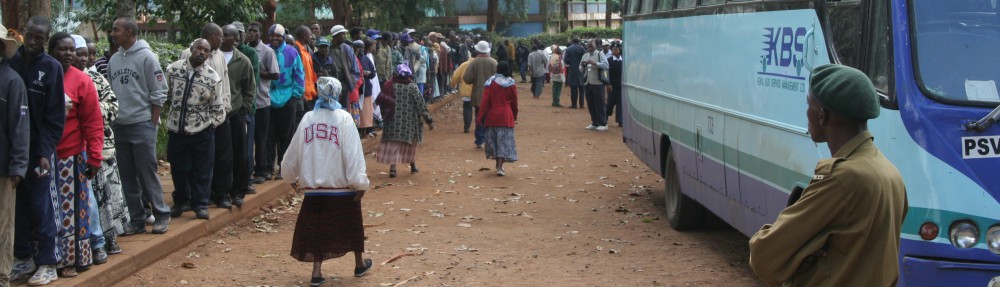
The Daily Monitor also features an interview with Graham Elson, the deputy chief of the EU Election Observation Mission which has now set up shop with staff and long term observers. Graham was in the same role in Kenya in 2007 and I found him to be very professional and a pleasure to work with. The EU team provided us at IRI with information on security and other areas of common concern that we were not able to get from our own Embassy. Obviously there was a divergence of opinion between the EU, which called initially for a recount and remedial action on the Kenya vote and the US, which initially congratulated Kibaki, then withdrew it but called for “power sharing” instead of remediation of the election.

Sea-based Piracy Responses and Proportionality

This weekend has seen successful special forces raids to re-take seized ships and rescue crews conducted by both South Korea and Malaysia.

Meanwhile, the Bangkok Post reports that Samsung Heavy Industries, South Korea’s third largest shipbuilder, has rolled out a new anti-piracy system that

. . .  detects smaller boats in the vicinity often undetected under existing marine radar systems and issues an automatic alert when approached.

“The alert is issued when an approaching vessel does not respond to usual ship-to-ship radio communications or shows unusual navigating patterns and speed,” the company spokesman told AFP.

The system allows sailors in a navigation room to remotely control water cannons on the ship’s deck that can up to 70 metres (230 feet) when pirates attempt to climb aboard.

“That way, crew will be safe from potential shooting attacks from pirates when firing the water cannons,” said the spokesman, adding the system is applicable to most existing ships.

“We believe more of our clients want ships armed with such a system, considering what has been happening near Somalia recent years,” he said.

H/T Watershed Legal Somali News Magazine on Twitter.

In an AP story today from the Los Angeles Times:

The European Union‘s naval force refuses to raid hijacked ships out of concern for the safety of hostages, but frustration is rising. Despite patrols by an international flotilla of modern warships, drones patrolling the Indian Ocean off the east African coast and Arabian Gulf and diverse strategies employed including the sinking of pirate boats, Somali pirates have been relentless.

They captured a record 1,016 hostages in 2010 and currently hold 32 vessels and 746 crew members of various nationalities after hijacking another six ships so far this year, according to a recent report by the International Maritime Bureau.

Eight crew members died and 13 were wounded in Somali pirate incidents in 2010, up from four dead and 10 wounded in 2009. There were no pirate killings elsewhere in the world in 2010.

Alan Cole, the head of the U.N.’s anti-piracy program at the U.N. Office on Drugs and Crime, said the South Korean and Malaysian navies may have resorted to using the commando raids out of frustration that other strategies employed to tackle piracy were not working.

“There is a good chance that navies will increase the numbers of patrols and step up military activity to try and deal with this problem,” he said.

.  .  .  .

The maritime bureau says there was drop in the number of attacks in the Gulf of Aden, leading to the Suez Canal, because of patrols by the international flotilla warships. Attacks in that area fell more than 50 percent, from 117 in 2009 to 53 in 2010.

At some point it seems clear to me that piracy continues to grow because it is so lucrative to the pirates and their sponsors while the costs are born disproportionately by national taxpayers as well as by crew members who are generally not paid much anyway.  The cheapest way to deal with piracy for vessel owners appears to be to risk an occasional ransom as a cost of doing business.  It might be cheaper, if a bit humiliating, for the taxpayers to buy systems like those developed by Samsung to defend vessels and give them to the vessel owners?

I am a long way from convinced that fighting a ground war in Somalia, whether using military or mercenary forces, is a rational way to address piracy–to the point of being highly skeptical of the actual motives of anyone claiming to undertake such a thing.

Somaliland’s new administration assessed five months in by the heads of the international election observation efforts

“Hope and Caution in Somaliland” by Steve Kibble and Michael Walls, in Pambazuka, suggests some positive developments from the Silanyo government but also significant work that has yet to get underway domestically. Diplomatic efforts seem to be positive in the region (and a visit to China has just been announced):

There is nevertheless ample evidence of general donor goodwill. In September, the US assistant secretary of state for African affairs announced a new policy on Somaliland that would see ‘aggressive’ engagement with the administration there, as well as that in Puntland. This is part of a ‘dual track’ strategy which will see the US continue to support the Mogadishu-based Transitional Federal Government, but which will also result in an increase in direct aid to Somaliland. The British ambassador to Ethiopia, a Danish minister, the Swedish ambassador and the UN envoy to Somalia all also confirmed increased aid to Somaliland and there has been some talk of direct budget support for the Somaliland government. If implemented, this would mark a significant shift in donor engagement with Somaliland, contributing materially to the process of incremental recognition mentioned above. However, these discussions are yet to result in action.

Finally, Somaliland has a significant potential opportunity at the present time given the impending expiry of the mandate of the Transitional Federal Government in the south. With the TFG representing an obstacle if Somaliland is to extend the depth and breadth of its formal engagement with the international community, negotiation over their future offers a leverage opportunity for both Somaliland and those amongst the international diplomatic community who would like to see a change in the nature of that engagement.

The new Hargeisa government will need to be far more clear-sighted and long-term in its vision to obtain not just outside support but sustained momentum for democracy and development. Civil society too can play a material role in seeing that Somaliland continues down a road in which the transition from discursive to representative democracy continues to advance the needs of the wider population, not just of a political elite.

5 Somalis Convicted of Piracy in U.S.court

Jurors in U.S. District Court in Norfolk, Virginia returned the first guilty verdicts on U.S. piracy charges in almost 200 years.

Museveni and Kenyan Politics, with America watching

The interplay of Ugandan and Kenyan politics continues, as covered in a fascinating story in the Standard, “Why Museveni is warming up to Kenyan politicians”. Well worth reading the whole thing.

Aside from the oil and ethnicity issues mentioned in the story, it is worth keeping in mind the value to Kenya–and to the United States–of Uganda’s troops serving in the AMISOM mission in Somalia. See the Jendayi Frazer interview with CFR.org from January 2008 on the impact of the post-election violence in Kenya in delaying a planned deployment to Somalia.

On the “Diplomacy or Assistance?” topic we will once again have dual U.S.-funded election observations for the Ugandan election in February, both the U.S. Embassy and IRI, like in Kenya. I have been waiting for well more than a year now for a response to my Freedom of Information Act request for the documentation behind the public statements made by the Embassy in Kenya about their observation of the Kenyan election. It will be interesting to see how transparent things are in Uganda this time.

See my April post “Odinga and Museveni, ICC”; and from January, “Secretary Clinton Keynote at National Prayer Breakfast and Museveni”, and “Somalia/Somaliland, Moi, Uganda . . . “

“Linkage”–remembering how we got here, from “rules of the game” with the Russians and the “Carter Doctrine” to Al-Queda in East Africa and the Embassy Bombings

A mixed verdict today in the Ghailani trial from the 1998 al-Qaeda bombing of the U.S. embassies in Kenya and Tanzania led me to pull of the shelf Zbigniew Brzezinski’s Power and Principle: Memoirs of the National Security Adviser 1977-1981. These were my high school years and I wrote a paper contrasting the views in Brzezinski’s book and Jimmy Carter’s memoir Keeping Faith as an undergrad. Kenya was handed off from Kenyatta to Moi during this time. My children are roughly the age I was then.

So what did Brzezinski have to say, writing in 1983, about U.S. policy in Kenya and Somalia and the Horn of Africa generally? For him it was all about strategic confrontation between the U.S. and the Soviet Union, globally and in regard to the Middle East, most importantly Saudi Arabia. “Linkage” was between the Ethiopia-Somalia conflict and the Strategic Arms Limitation Treaty negotiations.

The more immediate source of friction between Vance and me was the Soviet-sponsored deployment of the Cuban military in the African Horn. In the summer of 1977, the long-standing territorial disputes in the Horn of Africa were complicated by the dramatic switch in allegiances of the Ethiopians and Somalis. The increasingly extreme leftist government of Ethiopia broke with the West, while the Somalis, who had been aided by Moscow, turned to the United States. The unsettled situation was of serious concern to Egypt, the Sudan, Saudi Arabia, Iran, and us, because we all had evidence that the Soviets were providing increased aid and using Cuban forces in the already tense border war. Of course, our ability to assist the Somalis was not helped by the fact that they were the nominal aggressors in the Ogaden, having crossed over an established border into territory they claimed belonged to them.
However, in my view the situation between the Ethiopians and the Somalis was more than a border conflict. Coupled with the expansion of Soviet influence and military presence to South Yemen, it posed a potentially grave threat to our position in the Middle East, notably in the Arabian peninsula. It represented a serious setback in our attempts to develop with the Soviets some rules of the game in dealing with turbulence in the Third World. The Soviets had earlier succeeded in sustaining, through the Cubans, their preferred solution in Angola, and they now seemed embarked on a repetition in a region in close proximity to our most sensitive interests.
I was strengthened in my view by the repeated, like-minded expressions of concern by both Giscard and Sadat, leaders with a refined strategic perspective. Both warned Carter on several occasions not to be passive or to underestimate the gravity of an entrenched Soviet military presence so close to weak, vulnerable, yet vitally needed Saudi Arabia. Sadat let it be known that he was afraid the Soviets were seeking to embarrass him specifically by seizing control of territory crucial to Egyptian interests. We had a report from the Shah, who had traveled to Aswan and to Riyadh, that both the Egyptians and the Saudis were increasingly concerned by the increased Soviet activity. In fact, the Shah reported that the Saudis were “petrified” by the prospect of a Soviet presence across the Red Sea. The Sudanese had also expressed to Carter their worries about Soviet activity and U.S. lack of activity. In a personal message the Sudanese President wrote: “We believe that the Soviet Union is pursuing a sinister grand strategy in Africa leading to some definite goals. We are truly alarmed . . .
Yet in spite of such expressions of concern, throughout the late fall of 1977 and much of 1978 I was very much alone in the U.S. government in advocating a stronger response: Vance insisted that this issue was purely a local one, while Brown [Sec. of Defense] was skeptical of the feasibility of any U.S. countermoves. But by the late summer of 1977, intelligence sources provided mounting evidence of growing Soviet-sponsored involvement. As a result, I promoted . . . a recommendation to the President, which he approved, to accelerate our efforts to provide support to the Sudan, to take steps to accelerate our efforts to reassure and strengthen Kenya, and to explore means of getting as many African leaders as possible to react adversely to the Soviet-sponsored Cuban military presence.
. . . . Continue reading →

Transparency International Annual Corruption Perception Index released [corrected and updated]

The new Transparency International corruption perception rankings for 2010 have been released today.

For East Africa:

66 Rwanda (4.0 score on a scale of 10) [up from 3.3 for 2009]
116 Ethiopia (2.7) [unchanged]
116 Tanzania (2.7) [up from 2.6]
127 Uganda (2.5) [unchanged]
154 Kenya (2.1) [down from 2.2]
170 Burundi (1.8) [unchanged]
172 Sudan (1.6) [up from 1.5]
178 Somalia (1.1–lowest) [unchanged]

The United States dropped to 22nd with a 7.1 score.

The new report was drawn from surveys taken from January 2009 to September 2010.

For these listed East African countries, there was no demonstrated significant change from 2009 to 2010.

Given its methodology, the CPI is not a tool that is
suitable for trend analysis or for monitoring changes in the
perceived levels of corruption over time for all countries.
Year-to-year changes in a country/territory’s score can
result from a change in the perceptions of a country’s
performance, a change in the ranking provided by original
sources or changes in the methodology resulting from TI’s
efforts to improve the index.
If a country is featured in one or more specific data
sources for both of the last two CPIs (2009 CPI and 2010
CPI), those sources can be used to identify whether there
has been a change in perceived levels of corruption in
that particular country compared to the previous year.
TI has used this approach in 2010 to assess country
progress over the past year and to identify what can be
considered to be a change in perceptions of corruption.
These assessments use two criteria:
(a) there is a year-on-year change of at least 0.3 points in
a country’s CPI score, and
(b) the direction of this change is confirmed by more than
half of the data sources evaluating that country.
Based on these criteria, the following countries showed
an improvement from 2009 to 2010: Bhutan, Chile, Ecuador,
FYR Macedonia, Gambia, Haiti, Jamaica, Kuwait and
Qatar. The following countries showed deterioration from
2009 to 2010: the Czech Republic, Greece, Hungary,
Italy, Madagascar, Niger and the United States.

Uganda, Iran and the Security-Democracy Trade Space?

Secretary of State Clinton noted this week to the African Chiefs of Mission the Africa Bureau’s efforts on wrangling votes for Iran sanctions:

The bureau was enormously helpful in rounding up votes for the sanctions resolution on Iran – Gabon, Nigeria, Uganda, thank you, because it wasn’t easy. I think I talked to President Museveni three times and Johnnie visited him several times. But – end result was we got strong African support for the international sanctions regime. We are building, and in some – many cases, rebuilding collaboration not only along bilateral lines, but multilateral alliances, most especially in our collaboration and engagement with the African Union, because it’s very important that we do more to build up the African Union and other regional entities like the East African Community, which has a real potential for being an engine of economic prosperity. [emphasis added]

Secretary Clinton’s Remarks at African Chiefs of Mission Conference

Tensions continue building over Uganda’s February 2011 elections–see yesterday’s news about opposition plans for a parallel electronic vote count and the Ugandan government’s strident reaction.

Carl LeVan has an excellent discussion of "Democratization and Securitization in Uganda" that I would highly recommend.

The ruling NRM has cleverly adopted the Global War on Terrorism as a political resource. Even before the terrorist bombing in the capital in July 2010, the government began closing political space in the name of national security while it successfully obtained aid commitments from the United States to fight counter-insurgency wars, one of which is against the brutal Lord’s Resistance Army (LRA) in the north.

. . . .

Looking beyond the Pentagon, Washington is clearly aware of Uganda’s governance drift. For example the US announced that will not renew 10 million dollars committed through Millennium Challenge Corporation to help Uganda move from “threshold” status to a full compact (ie, an agreement) for aid. USAID’s plans call for strengthening democratic institutions, enhancing political competition, and improving parliamentary capacity for oversight through partnerships with civil society. Unfortunately USAID faces an uphill battle, with no increases in the lines funding for either for civil society programs or for its good governance in Uganda, and cuts are planned for programs relating to “political competition and consensus building.” Even aid to fight transnational crime is slated for cuts.

In addition to all the regional security issues involving Somalia, Sudan, Congo and the Lord’s Resistance Army, the Iran sanctions issue adds another interesting twist. I noted back in May that Assistant Secretary Carson and AFRICOM Commander General Ward were seeking Museveni’s support on Iran sanctions during a visit to Kampala, as well as pushing for Museveni to relinquish unilateral control of the Electoral Commission. The U.S. succeeded in persuading Uganda to support sanctions, but did not secure action on the Electoral Commission. Both worthy goals, but is there a trade off?

It is also interesting to note a report that Uganda has now been working with Iran to create a joint bank as a mechanism to allow Uganda to obtain access to $46M in pledged Iranian credits that have impeded by the sanctions:

[A] memo prepared by the ministry for Parliament’s public accounts committee, in response to an audit query, said that sanctions had complicated the money transfer. "The ministry has followed up the implementation of this line of credit. However, it has faced challenges, especially following the imposition of sanctions on Iran," said the memo.

"In a bid to overcome the difficulty in transferring funds to and from Iran because of sanctions and to promote investment and trade, the two countries agreed on the establishment of a bank as a joint venture as the best way forward," it said.