Kenya Defense Forces essentially collaborating with Al Shabaab in illegal charcoal exports

The Institute for Defense AnalysesAfrica Watch publication (PDF below) has a discussion by Amb. George Ward of the recent report for the UNEP and Interpol on the banned charcoal trade from Somalia (“The Somali Charcoal Industry–Strange Bedfellows”). Rather than shut down the trade that has been the primary revenue source for Al Shabaab, the Kenyan Defense Forces have continued the trade out of Kismayo, which they captured nearly two years ago, along with their present day allies in the Ras Kamboni militia. Further, the KDF is apparently participating in the same overall network of deforestation, charcoal production and brokered export trade that includes continued unmolested shipping by Al Shabaab itself from Baraawe. The traders include businessmen established in Nairobi and Garissa, so Kenya profits on that end too.

Fortunately for the Kenyan taxpayers, the EU and the United States primarily fund the AMISOM mission which has covered the Kenyan forces since mid-2012. Something tells me the charcoal proceeds generated through the KDF are not going to the Kenyan treasury.

africawatch-july-10-2014-vol5.pdf

Of course, other reports of KDF dealing in the charcoal trade have been out there for a long time.  See my post “Kenya’s persistent national security corruption continues to burden Somali endeavors”.

Mpeketoni: Terrorism and Politics as Ususal

Muthoni Wanyeki’s column this week in the East African strikes me as hitting exactly the right point:  “Mpeketoni: Get on with finding out who and why”.  Take time to read it.

The Jubilee Government was in a tizzy about stopping Raila Odinga from leading opposition CORD rallies around the country before the Mpeketoni attacks just over a week ago.  The attacks then became the focus of attention for Kenyans and the Kenyan media, with Uhuru Kenyatta deflecting things back to Raila and CORD by as much as accusing them of undertaking the attacks and explicitly denying a role for Al Shabaab.

Any reasonable observer recognizes that the Mpeketoni attacks in a sensitive area very near the border have less ambiguity about them as an incidence of terrorism than most of the individual bombings routinely attributed to Al Shabaab in Nairobi or even the Westgate attack last year. Yes, the methodological details vary–as they did in each of these from the previous Al Shabaab World Cup attack in Kampala.  Here is former Marine and security expert Andrew Franklin, who has written here previously, discussing Al Shabaab and Mpeketoni, along with unfulfilled security reform, on KTN.

With the victims largely now out of sight and out of mind in the hinterlands the media has moved on to the incessant tribal politics that makes for easy punditry in lieu of actual investigation and in-depth reporting.

I have never been a big fan of rallies in Kenyan politics–not in 2007 campaign when I was trying to help support a better process, not in 2011-12 when they were used to try to stop the ICC, and again, not in the 2013 campaign.  Nonetheless, I am pretty well inured to the fact that the usual suspects in Kenyan politics, on whatever side they happen to be at any given time, use these rallies as a primary means to connect directly to their supporters and to get national media for their messages.  I wish Kenya’s politics was a little more creative, but then, the political class as it exits always wins, so I guess they don’t feel a lot of incentive to change.  Regardless, the rallies are not in and of themselves generally dangerous except to the extent the security forces are engaged to make them so.

Tribal animosities were clearly more raw and pervasive in the spring of 2013 when I was in Nairobi for the election than they were when I left in May 2008 during the immediate post-election period.  It appears that the last year has not seen marked improvement.  An obvious reason why all this should be expected is that the parts of the February 28, 2008 election peace deal that were to address the underlying issues have not been implemented and the politics of 2011-2013 were so explicitly tribal.

Why haven’t they been implemented?  One reason is that the February 28, 2008 deal was made by Kibaki and Raila with Kofi Annan after the larger mediation process between PNU and ODM broke down.  PNU was a coalition of parties and not all of them ever supported the deal from the inception.  Uhuru Kenyatta’s KANU being one such at the time.  Raila and Kibaki cooperated to support the passage of the new constitution in 2010, but the Truth, Justice and Reconciliation Commission plodded along on the backburner.  The biggest single thing to galvanize government attention during the remainder of Kibaki’s second term was the fight to block the ICC, and, of course, Raila was running for president again, along with Saitoti and Uhuru and some others.  By the time the TJRC report was finalized, the new State House was not prepared to accept it as written.

Rallies will come, and rallies will go.  The question is whether the long term work of protecting Kenyans from the persistent threat of terrorism and the long term work of “tribal” reconciliation will be taken up or yet again deferred for some future generation.

Uhuru Park March 3, 2013

After the Rally  (Uhuru Park)


New Congressional Research Service report on the U.S. response to the Lord’s Resistance Army

The Lord’s Resistance Army: The U.S. Response was submitted by CRS on May 15 and has been published by the Federation of American Scientists.

The LRA is assessed to remain in much diminished capacity in a territory covering parts of Northern Democratic Republic of Congo, South Sudan, Sudan and the Central African Republic, but still resilient in these remote areas.

The most recent concerns are the deterioration of the overall stability and governance of the Central African Republic and South Sudan–with related questions of U.S. and regional priorities.  Likewise there are questions regarding the relationship of continued U.S. support for the Ugandan military to the intention to “review” overall U.S. relations in the wake of Uganda’s new laws targeting homosexuals and more broadly to U.S. support for democracy and human rights within Uganda. In early 2013 AFRICOM’s commander identified the anti-LRA operations, known as “Observant Compass”, as the command’s third highest operational priority after the anti-terrorism efforts in Somalia and Northwest Africa, but obviously a lot of things have been happening since then.

As tourism yields to terrorism, Kenyan government moves to pay Anglo Leasing “ghost companies” for security deals that never materialized, to clear way for more borrowing

Yesterday it was two explosions in the Nairobi’s crowded Gikomba market, one reportedly on a bus and another in a stall. Perhaps a dozen killed and 70 injured.

Two British companies loaded up roughly 400 tourists in Mombasa and flew them home early. U.S. Ambassador Robert Godec told the Associated Press that the American Embassy has increased security measures–more security personnel are being brought in and other staff reduced.

Since the Westgate attack in September, there have been a dozen of these bombings.

In the meantime, Kenyan president Uhuru Kenyatta had directed to pay almost 💲17M to two sketchy entities for claims for financing bogus security acquisition contracts in the Anglo Leasing scam uncovered by John Githongo. After Githongo’s whistleblowing Kenyatta himself as leader of KANU as the official opposition identified the claims as bogus. Kenyatta now claims that the Attorney General dropped the ball and allowed these entities to successfully sue and take judgements in court in the UK. He has directed that payment be made to clear Kenya’s credit to undertake large new borrowings on through the “Eurobond” market. The Law Society of Kenya says that the Government is lying and did not lose in court but rather agreed to pay.

The UK and US criticized the corruption of Anglo Leasing back when it was revealed in 2005-06. Neither the whistleblowing, nor many millions of dollars spent on alleged “good governance” programs seem to have deflected the ultimate success of the scam. . . .

More on the Somali roundups in Kenya

Another must read is from Cedric Barnes at the International Crisis Group: Losing Hearts and Minds in Kenya. Horne argues that the roundups specifically contradict the unity messaging offered by the Kenyan government after Westgate and are likely to backfire by promoting marginalization and thus increasing the persuasive power of extremists.  The operations highlight the extremely slow pace of security reforms in Kenya; the going rate to avoid getting arrested if you are of Somali ethnic background is 5000 KSh. Horne also points out that Kenyans of Somali ethnicity and those from the historically marginalized regions in the eastern and northeastern part of the country have always had difficulty getting identity documents from the authorities in the Kenyan government.

Here is Muthoni Wanyeki in The East African : Usalama Watch–State is Fracturing Kenyan Society: “A journalist in discussion with a senior Anti-Terrorism Police Unit officer tells of the ATPU’s alleged frustration with the whole operation — for breaking down its intelligence networks, having nothing to do with counter-terrorism and the likelihood of blowback.”

And Andrew Franklin in Business Daily: Let’s Change Our Tactics in Fighting Terrorism:

Kenyans of Somali origin have also been detained as potential terrorists, making citizenship no bar to this programme of racial profiling.There is no indication that any useful intelligence leading to the apprehension of the café bombing Al-Shabaab terrorists has been obtained although at least 82 “illegals” have been deported to Somalia.The reality is that if the deportees are genuine hardcore Al-Shabaab operators, they will soon return to Nairobi via Kenya’s undefended porous border.

The obvious question about all this: why?  At least one opposition politician has suggested that the operations are intended to curry favor with the West or the U. S. in particular for some reason.  Admittedly I am not objective as an American but I tend to think that the roundups are obviously enough counterproductive (e.g., they increase rather than decrease net terrorism risk) that the Kenyatta administration would not find any serious encouragement for this from Western governments.  Maybe I am naive, but its worth noting that the International Crisis Group is a firmly Western Establishment voice.

Key Reading on Kenya Police Action: Mass Arrests “Counterproductive”

The U.S. Institute for Defense Analyses in the latest issue of Africa Watch features an article by Alexander Noyes entitled Kenya: Mass Arrests Counterproductive and Undermine Security Reform Pledge:

Kenya’s vulnerability to Islamist militant attacks should not be downplayed, as tragically illustrated by the Westgate mall massacre last September. That said, the government’s heavy-handed counterterrorism response is troubling and counterproductive on a number of fronts. First, as warned by the KNCHR and highlighted in the April 3 edition of Africa
Watch, such indiscriminate policies fuel a “cycle of violence” that risks further alienating and radicalizing Kenya’s Somali and Muslim communities. Second, the crackdown undermines President Kenyatta’s recent pledge to overhaul Kenya’s security agencies. As the author has argued elsewhere, Kenya’s previous power-sharing government was able to achieve real, if halting and incomplete, institutional security reform successes, including legislative and constitutional changes.The recent mass arrests and troubling allegations against security forces suggest that the Kenyatta administration is more interested in building up the capacity of the security agencies to fight terrorism—fostering the perception of security—than in consolidating any of Kenya’s fragile institutional gains on security reform.
Kenyans going for water

Kenyans going for water

Kenya: Security, Corruption, Terror and Elections (and Railroads)

Nairobi Station - Rift Valley Railways

Nairobi Station – Rift Valley Railways

“On Security, Corruption and Terror Attacks” from the Mzalendo blog:

The link between corruption and the country’s susceptibility to is also recognised in the Parliamentary Report on the Inquiry into the Westgate and other attacks in Mandera in North Eastern and Kilifi in the Coastal Region. The report mentions systemic corruption and the link to terror attack stating:

“Corruption has greatly led to the vulnerability of the country in many cases including where immigration officials are compromised thus permitting ‘aliens’ who could be terrorists to enter the country and acquire identification. This enables terrorists ease of movement and are therefore able to plan and execute attacks without the fear of discovery. Further compromising of security officials enables ‘suspected individuals’ to fail to pursue suspected terrorists and enable them to secure early release when caught or reported in suspicious criminal activities.”

Of the link between Kenyan troops in Somalia and the increase in terror attacks in the country the report states, “It should also be interrogated why other countries such as Ethiopia and Burundi who had earlier sent troops to Somalia have not been attacked by the al-shaabab. Tanzania has also not suffered any terrorist attacks after the 1998 bombings. Is it because our security forces are weak, in-disciplined and easily corruptible?”

The report makes further note of nationwide systemic failure on the part of the Immigration Services Department, Department of Refugee Affairs; and Registration of Persons Department, also “rampant corruption by security officers and other government agents,” and  further that, “police officers are corrupt and lax too. They work in cahoots with alShabaab and are paid to pass information to the latter.”

Last week National Assembly rejected the Joint Committees report and the recommendations made therein. However questions and issues in the report raised with regards to the link between corruption and terrorism still remain.

AfriCOG report: Election Day 2013 and its Aftermath:

In commemoration of this historic election, the Africa Centre for Open Governance (AfriCOG) presents its own findings related to election day and its aftermath in this report. In line with its commitment to promote permanent vigilance by citizens over public life and public institutions, AfriCOG provides an account of voters’experiences at the polling station. In addition, the report details the counting, tallying and results transmission procedures, noting the varied problems associated with these procedures. Overall, in contrast to many observer reports, AfriCOG finds that the failure of electoral technology made it impossible to verify the manual counts of election results. This was compounded by a wide array of problems at the polling station, ranging from names missing from the voters’ register to voter bribery.

To conclude, AfriCOG recommends a series of reforms to ensure that future elections live up to constitutional standards for transparency and verifiability.

And “TransCentury sells Rift Valley Railways stake to Citadel”.  The RVR saga continues, alongside the SGR saga.

“Shining a spotlight on the dark corners . . .” Should the U.S. use the NSA to combat human trafficking and slavery in East Africa? In Florida?

January has been “National Slavery and Human Trafficking Prevention Month”. Here is President Obama in his proclamation:

Because modern-day slavery is a global tragedy, combating it requires inter- national action. The United States is shining a spotlight on the dark corners where it persists, placing sanctions on some of the worst abusers, giving countries incentives to meet their responsibilities, and partnering with groups that help trafficking victims escape from their abusers’ grip. We are working with other nations as they step up their own efforts, and we are seeing more countries pass anti-human trafficking laws and improve enforcement.
At home, we are leading by example. My Administration is cracking down on traffickers, charging a record number of perpetrators. We are deploying new technology in the fight against human trafficking, developing the Federal Government’s first-ever strategic action plan to strengthen victim services, and strengthening protections against human trafficking in Federal contracts. During the past year, the White House has hosted events on combating human trafficking, bringing together leaders from every sector of society. Together, we came up with new ideas to fight trafficking at the national and grassroots levels.
As we work to dismantle trafficking networks and help survivors rebuild their lives, we must also address the underlying forces that push so many into bondage. We must develop economies that create legitimate jobs, build a global sense of justice that says no child should ever be exploited, and empower our daughters and sons with the same chances to pursue their dreams. This month, I call on every nation, every community, and every individual to fight human trafficking wherever it exists. Let us declare as one that slavery has no place in our world, and let us finally restore to all people the most basic rights of freedom, dignity, and justice

Human trafficking (along with the trafficking in ivory and drugs) has been a persistent concern for the U.S. in Kenya. When the President says we are applying “new technology” does that include the resources of the NSA and the intelligence community more broadly? Should it? Where does this fit in our priorities?

A Guest Post on the State of Kenya@50: “Where Did The Time Go and What Do We Have to Show For It?”

Following is a “guest post” from Andrew J. Franklin, an American now leaving Kenya after more than thirty years of Kenya’s fifty year independent history. This was originally written back in May, after the election failures but months before the Westgate fiasco, about which we learned more damning information with the report this week from the review by the NYPD:
Kenya Map at Nairobi School

It’s mid-May, do you know where your election results are?

Good question! As Kenya prepares to celebrate 50 years of Independence – and, remarkably for Africa, largely free of tribal massacres, wars, natural and/or manmade disasters, successive failed or successful military coups d’etat, vicious secret police operations or state sponsored “disappearances – this steadily failing state is increasingly unable to conduct normal run of the mill governmental functions.

The GOK was able to carry out a national census until the late 1990s, deliver mail and inland cables, find the owners of automobiles allegedly involved in traffic offenses, pay pensions, etc. The more international assistance and support for the GOK and its myriad associated agencies, parastatals, universities and authorities the faster state operations have deteriorated.

The incredible investment in “IT” prior to the 2013 General Elections was not only supposed to prevent or mitigate electoral fraud but was also a belated recognition of just how bad government administration had become.

The IEBC was unable to organize or conduct “voter education” prior to the March 4th polls and is probably unable to find all 120,000 (?) temporary workers hired for these elections; media reports indicate that election- related pay owed to the police, NYS recruits and prison warders has still not been paid.

In essence it is an amazingly foolish leap of faith to expect the IEBC to release any election results for President, Governors and members of the National Assembly and Senate. The longer these results are kept from the public the greater will be arguments that these elections were stolen; 50% of the country is already on a slow boil and the new administration is clearly not able to handle long simmering insecurity in Mandera, Garissa and Wajir Counties or in Western Kenya where criminal gangs are terrorizing the populace.

Reports of a resurgence of Mungiki in and around Nairobi as well as continuing MRC related activity in the “Coast Province” counties – including Lamu – show that the state of national insecurity is more serious than anyone will publicly admit. The heavy handed response on Tuesday, 14/05/2013, by some 400 “security personnel” drawn from the disparate forces within the “National” Police Service to only 250 noisy demonstrators – and 15 or so pigs and piglets – outside Parliament showed an usual lack of any police command and control.

Meanwhile the Obama Administration seems blissfully unaware or unconcerned of the situation in Kenya; our bureaucrats just seem to be hunkering down and covering their asses.

Reports that the police fired live ammunition to “break up the crowd of peaceful demonstrators” after tear gas and water cannon proved “ineffective” indicates a lack of discipline or concern for innocent bystanders or onlookers in offices, shops or even the carparks in the vicinity of Parliament right smack in the CBD!

The use of live ammunition to quell demonstrations in Kisumu in the aftermath of the Supreme Court decision on March 30th elicited little comment in the domestic media and certainly no public protests from the US Embassy. Apparently the rubber bullets procured by the NPS prior to the elections are still in their original packing?

The bottom line is that “Something’s happening here. What it is, is very clear…” To Some!

Andrew J. Franklin, J.D.
Former U.S. Marine, resident of Nairobi since March, 1981
Veterans Day–America and Africa

Happy Veterans Day to my friends and readers in and around the Armed Services.

I always think on these occasions especially of my Uncle Gid and late Uncle Elvin who went off to fight in World War II as farm boys. And my grandfather’s older brothers who fought in Europe in World War I, through that eleventh hour of the eleventh day of the eleventh month, even though their father was a German immigrant (of more than 40 years in Kansas by then) who wondered whether his neighbors would let him continue to live in the area with the country at war.

At my AfriCommons Flickr account I have started a small gallery for photos of Kenyans serving in the U.S. military. The first image below is the only one that has a Creative Commons license for me to repost here. The second image is just for entertainment.

Cleaning Up for Veterans Day

111113-N-OM503-007

SANTA BARBARA, Calif. (Nov. 13, 2011) Logistics Specialist 3rd Class Julius Okeyo, originally of Kenya, reaches for a small bit of debris during the community beach clean-up conducted by the crew of USS MILIUS (DDG 69). The Arleigh Burke-class Aegis guided missile destroyer was invited to the coastal city to participate in a weekend filled with community events including marching in the Veteran’s Day Parade, a hospital visit and ship tours for the public. (U.S. Navy photo by Mass Communication Specialist 1st Class Kim McLendon)

“Marines Support Shared Accord in South Africa”

Marines support Shared Accord in South Africa

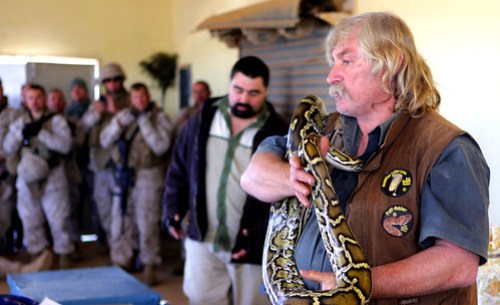
Basil Mills, a wildlife conservation expert, shows Marines from 4th Law Enforcement Battalion various reptiles and wild life they might encounter in the South African wildness, where they will stay for the length of Exercise Shared Accord 13. Marines from 4th Law Enforcement Battalion supported Exercise Shared Accord 13, a multilateral training engagement with more than 700 servicemembers from the U.S. Marines, Army, Navy, and Air Force along with more than 3,000 South African National Defense Force counterparts in Port Elizabeth, South Africa, from July 24 – Aug. 7. (U.S. Army Africa photo)