


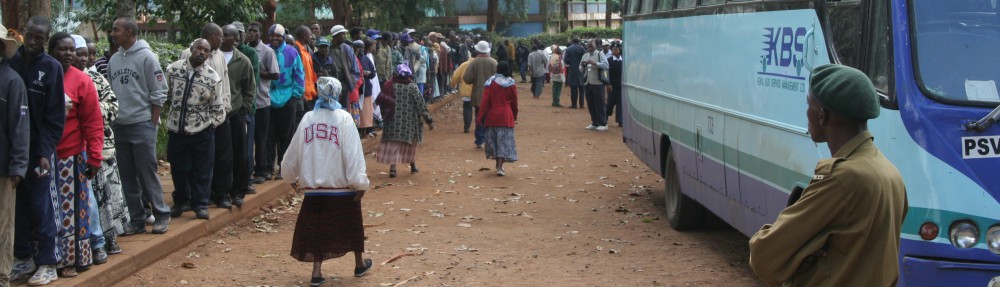
Okay, congratulations are in order for a great job by presiding officers and polling clerks, and incredibly patient voters at the polling centre where I spent the late afternoon and on until finishing the presidential count and posting the signed off results on the door to be photographed at the stream I was covering.
Everyone got better at adapting to the absence of the technology and the cumbersome process and voters moved much faster through the remaining lines in late afternoon and early evening. Having stood in the hot son all day in huge lines surely motivated everyone to get done, but essentially no grousing was to be heard where I was at that point.
Turnout at the stream I closed was 626 valid votes cast for president from 755 registered voters. So over 80%. The boxes were jammed full of ballots but the system worked. Totals for president were Odinga 433, Kenyatta 170, Mudavadi 8, Kenneth 7 and the rest less. Dida was the only presidential candidate in that stream to get 0.
Will post “snaps” soon.
One big challenge is slowness of process–certainly no surprise at all which is why my civil society colleagues asked that the contingency plans for this be announced ahead of time by the IEBC (electoral commission). Poll openings at 8-10am appear common in Nairobi rather than scheduled 6am–again no surprise given the logistics involved. It certainly appears that in most cases a paper rather than electronic poll book is in use. Further it appears that complete absence of working electronic BVR for voter identification is common. Some polling streams never received hardware at all; others received too little or found it unusable for whatever reason.
Wholly manual voting then is normal, even though the voter registration was truncated to provide for the use of BVR. Given that the voting is inevitably slow and the turnout is huge, I heard from one fellow observer of polling station workers just taking down names of people who presented IDs and allowing them to vote because it would take too long to try to find and check off names on the paper lists.
The voters are being in general extremely patient with hours of pre-dawn queuing and waiting in hot sun. Ordinary Kenyans in Nairobi certainly are demonstrating both peace and a commitment to the voting process itself.
The unexpected problem, to me and people I have spoken with, is that the ballot boxes were getting close to full with only a relatively small percentage of voters having voted. Presiding officers indicated no backup capacity, but were shaking the boxes to settle the cast ballots..
I covered the opening of a Nairobi polling centre this morning.
Loose general impressions in comparison with 2007: pre-opening lines seemed even bigger than 2007; large numbers of people got out to que in the pre-dawn; actual voting quite slow as should be expected with new and complicated process and six ballots versus three. There was some stream of periodic boisterousness from people waiting and concerned by bottlenecks–things were quiter in 2007.
One thing that annoyed me was to see that the ballot papers are all white paper except for the color on the front only to correspond with the specific race (i.e. “purple” for woman’s representative to National Assembly). This means when you fold the six ballots for secrecy and to drop them in the color-coded box they look the same. My civil society colleagues raised this issue, among many, with the IEBC. The IEBC reported to one member of the civil society coalition who then circulated the response, that the cheaper ballot papers colored only on one side were only for the “mock election” testing, and that today, voters would have the intended fully colored paper.
Apparently not so. Not that the problem in itself is of such magnitude perhaps, but the quality of the information and means of communication from the IEBC were lacking on this point. And of course it would be good to know, even though it will be too late, what happened in the procurement process to cause this.
Enjoyed meeting diplomatic observers from the Danish Embassy and the Eritrean Foreign Ministry.

AllAfrica.com has put together a special feature page on the Kenyan elections that is a good source for the latest stories from the main Kenyan media sources: “Kenya Decides: 2013 Elections”. (h/t @GeorgetownDG)
On Thursday, February 28, the Institute for Security Studies Nairobi office will host a “Seminar on Kenya’s 2013 Elections: issues, actors and scenarios.” Register on-line through the link.
IRIN has published on on-line “multimedia documentary” entitled “No Ordinary Elections” which does a nice job of informing an international audience of the basic context of the upcoming Kenyan election and includes good interviews discussing humanitarian concerns and preparations in general terms. A work of art in internet publishing.
In the latest developments, there is a lot of buzz in the human rights community regarding the announcement by Chief Justice Mutunga at a press conference today that he had received a letter threatening judges and others regarding any ruling against the candidacy of Uhuru Kenyatta purporting to be from a Mungiki-associated group, Further, as reported in the Star story “Chief Justice Raises Concern Over Threats to Judges”:
The CJ also revealed that he was asked by an immigration officer at the JKIA to seek travel clearance from the Head of Civil Service Francis Kimemia a day after the letter was posted.
“I was stopped at the Jomo Kenyatta International Airport (JKIA) by an Immigration Officer, who insisted that I could not travel because I had not been cleared by Mr. Francis Kimemia, the Permanent Secretary, Head of the Public Service, and Secretary to the Cabinet.” Mutunga said.
The CJ further asked Inspector General of police David Kimaiyo to take the necessary steps to protect judges from threats and intimidation so as not to give constitutional rulings. “The Judiciary will not flinch from interpreting the constitution as required. The constitution must be guarded jealously,” He said.
From The Standard: “CJ Mutunga bombshell”.
From the Daily Nation: “Chief Justice Speaks Out on Threatening Letter.”
Obviously a lot of difference among the media houses in how to report this. Thus the need to read widely to put together the pieces in getting the facts and understand the interests.
While I would completely reserve judgement as to exactly what to make of the threatening letter, the “immigration” harassment is disturbing in light of Kenya’s short but unduly “colorful” history involving politics at these highest levels. Certainly the President himself should address this if he wants to reassure the country at a time in which no one needs any more tension than can be helped.
This has overshadowed the other big political story of the day, that Uhuru Kenyatta’s campaign has announced that he will drop out of the second presidential debate scheduled for Monday, complaining of the allegedly unfair amount of emphasis on the charges he faces from the International Criminal Court and “ganging up” by the other candidates on this point.
My sense of the political strategy here would be that Kenyatta feels he is in solid position to make a runoff, and not in striking distance to win in the first round, so there is nothing major to be gained from another debate, while there are risks from undesired questions and unscripted situations. He has plenty of money and media access as a top candidate so he probably doesn’t feel a need to share the stage to communicate whatever he wants to say in the last days of the campaign. Likewise, part of his approach since the ICC charges have been confirmed has been to portray himself as a victim of other politicians and interests, so claiming that he was treated unfairly in the debate fits with that theme, too.
The Nairobi media reporting is a bit garbled but the gist of things is that the Kenyan High Court (as opposed to the Court of Appeal or the Supreme Court) has dismissed a petition filed some months ago by civil society groups, including significantly the Kenyan Chapter of the International Commission of Jurists, challenging the eligibility of many of the candidates for President of Kenya on the basis of the “integrity” provisions of the new Kenyan Constitution.
Almost 13 months ago I posted that it was time for Kenya’s judicial system to answer the question posed regarding the application of these constitutional provisions to the candidacy of those facing confirmed charges from the International Criminal Court. Unfortunately, even though the election has ended up being set for a delayed date, the Kenyan court system has still managed to let the clock seemingly run out without reaching any clarity or finality, such that the election is expected to proceed with the “Uhuruto” ticket on the ballot.
Without having a copy of an opinion yet, from the media reports, the High Court ruled that it did not have jurisdiction over the challenge because the constitution vests exclusive jurisdiction in the Supreme Court over challenges involving the nomination and election to the presidency and that further the jurisdiction of the Kenyan courts and ICC was concurrent and with the ICC case proceeding only the ICC could bar the indictees from running for office.
As an American rather than Kenyan lawyer, and having not read the opinion, I don’t want to go too far into the details here, but I would note that (1) Ruto as opposed to Uhuru is no longer running for president, so the practical question now for his eligibility is distinguishable; (2) the High Court has original jurisdiction to interpret the provisions of the constitution, which seems to me to clearly be the issue here–as opposed to a more ordinary nomination or election challenge which would seem to me to be a more plain way to interpret the various constitutional provisions as a whole.
Here is a long quote from the Daily Nation story “Jubilee, Cord plaud ruling on eligibility case”:
Mr Odinga on his part said he respected the ruling saying that the court had held that in matters relating to the presidential election, the Supreme Court had ‘exclusive and original jurisdiction.’
“I have repeatedly said that my main competitor should have the opportunity to face me in a free and fair election whose outcome is determined by the people of Kenya,” said Mr. Odinga upon hearing of the Court’s decision.
But Restore and Build Kenya (RBK) presidential candidate Prof James Ole Kiyiapi accused the judges of failing to give Kenyans directions on matters of integrity.
“By declaring that they lack jurisdiction, Kenyan courts have failed to give the country direction on matters of integrity as outlined in chapter six of the constitution,” he stated.
The five High court judges – Mbogholi Msagha, Luka Kimaru, George Kimondo, Pauline Nyamweya and Hellen Omondi – dismissed a petition filed by civil society groups challenging Mr Kenyatta and Mr Ruto;s suitability to run for the presidency and deputy presidency as they face serious crimes at the International Criminal Court (ICC).
The Judges ruled that despite the serious nature of the crimes facing Mr Kenyatta and Mr Ruto at the ICC, they are still presumed innocent until the contrary happens.
“It is common knowledge the two have been indicted but since Kenyan courts and the ICC are of concurrent jurisdiction, we cannot adjudicate over the same matter. Only the ICC can bar them to run for public office,” ruled the judges.
They ruled that the High Court had no jurisdiction to hear any petition relating to presidential candidates’ nomination.
So I tend to agree with Prof. Ole Kiyiapi that the High Court has ducked the issue and left a real lack of clarity as to the meaning of the constitution. The problem is appeals and further proceedings are now unlikely to have time to be resolved before March 4.
Even though I’m committed to not attempting to “cover” the Kenyan presidential campaign remotely, yesterday’s debate was one of those big moments in various respects that begs some comment from anyone writing about Kenyan politics and governance.
As far as the election itself, I don’t expect a major impact from the debate or anything specific said. Most voters have made up their minds during the course of the two and a half years that the campaign has been the primary focus of Kenya’s pols. The biggest election variable I would expect would be turnout and neither of the two contenders who could actually win at the end of the day stumbled badly enough or scored enough points in this debate to have a dramatic effect.
Several things stand out for me, however. First is national pride. There is a sense of “joining the big leagues” and capturing an international stage as a modern democracy that Kenyans take pride in here. Sports has been the most similar national rallying point otherwise, and the London Olympics was a disappointment so it is good to see Kenyans have a point of positive recognition as Kenyans. Unfortunately, it comes so late in the campaign that the opportunity for this positive spirit to make a major difference in the preparation for voting and the more general groundwork for the election is limited. Tensions are already high because the realization is sinking in that the election is a big challenge and there will be some problems.
From talking to friends in Kenya and following things I do believe that there is some real value to the determination of many Kenyans to try to prevent the country from being perceived to make a negative spectacle of itself through violence and it makes sense to me to hope for some incremental benefit to this sort of positive pre-election publicity. Nonetheless, the overall amount of election-connected violence in the year before the vote was lower in 2007 in some respects, and people voted very peacefully and in large numbers. When violence occurred after the vote, the vast majority of Kenyans, especially those who actually voted, did not participate. So I don’t think you can measure the risk of violence by the overall sentiments of the population. Energy is much more wisely spent on preparation than prognostication.
A related point to me is that this debate simply shows the world the level of technological and economic development that exits in Nairobi, particularly in the media. The country was very much ready for this in 2007, and in some ways it seems more surprising that this didn’t happen in 2007 than that it did in 2013. More than anything it reflects, to me, the different dynamics of not having an incumbent seeking or planning to stay in office.
The second major impression for me was how the debate showed the disfunction of Kenya’s political parties at a national level. Without established major parties of some coherence other than as platforms for individuals, we end up with six candidates, then eight by court order at the last minute, and almost all the post-debate discussion centered on the contest for power among the individuals or the event of having the debate itself, rather than on anything of real substance about what one candidate believably could accomplish versus another. Congratulations are due more to Kenya’s media than to the political process or the candidates or parties it seems to me.
Some of the other things commented on widely were less significant to me, perhaps because my expectations of what could be possible in Kenya are higher. Martha Karua on stage was not a big moment in my book. She will rank significantly less of a factor in 2013 than Charity Ngilu did in 1997. Karua’s big moment in national leadership was her role as Kibaki’s lion(ess) facing off with Ruto at the Kenyatta International Conference Center December 28-30, 2007, and facing off with both the ODM side and Kofi Annan in the (generally unsuccessful) mediation afterwards prior to the February 28 post-election settlement signed by Kibaki and Raila. She is a strong capable female lawyer, but she doesn’t have an obvious constituency as a candidate for president of Kenya at this point and I don’t see her presence at the debate or her fortunes in this election as a proxy for the general status of women in politics in Kenya.
More striking is the idea of someone facing ICC trial for “crimes against humanity” this spring on stage on an equal footing and an understood stature as one of the two candidates who could become president. That to me is the greatest novelty of this debate.
[Update: See “What we learned from Kenya’s first ever televised presidential debate” at Africa is a County, especially for a fun list of tweets from watching the debate in livestream.]
Africa Review reports on the statement of the Inter-Governmental Authority on Development (IGAD) from this week’s visit to Nairobi by executive secretary Mahboub Maalim (himself a Kenyan) and others from the Addis headquarters under the headline “IGAD confident of peaceful Kenya election”:
In his statement, Mr Maalim said: “Igad has come to the conclusion that Kenya’s election is not an event. It is a process and that March 4th is not the end; it is the beginning of a process that could last till June 2013. Kenyans must therefore brace themselves for the long haul.”
Mr Maalim said the Independent Electoral and Boundaries Commission (IEBC) and the judiciary are crucial for the success of the polls.
“The efficiency of the IEBC during the voter registration process must be lauded. We expect that the same efficiency will apply to the March 4 poll. This is critical if Kenya is to avoid petitions arising from IEBC system failure. The efficiency and believability of the Supreme Court in dealing with the presidential election petitions is also critical. This will determine whether or not the transition is successful,” the Igad executive secretary said.
He said IEBC should be encouraged to conduct a systems dry-run with peer reviewers to seal any loopholes that would affect its efficiency.
Dr Kimani said the recent party nominations in Kenya were inclusive, open and transparent and that it was what the rest of the region had expected.
Igad brings together six countries in the Horn of Africa – Djibouti, Ethiopia, Kenya, Somalia, Sudan and Uganda – for development and drought control in their region
“Party nominations were inclusive, open and transparent”. Wow, that is certainly a unique perspective that contradicts the reporting in the Kenyan and international press, the reporting of Kenyan civil society umbrella KPTJ, and, for example, the reporting of the Center for Multi-Party Democracy-Kenya which is a well established and leading presence in Nairobi on these matters. So who is right here? Might it be relevant that IGAD is an organization of governments that are all far more “challenged” in terms of democratic practices in general, and elections specifically, than even Kenya in the wake of power-sharing and the debacle of 2007, along with the Government of Kenya itself?
I am all for whomever exhorting peace, although I am substantially skeptical that official pronouncements of this type have actual impact on ultimate behavior. Likewise, I am all for encouragement, hope and reasoned, well-grounded optimism in the context of pushing for the best election possible from where things really stand today. But this type of statement about the primaries is a “diplomatic” position rather than an observation or representation of fact. It undermines the credibility of whatever else is said in the same statement as being connected to the facts. At best it is unhelpful–it might be dangerous.
Jay Naidoo of The Daily Maverick writes from “the Mukuru Kwa Reuben slum, one of the largest in Nairobi” with an unknown population size: “I have a right to a toilet–it’s human dignity”.
An update on the preparation for Kenya’s citizen digital “crowdsourced” monitoring/mapping effort, using the Ushahidi software: “Uchagazi Community Next Steps”.
H/t to the UN Dispatch blog for noting another official pre-election delegation in Nairobi: “Kenya: UN official stresses need for peaceful and transparent elections”:
“Kenya’s elections will be watched closely around the world,” Under-Secretary-General for Political Affairs Jeffrey Feltman said during a visit to Nairobi, the capital.
“Let me take this opportunity to appeal to all Kenyans to exercise their democratic right and participate actively – but peacefully – in the elections,” he said. “Let me also underscore the responsibility shared by leaders at all levels to abide by legal mechanisms and to send a clear message to supporters that violence of any kind would be unacceptable.”
Mr. Feltman, who oversees UN support to elections globally in his capacity as Focal Point for UN Electoral Assistance, commended the electoral authorities for their preparations and underscored the readiness of the UN to continue providing financial and technical assistance to the electoral process.
In the category of “open government initiatives,” and “what’s good for the goose is good for the gander,” the Project on Government Oversight (US) is asking citizens to push the White House to finally fill the vacancy for the the Inspector General for the State Department:
Inspectors general are independent watchdogs within federal agencies that are essential to a well-functioning government. They conduct audits and investigations that identify wasteful government practices, fraud by individuals and government contractors, and other sorts of government misconduct. Congress and the public rely on their reports to hold agencies and individuals accountable for wrongdoing, identify a need for legislation, and evaluate the effectiveness of government programs and policies.
Unfortunately, President Obama went his entire first term without nominating an inspector general for the State Department. At over five years, the State Department opening is the longest running vacancy among federal agencies.
Wycliffe Muga in The Star on “Why we should not dismiss foreigners”, with an example from his own experience in Kenya, but perhaps a universal lesson.
In the category of “it could be worse”: “Is a military coup Museveni’s last line of defense against NRM rebels?” asks Gaaki Kigambo in The East African.
Statement of Senator Richard Lugar:
It is a pleasure to welcome Ambassador Godec once again before the Committee, in this case as the President’s nominee to be Ambassador to Kenya. His stewardship as Chargé over the last several months comes at a very challenging time for our large and important East Africa embassy. He has brought deft and experienced management to Nairobi and effectively sustained our varied interests and priorities with Kenyans and the Kenyan government at a critical time. Among the most important interests is United States support for a free and fair electoral process leading up to national elections in 2013, the first since the abhorrent violence that followed the 2007 elections.
United States interests extend broadly in East Africa and recognize the commitment Kenya has made in Somalia under the AMISOM umbrella, as well as its long support for regional peace initiatives. Kenya also has been a key counter-terrorism partner in a variety of areas that are of mutual concern with broad global potential for impact. These include Kenyan efforts fighting Al Shabab and building its own counter-terror capabilities in maritime and border security. Our extensive cooperation extends to providing a regional platform for the Defense Threat Reduction Agency and the Center for Disease Control in securing biological materials that pose a threat to millions if Continue reading