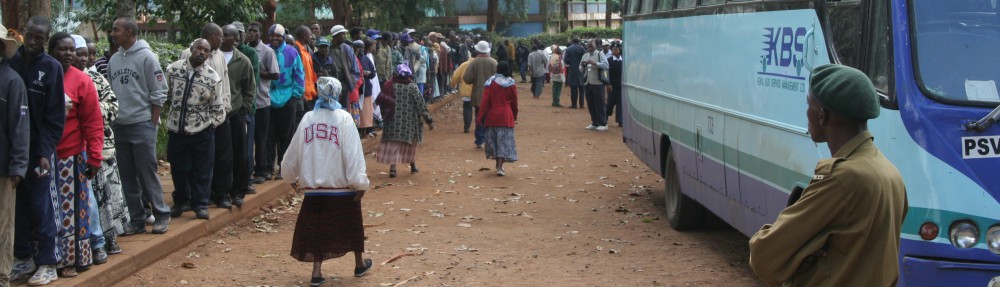
“And the beat(ings) go on . . .”; as 2007 bleeds into 2013, what would it take for Human Rights Watch and others to make Kenyan politics less deadly?

The latest Kenya release from Human Rights Watch, dated yesterday, decries the terrible beating of Kenyan activist Okiya Omtatah Okoiti.

Omtatah, executive director of Kenyans for Justice and Development (KEJUDE) Trust, a local NGO that advocates for transparency and accountability, was attacked by two unidentified men in central Nairobi. He lost six teeth and suffered serious injuries to his face and the back of his head, which required surgery. Omtatah told Human Rights Watch and ARTICLE 19 that the attackers demanded that he withdraw a lawsuit he filed to demand accountability in the procurement of biometric voter registration (BVR) kits because of corruption associated with the process.

“This vicious attack was clearly meant not just to intimidate Omtatah but to seriously injure him – and perhaps even to kill him,” said Leslie Lefkow, deputy Africa director at Human Rights Watch. “The aim seems to be to stop his work on corruption in the procurement of biometric voter registration kits for the upcoming elections.”

Certainly this is a crucial and timely issue in working toward integrity in the upcoming Kenyan election and in protecting an activist who took a big risk in pursuing legal action against election-related corruption. So kudos to Human Rights Watch and Article 19 for calling attention to the attack. Unfortunately, it is hard to imagine that anything will actually happen as a result of this statement that “[t]he Kenyan authorities should promptly and thoroughly investigate a serious physical assault . . . and bring appropriate charges.” Of course, they should–that goes without saying; of course. they won’t.

Why won’t they? Are they confident they can wait it out and the outside actors and international players who care about Omtatah now will move on to the next outrage, the next victim, without really disrupting the vicious cycle?

Why would I suggest this? Not to be gratuitously critical of Human Rights Watch or any of the many organizations trying to support human rights defenders. Rather I say this on the basis of my own hard-earned experience with well-intentioned failure in dealing with election fraud and violence in Kenya in 2007/08. I moved my family to Kenya for a year to help support democracy in the last election cycle–we were able to take in a couple of displaced families for a few months after the election, and help a few others a bit, but nothing that I did in my NGO work really changed anything as far as upholding democracy. My organization, IRI, issued a report noting the election fraud, in July 2008, and in August 2008 released the exit poll showing that voters at the polls on election day reported favoring the opposition, before the mark-ups of the tallies for the incumbent at the Electoral Commission in Nairobi afterwards. But these reports were months too late to really matter. It is going to take more to make a difference in the brutal world of Kenyan politics.

So how does Human Rights Watch yesterday describe what happened with the 2007/08 election situation:
Continue reading

Godec Confirmation Hearing

The U.S. Senate Foreign Affairs Committee will conduct confirmation hearings on the nomination of Ambassador Robert F. Godec for Ambassador to Kenya on Wednesday, November 28.

Godec has been serving in Nairobi since late summer following the resignation of Ambassador Scott Gration. Gration and his wife are staying in Nairobi.

Kenyan Election Violence: why would anyone expect the Kenyan Police to play a positive role in March 2013?

(As an aside, here is a headline to pause over from the Daily Nation“Sudan’s Islamists need new blood: vice president”.)

On Kenya’s police, Jeffrey Gettleman has an outstanding story in the New York Times: “Police Killing in Kenya Deepens Aura of Menace”.  Gettleman ties a compelling story of what amounts to the “typical” extrajudicial execution of two bothers in Nairobi’s slums to the massacre of new police recruits in Samburu:

The two episodes were hundreds of miles apart and technically had nothing to do with each other. But beneath them was the same rotten root: a spectacularly dysfunctional national police force.

“On a scale of 1 to 10, I would give our police a 2,” said Macharia Njeru, the chairman of Kenya’s new police oversight board, citing corruption allegations, human rights abuses, extrajudicial killings, failed inquiries and lost public trust.

“The list is endless,” Mr. Njeru said.

.  .  .  .

“On the face of it, it’s quite clear that the police leadership totally failed,” Mr. Njeru said. “The senior commanders were sleeping on the job.”

Kenya’s news media have characterized the massacre as the single most disastrous episode for the Kenyan police since independence in 1963. Unlike Kenya’s thriving business community, its booming safari industry or its reforming judiciary, Mr. Njeru said, the national police service has intentionally been kept weak for decades so it could be manipulated by politicians.

The concept of the various reforms under the new Constitution is great, but surely it is time to face the fact that it is simply too late for deep substantive change.   Of course every effort should be made by Kenya’s international supporters to intervene and step up as well as possible, but let us not kid ourselves.  It has been almost 59 months since the 2007 election disaster–the Kenyan police are still in the state they are in, with less than four months to go to March 4, 2013 because the Kenyan powers that be chose the status quo instead of reform (and for obvious reasons).

Again, please remember that current Kenyan Police Commissioner Mathew Iteere was the commander of the Kenya Police’s GSU (“General Service Unit”) branch during the 2007 election and its aftermath.

Let’s see what the Kenya Police official website has to say about the status of reforms today:

.  .  .  the Government has made some important steps. A task force appointed in March 2003 is drawing a road map for the Police Reforms. The Commissioner of Police is committed to a Police Force whose members are motivated, people friendly, open, relaxed and honest with one another and the public; know their role and mandate and be proud of their job; appreciated by the public…

The just concluded Constitutional review holds a promise for the establishment of an emancipated Police Service, that will operate in conformity with democratic transformation from the current practice of Regime Policing to Democratic Policing (Community Policing)

These measures augur well with the Police Reforms as well as the goodwill of citizens. An international survey conducted in January 2003 placed Kenyan’s as the most optimistic citizens in the world. The Government will do well to tap into this optimism. It is the energy that will drive the nation’s transformation to Its desired destination.

For citizen’s security:this is the moment.

Yes, 2003 was in fact “the moment”.  Let’s not let 2013 be remembered as a different kind of “moment”.

Upcoming Nairobi Seminar

Institute for Security Studies and Hanns Seidel Foundation Seminar, Nairobi
Oil and Gas Discoveries in Kenya and the Region: Opportunities and Challenges
Tuesday 6 November 2012
10h00 to 13h00

East Africa, and Kenya in particular, is increasingly developing into an important hydrocarbon region. With proven reservoirs and heightened exploration activity, the region is hoping for an oil boom and the attendant profits. In ideal circumstances, the oil and gas resources in Kenya and the region should become engines of stability, economic growth and improved governance. Looking at experiences elsewhere on the continent, however, there is a danger of the ‘resource curse’ syndrome, which counsels about the perils of hydrocarbons turning into sources of instability and ecological catastrophe. Indeed, the dismal track record of Africa’s oil producers has led to concerns about the possibility of Kenya and the greater region falling victim to Africa’s paradox of plenty. There are already emerging concerns about territorial disputes relating to Kenya and the region linking to the discovery of natural resources.

As Kenya in particular draws increasing interest from major oil companies, the question is: what are the short- and medium-term projections for oil and gas discoveries, and what are the geostrategic implications? Significantly, what policy options should Kenya pursue to avoid past development failures associated with petroleum and to militate against potential conflict? This seminar will examine these questions, among others, with the aim of offering policy recommendations on improving outcomes of oil and gas production in Kenya and the region.

At the ISS office at Braeside Gardens on Gitanga Road in Lavington.

Link to register is here.

Sunday music: Sauti Sol


Nairobi’s Sauti Sol featured on NPR’s Weekend Edition for a “sunny” but authentic appeal: “Native Sons Sing Straight to Kenya’s Youth”.

Here is “Blue Uniform”, video with lyrics, at Ghalfa.com.

At the Ghalfa Blog: “Sauti Sol is the Finest Kenyan Band to Walk the Earth:  Here’s Why”:

They have cross demographic appeal

Whether you are from the hilly valleys of Kakamega, or from the concrete jungle in Nairobi, Sauti Sol don’t leave you feeling alienated. Why? They sing in fluent English, Kiswahili and their native Luhya dialect. That’s a rare triple threat that you don’t get from many Nairobi bands, ESPECIALLY those from suburbia.

They have cross border appeal

These guys top charts from Kenya to the Netherlands. They also have mzungu fans screaming their name at international festivals such as South by South West in Austin, Texas. But don’t take my word for it, just take a look at the video . . . for their spellbinding performance of ‘Awinja’ at SXSW earlier this year . . .


Western storytelling, the East African “middle class” and how to account for “politics”

Here we have an interesting paradigmatic story from Der Spiegel, translated from German for their English version, “Up and Coming in Kampala; Africa’s Growing Middle Class Drives Development” by Horand Knaup and Jan Puhl:

Three good anecdotal stories here of successful start-up African businesses generating local jobs and wealth through import substitution with domestic production. They help to grow a domestic consumer market and ultimately look to export as well. One of the two in Uganda got significant assistance from the national government and the Kenyan business got financing from a German international development arm.

She earned her starting capital by importing clothes from the West, but then she began designing her own collections, and soon “Sylvia Owori” was the most popular label among women in East Africa.

Owori has her collection produced by seamstresses in villages. She has trained 200 women and sponsors the purchase of their sewing machines. “When I receive a big order, I can deliver quickly and flexibly,” she says. On the other hand, she says, the women can stand on their own feet when she doesn’t happen to have any work for them.

Her latest creation is a denim laptop bag shaped like the map of Africa. “This bag was once a pair of jeans,” she says. “You threw it into a container for old clothing and sent it to Africa. We made something new out of it and will sell it back to you.” Swedish fashion giant H&M is interested in the bag, and two other Western fashion chains have asked Owori to meet with them in London.

It’s a question of finding new ways to stimulate economic growth. The corrupt oligarchies in many African countries have made money from the export of commodities, but only a fraction of the population has benefited from the proceeds. The growth being generated by Africa’s middle class is more sustainable, say development experts. Much of it is based on the processing of African fabrics, wood and fruits, and it creates jobs.

Good examples of what is going right and working, from two of Africa’s 50+ plus countries. Well done as such.

“She is the epitome of a success story. And success stories are no longer a rarity in Africa, despite its reputation as a continent of poverty and suffering.” Right and important.

But then we get into the broad assertions and big selective extrapolations. “This growth is producing a middle class that’s growing from year to year. According to the African Development Bank, this middle class already includes 313 million people, or 34 percent of the total population.” To say that “this middle class” includes roughly a third of the population of the entire continent is to me quite misleading in the context of this story,

Continue reading

Gration resigns–to leave Embassy late July

U.S. Ambassador Scott Gration released a statement to the media in Kenya this morning stating that he had resigned, effective late July, citing differences with Washington over “my leadership style and certain other priorities.”

See the Standard here.

Imenti Central MP Gitobu Imanyara said: “the resignation of Ambassador Gration is good news for Kenyan-US relations particularly in terms of the reform agenda. He has been too sympathetic to the lords of impunity.”

U.S./Somaliland relationship continues to mature as U.S. leads donor delegation on preparation for municipal elections

The key focus in current Somaliland politics is the municipal elections set to be held soon.  The National Election Commission reports being close to readiness, having (with some significant dispute) determined six additional parties to compete with the established three national parties, Kulmiye, UDUB and UCID.  Somaliland’s first local elections since modern independence was declared in 1991 were held in December 2002.  The next election was originally scheduled for December 2007, when I was there, to be followed by the April 2008 presidential election coinciding with the scheduled end of President Riyale’s term.  The Presidential election was delayed until ultimately held successfully on June 28, 2010–and now the local elections are to follow.

The top deputy for Somalia/Somaliland at the U.S. Embassy in Nairobi has led a six-member donor group to Somaliland to assess preparations for the elections and opportunities for donor support.

President Silanyo told the visiting delegation his government has already allocated funds for the upcoming electoral process and all preparations have been finalized, he reminded them the need for the international community to support this country in pertinent issues as security and bilateral ones.

Mr. Douglas Meurs said, the United States continues to engage with the administration in Somaliland on a range of issues, most directly Somaliland’s continued progress towards democratization and economic development.

In Feb 2007, the United States provided a total of $1 million through the International Republican Institute to support training for parliamentarians and other key programs in preparations for the upcoming municipal and presidential elections in Somaliland.

The United States will continue to engage with Somaliland, in order to support the return of lasting peace and stability in the Horn of Africa.

by Goth Mohamed Goth
somalilandpress.com

This is encouraging progress in several respects. For my first months as IRI East Africa director, we had to keep our contact with Somaliland on life support as best we could at “no cost”, hoping for renewed funding to come through from the U.S.  When funds were available, we were able to re-start programming supported by travel from Nairobi, then open an office in Hargeisa.  At that time, U.S. Government employees and direct contractors were generally not allowed to travel to Somaliland–even prominent U.S. professors who were contracted to assess our programming in the spring of 2008 were left to work from Nairobi without being allowed to go to Hargeisa. We participated in donor meetings which happened only in Nairobi.  Having senior U.S. officials lead donor groups and interact with the Somaliland stakeholders directly in the county is one more sign of de facto “normalcy” in the interactions.

IMG_1312
With now-President Silanyo (at right) and Kulmiye Party group at party headquarters (I’m second from the right.)

The Michuki Rule

Much is being said and written about John Michuki with his passing this week.  The best I have read so far is here from Charles Onyango-Obbo: “Michuki was the bad guys’ good guy, and he was not afraid to take action.”

To some, Michuki gets some real credit for the fact that Kenya’s economy isn’t worse (Ken Opalo’s blog: “Michuki was among the group of super-wealthy conservative elites who at independence took over power and managed to quiet the more radical elements of the independence movement. Under their watch Kenya emerged as a capitalist enclave even as its many neighbors flirted with communism and African Socialism, with disastrous consequences.”)  I am not an enthusiast of that view.  My perspective would be to say that perhaps a bit of credit is due, in the sense that Kenya could certainly have done worse, but it could also be said that Michuki and his cronies helped assure the triumph of neo-colonialism over a robust national market economy, helped assure the growth of tribalism over the development of national identity and more generally stymied the opportunity for a competitive democratic system and political liberty.  As far as the economy, lets not forget that State ownership has been a big presence in Kenya’s economy even if less than in some others.  Likewise, privatization remains a highly politicized and extremely opaque process that seems to tie to the funding of election campaigns rather than to “technocratic” considerations (witness “Mobiltelea” and the Safaricom deal rushed through at the end of 2007 and unaddressed since).  In other words, to me not going Communist/Socialist is not nearly enough to justify the costs imposed on Kenyans by KANU and its successor as served, with effectiveness, by Hon. Michuki.  By any account, the Cold War has been over for a long time.

I did not meet Hon. Michuki and I do recognize that he was an accomplished man with friends beyond his politics and I appreciate that his command of “the Michuki Rules” was missed on the roads and highways during my time in Kenya in 2007 and 2008.  At the same time, the Standard raid cast a shadow over the Kenyan election campaign when I arrived in mid-2007 and he was the identified proponent of the raid (I give him his due for the courage  to “own” the raid, when others, including the President were relatively speaking “shrinking violets,” but the conduct was indefensible).  LIkewise, Michuki was the Minister of Internal Security when the country became insecure with the election crisis and the security forces protected Uhuru Park instead of the public, and he issued the order banning live broadcasting.  I respected his abilities, but I wished that he had stuck to his positive strengths when I was working to assist Kenyans in their democratic processes.

Most recently, Michuki has been Environment Minister and will be remembered in this last role for spurring the cleanup of the Nairobi River–certainly a task of government for the “common good”.  Here is a clip from NTV covering his recognition at a UN environment meeting he would have hosted:

Kenya Awaits ICC Rulings; Calls Continue for New Charges on Kibera and Kisumu and for Local Tribunals

The International Criminal Court is widely expected to announce rulings by its Pre-Trial Panel in the cases against the “Ocampo Six” during the third week in January.  Today’s Standard details the various options available to the Panel:

The ICC could commit all or some of the six to trial, or decline to confirm the charges if it determines that there is insufficient evidence.

It could also opt to adjourn the hearing and request the Prosecutor to consider either providing further evidence or conducting further investigations, or amending a charge because the evidence submitted appears to establish a different crime within the jurisdiction of the Court.

Once the charges have been confirmed, the Presidency of the court shall constitute a Trial Chamber.

. . . .

Ruto and Kosgey are charged with being indirect co-perpetrators of murder, forcible transfer of populations and persecution. The court ruled that there was not enough evidence that Sang was an indirect co-perpetrator in the crimes, but accused him contributing to the same set of crimes. . . .

Uhuru and Muthaura are accused of being co-perpetrators of murder under Articles 7(l)(a)), forcible transfer of persons, rape, persecution and other inhumane acts while Ali is accused of contributing to their commission.

In an article yesterday, the Institute on War and Peace Reporting discusses the calls for renewed attempts to prosecute cases on the violence in Kibera and Kisumu:

Rights activists say international indictments in cases arising from post-election violence in Kenya in 2007-08 must be expanded to cover killings and other abuses committed by police in a Nairobi neighbourhood and the city of Kisumu.

Judges at the International Criminal Court, ICC, removed the two elements when they considered the prosecutor’s application for charges in March, saying there was insufficient evidence to pin them to the individuals accused.

Lawyers say the failure to charge three of the six suspects with the shootings means the victims of violence in Kibera and Kisumu feel left out of the justice process.

Kibera, a slum area of Nairobi, and Kisumu in western Kenya experienced some of the most brutal attacks in the violence that followed a December 2007 presidential election. The Commission of Inquiry into the Post-Election Violence, set up in February 2008 to investigate the violence, found that overall, the police killed 405 of a total of 1,100 people who died during the violence, and injured a further 557. The vast majority of killings by police are thought to have occurred in Kibera and Kisumu.

When he formulated charges against six senior figures accused of responsibility for the violence, ICC prosecutor Luis Moreno-Ocampo accused a group of three of them, who fall into one of the two cases he brought, of being behind the Kibera and Kisumu attacks.

. . . .

When ICC judges issued their ruling on Moreno-Ocampo’s application for charges on March 8, they found insufficient evidence had been presented to link the three PNU suspects to events in Kibera and Kisumu.

The judges said there were reasonable grounds to believe that Kenyan police shot and killed more than 60 people in Kisumu, and that police killed and raped civilians in Kibera. However, they took the view that the prosecutor had failed to demonstrate that crimes in Kibera and Kisumu were part of a wider state policy, so that they would fall within the court’s jurisdiction.

“The material presented by the prosecutor does not provide reasonable grounds to believe that the events which took place in Kisumu and/or in Kibera can be attributed to Muthaura, Kenyatta and/or Ali under any mode of liability,” the judges said in their ruling.

The judges’ ruling provoked outrage among victims and raised questions about the scope of the justice process, given the omission of two key focal points of the violence.

“[Nairobi] experienced a lot of violence and Kibera was the epicentre of it,” Priscilla Nyokabi, executive director of the legal aid centre Kituo Cha Sheria in Nairobi, said. “It will be so bad if Kibera is not made to feel a sense of justice.”

According to Godfrey Musila, an expert on international law based in Nairobi, “Ideally, charges brought by the prosecutor should reflect patterns of the violence. It undermines the court when the perception around is that the epicentres of the violations are out of the scope of the cases.”

Rights activists and legal experts are urging the ICC prosecutor to renew his request for judges to include Kibera and Kisumu in the charges against Muthaura, Kenyatta and Ali.

Moreno-Ocampo told IWPR in early December that he was gathering additional evidence on crimes committed in Kibera and Kisumu, but that he would not decide whether to ask for these charges to be added to the case until ICC judges had assessed his evidence of other crimes.

And Human Rights Watch’s “Turning Pebbles” report last month on accountability for post election violence called on Kenya to establish a special judicial mechanism or “local tribunal” to go beyond the few and limited charges being brought in the ICC system.

On Kibera, please see the report of exiled investigative journalist Clifford Derrick regarding his own experience as a victim of violence intended to stop him from reporting on illicit activity to disrupt the vote in Kibera.