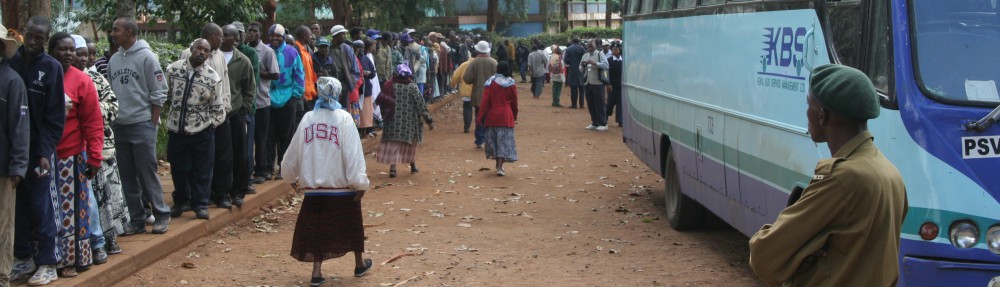
Let them eat cake . . .

From the “Corridors of Power” feature in Nairobi’s The Star:

Caddies at Muthaiga Golf Club have reportedly appealed to the club management to rescind their decision to suspend Ugali from the menu. Our mole tells us that the attendants who carry golf clubs for players have been begging to have the staple food reinstated on the menu at least once a week. The golfers banned the meal a few weeks ago when Kenyans under the banner “Unga Revolution” took to the streets to protest high food prices. …

Sorry, but you don’t have to be at all politically to the “left” in the way that would be understood in the United States (or in France today for that matter) to recognize that Kenya has a problem with the divide between the lingering neo-colonial elite and the other, say 99% of Kenyans.  Skyrocketing food prices have continued to be one of the major factors that prevents the typical hard-working, entrepreneurial Kenyan from being able to make it into the new “middle class”.  Poor performance in government over years by officials who, by virtue of their political power have great resources at their personal disposal (and use those resources to perpetuate that power) is a big part of the reason access to affordable food is so unreliable relative to Kenya’s agricultural potential–and in fact, relative to Kenya’s actual agricultural output.  The Muthaiga Club is one of the places these officials like to separate themselves from their constituents.

Horn of Africa Famine Updates

Africa Works has a short post today that I will quote in full, recognizing the hard reality:

Africa Works (G. Pascal Zachary):  Somalia and the limits of humanitarian aid:

Jeffrey Gettleman’s excellent article on the Somali famine presents a useful reminder of Amartya Sen’s famous insight that famines, chiefly, are human constructions. The persistence of famines isn’t a tragedy but rather a consequence of social and political breakdowns. In the Somali case, the country’s long civil war– and the tactics used by contending factions — means that famine is a tool of combat rather than the result of “food shortages” as such.

Because famines usually arise from dysfunctional distribution of food resources (rather than from an absolute shortage of food), aid agencies are inevitably limited in what they can do to alleviate famines. Moreoever, realities on the ground mean that famine aid inevitably benefits combatants as much or more than the truly needy. In Somalia, political dysfunction mocks the good intentions of relief agents. That famines are man-made does not obviate the need for famine relief efforts. However, the social construction of famines ought to give rise to a parallel public understanding of why famines persist and the limits of humanitarian aid.

The U.S. State Department has a “background briefing” on “Somalia and the Delivery of Humanitarian Assistance”:

. . . nearly 12 million people primarily in Ethiopia, Kenya, and Somalia in urgent need of humanitarian assistance. Three reasons for this: This two-year drought that we’re currently experiencing, which is part of a 60-year drought cycle; then continued lack of central government in Somalia; and then the work of al-Shabaab or the depredations of al-Shabaab in southern and central Somalia.

We are taking all of the necessary steps. We’re doing everything we can to provide assistance to Somalis in need. That is really – right now our primary concern is helping to save lives in the Horn of Africa. And I just have to point out that it’s not a coincidence that the two areas in Somalia where the UN has declared famine conditions exist are areas under al-Shabaab’s control. Be that as it may, we are doing everything we can to get aid to people who need it. And we do remain, of course, concerned about the actions of al-Shabaab. And so as we’re delivering aid to people in need, we have got to take care that al-Shabaab is not able to profit from this humanitarian crisis.

Now, U.S. law has never prohibited humanitarian assistance to people in need in Somalia. In fact, about 90 million – or rather, about $80 million of our aid thus far has, in fact, been delivered to people in Somalia. But in the face of this evolving crisis and the extreme humanitarian needs, we have issued new guidance to allow more flexibility and to provide a wider range of age – of aid to a larger number of areas in need. We hope this guidance will clarify that aid workers who are partnering with the U.S. Government to help save lives under difficult and dangerous conditions are not in conflict with U.S. laws and regulations that seek to limit the resources or to eliminate resources flowing to al-Shabaab.

. . . .

We don’t expect there to be any grand bargain where we’ll be able to have access to all of southern Somalia, but we are working to find whatever ways we can to deliver that assistance and have a significant contribution of food arriving as we speak.

19,000 metric tons started arriving last week. We have been working throughout the Horn since the early warning systems alerted us to a possible drought last fall, and we were able to preposition supplies and increase programming throughout the Horn. The difficulty has been access in southern Somalia, and so that is the biggest challenge facing us right now, is how to get aid to the people who need it most who are still stuck inside of south Somalia. We’ve seen a huge refugee outflow into Ethiopia and Kenya as well as a significant displacement – about 1.6 million Somalis have fled north into the urban areas, which is – also presents a humanitarian challenge for us.

We believe that there will be ways and opportunities to move selectively into parts of southern Somalia with food, health – health is a critical piece of this given the leading cause of death in the ’92 famine was health-related causes – and send the therapeutic and supplemental feeding that will help save lives. We’re moving aggressively to provide all of that assistance.

Owen Barder at “Owen Abroad” has excellent background on the context of the famine and how preparation from past experience and political divergence make the situation now so different in Somalia and Ethiopia. And links on where each of us can contribute financially to relief efforts. (h/t Texas in Africa).

Uganda’s Independent features CSIS report on risk of instability with NRM decline, Museveni succession

“American Group Predicts Instability Over Succession”  Independent(Kampala) July 22:

Election year 2016 will be a turning point for Uganda, according to a report by the powerful American policy solutions provider, the Centre for Strategic and International Studies (CSIS).

As a sign of likely instability, the June 30 report notes that “the NRM is on a long-term trajectory of decline, and thus its survivability by the end of President Museveni’s current presidential term is certainly in doubt.”

Titled “Assessing risks to stability in Sub-Saharan Africa”, the report was commissioned by the Unites States of America’s military Africa Command, AFRICOM, which plans for America’s strategic security interests on the continent. The US government often uses the CSIS reports to project the future and strategise for change. The report is based on events that have toppled regimes that appeared to have a firm grip on power in Egypt, Tunisia, and led to a western-backed armed rebellion in Libya.

. . . .

The report is based on studies in 10 countries; Angola, Botswana, Ethiopia, Ghana, Kenya, Rwanda, Senegal, Sudan, and Uganda, that it describes as “undergoing the growing pains of democracy”.

It notes: “In Ethiopia, Uganda, Rwanda, Sudan, and Angola – democracy has little meaning beyond the ritualistic holding of elections in which political space is severely constrained and the winner is generally predetermined”.

Joel Barkan, a professor of political science at the University of Iowa and a specialist on politics and development policy in sub-Saharan Africa whose books about the politics of Sub-Saharan African countries are recommended readings in many universities, wrote the Uganda section of the report.

He notes that change is inevitable by all means either through anointment of a successor by Museveni himself or through the overthrow of Museveni or his chosen successor.

He says the style of Museveni’s governance has grave implications for the future stability of the country because it is highly personalised that the running of the country to a greater extent revolves around Museveni’s personal position.

At the centre of the report lies a big question on whether Museveni will run for a fifth elected term in 2016 at the age of 73 or who will be his successor if he decides to step down and how the succession will be managed not to create disputes both within the party and the country at large.

Although he seems to have an insatiable desire to remain in power, Barkan counsels, Museveni should be realistic enough to know he does not have much time left and the sooner he drafts his end game the better for him and his country.

The CSIS Africa Program homepage for the “Stress Testing African States” reports provides an overview and gateway to the details of the studies.

Another good new read:  “A Middle-Income Uganda:  Aiming for Mediocrity and Failing” at the LSE Africa blog.

Ongoing East African Food Crisis Continues to Worsen

“Famine in East Africa: A Catastrophe in the Making,” Der Speigel:

Eastern Africa is baking under a merciless sun; the last two rainy seasons have brought no precipitation at all. It is said to be the worst drought since 1950. And hunger comes at its the heels. In Somalia, Ethiopia, Kenya, Djibouti, and Uganda, people are suffering like they haven’t in a long while. The UN estimates that some 12 million people are already faced with hunger. And that is likely just the beginning.

There are many indications that the situation will only worsen in the coming weeks. For the moment, many of the regions in eastern Africa are classified by the UNHCR as “emergency” areas. But on Wednesday, the UNHCR declared famine in two regions in southern Somalia and said that it could spread unless enough donors can be found to help those in need. “If we don’t act now, famine will spread to all eight regions of southern Somalia within two months,” said Mark Bowden, humanitarian coordinator for Somalia.

It is a catastrophe that has been a long time in coming. Experts have been warning of the approaching famine for months and the causes are clear. They also know that the current disaster won’t be the last. As a result of climate change, it has become increasingly the case that rainy seasons fail to materialize in the region. Adding to the problem, the population in the countries currently suffering has quadrupled in recent decades, from 41 million to 167 million. Plus, aid organizations tend to budget most of their money for emergency situations, leaving little left over for wells, fertilizer, seeds and efforts to teach farmers how to make the most from their plots of land — all measures that could forestall the next disaster.

Somalia has been especially hard hit because the Islamists from the al-Shabab militia, who are fighting against the country’s government, have chased almost all aid organizations out of the country.  .  .  .

.  .  .  .

Despite the difficulties, the WFP has managed to more or less rebuild the harbor in recent years. Warships from the European Union anti-piracy mission Atalanta guide freighters full of aid supplies through the pirate infested waters and into the harbor.  .  .  .

. . . .

An equally large problem is the phenomenon known in aid circles as “donor fatigue.” People around the world are becoming tired of sending money to Africa, where nothing ever seems to change. Just last year, the WFP asked rich countries for $500 million to combat hunger on the Horn of Africa. They were unable to raise even half of that. And that despite the fact that the scientists working for the US-based Famine Early Warning System have long been warning that first the crops, then the animals and finally the people themselves would begin dying should the rainy season fail to materialize.

“Refugees flee famine stricken Somalia”, NPR

Does KSh4,500 for a bag of maize approach a “tipping point”?

There are a lot of good things happening in Kenya that are helping to lay the groundwork for a positive future.   Right now, however, the combination of the plummeting shilling and high inflation focused especially on basic food items and other household necessities, along with an especially severe regional drought is causing suffering and raises questions for the intermediate future as we head into another election year.

Increasing numbers of refugees are flowing to Kenya from Somalia due to drought aside from the fighting, in a situation in which Kenya is already well beyond current capacity under existing refugee arrangements.

The basic situation of high and inflating cost of food staples, drought and refugees is “the usual crisis” in Kenya–its not less severe because it doesn’t get solved but we all somewhat get used to it as “background” and pay more attention to “the next new thing”.  Now however, it is getting worse.  Will Kenyan politicians continue to see this as a challenge primarily for Western donors while focusing on the election?  Is there a “tipping point” where this moves out of the background and disrupts the usual course of things in Nairobi, for better or worse?

“Severe food crisis hits region”, IRIN Global

In Kenya, rising inflation rates have also adversely affected poor households’ ability to buy food. Prices of the main staple, maize, have tripled from about 1,300 shillings (US$14.4) in January to 4,500 ($50) for a 90kg bag.

Recently, the government announced the removal of tax on imported maize in a bid to cushion consumers. But millers say rising global maize prices mean the measure will have little impact on the commodity’s prices locally.

“The problem has been compounded by the fact that the Kenyan shilling has been on a free-fall, trading at an all-time low [about 90 shillings to the US dollar] not experienced in the country for almost two decades. I do not see the cost of maize dropping any time soon,” said a miller who requested anonymity.

The recent March to May “long rains” in Kenya were poor for the second or third successive season in most rangelands and cropping lowlands, with many of these areas receiving 10-50 percent of normal rains, noted the Famine Early Warning Systems Network (FEWSNET).

The consequences include declining water and pasture, and subsequent livestock deaths. In the predominantly pastoralist north, a low milk supply has contributed to malnutrition levels soaring above 35 percent. The GAM rate in northwestern Turkana has hit 37.4 percent, the highest ever in the district.

Nationally, at least 3.2 million people are currently food insecure – up from a projection of 2.4 and 1.6 million in April and January, respectively.

Even in Kenya’s coastal region, thousands are food insecure, says the Kenya Red Cross Society’s (KRCS) region manager, Gerald Bombe.

“There is a need to import maize and distribute food and water to the hardest hit areas,” added Kevin Lunani, a local leader in the coastal Kisauni region.

Figures I read recently would place Kenya as the largest recipient of U.S. aid outside the greater Middle East/North Africa and Afghanistan/Pakistan–in other words greater than any other country in Latin America, Sub Saharan Africa or elsewhere in Asia, for the 2008-2011 period.  I don’t have time to dive into the numbers for serious comparisons, but accepting the general point that Kenya is a particular favorite as a major target of aid for the U.S. we need to ask whether we are accomplishing what we want to accomplish.

Four out of the Five Members of the East African Community are among the 20 USAID “‘Feed the Future’ Focus Countries

From a USAID press release, “USAID Administrator Rajiv Shah Announces 20 Feed the Future Initiative Focus Countries“:

In 2008, the Lancet identified just 36 countries that are home to 90 percent of all children whose growth was stunted for lack of adequate food. Based on this global burden of undernutrition and other criteria that examined the prevalence and dynamics of poverty, country commitment, and opportunities for agriculture-led growth, the 20 Feed the Future focus countries are: Ethiopia, Ghana, Kenya, Liberia, Mali, Malawi, Mozambique, Rwanda, Senegal, Tanzania, Uganda, and Zambia in Africa; Bangladesh, Cambodia, Nepal, Tajikistan in Asia; and Guatemala, Haiti, Honduras, and, Nicaragua in Latin America.

These countries experience chronic hunger and poverty in rural areas and are particularly vulnerable to food price shocks. At the same time, they demonstrate potential for rapid and sustainable agriculture-led growth, good governance, and opportunities for regional coordination through trade and other mechanisms. USAID will work with strategic partners Brazil, India, Nigeria, and South Africa to harness the power of regional coordination and influence in these focus countries.

Certainly it is encouraging that USAID finds Kenya, Uganda, Tanzania and Rwanda to present potential for rapid improvement–and perhaps the potential of the EAC itself is significant to this.   The listing is also a good reminder for Kenya that in spite of its significantly higher level of aggregate and per capita GDP, and overall growth, rural hunger remains all too common.  While this seems a constructive approach for USAID, I am skeptical that donors will  change the situation dramatically in Kenya until Kenya’s leaders share the priority to a greater extent than they have seemed to in recent years.

Another Ugandan Weapons Procurement Scandal?

The East African reports:  “$740M fighter jets scam sneaks under the radar.”

In a deal reminiscent of previous purchases of military hardware in which the army bypassed civilian oversight, the Ministry of Defence and Bank of Uganda are in the news again following revelations that on the express instructions of President Yoweri Museveni, the ministry withdrew money from the central bank without due parliamentary approval, to buy six fighter jets and other military equipment from Russia worth $740 million.

It also emerged that this money is from the supplementary budget and that part of it — over $400 million — has already been spent. Hence government only wants parliament to rubberstamp the acquisition.

The deal marks a return to the late 1990s, when under the cover of classified expenditure, the country lost $6 million after shadowy middlemen sold the Uganda People’s Defence Forces attack helicopters that could not fly.

.  .  .  .

As usual, the president is once again on hand to let Defence off the hook.

On the night of March 24, Museveni met the National Resistance Movement parliamentary caucus at State House Entebbe and told the legislators to support the $740 million supplementary expenditure.

Although he did not mention the country the jets were bought from, the Daily Monitor reported last week that Russian defence websites claimed that Uganda and Algeria had gone shopping in the Russian capital.

It further revealed that the two countries paid a joint price of $1.2 billion for 22 jets — Uganda’s being only six.

Hence each of Uganda’s jets should have cost $54.5 million, translating into a total of $327 million.

.  .  .  .

The army also bought some 90 tanks from Bulgaria, only 10 of which proved operational.

The purchase earlier of another set of MiG jet fighters also followed a similar pattern: They arrived with one wing, had no spare parts nor bomb loading capacity.

Public policy analysts argue that these dubious procurements are not just bad luck hounding Uganda’s military.

Rather, they say, defence spending is the conduit through which public finances are channelled to fund politics.


In the meantime, the Kenya Broadcasting Corporation reports that the drought and increasing food prices leave 5 million people at risk of hunger in the greater Horn of Africa region:

The World Food Program – WFP Executive Director Josette Sheeran has expressed fears that drought coupled by rising food prices could drive some 5 million people into hunger in the Horn of Africa sub-region.

Sheeran said the number of hungry people in the Horn of Africa was growing and WFP aims to assist 5.2 million people as drought, rising food and fuel prices and conflict take their toll.

“More and more people need help in the Horn and we’re now on high alert over the impact of the March to May long rains. The drought began with the failure of the October to December short rains last year in eastern parts of the Horn of Africa, pushing an additional 1.4 million people into hunger,” said Sheeran.

The World Food Program is also warning that the number of people in need of assistance may increase if the current long rains – from March to May – are poor.

Sheeran who is in Nairobi on a fact finding mission noted that farmers in producing areas that have abundant supplies are selling their produce to WFP so that it can be used to help the poorest in drought-stricken areas.

In 2010 WFP bought food worth a total of US$139 million in Kenya, Uganda and Ethiopia.

Food prices have started rising in areas that relied on the failed short rains for food production, with increases for maize of 25 percent to 120 percent in some remote parts of the Horn.

Cereal prices in the region over the next six months are expected to increase by 40 to 50 percent.

Nestle Chairman Says U.S. Biofuel Policy Causes Starvation at Time of Food Crisis

Interestingly, the head of Nestlé lashed out at U.S. ethanol policy yesterday at the Council on Foreign Relations as reported in The Independent:

Today, 35 per cent of US corn goes into biofuel,” the Nestlé chairman told an audience at the Council on Foreign Relations (CFR) in New York yesterday. “From an environmental point of view this is a nonsense, but more so when we are running out of food in the rest of the world.
“It is absolutely immoral to push hundreds of millions of people into hunger and into extreme poverty because of such a policy, so I think – I insist – no food for fuel.”

Corn prices almost doubled in the year to February, though they have fallen from their peak in the past few weeks. Anger at rising food prices contributed to protests across the Middle East, and rising commodities costs were among the factors pushing UK inflation to 4.4 per cent in February, according to figures out yesterday.

US exports account for about 60 per cent of the world’s corn supply. Demand has surged as more people join the middle classes in emerging economies such as China and India, not just because these new consumers demand more food made from corn, but also because demand for meat has increased and livestock farmers need to buy more feed.

Nestlé, the company behind Shredded Wheat, Nescafé and Aero chocolate bars, has been lobbying European regulators and governments around the world against setting high targets for biofuel use, even though many countries see the production of ethanol as a means of meeting obligations to cut carbon fuel emissions.

The lobbying has fallen on deaf ears in the US, however. Ethanol production from corn is heavily subsidised, with output running at more than 13.5 billion gallons annually. Policies to promote its production are “absurd”, Mr Brabeck-Letmathe claimed yesterday, and meeting a mooted global target of having 20 per cent of fuel demand with biofuels would involve increasing production by one third.

“What is the result? Prices are going up. It’s not very complicated,” he said. “This question is now the number one priority for the G20 meeting in Nice, and the main thing we are going to do is fight against speculation. We are concentrating on the irrelevant.”

Speaking to farmers earlier this month, the Obama administration’s agriculture secretary said he found arguments from the like of Nestlé “irritating”. Mr Vilsack said: “The folks advancing this argument either do not understand or do not accept the notion that our farmers are as productive and smart and innovative and creative enough to meet the needs of food and fuel and feed and export.” . . . .

There are a number of recent biofuel projects at various stages in Kenya. Obviously this is controversial, but without the subsidies so far as I know these projects involve non-food crops,  UPDATE:  Here is a story this week in AFP about opposition to plans to grow jatropha on 50,000 hectares near Malindi on the Kenyan coast for the European ethanol market.


ICC Judges Summon “Ocampo Six” while Government of Kenya Lobbies for “Delay” in New York and Food Crisis Worsens [updated]

2.4 Million Kenyans threatened by acute food shortage.

The food crisis worsens in Kenya.  [In an post last fall entitled “The Kenya Lobby, Corruption and Hunger” I noted a report predicting an increase in hunger.  We are now seeing that play out, while the Government of Kenya remains focused elsewhere.]

Ocampo Six ordered to appear in the Hague.

ICC:  Kalonzo shuttle diplomacy hits New York.

The Vice President said that Kenya has no intentions of pulling out of the ICC nor is it seeking to assist those named by the ICC prosecutor to escape justice: “All we want is [for] the UN Security Council to consider positively the Africa Union resolution endorsing Kenya’s request for a 12 month deferral to allow us to complete reforms and embark on local trials.”

For some reason the Vice President does not seem to be calling attention to the fact that the Kenyan Parliament recently voted almost unanimously to support withdrawal from the ICC, well after the promulgation of the new constitution.

[Update:  no indication in any change in position by the United States which remains unwilling to support UN Security Council intervention to stop the ICC prosecutions.]

The Cigarette Trade: Kenya moves toward switch from tobacco to food; U.S. should “get right” on this issue

A few months before I moved to Kenya I helped teach a church seminar on globalization.  Mississippi was a pioneer in the state lawsuits against tobacco companies for smoking-related costs and had education programs funded from the proceeds, so it was especially striking to me in preparing to teach to read materials about U.S. advocacy for tobacco exports in negotiating a number of trade agreements.  I had also  just returned from a trip to Japan where I couldn’t help but notice how ubiquitous “the Marlboro Man” still was.  Back in 1999 when I was preparing to teach a program for IRI in Mongolia I saw statistics about the huge increase in smoking during that first post-communist decade and saw very small children peddling cigarettes on the street.

It was in this context that I was especially interested to see a recent post by Thomas Bollyky on the Center for Global Development’s Global Health Policy blog, “Ten Years On, America has Dropped the Ball on the Global Tobacco Epidemic”:

We want to stop American kids from smoking; why don’t we have the same concern for Asian or African kids? Senator John McCain asked that question on the floor of the U.S. Senate fifteen years ago. And, this week, on the ten-year anniversary of President Bill Clinton’s executive order instructing U.S. agencies to take “strong action to address the potential global epidemic of diseases caused by tobacco use,” that same question is still being asked about U.S. policy.

“Smoke and Mirrors:  It’s time for Washington to stop giving cigarette makers an open door to developing countries” by Thomas J. Bollyky  in Foreign Policy:

Smoking-control efforts in developing countries are stalling in the face of fierce industry opposition. Tobacco industry promotional investments dwarf expenditures on tobacco control in these countries. In 2009, the WHO reported that less than 10 percent of the world’s population is covered by any of the WHO-recommended measures to reduce demand for tobacco and regulate tobacco-industry marketing.

Some policymakers in Washington make the argument that American jobs depend on tobacco companies’ free access to developing countries. But that’s a false choice: Doing more for international tobacco control would not put U.S. jobs at risk. The United States currently exports significant volumes of high-quality tobacco leaf and premium cigarettes to Japan, Europe, and affluent Middle Eastern countries, but hardly anything at all to cost-sensitive developing-country markets. Moreover, cigarette production has largely shifted to overseas factories. With domestic consumption declining, the tobacco industry now provides less than 2 percent of the jobs in the six southeastern U.S. states most associated with tobacco growing and product manufacturing.

In fact, taking the lead on international tobacco control would clearly be in the national interest of the United States. . . .

“Kenya:  Tobacco farmers at the crossroads” from AfricaFiles

The battle between pro- and anti-tobacco groups in Kenya ratchets up as market indicators and a ‘fact-finding mission’ has led to a call for the abandonment of the historical cash crop in the Kuria District and beyond. Diminishing tobacco prices, environmental damage and questionable corporate contracts with local farmers have been used as fuel for a quickly expanding political and economic fire. Vested interests on either side have launched campaigns in support of their respective causes while concerns continue over the eventual consequence for Kenya’s fertile ground; particularly given the land’s potential capacity for food production.

“Farmers replacing tobacco with food crops in Kenya”  in the New Agriculturalist

Due to the high number of deaths and costs associated with tobacco consumption, the Kenyan government has initiated a programme to alternate tobacco with other crops. “Since the alternation process began more than a year ago, we have managed to introduce several food cash crops to farmers and they are making more money than they would from tobacco,” explains Dr William Maina, who heads the communicable diseases department in the Ministry of Health. Farmers have been provided with loans to help them grow alternative crops, including sugarcane, cotton, oranges, pineapples, bananas, cassava and maize.

The crop alternation process has been influenced by the Tobacco Control Bill, signed by Kenya’s president, Mwai Kibaki, in 2007. While the Bill does not outlaw the cultivation of tobacco, the regulation does call for the promotion of economically viable alternative crops. “The US$300 million we generate in revenue from tobacco is very little considering that we are spending well over US$1 billion treating tobacco related diseases each year,” Dr Maina adds. Government representatives have said that tobacco also threatens food security and has resulted in higher food import costs.

Alternative crops are now being grown on about 40 per cent of the land that was previously under tobacco cultivation. .  .  .

“Kenya: Delegation takes a hard stance against tobacco”

Kenya on Thursday took a hard stance against tobacco, according to officials attending the WHO FCTC (Framework Convention on Tobacco Control) Conference of Parties in Uruguay.

The delegation supported the proposed guidelines in articles 9 and 10 of the FCTC calling for a ban of tobacco ingredients in blended cigarettes. Basically, the proposals prohibit use of ingredients to enhance or sweeten cigarette taste.

This stance is at variance with the positions taken by Comesa and African Union countries. The delegation said countries growing the crop were “suffering under tobacco slavery and needing help from Western countries”.

Countries whose economies are heavily dependent on the crop and fearing damages to their economies are said to be heavily aggrieved by the position.

Following the Comesa Heads of states conference, members were urged to oppose the recommended ban on ingredients in tobacco products to preserve the trading bloc’s economies.

Kenyan farmers grow the crop in Western and Eastern parts of the country and cigarettes have become a major trade commodity for British American Tobacco, which exports 60 per cent of its production, and Mastermind Tobacco. . . .