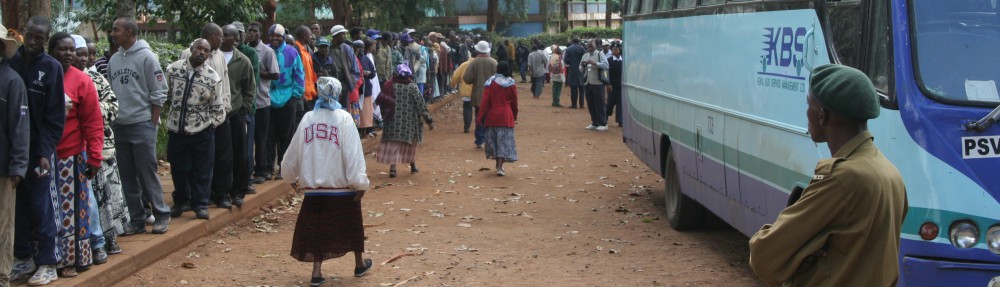
Having apologized for having gotten our shoes in the way of the vomit, donors to Kenya’s government are now finally alarmed again about the (ongoing) corruption

Here is the latest from Kenya’s Journalists for Justice on the corrupt involvement of personnel in the Kenya Defense Forces in the charcoal and sugar smuggling trade.

It’s not so much that I’m jaded, it’s just that I have watched this movie before–and even been an “extra” of sorts in one of the previous remakes.

Yes, corruption is obviously getting even worse within this Kenyan administration than within the last.  But that was also true when I lived in Kenya during the end of the first Kibaki administration and into the beginning of the second.

There are several readily apparent reasons.  For instance, when I lived in Kenya I made the acquaintance of a Western expat whose spouse was in the tourism business. Prior to the 2007 vote count corruption and violence, the tourism business was booming.  But corruption was up as a cost of doing business as it was explained to me because to operate you had to pay off a second generation, too–the kids of the senior politicians.  Presumably this generational expansion has continued.  Why wouldn’t it?

The year before I moved to Kenya the UK and US envoys had been outspokenly opposed to the corruption, in the context of the Anglo Leasing revelations by John Githongo of massive corruption involving national security procurements, touching our own security interests aside from our sensibilities about criminal behavior, along with the outrageous shenanigans involving the Artur Brothers, and the Standard media raid, among others.  The British envoy even offered the memorably colorful “vomit on our (the donors’) shoes” metaphor about the extent of the gluttonous “eating”.

But by the time I arrived in mid-2007 things were different.  New personnel led the diplomatic missions.  On the US side we apparently helped Moi and Kibaki get back together, and hosted Interior Minister John Michuki, of “rattling the snake” fame, who had taken credit for the Standard raid, on a security tour of the U.S.  Michuki represented Kibaki at our Embassy’s Fourth of July party, where Moi unofficially planted himself to catch the receiving line.

And then we looked the other way at the corruption of the Electoral Commission of Kenya.  Ambassador Ranneberger made sure to get his predecessor Ambassador Bellamy removed from our IRI Election Observation Mission on the basis that he was “perceived as anti-government”.  Bellamy had spoken out on the corruption, in particular the Standard raid.  The week before the vote, Ranneberger noted for the Kenyan public that Kenya was “on track” in fighting the vice of corruption, that  we had had Enron in the U.S., that prosecutions for Anglo Leasing and Goldenburg could take time, and that the World Bank had given the Kibaki administration an award for procurement reform (of all things) and that he expected a “free and fair” election.  And then we tried at first to sell the ECK’s election “count” even though we knew full well that it was bogus.  When that didn’t fly, we supported “power sharing” so long as there was no new election before Kibaki’s full second term was up.  According to a news report from Nairobi years later from stolen cables from “Wikileaks” we issued a couple of “travel bans” based on alleged evidence of bribery against two of the ECK commissioners, but we never disclosed this action or the evidence, why we singled out these two or anything else about the matter.

During the post election violence a diplomat explained to me that the reason many of the younger pols in Kibaki’s PNU coalition were against a power sharing settlement was that they didn’t want to share the secondary ministry appointments.  Ultimately by adding opposition politicians into the second Kibaki administration through “power sharing” with extra ministries you further expanded the multigenerational set of stomachs to let eat.  One way to look at the settlement naturally has been that Kibaki and Raila were willing to stop the fighting (so long as Kibaki retained with further ambiguity the full second term Presidency which the ECK had delivered to him) and the rest were bribed to acquiesce.

So you cannot tell me with a straight face that the diplomatic position of the United States in 2007-08 was to “oppose” corruption as a high rather than a subordinated priority.

After being stung by criticism from the election debacle, Ranneberger was reborn as an outspoken “reform agenda” campaigner for his extended tour on through the passage of a new constitution.  He compiled dossiers on money laundering and drug smuggling through politico/business interests and encouraged action, albeit to no avail. His successors quietly moved on, however, and we helped sell a new badly handled election in 2013 by a new, but probably more pervasively corrupted electoral authority.  We helped pay for expensive technology that was doomed by procurement fraud but kept quiet.  The British Serious Fraud Office successfully prosecuted one of their companies and its owners for bribes on other election procurements, but the Kenyan administration has taken no action to follow up and we have kept our silence.

With time, we have come again to affectionately embrace our usual suspect “partners”, with new programs headquartered in our favorite African city of Nairobi.  A photo op in the Oval Office with POTUS and FLOTUS for the Kenyan President and First Lady last year, followed this summer by a glowing official Presidential visit to Nairobi with a telegenic dance party at State House.   Never mind what we said before; please can we give you more?  Some eloquent speech about the cost of corruption, safely abstract from the burgeoning accumulation of years of specific cases on the impunity docket.  Yes we can dance with this new set of shoes without even looking down at the vomit.

Surely then it can be no surprise that things have gotten that much worse.  With a new report by Kenyan journalists on the longstanding implication of Kenyan Defense Forces which we help underwrite in Jubaland in the sugar and charcoal smuggling rackets, and fresh levels of embarrassment from the international press from the National Youth Service, irregular handling of bond proceeds amid rising debt levels, more land grabbing and another looted bank, all with a new election cycle approaching, the season has turned again and it is the time for furrowed brows.  Time for the U.S. to lead a donor group to call on the current version of the anti-corruption authority.  To talk again of “visa bans” and offers again to assist in “asset recovery”.

Instead of another remake, could this be a sequel offering a surprise ending, with say, even a few villains in jail, or at least less rich, as a cautionary tale for some and a bit of hope and inspiration for others? Or is this just another iteration of “the formula” in which the sheriff rides into town, frowns at the drunken brawl, then passes along to enjoy the cinematic scenery on the way home?

Only time will tell.  I do think we genuinely would prefer to be against the corruption rather than aligned with it.  We just lose our nerve and get distracted by other priorities that seem more immediate.  Making a dent in Kenya’s entrenched culture of impunity would take a long hard slog, in the face of bitter opposition formal and informal.  It would be messy and likely involve putting up with a bit of embarrassment–it could involve some risk and actual cost.  In any event  it would take a good while for us to convince the players that we had become serious.
 “The last hopeful place” for democratic progress in East Africa–Tanzania’s election is important test for US Millenium Challenge Corporation model

imageThe United States invested heavily in its relationship with Tanzania in the “post-Cold War” era and on into the present period of “democratic recession”.  The Millenium Challenge Corporation has had the Tanzania compact as a flagship relationship and just voted late last month to proceed with the partnership on the basis of a barely cleared corruption hurdle.  I don’t follow Tanzanian politics closely and never lived there, but the consensus in the West appears to be that corruption has worsened in recent years while basic stability and growth in the aggregate size of the economy from a low base have been more positive features.  Most Tanzanians remain materially poor and only a small percentage of younger people have jobs as population growth remains rapid.

Western discussion of the election seems to be have been fairly muted given its conceptual significance.  I think part of the reason for this is that the match up presents some conumdrums that raise the stakes of commentary and exhortation from the outside.  Given that Tanzania has remained under the current version (“CCM”) of the Independence/Cold War era “single party” for all these years, the point of democracy assistance and outside focus would normally be on progress toward levelling the playing field so that someone else could eventually win if the majority of citizens was so inclined.

The twist is that the opposition coalition, representing the pre-existing reformist voices, ended up fronting a candidate, Edward Lowassa, by reputation a leading player in the corruption himself.  He was forced out as Prime Minister in 2008–a time when anti-corruption and goverance reform was in vogue among donors–and was pushed aside this year from his expected ruling CCM party nomination to succeed Kikwete before defecting to the opposition Chadema party.

Nonetheless, in Tanzania, unlike in any of its four East African Community neighbors the trajectory toward fair competition and “deeping democracy” has remained plausibly if uncertainly intact.  The National Election Commission has registered 24M voters compared to 14M by Kenya’s IEBC in 2013 (estimates suggest Tanzania has a population perhaps around 10% higher).  At the same time, there has been recent democratization “backsliding” on issues besides corruption, in particular media freedom.

Among donors there is what Jeffrey Gettleman’s piece in today’s New York Times notes is being called “democracy fatigue”.  Maybe things have gone badly enough around the region that we are just happy that Tanzania’s President Kikwete is honoring constitutional term limits, especially in the wake of a derailed constitutional reform effort that was supposed to lead to a referendum on a new charter before this election.

Regardless of the outcome a well run election understood by Tanzanian voters to have been free and fair would be arguably a “feather in the cap” for the MCC model and the general U.S. assistance structure.  Which of course is one more important reason for journalists covering the election observations to be responsibly sensitive to the underlying interests and conflicts faced by the various observation missions and individual observers.

See “The Kenyan factor in Tanzania’s 2015 electionin The Citizen.

And “Tanzania’s election crackdown on free speech” in The Daily Beast.

American diplomatic perspective on Obama’s Kenya visit, and a few personal thoughts (updated)

Johnnie Carson and Mark Bellamy have a very well done op-ed up in the New York Times on “Obama’s chance to revisit Kenya“.  In case you missed it, I would recommend it as the most worthwhile commentary I have seen in the U.S.-based news media on the presidential trip this week.

I hope the visit goes well and accomplishes something worthwhile for both countries.  The topic of entrepreneurship is certainly an important one for Kenya, where most people do not have employment. [The director for human development of the African Development Bank cites a 80% unemplyment rate for Kenyans under age 35 in support of a loan of $62M to the Government of Kenya to support training for 3000 youth in “technical vocational education” that will “play an important role in supporting the emerging oil, gas and mining industry.” ]

The first U.S. presidential visit to Kenya will unavoidably be a major boost politically for Uhuru Kenyatta and his administration by its nature and will be a boon for the Kenyan president’s elite friends and cronies in other political/business roles in Nairobi.  I am not sure how important a “global summit” of this type is for entrepreneurship as such, but I will try to accentuate the positive in this regard by looking at the trip as a diplomatic endeavor with potential side benefits.

One small thing that I do think should be said:  I hope that before getting to Kenya President Obama will have apologized to former Ambassador Gration for letting him get “run up the flagpole” over doing State Department business on a private email account in light of subsequent news on this topic within the State Department. General Gration did important service to Senator Obama as his military escort on his last trip to Kenya in 2006 and in speaking out about the “birther” and related personal smears as I have previously written (“Gration spoke out on Obama/Odinga “smears” in 2008 campaign” August 16, 2010).  The Ambassador serves at the pleasure of the president and I don’t question the President’s prerogative to change his mind about a political appointment, but in hindsight this should have been handled differently.

On the security front, please read “Ahead of Obama Visit, Kenya Seeks to Show Security Threats Are Under Control” in the Wall Street Journal:

The government’s push to move beyond its security challenges is one of the problems, said Andrew Franklin, a former U.S. Marine who runs a security consultancy .  .  . “Nobody is interested in getting to grips with the situation,” Mr. Franklin said.  “What the government of Kenya is refusing to accept is that we have a genuine insurgency going on.”
He argued that an attack in April at a university in the eastern town of Garissa showed just how little the Kenyan security forces had learned.  Al-Shabaab killed 147 people in an assault that wasn’t put down until late in the day because of delays flying an elite unit out to fight the militants.
“They had all day to kill students,” Mr. Franklin said.
But Mr. Kenyatta’s message that it was time to move on appeared to be gaining the upper hand with Nairobi residents pouring into the Westgate mall over the weekend. . . .

For a great panel discussion of the trip to Kenya and Ethiopia from the perspective of U.S. foreign policy, see the audio or visual from last week’s program at CSIS, “Policy Issues in Kenya and Ethiopia Ahead of President Obama’s Trip.”  The panel included Ambassador Mark Bellamy, Terrence Lyons of George Mason University, Sarah Prey of the Open Society Foundations and EJ Hogendoorn of the International Crisis Group.

Update: Make sure to also see the letter to President Obama from 14 U.S. experts on East Africa released by Human Rights Watch Tuesday.  Signers include Ambassador Bellamy, senior scholars John Harbeson and David Throup and many of the younger generation of policy and civil society leaders in Washington who will be familiar to Americans engaged on American policy in and on Kenya.

How will the Iran nuclear deal play out in East Africa?

I wish I had a clear sense of how this might develop but I don’t.  It seems to me that there may be several areas of impact over the next few years:

+Diplomatic leverage of Museveni, Kenyatta, Kigame et al vis-a-vis the United States will be reduced as one of the main US “asks”–UN votes to maintain nuclear-related sanctions against Iran–drops away.

+While I do not foresee the current US administration raising expectations for other US priorities from these East African leaders, the next US administration might feel some greater freedom to address “the democratic recession,” declining press freedom, and other issues on the formal US policy list.

+Oil prices:  if a lot more Iranian oil gets to market both in the near term from the immediate impact of lifting sanctions and the longer term from the increase in capacity associated with ramped up foreign investment, the prospects for oil production in Uganda and Kenya will be impacted, especially as related to the 2021-22 election cycle.

+Iran will reassume a stronger role in trade and finance in the region and thus compete more strongly with Israel, Saudi Arabia and the Gulf States.

+Iran will presumably increase its regional naval presence.

+The fall of the Gaddafi regime in Libya and subsequent sad state of affairs in that country reduced one major “petrocash” player in East African politics; an Iran less cash-strapped by UN sanctions might have aspirations to finance East African politicians aside from its espionage/security/terrorism enagement.

New Developments on Iran’s Geopolitcal Efforts in Africa–another challenge for democracy?

Uganda, Iran and the Security-Democracy Trade Space?

High Level  U.S. Delegation Carries Requests to Museveni on Fair Elections and Iran Sanctions

My Memorial Day post: If a President Al Gore had invaded Iraq in 2003 with the support of Sen. Hillary Clinton . . .

all the current GOP presidential candidates would agree now that it was a foolish act of hubris given that the administration had in hindsight clearly been shown to have simply not known what they were doing.

I am not now nor have I even been a member of the Democratic party.  I worked in the defense industry throughout the whole bloody course of the Iraq war.  I even voted for George W Bush that first time in 2000 even though I knew deep down he had very thin, maybe too thin, experience on foreign and national security policy.  (In my defense I will say that I don’t think I should have been expected to know how strongly opposed many of his most senior advisers and subsequent appointees would turn out to be to the values he expressed in seeking our votes in his campaign that year.)

I certainly did not wish him to fail, nor did I wish the harm experienced by my country or by Iraq and its region from that decision but I cannot pretend it away.  It seems to me to be deeply misconceived for citizens of a democratic republic to create an “identity politics” around the competition of parties to the point of transcending a larger patriotism, moral and spiritual values, even the ability to observe and process basic facts.  Over 4000 Americans and over 100000 Iraqi civilians were killed in the Iraq war and the pre-ISIS aftermath and no one who wants to be the “leader of the free world” can plausibly duck an assessment of this war, of our choice, because of the identify of the party of the Commander in Chief at the time.

Part of the reason I took leave from my job and moved my family to East Africa in 2007 to work on democracy assistance is that I had seen how badly we were screwing up our relationships in the world by having embraced a doctrine of “preemptive war” that traditionally might have been seen as unworthy of our national ethos by both “hawks” and “doves” of other generations.  And how our biggest democracy assistance program, by far, was going in Iraq were it was in many respects too late in the wake of the invasion, as opposed to places like Kenya and Somaliland that were not at war where we had a bona fide opportunity to make a positive contribution.  The suspicions and damaged credibility of our country made the work more challenging even among those inclined to a positive view of our aspirations.

Other than the “moral injury” to our country as a whole, the Iraq war did me no personal harm–my taxes didn’t go up so my kids presumably get stuck with the bill, although it might cramp my Social Security and Medicare down the road.  I worked primarily in Navy shipbuilding, on which going to war or not going to war had relatively little business impact; we didn’t build more or less ships than we would have if we had not gone into Iraq from 2003-11.  Before we launched the invasion I was convinced by a senior friend in the industry who had been a naval officer that the sectarian situation in Iraq was beyond our grasp and I did not see the decision to launch the war as anything other than a huge risk that would have been warranted only by an extreme immediate threat which the Iraqi regime simply did not pose by any reasoned assessment.

But here at home now my dry cleaner is an Iraqi Christian.  Before we invaded, he was a medical doctor, a specialist, in his country, as was his wife.  He runs the cleaners himself six days a week, but will be closed and with his family for Memorial Day.  I’ll think of him with gratitude that he was able to get here and for the relative safety and freedom he has here, but with sadness that we elected to reach for the war hammer rather than have the patience to continue to turn the diplomatic screw in 2003 and in so doing upended his life, that of his family and community and his country.  (See Waiting for An Ordinary Day: The Unraveling of Life in Iraq by Wall Street Journal reporter Farnaz Fassihi, excerpted here.  A must read, to accompany all the war and political reporting, on life for middle class Iraqis following the invasion, for those who want to learn from the war.)

I will mourn those Americans who gave their lives for the endeavor, especially those young people who volunteered out of patriotism to protect our country in the wake of the 9-11 attacks.  The rest of us collectively let them down and the very least that is required of us now is to learn from their sacrifice and do better together whatever our preferences of party or domestic ideology.

I will also be thinking with gratitude of my uncle who volunteered for the Navy in World War II as a 17 year old on the family farm after Pearl Harbor, made it home from the Pacific and is still with us at 90.  He he told me years ago that he did not believe we had any business taking it on ourselves to invade Iraq to change the regime without the support of the United Nations that we created with our allies in the wake of that war that he and his “greatest generation” fought at high but shared cost.  And his grandson, serving in the Air Force now, with his own young son.  Let us use his service wisely, with a judicious and open debate over what we ask him to do for us, being honest enough with ourselves to learn from the experiences that have cost the lives of others.


Why the U.S. got started training the Kenya Police Service: 1977 Embassy cable 

R 041148Z MAR 77
FM AMEMBASSY NAIROBI
TO SECSTATE WASHDC 6574
INFO DA WASHDC//DAMO-SSA//
CDRTRADOC FT MONROE VA//ATTNG-PRD-SA-T//
USCINCEUR VAIHINGEN GERMANY//ECJ4/7-SARA-T//
CDRUSA CRIME LAB FT GORDON GA

C O N F I D E N T I A L NAIROBI 2870 {declassified, released 2009}

E.O. 11652: GDS
TAGS: MASS, PINT, KE
SUBJECT: FIREARMS IDENTIFICATION TRAINING FOR KENYA POLICE
REF: (A) STATE 017363, (B) 76 NAIROBI 13349,(C) DSAA 4058/76 282216Z DEC 76

1. IN REPLY TO JUSTIFICATION REQUESTED IN REFTEL A, EMBASSY
SUBMITS FOLLOWING:

2. PURPOSE OF PROPOSED TRAINING:

A. ENABLE GOK POLICE PERSONNEL TO QUALIFY AS EXPERTS IN
COURT TESTIMONY REGARDING BALLISTICS AND FIREARMS EXAMINATION.

B. TO IDENTIFY WEAPONS USED IN CRIMINAL AND TERRORIST
ACTIVITY BY TYPE, MODEL AND INDIVIDUAL WEAPON USING SCIENTIFIC
TECHNIQUES FOR COMPARISON AND EVALUATION.

C. TO ESTABLISH FROM EXISTING EVIDENCE THE OWNERSHIP AND
ORIGIN OF THESE WEAPONS.

3. USEFULNESS TO GOK:

A. COUNTER-GUERRILLA AND BANDIT OPERATIONS. PRIMARILY
IN NORTHERN PROVINCES DIRECTED AGAINST INFILTRATION
OF SOMALI SHIFTA GUERRILLAS. THESE OPERATIONS TO DATE HAVE
BEEN CONDUCTED BY THE KENYAN ARMY AND THE KENYA POLICE,
PARA-MILITARY GENERAL SERVICES UNIT (GSU). THEY ARE CONDUCTED
AS POLICE OPERATIONS REQUIRING ALL UNITS INVOLVED
TO RESTRICT THEIR ACTIVITIES TO THOSE OF LAW ENFORCEMENT.
THE SERVICES OF A COMPETENT FIREARMS EXAMINER WOULD BE
EXTREMELY VALUABLE TO THE GOK FROM THE STANDPOINT OF INITIAL
IDENTIFICATION OF THE TYPE AND ORIGIN OF WEAPONS USED AND
ALSO AS AN EXPERT WITNESS AT SUBSEQUENT COURT PROCEEDINGS.

B. CONVENTIONAL CRIMINAL ACTIVITY, TERRORISM. GOK
SOURCES ESTIMATE THAT THE NUMBER OF CONVENTIONAL CRIMES
(MURDER, ROBBERY, ETC.) INVOLVING THE USE OF A FIREARM HAVE
INCREASED APPROXIMATELY 50 PERCENT IN THE LAST FIVE YEARS.
POACHING IN THE NATIONAL PARKS REMAINS A SERIOUS PROBLEM WITH
POSSIBLE LONG TERM DAMAGE TO THE TOURIST INDUSTRY. KENYA MUST BE
CONSIDERED AN AREA OF POSSIBLE TERRORIST ACTIVITY BECAUSE
OF THE POLITICAL ORIENTATION AND MILITANCY OF HER NEIGHBORS.
A TRAINED FIREARMS AND BALLISTICS EXPERT WOULD BE A KEY
PERSON IN THE INVESTIGATION AND PROSECUTION OF ANY CASES
INVOLVING THE ABOVE TYPE OF ACTIVITY.

4. AS MENTIONED REFTEL B, THE KENYA POLICE, IN ADDITION TO
THE ARMED FORCES WITH FORENSIC LABORATORY SERVICES. THE
KENYA POLICE HAVE ADVISED THAT THE INDIVIDUALS INVOLVED
IN PROPOSED TRAINING COULD BE SECONDED TO THE KENYA ARMY
IF NECESSARY TO OVERCOME OBJECTIONS RAISED IN REFTEL C.
THE KENYA POLICE IS UNDER THE DIRECT CONTROL OF THE OFFICE
OF THE PRESIDENT.

5. DIRECT USG INTERESTS: Continue reading

Now to that next step: evaluating the Kenya Defense Forces role in Somalia and Kenya’s security needs

Andrew J. Franklin’s “Terrorism and the rising cost of Kenya’s war in Somalia,” in The Standard gives a perspective on cost and “mission creep” since the original Operation Linda Nichi incursion of October 2011.  Take time to read his assessment that over the course of what is best understood as a war rather than participation in a “peacekeeping mission” Kenya has come to face an insurgency in the border counties that now poses an existential threat to the county such that the priority for Kenyan security needs to be a focus by the KDF on a comprehensive border security initiative and finally implementing the critical domestic security reforms set out in the law since 2010.

Do not forget my post of last July highlighting the reporting of Amb. George Ward at the Institute for Defense Analyses: “Kenya Defense Forces essentially collaborating with Al Shabaab in illegal charcoal exports.”  And from October 2013: “Kenya’s persistent national security corruption continues to burden Somali endeavors.”

Kenyan political leaders had unsuccessfully sought U.S. support for an operation to secure a “Jubaland” buffer region long before the October 2011 action.  There were probably a variety of motives to proceed when Linda Nichi went forward, some of which related to security and some of which related to various opportunities and schemes of a more “commercial” nature.

Without a coalition government in place as there was in 2011, President Kenyatta has the power and the accountable responsibility as Commander in Chief to articulate the mission of the KDF and the strategy to be employed, now.  Kenyans are clearly less safe than they were three-and-a-half years ago, so continuing to pursue a muddled mission without an obvious strategy seems quite dangerous.

Kenyans going for water

Kenyans going for water

US Military may be uniquely situated to help in ebola crisis [updated]

[Sept. 19:  For a contra view see this column from @MeanCharlotte in the Los Angeles Times, reflective of views on the right that the military, at least under this president, is not the right tool for “wars” that are metaphorical rather than involving combat (“Ebola isn’t the Islamic State.  It’s a virus.”). Likewise, some of those on the left, particularly in Africa, who are suspicious of AFRICOM in concept, are leery of hidden motives. Many envision a deployment heavy on combat-ready “warfighters” to conduct a mission skewed toward policing or physical security in a way that I don’t expect to be what is planned or what will transpire.  Not disputing the basis for wariness based on experience with recent wars and some relief and development efforts, I “stick to my guns” (metaphorically) in seeing this crisis and the balance of options available differently.]

Regarding the AFRICOM deployment to lead/assist the U.S. response to the ebola crisis in West Africa, here is a link to a fact sheet describing the basic work of the U.S. Army Medical Research Institute of Infectious Diseases at Ft. Detrick, Maryland.  The Institute was established in 1969 and has as a primary function ongoing work on botulism, plague, anthrax and ebola, among other threats to military personnel and to public health.  They do pioneering work on vaccines in these areas, for instance.

The U.S. military is not necessarily well suited for all the various tasks that it gets assigned because no one else in the U.S. government is staffed or funded or otherwise able to do them.  Addressing an infectious epidemic on a crisis basis is much more suited to military leadership, and our specifically planned for and developed capacities, than general “development” or disaster relief work, I believe.

The U.S. military has a huge medical capacity in its own right to serve the military itself, in peacetime and as deployed around the world, along with civilian dependents and others, separately from combat-specific capacity.  We have a volunteer military, but once you volunteer you are subject to being assigned on a “command and control” basis that makes the military more flexible in a crisis than a civilian governmental or private entity.  I am one of those people who have concerns that we should have more capacity in other parts of our government, including civilian development and diplomacy functions, but such concerns should not makes us unduly reticent to use the resources that are available to help address an immediate human crisis as best we can.

Likewise, I am not an advocate of promiscuous use of the military either for war or as a substitute development agency–see my post from  2010:  “Provocative Question: To Eliminate Redundancy, Should We Move USAID From DOS to DOD?” –so I understand the general concern or skepticism, but in this specific instance we in the United States, and people at risk in West Africa, need to make use of the resources developed and available through the military.

[Update: See this from Foreign Policy: “Can the U.S. Army Degrade and Destroy Ebola?” from an expert who had an opportunity to have input on the planning.]

Catching up on some prior must reads:

“John Githongo: corruption in Kenya is poisoning politics” from The Guardian, July 3.

“After Westgate: opportunities and challenges in the war against Al-Shabaab”, a Chatam House paper by Paul D. Williams, July.

.  .  .  As Al-Shabaab loses territory and its popularity among Somalis continues to dwindle, other clan- and region-based actors will become more salient as national debates over federalism, the decentralization of governance mechanisms beyond Mogadishu and the place of clannism will occupy centre stage. As a consequence, AMISOM’s principal roles should gradually shift from degrading Al-Shabaab towards a broader stabilization agenda: encouraging a national consensus over how to build effective governance structures; developing an effective set of Somali National Security Forces; and ensuring that the Federal Government delivers services and effective governance to its citizens, especially beyond Mogadishu in the settlements recently captured from Al-Shabaab. As it stands, however, AMISOM is not prepared to carry out these activities. More worryingly, nor is the Somali Federal Government.

Uganda: “bursting at the seams” says State OIG inspection

The State Department Office of the Inspector General released this afternoon its latest regular inspection report for the U.S. Embassy in Uganda. The Kampala mission, the second largest in Sub-Saharan Africa, gets good marks, but is facing critical physical space problems from ongoing and expected growth–“bursting at the seams”. More of general interest, how does the IG summarize the context of the mission of the United States in Uganda? Here you are:

Uganda has experienced nearly three decades of domestic stability, except in northern areas. President Museveni’s National Resistance Movement took power in 1986. Irregularities marred his reelection in 2011, and he is expected to run again in 2016. Uganda has never experienced a peaceful transition of political power, and civil society does not effectively hold government accountable. Uganda’s record on democracy, human rights, and anticorruption is poor, but it has become an important force for regional stability in East Africa. It contributes to the African Union Mission in Somalia, leads regional efforts against the Lord’s Resistance Army, and has mediated talks between the Democratic Republic of the Congo and the M23 rebels.
The passage of Uganda’s Anti-Homosexuality Act in early 2014 prompted Washington to reassess the bilateral relationship, including U.S. foreign assistance, which was taking place during the inspection. Bilateral security cooperation has included peacekeeping training for Ugandan forces in Somalia and Ugandan support for the 2013 evacuation of U.S. diplomats from South Sudan.
Economic growth over the past decade has averaged 6 to 7 percent, with inflation in the single digits, and the percentage of the population in poverty dropped by half. Uganda’s population is projected to grow from 35 million to more than 60 million over the next 20 years, threatening to erode and even reverse development progress. The economy provides one job for every 40 new entrants to the job market. By the end of this decade, Uganda may be an oil- producing country, which would significantly raise government revenue but could also exacerbate corruption. U.S. exports to Uganda in 2012 totaled $100 million, half of which consisted of aircraft and machinery.
HIV/AIDS prevalence rates declined in the early 1990s to less than 7 percent, one of the lowest rates in Africa, but has begun to rise again. The U.S. Agency for International Development’s (USAID) FY 2013 assistance budget for Uganda was $67.5 million for development, $11 million for Food for Peace, and $84.95 million for the Global Health Initiative. The Department of State (Department) also provided $316.14 million for the Global Health Initiative, $190,000 in foreign military financing, and $522,000 in international military engagement and training. International narcotics control and law enforcement funding of $600,000 went directly to Uganda.
With 712 employees, the embassy is the second largest in Sub-Saharan Africa and includes 147 U.S. direct hires compared to 91 in 2007. Other departments and agencies represented in the embassy include USAID, the U.S. Department of Defense (DOD), the Centers for Disease Control and Prevention (CDC), the Federal Aviation Administration, the U.S. Department of the Treasury, and the Peace Corps. The embassy chancery accommodates all employees and has annexes in Gulu (CDC) and Entebbe (CDC and DOD), which are 7 hours away and 90 minutes away, respectively, by vehicle. In addition, the general services office and warehouse facility is located 6 kilometers from the embassy compound, and it has more desks than some smaller embassies in Africa.

New Congressional Research Service report on the U.S. response to the Lord’s Resistance Army

The Lord’s Resistance Army: The U.S. Response was submitted by CRS on May 15 and has been published by the Federation of American Scientists.

The LRA is assessed to remain in much diminished capacity in a territory covering parts of Northern Democratic Republic of Congo, South Sudan, Sudan and the Central African Republic, but still resilient in these remote areas.

The most recent concerns are the deterioration of the overall stability and governance of the Central African Republic and South Sudan–with related questions of U.S. and regional priorities.  Likewise there are questions regarding the relationship of continued U.S. support for the Ugandan military to the intention to “review” overall U.S. relations in the wake of Uganda’s new laws targeting homosexuals and more broadly to U.S. support for democracy and human rights within Uganda. In early 2013 AFRICOM’s commander identified the anti-LRA operations, known as “Observant Compass”, as the command’s third highest operational priority after the anti-terrorism efforts in Somalia and Northwest Africa, but obviously a lot of things have been happening since then.