Trump’s State Department has spotted “democracy” in the DRC. Obama saw it in Ethiopia in 2015. My eyes are not as sharp.

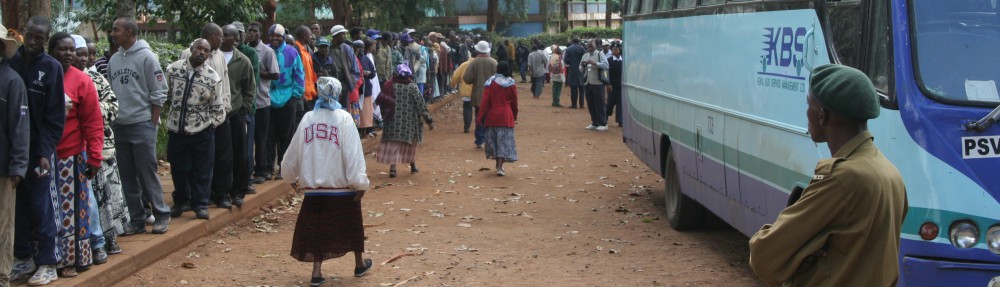
Western Uganda red dirt road and travellers

Four things can be and are true: 1) the announced presidential election results in the Democratic Republic of the Congo are not believed to be plausible by well informed and reasonably neutral/objective outsiders; 2) the Government of the DRC, including the CENI, had and continues to have ample means to persuade skeptics but has not shown serious interest (like in Kenya 2007); 3) the outcome was a fait accompli once announced and once the courts declined formally to overturn it nothing serious was going to be done about it; 4) the DRC/Zaire/Belgian Congo has never been a bona fide electoral democracy at a national/presidential level yet.

As far as the exercise of the proverbial “license to lie” by diplomats who saw Laurent and Felix on parade dressed in their new democratic finery, at least the Westerners among them were embarrassed enough to tell on themselves anonymously to the Western press. Not that this changes the substance of anything, but it makes me personally feel a little better as an American reading about all this. If I am going to be lied to by officials in my government, as an incident to their job of lying overseas to foreigners, at least I prefer that the lie not be intended to actually deceive. As The Economist says: “Calling Mr. Tshisekedi the winner fools no one.”

“Today we are gathered to honor the fresh air, green sky and blue grass of Governor Sonko’s Nairobi and dance with President Kenyatta and family who are truly shocked there is corruption going on here . . .”

But who knows? Maybe positive changes toward democracy will break out in Kinshasa in the future like they seem to have just lately in Addis. We can hope. And if not toward democracy, there are, God knows, many other things that have much room to change for the better in the DRC.

Has our choice to invest ourselves in technology robbed us of the ability to be taught by the next Rev. Dr. Martin Luther King, Jr.?

Some thoughts from the King holiday this week:

MLK became a Christian teacher for me through his writings when I was a young lawyer and a newly adoptive Mississippian in the 1990’s. I also learned a lot of the history of Civil Rights and the South through Taylor Branch’s voluminous King biographies among my other more Mississippi-specific reading. I used material from Rev. King to guest teach a couple of my Sunday School classes in Mississippi.

This was not that long ago by the timeframes of my life but before smartphones and “social media.” Also before any of us knew of Barak Obama, before my year in Kenya, and while I was still a “lifelong” Republican if drifting away in part because of some of the demands of my own faith.

King’s ministry and leadership had a long arc with a slow rise. We have learned that the FBI tried to stop him at an intermediate point but failed. His influence in some important respects peaked over years after his murder. He did not convince the majority of Southern whites in his lifetime that he was substantially right about the biggest things, but eventually he did.

Now he is a statute off the mall in Washington and a great source of quotes for all occasions and whatever purpose but we can hardly stop and think and/or pray and talk through the differences in how we see our country around us.

I am afraid that today someone like King would be delegitimized and marginalized long before he or she could lead us to change.

Likewise, the less currently “popular” parts of his message might further overwhelm those that were eventually heard. And we could not hear a Christian minister today as we eventually came to hear him.

Today, it would not seem feasible to pass morally challenging legislation like the Civil Rights Act and the Voting Rights Act with bipartisan support and against bipartisan opposition because we do not allow ourselves to accept leadership of that type from outside politics and the people that we elect are not leaders at that level.

And now we find ourselves beset with contentions and backlash after years in which many of us assumed that continued steady if slow progress was assured. We have what seems to me an extraordinary partisan divide in which the vast majority of Republicans see racial discrimination against African-Americans as mostly a solved issue and “reverse discrimination” as more salient while the vast majority of Democrats see it in a more “traditional” frame.

As a moderately conservative white adoptive Southerner, “my people” are now very much oriented to the Republican side of politics but I cannot understand my day-to-day world in a way that inverts the racial discrimination burden and it is a struggle for me to know how to address myself to this gap of perception. We made tremendous progress during my lifetime and it is vital to recognize that–and to recognize the toil, sacrifice and courage of those like King that were necessary for the country to accomplish that. But you cannot just declare “peace with honor” and pretend that things cannot come apart because you do not want to deal with the challenge any more.

  • We have work to do.
  • The New York Times on Kenya: working through my reaction to the mess they have made on the photograph of terror victims at a time of grief

    1. I cannot and have not defended New York Times’ use of the particular photograph of victims that has angered Kenyans.

    Using that photo, especially while the attack was ongoing, was bad judgment in a number of respects that have been well explained by others.

    2. My personal inclination from my own circumstances is usually to be somewhat defensive of the Times when they get attacked . . .

    . . . as they frequently do, not because they are not regularly frustrating and imperfect but because they have been and continue to be a critical part of the wider media firmament in the United States. And newspaper journalism in the United States is suffering to our detriment and all professional news reporting is contested in our Trump era. (More about this later).

    3. But, apologies are easy.

    I understand that if the Times turned over editorial judgment to social media responders they would quickly be lost in the internet sea and cease to exist or be snatched up by a hedge fund and/or an ideologically motivated billionaire and/or have to publish listicles and soft porn to survive. Likewise they can never willingly let themselves be bullied by authoritarian governments so the grandstanding demands and threats from the Media Council of Kenya make the situation harder to address constructively and are not in well considered good faith in my opinion.  But apologies are still easy. (And surely taking down or swapping out the one photograph would be a “correction” not some actual editorial diversion.)

    4. Thus, I come around to seeing and feeling a humility and empathy problem.

    Especially as time has gone by. The Times is not the Daily Mail nor The Sun and does not deserve to be the poster child for historical imperialism/colonialism devaluing black and brown bodies even if it has its own limitations and faults. But the Times made a mistake here and it was unforced and not anyone else’s fault. The tone deaf lack of responsiveness makes me more appreciative of the perspectives that I have picked up from friends in academia and journalism and other fields over the years that are more critical of the Times.

    5. The individual reporter did nothing substantively professionally wrong.

    The complaint is with the photo placed by the editors in New York not with the reporter’s story. The photo was by a Kenyan photographer through the Associated Press. So it is simply not her fault. In the moment of anguish with the attack it seems that she received a lot of the grief associated with this situation which was not her doing or in control. Having arrived at an understanding of the facts, there is apparently still a broad sentiment among many Kenyans, including many that I admire and respect, to deport her for being insensitive and seemingly a bit flip in responding. In other words, to me more of a moral question as to whether we think from Twitter that she has the personal traits we approve of as opposed to her actual writing.

    Keep in mind that she is a corporate employee presumably. Without knowing the details of her individual situation with the Times, in general terms most American employees are subject to being fired at will, for any reason or no reason, without any legal right to severance as in Kenya, much less “due process”. I am a corporate lawyer [my experience in the world of Kenyan media and politics (and especially the New York Times) that has been the basis for this blog was “on leave” from that corporate career] so I know something about how things work. For a remote employee to say unilaterally to the public on social media that her bosses back in New York screwed up something that is in their job description and discretion and not hers is problematic.

    The reporter/correspondent is supposed to say “I am sorry but I personally think my bosses have made a terrible mistake with the company product back in New York”? I do not know what I would have done in her shoes, and I can sit back at home and imagine doing better but realistically she was in a losing position.

    I had a slightly analogous situation as an NGO employee in Kenya when my bosses back in Washington put out a press statement that the exit poll I supervised in the 2007 election showing an opposition win was “invalid”. I was in a lose/lose situation on my own in Nairobi. My threading of the needle in dealing with that situation has never been fully satisfactory to anyone so far as I know but not fully “toeing the line” has been life changing in some respects. I objected strenuously in private. In public when I was pressed by a reporter for Nairobi’s Star on whether the statement from Washington “reflected my personal opinion” I explained that “it was’t intended to reflect my personal opinion”–no surprise that the reporting when it hit the paper was that I had said that it “did not reflect” my own opinion. When it was faxed to Washington the president of my organization “hit the roof” per a phone call from my boss who had heard it from him. After I explained the exact choice of words, she ran interference for me and got him “calmed down” on the basis that I had been “misquoted”. Of course I knew when the reporter called me that I was likely to get get fired for diverging from my superiors and I did not have an opportunity to go ask my wife and kids.

    I did some things privately during the interval to keep the exit poll from “going away” before it was ultimately released publicly in July but that was closely held and I have never written about that part of the story yet.

    It was only post-employment that I felt that I could publicly express my own opinions related to my work.  Ultimately I was quoted from published interviews in The Nation magazine and The New York Times itself (and written about by Kenyan media and and The Weekly Standard and RedState.com without being contaced or interviewed).

    Fortunately, my temporary duty in NGO-world was ending in a few weeks anyway. My law job was waiting for me at home. I decided not to resign to keep the office together and I did not get fired. But I was on a short leash until my return to the States and I avoided being out and about or meeting politicians so I would not have to be chose between being openly insubordinate or dishonest. I am grateful that I had some room to maneuver in that pre-social media era.

    7. Where do my Kenyan friends want this to end up?

    Is “the Kenya we want” one in which foreign reporters for foreign newspapers get deported because they are perceived to be insensitive on social media? What are the ramifications of that? Just reporters? Etc.

    Remember that the Times of London correspondent was detained at the airport and expelled by all appearances because he was investigating the Eurobond mysteries. No one filled those shoes. You are still on the hook for the debt and it turns out there seems to have been a secret problem with the SGR financing from 2014 that you are just reading about now.

    This deserves to be reflected on and discussed–perhaps mediated–offline and in person, with a little space from the anguish of this attack, and this photo.

    6. The peak of this for me is someone on Twitter who wanted to deport the photographer.

    Fortunately the Courts in Kenya have now clearly and explicitly ruled against the Executive Branch’s power to deport a Kenyan in the Miguna Miguna cases. We all know the application of the law to the actions of Executive Branch is difficult and often contested as a matter of power rather than right–here in the United States also–so I think Kenyans would be wise to think carefully on this.

    A Chaotic Kenya Vote and a Secret US Exit Poll in New York Times

    Kenya’s Debt-laden Railroad Blues falls off the playlist as brutal suicide attack hits Nairobi and AP photo on NYTimes online hits raw nerves

    Nairobi Kenya Microsoft billboard

    Twenty-and-a-half years after the al-Queda bombing of the U.S. Embassy in Nairobi, a small team of gunmen and a bomber hit a hotel and office complex in Westlands, reminiscent of the 2013 Westgate Mall attack. With the “known missing” fully accounted for now, the death toll stands at 21. Many more were injured and the trauma is compounded by the uncertainty of many who were trapped and/or missing.

    There is so much news coverage now from Nairobi that I really have nothing to add, other than condolences. Here is a good straight news story from NPR’s Eyder Peralta on the photography/reporting imbroglio.

    On Sunday and Monday a governance and economy controversy was escalating in Kenya after the Sunday Nation published an expose on “Hidden traps in SGR deal with China“. Sadly, unlike a terrorist attack, this is new bad news. If true it poses serious challenges to the credibility of those who have known the actual terms of the as yet undisclosed deal between the Kenyatta and Xi governments dating back to 2014, as well as to the viability of “Big Four Agenda”, “Vision 2030” and the overall public version of Kenya’s economic development aspirations.

    Kenya President Uhuru Kenyatta meets with Chinese Communist Party leaders to on behalf of his Jubilee Party at Kenya’s State House

    Update: I am not much of a consumer of television news, but I thought this online “print” story from CNN’s Sam Kiley was a good quick overview of the Westlands attack for general international audiences (as opposed to readers of this blog): “Nairobi attack shows attempts to neutralize Africa’s terror threat have failed“.

    In Sudan, is the International Criminal Court an impediment to progress toward democracy and/or human rights now?

    I am no expert on Sudan and the International Criminal Court practice, such as it is, is not my field in law.

    But I am an observer of various related neighborhoods and did a bit of work in Sudan back in 2007-08. Also, over the years I have never quite seen answers develop to some of the conceptual uncertainties I looked at about the idea of an international criminal court while in law school. And, of course, there is my experience with the multifaceted failure of the ICC’s attempt to prosecute a few symbolic “most responsible” members of Kenya’s political elite for the instrumental murder and mayhem that was part of the competition for power in Kenya in December 2007-February 2008.

    Thus, some questions:

    1) Does the ICC indictment against Bashir hinder the prospects for Sudanese to get Bashir out of power through popular protest?

    2) Are we all agreed that the ICC is not ready to prosecute a case against Bashir even though the facts of the case are many years old and the charges themselves have been pending for almost ten years? If so, is this not hugely important to weighing the practical value of the Bashir case to the Sudanese people today?

    You can watch the discussion from a March 2009 event from the Overseas Development Institute and the Royal African Society on the ICC’s decision here.

    3) How many Member States have declined to act on the Bashir warrant when he was in their jurisdiction? How many have attempted to act? How many Member States have honored the spirit of the case against Bashir during its pendency?

    4) What diplomatic efforts have the Prosecutors been making during the pendency of the Bashir case? Is diplomacy by a Prosecutor a form of informal pleas bargaining? Is it really the case that the ICC cannot plea bargain? Is it in the larger interests of justice for a jurisdiction to have a prosecuting authority that cannot plea bargain? What about pardon authority?

    5) What are the lessons from the failed cases against Uhuru Kenyatta and William Ruto? And more broadly from the overall success of the perpetrators of political violence in Kenya in avoiding prosecution, avoiding other penalties or sanctions, keeping the political gains achieved through violence and obtaining further support from Member State governments and other governments which notionally supported accountability?

    I recognize that this is a very tough time for human rights and humanitarianism as reflected in this post on counter-humanitarianism, 2019’s biggest challenge: the humanitarian sell-out” from Christina Bennett at the Overseas Development Institute. All the more reason those of us who care about people in the hands of angry rulers need to ask ourselves the hard questions.

    Update: The International Crisis Group has a new report out titled “Prospects for a peaceful transition in Sudan improving” (h/t The Official blog of David Shinn) which notes the ICC issue and discusses the idea of bargaining through the UN Security Council’s deferral process:

    The UN Security Council might also offer to request the ICC defer investigation or prosecution of Bashir’s case for one year, pursuant to the Rome Statute’s Article 16, were he to resign or to leave office in 2020; the deferral could be extended provided Bashir stayed out of – and did not interfere in any way with – Sudanese politics. The downsides to deferring his case would be enormous, but without a pledge along these lines, Bashir is unlikely to step down.

    One problem with this is that 3 of the Permanent Members of the Security Council are Non-Members of the ICC. China and Russia are hardly advocates of human rights, rule of law or democracy and the present United States administration expresses opposition to the existence of the ICC as such, escalating the complications associated with U.S. diplomacy involving ICC cases. What are the interests of the CCP here? Reports indicate that the Bashir regime has brought in Russian “Wagner Group” mercenaries.

    Of course in the Kenyan cases, unsuccessfully pursuing a Security Council deferral was the major diplomatic priority for Kenya’s Government for a period of years, as well as attacks on the Court though the African Union, IGAD and whatever other fora could be found. The diplomacy failed, but the Prosecution failed anyway, with loss of life and other large costs left to the witnesses and victims.

    Update Jan 16: World Politcs Review has a new piece from Richard Downey of CSIS.

    Kenya: How will the Trump Administration’s support for the Uhuru-Raila handshake play out in 2019?

    Happy 2019!

    What will 2019 hold for the relations between the United States and Kenya, particularly the Trump-Pence and Kenyatta-Ruto Administrations?

    Kyle McCarter, just confirmed by the U.S. Senate as Trump’s man in Kenya, after a delay since last spring, will shortly replace Robert Godec who shepherded U.S. interests as defined by the Obama and Trump Administrations, respectively, during the UhuRuto election in 2013 and re-election in 2017. The 2020 American presidential race is kicking off now a year ahead of the party primaries so it does not seem likely that McCarter’s efforts in Kenya will command a high place in the U.S. President’s personal attention soon. (If Trump is re-elected it would seem a fairly safe bet that McCarter would stay on for Kenya’s 2022 election, but as a political appointee he would likely be replaced in 2021 if the White House changes hands.)

    It has been interesting to see a higher public profile recently from the U.S. administration on efforts to combat narcotics trafficking networks operating in and through Kenya, along with anti-addiction programs. McCarter has a voluntary service background in this challenge at home in Illinois in addition to his family missionary work in Kenya, so this might be a place where his talents would especially dovetail with diplomatic priorities. Here is a summary of the work of the State Departments’s Bureau of Narcotics and International Law Enforcement in Kenya.

    We have also seen an encouraging new development with the recent and current prosecutions by the U.S. of cases involving bribery of high government officials in Uganda and Mozambique (going along with the U.S. extradition and prosecution of members of the Kenya-based Akasha narcotics trafficking syndicate). See the Amabhungane story on the Mozambique cases here.

    The U.S. has been quietly supporting capacity building for Kenyan prosecutors; some people, including some Kenyans, think that the Director of Public Prosecution is now closer to “the real deal” than his predecessors and that President Kenyatta is actually now waging a form of a genuine if limited “war on corruption”. (We shall see.)

    On the Kenyan side, with the end of 2018 we reached the end of the first year of the Second UhuRuto Administration and the first year of “Uhuru’s Big Four Agenda”.

    In late 2017 we witnessed the opposition-boycotted “fresh” presidential election conducted by the highly controversial (and at least to some extent corrupt we now know) IEBC, followed by an international diplomatic circling of the wagons to close out Kenya’s political season on that basis.

    Uhuru’s Jamhuri Day speech in December 2017, a month after his second inauguration, announced the UNDP (United Nations Development Program)-supported “Big Four Agenda”.

    “On reflection, I came up with four responses to your concerns. I call them the Big Four: food security, affordable housing, manufacturing and affordable healthcare for all. During the next 5 years, I will dedicate the energy, time and resources of my Administration to the Big Four.”

    Fulfilling these development targets would be the prospective reward to ordinary Kenyan citizens for their role, such as it was, in the re-election drama, and serve as Uhuru Kenyatta’s “legacy”, to cement his place within Kenya’s First Family and presumably secure the status of yet another generation of Kenya’s post-colonial pre-democratic elite.

    I was struck by the fact that the Jubilee/UhuRuto election campaign did not offer the “Big Four” as its electoral platform. Needless to say, it is a bit incongruous to see the Jubilee Government and its international supporters (the same ones funding Kenya’s serially corrupt electoral management bodies) not offer a serious nod toward seeking a direct democratic mandate for such an ambitious and aggressive program to define a Kenyan president’s term in office.

    I am fully in support of the concepts of “the Big Four” in having the Government of Kenya actually prioritize the common welfare of Kenya’s citizens. It is just that this type of service provision is frankly head-spinningly counterintuitive coming from Kenya’s existing political class. Anyone who has been blessed to live in Kenya and follows its politics must have asked at the inception a year ago if this “Big Four” was not just the another expression of foreign ambitions projected on Kenya and indulged by Kenya’s elite for their paramount purpose: looking out for themselves.

    Now that a year has gone by, the attention of Kenya’s governmental leaders draws more and more tightly around their next election in three-and-a-half years while the reality of the debt load from the most recent pre-election period bears down. It would seem that skepticism was well warranted.

    The United States reportedly took a key “leading from behind” role in late 2017 and early 2018 in bringing Raila into some form of post-election accommodation with the Kenyatta’s while taking both a publicly and privately assertive position against the “People’s Presidency” inauguration gambit last January. Since that time we have a new Secretary of State, a permanent Assistant Secretary for the Africa Bureau, and now a new Ambassador, but no open discontinuities in Trump Administration policy on Kenya. Dr. Jendayi Frazer who was the Assistant Secretary in 2007-08 is still around in the same various private capacities as she was in during 2013 and 17 (as far as I know). She was most recently in the Kenyan media visiting with Mombasa County Governor Joho, reportedly discussing “violent extremism” before a Mastercard Foundation event. Most of the other people who were involved in Kenya diplomacy and policy at a senior level in the Obama years are in quasi-official related positions and/or the Albright Stonebridge Group, awaiting a change in administration if not retired.

    With the “handshake” between Uhuru and Raila it seems that Kenya’s opposition has been left with less power in parliament than at any time within the past twenty years.

    Certainly Daniel arap Moi must rest easy knowing that the rumors of his political demise were greatly exaggerated. His succession project from 2002 has more-or-less succeeded. Kenyans are freer as a matter of civil liberties now than they were during the days of his rule as recorded in history and as described to me by politicians who were in opposition back in 2007 but have circled back in the years since. At the same time, extra-judicial killing remains a constant threat to the poor and to anyone whose exercise of those liberties might seem to present a real challenge to the political status quo. The killings by State security forces in support of the 2017 elections were significantly escalated from 2013 and after ten years it is now safe and necessary to say that the post-election violence of 2007-08 has been effectively ratified by the State as the violence of 1992 and 1997 under Moi was. And Kenya may be even more pervasively corrupt than ever. Elections arguably peaked in the 2002 landslide.

    The “international community” as it identifies itself has accepted and moved on from its abject defeat by Kenya’s political elite (and by its own vanity and lack of substantive commitment) on the issue of “justice” for the politically instrumental murder and mayhem of 2007-08.

    Trump’s “New Africa Policy” as per National Security Advisor John Bolton suggests that we should not expect any separate new “flagship” initiatives for development or assistance from the U.S., nor other major changes emanating from the White House. The “New Africa Policy” could be seen as raising questions of how far the U.S. will be willing to financially underwrite the “Big Four” approach on development assistance. Bolton himself was both the intellectual and political leader of the campaign to keep the ICC as far from any interaction with U.S. policy as possible and is a career U.N. skeptic. There are elements of the approach talked about for “the Big Four” that fit up with what we hear from USAID in the Trump era, in particular a heavier focus on creating opportunities for private foreign investment coupled with reduced direct assistance spending. At the same time, the sexiest sector for investment under the Big Four, under Universal Health Coverage, is predicated on the rejection of the Republican approaches to healthcare in the United States, so the rationale for U.S. Government support under a Trump Administration is fuzzy at best.

    Just as most of Kenya’s major politicians have history as cooperators in some fashion with Kenya’s single party KANU regimes, some of those around Trump worked for Moi directly (Paul Manafort and Roger Stone most conspicuously) and Americans of longevity in the Foreign Service have background with the USG-GOK alliance under Moi. It will be interesting to see where Ambassador McCarter fits into this history.

    On one hand, McCarter is a Trump political appointee from Republican politics; on the other his background with Kenya as a missionary makes him a somewhat anomalous figure in the world of Black, Manafort and Stone, Cambridge Analytica and other Trump-connected international operatives and lobbyists, and with Donald Trump and his Organization, the global hotel/gambling developer and brand broker.

    McCarter has been around Kenya independently and will have is own pre-existing relationships and his own impressions on Kenya’s politics not tied to the Trump family.

    McCarter’s religious background as an Oral Roberts University graduate and missionary in itself, and political background as an elected official from a less urbanized portion of the American Midwest may give the new Ambassador some head start in relating to ordinary Kenyans over someone from a more typical background for a professional diplomat.

    Will McCarter tuck comfortably into the pre-existing Bush/Obama/Trump policy for Kenya of accentuating the positives about those in power and how we can keep things quietly spinning without risk of disruption? Or might he be more plainspoken? How will he see his role in the “handshake” and “Building Bridges” endeavor as Kenya’s pols move more quickly on to jockeying for advantage for the next dispensation from 2022? Can McCarter find a way to contribute something lasting on corruption and law enforcement even if the “Big Four” is “overcome by events” as politics moves on?

    Kenya visit by IFES President Bill Sweeney March 2017

    An earlier Handshake: IFES president Bill Sweeney calls on Jubilee Speaker of National Assembly Justin Muturi on visit coinciding with IEBC’s announcement of sole source deal with Safran Morpho to acquire Kenya Integrated Election Management System (KIEMS) in March 2017. Sweeney also brought the new IFES country director for its USAID election support program who was hired to replace the director who had been purged following criticism from the Jubilee Party and the Kenyatta Administration.